P R O F. S U B O D H S H AN K A R , F I T P
D e a n , F a c u l t y o f A r c h i t e c t u r e & P l a n n i n g , I n t e g r a l U n i v e r s i t y ,
L u c k n o w
F o r m e r C h i e f A r c h i t e c t P l a n n e r , U . P . H o u s i n g & D e v . B o a r d
Planning & Urban Management
Issues and Challenges
Urban Planning
Urban Planning means the scientific , aesthetic and orderly disposition
of Land, Resources, Facilities, and Services with a view of securing the
Physical, Economic and Social efficiency, health and well being of
Urban Communities.
Urban Planning integrates land-use, environment, transportation &
services to improve economic and social environment of cities
Urban Management
Key Issues
 Rapid Urban Growth- PURA (provision of urban facilities in rural areas)
 Basic Services- Water Supply, Sewerage, Drainage, Waste Disposal etc
 Traffic & Transportation- congestion; safety; parking
 Land Acquisition & Management- land pooling; rationalize demand
 Environmental Degradation- adoption of green concepts
 Participatory Planning
Urban Management
Key Challenges
 Urban Poverty- employment oriented development
 Urban Sprawl- compact urban form; mixed land use
 Sustainability – economic; environmental
 Urban Administration – Decentralized ; 74 Constitutional Amendment Act
 Global Aspirations
 Heritage Conservation
 Capacity Building- professional city managers
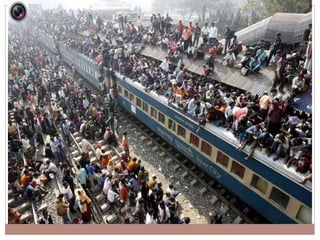
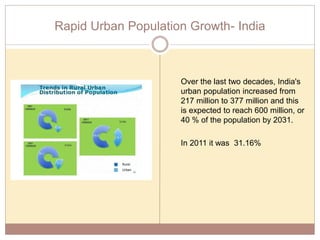
Rapid Urban Population Growth- India
Over the last two decades, India's
urban population increased from
217 million to 377 million and this
is expected to reach 600 million, or
40 % of the population by 2031.
In 2011 it was 31.16%
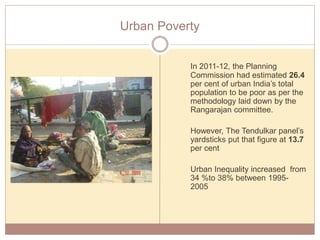
Urban Poverty
In 2011-12, the Planning
Commission had estimated 26.4
per cent of urban India’s total
population to be poor as per the
methodology laid down by the
Rangarajan committee.
However, The Tendulkar panel’s
yardsticks put that figure at 13.7
per cent
Urban Inequality increased from
34 %to 38% between 1995-
2005
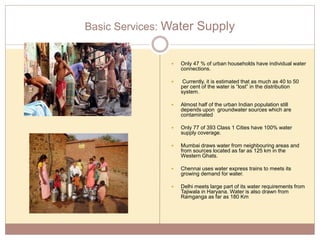
Basic Services: Water Supply
 Only 47 % of urban households have individual water
connections.
 Currently, it is estimated that as much as 40 to 50
per cent of the water is “lost” in the distribution
system.
 Almost half of the urban Indian population still
depends upon groundwater sources which are
contaminated
 Only 77 of 393 Class 1 Cities have 100% water
supply coverage.
 Mumbai draws water from neighbouring areas and
from sources located as far as 125 km in the
Western Ghats.
 Chennai uses water express trains to meets its
growing demand for water.
 Delhi meets large part of its water requirements from
Tajiwala in Haryana. Water is also drawn from
Ramganga as far as 180 Km
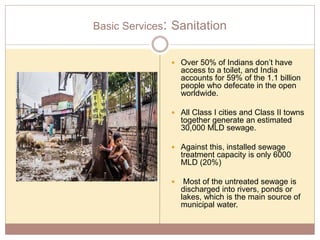
Basic Services: Sanitation
 Over 50% of Indians don’t have
access to a toilet, and India
accounts for 59% of the 1.1 billion
people who defecate in the open
worldwide.
 All Class I cities and Class II towns
together generate an estimated
30,000 MLD sewage.
 Against this, installed sewage
treatment capacity is only 6000
MLD (20%)
 Most of the untreated sewage is
discharged into rivers, ponds or
lakes, which is the main source of
municipal water.
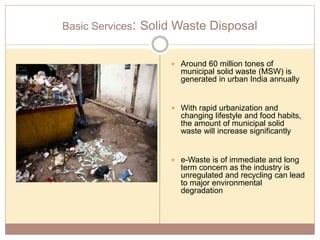
Basic Services: Solid Waste Disposal
 Around 60 million tones of
municipal solid waste (MSW) is
generated in urban India annually
 With rapid urbanization and
changing lifestyle and food habits,
the amount of municipal solid
waste will increase significantly
 e-Waste is of immediate and long
term concern as the industry is
unregulated and recycling can lead
to major environmental
degradation
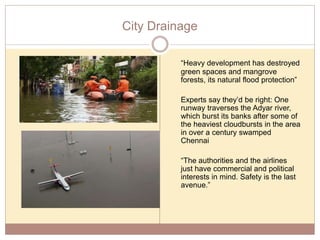
City Drainage
“Heavy development has destroyed
green spaces and mangrove
forests, its natural flood protection”
Experts say they’d be right: One
runway traverses the Adyar river,
which burst its banks after some of
the heaviest cloudbursts in the area
in over a century swamped
Chennai
“The authorities and the airlines
just have commercial and political
interests in mind. Safety is the last
avenue.”
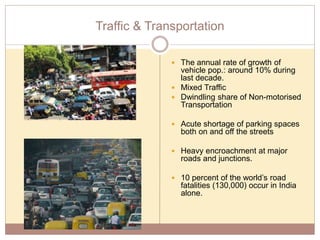
Traffic & Transportation
 The annual rate of growth of
vehicle pop.: around 10% during
last decade.
 Mixed Traffic
 Dwindling share of Non-motorised
Transportation
 Acute shortage of parking spaces
both on and off the streets
 Heavy encroachment at major
roads and junctions.
 10 percent of the world’s road
fatalities (130,000) occur in India
alone.
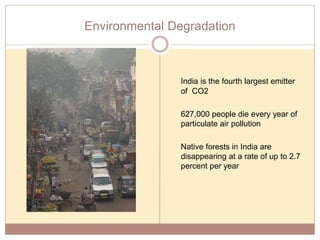
Environmental Degradation
India is the fourth largest emitter
of CO2
627,000 people die every year of
particulate air pollution
Native forests in India are
disappearing at a rate of up to 2.7
percent per year
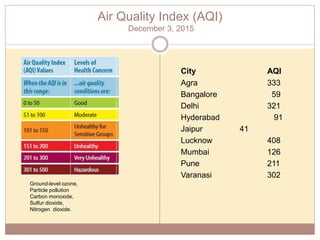
Air Quality Index (AQI)
December 3, 2015
City AQI
Agra 333
Bangalore 59
Delhi 321
Hyderabad 91
Jaipur 41
Lucknow 408
Mumbai 126
Pune 211
Varanasi 302
Ground-level ozone,
Particle pollution
Carbon monoxide,
Sulfur dioxide,
Nitrogen dioxide.
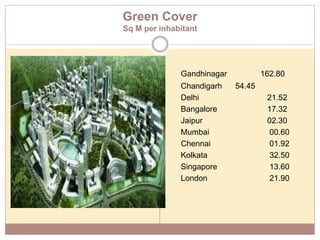
Green Cover
Sq M per inhabitant
Gandhinagar 162.80
Chandigarh 54.45
Delhi 21.52
Bangalore 17.32
Jaipur 02.30
Mumbai 00.60
Chennai 01.92
Kolkata 32.50
Singapore 13.60
London 21.90
Slums
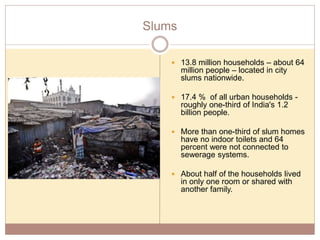
 13.8 million households – about 64
million people – located in city
slums nationwide.
 17.4 % of all urban households -
roughly one-third of India's 1.2
billion people.
 More than one-third of slum homes
have no indoor toilets and 64
percent were not connected to
sewerage systems.
 About half of the households lived
in only one room or shared with
another family.
Urban Land Crunch
 Developed Land- Shortage and high pricing
 Land Acquisition Act – 1894 and 2011/2014?
 Land Development Norms- Density, FAR
 Compact City form
Coordination of Civic Affairs through 74 Constitutional
Amendment Act-1992 ???
 The people to take part in the issues that affected them directly.
 The municipalities to be made responsible for urban planning, land use, water
supply, roads, bridges, health sanitation slum improvement etc. in addition
irrigation, libraries, cultural activities etc added to the local government’s share
of responsibilities.
 The authority to take decisions on these subjects was to be transferred by the
state governments to the municipalities.
CURITIBA(BRAZIL)
Success Storey
Urban Management-Curitiba (Brazil)
Innovative managerial skills of Architect Turned 3 time Mayor
Jaime Lerner
“Fewer Cars and Separated Garbage”
 Trinary System- Integration of mass transit access roads and Land Use together
(Dense development along traffic corridors)
 Bus Rapid Transit (BRT)- carries 2.6 million people per day
 Overnight conversion of busy though fares in -to pedestrianized Public Spaces with
the help of students art work etc
 Expanded Parks and Public Space for Greener Future- Increased green space from 1
Sq.M. To 52 Sq.M. per each inhabitant- Sheeps grazed the grass and produced
manure, also gave wool fibre.
 Turned Rubbish into opportunity- Bus or Movie tickets in exchange
GDP of Curitiba increased by 48% more than that of Brazil
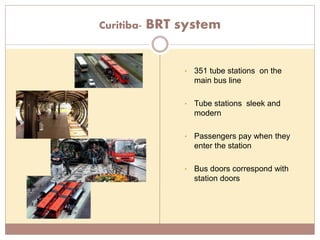
Curitiba- BRT system
• 351 tube stations on the
main bus line
• Tube stations sleek and
modern
• Passengers pay when they
enter the station
• Bus doors correspond with
station doors
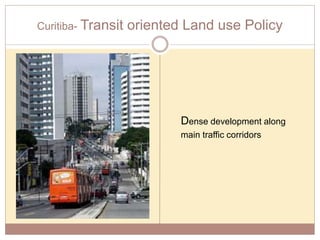
Curitiba- Transit oriented Land use Policy
Dense development along
main traffic corridors
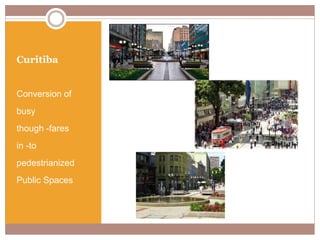
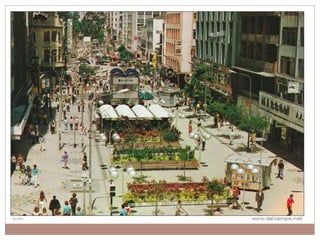
Curitiba
Conversion of
busy
though -fares
in -to
pedestrianized
Public Spaces
Curitiba- Garbage Recycling through Complementary Currency
 Anyone who deposited a bag full of pre-sorted garbage received a bus token.
 Plastic chits for paper & carton collectors, exchangeable for parcels of seasonal fresh
fruits and vegetables.
 For every 4 pounds of recycling garbage a pound of fruits, vegetable and eggs,
 In addition, a school-based garbage collection program supplied poorer students with
notebooks.
 More than 70% of Curitiban households became involved in the programs.
 The 62 poorer neighborhoods alone exchanged 11,000 tons of garbage for nearly a
million bus tokens and 1,200 tons of food
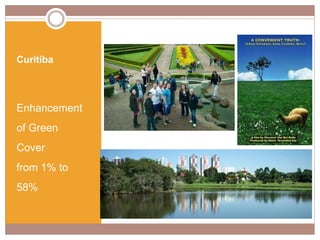
Curitiba
Enhancement
of Green
Cover
from 1% to
58%
Jaime Lerner- Architect- Planner turned Politician
 Born December 17, 1937
 Mayor of Curitiba- 1971-75, 1979-84 and 1989-92
 Governor of the state of Paraná, Brazil
o Helped create the Institute of Urban Planning and Research of Curitiba
o Past President- International Union of Architects-UIA(2002-05)
o Recipient of U.N. Environmental Award(1990)
 Transformed Curitiba into one of the greenest cities in the world
 Introduced BRT system in Curitiba
 Introduced concept of “ Garbage that is not Garbage”
 Achieved Pedestrianisation of the main shopping thoroughfare within 72 hours
 Made possible Increasing of green space from 1 Sq.M. To 52 Sq.M.
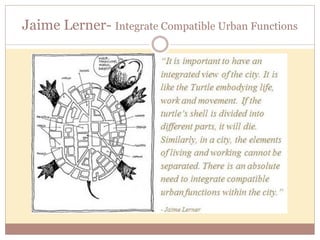
Jaime Lerner- Integrate Compatible Urban Functions
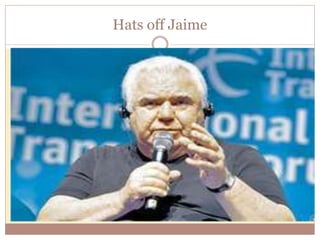
Hats off Jaime

Planning and Urban Management-issues & challenges

  • 1.
    P R OF. S U B O D H S H AN K A R , F I T P D e a n , F a c u l t y o f A r c h i t e c t u r e & P l a n n i n g , I n t e g r a l U n i v e r s i t y , L u c k n o w F o r m e r C h i e f A r c h i t e c t P l a n n e r , U . P . H o u s i n g & D e v . B o a r d Planning & Urban Management Issues and Challenges
  • 3.
    Urban Planning Urban Planningmeans the scientific , aesthetic and orderly disposition of Land, Resources, Facilities, and Services with a view of securing the Physical, Economic and Social efficiency, health and well being of Urban Communities. Urban Planning integrates land-use, environment, transportation & services to improve economic and social environment of cities
  • 4.
    Urban Management Key Issues Rapid Urban Growth- PURA (provision of urban facilities in rural areas)  Basic Services- Water Supply, Sewerage, Drainage, Waste Disposal etc  Traffic & Transportation- congestion; safety; parking  Land Acquisition & Management- land pooling; rationalize demand  Environmental Degradation- adoption of green concepts  Participatory Planning
  • 5.
    Urban Management Key Challenges Urban Poverty- employment oriented development  Urban Sprawl- compact urban form; mixed land use  Sustainability – economic; environmental  Urban Administration – Decentralized ; 74 Constitutional Amendment Act  Global Aspirations  Heritage Conservation  Capacity Building- professional city managers
  • 6.
    Rapid Urban PopulationGrowth- India Over the last two decades, India's urban population increased from 217 million to 377 million and this is expected to reach 600 million, or 40 % of the population by 2031. In 2011 it was 31.16%
  • 7.
    Urban Poverty In 2011-12,the Planning Commission had estimated 26.4 per cent of urban India’s total population to be poor as per the methodology laid down by the Rangarajan committee. However, The Tendulkar panel’s yardsticks put that figure at 13.7 per cent Urban Inequality increased from 34 %to 38% between 1995- 2005
  • 8.
    Basic Services: WaterSupply  Only 47 % of urban households have individual water connections.  Currently, it is estimated that as much as 40 to 50 per cent of the water is “lost” in the distribution system.  Almost half of the urban Indian population still depends upon groundwater sources which are contaminated  Only 77 of 393 Class 1 Cities have 100% water supply coverage.  Mumbai draws water from neighbouring areas and from sources located as far as 125 km in the Western Ghats.  Chennai uses water express trains to meets its growing demand for water.  Delhi meets large part of its water requirements from Tajiwala in Haryana. Water is also drawn from Ramganga as far as 180 Km
  • 9.
    Basic Services: Sanitation Over 50% of Indians don’t have access to a toilet, and India accounts for 59% of the 1.1 billion people who defecate in the open worldwide.  All Class I cities and Class II towns together generate an estimated 30,000 MLD sewage.  Against this, installed sewage treatment capacity is only 6000 MLD (20%)  Most of the untreated sewage is discharged into rivers, ponds or lakes, which is the main source of municipal water.
  • 10.
    Basic Services: SolidWaste Disposal  Around 60 million tones of municipal solid waste (MSW) is generated in urban India annually  With rapid urbanization and changing lifestyle and food habits, the amount of municipal solid waste will increase significantly  e-Waste is of immediate and long term concern as the industry is unregulated and recycling can lead to major environmental degradation
  • 11.
    City Drainage “Heavy developmenthas destroyed green spaces and mangrove forests, its natural flood protection” Experts say they’d be right: One runway traverses the Adyar river, which burst its banks after some of the heaviest cloudbursts in the area in over a century swamped Chennai “The authorities and the airlines just have commercial and political interests in mind. Safety is the last avenue.”
  • 12.
    Traffic & Transportation The annual rate of growth of vehicle pop.: around 10% during last decade.  Mixed Traffic  Dwindling share of Non-motorised Transportation  Acute shortage of parking spaces both on and off the streets  Heavy encroachment at major roads and junctions.  10 percent of the world’s road fatalities (130,000) occur in India alone.
  • 13.
    Environmental Degradation India isthe fourth largest emitter of CO2 627,000 people die every year of particulate air pollution Native forests in India are disappearing at a rate of up to 2.7 percent per year
  • 14.
    Air Quality Index(AQI) December 3, 2015 City AQI Agra 333 Bangalore 59 Delhi 321 Hyderabad 91 Jaipur 41 Lucknow 408 Mumbai 126 Pune 211 Varanasi 302 Ground-level ozone, Particle pollution Carbon monoxide, Sulfur dioxide, Nitrogen dioxide.
  • 15.
    Green Cover Sq Mper inhabitant Gandhinagar 162.80 Chandigarh 54.45 Delhi 21.52 Bangalore 17.32 Jaipur 02.30 Mumbai 00.60 Chennai 01.92 Kolkata 32.50 Singapore 13.60 London 21.90
  • 16.
    Slums  13.8 millionhouseholds – about 64 million people – located in city slums nationwide.  17.4 % of all urban households - roughly one-third of India's 1.2 billion people.  More than one-third of slum homes have no indoor toilets and 64 percent were not connected to sewerage systems.  About half of the households lived in only one room or shared with another family.
  • 17.
    Urban Land Crunch Developed Land- Shortage and high pricing  Land Acquisition Act – 1894 and 2011/2014?  Land Development Norms- Density, FAR  Compact City form
  • 18.
    Coordination of CivicAffairs through 74 Constitutional Amendment Act-1992 ???  The people to take part in the issues that affected them directly.  The municipalities to be made responsible for urban planning, land use, water supply, roads, bridges, health sanitation slum improvement etc. in addition irrigation, libraries, cultural activities etc added to the local government’s share of responsibilities.  The authority to take decisions on these subjects was to be transferred by the state governments to the municipalities.
  • 19.
  • 20.
    Urban Management-Curitiba (Brazil) Innovativemanagerial skills of Architect Turned 3 time Mayor Jaime Lerner “Fewer Cars and Separated Garbage”  Trinary System- Integration of mass transit access roads and Land Use together (Dense development along traffic corridors)  Bus Rapid Transit (BRT)- carries 2.6 million people per day  Overnight conversion of busy though fares in -to pedestrianized Public Spaces with the help of students art work etc  Expanded Parks and Public Space for Greener Future- Increased green space from 1 Sq.M. To 52 Sq.M. per each inhabitant- Sheeps grazed the grass and produced manure, also gave wool fibre.  Turned Rubbish into opportunity- Bus or Movie tickets in exchange GDP of Curitiba increased by 48% more than that of Brazil
  • 21.
    Curitiba- BRT system •351 tube stations on the main bus line • Tube stations sleek and modern • Passengers pay when they enter the station • Bus doors correspond with station doors
  • 22.
    Curitiba- Transit orientedLand use Policy Dense development along main traffic corridors
  • 23.
    Curitiba Conversion of busy though -fares in-to pedestrianized Public Spaces
  • 25.
    Curitiba- Garbage Recyclingthrough Complementary Currency  Anyone who deposited a bag full of pre-sorted garbage received a bus token.  Plastic chits for paper & carton collectors, exchangeable for parcels of seasonal fresh fruits and vegetables.  For every 4 pounds of recycling garbage a pound of fruits, vegetable and eggs,  In addition, a school-based garbage collection program supplied poorer students with notebooks.  More than 70% of Curitiban households became involved in the programs.  The 62 poorer neighborhoods alone exchanged 11,000 tons of garbage for nearly a million bus tokens and 1,200 tons of food
  • 26.
  • 28.
    Jaime Lerner- Architect-Planner turned Politician  Born December 17, 1937  Mayor of Curitiba- 1971-75, 1979-84 and 1989-92  Governor of the state of Paraná, Brazil o Helped create the Institute of Urban Planning and Research of Curitiba o Past President- International Union of Architects-UIA(2002-05) o Recipient of U.N. Environmental Award(1990)  Transformed Curitiba into one of the greenest cities in the world  Introduced BRT system in Curitiba  Introduced concept of “ Garbage that is not Garbage”  Achieved Pedestrianisation of the main shopping thoroughfare within 72 hours  Made possible Increasing of green space from 1 Sq.M. To 52 Sq.M.
  • 29.
    Jaime Lerner- IntegrateCompatible Urban Functions
  • 30.