Jorge Núñez Ferrer
CEU, 4/3/2014
 The what and why of Smart Cities
 Balancing objectives of cities
 Transition to a Smart City
 The role of (right kind of) standards
 The city planning revolution
 The challenges of efficient integration
 Creating value
 The need for new Financial models
 EU strategy for Smart Cities, now and …later?
 The clash of systems
 Is smart synonymous with unnecessarily
complex and expensive?
 Are there stupid cities too?
 Is this a corporate invention to sell gadgets?
 Do we need them?
 Are we smart enough to live in a smart city?
 Is a smart city a controlling-restrictive city?
 Is it worth the cost?
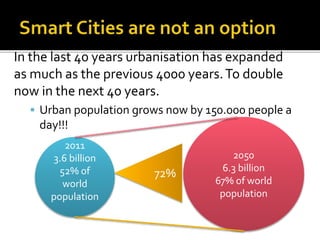
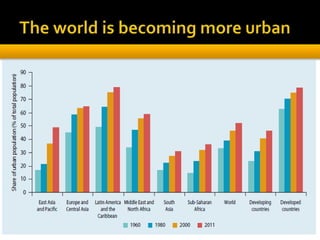
In the last 40 years urbanisation has expanded
as much as the previous 4000 years.To double
now in the next 40 years.
 Urban population grows now by 150.000 people a
day!!!
2011
3.6 billion
52% of
world
population
2050
6.3 billion
67% of world
population
72%
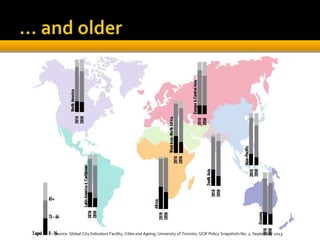
Source: Global City Indicators Facility, Cities and Ageing, University of Toronto, GCIF Policy Snapshots No. 2, September 2013.
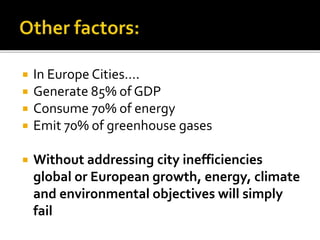
 In Europe Cities….
 Generate 85% of GDP
 Consume 70% of energy
 Emit 70% of greenhouse gases
 Without addressing city inefficiencies
global or European growth, energy, climate
and environmental objectives will simply
fail
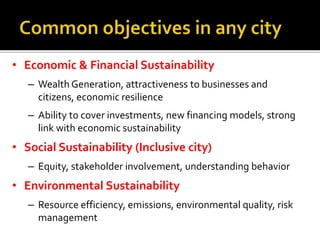
• Economic & Financial Sustainability
– Wealth Generation, attractiveness to businesses and
citizens, economic resilience
– Ability to cover investments, new financing models, strong
link with economic sustainability
• Social Sustainability (Inclusive city)
– Equity, stakeholder involvement, understanding behavior
• Environmental Sustainability
– Resource efficiency, emissions, environmental quality, risk
management
 Developing smart cities is NOT about city authorities
procuring technologies
 It is not only on supporting technology innovation
 It is about:
 Developing the right environment for smart solutions to be
effectively adopted and used.
 Being inclusive: Citizens are not only inhabitants, but shapers of
the smart city as prosumers of city services
 Partnering with industry, financiers and end users…this is
sometimes a non-traditional partnership.
 Reforming and adapting the administrative, finance and
procurement mechanisms to take into account the lifecycle of
new infrastructures
 Cities are in general run rather inefficiently
 Utilities and services need to collaborate and
infrastructures need to integrate.
 For this it is important that companies and
authorities collaborate
 Key is open data – in standardised formats
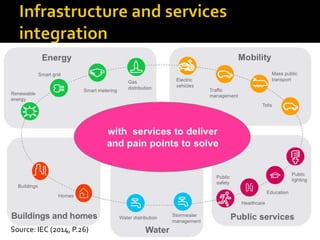
Source: IEC (2014, P.26)
 To allow planning, benchmarking and technology
compatibility standards are taking a central role
 Standards ensure collaboration, allow
replicability, enable the creation of new markets
 International bodies ISO, IEC
 European CEN CENELEC, ETSI
 National BSI, etc.
 Standards enable smart cities: an aligned
approach for design, development and operation
of the system of systems
 Standards increase the number of solutions,
increase competition and benefit customers (cities
and citizens)
 Standards guarantee:
 Specified performance levels;
 Compatibility & Interoperability
 Increase competition
Standards allow for smart opportunities
a) Planning requires:
1. understanding the OBJECTIVES of the city
2. a holistic approach – INTEGRATION
3. Knowledge of the cities needs today and good projections
– INDICATORS
4. Know the stakeholders and their role
5. TECHNICAL KNOWLEDGE
6. CAPACITYTO ADAPT in time. Investments risk locking
the city for a long time into a specific infrastructure.
Technologies need to be compatible, interoperable.
b) There will be a need for REGULATORY AND PUBLIC
PROCUREMENT REFORM
 Traditional procurement is generally:
 Anti-innovation
 Seeks the lowest investment cost
 There is a need of further reform:
 Include the lifecycle costs of projects
 Encourage innovative procurement
 Focus has to move away from CAPEX to OPEX
 Administrations need to learn to partner with
private sector - PPPs
 Citizens are key
 Not only as users, but as prosumers
 They will be important providers of services
 Planning needs to take into account the market
opportunities of smarter systems, enhancing
entrepreneurial possibilities
 Improving opportunities and living standards
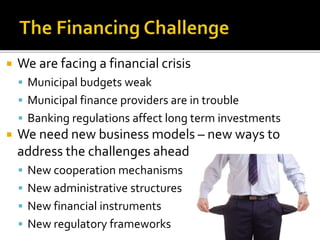
 We are facing a financial crisis
 Municipal budgets weak
 Municipal finance providers are in trouble
 Banking regulations affect long term investments
 We need new business models – new ways to
address the challenges ahead
 New cooperation mechanisms
 New administrative structures
 New financial instruments
 New regulatory frameworks
 The monoline insurance companies that provided
bonds and guarantees got severely hit by the
crisis
 The banking sector regulations (Basel III) make
infrastructure lending less interesting: higher
capital reserves and additional financial save-
guards in line with loan size and duration
 Taxation avenues are limited
 Green bonds
 Guarantees
 In EU:
 Innovation - EIP:
▪ Horizon 2020
▪ Risk Sharing facilities
 Deployment:
▪ EEEF, etc.
▪ Project bonds
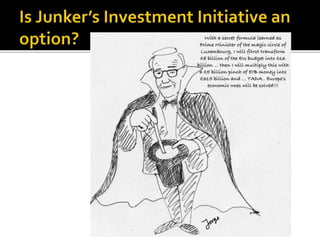
▪ Juncker’s investment initiative
 DEPLOYMENT
 EU does not manage to bring innovations to the
market.
 Lack of scaling up and deployment
 Low risk appetite in the market
 EU market is inflexible and fragmented
 EU funding focused on innovation
 National restricted due to economy and state aid
rules
 Some funding available through structural funds,
Cohesion Funds and CEF
 External Industrial Competition
 Guarantees for green bonds – EU level for
Energy and for Smart Cities (to cover the
receding investments from banks and other
financiers)
 Equity and guarantees for innovation.
 Risk: Uptake of projects that would be done
anyway due to political pressure – 315 bn in 2
years.
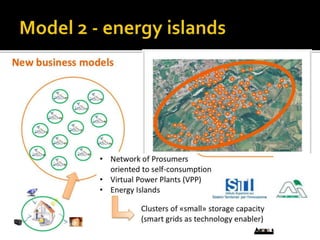
Two models:
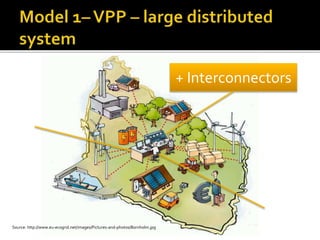
 Mainly large but decentralised producers with
interconnectors
 Decentralised energy Islands
 Large producers are tending to prefer 1 despite
competition
 Second option linked with storage can change the
landscape of energy radically
 Emerging concern: Stranded assets
+ Interconnectors
Source: http://www.eu-ecogrid.net/images/Pictures-and-photos/Bornholm.jpg
 www.ceps.eu
 Cities:The Juncker Commission should not miss this key to growth, jobs and the
environment
http://www.ceps.eu/book/cities-juncker-commission-should-not-miss-key-growth-jobs-and-environment
 www.iec.ch
 White paper – Orchestrating Smart Cities
http://www.iec.ch/whitepaper/smartcities/?ref=extfooter

Smart cities, CEU lecture

  • 1.
  • 2.
     The whatand why of Smart Cities  Balancing objectives of cities  Transition to a Smart City  The role of (right kind of) standards  The city planning revolution  The challenges of efficient integration  Creating value  The need for new Financial models  EU strategy for Smart Cities, now and …later?  The clash of systems
  • 3.
     Is smartsynonymous with unnecessarily complex and expensive?  Are there stupid cities too?  Is this a corporate invention to sell gadgets?  Do we need them?  Are we smart enough to live in a smart city?  Is a smart city a controlling-restrictive city?  Is it worth the cost?
  • 4.
    In the last40 years urbanisation has expanded as much as the previous 4000 years.To double now in the next 40 years.  Urban population grows now by 150.000 people a day!!! 2011 3.6 billion 52% of world population 2050 6.3 billion 67% of world population 72%
  • 6.
    Source: Global CityIndicators Facility, Cities and Ageing, University of Toronto, GCIF Policy Snapshots No. 2, September 2013.
  • 7.
     In EuropeCities….  Generate 85% of GDP  Consume 70% of energy  Emit 70% of greenhouse gases  Without addressing city inefficiencies global or European growth, energy, climate and environmental objectives will simply fail
  • 8.
    • Economic &Financial Sustainability – Wealth Generation, attractiveness to businesses and citizens, economic resilience – Ability to cover investments, new financing models, strong link with economic sustainability • Social Sustainability (Inclusive city) – Equity, stakeholder involvement, understanding behavior • Environmental Sustainability – Resource efficiency, emissions, environmental quality, risk management
  • 9.
     Developing smartcities is NOT about city authorities procuring technologies  It is not only on supporting technology innovation  It is about:  Developing the right environment for smart solutions to be effectively adopted and used.  Being inclusive: Citizens are not only inhabitants, but shapers of the smart city as prosumers of city services  Partnering with industry, financiers and end users…this is sometimes a non-traditional partnership.  Reforming and adapting the administrative, finance and procurement mechanisms to take into account the lifecycle of new infrastructures
  • 10.
     Cities arein general run rather inefficiently  Utilities and services need to collaborate and infrastructures need to integrate.  For this it is important that companies and authorities collaborate  Key is open data – in standardised formats
  • 11.
  • 12.
     To allowplanning, benchmarking and technology compatibility standards are taking a central role  Standards ensure collaboration, allow replicability, enable the creation of new markets  International bodies ISO, IEC  European CEN CENELEC, ETSI  National BSI, etc.
  • 13.
     Standards enablesmart cities: an aligned approach for design, development and operation of the system of systems  Standards increase the number of solutions, increase competition and benefit customers (cities and citizens)  Standards guarantee:  Specified performance levels;  Compatibility & Interoperability  Increase competition Standards allow for smart opportunities
  • 14.
    a) Planning requires: 1.understanding the OBJECTIVES of the city 2. a holistic approach – INTEGRATION 3. Knowledge of the cities needs today and good projections – INDICATORS 4. Know the stakeholders and their role 5. TECHNICAL KNOWLEDGE 6. CAPACITYTO ADAPT in time. Investments risk locking the city for a long time into a specific infrastructure. Technologies need to be compatible, interoperable. b) There will be a need for REGULATORY AND PUBLIC PROCUREMENT REFORM
  • 15.
     Traditional procurementis generally:  Anti-innovation  Seeks the lowest investment cost  There is a need of further reform:  Include the lifecycle costs of projects  Encourage innovative procurement  Focus has to move away from CAPEX to OPEX  Administrations need to learn to partner with private sector - PPPs
  • 16.
     Citizens arekey  Not only as users, but as prosumers  They will be important providers of services  Planning needs to take into account the market opportunities of smarter systems, enhancing entrepreneurial possibilities  Improving opportunities and living standards
  • 17.
     We arefacing a financial crisis  Municipal budgets weak  Municipal finance providers are in trouble  Banking regulations affect long term investments  We need new business models – new ways to address the challenges ahead  New cooperation mechanisms  New administrative structures  New financial instruments  New regulatory frameworks
  • 18.
     The monolineinsurance companies that provided bonds and guarantees got severely hit by the crisis  The banking sector regulations (Basel III) make infrastructure lending less interesting: higher capital reserves and additional financial save- guards in line with loan size and duration  Taxation avenues are limited
  • 19.
     Green bonds Guarantees  In EU:  Innovation - EIP: ▪ Horizon 2020 ▪ Risk Sharing facilities  Deployment: ▪ EEEF, etc. ▪ Project bonds ▪ Juncker’s investment initiative
  • 20.
     DEPLOYMENT  EUdoes not manage to bring innovations to the market.  Lack of scaling up and deployment  Low risk appetite in the market  EU market is inflexible and fragmented  EU funding focused on innovation  National restricted due to economy and state aid rules  Some funding available through structural funds, Cohesion Funds and CEF  External Industrial Competition
  • 22.
     Guarantees forgreen bonds – EU level for Energy and for Smart Cities (to cover the receding investments from banks and other financiers)  Equity and guarantees for innovation.  Risk: Uptake of projects that would be done anyway due to political pressure – 315 bn in 2 years.
  • 23.
    Two models:  Mainlylarge but decentralised producers with interconnectors  Decentralised energy Islands  Large producers are tending to prefer 1 despite competition  Second option linked with storage can change the landscape of energy radically  Emerging concern: Stranded assets
  • 24.
  • 26.
     www.ceps.eu  Cities:TheJuncker Commission should not miss this key to growth, jobs and the environment http://www.ceps.eu/book/cities-juncker-commission-should-not-miss-key-growth-jobs-and-environment  www.iec.ch  White paper – Orchestrating Smart Cities http://www.iec.ch/whitepaper/smartcities/?ref=extfooter