IoT analytics: There’s not
just predictive maintenance
Dr. Boris Adryan
Head of IoT & Data Analytics
Zühlke Engineering GmbH
@BorisAdryan
Presented at Consortium for the 4th Revolution Executive Briefing Day (C4IR-1
Cambridge, UK 2-3 February 2017 www.cir-strategy.com/events
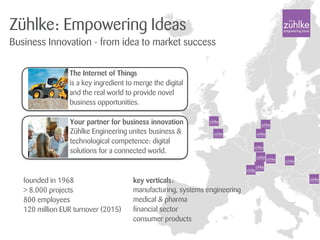
Zühlke: Empowering Ideas
Business Innovation - from idea to market success
founded in 1968
> 8.000 projects
800 employees
120 million EUR turnover (2015)
key verticals:
manufacturing, systems engineering
medical & pharma
financial sector
consumer products
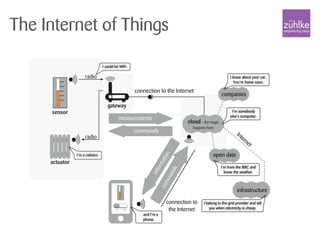
The Internet of Things
is a key ingredient to merge the digital
and the real world to provide novel
business opportunities.
Your partner for business innovation
Zühlke Engineering unites business &
technological competence: digital
solutions for a connected world.
The Internet of Things
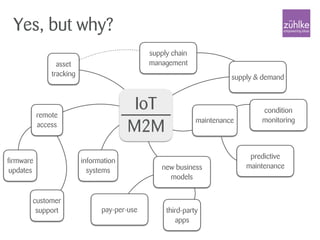
Yes, but why?
IoT
M2M
asset
tracking
remote
access
information
systems new business
models
supply & demand
maintenance
pay-per-use third-party
apps
firmware
updates
customer
support
predictive
maintenance
condition
monitoring
supply chain
management
Only today!
Live and exclusive at C4IR:
Mostly NDA stuff.
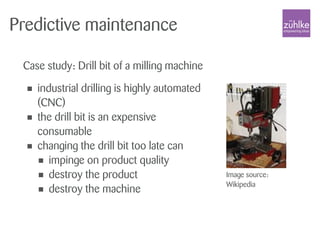
Predictive maintenance
Case study: Drill bit of a milling machine
Image source:
Wikipedia
• industrial drilling is highly automated
(CNC)
• the drill bit is an expensive
consumable
• changing the drill bit too late can
• impinge on product quality
• destroy the product
• destroy the machine
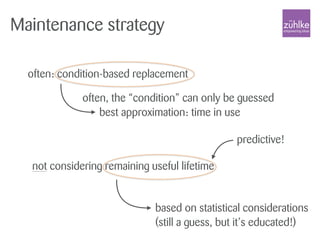
often: condition-based replacement
Maintenance strategy
not considering remaining useful lifetime
often, the “condition” can only be guessed
best approximation: time in use
based on statistical considerations
(still a guess, but it’s educated!)
predictive!
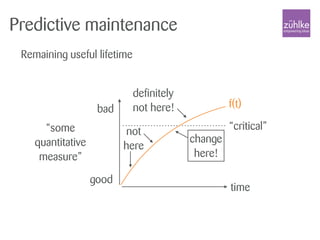
Predictive maintenance
Remaining useful lifetime
“some
quantitative
measure”
bad
good
time
“critical”
change
here!
not
here
definitely
not here! f(t)
Predictive maintenance
Remaining useful lifetime
time
g(t)
h(t)
i(t)
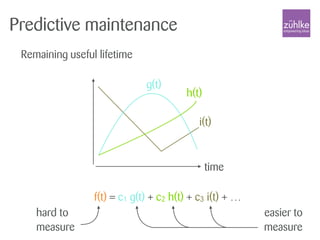
f(t) = c1 g(t) + c2 h(t) + c3 i(t) + …
hard to
measure
easier to
measure
Predictive maintenance
Remaining useful lifetime
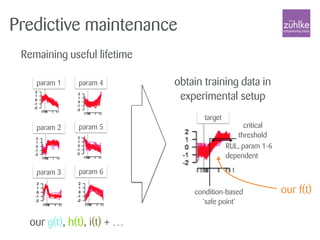
param 1
param 2
param 3
param 4
param 5
param 6
target
condition-based
‘safe point’
critical
threshold
RUL, param 1-6
dependent
t
obtain training data in
experimental setup
our f(t)
our g(t), h(t), i(t) + …
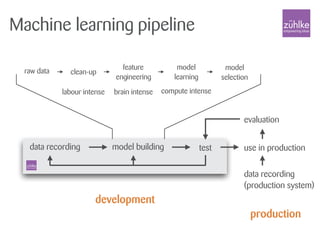
data recording model building test use in production
data recording
(production system)
evaluation
raw data clean-up
feature
engineering
model
learning
model
selection
labour intense compute intensebrain intense
Machine learning pipeline
development
production
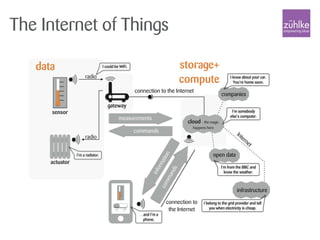
The Internet of Things
data storage+
compute
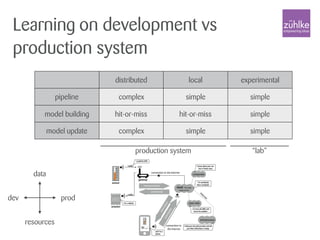
distributed local experimental
pipeline complex simple simple
model building hit-or-miss hit-or-miss simple
model update complex simple simple
production system “lab”
Learning on development vs
production system
data
resources
proddev
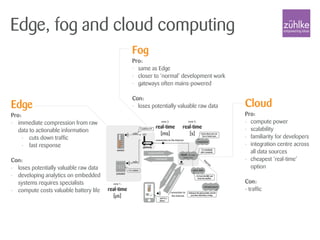
Edge, fog and cloud computing
Edge
Pro:
- immediate compression from raw
data to actionable information
- cuts down traffic
- fast response
Con:
- loses potentially valuable raw data
- developing analytics on embedded
systems requires specialists
- compute costs valuable battery life
Cloud
Pro:
- compute power
- scalability
- familiarity for developers
- integration centre across
all data sources
- cheapest ‘real-time’
option
Con:
- traffic
Fog
Pro:
- same as Edge
- closer to ‘normal’ development work
- gateways often mains-powered
Con:
- loses potentially valuable raw data
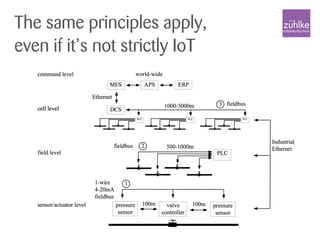
The same principles apply,
even if it’s not strictly IoT
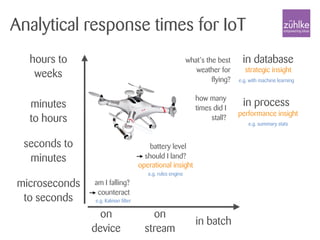
Analytical response times for IoT
microseconds
to seconds
seconds to
minutes
minutes
to hours
hours to
weeks
on
device
on
stream
in batch
am I falling?
counteract
battery level
should I land?
how many
times did I
stall?
what’s the best
weather for
flying?
in process
in database
operational insight
performance insight
strategic insight
e.g. Kalman filter
e.g. with machine learning
e.g. rules engine
e.g. summary stats
Be as fast as you must.
But don’t be any faster
just for the sake of it.
Summary: IoT Data Analytics (I)
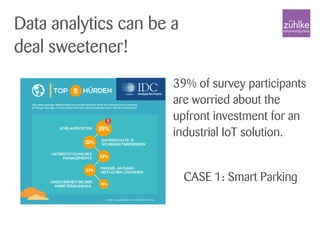
Data analytics can be a
deal sweetener!
39% of survey participants
are worried about the
upfront investment for an
industrial IoT solution.
CASE 1: Smart Parking
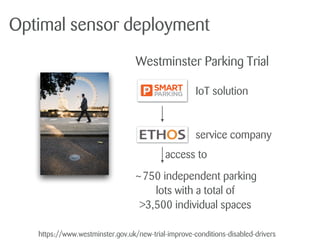
Westminster Parking Trial
https://www.westminster.gov.uk/new-trial-improve-conditions-disabled-drivers
IoT solution
service company
~750 independent parking
lots with a total of
>3,500 individual spaces
access to
Optimal sensor deployment
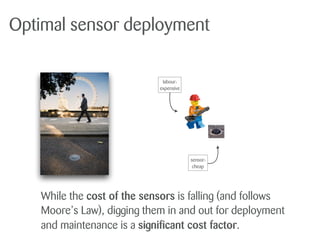
labour:
expensive
sensor:
cheap
While the cost of the sensors is falling (and follows
Moore’s Law), digging them in and out for deployment
and maintenance is a significant cost factor.
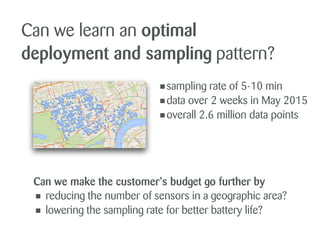
Can we learn an optimal
deployment and sampling pattern?
•sampling rate of 5-10 min
•data over 2 weeks in May 2015
•overall 2.6 million data points
Can we make the customer’s budget go further by
• reducing the number of sensors in a geographic area?
• lowering the sampling rate for better battery life?
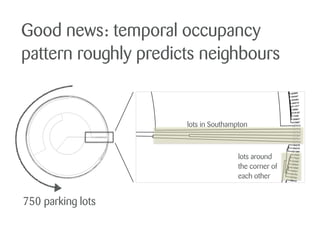
Good news: temporal occupancy
pattern roughly predicts neighbours
lots in Southampton
lots around
the corner of
each other
750 parking lots
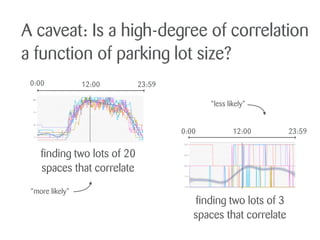
A caveat: Is a high-degree of correlation
a function of parking lot size?
finding two lots of 20
spaces that correlate
finding two lots of 3
spaces that correlate
0:00 12:00 23:59
0:00 12:00 23:59
“more likely”
“less likely”
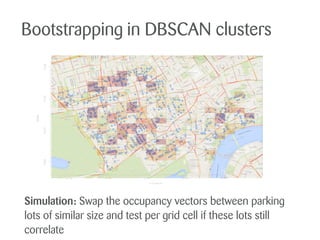
Bootstrapping in DBSCAN clusters
Simulation: Swap the occupancy vectors between parking
lots of similar size and test per grid cell if these lots still
correlate
Stratification strategy
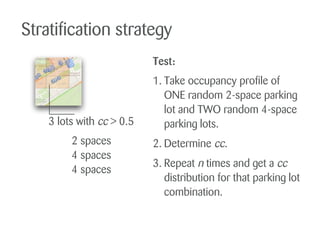
3 lots with cc > 0.5
2 spaces
4 spaces
4 spaces
Test:
1. Take occupancy profile of
ONE random 2-space parking
lot and TWO random 4-space
parking lots.
2. Determine cc.
3. Repeat n times and get a cc
distribution for that parking lot
combination.
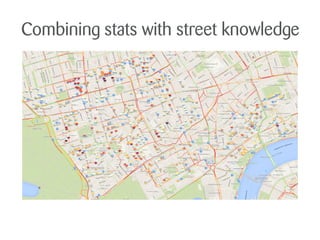
Combining stats with street knowledge
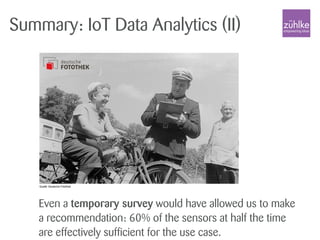
Even a temporary survey would have allowed us to make
a recommendation: 60% of the sensors at half the time
are effectively sufficient for the use case.
Summary: IoT Data Analytics (II)
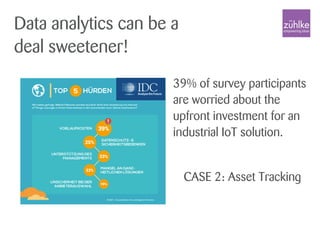
Data analytics can be a
deal sweetener!
39% of survey participants
are worried about the
upfront investment for an
industrial IoT solution.
CASE 2: Asset Tracking
IoT - is it worth it?
The upgrade of a ‘dumb’ asset to
a ‘smart’ asset is an investment.
time,
money
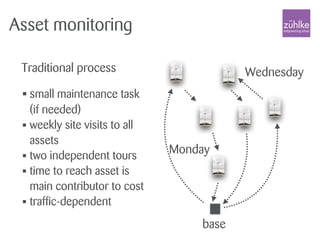
Asset monitoring
base
Monday
WednesdayTraditional process
• small maintenance task
(if needed)
• weekly site visits to all
assets
• two independent tours
• time to reach asset is
main contributor to cost
• traffic-dependent
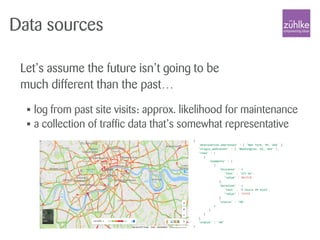
Data sources
Let’s assume the future isn’t going to be
much different than the past…
• log from past site visits: approx. likelihood for maintenance
• a collection of traffic data that’s somewhat representative
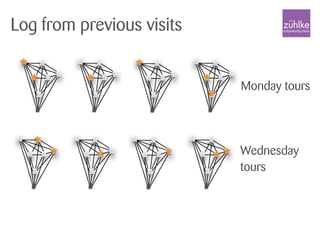
Log from previous visits
Monday tours
Wednesday
tours
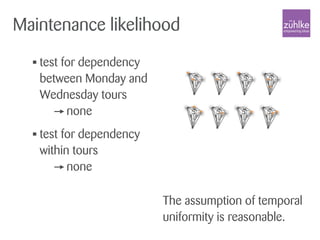
Maintenance likelihood
• test for dependency
between Monday and
Wednesday tours
none
• test for dependency
within tours
none
The assumption of temporal
uniformity is reasonable.
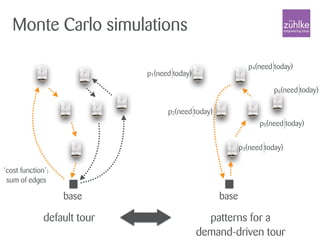
Monte Carlo simulations
p1(need today)
patterns for a
demand-driven tour
‘cost function’:
sum of edges
base
default tour
base
p2(need today)
p3(need today)
p4(need today)
p5(need today)
p6(need today)
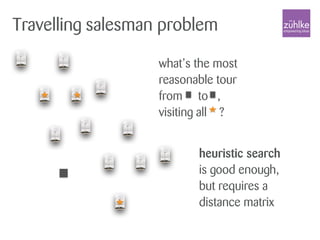
Travelling salesman problem
what’s the most
reasonable tour
from to ,
visiting all ?
heuristic search
is good enough,
but requires a
distance matrix
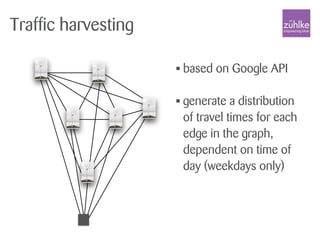
Traffic harvesting
• based on Google API
• generate a distribution
of travel times for each
edge in the graph,
dependent on time of
day (weekdays only)
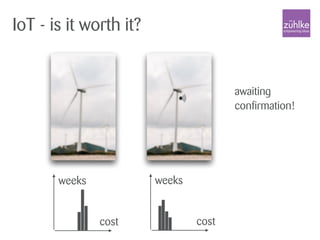
IoT - is it worth it?
cost
awaiting
confirmation!
weeks
cost
weeks
Preliminary data taken from manual surveys, along with
‘open data’ and other sources can help making an
educated guess of the business value of an IoT solution.
Summary: IoT Data Analytics (III)
Dr. Boris Adryan
eMail: boad@zuehlke.com
Twitter: @BorisAdryan
www.linkedin.com/in/
borisadryan
Thank you!

Global C4IR-1 Masterclass Adryan - Zuehlke Engineering 2017

  • 1.
    IoT analytics: There’snot just predictive maintenance Dr. Boris Adryan Head of IoT & Data Analytics Zühlke Engineering GmbH @BorisAdryan Presented at Consortium for the 4th Revolution Executive Briefing Day (C4IR-1 Cambridge, UK 2-3 February 2017 www.cir-strategy.com/events
  • 2.
    Zühlke: Empowering Ideas BusinessInnovation - from idea to market success founded in 1968 > 8.000 projects 800 employees 120 million EUR turnover (2015) key verticals: manufacturing, systems engineering medical & pharma financial sector consumer products The Internet of Things is a key ingredient to merge the digital and the real world to provide novel business opportunities. Your partner for business innovation Zühlke Engineering unites business & technological competence: digital solutions for a connected world.
  • 3.
  • 4.
    Yes, but why? IoT M2M asset tracking remote access information systemsnew business models supply & demand maintenance pay-per-use third-party apps firmware updates customer support predictive maintenance condition monitoring supply chain management
  • 5.
    Only today! Live andexclusive at C4IR: Mostly NDA stuff.
  • 6.
    Predictive maintenance Case study:Drill bit of a milling machine Image source: Wikipedia • industrial drilling is highly automated (CNC) • the drill bit is an expensive consumable • changing the drill bit too late can • impinge on product quality • destroy the product • destroy the machine
  • 7.
    often: condition-based replacement Maintenancestrategy not considering remaining useful lifetime often, the “condition” can only be guessed best approximation: time in use based on statistical considerations (still a guess, but it’s educated!) predictive!
  • 8.
    Predictive maintenance Remaining usefullifetime “some quantitative measure” bad good time “critical” change here! not here definitely not here! f(t)
  • 9.
    Predictive maintenance Remaining usefullifetime time g(t) h(t) i(t) f(t) = c1 g(t) + c2 h(t) + c3 i(t) + … hard to measure easier to measure
  • 10.
    Predictive maintenance Remaining usefullifetime param 1 param 2 param 3 param 4 param 5 param 6 target condition-based ‘safe point’ critical threshold RUL, param 1-6 dependent t obtain training data in experimental setup our f(t) our g(t), h(t), i(t) + …
  • 11.
    data recording modelbuilding test use in production data recording (production system) evaluation raw data clean-up feature engineering model learning model selection labour intense compute intensebrain intense Machine learning pipeline development production
  • 12.
    The Internet ofThings data storage+ compute
  • 13.
    distributed local experimental pipelinecomplex simple simple model building hit-or-miss hit-or-miss simple model update complex simple simple production system “lab” Learning on development vs production system data resources proddev
  • 14.
    Edge, fog andcloud computing Edge Pro: - immediate compression from raw data to actionable information - cuts down traffic - fast response Con: - loses potentially valuable raw data - developing analytics on embedded systems requires specialists - compute costs valuable battery life Cloud Pro: - compute power - scalability - familiarity for developers - integration centre across all data sources - cheapest ‘real-time’ option Con: - traffic Fog Pro: - same as Edge - closer to ‘normal’ development work - gateways often mains-powered Con: - loses potentially valuable raw data
  • 15.
    The same principlesapply, even if it’s not strictly IoT
  • 16.
    Analytical response timesfor IoT microseconds to seconds seconds to minutes minutes to hours hours to weeks on device on stream in batch am I falling? counteract battery level should I land? how many times did I stall? what’s the best weather for flying? in process in database operational insight performance insight strategic insight e.g. Kalman filter e.g. with machine learning e.g. rules engine e.g. summary stats
  • 17.
    Be as fastas you must. But don’t be any faster just for the sake of it. Summary: IoT Data Analytics (I)
  • 18.
    Data analytics canbe a deal sweetener! 39% of survey participants are worried about the upfront investment for an industrial IoT solution. CASE 1: Smart Parking
  • 19.
    Westminster Parking Trial https://www.westminster.gov.uk/new-trial-improve-conditions-disabled-drivers IoTsolution service company ~750 independent parking lots with a total of >3,500 individual spaces access to Optimal sensor deployment
  • 20.
    Optimal sensor deployment labour: expensive sensor: cheap Whilethe cost of the sensors is falling (and follows Moore’s Law), digging them in and out for deployment and maintenance is a significant cost factor.
  • 21.
    Can we learnan optimal deployment and sampling pattern? •sampling rate of 5-10 min •data over 2 weeks in May 2015 •overall 2.6 million data points Can we make the customer’s budget go further by • reducing the number of sensors in a geographic area? • lowering the sampling rate for better battery life?
  • 22.
    Good news: temporaloccupancy pattern roughly predicts neighbours lots in Southampton lots around the corner of each other 750 parking lots
  • 23.
    A caveat: Isa high-degree of correlation a function of parking lot size? finding two lots of 20 spaces that correlate finding two lots of 3 spaces that correlate 0:00 12:00 23:59 0:00 12:00 23:59 “more likely” “less likely”
  • 24.
    Bootstrapping in DBSCANclusters Simulation: Swap the occupancy vectors between parking lots of similar size and test per grid cell if these lots still correlate
  • 25.
    Stratification strategy 3 lotswith cc > 0.5 2 spaces 4 spaces 4 spaces Test: 1. Take occupancy profile of ONE random 2-space parking lot and TWO random 4-space parking lots. 2. Determine cc. 3. Repeat n times and get a cc distribution for that parking lot combination.
  • 26.
    Combining stats withstreet knowledge
  • 27.
    Even a temporarysurvey would have allowed us to make a recommendation: 60% of the sensors at half the time are effectively sufficient for the use case. Summary: IoT Data Analytics (II)
  • 28.
    Data analytics canbe a deal sweetener! 39% of survey participants are worried about the upfront investment for an industrial IoT solution. CASE 2: Asset Tracking
  • 29.
    IoT - isit worth it? The upgrade of a ‘dumb’ asset to a ‘smart’ asset is an investment. time, money
  • 30.
    Asset monitoring base Monday WednesdayTraditional process •small maintenance task (if needed) • weekly site visits to all assets • two independent tours • time to reach asset is main contributor to cost • traffic-dependent
  • 31.
    Data sources Let’s assumethe future isn’t going to be much different than the past… • log from past site visits: approx. likelihood for maintenance • a collection of traffic data that’s somewhat representative
  • 32.
    Log from previousvisits Monday tours Wednesday tours
  • 33.
    Maintenance likelihood • testfor dependency between Monday and Wednesday tours none • test for dependency within tours none The assumption of temporal uniformity is reasonable.
  • 34.
    Monte Carlo simulations p1(needtoday) patterns for a demand-driven tour ‘cost function’: sum of edges base default tour base p2(need today) p3(need today) p4(need today) p5(need today) p6(need today)
  • 35.
    Travelling salesman problem what’sthe most reasonable tour from to , visiting all ? heuristic search is good enough, but requires a distance matrix
  • 36.
    Traffic harvesting • basedon Google API • generate a distribution of travel times for each edge in the graph, dependent on time of day (weekdays only)
  • 37.
    IoT - isit worth it? cost awaiting confirmation! weeks cost weeks
  • 38.
    Preliminary data takenfrom manual surveys, along with ‘open data’ and other sources can help making an educated guess of the business value of an IoT solution. Summary: IoT Data Analytics (III)
  • 39.
    Dr. Boris Adryan eMail:boad@zuehlke.com Twitter: @BorisAdryan www.linkedin.com/in/ borisadryan Thank you!