Why Study Urbanisation?
DR. RAVIKANT JOSHI
LECTURE DELIVERED TO SCHOLARS OF INDIAN SCHOOL OF PUBLIC POLICY
10TH SEPTEMBER, 2020
Unprecedented pace of urbanisation during 20th Century is a
turning point in human history - It has changed human geography
beyond recognition
21st Century will be a century of cities and urbanisation – make or
break century of human existence
Unprecedented Urbanisation
Widespread all pervading urbanisation is a truly 20th century phenomenon
Rome was the first settlement to reach 1mn population
1800 – London become the second city to reach 1 mn
World’s total and urban population growth
◦ 1800 – only 2 % of World’s Population was urban
◦ 1900 – 15% (250 mn) of World’s Population (1.5-1.7 bn) was urban
◦ 1950 – 30% (715mn) of World’s Population (2.5bn) was urban
◦ 2000 – 46% (2.8bn) of World’s Population (6.1bn) was urban
◦ 2010 – 50% (3.4 bn) of World’s Population (6.8 bn) become urban
Unprecedented pace of urbanisation during 20th Century. Turning point in
human history – during 1950-2000 urban population increased by 2.1 bn – same
number will increase during 2000-2030
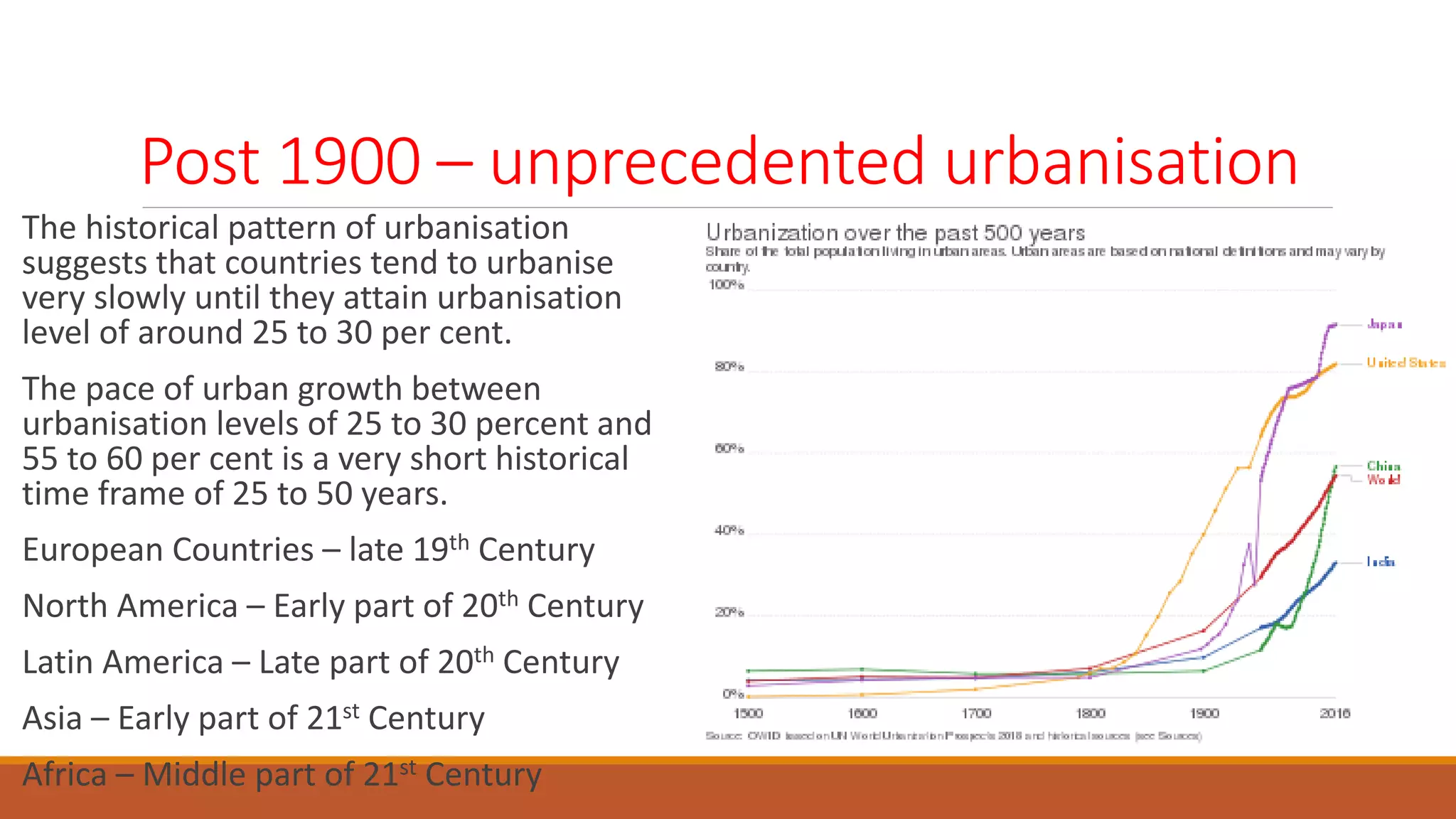
Post 1900 – unprecedented urbanisation
The historical pattern of urbanisation
suggests that countries tend to urbanise
very slowly until they attain urbanisation
level of around 25 to 30 per cent.
The pace of urban growth between
urbanisation levels of 25 to 30 percent and
55 to 60 per cent is a very short historical
time frame of 25 to 50 years.
European Countries – late 19th Century
North America – Early part of 20th Century
Latin America – Late part of 20th Century
Asia – Early part of 21st Century
Africa – Middle part of 21st Century
Regional Dynamics of Urbanisation 1950-2000
The fulcrum of urban population shifting away from Europe and NA to developing
countries.
1950-2000 1.5% growth rate of urban population in North America and Europe
Share of Europe and North America in urban population declined from 53% to
27.5% and will go down to 17% by 2030
Latin America now has become predominantly urban and will surpass Europe in
urbanisation level by 2030.
Six out of 10 countries with the largest urban populations are in Asia
At present half of urban population lives in Asia and in 2030 it will have majority of
urban population of the world
In 2030 2.7bn urban population will be in Asia and all other regions will have urban
population of about 2.3bn
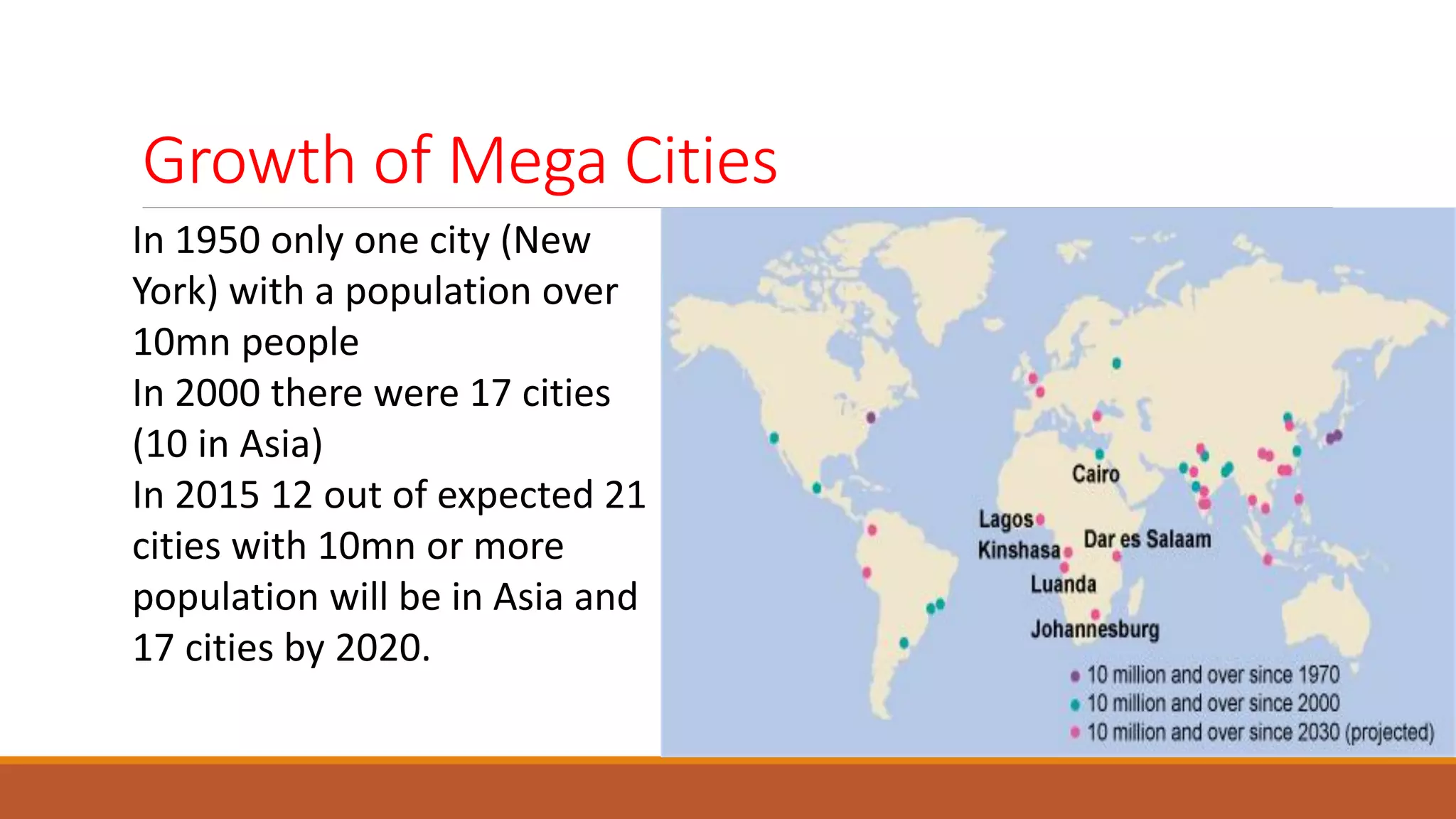
Growth of Mega Cities
In 1950 only one city (New
York) with a population over
10mn people
In 2000 there were 17 cities
(10 in Asia)
In 2015 12 out of expected 21
cities with 10mn or more
population will be in Asia and
17 cities by 2020.
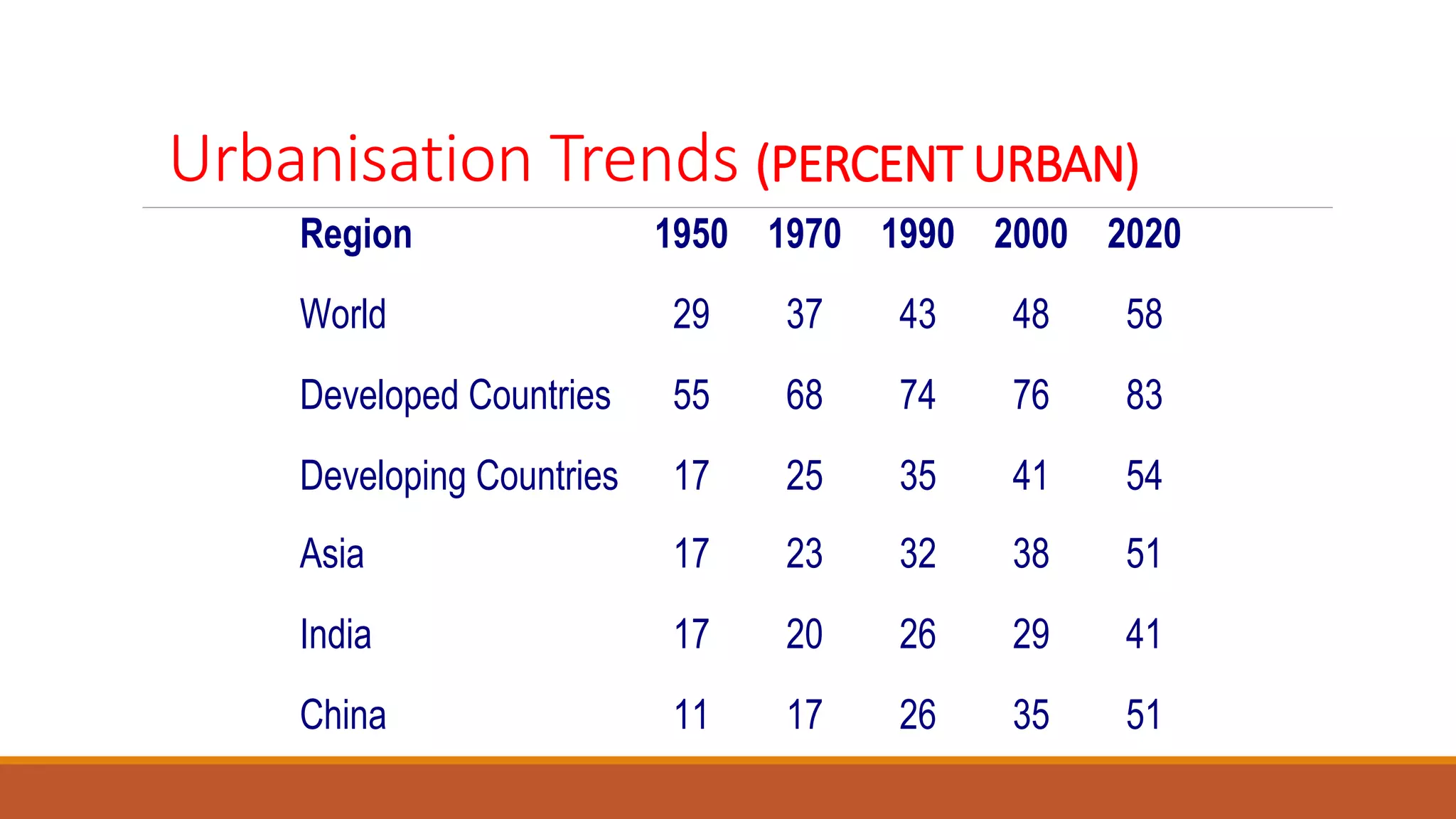
Urbanisation Trends (PERCENT URBAN)
Region 1950 1970 1990 2000 2020
World 29 37 43 48 58
Developed Countries 55 68 74 76 83
Developing Countries 17 25 35 41 54
Asia 17 23 32 38 51
India 17 20 26 29 41
China 11 17 26 35 51
2008 - World becomes Urban – No more rural
Why Study Urbanisation? – future challenges
2.2bn people will get added to world’s population by 2030
World’s population is growing by 77mn p.a. (1.2 % per annum).
World’s urban population is growing (60mn p.a.) three times of rural
population (17mn p.a.)
By 2030 world’s total population will be 8.35bn while urban
population will be 5 bn that is 60%.of total population
Out of this 4bn (80%) will be staying in today’s developing countries.
World’s population will stabilise by 2050 around 9 to 9.5 bn – out of
that Urban population will be 6 to 6.3 bn (66 %)
World needs urban policy makers/professionals to handle this growth
Why Study Urbanisation ? – for addressing
climate change
By 2050 world will reach 70 per cent level of urbanisation, more than 6 billion people in Cities
Future Urbanisation is going to be a good thing or bad thing ? If we care about the people and
future of humanity then this is the defining question.
In words of Peter Calthrope - architect, urban designer and urban planner
◦ While addressing climate change we will be building cities for additional 3 billion of the people
that is doubling urban environment
◦ Unless we set right our cities climate change solutions will not be able to save mankind because
cities constitute 70 % of CO2 emissions
◦ Not only environmental impact but so much more depends on how we shape our cities – our
social well being, economic vitality, sense of community and connectedness
◦ Fundamentally the way we shape cities is the manifestation of the kind of humanity we bring to
bare
◦ Getting future of the cities right is at most necessary to get future of the World right
◦ Setting Cities right will make Climate Change possible
Why Study Urbanisation? Close relationship
with economic growth
Urbanisation refers to the population shift from rural to urban – a process by which towns and
cities are formed and become larger as more people begin living and working in urban areas.
Urbanisation is not a modern phenomenon – it existed right from the down of civilization, first
cities got formed around 8000 BC. It is a process linked to modernisation, industrialization,
globalization.
Urbanisation relevant to many disciplines – urban planning, geography, sociology, architecture,
economics, public health and now climate change
Urban growth refers to absolute number of people living in urban areas and increase in it
Urbanisation gets promoted by
◦ Economies of scale in production – manufacturing – require larger settlements of people
◦ The existence of information externalities leading to agglomeration economies.
◦ Technology development – building & transportation
◦ Substitution of capital for land
◦ With the growing importance and role of service industry
Urbanisation & Economic Growth
Urbanisation and economic growth are inevitably
linked, however the impacts from this can be both
negative and positive.
Urbanisation and economic growth are
interdependent and increase in tandem
Urbanisation and poverty levels are well known to be
correlated.
According to the Global Monetary Report, countries
that have 40% or less people living in urban areas
have significantly lower income levels, and higher
poverty rates.
Urbanisation reduces poverty because it creates new
opportunities.
Urbanisation & Economic Growth
The existence of agglomeration economies give rise to continuing accretion of people in a
settlement, thus promoting city growth.
Urbanisation and Cities are acting as ‘engines of economic growth’, ‘agents of change’, and
‘incubators of innovations’.
Between 1960 to 2000 World output went up fourfold while urban population tripled.
Urbanisation Negative Impact -
Urbanisation has caused unprecedented economic growth, however that growth has
caused huge inequalities.
India has some of the worst inequality in the world, with one-fourth of India's urban
population living in slums
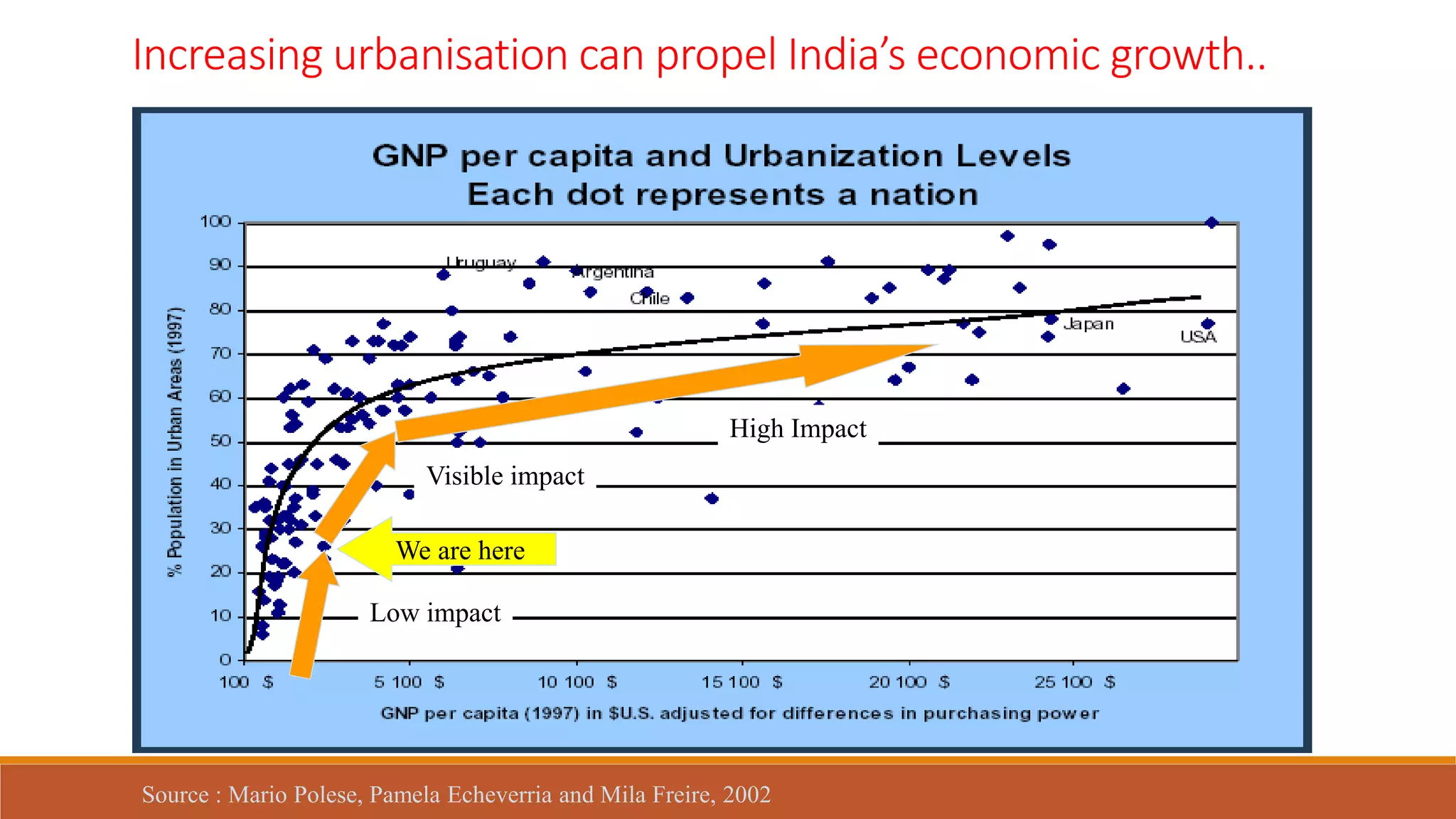
Increasing urbanisation can propel India’s economic growth..
We are here
Low impact
Visible impact
High Impact
Source : Mario Polese, Pamela Echeverria and Mila Freire, 2002
Why Cities? – for economic prosperity and
now for sustainable world !!
All through organized history, if you wanted prosperity you had to
have cities. Cities are places that attract new people with new ideas.
– Jane Jacobs, author of “Cities and the Wealth of Nations”
All through future time, if you want Sustainable Development and
Sustainable World, you will have to have Sustainable Cities -
Ravikant Joshi
Sustainable cities are critical to reducing greenhouse gas emissions
and meeting the economic and social needs of people worldwide -
Ban Ki Moon – UN General Secretary
Why Study Cities? – it’s a living organism
– a way of life
21st Century is going to be a Century of Cities
Future of Cities is going to be Future of all of us, Future of the World and Humanities
A City is not mere a concentration of ‘n’ number of people.
Cities have been a prime phenomenon of human civilization.
50 % of Global GDP is produced by 600 cities
A City gets in one or another manner – a face, an identity
A City is a living organism and like a child its personality need to be shaped, nurtured and
developed.
A city, after all, is only a means to a way of life. More than ever, life happens outside the home,
rather than inside it: a good city can make life happier regardless of a society’s level of economic
development.
Why study Cities ? – for addressing poverty issue
◦ World population 6.1 billion (2000) of which 1.0 billion are poor of which
750 million live in urban areas
◦ World – Urban population @ 50.0 % of total & slum @ 33% of Urban
◦ 1.3 billion out of 3.9 billion urban population lives in slums
◦ In Developed Countries – 75.5 % & 6 %
◦ In Developing Countries – 40.9 % & 43%
◦ In Least Developing Countries – 26.2 % & 78.2%
◦ Poverty is getting transferred to urban areas – Urbanisation of Poverty
By all accounts, urbanisation will define the
trajectory of Indian development.
Economic Survey of India – 2017
“By all accounts, sustainable financing
strategies will define the trajectory of
achieving Sustainable Cities and Sustainable
Development Goals by India”
Cities that are entrusted with responsibilities,
empowered with resources, and encumbered
by accountability can become effective vehicles for unleashing
dynamism so that to competitive federalism India can add, and rely on,
competitive sub-federalism - Economic Survey of India 2017
BUT IN REALITY IN INDIA THERE EXISTS CITIES THAT -
• ARE NOT ENTRUSTED WITH RESPONSIBILITIES,
• ARE NOT EMPOWERED WITH RESOURCES,
• AND ARE NOT ENCUMBERED BY ACCOUNTABILITY
• HAVE BECOME INEFFECTIVE/INADEQUATE VEHICLES FOR
UNLEASHING DYNAMISM AND INNOVATIONS TO ACHIEVE
SUSTAINABLE URBAN DEVELOPMENT.
Urbanisation in India trails global average
17.3 18.0
19.9
23.3
25.7
27.8
28.8
33.0
36.1
38.9
42.6
46.4
0.0
5.0
10.0
15.0
20.0
25.0
30.0
35.0
40.0
45.0
50.0
1951 1961 1971 1981 1991 2001
India Global Average
%
of
total
population
Urbanisation in India
377.16 million urban population; 31.15 % of total population as per 2011 Census
7933 urban settlements, 4041 Statutory towns
53.12 million below poverty line urban people
Contributes 60 per cent of the GDP
25 percent do not have access to adequate and door step water
19 percent do not have access to latrines
Less than 250 cities have full or partial sewerage system
Only 29 percent capacity for waste water treatment (11000 mld against 38000 mld generation
Less than 40 percent solid waste get scientifically treated
Absolute housing shortage 0.39 million units, relative housing shortage 18.8 million units
Urbanisation in India
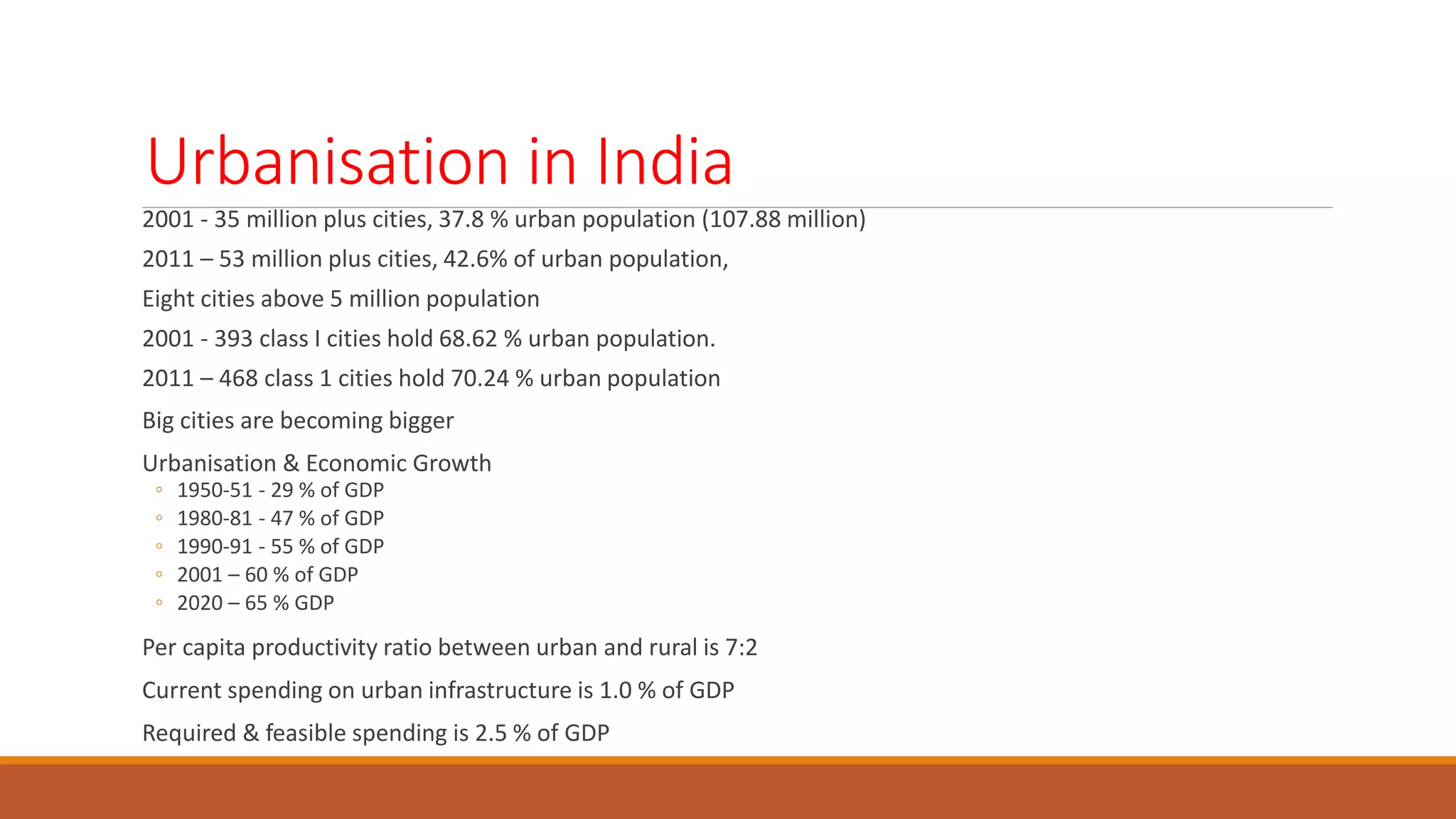
2001 - 35 million plus cities, 37.8 % urban population (107.88 million)
2011 – 53 million plus cities, 42.6% of urban population,
Eight cities above 5 million population
2001 - 393 class I cities hold 68.62 % urban population.
2011 – 468 class 1 cities hold 70.24 % urban population
Big cities are becoming bigger
Urbanisation & Economic Growth
◦ 1950-51 - 29 % of GDP
◦ 1980-81 - 47 % of GDP
◦ 1990-91 - 55 % of GDP
◦ 2001 – 60 % of GDP
◦ 2020 – 65 % GDP
Per capita productivity ratio between urban and rural is 7:2
Current spending on urban infrastructure is 1.0 % of GDP
Required & feasible spending is 2.5 % of GDP
Future Urbanisation in India
In 2021 – urban population will be 550 million almost 50 percent of
total population
It will then contribute 75 % to the GDP
There will 75 million plus cities
2031 – 87 million plus cities
In top ten cities India will have three cities and in top twenty cities
of the world India will have eight cities.
Vision/ expectations / characterises of
Future Cities
Vision for Future Cities under SDG 11 – Sustainable Cities
◦ Inclusive, Safe, Resilient, Sustainable
Other Expectations about Future Cities
◦ Basic services for all / Cities for all
◦ Fair and equal city - Access to Equal opportunities and face no discrimination
◦ Cleaner
◦ Connected
◦ Affordable
◦ Green /Garden City / eco – city
◦ Competitive City
◦ Smart City
Future of Cities? / Future of Urbanisation?
Even the cities of Developed Countries crumbling, decelerating and the future of Cities of
developing and underdeveloped countries at present appear bleak
So much is needed to be done with the existing cities and so many solutions are offered, as
a result policy and decision makers, implementers of most of the cities are feeling confused
and bogged down and do not know where to start
But there is a hope because more than 80 percent of the cities in developing countries that
will exist in 2065 have not yet been built. What has yet to be built could be different and
better than all existing cities.
An urban challenge for the next few decades will be to create dense cities which offer
much more of what people seek in the suburbs: everything at walkable distance and walk is
possible, green parks and safe and car-free spaces for children to ride bicycles.
Future of Cities - There is hope….
World has adopted sustainable development goal of ‘sustainable cities’
In Habitat III conference countries have framed new urban agenda and has
adopted it for implementation
New institution UN Urban which will coordinate global approach to urbanisation
is getting set up
Monitoring Systems like ‘Sustainable Cities Index,’ Resilient Cities Report, Cities
of Opportunity Report, City Liveability Index and many more are getting created
Countries and cities mainly of developed countries and few of developing
countries are adopting newer ways of urban planning, design, renewal, service
delivery, resource and energy conservation
25 cities commit to become Emission Neutral by 2050 – C40 Press Release
Why Study Urbanisation?
THANK YOU

Why to study Urbanisation ?

  • 1.
    Why Study Urbanisation? DR.RAVIKANT JOSHI LECTURE DELIVERED TO SCHOLARS OF INDIAN SCHOOL OF PUBLIC POLICY 10TH SEPTEMBER, 2020
  • 2.
    Unprecedented pace ofurbanisation during 20th Century is a turning point in human history - It has changed human geography beyond recognition 21st Century will be a century of cities and urbanisation – make or break century of human existence
  • 3.
    Unprecedented Urbanisation Widespread allpervading urbanisation is a truly 20th century phenomenon Rome was the first settlement to reach 1mn population 1800 – London become the second city to reach 1 mn World’s total and urban population growth ◦ 1800 – only 2 % of World’s Population was urban ◦ 1900 – 15% (250 mn) of World’s Population (1.5-1.7 bn) was urban ◦ 1950 – 30% (715mn) of World’s Population (2.5bn) was urban ◦ 2000 – 46% (2.8bn) of World’s Population (6.1bn) was urban ◦ 2010 – 50% (3.4 bn) of World’s Population (6.8 bn) become urban Unprecedented pace of urbanisation during 20th Century. Turning point in human history – during 1950-2000 urban population increased by 2.1 bn – same number will increase during 2000-2030
  • 4.
    Post 1900 –unprecedented urbanisation The historical pattern of urbanisation suggests that countries tend to urbanise very slowly until they attain urbanisation level of around 25 to 30 per cent. The pace of urban growth between urbanisation levels of 25 to 30 percent and 55 to 60 per cent is a very short historical time frame of 25 to 50 years. European Countries – late 19th Century North America – Early part of 20th Century Latin America – Late part of 20th Century Asia – Early part of 21st Century Africa – Middle part of 21st Century
  • 5.
    Regional Dynamics ofUrbanisation 1950-2000 The fulcrum of urban population shifting away from Europe and NA to developing countries. 1950-2000 1.5% growth rate of urban population in North America and Europe Share of Europe and North America in urban population declined from 53% to 27.5% and will go down to 17% by 2030 Latin America now has become predominantly urban and will surpass Europe in urbanisation level by 2030. Six out of 10 countries with the largest urban populations are in Asia At present half of urban population lives in Asia and in 2030 it will have majority of urban population of the world In 2030 2.7bn urban population will be in Asia and all other regions will have urban population of about 2.3bn
  • 6.
    Growth of MegaCities In 1950 only one city (New York) with a population over 10mn people In 2000 there were 17 cities (10 in Asia) In 2015 12 out of expected 21 cities with 10mn or more population will be in Asia and 17 cities by 2020.
  • 7.
    Urbanisation Trends (PERCENTURBAN) Region 1950 1970 1990 2000 2020 World 29 37 43 48 58 Developed Countries 55 68 74 76 83 Developing Countries 17 25 35 41 54 Asia 17 23 32 38 51 India 17 20 26 29 41 China 11 17 26 35 51
  • 8.
    2008 - Worldbecomes Urban – No more rural
  • 9.
    Why Study Urbanisation?– future challenges 2.2bn people will get added to world’s population by 2030 World’s population is growing by 77mn p.a. (1.2 % per annum). World’s urban population is growing (60mn p.a.) three times of rural population (17mn p.a.) By 2030 world’s total population will be 8.35bn while urban population will be 5 bn that is 60%.of total population Out of this 4bn (80%) will be staying in today’s developing countries. World’s population will stabilise by 2050 around 9 to 9.5 bn – out of that Urban population will be 6 to 6.3 bn (66 %) World needs urban policy makers/professionals to handle this growth
  • 10.
    Why Study Urbanisation? – for addressing climate change By 2050 world will reach 70 per cent level of urbanisation, more than 6 billion people in Cities Future Urbanisation is going to be a good thing or bad thing ? If we care about the people and future of humanity then this is the defining question. In words of Peter Calthrope - architect, urban designer and urban planner ◦ While addressing climate change we will be building cities for additional 3 billion of the people that is doubling urban environment ◦ Unless we set right our cities climate change solutions will not be able to save mankind because cities constitute 70 % of CO2 emissions ◦ Not only environmental impact but so much more depends on how we shape our cities – our social well being, economic vitality, sense of community and connectedness ◦ Fundamentally the way we shape cities is the manifestation of the kind of humanity we bring to bare ◦ Getting future of the cities right is at most necessary to get future of the World right ◦ Setting Cities right will make Climate Change possible
  • 11.
    Why Study Urbanisation?Close relationship with economic growth Urbanisation refers to the population shift from rural to urban – a process by which towns and cities are formed and become larger as more people begin living and working in urban areas. Urbanisation is not a modern phenomenon – it existed right from the down of civilization, first cities got formed around 8000 BC. It is a process linked to modernisation, industrialization, globalization. Urbanisation relevant to many disciplines – urban planning, geography, sociology, architecture, economics, public health and now climate change Urban growth refers to absolute number of people living in urban areas and increase in it Urbanisation gets promoted by ◦ Economies of scale in production – manufacturing – require larger settlements of people ◦ The existence of information externalities leading to agglomeration economies. ◦ Technology development – building & transportation ◦ Substitution of capital for land ◦ With the growing importance and role of service industry
  • 12.
    Urbanisation & EconomicGrowth Urbanisation and economic growth are inevitably linked, however the impacts from this can be both negative and positive. Urbanisation and economic growth are interdependent and increase in tandem Urbanisation and poverty levels are well known to be correlated. According to the Global Monetary Report, countries that have 40% or less people living in urban areas have significantly lower income levels, and higher poverty rates. Urbanisation reduces poverty because it creates new opportunities.
  • 13.
    Urbanisation & EconomicGrowth The existence of agglomeration economies give rise to continuing accretion of people in a settlement, thus promoting city growth. Urbanisation and Cities are acting as ‘engines of economic growth’, ‘agents of change’, and ‘incubators of innovations’. Between 1960 to 2000 World output went up fourfold while urban population tripled. Urbanisation Negative Impact - Urbanisation has caused unprecedented economic growth, however that growth has caused huge inequalities. India has some of the worst inequality in the world, with one-fourth of India's urban population living in slums
  • 14.
    Increasing urbanisation canpropel India’s economic growth.. We are here Low impact Visible impact High Impact Source : Mario Polese, Pamela Echeverria and Mila Freire, 2002
  • 15.
    Why Cities? –for economic prosperity and now for sustainable world !! All through organized history, if you wanted prosperity you had to have cities. Cities are places that attract new people with new ideas. – Jane Jacobs, author of “Cities and the Wealth of Nations” All through future time, if you want Sustainable Development and Sustainable World, you will have to have Sustainable Cities - Ravikant Joshi Sustainable cities are critical to reducing greenhouse gas emissions and meeting the economic and social needs of people worldwide - Ban Ki Moon – UN General Secretary
  • 16.
    Why Study Cities?– it’s a living organism – a way of life 21st Century is going to be a Century of Cities Future of Cities is going to be Future of all of us, Future of the World and Humanities A City is not mere a concentration of ‘n’ number of people. Cities have been a prime phenomenon of human civilization. 50 % of Global GDP is produced by 600 cities A City gets in one or another manner – a face, an identity A City is a living organism and like a child its personality need to be shaped, nurtured and developed. A city, after all, is only a means to a way of life. More than ever, life happens outside the home, rather than inside it: a good city can make life happier regardless of a society’s level of economic development.
  • 17.
    Why study Cities? – for addressing poverty issue ◦ World population 6.1 billion (2000) of which 1.0 billion are poor of which 750 million live in urban areas ◦ World – Urban population @ 50.0 % of total & slum @ 33% of Urban ◦ 1.3 billion out of 3.9 billion urban population lives in slums ◦ In Developed Countries – 75.5 % & 6 % ◦ In Developing Countries – 40.9 % & 43% ◦ In Least Developing Countries – 26.2 % & 78.2% ◦ Poverty is getting transferred to urban areas – Urbanisation of Poverty
  • 18.
    By all accounts,urbanisation will define the trajectory of Indian development. Economic Survey of India – 2017 “By all accounts, sustainable financing strategies will define the trajectory of achieving Sustainable Cities and Sustainable Development Goals by India”
  • 19.
    Cities that areentrusted with responsibilities, empowered with resources, and encumbered by accountability can become effective vehicles for unleashing dynamism so that to competitive federalism India can add, and rely on, competitive sub-federalism - Economic Survey of India 2017 BUT IN REALITY IN INDIA THERE EXISTS CITIES THAT - • ARE NOT ENTRUSTED WITH RESPONSIBILITIES, • ARE NOT EMPOWERED WITH RESOURCES, • AND ARE NOT ENCUMBERED BY ACCOUNTABILITY • HAVE BECOME INEFFECTIVE/INADEQUATE VEHICLES FOR UNLEASHING DYNAMISM AND INNOVATIONS TO ACHIEVE SUSTAINABLE URBAN DEVELOPMENT.
  • 20.
    Urbanisation in Indiatrails global average 17.3 18.0 19.9 23.3 25.7 27.8 28.8 33.0 36.1 38.9 42.6 46.4 0.0 5.0 10.0 15.0 20.0 25.0 30.0 35.0 40.0 45.0 50.0 1951 1961 1971 1981 1991 2001 India Global Average % of total population
  • 21.
    Urbanisation in India 377.16million urban population; 31.15 % of total population as per 2011 Census 7933 urban settlements, 4041 Statutory towns 53.12 million below poverty line urban people Contributes 60 per cent of the GDP 25 percent do not have access to adequate and door step water 19 percent do not have access to latrines Less than 250 cities have full or partial sewerage system Only 29 percent capacity for waste water treatment (11000 mld against 38000 mld generation Less than 40 percent solid waste get scientifically treated Absolute housing shortage 0.39 million units, relative housing shortage 18.8 million units
  • 22.
    Urbanisation in India 2001- 35 million plus cities, 37.8 % urban population (107.88 million) 2011 – 53 million plus cities, 42.6% of urban population, Eight cities above 5 million population 2001 - 393 class I cities hold 68.62 % urban population. 2011 – 468 class 1 cities hold 70.24 % urban population Big cities are becoming bigger Urbanisation & Economic Growth ◦ 1950-51 - 29 % of GDP ◦ 1980-81 - 47 % of GDP ◦ 1990-91 - 55 % of GDP ◦ 2001 – 60 % of GDP ◦ 2020 – 65 % GDP Per capita productivity ratio between urban and rural is 7:2 Current spending on urban infrastructure is 1.0 % of GDP Required & feasible spending is 2.5 % of GDP
  • 23.
    Future Urbanisation inIndia In 2021 – urban population will be 550 million almost 50 percent of total population It will then contribute 75 % to the GDP There will 75 million plus cities 2031 – 87 million plus cities In top ten cities India will have three cities and in top twenty cities of the world India will have eight cities.
  • 24.
    Vision/ expectations /characterises of Future Cities Vision for Future Cities under SDG 11 – Sustainable Cities ◦ Inclusive, Safe, Resilient, Sustainable Other Expectations about Future Cities ◦ Basic services for all / Cities for all ◦ Fair and equal city - Access to Equal opportunities and face no discrimination ◦ Cleaner ◦ Connected ◦ Affordable ◦ Green /Garden City / eco – city ◦ Competitive City ◦ Smart City
  • 25.
    Future of Cities?/ Future of Urbanisation? Even the cities of Developed Countries crumbling, decelerating and the future of Cities of developing and underdeveloped countries at present appear bleak So much is needed to be done with the existing cities and so many solutions are offered, as a result policy and decision makers, implementers of most of the cities are feeling confused and bogged down and do not know where to start But there is a hope because more than 80 percent of the cities in developing countries that will exist in 2065 have not yet been built. What has yet to be built could be different and better than all existing cities. An urban challenge for the next few decades will be to create dense cities which offer much more of what people seek in the suburbs: everything at walkable distance and walk is possible, green parks and safe and car-free spaces for children to ride bicycles.
  • 26.
    Future of Cities- There is hope…. World has adopted sustainable development goal of ‘sustainable cities’ In Habitat III conference countries have framed new urban agenda and has adopted it for implementation New institution UN Urban which will coordinate global approach to urbanisation is getting set up Monitoring Systems like ‘Sustainable Cities Index,’ Resilient Cities Report, Cities of Opportunity Report, City Liveability Index and many more are getting created Countries and cities mainly of developed countries and few of developing countries are adopting newer ways of urban planning, design, renewal, service delivery, resource and energy conservation 25 cities commit to become Emission Neutral by 2050 – C40 Press Release
  • 27.