Grand Challenges for
Engineering
A retrospective view of the 2008 report by
the US National Academy of Engineering
&
The UK Industrial Strategy
Some brief comments
Alec N Broers
15th Anniversary High Value Manufacturing & 4th New Materials
& Graphene Conference 2017
2-3 November 2017
www.cir-strategy.com/events
Background
•  In 2003 the National Academy of Engineering produced a book
about the 20th century entitled A Century of Innovation: twenty
Engineering Achievements That Transformed our Lives. The
book gained widespread recognition and was used successfully
in schools to inspire young people to study engineering and
science.
Greatest Engineering Achievements of the 20th
Century
1.  Electrification
2.  Automobile
3.  Airplane
4.  Water Supply and Distribution
5.  Electronics
6.  Radio and Television
7.  Agricultural Mechanization
8.  Computers
9.  Telephone
10. Air Conditioning and Refrigeration
11. Highways
12. Spacecraft
13. Internet
14. Imaging
15. Household Appliances
16. Health Technologies
17. Petroleum and Petrochemical
Technologies
18. Laser and Fiber Optics
19. Nuclear Technologies
20. High-performance Materials
Retrospective
The achievements of the 20th century were numerous,
comprehensive and revolutionary. By the end of the century it
was possible to communicate with anyone anywhere in the
world instantly by audio and video. One could travel within a
day to any major population centre anywhere in the world. Life
expectancy for the fortunate in the developed world was
extended more than 50%, the world’s population had grown
from 1.6 billion to 6 billion, and the production of food and the
supply of clean water had saved billions of lives, even if billions
still starved and died of water-born disease. Huge areas of the
earth previously considered uninhabitable were inhabited,
think of the major conurbations in the middle East such as
Dubai, and finally leisure activities had become vastly more
sophisticated.
Retrospective
Never in a single century had human life changed so rapidly,
nor human population grown so fast. This was all was quite
remarkable as the first half of the century was dominated by
two devastating world wars, and the great depression, and
wars continued through much of the second half of the
century. There was also disruptive political upheaval in
eastern Europe and the Soviet Union, and in many other parts
of the world. None the less, technological progress was
relentless across the full spectrum of these 24
accomplishments and in the latter part of the century was
accelerated by ever increasing contributions from the Far
East, especially South Korea, China and India.
Retrospective
•  However, it was only in the final quarter of the century that the
consequences of this headlong progress, most of it enabled by
creative engineers, began widely to be recognized. It
immediately became frighteningly clear that this rate of
advancement was not sustainable. We were depleting the
world’s resources at a rate that would leave future generations
deprived, and were producing changes that could be
irreversible. The full consequences of much of this did not
emerge until after the turn of the century and indeed these
consequences are still emerging.
•  Awareness of the seriousness of the situation had only just
emerged when the goals for the Grand Challenges for
Engineering project were set in 2006
Where and when was the Grand
Challenges project initiated?
In 2006, following the success of A Century of Innovation, the
National Academy of Sciences asked the NAE to call together a
panel of thinkers to identify the world's grand challenges and
opportunities - specifically, those that might be addressed with
the help of engineering in roughly the next century.
The aims of the exercise set in 2006
were:
•  Improve public understanding of how
engineering can address current and emerging
societal challenges.
•  Excite young people about possibly solving
such challenges through an engineering career.
•  Highlight engineering research opportunities
related to the challenges.
The Panel
•  William Perry (NAE) Committee
Chairman, Former Secretary of
Defense, Prof Engineering,
Stanford U
•  Alec Broers (NAE) Chairman
Select Committee for Science &
Tech, UK House of Lords
•  Farouk El-Baz (NAE) Director
Center for Remote Sensing,
Boston U
•  Calestous Juma (NAS) Prof
Practice of International
Development, Harvard U
•  Wesley Harris (NAE) Dept Head
and C Draper Prof Aeronautics &
Astronautics, MIT
•  Bernadine Healy (IOM) Health
Editor and Columnist, US News &
World report
•  Daniel Hillis (NAE) Chairman &
Co-Founder , Applied Minds, Inc.
•  Dean Kamen (NAE) Founder &
President, DEKA Research &
Development Corp.
•  Ray Kurzweil (NAE) Chairman &
CEO Kurzweil Technologies Inc.
•  Robert Langer NAE/NAS/IOM)
Institute Professor, MIT
The Panel (continued)
•  Jaime Lerner, Architect and
Urban Planner, Instituto Jaime
Lerner
•  Bindu Lohani (NAE), Director
General & CCO Asian
Development Bank
•  Jane Lubchenco (NAS), Prof
Marine Biology & Distinguished
Prof Biology, Oregon State U
•  Mario Molina (NAS/IOM), Prof
Chemistry & Biochem, U of
California
•  Larry Page (NAE), Co-Founder &
President of Products, Google Inc
•  Robert Socolow, Prof of
Mechanical & Aerospace Eng. ,
Princeton U Environmental Inst.
•  Craig Venter (NAS), President The
Craig Venter Institute
•  Jackie Ying, Executive Director,
Institute of Bioengineering and
Nanotechnology, Singapore
The Panel’s first meeting
The panel’s first meeting was in Washington on June 15th 2007,
where it was decided that the most effective way to meet the
goals of the project was to identify a small number of key
challenges that would, if met, profoundly improve life, work,
and learning as we experience them today. The original idea of
developing an all-inclusive list was abandoned as it became
clear that the list could easily exceed 100 challenges. We tried
to reduce the number to 10 but this proved too difficult. In the
end, after hours of debate in the first and in subsequent
meetings we settled on 14. Here they are:
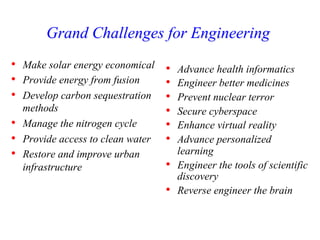
Grand Challenges for Engineering
•  Make solar energy economical
•  Provide energy from fusion
•  Develop carbon sequestration
methods
•  Manage the nitrogen cycle
•  Provide access to clean water
•  Restore and improve urban
infrastructure
•  Advance health informatics
•  Engineer better medicines
•  Prevent nuclear terror
•  Secure cyberspace
•  Enhance virtual reality
•  Advance personalized
learning
•  Engineer the tools of scientific
discovery
•  Reverse engineer the brain
Observations and Conclusions of the
2008 report
•  In the stovepipes of the past, scientists
discovered; engineers created; and doctors
healed.
•  In the 21st century, science, engineering, and
medicine are totally interdependent and the
boundaries between the disciplines become
blurred, even disappear.
•  This interdependence is reflected in the
challenges.
Observations and Conclusions of the
2008 report
•  These were not necessarily the top 14 challenges. They were
chosen because of their diversity and because they will all
improve the quality of life throughout the world.
•  They have stood up extremely well to the test of time, at least the
first decade, and they map closely onto the United Nations
Sustainable development Goals
•  The engagement of the brightest of the world’s young people is
essential to meet these challenges hence the GC Scholars
Program and the Grand Challenges gatherings organized by the
US National Academy of Engineering, The Royal Academy of
Engineering and the Chinese Academy of Engineering
Michael Heseltine Industrial Strategy 2017
Michael Heseltine
Industrial Strategy 2017

Grand challenges for engineering

  • 1.
    Grand Challenges for Engineering Aretrospective view of the 2008 report by the US National Academy of Engineering & The UK Industrial Strategy Some brief comments Alec N Broers 15th Anniversary High Value Manufacturing & 4th New Materials & Graphene Conference 2017 2-3 November 2017 www.cir-strategy.com/events
  • 2.
    Background •  In 2003the National Academy of Engineering produced a book about the 20th century entitled A Century of Innovation: twenty Engineering Achievements That Transformed our Lives. The book gained widespread recognition and was used successfully in schools to inspire young people to study engineering and science.
  • 4.
    Greatest Engineering Achievementsof the 20th Century 1.  Electrification 2.  Automobile 3.  Airplane 4.  Water Supply and Distribution 5.  Electronics 6.  Radio and Television 7.  Agricultural Mechanization 8.  Computers 9.  Telephone 10. Air Conditioning and Refrigeration 11. Highways 12. Spacecraft 13. Internet 14. Imaging 15. Household Appliances 16. Health Technologies 17. Petroleum and Petrochemical Technologies 18. Laser and Fiber Optics 19. Nuclear Technologies 20. High-performance Materials
  • 5.
    Retrospective The achievements ofthe 20th century were numerous, comprehensive and revolutionary. By the end of the century it was possible to communicate with anyone anywhere in the world instantly by audio and video. One could travel within a day to any major population centre anywhere in the world. Life expectancy for the fortunate in the developed world was extended more than 50%, the world’s population had grown from 1.6 billion to 6 billion, and the production of food and the supply of clean water had saved billions of lives, even if billions still starved and died of water-born disease. Huge areas of the earth previously considered uninhabitable were inhabited, think of the major conurbations in the middle East such as Dubai, and finally leisure activities had become vastly more sophisticated.
  • 6.
    Retrospective Never in asingle century had human life changed so rapidly, nor human population grown so fast. This was all was quite remarkable as the first half of the century was dominated by two devastating world wars, and the great depression, and wars continued through much of the second half of the century. There was also disruptive political upheaval in eastern Europe and the Soviet Union, and in many other parts of the world. None the less, technological progress was relentless across the full spectrum of these 24 accomplishments and in the latter part of the century was accelerated by ever increasing contributions from the Far East, especially South Korea, China and India.
  • 7.
    Retrospective •  However, itwas only in the final quarter of the century that the consequences of this headlong progress, most of it enabled by creative engineers, began widely to be recognized. It immediately became frighteningly clear that this rate of advancement was not sustainable. We were depleting the world’s resources at a rate that would leave future generations deprived, and were producing changes that could be irreversible. The full consequences of much of this did not emerge until after the turn of the century and indeed these consequences are still emerging. •  Awareness of the seriousness of the situation had only just emerged when the goals for the Grand Challenges for Engineering project were set in 2006
  • 8.
    Where and whenwas the Grand Challenges project initiated? In 2006, following the success of A Century of Innovation, the National Academy of Sciences asked the NAE to call together a panel of thinkers to identify the world's grand challenges and opportunities - specifically, those that might be addressed with the help of engineering in roughly the next century.
  • 9.
    The aims ofthe exercise set in 2006 were: •  Improve public understanding of how engineering can address current and emerging societal challenges. •  Excite young people about possibly solving such challenges through an engineering career. •  Highlight engineering research opportunities related to the challenges.
  • 10.
    The Panel •  WilliamPerry (NAE) Committee Chairman, Former Secretary of Defense, Prof Engineering, Stanford U •  Alec Broers (NAE) Chairman Select Committee for Science & Tech, UK House of Lords •  Farouk El-Baz (NAE) Director Center for Remote Sensing, Boston U •  Calestous Juma (NAS) Prof Practice of International Development, Harvard U •  Wesley Harris (NAE) Dept Head and C Draper Prof Aeronautics & Astronautics, MIT •  Bernadine Healy (IOM) Health Editor and Columnist, US News & World report •  Daniel Hillis (NAE) Chairman & Co-Founder , Applied Minds, Inc. •  Dean Kamen (NAE) Founder & President, DEKA Research & Development Corp. •  Ray Kurzweil (NAE) Chairman & CEO Kurzweil Technologies Inc. •  Robert Langer NAE/NAS/IOM) Institute Professor, MIT
  • 11.
    The Panel (continued) • Jaime Lerner, Architect and Urban Planner, Instituto Jaime Lerner •  Bindu Lohani (NAE), Director General & CCO Asian Development Bank •  Jane Lubchenco (NAS), Prof Marine Biology & Distinguished Prof Biology, Oregon State U •  Mario Molina (NAS/IOM), Prof Chemistry & Biochem, U of California •  Larry Page (NAE), Co-Founder & President of Products, Google Inc •  Robert Socolow, Prof of Mechanical & Aerospace Eng. , Princeton U Environmental Inst. •  Craig Venter (NAS), President The Craig Venter Institute •  Jackie Ying, Executive Director, Institute of Bioengineering and Nanotechnology, Singapore
  • 12.
    The Panel’s firstmeeting The panel’s first meeting was in Washington on June 15th 2007, where it was decided that the most effective way to meet the goals of the project was to identify a small number of key challenges that would, if met, profoundly improve life, work, and learning as we experience them today. The original idea of developing an all-inclusive list was abandoned as it became clear that the list could easily exceed 100 challenges. We tried to reduce the number to 10 but this proved too difficult. In the end, after hours of debate in the first and in subsequent meetings we settled on 14. Here they are:
  • 13.
    Grand Challenges forEngineering •  Make solar energy economical •  Provide energy from fusion •  Develop carbon sequestration methods •  Manage the nitrogen cycle •  Provide access to clean water •  Restore and improve urban infrastructure •  Advance health informatics •  Engineer better medicines •  Prevent nuclear terror •  Secure cyberspace •  Enhance virtual reality •  Advance personalized learning •  Engineer the tools of scientific discovery •  Reverse engineer the brain
  • 14.
    Observations and Conclusionsof the 2008 report •  In the stovepipes of the past, scientists discovered; engineers created; and doctors healed. •  In the 21st century, science, engineering, and medicine are totally interdependent and the boundaries between the disciplines become blurred, even disappear. •  This interdependence is reflected in the challenges.
  • 15.
    Observations and Conclusionsof the 2008 report •  These were not necessarily the top 14 challenges. They were chosen because of their diversity and because they will all improve the quality of life throughout the world. •  They have stood up extremely well to the test of time, at least the first decade, and they map closely onto the United Nations Sustainable development Goals •  The engagement of the brightest of the world’s young people is essential to meet these challenges hence the GC Scholars Program and the Grand Challenges gatherings organized by the US National Academy of Engineering, The Royal Academy of Engineering and the Chinese Academy of Engineering
  • 16.
  • 17.