
Finding Certainty
in Uncertain Times
1-2 December 2009
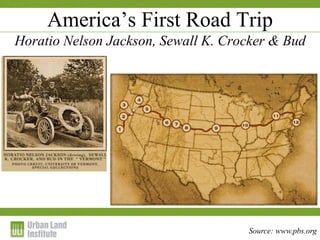
America’s First Road Trip
Horatio Nelson Jackson, Sewall K. Crocker & Bud
Source: www.pbs.org
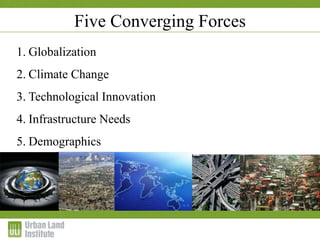
Five Converging Forces
1. Globalization
2. Climate Change
3. Technological Innovation
4. Infrastructure Needs
5. Demographics
1-2 December 2009
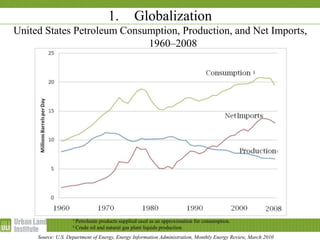
Source: U.S. Department of Energy, Energy Information Administration, Monthly Energy Review, March 2010
1. Globalization
United States Petroleum Consumption, Production, and Net Imports,
1960–2008
¹ Petroleum products supplied used as an approximation for consumption.
² Crude oil and natural gas plant liquids production.
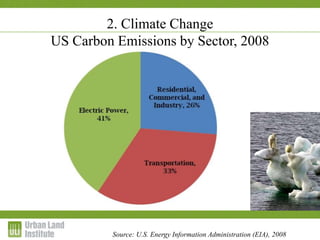
Source: U.S. Energy Information Administration (EIA), 2008
2. Climate Change
US Carbon Emissions by Sector, 2008
1-2 December 2009
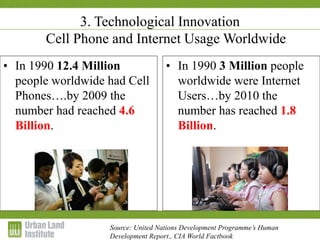
3. Technological Innovation
Cell Phone and Internet Usage Worldwide
Source: United Nations Development Programme’s Human
Development Report., CIA World Factbook
• In 1990 12.4 Million
people worldwide had Cell
Phones….by 2009 the
number had reached 4.6
Billion.
• In 1990 3 Million people
worldwide were Internet
Users…by 2010 the
number has reached 1.8
Billion.
1-2 December 2009
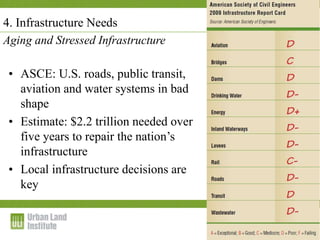
4. Infrastructure Needs
Aging and Stressed Infrastructure
• ASCE: U.S. roads, public transit,
aviation and water systems in bad
shape
• Estimate: $2.2 trillion needed over
five years to repair the nation’s
infrastructure
• Local infrastructure decisions are
key
1-2 December 2009
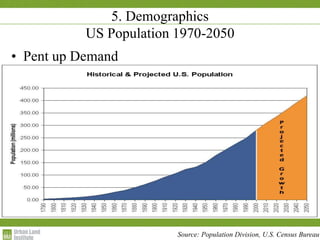
Source: Population Division, U.S. Census Bureau
5. Demographics
US Population 1970-2050
• Pent up Demand
But Demand Suppressed Today
• Need 1.5+ million homes a year
• Today’s household formation 25% of normal
– 2006/7: 1.6 million
– 2008/9: <0.4 million
– A 75% drop in two years
• Today’s low housing starts sufficient to meet new household
formation
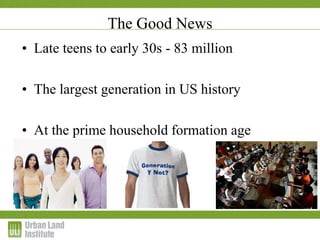
• Late teens to early 30s - 83 million
• The largest generation in US history
• At the prime household formation age
The Good News
Their Challenges
• Incomes down last decade
– Men: Down 23%,
– Women: Down 3%
• Over 30% are unemployed
• Carrying large school debts
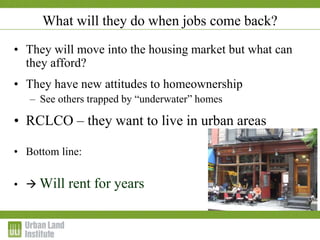
• They will move into the housing market but what can
they afford?
• They have new attitudes to homeownership
– See others trapped by “underwater” homes
• RCLCO – they want to live in urban areas
• Bottom line:
•  Will rent for years
What will they do when jobs come back?
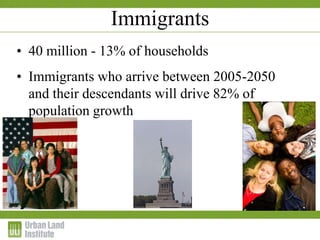
Immigrants
• 40 million - 13% of households
• Immigrants who arrive between 2005-2050
and their descendants will drive 82% of
population growth
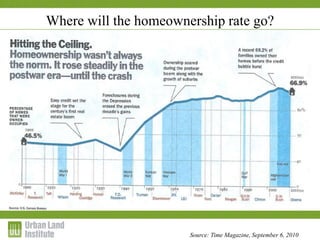
Where will the homeownership rate go?
Source: Time Magazine, September 6, 2010
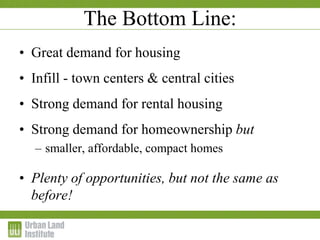
• Great demand for housing
• Infill - town centers & central cities
• Strong demand for rental housing
• Strong demand for homeownership but
– smaller, affordable, compact homes
• Plenty of opportunities, but not the same as
before!
The Bottom Line:
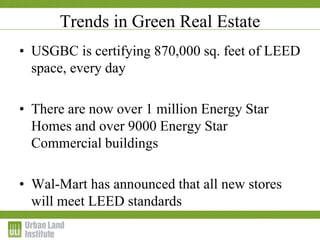
Trends in Green Real Estate
• USGBC is certifying 870,000 sq. feet of LEED
space, every day
• There are now over 1 million Energy Star
Homes and over 9000 Energy Star
Commercial buildings
• Wal-Mart has announced that all new stores
will meet LEED standards
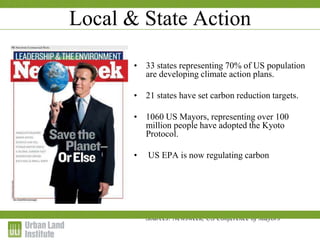
Local & State Action
• 33 states representing 70% of US population
are developing climate action plans.
• 21 states have set carbon reduction targets.
• 1060 US Mayors, representing over 100
million people have adopted the Kyoto
Protocol.
• US EPA is now regulating carbon
Sources: Newsweek, US Conference of Mayors
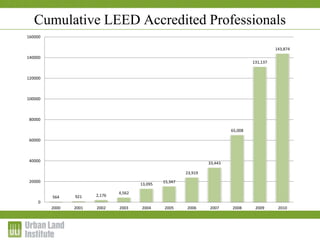
564 921 2,176
4,562
13,095
15,347
23,919
33,443
65,008
131,137
143,874
0
20000
40000
60000
80000
100000
120000
140000
160000
2000 2001 2002 2003 2004 2005 2006 2007 2008 2009 2010
Cumulative LEED Accredited Professionals
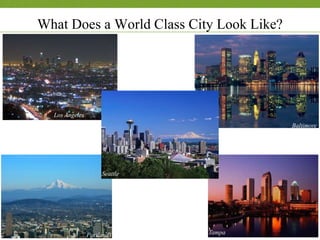
What Does a World Class City Look Like?
Los Angeles
Seattle
Portland Tampa
Baltimore
1-2 December 2009
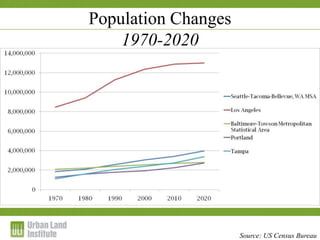
Source: US Census Bureau
Population Changes
1970-2020
1-2 December 2009
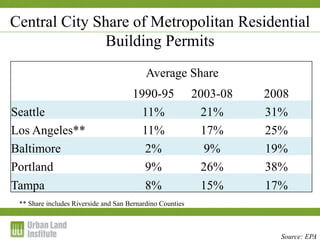
Central City Share of Metropolitan Residential
Building Permits
Source: EPA
** Share includes Riverside and San Bernardino Counties
Average Share
1990-95 2003-08 2008
Seattle 11% 21% 31%
Los Angeles** 11% 17% 25%
Baltimore 2% 9% 19%
Portland 9% 26% 38%
Tampa 8% 15% 17%
1-2 December 2009
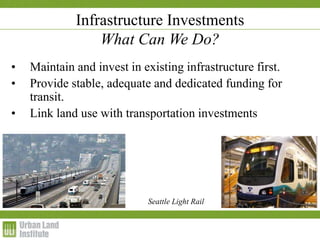
Infrastructure Investments
What Can We Do?
• Maintain and invest in existing infrastructure first.
• Provide stable, adequate and dedicated funding for
transit.
• Link land use with transportation investments
Seattle Light Rail
1-2 December 2009
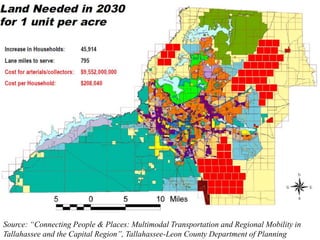
Source: “Connecting People & Places: Multimodal Transportation and Regional Mobility in
Tallahassee and the Capital Region”, Tallahassee-Leon County Department of Planning
1-2 December 2009
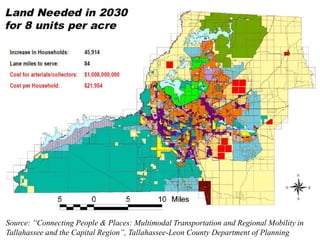
Source: “Connecting People & Places: Multimodal Transportation and Regional Mobility in
Tallahassee and the Capital Region”, Tallahassee-Leon County Department of Planning
1-2 December 2009
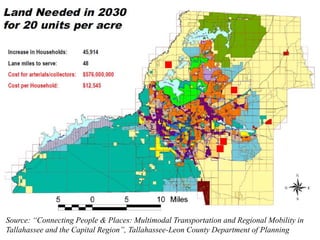
Source: “Connecting People & Places: Multimodal Transportation and Regional Mobility in
Tallahassee and the Capital Region”, Tallahassee-Leon County Department of Planning
1-2 December 2009
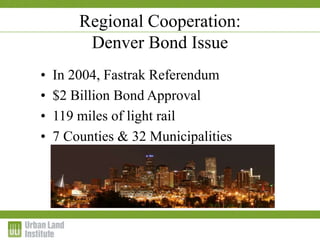
Regional Cooperation:
Denver Bond Issue
• In 2004, Fastrak Referendum
• $2 Billion Bond Approval
• 119 miles of light rail
• 7 Counties & 32 Municipalities
1-2 December 2009
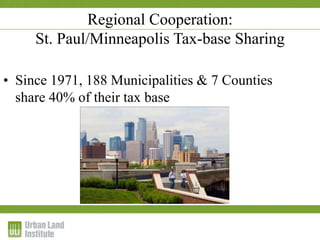
• Since 1971, 188 Municipalities & 7 Counties
share 40% of their tax base
Regional Cooperation:
St. Paul/Minneapolis Tax-base Sharing
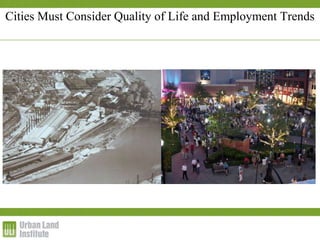
Cities Must Consider Quality of Life and Employment Trends
1-2 December 2009
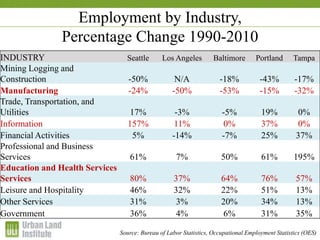
Employment by Industry,
Percentage Change 1990-2010
Source: Bureau of Labor Statistics, Occupational Employment Statistics (OES)
INDUSTRY Seattle Los Angeles Baltimore Portland Tampa
Mining Logging and
Construction -50% N/A -18% -43% -17%
Manufacturing -24% -50% -53% -15% -32%
Trade, Transportation, and
Utilities 17% -3% -5% 19% 0%
Information 157% 11% 0% 37% 0%
Financial Activities 5% -14% -7% 25% 37%
Professional and Business
Services 61% 7% 50% 61% 195%
Education and Health Services
Services 80% 37% 64% 76% 57%
Leisure and Hospitality 46% 32% 22% 51% 13%
Other Services 31% 3% 20% 34% 13%
Government 36% 4% 6% 31% 35%
1-2 December 2009
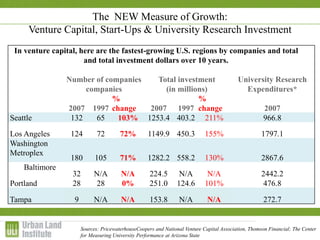
The NEW Measure of Growth:
Venture Capital, Start-Ups & University Research Investment
Sources: PricewaterhouseCoopers and National Venture Capital Association, Thomson Financial; The Center
for Measuring University Performance at Arizona State
In venture capital, here are the fastest-growing U.S. regions by companies and total
and total investment dollars over 10 years.
Number of companies
companies
Total investment
(in millions)
University Research
Expenditures*
2007 1997
%
change 2007 1997
%
change 2007
Seattle 132 65 103% 1253.4 403.2 211% 966.8
Los Angeles 124 72 72% 1149.9 450.3 155% 1797.1
Washington
Metroplex
180 105 71% 1282.2 558.2 130% 2867.6
Baltimore
32 N/A N/A 224.5 N/A N/A 2442.2
Portland 28 28 0% 251.0 124.6 101% 476.8
Tampa 9 N/A N/A 153.8 N/A N/A 272.7
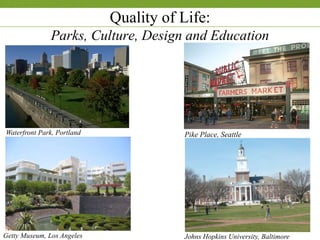
Quality of Life:
Parks, Culture, Design and Education
Getty Museum, Los Angeles
Waterfront Park, Portland
Johns Hopkins University, Baltimore
Pike Place, Seattle
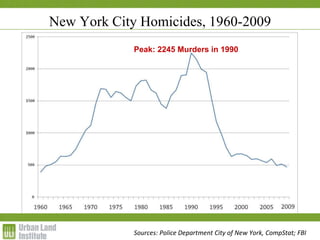
New York City Homicides, 1960-2009
Sources: Police Department City of New York, CompStat; FBI
Peak: 2245 Murders in 1990
1-2 December 2009
Lessons Learned
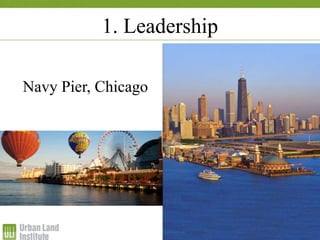
1. Leadership
Navy Pier, Chicago
1-2 December 2009
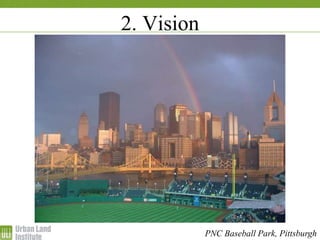
2. Vision
PNC Baseball Park, Pittsburgh
1-2 December 2009
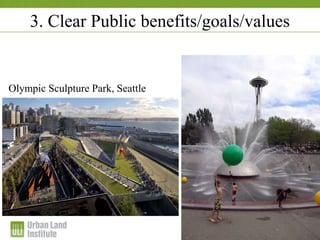
3. Clear Public benefits/goals/values
Olympic Sculpture Park, Seattle
1-2 December 2009
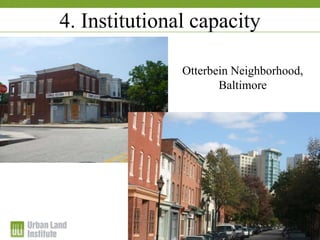
4. Institutional capacity
Otterbein Neighborhood,
Baltimore
1-2 December 2009
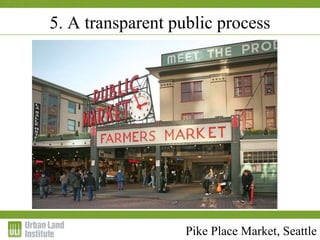
5. A transparent public process
Pike Place Market, Seattle
1-2 December 2009
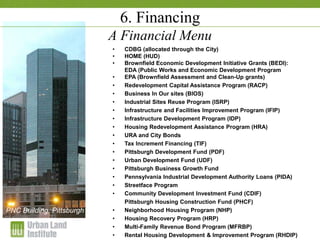
6. Financing
A Financial Menu
• CDBG (allocated through the City)
• HOME (HUD)
• Brownfield Economic Development Initiative Grants (BEDI):
EDA (Public Works and Economic Development Program
• EPA (Brownfield Assessment and Clean-Up grants)
• Redevelopment Capital Assistance Program (RACP)
• Business In Our sites (BIOS)
• Industrial Sites Reuse Program (ISRP)
• Infrastructure and Facilities Improvement Program (IFIP)
• Infrastructure Development Program (IDP)
• Housing Redevelopment Assistance Program (HRA)
• URA and City Bonds
• Tax Increment Financing (TIF)
• Pittsburgh Development Fund (PDF)
• Urban Development Fund (UDF)
• Pittsburgh Business Growth Fund
• Pennsylvania Industrial Development Authority Loans (PIDA)
• Streetface Program
• Community Development Investment Fund (CDIF)
Pittsburgh Housing Construction Fund (PHCF)
• Neighborhood Housing Program (NHP)
• Housing Recovery Program (HRP)
• Multi-Family Revenue Bond Program (MFRBP)
• Rental Housing Development & Improvement Program (RHDIP)
PNC Building, Pittsburgh
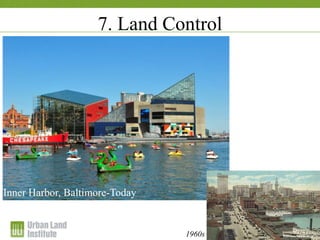
7. Land Control
1960s
Inner Harbor, Baltimore-Today
1-2 December 2009
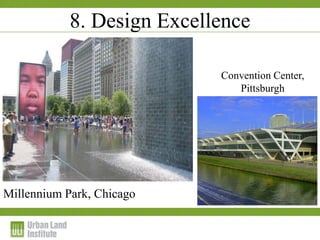
8. Design Excellence
Convention Center,
Pittsburgh
Millennium Park, Chicago
1-2 December 2009
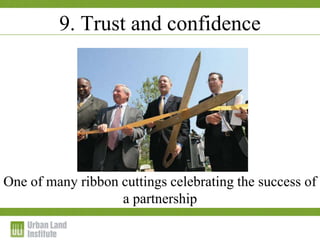
9. Trust and confidence
One of many ribbon cuttings celebrating the success of
a partnership
1-2 December 2009
“There is nothing more difficult to carry out, nor more doubtful of
success, nor more dangerous to handle, than to initiate a new order of
things. For the reformer has enemies in all those who profit by the
old order, this luke-warmness arising partly from the fear of their
adversaries who have the laws in their favor, and partly from the
incredulity of mankind, who do not truly believe in anything new
until they have had actual experience of it.”
- Niccolo Machiavelli (1469-1527)
Leadership

Sustainable Coastal Development: Finding Certainty in Uncertain Times

  • 1.
  • 2.
    1-2 December 2009 America’sFirst Road Trip Horatio Nelson Jackson, Sewall K. Crocker & Bud Source: www.pbs.org
  • 3.
    Five Converging Forces 1.Globalization 2. Climate Change 3. Technological Innovation 4. Infrastructure Needs 5. Demographics
  • 4.
    1-2 December 2009 Source:U.S. Department of Energy, Energy Information Administration, Monthly Energy Review, March 2010 1. Globalization United States Petroleum Consumption, Production, and Net Imports, 1960–2008 ¹ Petroleum products supplied used as an approximation for consumption. ² Crude oil and natural gas plant liquids production.
  • 5.
    Source: U.S. EnergyInformation Administration (EIA), 2008 2. Climate Change US Carbon Emissions by Sector, 2008
  • 6.
    1-2 December 2009 3.Technological Innovation Cell Phone and Internet Usage Worldwide Source: United Nations Development Programme’s Human Development Report., CIA World Factbook • In 1990 12.4 Million people worldwide had Cell Phones….by 2009 the number had reached 4.6 Billion. • In 1990 3 Million people worldwide were Internet Users…by 2010 the number has reached 1.8 Billion.
  • 7.
    1-2 December 2009 4.Infrastructure Needs Aging and Stressed Infrastructure • ASCE: U.S. roads, public transit, aviation and water systems in bad shape • Estimate: $2.2 trillion needed over five years to repair the nation’s infrastructure • Local infrastructure decisions are key
  • 8.
    1-2 December 2009 Source:Population Division, U.S. Census Bureau 5. Demographics US Population 1970-2050 • Pent up Demand
  • 9.
    But Demand SuppressedToday • Need 1.5+ million homes a year • Today’s household formation 25% of normal – 2006/7: 1.6 million – 2008/9: <0.4 million – A 75% drop in two years • Today’s low housing starts sufficient to meet new household formation
  • 10.
    • Late teensto early 30s - 83 million • The largest generation in US history • At the prime household formation age The Good News
  • 11.
    Their Challenges • Incomesdown last decade – Men: Down 23%, – Women: Down 3% • Over 30% are unemployed • Carrying large school debts
  • 12.
    • They willmove into the housing market but what can they afford? • They have new attitudes to homeownership – See others trapped by “underwater” homes • RCLCO – they want to live in urban areas • Bottom line: •  Will rent for years What will they do when jobs come back?
  • 13.
    Immigrants • 40 million- 13% of households • Immigrants who arrive between 2005-2050 and their descendants will drive 82% of population growth
  • 14.
    Where will thehomeownership rate go? Source: Time Magazine, September 6, 2010
  • 15.
    • Great demandfor housing • Infill - town centers & central cities • Strong demand for rental housing • Strong demand for homeownership but – smaller, affordable, compact homes • Plenty of opportunities, but not the same as before! The Bottom Line:
  • 16.
    Trends in GreenReal Estate • USGBC is certifying 870,000 sq. feet of LEED space, every day • There are now over 1 million Energy Star Homes and over 9000 Energy Star Commercial buildings • Wal-Mart has announced that all new stores will meet LEED standards
  • 17.
    Local & StateAction • 33 states representing 70% of US population are developing climate action plans. • 21 states have set carbon reduction targets. • 1060 US Mayors, representing over 100 million people have adopted the Kyoto Protocol. • US EPA is now regulating carbon Sources: Newsweek, US Conference of Mayors
  • 18.
    564 921 2,176 4,562 13,095 15,347 23,919 33,443 65,008 131,137 143,874 0 20000 40000 60000 80000 100000 120000 140000 160000 20002001 2002 2003 2004 2005 2006 2007 2008 2009 2010 Cumulative LEED Accredited Professionals
  • 19.
    What Does aWorld Class City Look Like? Los Angeles Seattle Portland Tampa Baltimore
  • 20.
    1-2 December 2009 Source:US Census Bureau Population Changes 1970-2020
  • 21.
    1-2 December 2009 CentralCity Share of Metropolitan Residential Building Permits Source: EPA ** Share includes Riverside and San Bernardino Counties Average Share 1990-95 2003-08 2008 Seattle 11% 21% 31% Los Angeles** 11% 17% 25% Baltimore 2% 9% 19% Portland 9% 26% 38% Tampa 8% 15% 17%
  • 22.
    1-2 December 2009 InfrastructureInvestments What Can We Do? • Maintain and invest in existing infrastructure first. • Provide stable, adequate and dedicated funding for transit. • Link land use with transportation investments Seattle Light Rail
  • 23.
    1-2 December 2009 Source:“Connecting People & Places: Multimodal Transportation and Regional Mobility in Tallahassee and the Capital Region”, Tallahassee-Leon County Department of Planning
  • 24.
    1-2 December 2009 Source:“Connecting People & Places: Multimodal Transportation and Regional Mobility in Tallahassee and the Capital Region”, Tallahassee-Leon County Department of Planning
  • 25.
    1-2 December 2009 Source:“Connecting People & Places: Multimodal Transportation and Regional Mobility in Tallahassee and the Capital Region”, Tallahassee-Leon County Department of Planning
  • 26.
    1-2 December 2009 RegionalCooperation: Denver Bond Issue • In 2004, Fastrak Referendum • $2 Billion Bond Approval • 119 miles of light rail • 7 Counties & 32 Municipalities
  • 27.
    1-2 December 2009 •Since 1971, 188 Municipalities & 7 Counties share 40% of their tax base Regional Cooperation: St. Paul/Minneapolis Tax-base Sharing
  • 28.
    Cities Must ConsiderQuality of Life and Employment Trends
  • 29.
    1-2 December 2009 Employmentby Industry, Percentage Change 1990-2010 Source: Bureau of Labor Statistics, Occupational Employment Statistics (OES) INDUSTRY Seattle Los Angeles Baltimore Portland Tampa Mining Logging and Construction -50% N/A -18% -43% -17% Manufacturing -24% -50% -53% -15% -32% Trade, Transportation, and Utilities 17% -3% -5% 19% 0% Information 157% 11% 0% 37% 0% Financial Activities 5% -14% -7% 25% 37% Professional and Business Services 61% 7% 50% 61% 195% Education and Health Services Services 80% 37% 64% 76% 57% Leisure and Hospitality 46% 32% 22% 51% 13% Other Services 31% 3% 20% 34% 13% Government 36% 4% 6% 31% 35%
  • 30.
    1-2 December 2009 TheNEW Measure of Growth: Venture Capital, Start-Ups & University Research Investment Sources: PricewaterhouseCoopers and National Venture Capital Association, Thomson Financial; The Center for Measuring University Performance at Arizona State In venture capital, here are the fastest-growing U.S. regions by companies and total and total investment dollars over 10 years. Number of companies companies Total investment (in millions) University Research Expenditures* 2007 1997 % change 2007 1997 % change 2007 Seattle 132 65 103% 1253.4 403.2 211% 966.8 Los Angeles 124 72 72% 1149.9 450.3 155% 1797.1 Washington Metroplex 180 105 71% 1282.2 558.2 130% 2867.6 Baltimore 32 N/A N/A 224.5 N/A N/A 2442.2 Portland 28 28 0% 251.0 124.6 101% 476.8 Tampa 9 N/A N/A 153.8 N/A N/A 272.7
  • 31.
    Quality of Life: Parks,Culture, Design and Education Getty Museum, Los Angeles Waterfront Park, Portland Johns Hopkins University, Baltimore Pike Place, Seattle
  • 32.
    New York CityHomicides, 1960-2009 Sources: Police Department City of New York, CompStat; FBI Peak: 2245 Murders in 1990
  • 33.
  • 34.
  • 35.
    1-2 December 2009 2.Vision PNC Baseball Park, Pittsburgh
  • 36.
    1-2 December 2009 3.Clear Public benefits/goals/values Olympic Sculpture Park, Seattle
  • 37.
    1-2 December 2009 4.Institutional capacity Otterbein Neighborhood, Baltimore
  • 38.
    1-2 December 2009 5.A transparent public process Pike Place Market, Seattle
  • 39.
    1-2 December 2009 6.Financing A Financial Menu • CDBG (allocated through the City) • HOME (HUD) • Brownfield Economic Development Initiative Grants (BEDI): EDA (Public Works and Economic Development Program • EPA (Brownfield Assessment and Clean-Up grants) • Redevelopment Capital Assistance Program (RACP) • Business In Our sites (BIOS) • Industrial Sites Reuse Program (ISRP) • Infrastructure and Facilities Improvement Program (IFIP) • Infrastructure Development Program (IDP) • Housing Redevelopment Assistance Program (HRA) • URA and City Bonds • Tax Increment Financing (TIF) • Pittsburgh Development Fund (PDF) • Urban Development Fund (UDF) • Pittsburgh Business Growth Fund • Pennsylvania Industrial Development Authority Loans (PIDA) • Streetface Program • Community Development Investment Fund (CDIF) Pittsburgh Housing Construction Fund (PHCF) • Neighborhood Housing Program (NHP) • Housing Recovery Program (HRP) • Multi-Family Revenue Bond Program (MFRBP) • Rental Housing Development & Improvement Program (RHDIP) PNC Building, Pittsburgh
  • 40.
    7. Land Control 1960s InnerHarbor, Baltimore-Today
  • 41.
    1-2 December 2009 8.Design Excellence Convention Center, Pittsburgh Millennium Park, Chicago
  • 42.
    1-2 December 2009 9.Trust and confidence One of many ribbon cuttings celebrating the success of a partnership
  • 43.
    1-2 December 2009 “Thereis nothing more difficult to carry out, nor more doubtful of success, nor more dangerous to handle, than to initiate a new order of things. For the reformer has enemies in all those who profit by the old order, this luke-warmness arising partly from the fear of their adversaries who have the laws in their favor, and partly from the incredulity of mankind, who do not truly believe in anything new until they have had actual experience of it.” - Niccolo Machiavelli (1469-1527) Leadership

Editor's Notes

  • #19 Source: Green Building Certification Institute, as of July 1, 2010