Introduction
An inorganic product of fusion which has been
cooled to rigid condition without crystallizing
o A state of matter
o A glassy or vitreous surface
o A solid with liquid like structure
o A non-crystalline solid
o An amorphous solid
o Short range order
o Uniform amorphous solid material.
o Produced when the viscous molten material
cools rapidly to below its glass transition
temperature, without sufficient time for a
regular crystal lattice to form.
Glass’s Characteristics
o Clear /transparent
o Brittle :- Unlike metals doesn't forms sheets
on hammering.
o Inert :- Chemically stable and non-volatile.
o Durable :- Able to withstand wear, pressure,
or damage
o Luster :- Has a specific shine.
Glass From Nature
Magma Fulgurite
Obsidian Tektites
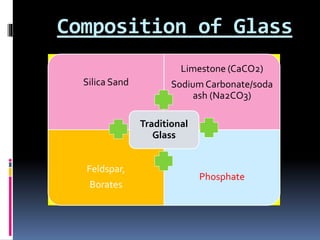
Silica Sand
Silica Sand
Limestone (CaCO2)
Sodium Carbonate/soda
ash (Na2CO3)
Feldspar,
Borates
Phosphate
Traditional
Glass
Composition of Glass
Quick Question
Name four of the major technological
achievements in glass which have had the
most profound impact on mankind.
Quick Question - Answer
1. Glass Window – Which enables
sunlight to come into dwelling unit
2. Lenses – Ophthalmic for improved
vision, microscope, telescope optics.
3. Light bulb envelope – Lighting.
4. Semiconducting Glasses – For computer
memory, solar cell, photocopiers. Also
known as optical fibre.
Glass Products
Solar Panels Shields
Windows
Furnitures
Vehicle’sWindows
Bulbs & Chandeliers
Processing Of Glass
 Glass used in modern windows is Float Glass.
 Flat Glass, another type of window glass is
processed by same procedure as of Float Glass.
 Process is also known as Pilkington Process.
 Made by floating molten glass on a bed of
molten metal.
 Metal is typically tin, but lead and various low
melting point alloys were used in the past.
These are further divided into Translucent and
Transparent Glass.
Transparent Glass
Glass with almost full permeability of light (as some of
the light gets reflected from surface)
Translucent Glass
Transparent Glass is further sandblasted or acid etched to
produced the effect of rendering of glass.This type of
glass is also called Frosted Glass.
Special Glass
Special Glass consists of :-
1. Laminated Glass
2. Bulletproof Glass
3. Insulating Glass
4. Glass Fibres
5. GlassWool (Made by Glass Fibres)
6. Glass Foam (Made by Glass Fibres)
Laminated Glass
Made by two or more sheets of glass with Polyvinyl
Butyl (P.V.B.) Interlayer.
Bullet Proof Glass
 Cut tempered glass sheets into desired
dimensions. Tempered glass has the same
composition as normal glass but has been treated
with heat to make it more impact resistant.
 Laminate the glass sheet with plastic. Serves as a
base for epoxy resin.
 Bond alternate layers of laminated glass sheets
with polycarbonate sheets of same dimensions.
 Make this composite material a total of 0.67
inches minimum to 3 inches maximum.
 4 to 5 inch of this glass is categorised as armoured
glass and is used in combat vehicles
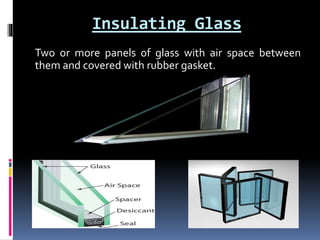
Insulating Glass
Two or more panels of glass with air space between
them and covered with rubber gasket.
Glass Fibres
Fibre Glass
Glass batch is melted in the glass tank furnace. Molten glass is
moulded into ordinary sized, marbles. Marbles are fed into
electrical furnace which has platinum-alloy bushing containing
many tiny holes. Glass flows through these holes and is drawn
down vertically forming individual filament. About 1/3 ounce of
glass produces 100 miles of filament at rate of about 6000 feet per
minute.
Glass Wool
After the mixture of natural sand and recycled glass at 1,450 °C,
the glass that is produced is converted into fibers. It is typically
produced like making cotton candy, forced through a fine mesh
by centripetal force, cooling on contact with the air. The cohesion
and mechanical strength of the product is obtained by the
presence of a binder that “cements” the fibers together.
For Aesthetic Purposes
Fibre Glass GlassWool
Glass Bricks/Blocks
 Bulletproof, waterproof, verminproof, fungusproof.
 Produced for both wall and floor applications.
 Used in floors are normally manufactured as a single
solid piece, or as a hollow glass block with thicker
side walls than the standard wall blocks.
 Normally cast into a reinforced concrete gridwork or
set into a metal frame, allowing multiple units to be
combined to span over openings in basements and
roofs.
 Glass wall blocks should not be used in flooring
applications.
 Hollow glass wall blocks are manufactured as two
separate halves and, whilst the glass is still molten,
the two pieces are pressed together and annealed.
Glass

Glass

  • 2.
    Introduction An inorganic productof fusion which has been cooled to rigid condition without crystallizing o A state of matter o A glassy or vitreous surface o A solid with liquid like structure o A non-crystalline solid o An amorphous solid o Short range order o Uniform amorphous solid material. o Produced when the viscous molten material cools rapidly to below its glass transition temperature, without sufficient time for a regular crystal lattice to form.
  • 3.
    Glass’s Characteristics o Clear/transparent o Brittle :- Unlike metals doesn't forms sheets on hammering. o Inert :- Chemically stable and non-volatile. o Durable :- Able to withstand wear, pressure, or damage o Luster :- Has a specific shine.
  • 4.
    Glass From Nature MagmaFulgurite Obsidian Tektites
  • 5.
    Silica Sand Silica Sand Limestone(CaCO2) Sodium Carbonate/soda ash (Na2CO3) Feldspar, Borates Phosphate Traditional Glass Composition of Glass
  • 6.
    Quick Question Name fourof the major technological achievements in glass which have had the most profound impact on mankind.
  • 7.
    Quick Question -Answer 1. Glass Window – Which enables sunlight to come into dwelling unit 2. Lenses – Ophthalmic for improved vision, microscope, telescope optics. 3. Light bulb envelope – Lighting. 4. Semiconducting Glasses – For computer memory, solar cell, photocopiers. Also known as optical fibre.
  • 8.
    Glass Products Solar PanelsShields Windows Furnitures Vehicle’sWindows Bulbs & Chandeliers
  • 9.
    Processing Of Glass Glass used in modern windows is Float Glass.  Flat Glass, another type of window glass is processed by same procedure as of Float Glass.  Process is also known as Pilkington Process.  Made by floating molten glass on a bed of molten metal.  Metal is typically tin, but lead and various low melting point alloys were used in the past. These are further divided into Translucent and Transparent Glass.
  • 10.
    Transparent Glass Glass withalmost full permeability of light (as some of the light gets reflected from surface)
  • 11.
    Translucent Glass Transparent Glassis further sandblasted or acid etched to produced the effect of rendering of glass.This type of glass is also called Frosted Glass.
  • 12.
    Special Glass Special Glassconsists of :- 1. Laminated Glass 2. Bulletproof Glass 3. Insulating Glass 4. Glass Fibres 5. GlassWool (Made by Glass Fibres) 6. Glass Foam (Made by Glass Fibres)
  • 13.
    Laminated Glass Made bytwo or more sheets of glass with Polyvinyl Butyl (P.V.B.) Interlayer.
  • 14.
    Bullet Proof Glass Cut tempered glass sheets into desired dimensions. Tempered glass has the same composition as normal glass but has been treated with heat to make it more impact resistant.  Laminate the glass sheet with plastic. Serves as a base for epoxy resin.  Bond alternate layers of laminated glass sheets with polycarbonate sheets of same dimensions.  Make this composite material a total of 0.67 inches minimum to 3 inches maximum.  4 to 5 inch of this glass is categorised as armoured glass and is used in combat vehicles
  • 16.
    Insulating Glass Two ormore panels of glass with air space between them and covered with rubber gasket.
  • 17.
    Glass Fibres Fibre Glass Glassbatch is melted in the glass tank furnace. Molten glass is moulded into ordinary sized, marbles. Marbles are fed into electrical furnace which has platinum-alloy bushing containing many tiny holes. Glass flows through these holes and is drawn down vertically forming individual filament. About 1/3 ounce of glass produces 100 miles of filament at rate of about 6000 feet per minute. Glass Wool After the mixture of natural sand and recycled glass at 1,450 °C, the glass that is produced is converted into fibers. It is typically produced like making cotton candy, forced through a fine mesh by centripetal force, cooling on contact with the air. The cohesion and mechanical strength of the product is obtained by the presence of a binder that “cements” the fibers together.
  • 18.
  • 19.
    Glass Bricks/Blocks  Bulletproof,waterproof, verminproof, fungusproof.  Produced for both wall and floor applications.  Used in floors are normally manufactured as a single solid piece, or as a hollow glass block with thicker side walls than the standard wall blocks.  Normally cast into a reinforced concrete gridwork or set into a metal frame, allowing multiple units to be combined to span over openings in basements and roofs.  Glass wall blocks should not be used in flooring applications.  Hollow glass wall blocks are manufactured as two separate halves and, whilst the glass is still molten, the two pieces are pressed together and annealed.