Presented by; M usman
khurram iqbal
Ahmad Naeem
Presented to; Dr. Asim
Glass Manufacturing
Contents
What is glass
Raw material
Manufacturing steps
Glass forming
Types and applications
An amorphous, rigid and brittle material,
typically transparent or translucent, made by
fusing sand with soda, lime, and sometimes
other ingredients; and cooling rapidly.
What is glass
Glass manufacturing materials can be divided
into 5 categories
1. Glass former
2. Flux
3. Modifier
4. Coloring agents
5. Fining agents
6. Cullet (broken glass pieces)
Raw Material
Glass former:
one of the most important components present
in any glass
Silica (SiO2),
boric oxide (B2O3) and
phosphoric oxide (P2O5) are the most
common type of glass formers present in
oxide glass
Raw material ……cont
The use of silica glass is wide but melting
temperature of silica is too high(1600-
1725ºC).
To reduce the processing temperature of
silica, different types of flux such as Na2O
and PbO can be used
Raw material
……cont
The addition of fluxes to silica reduces the
overall cost of glass processing but results in
degradation of properties.
Sodium carbonate and calcium carbonate are
common fluxes. Potash glass is more dense than
soda glass.
To overcome this problem, different property
modifiers or intermediates such as boron,
sodium, magnesium, titanium, and calcium can
be used to modify the properties of glass.
Raw material…. cont
Colorants are used to control the color in the
final glass.
The amount of iron oxides (impurities)
present in the glass results in unintentional
change in color of glass.
The other types of colorants used are gold
and silver. These types of colorants change
glass color by forming colloids in glasses
Raw material….
cont
As the raw materials melt and react inside the
furnace, carbon dioxide and water emission takes
place which causes formation of bubbles.
Fining agents such as arsenic, antimony oxides,
potassium and sodium nitrates are added to raw
materials to remove bubbles from the melt
The high temperature and low viscosity is maintained
to raise the gas bubbles at the upper surface of the
melt and hence removed from the melt.
Raw material….cont
• Fining is important because it controls the
homogeneity of glass by eliminating bubbles.
The manufacture of glass is in four phases:
(1) preparation of raw material,
(2) melting in a furnace,
(3) forming and
(4) finishing.
Manufacturing steps
Process flow diagram
Depending upon the applications, there are
different processes of forming the glass.
The most common type of glass forming
process can be categorized as:
1. Flat glass
2. Glass fibers
3. Glass tubing
Glass Forming
Flat glass, sheet glass, or plate glass is made
by two processes.
The processes are
float glass process and
rolled glass process
1) Flat glass
Ribbon of glass is made by pouring molten
glass from the furnace to a bed of molten
metal such as tin, lead and low melting point
alloys under controlled atmosphere.
Float glass process
In the drawing or rolling process, the
continuous stream of molten glass from a
furnace passes through a pair of water cooled
rollers
Rolled glass process
Fiberglass is available in two types
continuous glass fiber and
short glass fiber (glass wool).
The first one is used in fabrication of
composite materials and latter one is used for
thermal insulation.
2. Glass fibers
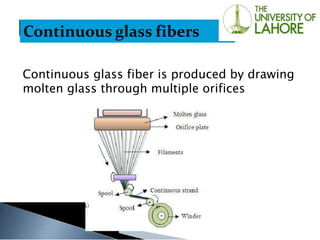
Continuous glass fiber is produced by drawing
molten glass through multiple orifices
Continuous glass fibers
In glass wool process , the molten glass is
ejected from a rotating head by centrifugal
spraying process
Short glass fiber
In this process, molten glass flows around a
rotating hollow cone-shaped or cylindrical
mandrel through which air is supplied
continuously to avoid the collapsing of glass
tube while the glass is drawn out by set of
rollers.
3. Glass tubing
In this process, molten glass flows around a rotating
hollow cone-shaped or cylindrical mandrel through
which air is supplied continuously to avoid the
collapsing of glass tube while the glass is drawn out by
set of rollers
Glass tubing
1. Soda-lime glass
2. Fused silica glass
3. Lead glass
4. Borosilicate glass
Types and applications of glass
Main constituent of practically all commercial
glass is sand.
Sand by itself can be fused to produce glass but
the temperature at which this can be achieved is
about1700°C. Adding other minerals and
chemicals to sand can considerably reduce the
melting temperature.
The addition of sodium carbonate (Na2CO3),
known as soda ash, to produce a mixture of 75%
silica (SiO2) and 25% of sodium oxide (Na2O), will
reduce the temperature of fusion to about 800°C
due to sodium silicate.
Soda-lime process
However, a glass of this composition is water-
soluble and is known as water glass.
To give the glass stability, other chemicals like
calcium oxide (CaO) and magnesium oxide
(MgO) are needed.
These are obtained by adding limestone which
results in a pure inert glass.
Soda-lime glass is a mixture of sodium silicate
and calcium silicate.
Soda – lime glass(water glass)
Simplest type off glass, consists mainly of
silica
Made by heating silica to a molten liquid,the
liquid is then cooled rapidly to form an
amorphous solid
Fused silica glass
Commonly known as Crystal or lead crystal
Made by using lead oxide instead of calcium oxide,
and potassium oxide instead of all or most of the
sodium oxide
Glass containing at least 24% PbO can be described
as lead crystal. Glass containing less than 24% PbO,
is known simply as crystal glass.
Lead Glass
Lead glass has a high refractive index making it
sparkle brightly and a relatively soft surface
Lead glass
Glass in the form of ovenware and other heat
resisting ware, better known under the trade name
Pyrex.
Borosilicate glass (or sodium-borosilicate glass) is
made mainly of silica (70-80%) and boric oxide (7-
13%) with smaller amounts of the alkalis (sodium and
potassium oxides) and aluminium oxide.
As it doesn't break when changing temperature
quickly.
sodium borosilicate glass is widely used across the
chemical industry, pharmaceutical sector for laboratory
apparatus
Borosilicate Glass
The basic flat glass product that is the first result
of the float process.
It is common glass that tends to break into large,
jagged shards.
It is used in some end products and often in
double-glazed windows.
Also the starting material used to produce more
advanced products through further processing
such as laminating, toughening, coating, etc
Annealed Glass
Glass can fracture due to stress concentration.
To avoid the fracture of glass, local high compressive stresses are
induced near the surfaces.
This is done by thermal toughening of glass.
Heating the glass plate to 650ºC after which rapidly cooling the
outer surface by air blasts.
Due to which thin compressive layer is created at the outer
surface and the center of the glass becomes the region of tensile
stresses. This causes the self-equilibrium.
Toughened or tempered glass
The glasses used in glazed door and making
tabletops are made by this process and is
termed as toughened or safety glass.
Made of two or more layers of glass with one or more
"interlayers" of polymeric material bonded between the glass
layers.
Laminated glass is produced using one of two methods:
Poly Vinyl Butyral (PVB) laminated glass
(Ethyl Vinyl Acetate (EVA) or Polyurethane (PU) are also used)
Cast in Place (CIP) laminated glass is made by pouring a resin into
the space between two sheets of glass that are held parallel and
very close to each other.
Laminated glass
Safety and security
Rather than shattering on impact, laminated
glass is held
together by the interlayer. This reduces the
safety hazard
associated with shattered glass fragments.
glass industry presentation.pptx

glass industry presentation.pptx

  • 1.
    Presented by; Musman khurram iqbal Ahmad Naeem Presented to; Dr. Asim
  • 2.
  • 3.
    Contents What is glass Rawmaterial Manufacturing steps Glass forming Types and applications
  • 4.
    An amorphous, rigidand brittle material, typically transparent or translucent, made by fusing sand with soda, lime, and sometimes other ingredients; and cooling rapidly. What is glass
  • 5.
    Glass manufacturing materialscan be divided into 5 categories 1. Glass former 2. Flux 3. Modifier 4. Coloring agents 5. Fining agents 6. Cullet (broken glass pieces) Raw Material
  • 6.
    Glass former: one ofthe most important components present in any glass Silica (SiO2), boric oxide (B2O3) and phosphoric oxide (P2O5) are the most common type of glass formers present in oxide glass Raw material ……cont
  • 7.
    The use ofsilica glass is wide but melting temperature of silica is too high(1600- 1725ºC). To reduce the processing temperature of silica, different types of flux such as Na2O and PbO can be used Raw material ……cont
  • 8.
    The addition offluxes to silica reduces the overall cost of glass processing but results in degradation of properties. Sodium carbonate and calcium carbonate are common fluxes. Potash glass is more dense than soda glass. To overcome this problem, different property modifiers or intermediates such as boron, sodium, magnesium, titanium, and calcium can be used to modify the properties of glass. Raw material…. cont
  • 9.
    Colorants are usedto control the color in the final glass. The amount of iron oxides (impurities) present in the glass results in unintentional change in color of glass. The other types of colorants used are gold and silver. These types of colorants change glass color by forming colloids in glasses Raw material…. cont
  • 10.
    As the rawmaterials melt and react inside the furnace, carbon dioxide and water emission takes place which causes formation of bubbles. Fining agents such as arsenic, antimony oxides, potassium and sodium nitrates are added to raw materials to remove bubbles from the melt The high temperature and low viscosity is maintained to raise the gas bubbles at the upper surface of the melt and hence removed from the melt. Raw material….cont
  • 11.
    • Fining isimportant because it controls the homogeneity of glass by eliminating bubbles.
  • 12.
    The manufacture ofglass is in four phases: (1) preparation of raw material, (2) melting in a furnace, (3) forming and (4) finishing. Manufacturing steps
  • 13.
  • 14.
    Depending upon theapplications, there are different processes of forming the glass. The most common type of glass forming process can be categorized as: 1. Flat glass 2. Glass fibers 3. Glass tubing Glass Forming
  • 15.
    Flat glass, sheetglass, or plate glass is made by two processes. The processes are float glass process and rolled glass process 1) Flat glass
  • 16.
    Ribbon of glassis made by pouring molten glass from the furnace to a bed of molten metal such as tin, lead and low melting point alloys under controlled atmosphere. Float glass process
  • 17.
    In the drawingor rolling process, the continuous stream of molten glass from a furnace passes through a pair of water cooled rollers Rolled glass process
  • 18.
    Fiberglass is availablein two types continuous glass fiber and short glass fiber (glass wool). The first one is used in fabrication of composite materials and latter one is used for thermal insulation. 2. Glass fibers
  • 19.
    Continuous glass fiberis produced by drawing molten glass through multiple orifices Continuous glass fibers
  • 20.
    In glass woolprocess , the molten glass is ejected from a rotating head by centrifugal spraying process Short glass fiber
  • 21.
    In this process,molten glass flows around a rotating hollow cone-shaped or cylindrical mandrel through which air is supplied continuously to avoid the collapsing of glass tube while the glass is drawn out by set of rollers. 3. Glass tubing In this process, molten glass flows around a rotating hollow cone-shaped or cylindrical mandrel through which air is supplied continuously to avoid the collapsing of glass tube while the glass is drawn out by set of rollers Glass tubing
  • 22.
    1. Soda-lime glass 2.Fused silica glass 3. Lead glass 4. Borosilicate glass Types and applications of glass
  • 23.
    Main constituent ofpractically all commercial glass is sand. Sand by itself can be fused to produce glass but the temperature at which this can be achieved is about1700°C. Adding other minerals and chemicals to sand can considerably reduce the melting temperature. The addition of sodium carbonate (Na2CO3), known as soda ash, to produce a mixture of 75% silica (SiO2) and 25% of sodium oxide (Na2O), will reduce the temperature of fusion to about 800°C due to sodium silicate. Soda-lime process
  • 24.
    However, a glassof this composition is water- soluble and is known as water glass. To give the glass stability, other chemicals like calcium oxide (CaO) and magnesium oxide (MgO) are needed. These are obtained by adding limestone which results in a pure inert glass. Soda-lime glass is a mixture of sodium silicate and calcium silicate. Soda – lime glass(water glass)
  • 25.
    Simplest type offglass, consists mainly of silica Made by heating silica to a molten liquid,the liquid is then cooled rapidly to form an amorphous solid Fused silica glass
  • 26.
    Commonly known asCrystal or lead crystal Made by using lead oxide instead of calcium oxide, and potassium oxide instead of all or most of the sodium oxide Glass containing at least 24% PbO can be described as lead crystal. Glass containing less than 24% PbO, is known simply as crystal glass. Lead Glass
  • 27.
    Lead glass hasa high refractive index making it sparkle brightly and a relatively soft surface Lead glass
  • 28.
    Glass in theform of ovenware and other heat resisting ware, better known under the trade name Pyrex. Borosilicate glass (or sodium-borosilicate glass) is made mainly of silica (70-80%) and boric oxide (7- 13%) with smaller amounts of the alkalis (sodium and potassium oxides) and aluminium oxide. As it doesn't break when changing temperature quickly. sodium borosilicate glass is widely used across the chemical industry, pharmaceutical sector for laboratory apparatus Borosilicate Glass
  • 29.
    The basic flatglass product that is the first result of the float process. It is common glass that tends to break into large, jagged shards. It is used in some end products and often in double-glazed windows. Also the starting material used to produce more advanced products through further processing such as laminating, toughening, coating, etc Annealed Glass
  • 30.
    Glass can fracturedue to stress concentration. To avoid the fracture of glass, local high compressive stresses are induced near the surfaces. This is done by thermal toughening of glass. Heating the glass plate to 650ºC after which rapidly cooling the outer surface by air blasts. Due to which thin compressive layer is created at the outer surface and the center of the glass becomes the region of tensile stresses. This causes the self-equilibrium. Toughened or tempered glass
  • 31.
    The glasses usedin glazed door and making tabletops are made by this process and is termed as toughened or safety glass.
  • 32.
    Made of twoor more layers of glass with one or more "interlayers" of polymeric material bonded between the glass layers. Laminated glass is produced using one of two methods: Poly Vinyl Butyral (PVB) laminated glass (Ethyl Vinyl Acetate (EVA) or Polyurethane (PU) are also used) Cast in Place (CIP) laminated glass is made by pouring a resin into the space between two sheets of glass that are held parallel and very close to each other. Laminated glass
  • 33.
    Safety and security Ratherthan shattering on impact, laminated glass is held together by the interlayer. This reduces the safety hazard associated with shattered glass fragments.