
MUGHAL ARCHITECTURE

              Azizur Khan
              Tanvi
              Gujarathi
              Akshata
              Hase Swapnil
              Kanse
              Nikhil Mehta
Introduction
• All the early Mughal Rulers except Aurangzeb
  were great builders.
• With the coming of the Mughals, Indian
  architecture was greatly influenced by Persian
  styles. The Mughals constructed excellent
  mausoleums, mosques, forts, gardens and cities.
• The Mughal buildings show a uniform pattern both
  in structure and character.
• It had a time-span of 132 years, practically from
  1526 to 1658, and Agra-Fatehpur Sikri, Lahore-
  Kashmir- Kabul, Delhi, Allahabad, Ajmer,
  Ahmedabad, Mandu and Burhanpur are its major
  centres.
Introduction
     The main characteristic features of
    Mughal architecture are :
•   The bulbous domes
•   The slender minarets with cupolas at
    the four corners
•   Large halls
•   Massive vaulted gateways and delicate
    ornamentation
Introduction
• Mughal architecture begins with Akbar who
  showed his passion for building by planning and
  constructing splendid edifices.
• During his reign Mughal architecture took on new
  forms.
• Akbar made free use of both Hindu and Persian
  styles.
• The use of red sandstone inlaid with white marble
  and painted designs on walls and ceiling are the
  salient -features of Akbar's buildings.
• Akbar constructed numerous forts, towers,
  palaces, mosques, mausoleums and gateways.
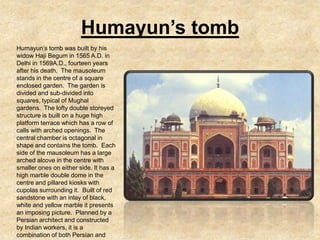
Humayun’s tomb
Humayun’s tomb was built by his
widow Haji Begum in 1565 A.D. in
Delhi in 1569A.D., fourteen years
after his death. The mausoleum
stands in the centre of a square
enclosed garden. The garden is
divided and sub-divided into
squares, typical of Mughal
gardens. The lofty double storeyed
structure is built on a huge high
platform terrace which has a row of
calls with arched openings. The
central chamber is octagonal in
shape and contains the tomb. Each
side of the mausoleum has a large
arched alcove in the centre with
smaller ones on either side. It has a
high marble double dome in the
centre and pillared kiosks with
cupolas surrounding it. Built of red
sandstone with an inlay of black,
white and yellow marble it presents
an imposing picture. Planned by a
Persian architect and constructed
by Indian workers, it is a
combination of both Persian and
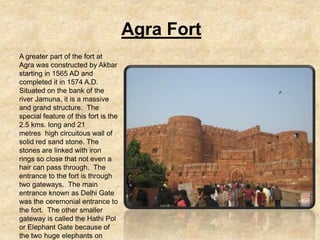
Agra Fort
A greater part of the fort at
Agra was constructed by Akbar
starting in 1565 AD and
completed it in 1574 A.D.
Situated on the bank of the
river Jamuna, it is a massive
and grand structure. The
special feature of this fort is the
2.5 kms. long and 21
metres high circuitous wall of
solid red sand stone. The
stones are linked with iron
rings so close that not even a
hair can pass through. The
entrance to the fort is through
two gateways. The main
entrance known as Delhi Gate
was the ceremonial entrance to
the fort. The other smaller
gateway is called the Hathi Pol
or Elephant Gate because of
the two huge elephants on
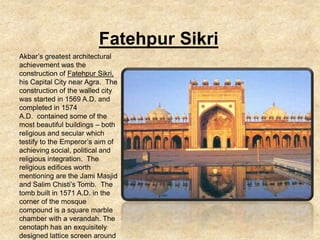
Fatehpur Sikri
Akbar’s greatest architectural
achievement was the
construction of Fatehpur Sikri,
his Capital City near Agra. The
construction of the walled city
was started in 1569 A.D. and
completed in 1574
A.D. contained some of the
most beautiful buildings – both
religious and secular which
testify to the Emperor’s aim of
achieving social, political and
religious integration. The
religious edifices worth
mentioning are the Jami Masjid
and Salim Chisti’s Tomb. The
tomb built in 1571 A.D. in the
corner of the mosque
compound is a square marble
chamber with a verandah. The
cenotaph has an exquisitely
designed lattice screen around
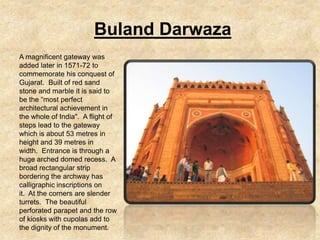
Buland Darwaza
A magnificent gateway was
added later in 1571-72 to
commemorate his conquest of
Gujarat. Built of red sand
stone and marble it is said to
be the “most perfect
architectural achievement in
the whole of India". A flight of
steps lead to the gateway
which is about 53 metres in
height and 39 metres in
width. Entrance is through a
huge arched domed recess. A
broad rectangular strip
bordering the archway has
calligraphic inscriptions on
it. At the corners are slender
turrets. The beautiful
perforated parapet and the row
of kiosks with cupolas add to
the dignity of the monument.
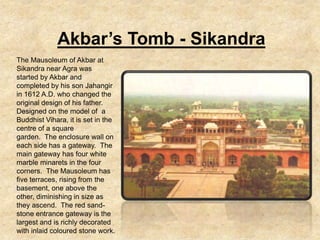
Akbar’s Tomb - Sikandra
The Mausoleum of Akbar at
Sikandra near Agra was
started by Akbar and
completed by his son Jahangir
in 1612 A.D. who changed the
original design of his father.
Designed on the model of a
Buddhist Vihara, it is set in the
centre of a square
garden. The enclosure wall on
each side has a gateway. The
main gateway has four white
marble minarets in the four
corners. The Mausoleum has
five terraces, rising from the
basement, one above the
other, diminishing in size as
they ascend. The red sand-
stone entrance gateway is the
largest and is richly decorated
with inlaid coloured stone work.
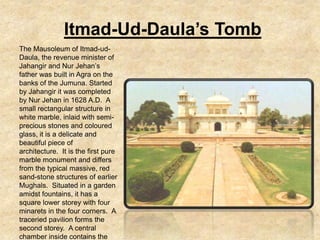
Itmad-Ud-Daula’s Tomb
The Mausoleum of Itmad-ud-
Daula, the revenue minister of
Jahangir and Nur Jehan’s
father was built in Agra on the
banks of the Jumuna. Started
by Jahangir it was completed
by Nur Jehan in 1628 A.D. A
small rectangular structure in
white marble, inlaid with semi-
precious stones and coloured
glass, it is a delicate and
beautiful piece of
architecture. It is the first pure
marble monument and differs
from the typical massive, red
sand-stone structures of earlier
Mughals. Situated in a garden
amidst fountains, it has a
square lower storey with four
minarets in the four corners. A
traceried pavilion forms the
second storey. A central
chamber inside contains the
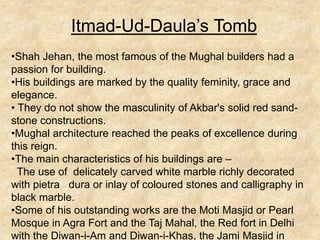
Itmad-Ud-Daula’s Tomb
•Shah Jehan, the most famous of the Mughal builders had a
passion for building.
•His buildings are marked by the quality feminity, grace and
elegance.
• They do not show the masculinity of Akbar's solid red sand-
stone constructions.
•Mughal architecture reached the peaks of excellence during
this reign.
•The main characteristics of his buildings are –
  The use of delicately carved white marble richly decorated
with pietra dura or inlay of coloured stones and calligraphy in
black marble.
•Some of his outstanding works are the Moti Masjid or Pearl
Mosque in Agra Fort and the Taj Mahal, the Red fort in Delhi
with the Diwan-i-Am and Diwan-i-Khas, the Jami Masjid in
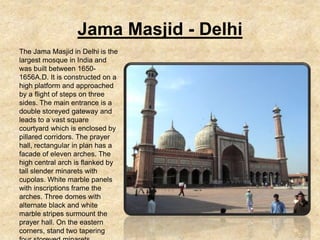
Jama Masjid - Delhi
The Jama Masjid in Delhi is the
largest mosque in India and
was built between 1650-
1656A.D. It is constructed on a
high platform and approached
by a flight of steps on three
sides. The main entrance is a
double storeyed gateway and
leads to a vast square
courtyard which is enclosed by
pillared corridors. The prayer
hall, rectangular in plan has a
facade of eleven arches. The
high central arch is flanked by
tall slender minarets with
cupolas. White marble panels
with inscriptions frame the
arches. Three domes with
alternate black and white
marble stripes surmount the
prayer hall. On the eastern
corners, stand two tapering
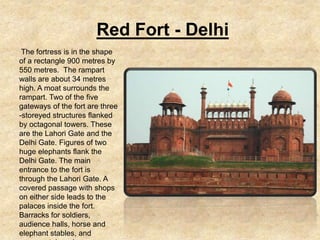
Red Fort - Delhi
 The fortress is in the shape
of a rectangle 900 metres by
550 metres. The rampart
walls are about 34 metres
high. A moat surrounds the
rampart. Two of the five
gateways of the fort are three
-storeyed structures flanked
by octagonal towers. These
are the Lahori Gate and the
Delhi Gate. Figures of two
huge elephants flank the
Delhi Gate. The main
entrance to the fort is
through the Lahori Gate. A
covered passage with shops
on either side leads to the
palaces inside the fort.
Barracks for soldiers,
audience halls, horse and
elephant stables, and
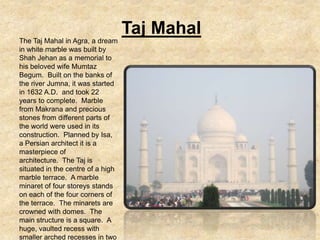
Taj Mahal
The Taj Mahal in Agra, a dream
in white marble was built by
Shah Jehan as a memorial to
his beloved wife Mumtaz
Begum. Built on the banks of
the river Jumna, it was started
in 1632 A.D. and took 22
years to complete. Marble
from Makrana and precious
stones from different parts of
the world were used in its
construction. Planned by Isa,
a Persian architect it is a
masterpiece of
architecture. The Taj is
situated in the centre of a high
marble terrace. A marble
minaret of four storeys stands
on each of the four corners of
the terrace. The minarets are
crowned with domes. The
main structure is a square. A
huge, vaulted recess with
smaller arched recesses in two
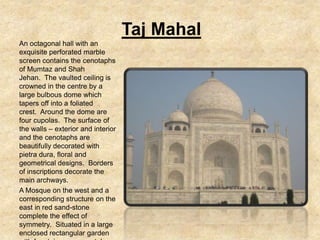
Taj Mahal
An octagonal hall with an
exquisite perforated marble
screen contains the cenotaphs
of Mumtaz and Shah
Jehan. The vaulted ceiling is
crowned in the centre by a
large bulbous dome which
tapers off into a foliated
crest. Around the dome are
four cupolas. The surface of
the walls – exterior and interior
and the cenotaphs are
beautifully decorated with
pietra dura, floral and
geometrical designs. Borders
of inscriptions decorate the
main archways.
A Mosque on the west and a
corresponding structure on the
east in red sand-stone
complete the effect of
symmetry. Situated in a large
enclosed rectangular garden
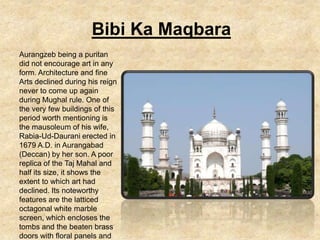
Bibi Ka Maqbara
Aurangzeb being a puritan
did not encourage art in any
form. Architecture and fine
Arts declined during his reign
never to come up again
during Mughal rule. One of
the very few buildings of this
period worth mentioning is
the mausoleum of his wife,
Rabia-Ud-Daurani erected in
1679 A.D. in Aurangabad
(Deccan) by her son. A poor
replica of the Taj Mahal and
half its size, it shows the
extent to which art had
declined. Its noteworthy
features are the latticed
octagonal white marble
screen, which encloses the
tombs and the beaten brass
doors with floral panels and
The Mughal period in the Indian
history is one of the glorious
periods that have enriched India in
multifarious ways. Art and
architecture had received a great
fillip during the Mughal period that
had gifted us with architectural
gems that have defied the passage
of time in their appeal and
Thank You..

Mughal architecture

  • 1.
    MUGHAL ARCHITECTURE Azizur Khan Tanvi Gujarathi Akshata Hase Swapnil Kanse Nikhil Mehta
  • 2.
    Introduction • All theearly Mughal Rulers except Aurangzeb were great builders. • With the coming of the Mughals, Indian architecture was greatly influenced by Persian styles. The Mughals constructed excellent mausoleums, mosques, forts, gardens and cities. • The Mughal buildings show a uniform pattern both in structure and character. • It had a time-span of 132 years, practically from 1526 to 1658, and Agra-Fatehpur Sikri, Lahore- Kashmir- Kabul, Delhi, Allahabad, Ajmer, Ahmedabad, Mandu and Burhanpur are its major centres.
  • 3.
    Introduction The main characteristic features of Mughal architecture are : • The bulbous domes • The slender minarets with cupolas at the four corners • Large halls • Massive vaulted gateways and delicate ornamentation
  • 4.
    Introduction • Mughal architecturebegins with Akbar who showed his passion for building by planning and constructing splendid edifices. • During his reign Mughal architecture took on new forms. • Akbar made free use of both Hindu and Persian styles. • The use of red sandstone inlaid with white marble and painted designs on walls and ceiling are the salient -features of Akbar's buildings. • Akbar constructed numerous forts, towers, palaces, mosques, mausoleums and gateways.
  • 5.
    Humayun’s tomb Humayun’s tombwas built by his widow Haji Begum in 1565 A.D. in Delhi in 1569A.D., fourteen years after his death. The mausoleum stands in the centre of a square enclosed garden. The garden is divided and sub-divided into squares, typical of Mughal gardens. The lofty double storeyed structure is built on a huge high platform terrace which has a row of calls with arched openings. The central chamber is octagonal in shape and contains the tomb. Each side of the mausoleum has a large arched alcove in the centre with smaller ones on either side. It has a high marble double dome in the centre and pillared kiosks with cupolas surrounding it. Built of red sandstone with an inlay of black, white and yellow marble it presents an imposing picture. Planned by a Persian architect and constructed by Indian workers, it is a combination of both Persian and
  • 6.
    Agra Fort A greaterpart of the fort at Agra was constructed by Akbar starting in 1565 AD and completed it in 1574 A.D. Situated on the bank of the river Jamuna, it is a massive and grand structure. The special feature of this fort is the 2.5 kms. long and 21 metres high circuitous wall of solid red sand stone. The stones are linked with iron rings so close that not even a hair can pass through. The entrance to the fort is through two gateways. The main entrance known as Delhi Gate was the ceremonial entrance to the fort. The other smaller gateway is called the Hathi Pol or Elephant Gate because of the two huge elephants on
  • 7.
    Fatehpur Sikri Akbar’s greatestarchitectural achievement was the construction of Fatehpur Sikri, his Capital City near Agra. The construction of the walled city was started in 1569 A.D. and completed in 1574 A.D. contained some of the most beautiful buildings – both religious and secular which testify to the Emperor’s aim of achieving social, political and religious integration. The religious edifices worth mentioning are the Jami Masjid and Salim Chisti’s Tomb. The tomb built in 1571 A.D. in the corner of the mosque compound is a square marble chamber with a verandah. The cenotaph has an exquisitely designed lattice screen around
  • 8.
    Buland Darwaza A magnificentgateway was added later in 1571-72 to commemorate his conquest of Gujarat. Built of red sand stone and marble it is said to be the “most perfect architectural achievement in the whole of India". A flight of steps lead to the gateway which is about 53 metres in height and 39 metres in width. Entrance is through a huge arched domed recess. A broad rectangular strip bordering the archway has calligraphic inscriptions on it. At the corners are slender turrets. The beautiful perforated parapet and the row of kiosks with cupolas add to the dignity of the monument.
  • 9.
    Akbar’s Tomb -Sikandra The Mausoleum of Akbar at Sikandra near Agra was started by Akbar and completed by his son Jahangir in 1612 A.D. who changed the original design of his father. Designed on the model of a Buddhist Vihara, it is set in the centre of a square garden. The enclosure wall on each side has a gateway. The main gateway has four white marble minarets in the four corners. The Mausoleum has five terraces, rising from the basement, one above the other, diminishing in size as they ascend. The red sand- stone entrance gateway is the largest and is richly decorated with inlaid coloured stone work.
  • 10.
    Itmad-Ud-Daula’s Tomb The Mausoleumof Itmad-ud- Daula, the revenue minister of Jahangir and Nur Jehan’s father was built in Agra on the banks of the Jumuna. Started by Jahangir it was completed by Nur Jehan in 1628 A.D. A small rectangular structure in white marble, inlaid with semi- precious stones and coloured glass, it is a delicate and beautiful piece of architecture. It is the first pure marble monument and differs from the typical massive, red sand-stone structures of earlier Mughals. Situated in a garden amidst fountains, it has a square lower storey with four minarets in the four corners. A traceried pavilion forms the second storey. A central chamber inside contains the
  • 11.
    Itmad-Ud-Daula’s Tomb •Shah Jehan,the most famous of the Mughal builders had a passion for building. •His buildings are marked by the quality feminity, grace and elegance. • They do not show the masculinity of Akbar's solid red sand- stone constructions. •Mughal architecture reached the peaks of excellence during this reign. •The main characteristics of his buildings are – The use of delicately carved white marble richly decorated with pietra dura or inlay of coloured stones and calligraphy in black marble. •Some of his outstanding works are the Moti Masjid or Pearl Mosque in Agra Fort and the Taj Mahal, the Red fort in Delhi with the Diwan-i-Am and Diwan-i-Khas, the Jami Masjid in
  • 12.
    Jama Masjid -Delhi The Jama Masjid in Delhi is the largest mosque in India and was built between 1650- 1656A.D. It is constructed on a high platform and approached by a flight of steps on three sides. The main entrance is a double storeyed gateway and leads to a vast square courtyard which is enclosed by pillared corridors. The prayer hall, rectangular in plan has a facade of eleven arches. The high central arch is flanked by tall slender minarets with cupolas. White marble panels with inscriptions frame the arches. Three domes with alternate black and white marble stripes surmount the prayer hall. On the eastern corners, stand two tapering
  • 13.
    Red Fort -Delhi The fortress is in the shape of a rectangle 900 metres by 550 metres. The rampart walls are about 34 metres high. A moat surrounds the rampart. Two of the five gateways of the fort are three -storeyed structures flanked by octagonal towers. These are the Lahori Gate and the Delhi Gate. Figures of two huge elephants flank the Delhi Gate. The main entrance to the fort is through the Lahori Gate. A covered passage with shops on either side leads to the palaces inside the fort. Barracks for soldiers, audience halls, horse and elephant stables, and
  • 14.
    Taj Mahal The TajMahal in Agra, a dream in white marble was built by Shah Jehan as a memorial to his beloved wife Mumtaz Begum. Built on the banks of the river Jumna, it was started in 1632 A.D. and took 22 years to complete. Marble from Makrana and precious stones from different parts of the world were used in its construction. Planned by Isa, a Persian architect it is a masterpiece of architecture. The Taj is situated in the centre of a high marble terrace. A marble minaret of four storeys stands on each of the four corners of the terrace. The minarets are crowned with domes. The main structure is a square. A huge, vaulted recess with smaller arched recesses in two
  • 15.
    Taj Mahal An octagonalhall with an exquisite perforated marble screen contains the cenotaphs of Mumtaz and Shah Jehan. The vaulted ceiling is crowned in the centre by a large bulbous dome which tapers off into a foliated crest. Around the dome are four cupolas. The surface of the walls – exterior and interior and the cenotaphs are beautifully decorated with pietra dura, floral and geometrical designs. Borders of inscriptions decorate the main archways. A Mosque on the west and a corresponding structure on the east in red sand-stone complete the effect of symmetry. Situated in a large enclosed rectangular garden
  • 16.
    Bibi Ka Maqbara Aurangzebbeing a puritan did not encourage art in any form. Architecture and fine Arts declined during his reign never to come up again during Mughal rule. One of the very few buildings of this period worth mentioning is the mausoleum of his wife, Rabia-Ud-Daurani erected in 1679 A.D. in Aurangabad (Deccan) by her son. A poor replica of the Taj Mahal and half its size, it shows the extent to which art had declined. Its noteworthy features are the latticed octagonal white marble screen, which encloses the tombs and the beaten brass doors with floral panels and
  • 17.
    The Mughal periodin the Indian history is one of the glorious periods that have enriched India in multifarious ways. Art and architecture had received a great fillip during the Mughal period that had gifted us with architectural gems that have defied the passage of time in their appeal and
  • 18.