Fathima SP Mariya Francis Rajiv Babu
PLASTIC 
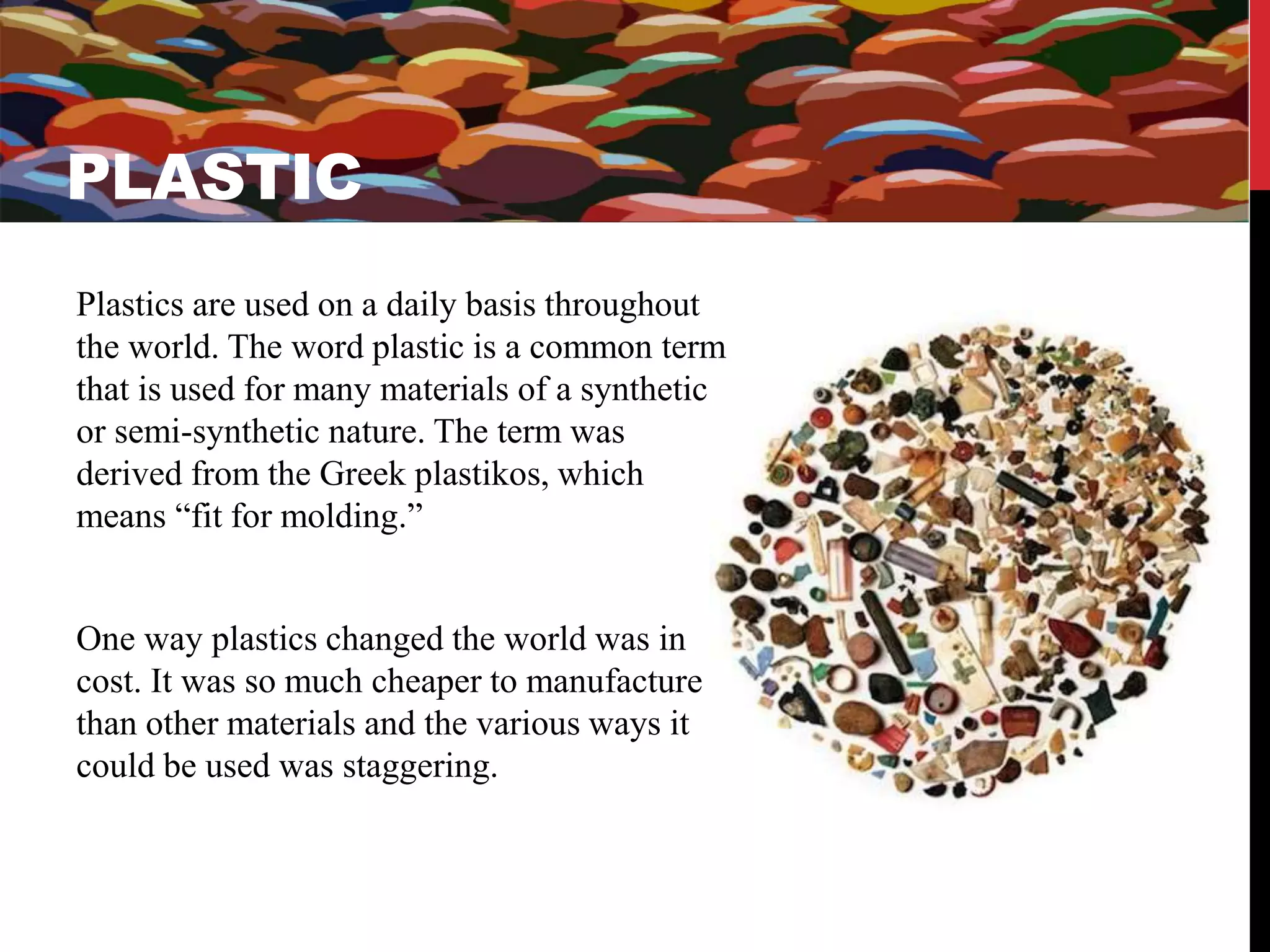
Plastics are used on a daily basis throughout 
the world. The word plastic is a common term 
that is used for many materials of a synthetic 
or semi-synthetic nature. The term was 
derived from the Greek plastikos, which 
means “fit for molding.” 
One way plastics changed the world was in 
cost. It was so much cheaper to manufacture 
than other materials and the various ways it 
could be used was staggering.
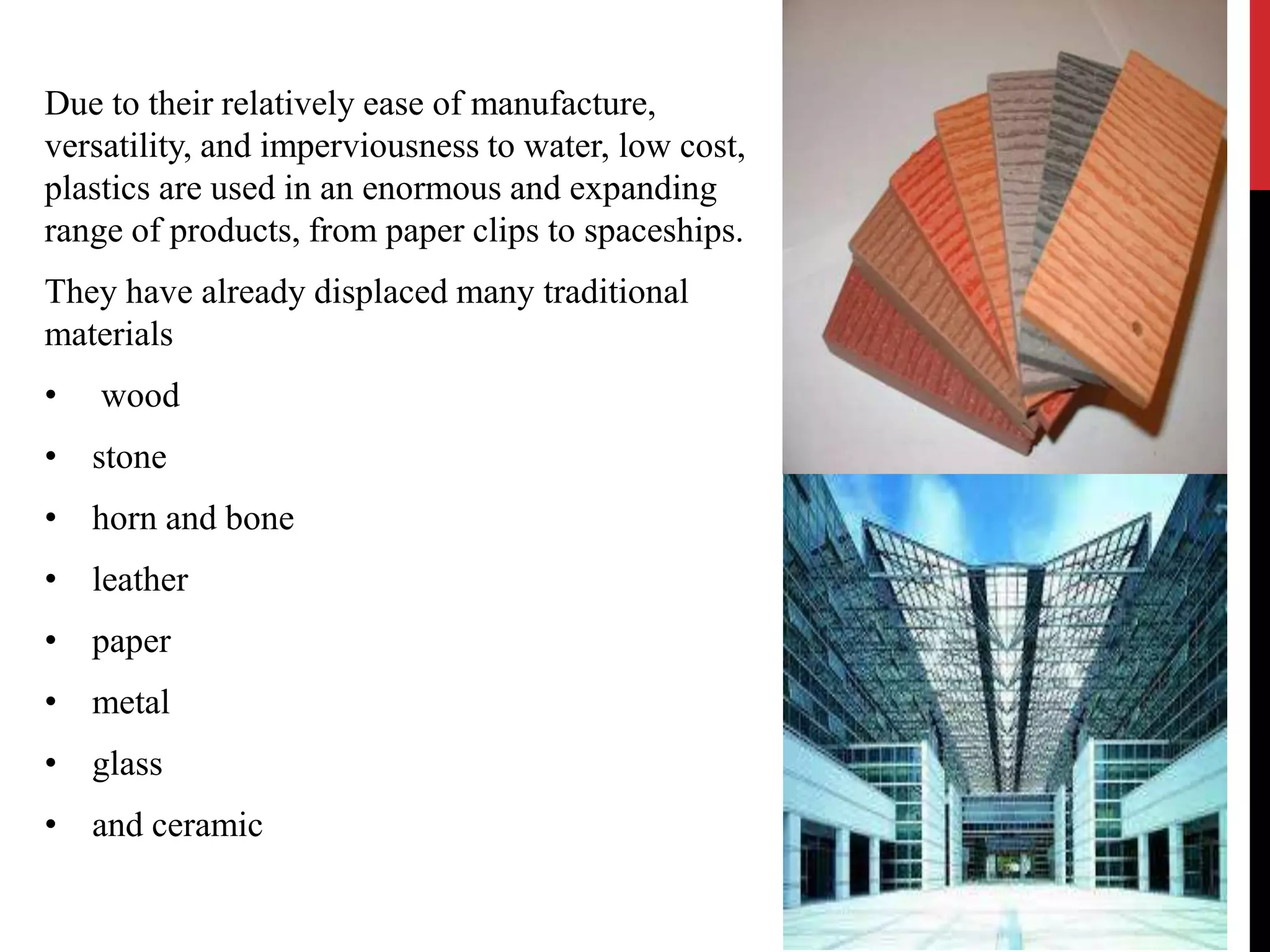
Due to their relatively ease of manufacture, 
versatility, and imperviousness to water, low cost, 
plastics are used in an enormous and expanding 
range of products, from paper clips to spaceships. 
They have already displaced many traditional 
materials 
• wood 
• stone 
• horn and bone 
• leather 
• paper 
• metal 
• glass 
• and ceramic
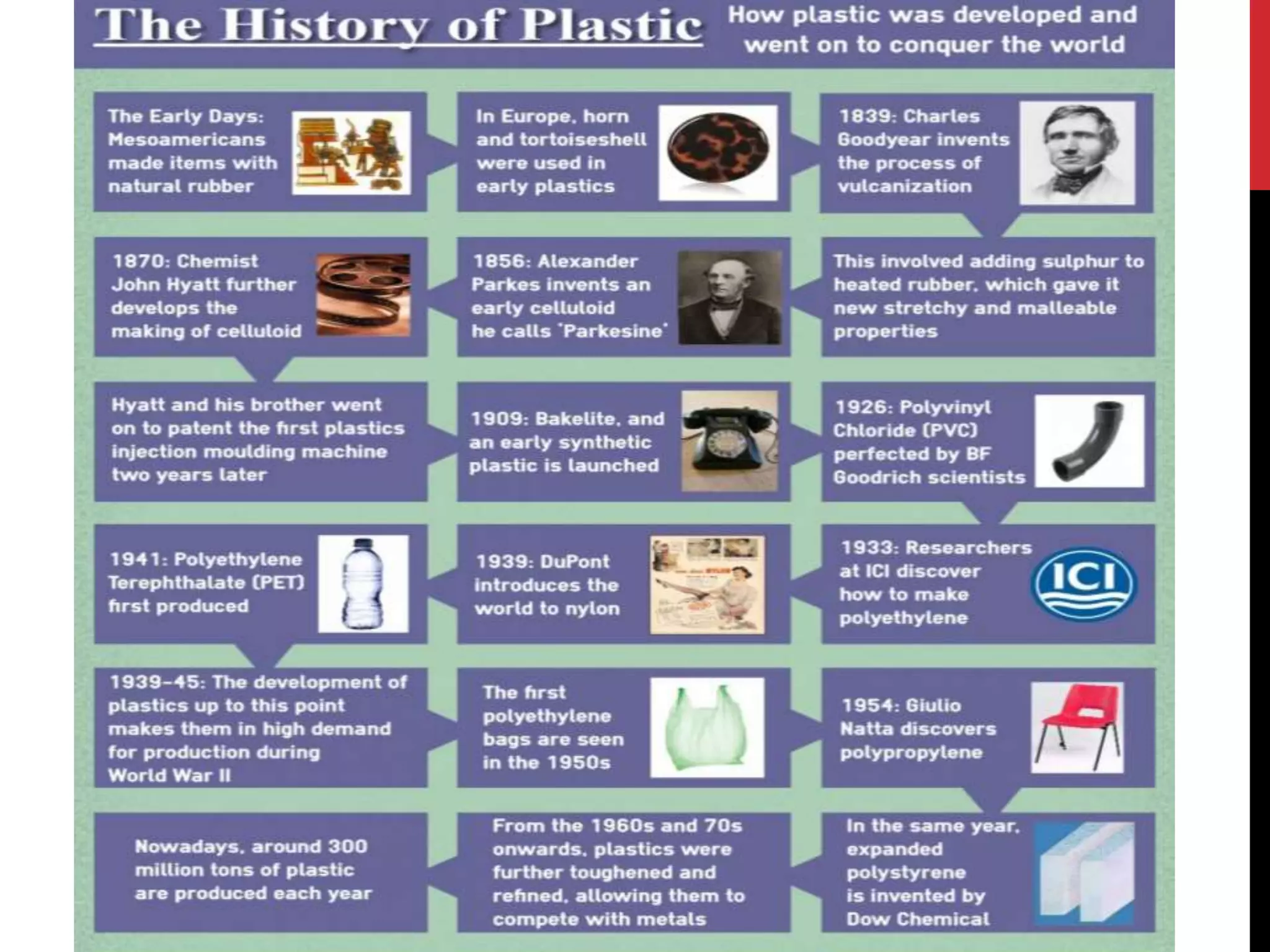
HISTORY 
The development of plastics has evolved from the 
use of natural plastic materials to the use of 
chemically modified, natural materials and finally 
to completely synthetic molecules. 
Early plastics were bio-derived materials such as 
egg and blood proteins, which are organic 
polymers 
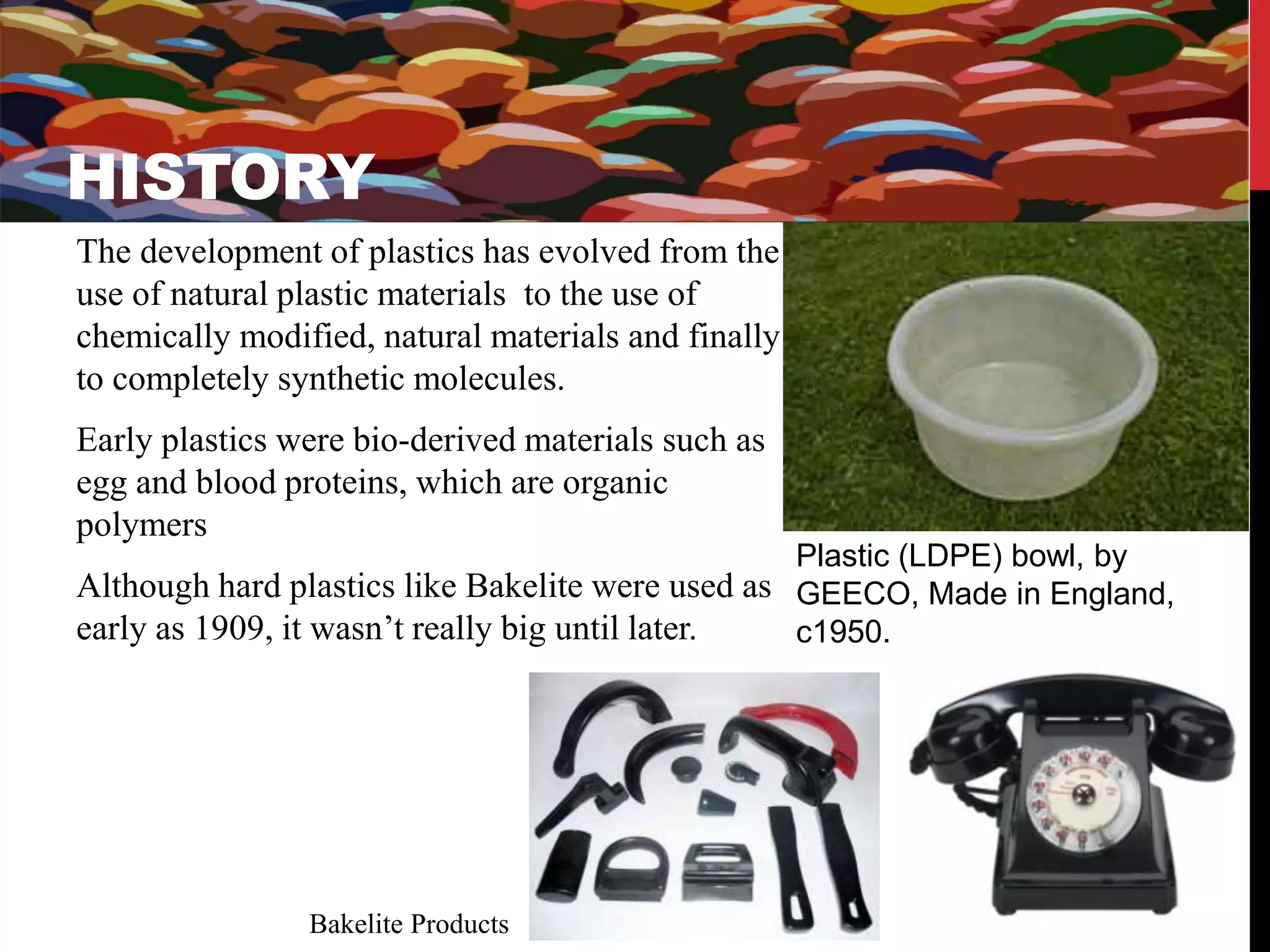
Although hard plastics like Bakelite were used as 
early as 1909, it wasn’t really big until later. 
Plastic (LDPE) bowl, by 
GEECO, Made in England, 
c1950. 
HISTORY 
Bakelite Products
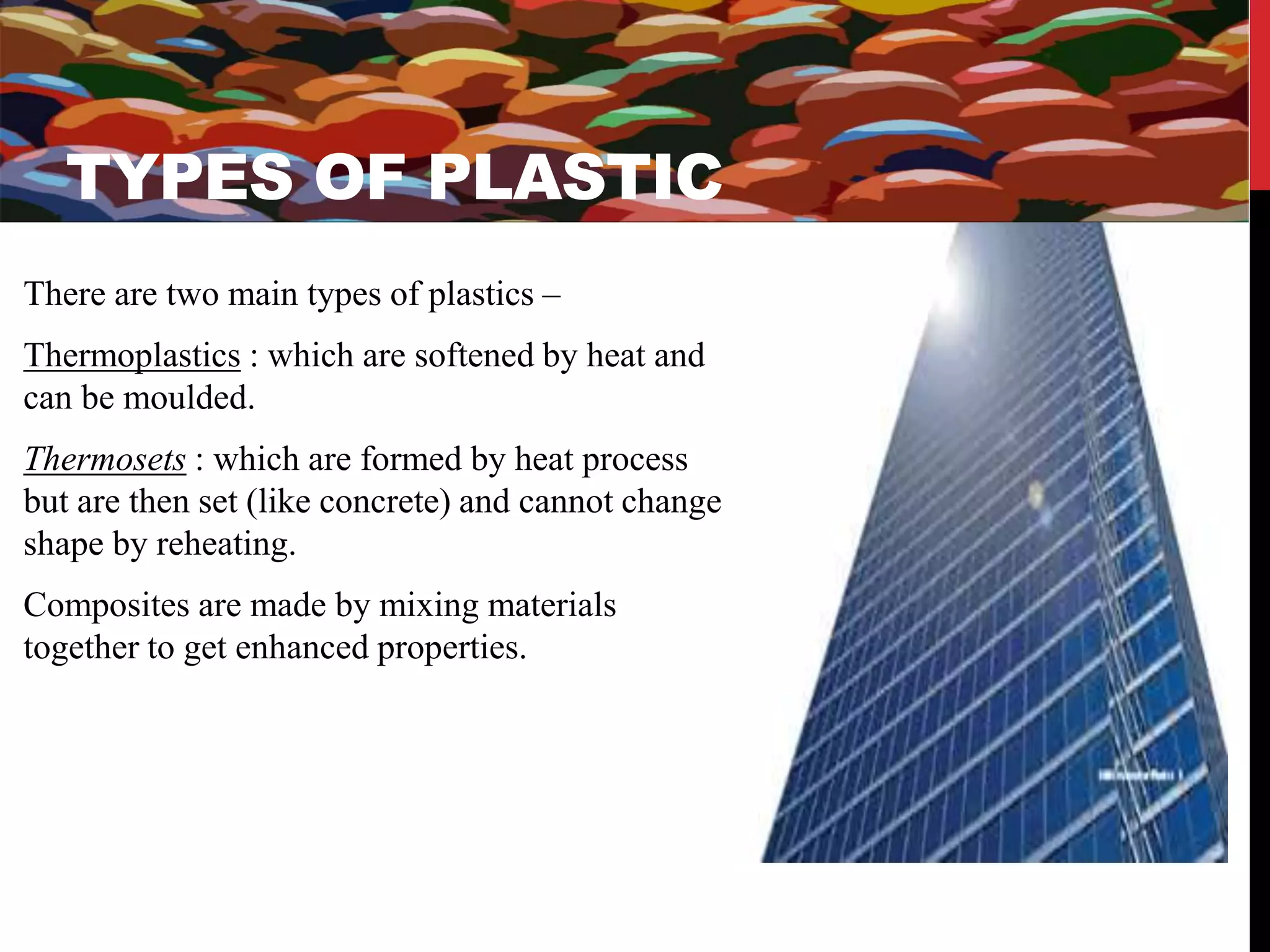
TYPES OF PLASTIC 
There are two main types of plastics – 
Thermoplastics : which are softened by heat and 
can be moulded. 
Thermosets : which are formed by heat process 
but are then set (like concrete) and cannot change 
shape by reheating. 
Composites are made by mixing materials 
together to get enhanced properties.
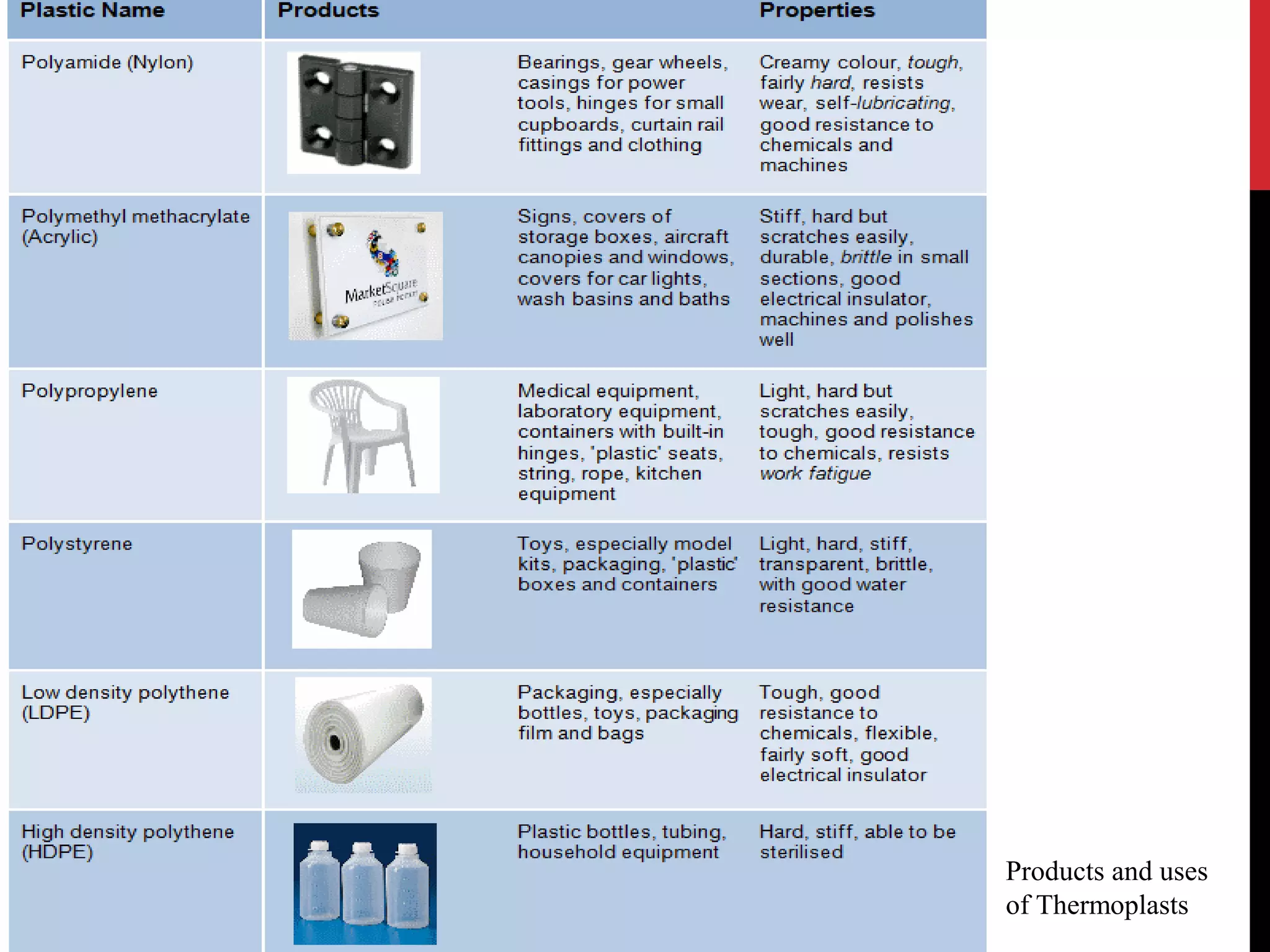
Products and uses 
of Thermoplasts
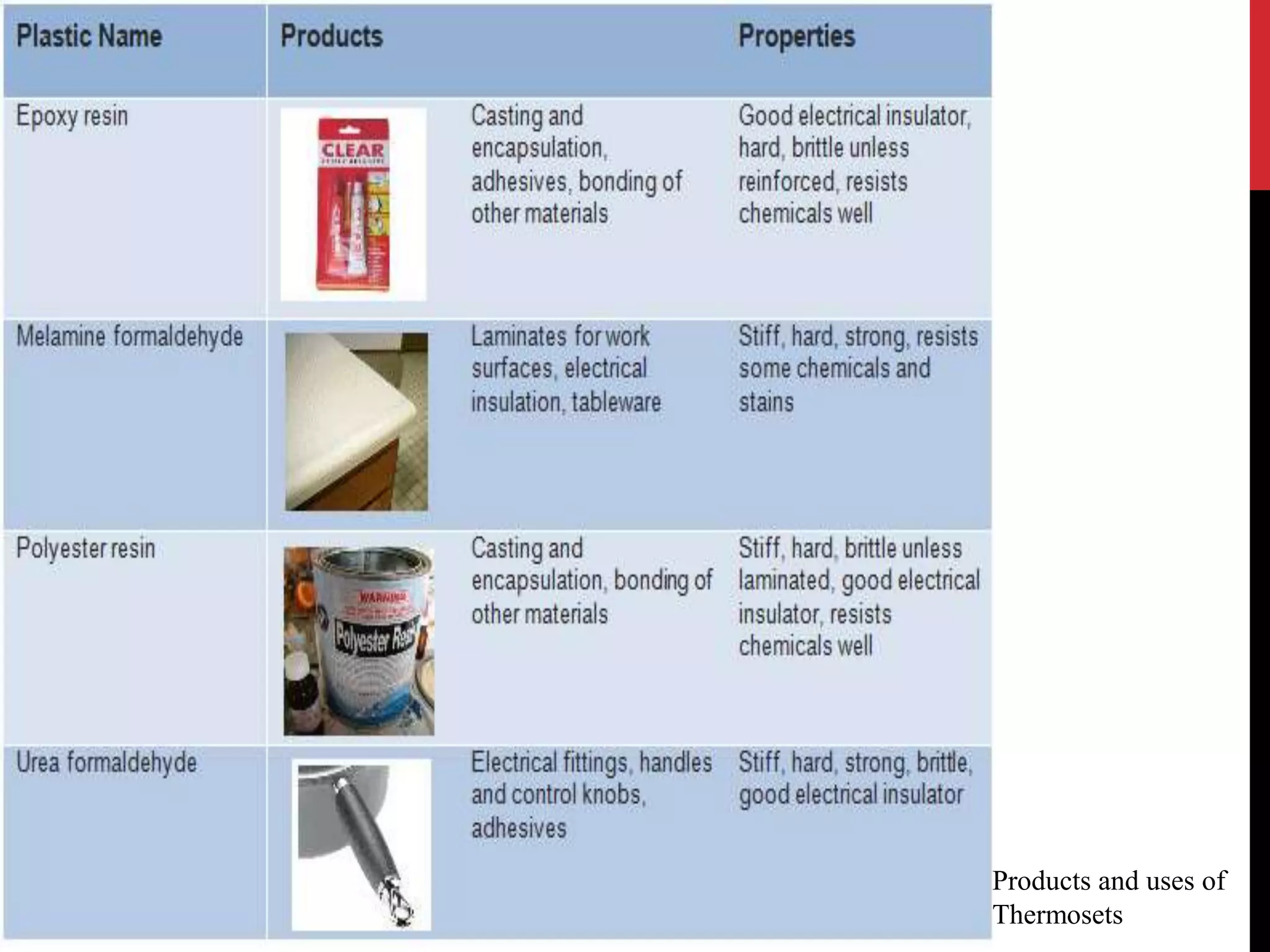
Products and uses of 
Thermosets
ADVANTAGES 
ADVANTAGES 
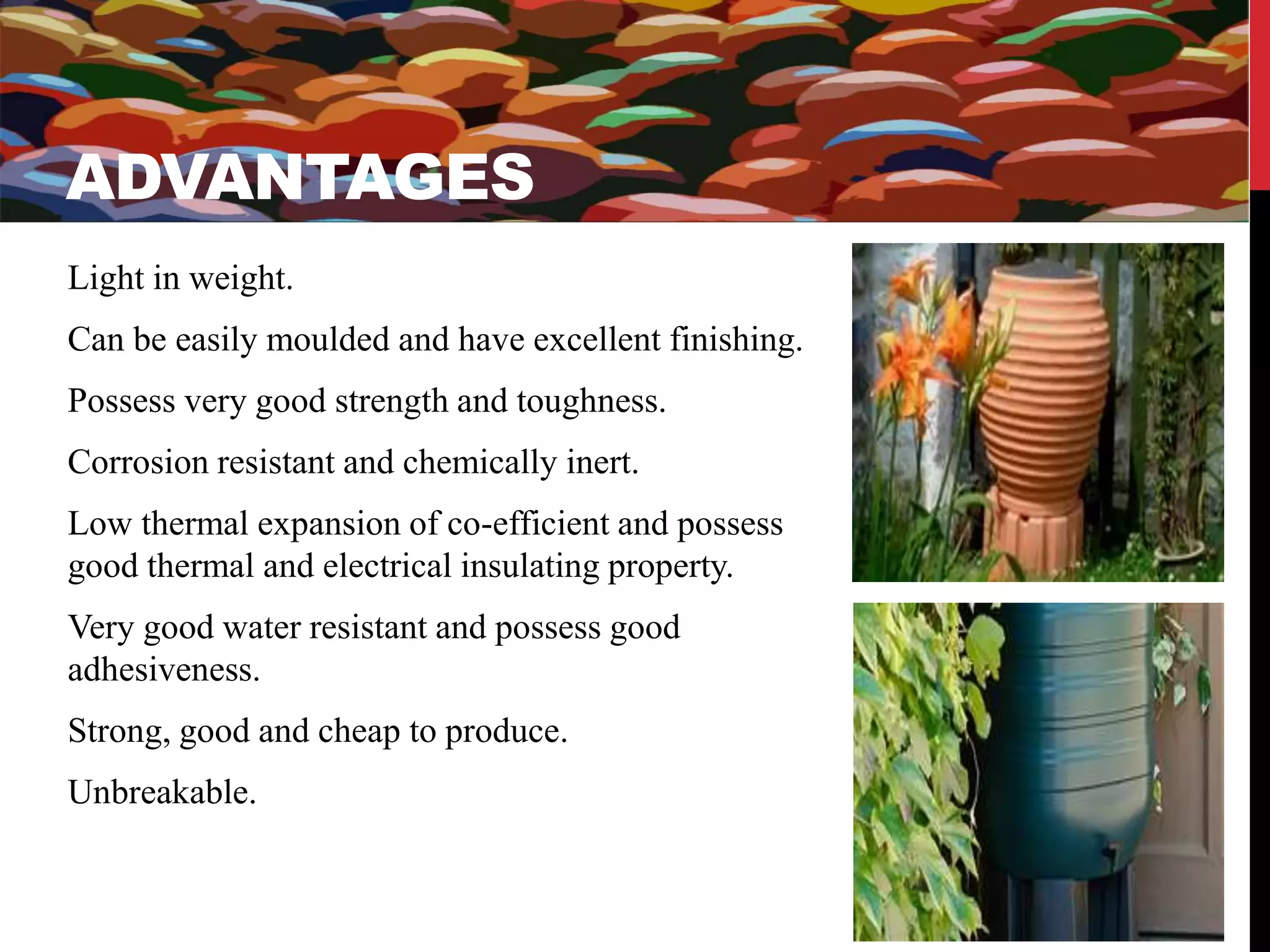
Light in weight. 
Can be easily moulded and have excellent finishing. 
Possess very good strength and toughness. 
Corrosion resistant and chemically inert. 
Low thermal expansion of co-efficient and possess 
good thermal and electrical insulating property. 
Very good water resistant and possess good 
adhesiveness. 
Strong, good and cheap to produce. 
Unbreakable.
DISADVANTAGES 
DISADVANTAGES 
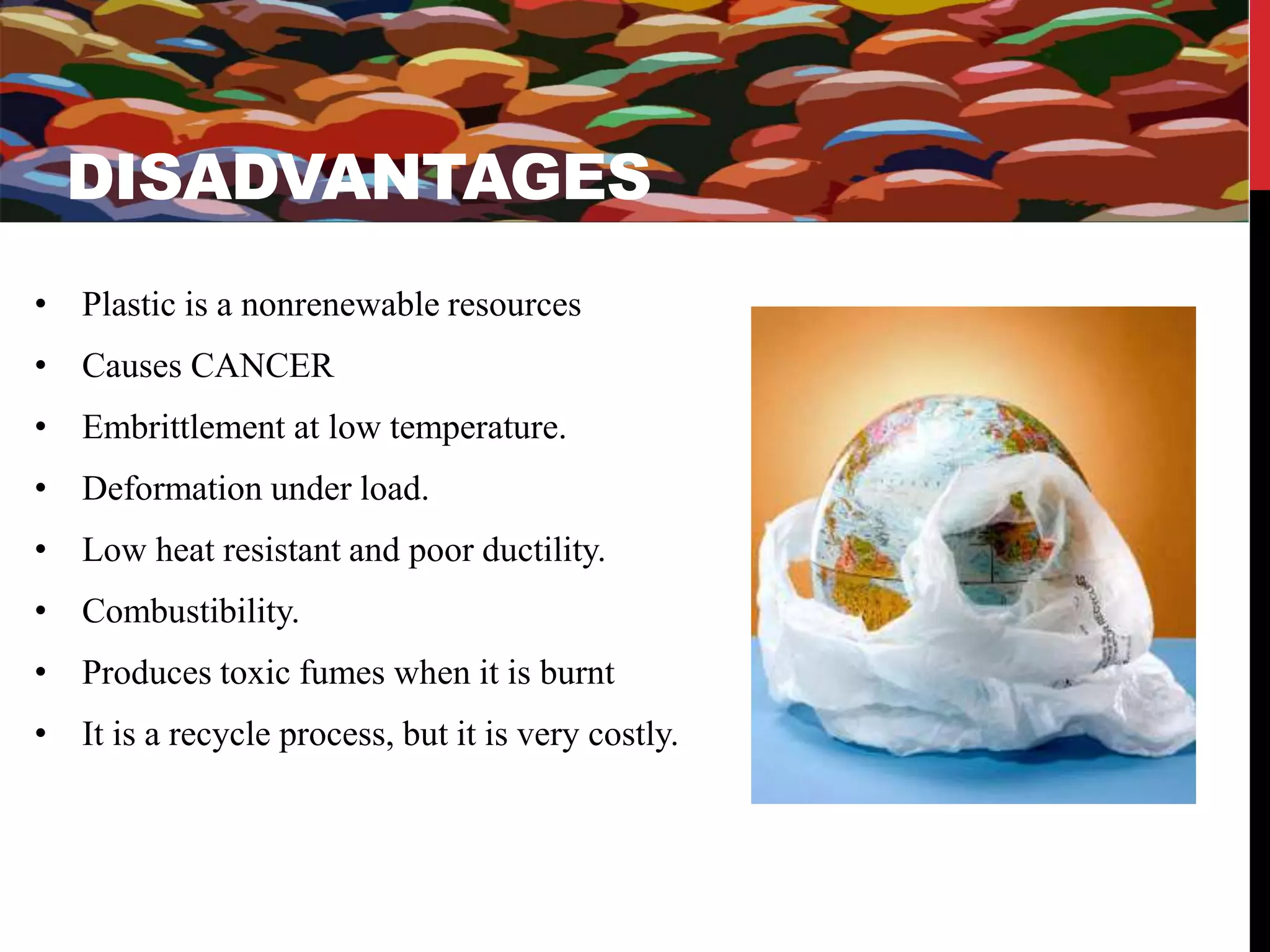
• Plastic is a nonrenewable resources 
• Causes CANCER 
• Embrittlement at low temperature. 
• Deformation under load. 
• Low heat resistant and poor ductility. 
• Combustibility. 
• Produces toxic fumes when it is burnt 
• It is a recycle process, but it is very costly.
AS A BUILDING MATERIAL 
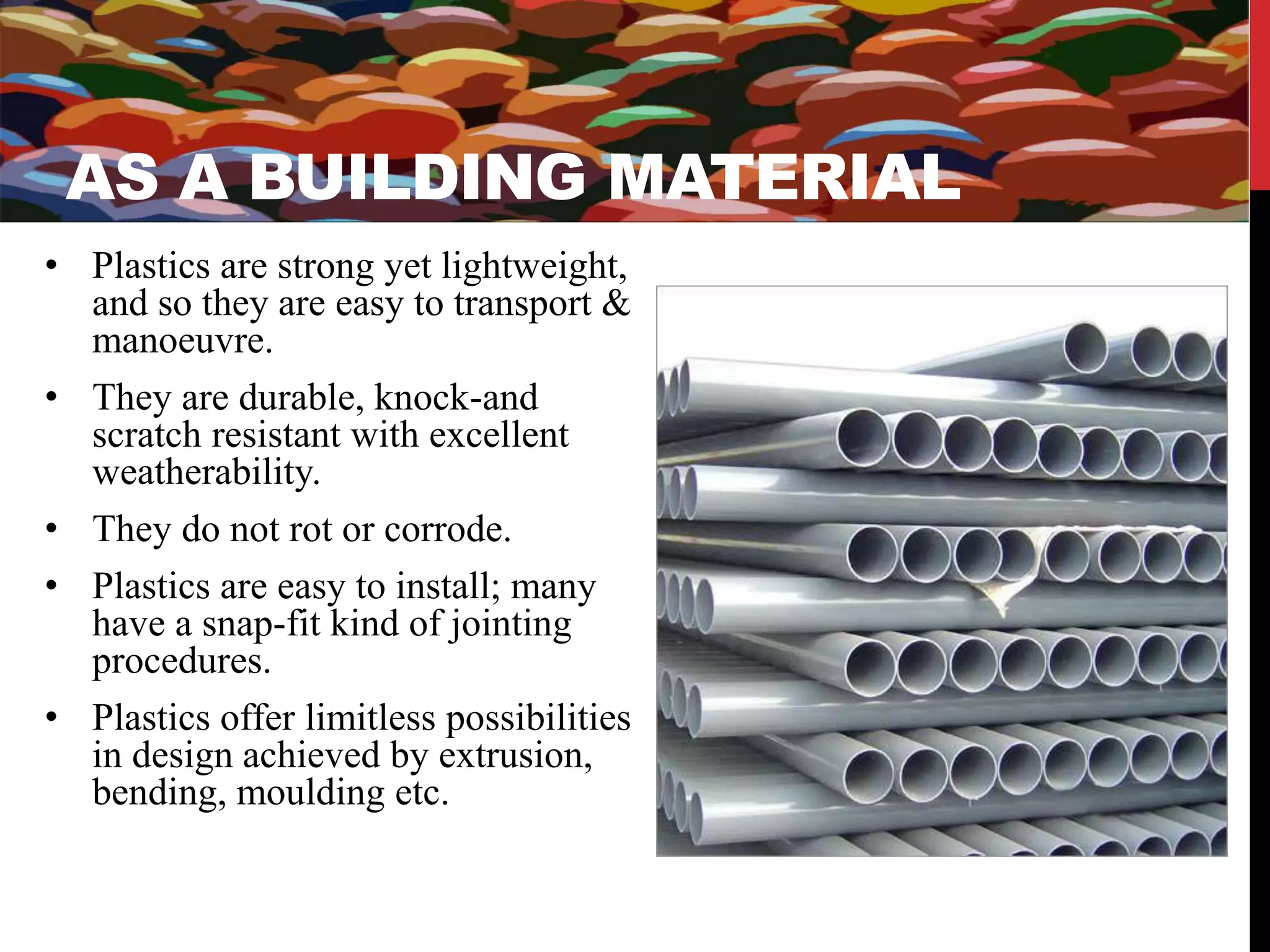
• Plastics are strong yet lightweight, 
and so they are easy to transport & 
manoeuvre. 
• They are durable, knock-and 
scratch resistant with excellent 
weatherability. 
• They do not rot or corrode. 
• Plastics are easy to install; many 
have a snap-fit kind of jointing 
procedures. 
• Plastics offer limitless possibilities 
in design achieved by extrusion, 
bending, moulding etc.
• They can be given any range of 
colours by adding pigments. 
• The plastics are low conductors 
of heat and thus are used as 
insulation materials in green 
building concepts. 
• The plastics products can achieve 
tight seals. 
• They can be sawn and nailed 
employing standard carpentry 
tools and skills. 
• They can be easily removed and 
recycled. 
• They are bad conductors of 
electricity.
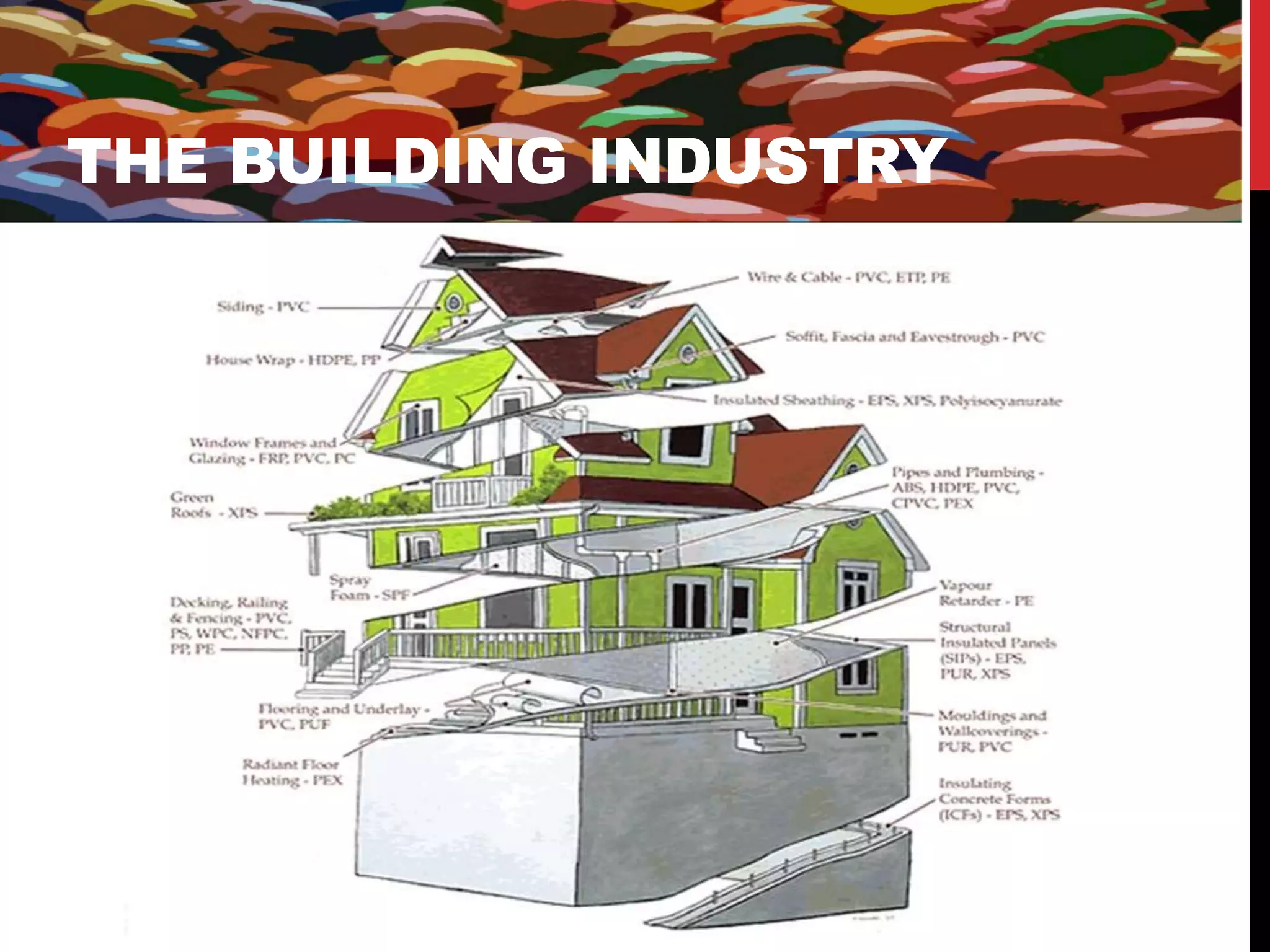
THE BUILDING INDUSTRY
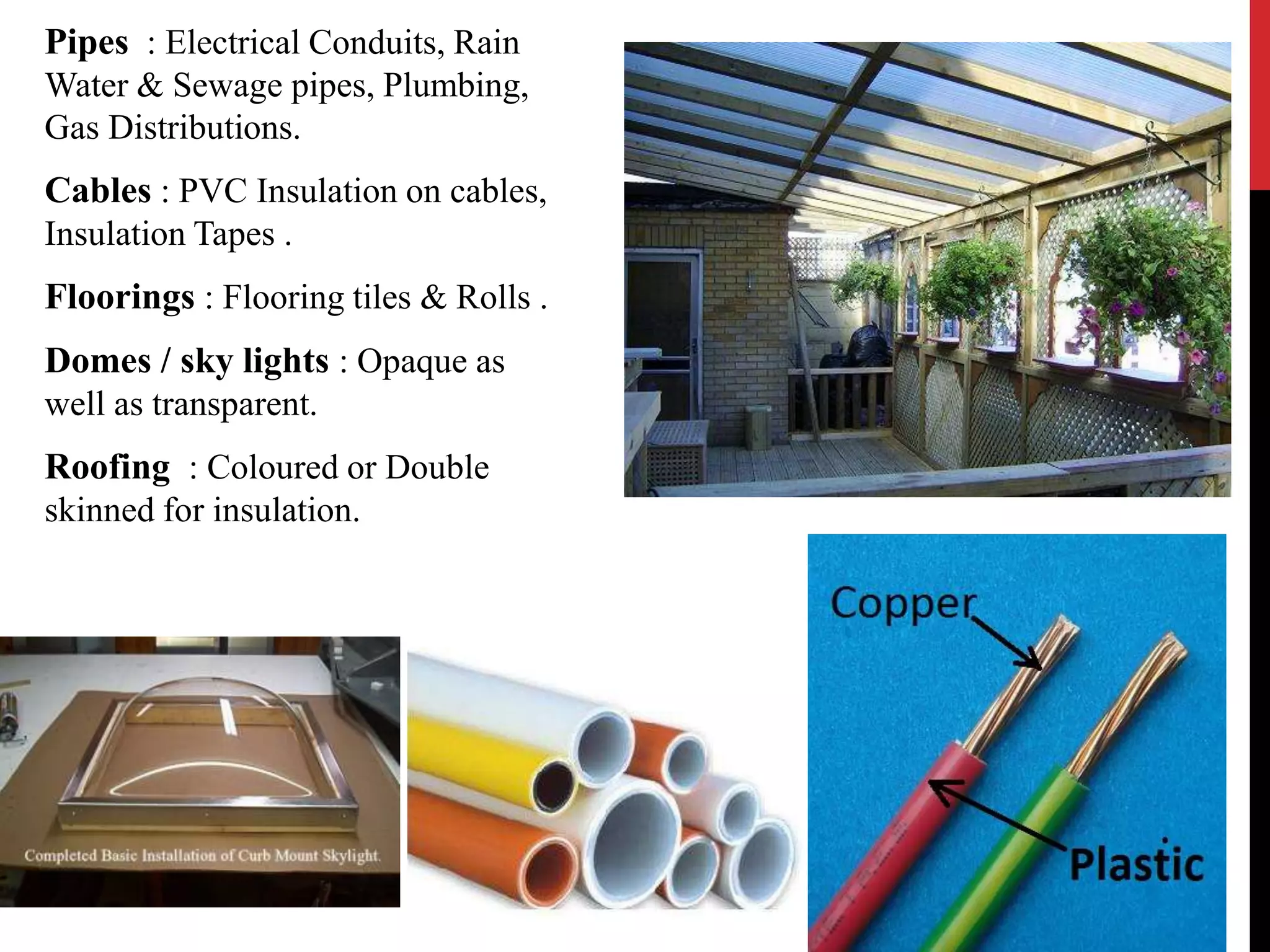
Pipes : Electrical Conduits, Rain 
Water & Sewage pipes, Plumbing, 
Gas Distributions. 
Cables : PVC Insulation on cables, 
Insulation Tapes . 
Floorings : Flooring tiles & Rolls . 
Domes / sky lights : Opaque as 
well as transparent. 
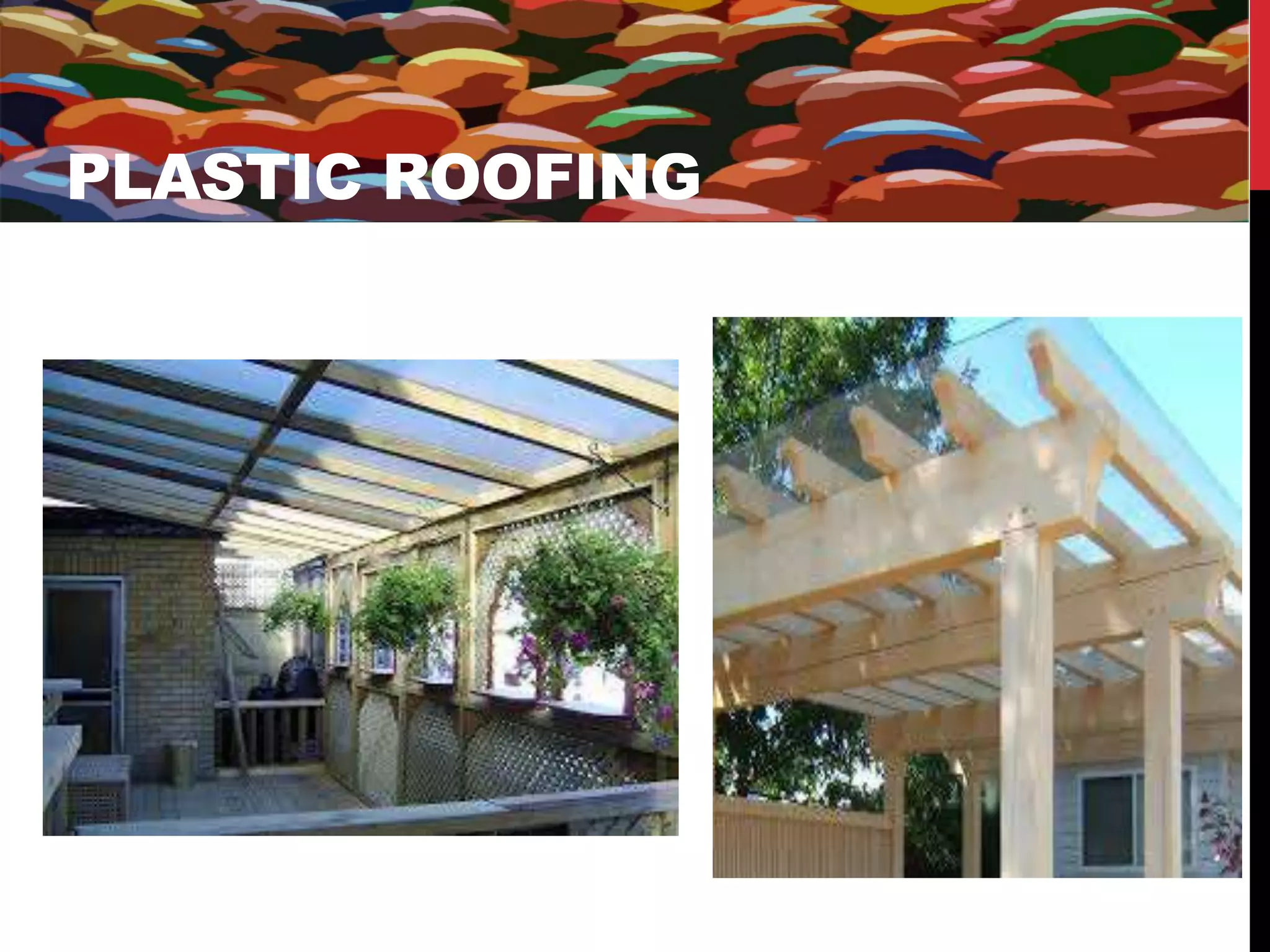
Roofing : Coloured or Double 
skinned for insulation.
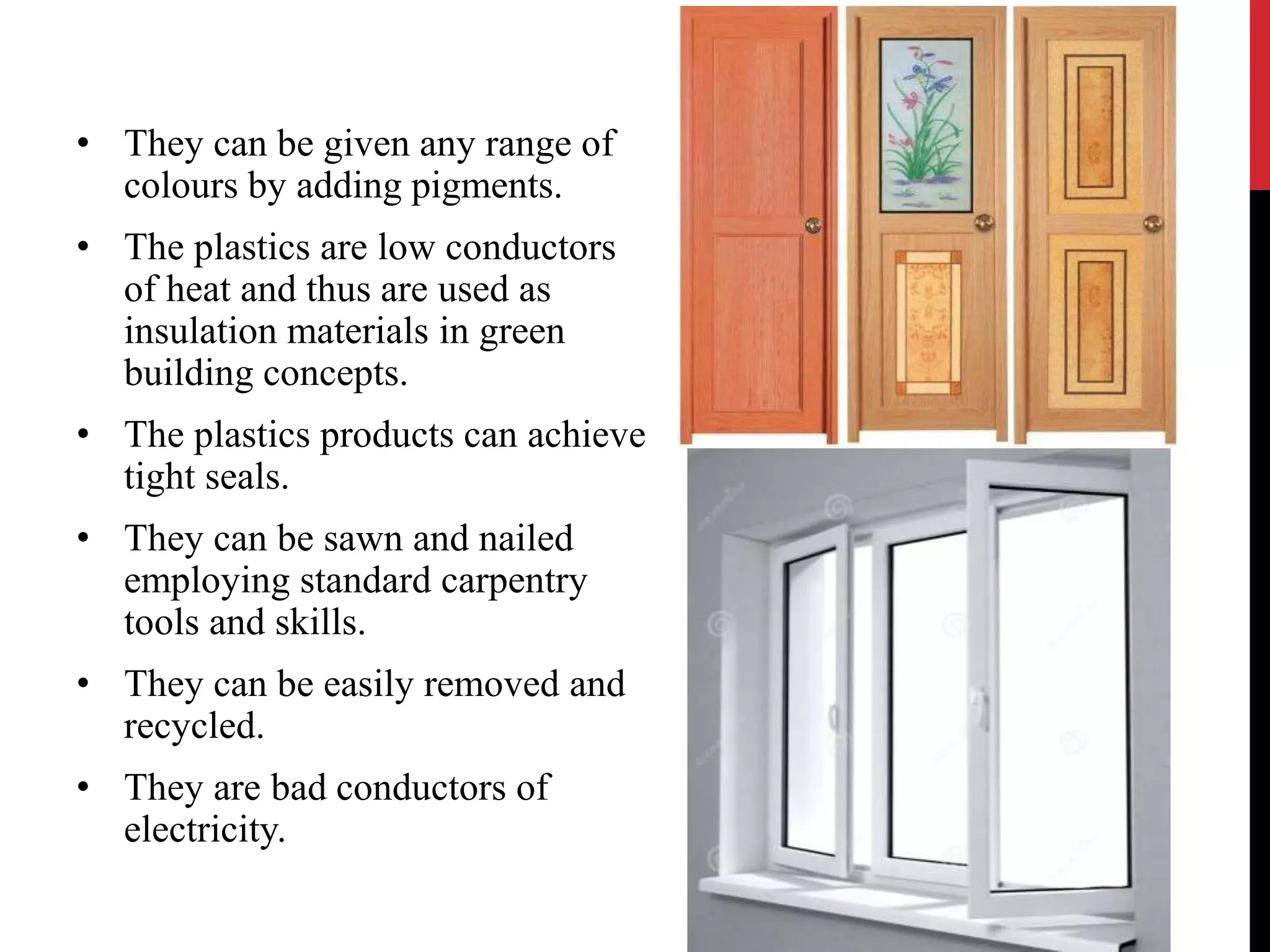
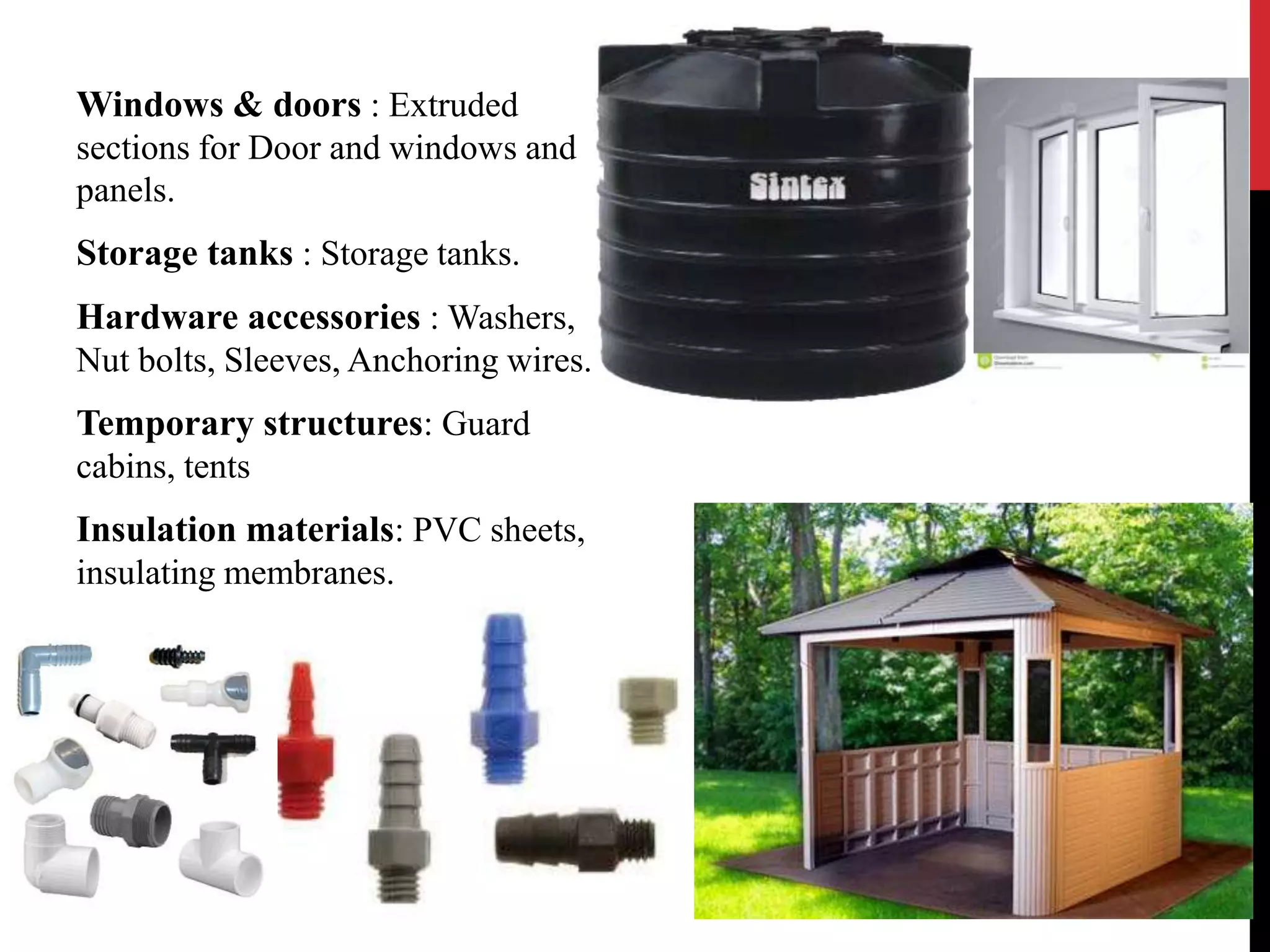
Windows & doors : Extruded 
sections for Door and windows and 
panels. 
Storage tanks : Storage tanks. 
Hardware accessories : Washers, 
Nut bolts, Sleeves, Anchoring wires. 
Temporary structures: Guard 
cabins, tents 
Insulation materials: PVC sheets, 
insulating membranes.
PLASTIC FLOORINGS 
PLASTIC FLOORING 
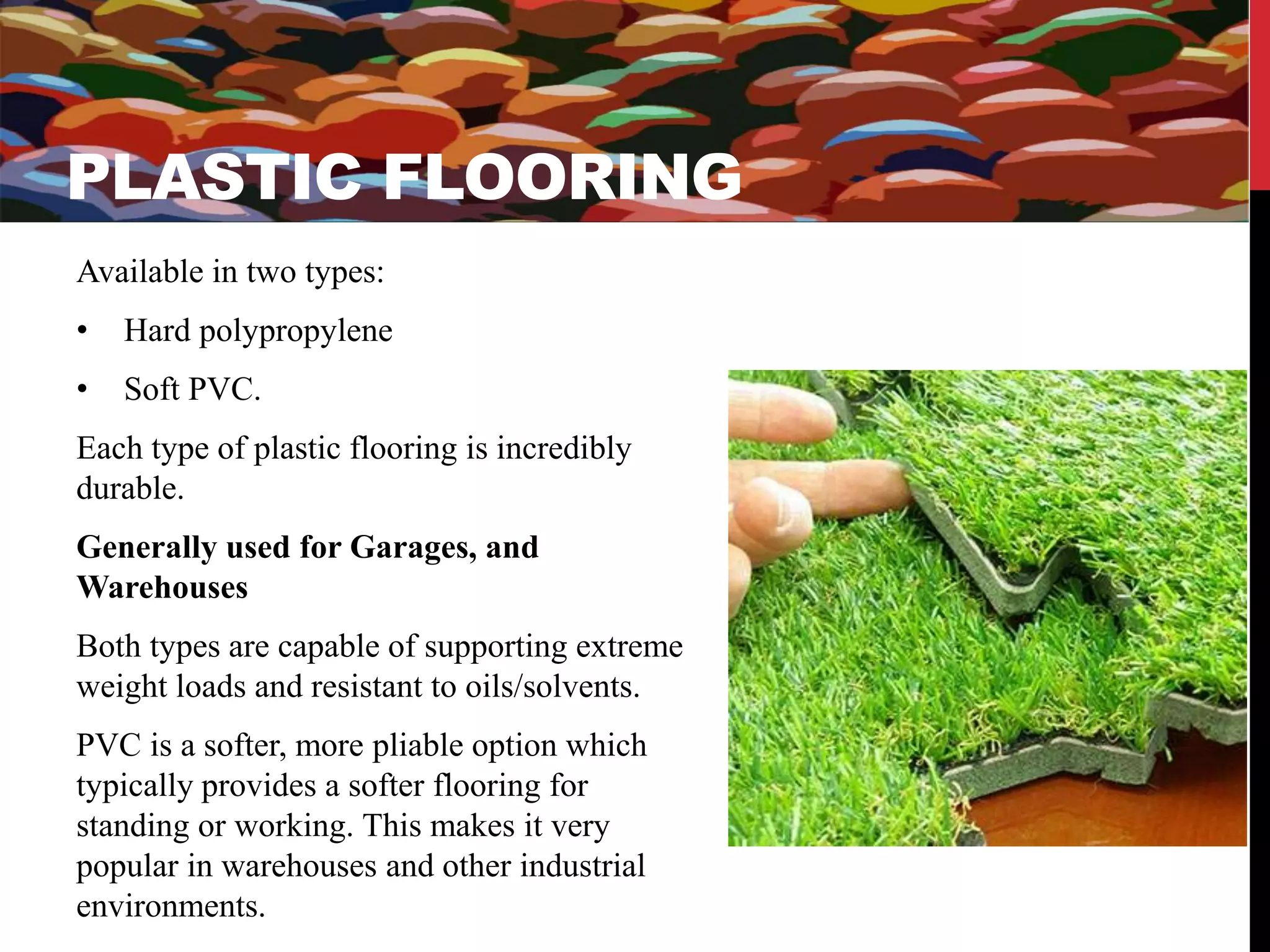
Available in two types: 
• Hard polypropylene 
• Soft PVC. 
Each type of plastic flooring is incredibly 
durable. 
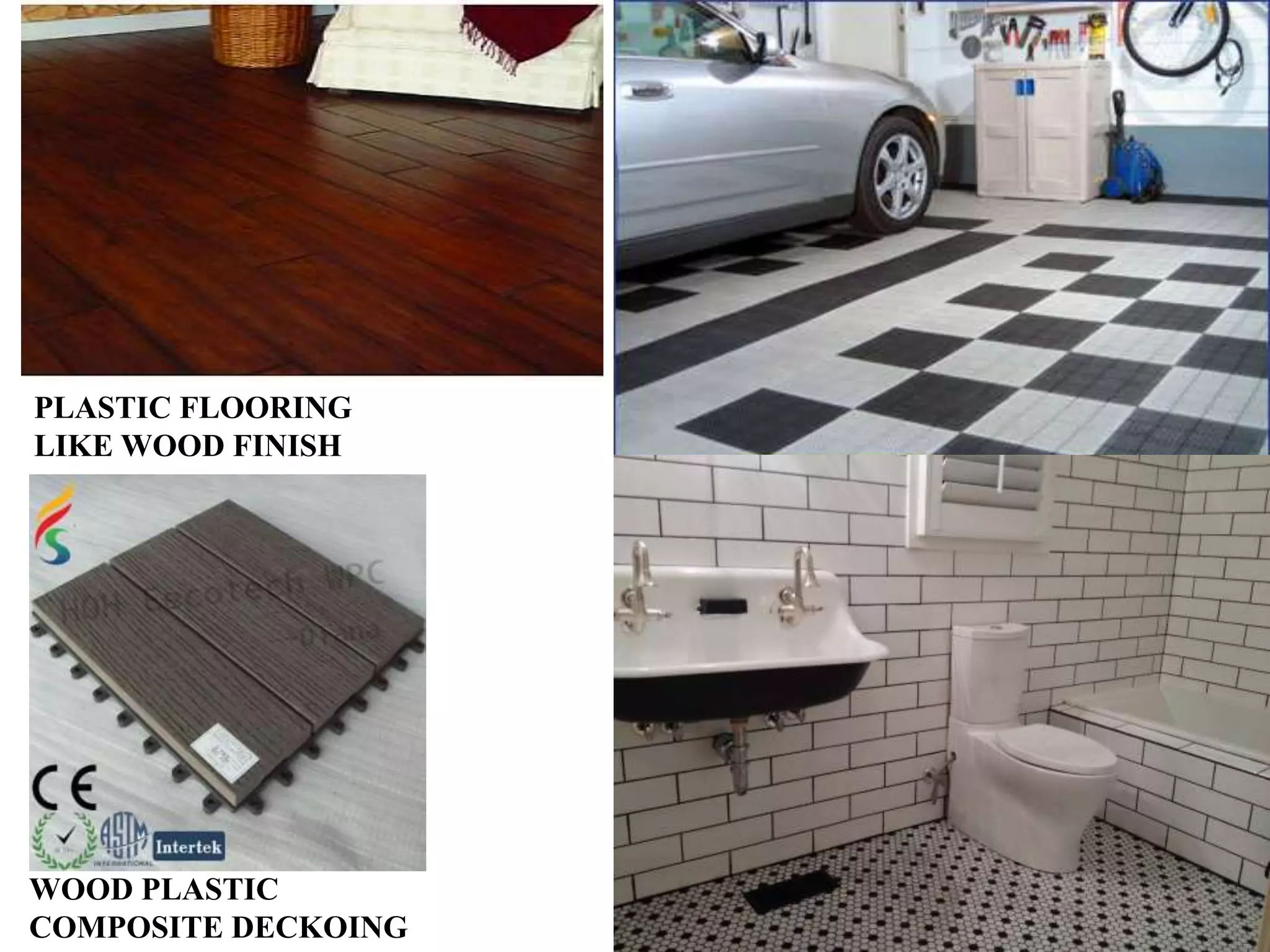
Generally used for Garages, and 
Warehouses 
Both types are capable of supporting extreme 
weight loads and resistant to oils/solvents. 
PVC is a softer, more pliable option which 
typically provides a softer flooring for 
standing or working. This makes it very 
popular in warehouses and other industrial 
environments.
PLASTIC FLOORING 
LIKE WOOD FINISH 
WOOD PLASTIC 
COMPOSITE DECKOING
PLASTIC WALLS 
APPLICATIONS FOR 
PLASTIC WALLS 
Commercial kitchens 
Bathrooms 
Washrooms 
Canteen Walls and Ceilings 
Food Processing Areas 
Changing Areas 
Fast Food Outlets 
Food Storage 
REASON 
Durable 
Waterproof 
Easy to clean 
Hygienic Wall & Ceilings 
Cost Effective 
Easy to Install 
Choice of colours & styles 
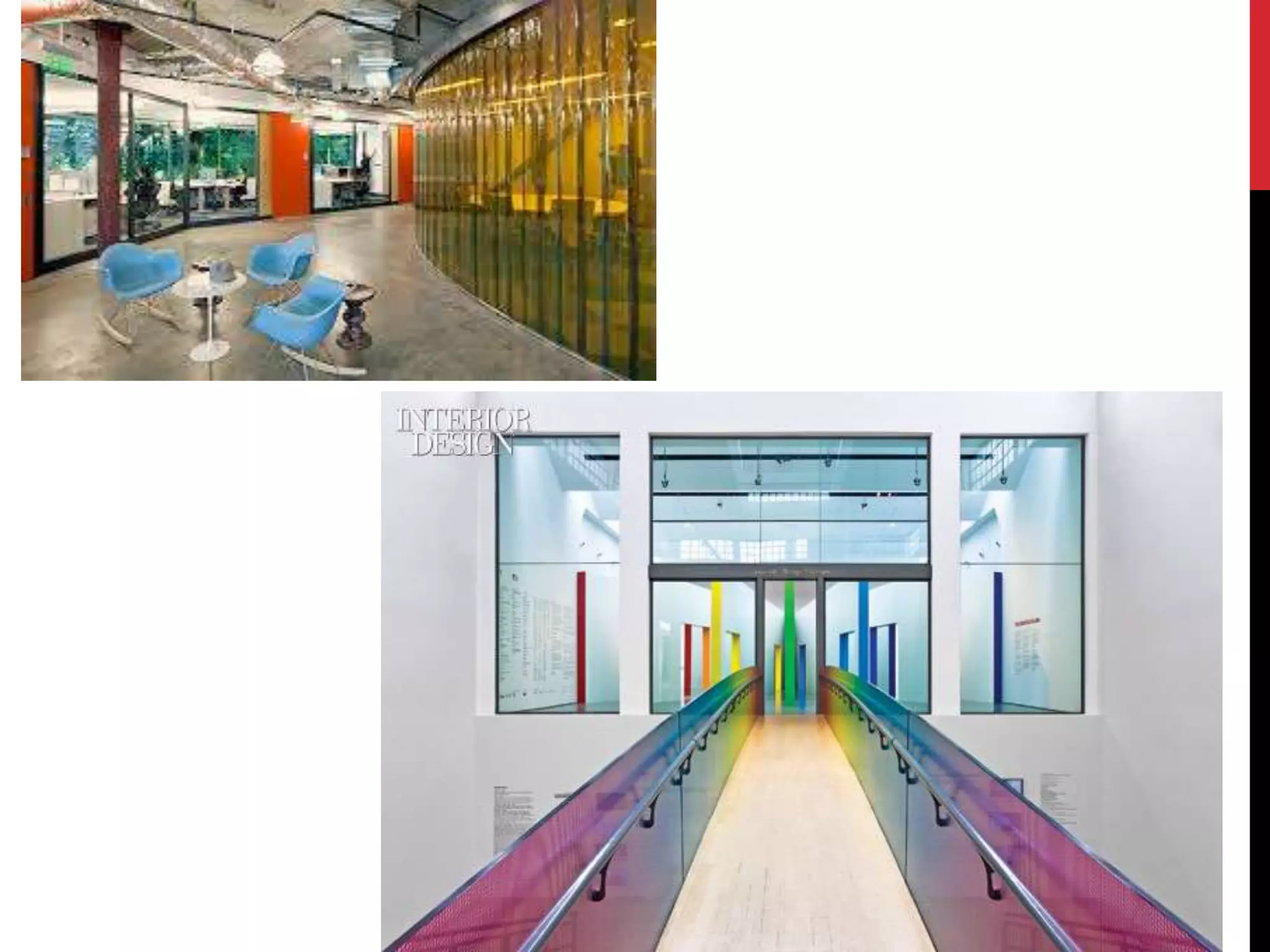
PLASTIC WALLS
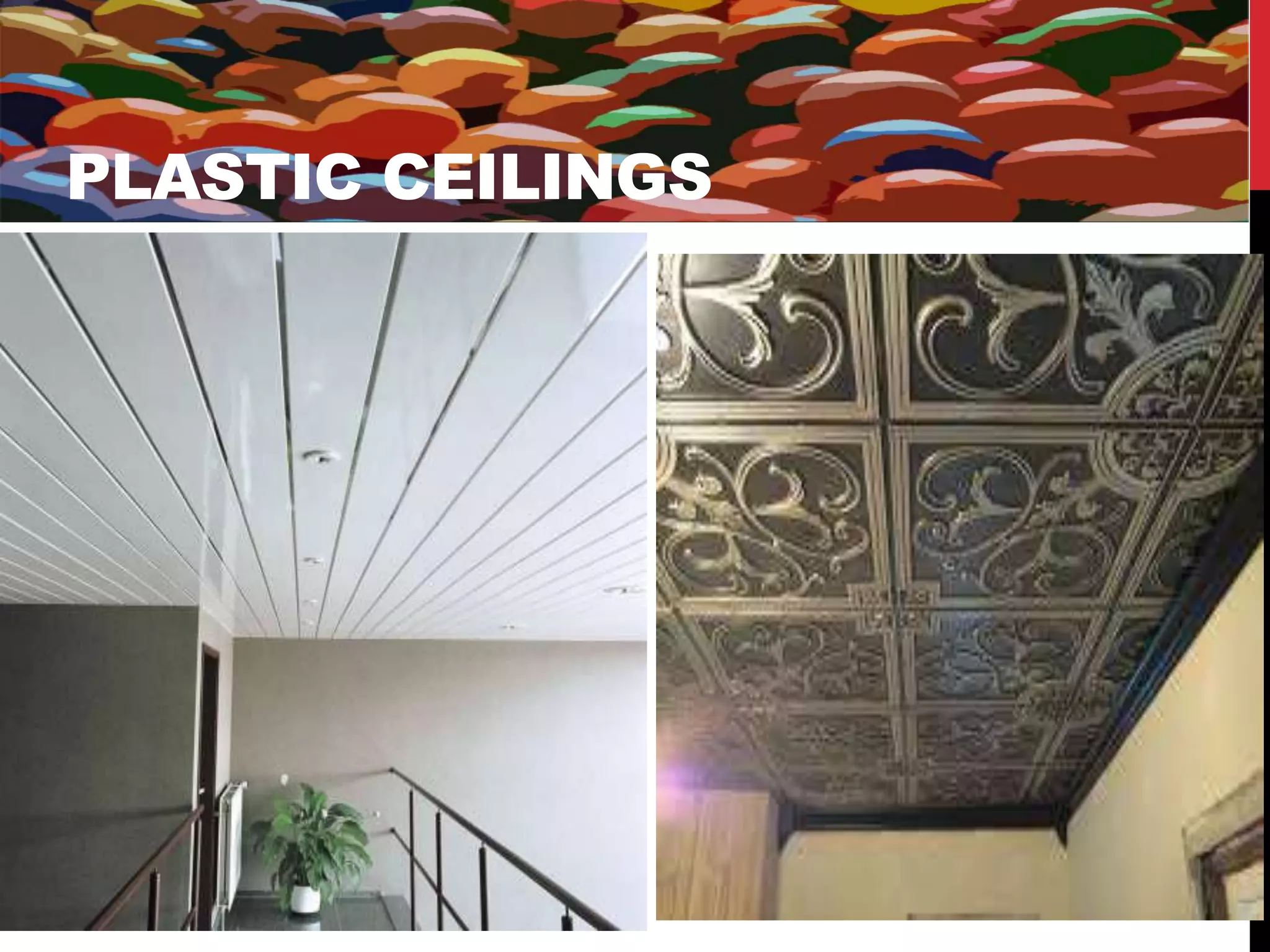
PPLLAASSTTIICC C CEEILILININGGSS
PPLLAASSTTIICC R ROOOOFFININGG
“GREEN” PLASTIC 
At first sight, plastics may appear to be a poor fit in the context of green 
building. Many in the design and construction industry consider plastics 
“unnatural” and nowhere near as “green” as more traditional materials 
like wood. However, more considered analysis reveals that plastic 
building materials bring a lot of advantages to the table, including 
• energy efficiencies 
• lower greenhouse gas emissions 
• durable 
• effective
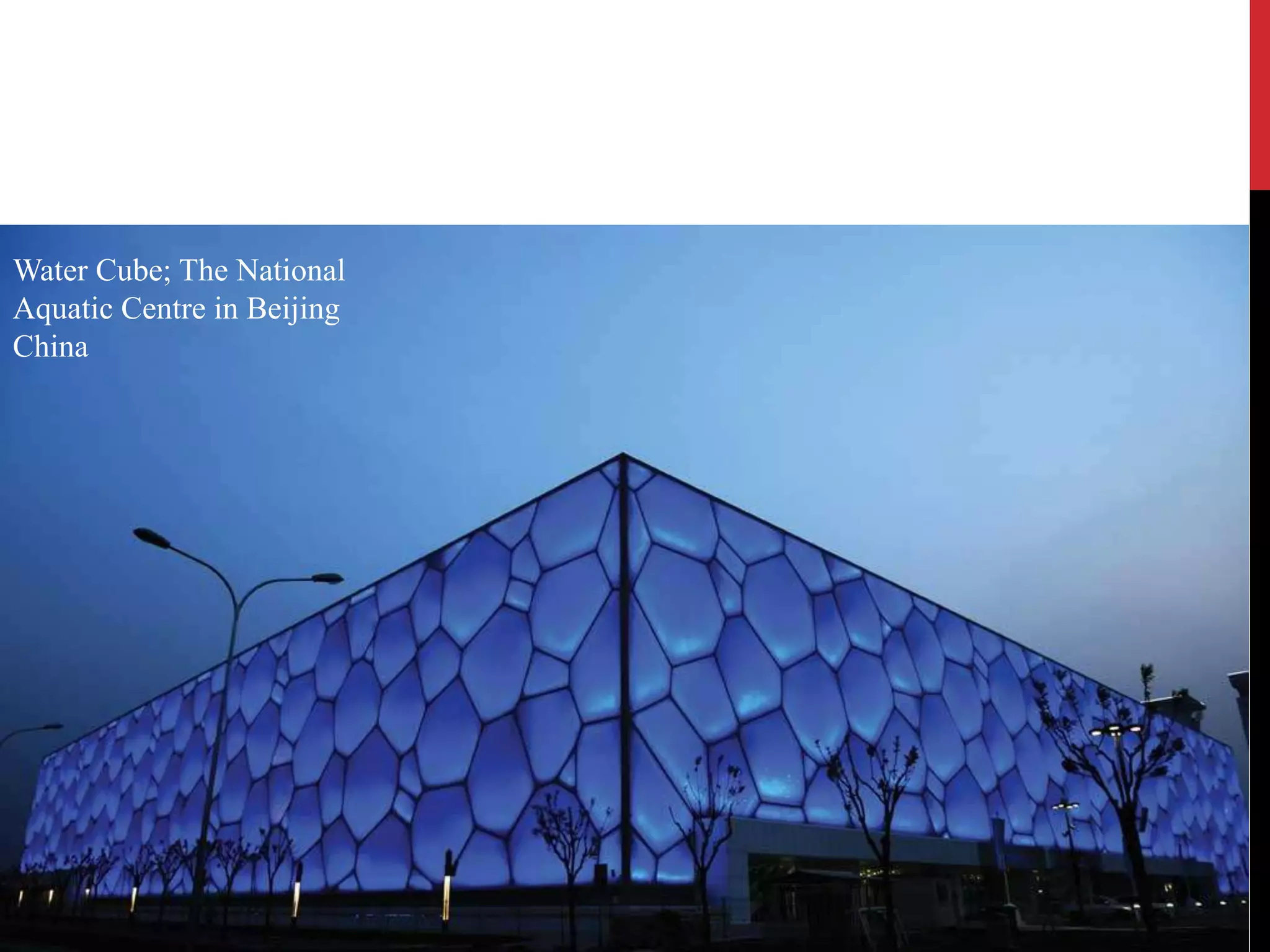
Water Cube; The National 
Aquatic Centre in Beijing 
China
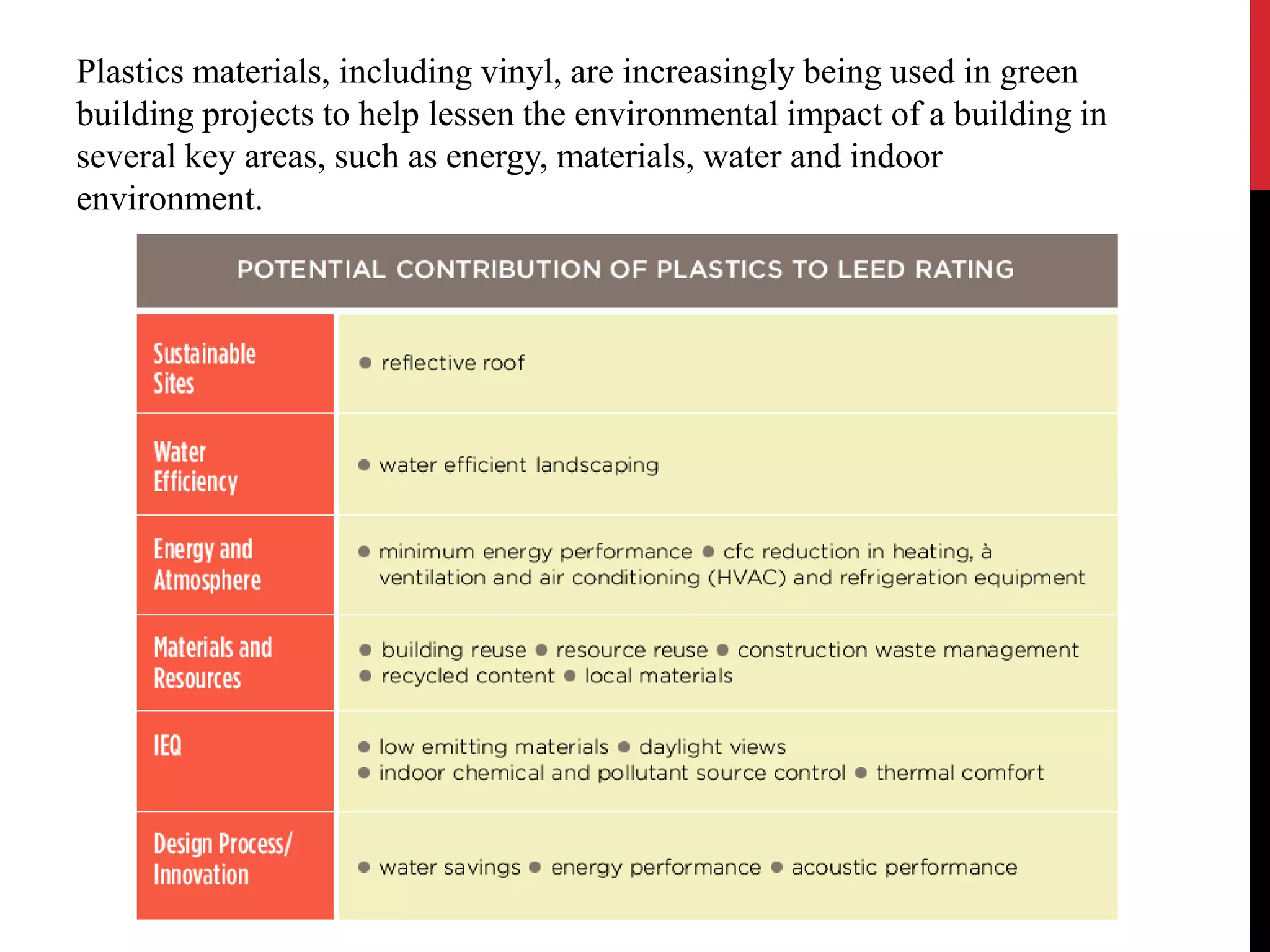
Plastics materials, including vinyl, are increasingly being used in green 
building projects to help lessen the environmental impact of a building in 
several key areas, such as energy, materials, water and indoor 
environment.
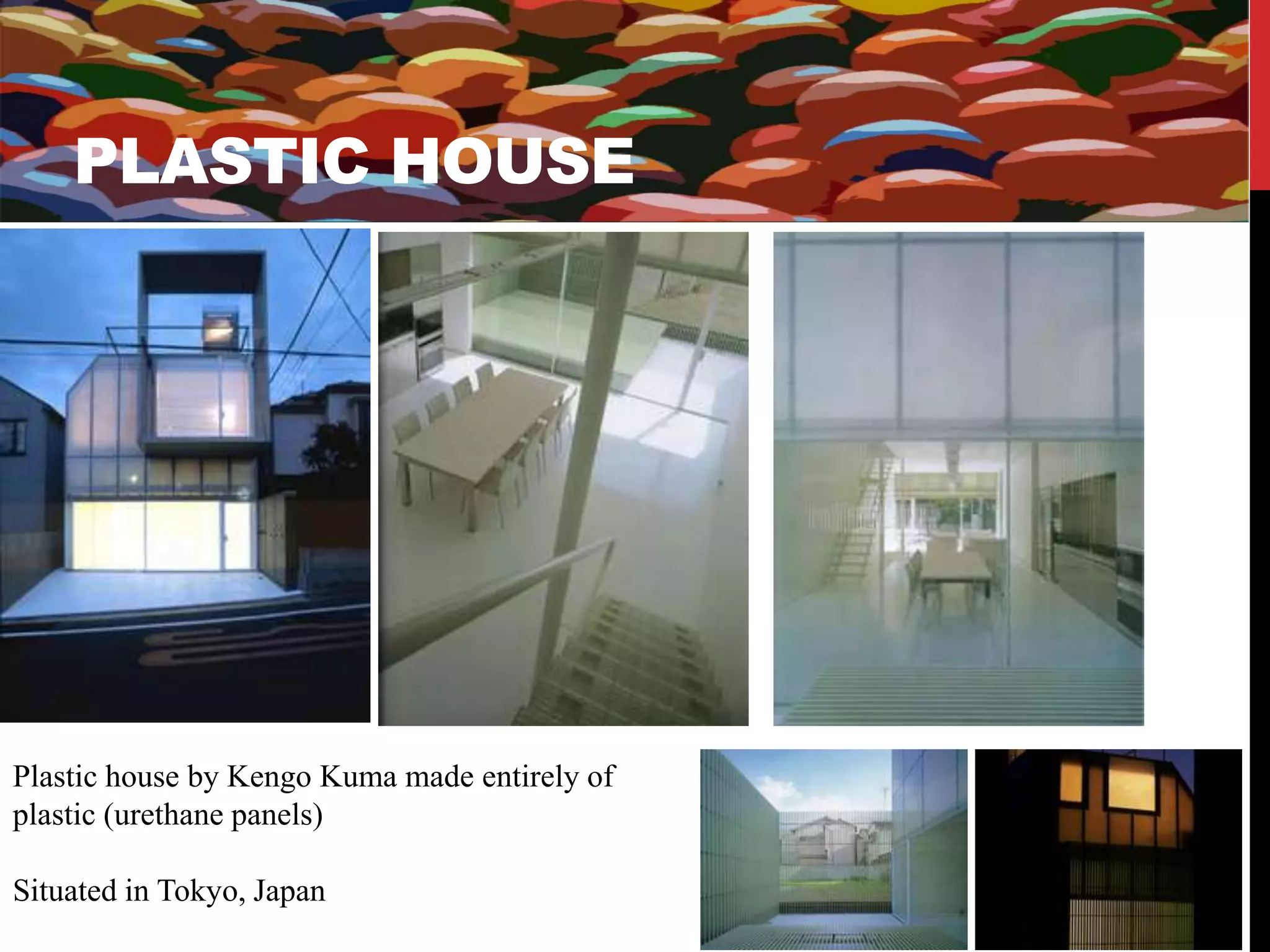
PLASTIC HOUSE 
Plastic house by Kengo Kuma made entirely of 
plastic (urethane panels) 
Situated in Tokyo, Japan
LIMITATIONS – AS A BUILDING MATERIAL 
• Plastics may be degraded under 
the action of direct sunlight 
which reduces their mechanical 
strength. 
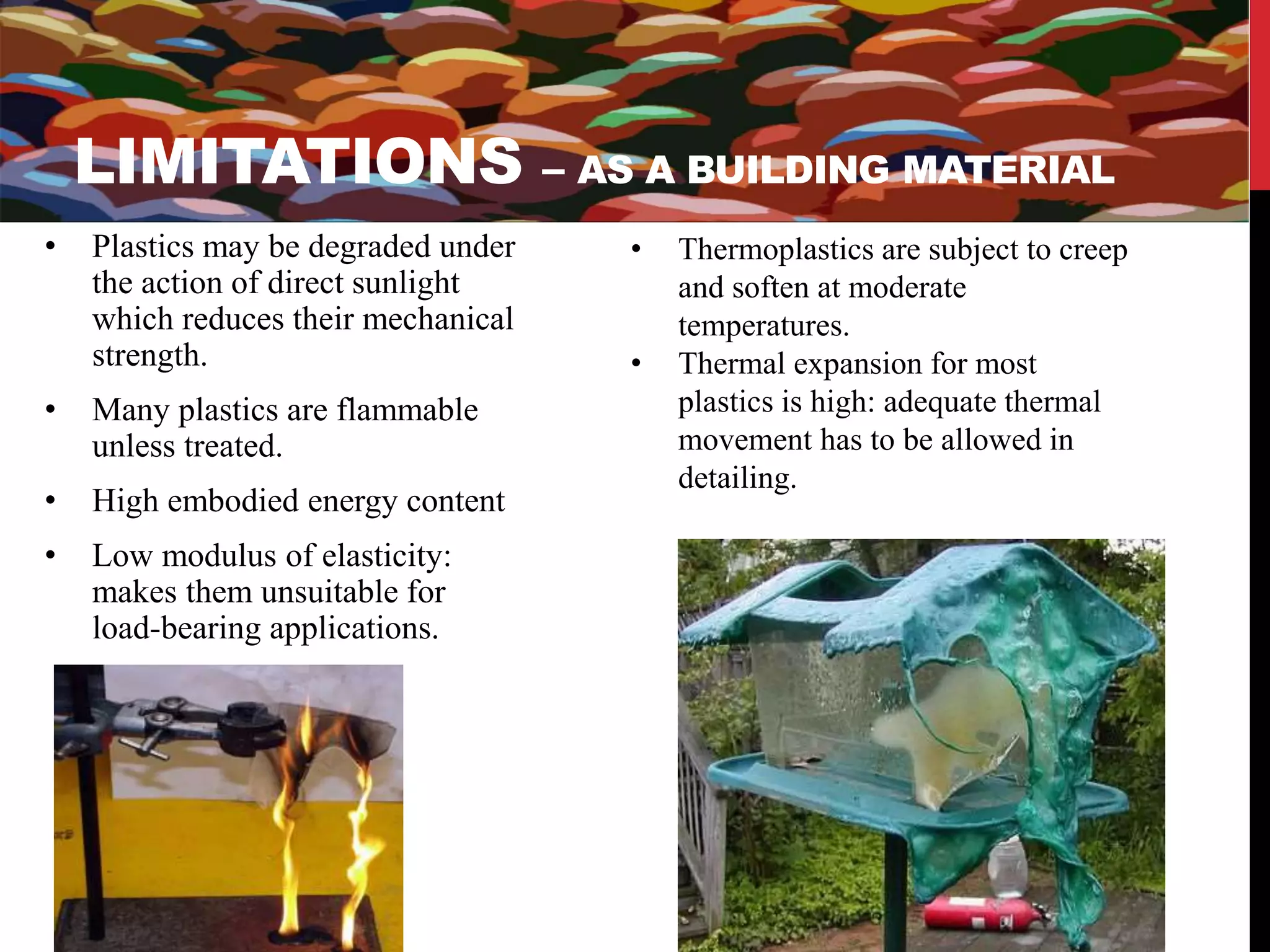
• Many plastics are flammable 
unless treated. 
• High embodied energy content 
• Low modulus of elasticity: 
makes them unsuitable for 
load-bearing applications. 
• Thermoplastics are subject to creep 
and soften at moderate 
temperatures. 
• Thermal expansion for most 
plastics is high: adequate thermal 
movement has to be allowed in 
detailing.
BIBLIOGRAPHY 
BI 
• Building Material and Construction, B.C. Punmia 
• Wikipedia.org 
(http://en.wikipedia.org/wiki/Plastics_in_the_Construction_Industry) 
• BBC (http://www.bbc.com/news/magazine-27442625) 
• Connecticutplastics 
(http://www.connecticutplastics.com/resources/connecticut-plastics-learning-center/ 
an-introduction-to-plastics/) 
• SAB Magazine (http://www.sabmagazine.com/blog/2008/12/18/water-cube/)
THANK YOU!

Plastics: An architectural study

  • 1.
    Fathima SP MariyaFrancis Rajiv Babu
  • 2.
    PLASTIC Plastics areused on a daily basis throughout the world. The word plastic is a common term that is used for many materials of a synthetic or semi-synthetic nature. The term was derived from the Greek plastikos, which means “fit for molding.” One way plastics changed the world was in cost. It was so much cheaper to manufacture than other materials and the various ways it could be used was staggering.
  • 3.
    Due to theirrelatively ease of manufacture, versatility, and imperviousness to water, low cost, plastics are used in an enormous and expanding range of products, from paper clips to spaceships. They have already displaced many traditional materials • wood • stone • horn and bone • leather • paper • metal • glass • and ceramic
  • 4.
    HISTORY The developmentof plastics has evolved from the use of natural plastic materials to the use of chemically modified, natural materials and finally to completely synthetic molecules. Early plastics were bio-derived materials such as egg and blood proteins, which are organic polymers Although hard plastics like Bakelite were used as early as 1909, it wasn’t really big until later. Plastic (LDPE) bowl, by GEECO, Made in England, c1950. HISTORY Bakelite Products
  • 6.
    TYPES OF PLASTIC There are two main types of plastics – Thermoplastics : which are softened by heat and can be moulded. Thermosets : which are formed by heat process but are then set (like concrete) and cannot change shape by reheating. Composites are made by mixing materials together to get enhanced properties.
  • 7.
    Products and uses of Thermoplasts
  • 8.
    Products and usesof Thermosets
  • 9.
    ADVANTAGES ADVANTAGES Lightin weight. Can be easily moulded and have excellent finishing. Possess very good strength and toughness. Corrosion resistant and chemically inert. Low thermal expansion of co-efficient and possess good thermal and electrical insulating property. Very good water resistant and possess good adhesiveness. Strong, good and cheap to produce. Unbreakable.
  • 11.
    DISADVANTAGES DISADVANTAGES •Plastic is a nonrenewable resources • Causes CANCER • Embrittlement at low temperature. • Deformation under load. • Low heat resistant and poor ductility. • Combustibility. • Produces toxic fumes when it is burnt • It is a recycle process, but it is very costly.
  • 12.
    AS A BUILDINGMATERIAL • Plastics are strong yet lightweight, and so they are easy to transport & manoeuvre. • They are durable, knock-and scratch resistant with excellent weatherability. • They do not rot or corrode. • Plastics are easy to install; many have a snap-fit kind of jointing procedures. • Plastics offer limitless possibilities in design achieved by extrusion, bending, moulding etc.
  • 13.
    • They canbe given any range of colours by adding pigments. • The plastics are low conductors of heat and thus are used as insulation materials in green building concepts. • The plastics products can achieve tight seals. • They can be sawn and nailed employing standard carpentry tools and skills. • They can be easily removed and recycled. • They are bad conductors of electricity.
  • 14.
  • 15.
    Pipes : ElectricalConduits, Rain Water & Sewage pipes, Plumbing, Gas Distributions. Cables : PVC Insulation on cables, Insulation Tapes . Floorings : Flooring tiles & Rolls . Domes / sky lights : Opaque as well as transparent. Roofing : Coloured or Double skinned for insulation.
  • 16.
    Windows & doors: Extruded sections for Door and windows and panels. Storage tanks : Storage tanks. Hardware accessories : Washers, Nut bolts, Sleeves, Anchoring wires. Temporary structures: Guard cabins, tents Insulation materials: PVC sheets, insulating membranes.
  • 17.
    PLASTIC FLOORINGS PLASTICFLOORING Available in two types: • Hard polypropylene • Soft PVC. Each type of plastic flooring is incredibly durable. Generally used for Garages, and Warehouses Both types are capable of supporting extreme weight loads and resistant to oils/solvents. PVC is a softer, more pliable option which typically provides a softer flooring for standing or working. This makes it very popular in warehouses and other industrial environments.
  • 18.
    PLASTIC FLOORING LIKEWOOD FINISH WOOD PLASTIC COMPOSITE DECKOING
  • 19.
    PLASTIC WALLS APPLICATIONSFOR PLASTIC WALLS Commercial kitchens Bathrooms Washrooms Canteen Walls and Ceilings Food Processing Areas Changing Areas Fast Food Outlets Food Storage REASON Durable Waterproof Easy to clean Hygienic Wall & Ceilings Cost Effective Easy to Install Choice of colours & styles PLASTIC WALLS
  • 21.
  • 22.
  • 24.
    “GREEN” PLASTIC Atfirst sight, plastics may appear to be a poor fit in the context of green building. Many in the design and construction industry consider plastics “unnatural” and nowhere near as “green” as more traditional materials like wood. However, more considered analysis reveals that plastic building materials bring a lot of advantages to the table, including • energy efficiencies • lower greenhouse gas emissions • durable • effective
  • 25.
    Water Cube; TheNational Aquatic Centre in Beijing China
  • 26.
    Plastics materials, includingvinyl, are increasingly being used in green building projects to help lessen the environmental impact of a building in several key areas, such as energy, materials, water and indoor environment.
  • 27.
    PLASTIC HOUSE Plastichouse by Kengo Kuma made entirely of plastic (urethane panels) Situated in Tokyo, Japan
  • 28.
    LIMITATIONS – ASA BUILDING MATERIAL • Plastics may be degraded under the action of direct sunlight which reduces their mechanical strength. • Many plastics are flammable unless treated. • High embodied energy content • Low modulus of elasticity: makes them unsuitable for load-bearing applications. • Thermoplastics are subject to creep and soften at moderate temperatures. • Thermal expansion for most plastics is high: adequate thermal movement has to be allowed in detailing.
  • 29.
    BIBLIOGRAPHY BI •Building Material and Construction, B.C. Punmia • Wikipedia.org (http://en.wikipedia.org/wiki/Plastics_in_the_Construction_Industry) • BBC (http://www.bbc.com/news/magazine-27442625) • Connecticutplastics (http://www.connecticutplastics.com/resources/connecticut-plastics-learning-center/ an-introduction-to-plastics/) • SAB Magazine (http://www.sabmagazine.com/blog/2008/12/18/water-cube/)
  • 30.