The Geriatric
Depression Scale
Eden Balbas, Melanie Doi, and Alyssa Hirata
Stanbridge University
Eden Balbas, OTS
• University of California, Irvine
• Degree: BA in Social Ecology
• Minor: Education
• Stanbridge University
• Degree: MS in Occupational Therapy
• My experience with geriatric
clients includes...
Melanie Doi, OTS
• University of California, Riverside
• Degree: BS Sociology
• Stanbridge University
• Degree: MS Occupational Therapy
• My experience with geriatrics clients include...
Alyssa Hirata, OTS
• California State University, Long Beach
• Degree: BA Psychology
• Minor: Chemistry
• Stanbridge University
• Degree: MS Occupational Therapy
• My experience with geriatrics clients
include...
Today’s Agenda
1. Introduction
2. Agenda
3. Objectives
4. Key Terms
5. Lecture
6. Community Resources Available
7. Activity: Case Study
8. Summary
9. Quiz
Objectives
By the end of this presentation, the attendees will
be able to:
• Define occupational therapy
• Identify the populations that work with
occupational therapists (OTR)
• Discuss the symptoms of depression
• Distinguish how occupational therapy (OT)
benefits individuals with depression
• Identify how to assist individuals with depression
Objectives (cont.)
• Discuss the causes of depression
• Identify the function of the Geriatric Depression
Scale (GDS)
• Discuss how to administer the GDS
• Describe how the GDS is scored
• Describe how the results of the GDS is interpreted
• Discuss community resources available to
individual with depression, and their family and
friends
Key Terms
1. Clients = individuals receiving occupational therapy
(OT) services
2. Depression= decrease in energy or drive to
participate in the things important to an individual; it’s
a medical diagnosis
3. Geriatrics= the study of the issues and processes of
aging
4. Geriatric Depression Scale= survey screening tool
used to identify depression in older adults
Opp, Ashley. (2017). Occupational therapy and depression: Reconstructing lives. In The American Occupational Therapy Association. Retrieved
from https://www.aota.org/about-occupational-therapy/professionals/mh/articles/depression.aspx
Key Terms (cont.)
5. Life events= a change in an individual’s typical routine,
leading to major changes or adjustments to their life
6. Occupation= everyday activities that have meaning to
an individual and “occupies” their time
7. Occupational therapist (OTR)= the practitioners who
deliver OT services and are responsible for the safety and
efficacy of the OT services
8. Occupational therapy (OT)= a client-centered medical
profession that revolves around the use of occupations
to enable and empower an individual, to participate in life
American Occupational Therapy Association (AOTA). (2014). Occupational therapy practice framework: Domain and process (3rd ed.). American Journal of
Occupational Therapy, 68(Suppl. 1), S1- S48. http://dx.doi.org/10.5014/ajot.2014.682006
xXJEashXx. (2010, March 22). Favorite Pixar's Up scene ever: Ellie and Carl's relationship through time, sad scene. [Video
file]. Retrieved from https://www.youtube.com/watch?v=F2bk_9T482g
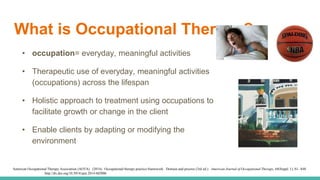
What is Occupational Therapy?
• occupation= everyday, meaningful activities
• Therapeutic use of everyday, meaningful activities
(occupations) across the lifespan
• Holistic approach to treatment using occupations to
facilitate growth or change in the client
• Enable clients by adapting or modifying the
environment
American Occupational Therapy Association (AOTA). (2014). Occupational therapy practice framework: Domain and process (3rd ed.). American Journal of Occupational Therapy, 68(Suppl. 1), S1- S48.
http://dx.doi.org/10.5014/ajot.2014.682006
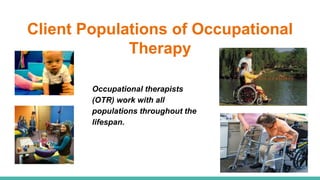
Client Populations of Occupational
Therapy
Occupational therapists
(OTR) work with all
populations throughout the
lifespan.
CHECKPOINT:
Depression is
a normal part
of aging.
FALSE
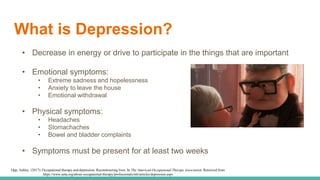
What is Depression?
• Decrease in energy or drive to participate in the things that are important
• Emotional symptoms:
• Extreme sadness and hopelessness
• Anxiety to leave the house
• Emotional withdrawal
• Physical symptoms:
• Headaches
• Stomachaches
• Bowel and bladder complaints
• Symptoms must be present for at least two weeks
Opp, Ashley. (2017). Occupational therapy and depression: Reconstructing lives. In The American Occupational Therapy Association. Retrieved from
https://www.aota.org/about-occupational-therapy/professionals/mh/articles/depression.aspx
Baycrest Health Sciences. (2010, June 10). Story of Don: A story of late-life depression after unexpected retiremen.. [Video file]. Retrieved
from https://www.youtube.com/watch?v=jupO4O0Fg0w&list=LL1x5Tdt3d6ER5Pi3vjRCnYA
Occupational Therapy and
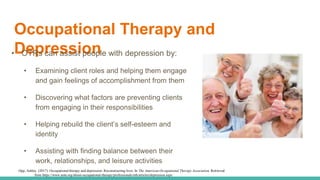
Depression• OTRs can assist people with depression by:
• Examining client roles and helping them engage
and gain feelings of accomplishment from them
• Discovering what factors are preventing clients
from engaging in their responsibilities
• Helping rebuild the client’s self-esteem and
identity
• Assisting with finding balance between their
work, relationships, and leisure activities
Opp, Ashley. (2017). Occupational therapy and depression: Reconstructing lives. In The American Occupational Therapy Association. Retrieved
from https://www.aota.org/about-occupational-therapy/professionals/mh/articles/depression.aspx
How Depression Relates to You
• You may have loved ones who are older adults
(family members or friends 65+ years or older)
• You may observe subtle signs of depression in older
loved ones
• You can discuss how they’re feeling and what they’re
thinking, without using the terms depressed, drugs, therapy,
or other terms that may make them defensive
• Participate in loved one’s medical care if your loved one
gives permission
Depression in the elderly: 7 ways to help. (n.d.). Retrieved from http://www.health.com/health/gallery/0,,20518814,00.html
How Depression Relates to You
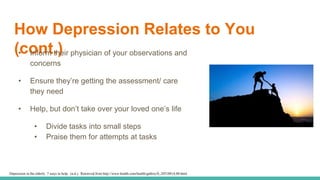
(cont.)• Inform their physician of your observations and
concerns
• Ensure they’re getting the assessment/ care
they need
• Help, but don’t take over your loved one’s life
• Divide tasks into small steps
• Praise them for attempts at tasks
Depression in the elderly: 7 ways to help. (n.d.). Retrieved from http://www.health.com/health/gallery/0,,20518814,00.html
What Causes Depression?
• Life events
• Lack of satisfaction from their relationships
• Death of a loved one
• Loss of independence
• Retirement
• Admission to nursing home or hospital
• Co-occurring illnesses
• Decreased neurotransmitters in the brain- may be genetic
Opp, Ashley. (2017). Occupational therapy and depression: Reconstructing lives. In The American Occupational Therapy Association. Retrieved from
https://www.aota.org/about-occupational-therapy/professionals/mh/articles/depression.aspx
CHECKPOINT:
Think of a time
where an older
adult in your life
may have
experienced
depression.
Would
anyone like
to share?
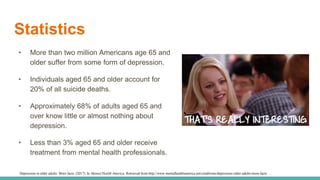
Statistics
• More than two million Americans age 65 and
older suffer from some form of depression.
• Individuals aged 65 and older account for
20% of all suicide deaths.
• Approximately 68% of adults aged 65 and
over know little or almost nothing about
depression.
• Less than 3% aged 65 and older receive
treatment from mental health professionals.
Depression in older adults: More facts. (2017). In Mental Health America. Retrieved from http://www.mentalhealthamerica.net/conditions/depression-older-adults-more-facts
What is the Geriatric Depression
Scale (GDS)?• Self-report screening tool to identify depression in
older adults
• Originally developed as 30-item measure (Geriatric
Depression Scale- Long Form: GDS-L) by J.A.
Yesavage and others
• Newer shortened form is 15-item measure (Geriatric
Depression Scale- Short Form: GDS-S) developed by
J.I. Sheikh and J.A. Yesavage in 1986
American Psychological Association (APA). (2017). Geriatric Depression Scale (GDS). Retrieved from
http://www.apa.org/pi/about/publications/caregivers/practice-settings/assessment/tools/geriatric-depression.aspx
What is the Geriatric Depression
Scale (GDS)? (cont.)
• Research shows the GDS-L and GDS-S are both successful in recognizing
depressive symptoms
• Used with healthy, medically ill, and mild to moderately cognitively impaired
older adults
• Used in any setting: community, acute and long-term care
• Easy to administer and score
○ “Yes/No” format
○ Takes approximately 5-7 minutes to administer
American Psychological Association (APA). (2017). Geriatric Depression Scale (GDS). Retrieved from
http://www.apa.org/pi/about/publications/caregivers/practice-settings/assessment/tools/geriatric-
depression.aspx
Greenberg, S. A. (2007). How to try this: The Geriatric Depression Scale: Short Form. The
American Journal of Nursing. 107(10), 60-69.
https://doi.org/10.1097/01.naj.0000292204.52313.f3
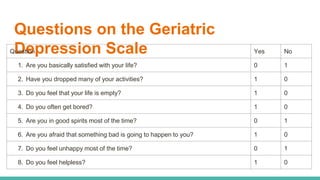
Questions on the Geriatric
Depression ScaleQuestion Yes No
1. Are you basically satisfied with your life? 0 1
2. Have you dropped many of your activities? 1 0
3. Do you feel that your life is empty? 1 0
4. Do you often get bored? 1 0
5. Are you in good spirits most of the time? 0 1
6. Are you afraid that something bad is going to happen to you? 1 0
7. Do you feel unhappy most of the time? 0 1
8. Do you feel helpless? 1 0
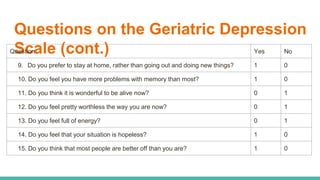
Questions on the Geriatric Depression
Scale (cont.)Question Yes No
9. Do you prefer to stay at home, rather than going out and doing new things? 1 0
10. Do you feel you have more problems with memory than most? 1 0
11. Do you think it is wonderful to be alive now? 0 1
12. Do you feel pretty worthless the way you are now? 0 1
13. Do you feel full of energy? 0 1
14. Do you feel that your situation is hopeless? 1 0
15. Do you think that most people are better off than you are? 1 0
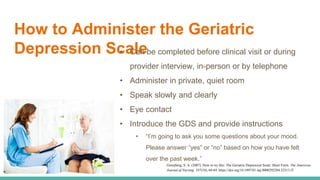
How to Administer the Geriatric
Depression Scale• Can be completed before clinical visit or during
provider interview, in-person or by telephone
• Administer in private, quiet room
• Speak slowly and clearly
• Eye contact
• Introduce the GDS and provide instructions
• “I’m going to ask you some questions about your mood.
Please answer “yes” or “no” based on how you have felt
over the past week.”
Greenberg, S. A. (2007). How to try this: The Geriatric Depression Scale: Short Form. The American
Journal of Nursing. 107(10), 60-69. https://doi.org/10.1097/01.naj.0000292204.52313.f3
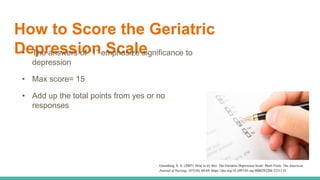
How to Score the Geriatric
Depression Scale• The answers of “1” emphasize significance to
depression
• Max score= 15
• Add up the total points from yes or no
responses
Greenberg, S. A. (2007). How to try this: The Geriatric Depression Scale: Short Form. The American
Journal of Nursing. 107(10), 60-69. https://doi.org/10.1097/01.naj.0000292204.52313.f3
How to Interpret Results
• A score of:
• 0- 4= Normal
• Depending on age, education, and
complaints
• 5- 8= Mild depression
• 9- 11= Moderate depression
• 12- 15= Severe depression
• Scores > 5 suggests depression and indicates a
complete assessment should follow the GDS
• Scores ≥ 10 typically indicates depressionGreenberg, S. A. (2007). How to try this: The Geriatric Depression Scale: Short Form. The American Journal of Nursing. 107(10),
60-69. https://doi.org/10.1097/01.naj.0000292204.52313.f3
Community Resources for Help- LA
County• LA Department of Mental Health
• Older Adults Prevention and Early Intervention Programs
• Coping skills
• Problem Solving Therapy
• LA County Elder Abuse Hotline: (877) 477- 3646
• Suicide Prevention Lifeline: (800) 273- 8255
Websites:
• http://dmh.lacounty.gov/wps/portal/dmh/our_services/
older_adults
• Service area listing:
• http://file.lacounty.gov/SDSInter/dmh/239132_SERVI
CEAREAOAProvlist1-25-16.pdf
Los Angeles County Department of Mental Health. (n.d.). Older adults. Retrieved from http://dmh.lacounty.gov/wps/portal/dmh/our_services/older_adults
Community Resources for Help-
Orange County• OC Health Care Agency: Adult and Older Adult
Behavioral Health
• Services:
• Assessment, evaluation, individual and group
therapy, substance abuse treatment, plan
development, crisis intervention, inpatient services
• Call 866-830-6011 or 714-517-6353 for services
• Suicide Prevention Line: 877-7-CRISIS or
(877) 727-4747
• Deaf and Hard of Hearing Text Line: TEXTME
• Website:
• http://www.ochealthinfo.com/bhs/about/aoabh
OC Health Care Agency. (n.d.). Adult and older adult behavioral health. Retrieved from http://www.ochealthinfo.com/bhs/about/aoabh
Case Study
Your 70-year-old widowed grandmother has planned to move to a nursing home
because she is unable to live on her own. She is no longer able to drive due to
the gradual visual loss she is currently experiencing. Before she became ill, she
loved taking her dog on walks, however, the nursing home she will be moving to
does not allow pets.
1. What are some of the anticipated challenges your grandmother might
experience?
2. How will you deal with this issue?
Summary
• We discussed:
• What is occupational therapy?
• Client population of OT
• What is depression?
• How OT relates to depression
• How depression relates to you
• Causes of depression
• What is the Geriatric Depression Scale (GDS)
• How to administer and interpret results
• Community resources available
• Take home brochure of today’s lecture
Quiz Time
References
American Occupational Therapy Association. (2014). Occupational therapy practice framework: Domain and process (3rd
ed.). American Journal of Occupational Therapy, 68(Suppl. 1), S1- S48. http://dx.doi.org/10.5014/ajot.2014.682006
American Psychological Association. (2017). Geriatric Depression Scale (GDS). Retrieved from
http://www.apa.org/pi/about/publications/caregivers/practice-settings/assessment/tools/geriatric-depression.aspx
Baycrest Health Sciences. (2010, June 10). Story of Don: A story of late-life depression after unexpected retirement. [Video file].
Retrieved from https://www.youtube.com/watch?v=jupO4O0Fg0w&list=LL1x5Tdt3d6ER5Pi3vjRCnYA
Conradsson, M., Rosendahl, E., Littbrand, H., Gustafson, Y., Olofsson, B., & Lovheim, H. (2013). Usefulness of the Geriatric
Depression Scale 15-item version among very old people with and without cognitive impairment. Aging & Mental Health,
17(5), 638-645. http://dx.doi.org/10.1080/13607863.2012.758231
Depression in older adults: More facts. (2017). In Mental Health America. Retrieved from
http://www.mentalhealthamerica.net/conditions/depression-older-adults-more-facts
Depression in the elderly: 7 ways to help. (n.d.). Retrieved from http://www.health.com/health/gallery/0,,20518814,00.html
Greenberg, S. A. (2007). How to try this: The Geriatric Depression Scale: Short Form. The American Journal of Nursing, 107(10),
60-69. https://doi.org/10.1097/01.naj.0000292204.52313.f3
Los Angeles County Department of Mental Health. (n.d.). Older adults. Retrieved from
http://dmh.lacounty.gov/wps/portal/dmh/our_services/older_adults
OC Health Care Agency. (n.d.). Adult and older adult behavioral health. Retrieved from
http://www.ochealthinfo.com/bhs/about/aoabh
References (cont.)
Opp, Ashley. (2017). Occupational therapy and depression: Reconstructing lives. In The American Occupational Therapy Association.
Retrieved from https://www.aota.org/about-occupational-therapy/professionals/mh/articles/depression.aspx
xXJEashXx. (2010, March 22). Favorite Pixar's Up scene ever: Ellie and Carl's relationship through time, sad scene. [Video file].
Retrieved from https://www.youtube.com/watch?v=F2bk_9T482g

Geriatric Depression Scale

  • 1.
    The Geriatric Depression Scale EdenBalbas, Melanie Doi, and Alyssa Hirata Stanbridge University
  • 2.
    Eden Balbas, OTS •University of California, Irvine • Degree: BA in Social Ecology • Minor: Education • Stanbridge University • Degree: MS in Occupational Therapy • My experience with geriatric clients includes...
  • 3.
    Melanie Doi, OTS •University of California, Riverside • Degree: BS Sociology • Stanbridge University • Degree: MS Occupational Therapy • My experience with geriatrics clients include...
  • 4.
    Alyssa Hirata, OTS •California State University, Long Beach • Degree: BA Psychology • Minor: Chemistry • Stanbridge University • Degree: MS Occupational Therapy • My experience with geriatrics clients include...
  • 5.
    Today’s Agenda 1. Introduction 2.Agenda 3. Objectives 4. Key Terms 5. Lecture 6. Community Resources Available 7. Activity: Case Study 8. Summary 9. Quiz
  • 6.
    Objectives By the endof this presentation, the attendees will be able to: • Define occupational therapy • Identify the populations that work with occupational therapists (OTR) • Discuss the symptoms of depression • Distinguish how occupational therapy (OT) benefits individuals with depression • Identify how to assist individuals with depression
  • 7.
    Objectives (cont.) • Discussthe causes of depression • Identify the function of the Geriatric Depression Scale (GDS) • Discuss how to administer the GDS • Describe how the GDS is scored • Describe how the results of the GDS is interpreted • Discuss community resources available to individual with depression, and their family and friends
  • 8.
    Key Terms 1. Clients= individuals receiving occupational therapy (OT) services 2. Depression= decrease in energy or drive to participate in the things important to an individual; it’s a medical diagnosis 3. Geriatrics= the study of the issues and processes of aging 4. Geriatric Depression Scale= survey screening tool used to identify depression in older adults Opp, Ashley. (2017). Occupational therapy and depression: Reconstructing lives. In The American Occupational Therapy Association. Retrieved from https://www.aota.org/about-occupational-therapy/professionals/mh/articles/depression.aspx
  • 9.
    Key Terms (cont.) 5.Life events= a change in an individual’s typical routine, leading to major changes or adjustments to their life 6. Occupation= everyday activities that have meaning to an individual and “occupies” their time 7. Occupational therapist (OTR)= the practitioners who deliver OT services and are responsible for the safety and efficacy of the OT services 8. Occupational therapy (OT)= a client-centered medical profession that revolves around the use of occupations to enable and empower an individual, to participate in life American Occupational Therapy Association (AOTA). (2014). Occupational therapy practice framework: Domain and process (3rd ed.). American Journal of Occupational Therapy, 68(Suppl. 1), S1- S48. http://dx.doi.org/10.5014/ajot.2014.682006
  • 10.
    xXJEashXx. (2010, March22). Favorite Pixar's Up scene ever: Ellie and Carl's relationship through time, sad scene. [Video file]. Retrieved from https://www.youtube.com/watch?v=F2bk_9T482g
  • 11.
    What is OccupationalTherapy? • occupation= everyday, meaningful activities • Therapeutic use of everyday, meaningful activities (occupations) across the lifespan • Holistic approach to treatment using occupations to facilitate growth or change in the client • Enable clients by adapting or modifying the environment American Occupational Therapy Association (AOTA). (2014). Occupational therapy practice framework: Domain and process (3rd ed.). American Journal of Occupational Therapy, 68(Suppl. 1), S1- S48. http://dx.doi.org/10.5014/ajot.2014.682006
  • 12.
    Client Populations ofOccupational Therapy Occupational therapists (OTR) work with all populations throughout the lifespan.
  • 13.
  • 14.
    What is Depression? •Decrease in energy or drive to participate in the things that are important • Emotional symptoms: • Extreme sadness and hopelessness • Anxiety to leave the house • Emotional withdrawal • Physical symptoms: • Headaches • Stomachaches • Bowel and bladder complaints • Symptoms must be present for at least two weeks Opp, Ashley. (2017). Occupational therapy and depression: Reconstructing lives. In The American Occupational Therapy Association. Retrieved from https://www.aota.org/about-occupational-therapy/professionals/mh/articles/depression.aspx
  • 15.
    Baycrest Health Sciences.(2010, June 10). Story of Don: A story of late-life depression after unexpected retiremen.. [Video file]. Retrieved from https://www.youtube.com/watch?v=jupO4O0Fg0w&list=LL1x5Tdt3d6ER5Pi3vjRCnYA
  • 16.
    Occupational Therapy and Depression•OTRs can assist people with depression by: • Examining client roles and helping them engage and gain feelings of accomplishment from them • Discovering what factors are preventing clients from engaging in their responsibilities • Helping rebuild the client’s self-esteem and identity • Assisting with finding balance between their work, relationships, and leisure activities Opp, Ashley. (2017). Occupational therapy and depression: Reconstructing lives. In The American Occupational Therapy Association. Retrieved from https://www.aota.org/about-occupational-therapy/professionals/mh/articles/depression.aspx
  • 17.
    How Depression Relatesto You • You may have loved ones who are older adults (family members or friends 65+ years or older) • You may observe subtle signs of depression in older loved ones • You can discuss how they’re feeling and what they’re thinking, without using the terms depressed, drugs, therapy, or other terms that may make them defensive • Participate in loved one’s medical care if your loved one gives permission Depression in the elderly: 7 ways to help. (n.d.). Retrieved from http://www.health.com/health/gallery/0,,20518814,00.html
  • 18.
    How Depression Relatesto You (cont.)• Inform their physician of your observations and concerns • Ensure they’re getting the assessment/ care they need • Help, but don’t take over your loved one’s life • Divide tasks into small steps • Praise them for attempts at tasks Depression in the elderly: 7 ways to help. (n.d.). Retrieved from http://www.health.com/health/gallery/0,,20518814,00.html
  • 19.
    What Causes Depression? •Life events • Lack of satisfaction from their relationships • Death of a loved one • Loss of independence • Retirement • Admission to nursing home or hospital • Co-occurring illnesses • Decreased neurotransmitters in the brain- may be genetic Opp, Ashley. (2017). Occupational therapy and depression: Reconstructing lives. In The American Occupational Therapy Association. Retrieved from https://www.aota.org/about-occupational-therapy/professionals/mh/articles/depression.aspx
  • 20.
    CHECKPOINT: Think of atime where an older adult in your life may have experienced depression. Would anyone like to share?
  • 21.
    Statistics • More thantwo million Americans age 65 and older suffer from some form of depression. • Individuals aged 65 and older account for 20% of all suicide deaths. • Approximately 68% of adults aged 65 and over know little or almost nothing about depression. • Less than 3% aged 65 and older receive treatment from mental health professionals. Depression in older adults: More facts. (2017). In Mental Health America. Retrieved from http://www.mentalhealthamerica.net/conditions/depression-older-adults-more-facts
  • 22.
    What is theGeriatric Depression Scale (GDS)?• Self-report screening tool to identify depression in older adults • Originally developed as 30-item measure (Geriatric Depression Scale- Long Form: GDS-L) by J.A. Yesavage and others • Newer shortened form is 15-item measure (Geriatric Depression Scale- Short Form: GDS-S) developed by J.I. Sheikh and J.A. Yesavage in 1986 American Psychological Association (APA). (2017). Geriatric Depression Scale (GDS). Retrieved from http://www.apa.org/pi/about/publications/caregivers/practice-settings/assessment/tools/geriatric-depression.aspx
  • 23.
    What is theGeriatric Depression Scale (GDS)? (cont.) • Research shows the GDS-L and GDS-S are both successful in recognizing depressive symptoms • Used with healthy, medically ill, and mild to moderately cognitively impaired older adults • Used in any setting: community, acute and long-term care • Easy to administer and score ○ “Yes/No” format ○ Takes approximately 5-7 minutes to administer American Psychological Association (APA). (2017). Geriatric Depression Scale (GDS). Retrieved from http://www.apa.org/pi/about/publications/caregivers/practice-settings/assessment/tools/geriatric- depression.aspx Greenberg, S. A. (2007). How to try this: The Geriatric Depression Scale: Short Form. The American Journal of Nursing. 107(10), 60-69. https://doi.org/10.1097/01.naj.0000292204.52313.f3
  • 24.
    Questions on theGeriatric Depression ScaleQuestion Yes No 1. Are you basically satisfied with your life? 0 1 2. Have you dropped many of your activities? 1 0 3. Do you feel that your life is empty? 1 0 4. Do you often get bored? 1 0 5. Are you in good spirits most of the time? 0 1 6. Are you afraid that something bad is going to happen to you? 1 0 7. Do you feel unhappy most of the time? 0 1 8. Do you feel helpless? 1 0
  • 25.
    Questions on theGeriatric Depression Scale (cont.)Question Yes No 9. Do you prefer to stay at home, rather than going out and doing new things? 1 0 10. Do you feel you have more problems with memory than most? 1 0 11. Do you think it is wonderful to be alive now? 0 1 12. Do you feel pretty worthless the way you are now? 0 1 13. Do you feel full of energy? 0 1 14. Do you feel that your situation is hopeless? 1 0 15. Do you think that most people are better off than you are? 1 0
  • 26.
    How to Administerthe Geriatric Depression Scale• Can be completed before clinical visit or during provider interview, in-person or by telephone • Administer in private, quiet room • Speak slowly and clearly • Eye contact • Introduce the GDS and provide instructions • “I’m going to ask you some questions about your mood. Please answer “yes” or “no” based on how you have felt over the past week.” Greenberg, S. A. (2007). How to try this: The Geriatric Depression Scale: Short Form. The American Journal of Nursing. 107(10), 60-69. https://doi.org/10.1097/01.naj.0000292204.52313.f3
  • 27.
    How to Scorethe Geriatric Depression Scale• The answers of “1” emphasize significance to depression • Max score= 15 • Add up the total points from yes or no responses Greenberg, S. A. (2007). How to try this: The Geriatric Depression Scale: Short Form. The American Journal of Nursing. 107(10), 60-69. https://doi.org/10.1097/01.naj.0000292204.52313.f3
  • 28.
    How to InterpretResults • A score of: • 0- 4= Normal • Depending on age, education, and complaints • 5- 8= Mild depression • 9- 11= Moderate depression • 12- 15= Severe depression • Scores > 5 suggests depression and indicates a complete assessment should follow the GDS • Scores ≥ 10 typically indicates depressionGreenberg, S. A. (2007). How to try this: The Geriatric Depression Scale: Short Form. The American Journal of Nursing. 107(10), 60-69. https://doi.org/10.1097/01.naj.0000292204.52313.f3
  • 29.
    Community Resources forHelp- LA County• LA Department of Mental Health • Older Adults Prevention and Early Intervention Programs • Coping skills • Problem Solving Therapy • LA County Elder Abuse Hotline: (877) 477- 3646 • Suicide Prevention Lifeline: (800) 273- 8255 Websites: • http://dmh.lacounty.gov/wps/portal/dmh/our_services/ older_adults • Service area listing: • http://file.lacounty.gov/SDSInter/dmh/239132_SERVI CEAREAOAProvlist1-25-16.pdf Los Angeles County Department of Mental Health. (n.d.). Older adults. Retrieved from http://dmh.lacounty.gov/wps/portal/dmh/our_services/older_adults
  • 30.
    Community Resources forHelp- Orange County• OC Health Care Agency: Adult and Older Adult Behavioral Health • Services: • Assessment, evaluation, individual and group therapy, substance abuse treatment, plan development, crisis intervention, inpatient services • Call 866-830-6011 or 714-517-6353 for services • Suicide Prevention Line: 877-7-CRISIS or (877) 727-4747 • Deaf and Hard of Hearing Text Line: TEXTME • Website: • http://www.ochealthinfo.com/bhs/about/aoabh OC Health Care Agency. (n.d.). Adult and older adult behavioral health. Retrieved from http://www.ochealthinfo.com/bhs/about/aoabh
  • 31.
    Case Study Your 70-year-oldwidowed grandmother has planned to move to a nursing home because she is unable to live on her own. She is no longer able to drive due to the gradual visual loss she is currently experiencing. Before she became ill, she loved taking her dog on walks, however, the nursing home she will be moving to does not allow pets. 1. What are some of the anticipated challenges your grandmother might experience? 2. How will you deal with this issue?
  • 32.
    Summary • We discussed: •What is occupational therapy? • Client population of OT • What is depression? • How OT relates to depression • How depression relates to you • Causes of depression • What is the Geriatric Depression Scale (GDS) • How to administer and interpret results • Community resources available • Take home brochure of today’s lecture
  • 33.
  • 34.
    References American Occupational TherapyAssociation. (2014). Occupational therapy practice framework: Domain and process (3rd ed.). American Journal of Occupational Therapy, 68(Suppl. 1), S1- S48. http://dx.doi.org/10.5014/ajot.2014.682006 American Psychological Association. (2017). Geriatric Depression Scale (GDS). Retrieved from http://www.apa.org/pi/about/publications/caregivers/practice-settings/assessment/tools/geriatric-depression.aspx Baycrest Health Sciences. (2010, June 10). Story of Don: A story of late-life depression after unexpected retirement. [Video file]. Retrieved from https://www.youtube.com/watch?v=jupO4O0Fg0w&list=LL1x5Tdt3d6ER5Pi3vjRCnYA Conradsson, M., Rosendahl, E., Littbrand, H., Gustafson, Y., Olofsson, B., & Lovheim, H. (2013). Usefulness of the Geriatric Depression Scale 15-item version among very old people with and without cognitive impairment. Aging & Mental Health, 17(5), 638-645. http://dx.doi.org/10.1080/13607863.2012.758231 Depression in older adults: More facts. (2017). In Mental Health America. Retrieved from http://www.mentalhealthamerica.net/conditions/depression-older-adults-more-facts Depression in the elderly: 7 ways to help. (n.d.). Retrieved from http://www.health.com/health/gallery/0,,20518814,00.html Greenberg, S. A. (2007). How to try this: The Geriatric Depression Scale: Short Form. The American Journal of Nursing, 107(10), 60-69. https://doi.org/10.1097/01.naj.0000292204.52313.f3 Los Angeles County Department of Mental Health. (n.d.). Older adults. Retrieved from http://dmh.lacounty.gov/wps/portal/dmh/our_services/older_adults OC Health Care Agency. (n.d.). Adult and older adult behavioral health. Retrieved from http://www.ochealthinfo.com/bhs/about/aoabh
  • 35.
    References (cont.) Opp, Ashley.(2017). Occupational therapy and depression: Reconstructing lives. In The American Occupational Therapy Association. Retrieved from https://www.aota.org/about-occupational-therapy/professionals/mh/articles/depression.aspx xXJEashXx. (2010, March 22). Favorite Pixar's Up scene ever: Ellie and Carl's relationship through time, sad scene. [Video file]. Retrieved from https://www.youtube.com/watch?v=F2bk_9T482g

Editor's Notes

  • #21  Considering all these different life-events that cause depression, I want you to think of a time where an older adult in your life may have experienced depression. Ex. death of a grandparent