
PHINOJ K ABRAHAM
I I ND M O T S T U D E N T
ALL INDIA INSTITUTE OF PHYSICAL
M E D I C I N E & R E H A B I L I TAT I O N ,
(AIIPM&R) MUMBAI
Overview

2

 Definition of Key Terms

 Clinical Depression
 Clinical Anxiety
 Impact of Depression & Anxiety on Human

life: OT Perspective
 Wellness Program for Depression &
Anxiety
Definitions of Key Terms
3

Fear
 Fear

– is a response to a
known, external, definite, or non conflictual
threat.

Anxiety
 Anxiety

– is a response to threat that is
unknown, internal, vague, or conflictual.

 The main psychological difference b/w the 2 emotional

response is the suddenness of fear and the insidiousness
of anxiety.
Key Terms Cont…
4

Depression
 Is

an emotion charecterized
by “sadness,”
crying, withdrawal from
others, and feeling of in
adequacy.
Intro to Psycho 7th edn, CT Morgan 1993

 Resulting

from a past
experience
Key Terms Cont…

5

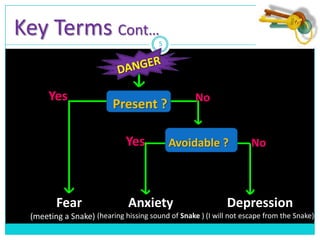
Yes

Present ?

Yes

Fear

No

Avoidable ?

Anxiety

No

Depression

(meeting a Snake) (hearing hissing sound of Snake ) (I will not escape from the Snake)
Key Terms Cont…
6

 Anxiety

 Fear

Future

Present

 Depression

 PTSD

Past
Key Terms Cont…

7

Stress
 Stress

is a condition or feeling experienced when a
person perceives that demands exceed the personal
and social resources the individual is able to mobilize.
Richard S Lazarus

 This

depends on how a person perceives, thinks, and
acts on external events or internal drives.
 Stressors: the situation/events which cause stress.
Cont…
8
Definition of Depression: DSM-IV-TR
9

 Major depressive episodes: Affective disorders
characterized by “sad” feelings & persistent
problems in other areas of life.

Intro to Psycho 7th edn, CT Morgan 1993

 A major depressive disorder occurs without a

history of a manic, mixed, or hypo manic episode.
 DSM-IV: one of the following must be present for at least

two weeks:
 Depressed mood
 Lack of pleasure (anhedonia)
Definitions
10

 Other symptoms:
 Feelings
 Blunt
 Lack

of overwhelming sadness and/or fear

affect

of pleasure

 Weight

gain or loss

 Disturbed

sleep patterns

 Psychomotor
 Fatigue,

agitation nearly every day

mental or physical.
Cont..
11

 Intense

feelings of guilt, nervousness, helplessness,

hopelessness, isolation or anxiety
 Cognitive

problems: concentrating, keeping focus, poor

memory
 Recurrent
 Suicide

thoughts of death

attempt or a specific plan for committing suicide

 A total of five symptoms must be present to diagnose a

major depressive disorder
Some Facts & Figures About Depression
12

 Nearly

5-10% of persons in a community at a given time are
in need of help for depression.
 As much as 8-20% of persons carry the risk of developing
depression during their lifetime.
 The average age of the onset of major depression in
between 20 and 40 years.
 Women have higher rates of depression than men.
 Marital status: depression more common in persons without
close IP relationship / among Divorced single person
 Race or ethnicity does not influence the prevalence of
depression
Ref : Conquering Depression: You can get out of the blues WHO
Causes
13

1. Life experiences & Environmental Stress
 “Stressful life

events more often precede first,
rather than subsequent, episodes of mood
disorders”
 Life event most often associated with development
of depression is losing a parent before age 11.
 The environmental Stressor most often associated
with the episode of depression is the loss of
Spouse.
Causes Cont…
14

2. Personality Factors
 No

single personality trait or type uniquely
predispose a person to depression
 Person with certain personality disorder like
OCD, histrionic & borderline – may be at grater
risk.
Causes Cont…
15

3. Social Interaction
• High frequencies of unpleasant un rewarding events
• Less hope & energy in activities / Social Interactions
• This, make them less rewarding to be around
• Thus others tends to avoid depressed people
• This deepens their depression
Causes Cont…
16

4. Biological factors & Depression
 There are four main biological factors that can

increase a persons risk for depression
 Genetic factors
 Biochemical factors
 Alterations in hormonal regulation
 Sleep abnormalities.
Causes – Psychological Theories
17

1. Psychodynamic Theory
 According

to this theory “depression is resulting from an
overly demanding super ego – one that sets standard too
high for the person to live up to – and from early loss of
attachment figures”
 Un realistic/achievable

Goals – Edward Bibring
 Depressed people have lived for their lives for some one
else (principle, ideal, institution / individual) – Silvano Arieti
 Parents fails to give the child a positive sense of self esteem
& self cohesion – Heinz Kohut (Self Psychological Theory)
 Traumatic childhood events – Johm Bowlby
 Child victimized by a tormenting parent. – Edith Jacobson
Causes – Psychological Theories Cont…
18

2. Cognitive theory
 According

to this theory depression results from
“specific cognitive distortions present in person
susceptible to depression”
 AARON BECK suggest a cognitive triad of depression
that consists of
Views about self – a negative self respect
About the environment – a tendency to experience
the world as hostile & demanding
About the future – the expectation of suffering &
failure.
Causes – Psychological Theories Cont…
19

3. Behavioral Theory
 Learned

Helplessness : this theory connects depressive

phenomena to the experience of uncontrollable life events.
 EX: Dog exposed to repetitive electric shocks from which
they could not escape
Reacted initially
 Then they reminded passively
 According to Behavioral theory “Dog learned that
outcomes were independent of response” so they had
 Cognitive Motivational deficit – not attempted to escape
 Emotional deficit – decreased reactivity.
Causes – Psychological Theories Cont…
20

Behavioral Theory cont…
 In human depression,
 Uncontrollable

stress events produce loss of self

esteem.
 Behavioral theory stresses that “improvement of

depression is dependent on the patients
learning a sense of control & mastery of
environment”
Types of Depressive Disorders
21

 Major Depressive Disorder
 Dysthymic Disorder
 Minor Depressive disorder
 Recurent Brief Depressive disorders
 Full Unipolar Spectrum.
Depression; It’s not only a state of mind.
22

Symptoms of Depression
Emotional Symptoms Include:

Physical Symptoms Include:

Sadness

Vague aches and pains

Loss of interest or pleasure

Headache

Overwhelmed

Sleep disturbances

Anxiety

Fatigue

Diminished ability to think or
concentrate, indecisiveness

Back pain

Excessive or inappropriate guilt

Significant change in appetite
resulting in weight loss or gain

Reference: American Psychiatric Association. Diagnostic and Statistical Manual of Mental
Disorders. Fourth Edition,Text Revision. 2000:345-356,489.
Depression – The Physical Presentation
23

 In primary care, physical symptoms are often the chief

complaint in depressed patients
In a New England
Journal of Medicine
study, 69% of
diagnosed depressed
patients reported
unexplained physical
symptoms as their
chief compliant1
Reference: Simon GE, et al. N Engl J Med. 1999;341(18):1329-1335.
The Importance of Emotional and
Physical Symptoms
24

• 76% of compliant depressed
patients with lingering
symptoms of depression
relapsed within 10 months

94% of depressed
patients who
experienced lingering
symptoms had mild to
moderate physical
symptoms1
Reference: Paykel ES, et al. Psychol Med. 1995;25:1171-1180.
Complications
25











Alcohol abuse
Substance abuse
Anxiety
Heart disease and other medical conditions
Work or school problems
Family conflicts
Relationship difficulties
Social isolation
Suicide
26
Anxiety Disorders
27

 A condition characterized by extreme, chronic anxiety

that disturbs mood, thought, behavior and/or
physiological activity.
www.psychiatric-disorders.com
 Anxiety Disorders: DSM-IV-TR
Panic Disorder
 Agoraphobia
 Social Phobia
 Specific Phobia
 Obessive Compulsive Disorder
 Generalized Anxiety Disorder (GAD) The most commonly diagnosed
 Separationa Anxiety Disorder

Diagnosis
28

 To better differentiate between GAD and other

anxiety or depressive disorders, 4 “first rank”
and at least 1 “second rank” symptoms are
needed
 First





Inability to relax, restlessness
Fatigueability
Exaggerated startle response
Muscle tension
Diagnosis Cont…
29

 First Cont…




Sleep disturbances
Difficulty in concentrating
Irritability

Second






Nausea or abdominal complaints
Dry mouth
Tachycardia
Tremor
Epidemiology
30

 Incidence & Prevalance
 National

prevalence rates of Anxiety Neurosis
Median 18.5 ; Mode 11-70
Indian Journal of Community Medicine
Vol. 26, No. 4 (2001-10 - 2001-12)

 Sex
 Women

: 30.5 % life time prevalence
 Men : 19.2 % life prevalence
National Co-morbidity Study, USA
Anxiety Facts

31

 Most common mental illness in the U.S. with 19

million of the adult (ages 18-54) U.S. population
affected.
 Anxiety is highly treatable (up to 90% of cases), but
only one-third of those who suffer from it receive
treatment
 People with an anxiety disorder are three-to-five times
more likely to go to the doctor and six times more
likely to be hospitalized for psychiatric disorders than
non-sufferers.
 Depression often accompanies anxiety disorders
Ref: 2003 Anxiety Disorders Association of America
Common Causes
32

 There is no one cause for anxiety disorders. Several

factors can play a role
 Genetics
 Brain

biochemistry
 Overactive "fight or flight" response
 Can be caused by too much stress
 Life circumstances/experiances
 Personality
 People who have low self-esteem and poor coping skills
may be more prone
 Certain drugs
 In very rare cases, a tumor of the adrenal gland
(pheochromocytoma) may be the cause of anxiety.
Causes – Psychological Theories
33

1. Psychoanalytic Theories
 Sigmund
I.

II.

Freud distinguished two types of anxiety:
Traumatic – arising from the person being
overwhelmed by stressors
Neurotic – anticipation of negative consequences
that activates defensive processes

2. Behavioural Theory


Postulate that anxiety, is a conditioned response to
a specific stimulus.
Causes – Psychological Theories Cont…
34

3. Existential Theories
 “….

Person experience feeling of living in a
purposeless universe“

4. Charles D. Spielberger’s State–Trait Anxiety
Inventory (STAI)
 State Anxiety : Anxious personality
 Trait Anxiety : momentary anxiety to a stimulus
Symptoms
35

 Anxiety is an emotion often accompanied by

various physical symptoms, including:









Twitching or trembling
Muscle tension
Headaches
Sweating
Dry mouth
Difficulty swallowing
Abdominal pain (may be the only symptom of stress
especially in a child)
Additional Symptoms
36











Dizziness
Rapid or irregular heart rate
Rapid breathing
Diarrhea or frequent need to urinate
Fatigue
Irritability, including loss of your temper
Sleeping difficulties and nightmares
Decreased concentration
Sexual problems
Recent Studies
37

‘Freedom From Fear’ conducted a survey among 410
attendees during National Anxiety Disorders Screening
Day on May 7, 2003. The results :
 An increase in physical aches and pains is directly
attributed to anxiety disorders and depression


60% of the respondents with undiagnosed medical
conditions said that on days when they feel anxious
or depressed, there is a moderate (41%) to severe
(19%) change in their physical symptoms or aches
and pains.
Recent Studies Cont…
38

 These physical symptoms or aches and pains include
 Backaches (13%)
 Vague aches and pains (14%)
 Headaches (14%),
 Digestive pain (11%)

 Dizziness (8%).
 50% of respondents with diagnosed medical conditions, such

as arthritis, migraines, diabetes, heart and respiratory
diseases, reported that on days when they feel anxious or
depressed, there is a moderate (38%) to severe (12%) change
in their physical symptoms or aches and pains.
Complication
39

 Emotional Complication
 risk

for depression
 Substance Abuse
 Physical Complications
 Heart

disease, and high blood pressure
 Sudden death from a heart attack or cardiac event.
 Gastrointestinal disorders
 Migraine and tension headaches
 Obesity as well as anorexia.
Vulnerable People
40

 Students
 Symptoms

of anxiety and symptoms of depression
were prevalent in medical students (43% and
14%, respectively) and in humanities students (52% and
12%, respectively).
International Journal of Social Psychiatry, Vol. 54, No. 6, 494-501 (2008)

 Main

Causes: Improper Time
management, Stress, Personal Demands, body image
perception & acceptance, un healthy Competition etc..
 Job losers & Job seekers


A 2002 study at the University of Michigan found “that secondary
stressors of job loss such as financial strain and loss of personal
control are the true culprits that lead to depression. The study also
found that elevated levels of depression ‘may reduce the likelihood of
reemployment.’”
Cont…
41

 Among workers
 In Unorganized sectors
 out of 457 million workers in India, 395 million (93%) are employed
in the unorganized sectors like construction, agriculture, weaving
and fishing and contribute to about 60% of national income.
 About 7 % of the total work force is employed in the formal or
organized sector
 Suicides epidemic is high in this sector.
 In Organized Sector
 Anxiety & Depression is because of
 Excessive Job demand
 Problems related to payment
 Un safe Job environment
 Job Dissatisfaction / Loosing Interest
Cont…
42

 Among Elderly
 Prevalence of depression 19.8%.
 The elderly living in a nuclear family system were 4.3
times more likely to suffer from depression than
those living in a joint family system
BMC Psychiatry 2007, 7:57doi:10.1186/1471-244X-7-57

 Common

causes:

 Changes within

the family
 Chronic pain and illness
 Difficulty getting around
 Frustration with memory loss
 Loss of a spouse or close friend
Cont…
43

 Among People with Chronic Disabilities
 The rate for depression occurring with other medical
illnesses is quite high:
 Heart attack: 40%-65%
 Coronary artery disease

(without heart attack): 18%-20%
 Parkinson’s disease: 40%
 Multiple sclerosis: 40%
 Stroke: 10%-27%
 Cancer: 25%
 Diabetes: 25%
www.cchs.net/health/health-info/docs/2200/2282.asp?index=9288
 Spinal Cord Injury: 22% - major depressive <2 months post
injury (Krause, Bombardier and Carter, 2008), 11.4% after 1 yr. Krause et al. (2000)
44
Impact of Depression & Anxiety on Human
life: OT Perspective 45
 “From

an occupational therapy
perspective, people with depression (or anxiety)
typically do not have the energy or drive to
participate in the things that are important to
them,”
Lisa Mahaffey, MS, OTR/L,

 OT

Evaluation

Model Of Human
Uniform
n

Occupation (MOHO) Gray Kielhofner

Terminology for Occupational Therapy

3ird
Model Of Human Occupation (MOHO)
46

 The Model of Human occupation seeks to

explain the occupational functioning of
person.
 It focuses on how person choose, order, and
perform in everyday occupational behavior.
 This model also stresses the Motivation for
mastery, control, personal effectiveness & the
need of persons to maintain a positive self –
image.
47

MOHO Conceptualize the Human being as an
Open System
MOHO : Concepts
48

Knowledge of Self

Experience

Decision Making

Physical

Social
Environment
MOHO : Person & Environment
49

Volition

Participation

Occupational Identity

Habituation

Performance

Occupational Adaptation

Performance
Capacity

Skill

Throughput

Output

Occupational Competence

Feedback s

Model of Human Occupation – (based on diagram by Gary Kielhofner)
Evaluation & Intervention Process using MOHO
50

 Evaluation Process


“…. Collect and use data to help clients understand
how their personal perceptions and subjective views
lead to occupational performance actions and
patterns.
Gary Kielhofner

 Therapeutic Intervention


The process of self-maintenance and change is
supported by allowing the person to participate in
freely chosen occupations in therapy
Gary Kielhofner
Case Study
51

 The application of MOHO in the treatment of a patient with

depression in Taiwan: A case study

Methods:
Multiple Chinese version MOHO assessments were applied to her at
initial stage. The therapeutic relationship with the patient was
developed through the discussion of the results of the assessment and
treatment planning.
 Results:
The patient obtained high scores on all symptom checklists and lower
satisfaction of her lifestyle and performance initially. A set of
meaningful occupations were constructed with her and the steps to
apply to her life were negotiated. Before her discharge in a month, her
daily living function, role performance, occupational identification and
competence improved from previous state.
 The MOHO is a useful theoretical base in the clinical assessment and
treatment of patients with minor mental disorder.


Yun-Ling Chen et., al MOHO Center Taiwan, Nov 29, 2008
Uniform Terminology for
Occupational Therapy
52

 According to AOTA, uniform terminology for OT
is “…. indented to provide a generic outline of the
domains of concerns of Occupational Therapy and is
designed to created common terminology for the
profession & to capture the essence of OT for succinctly
others”
 Domains of Concerns are,
 Performance

Areas
 Performance Components
 Performance Contexts
Uniform Terminology Cont…
53



Performance Areas






Performance Components






Activities of Daily Living
Work & productive activities
Play & Leisure activities

Sensory-motor components
Cognitive Integration & Components
Psychosocial Skills & Components

Performance Contexts



Temporal Aspects
Environmental Aspects
54
55

 “Every tomorrow has two handles. We

can take hold of it with the handle of

anxiety or the handle of faith.”
Henry Ward Beecher
Wellness
56

 Wellness is a state of optimal

well-being that is oriented
toward maximizing an
individual’s potential.
 This is a life-long process
 Dimensions: physical,
intellectual, emotional,
social, spiritual, and
environmental well-being.
How? - by adapting patterns of behavior
Wellness Program for Depression & Anxiety
57

Levels


Intra – personal








Creative Self
Coping Self
Essential Self
Physical Self
General Feeling of Well-Being

Inter-personal


Social Self
Creative Self
58

 Thinking. Being mentally active and open-minded. The ability to








be creative and experimental. Having a sense of curiosity. The
ability to apply problem-solving strategies to social conflicts.
Emotions. Being aware of or in touch with your feelings. The
ability to express appropriately positive and negative feelings.
Control. Beliefs about your competence, confidence, and
personal mastery. Beliefs that you can usually achieve the goals
you set out for yourself.
Work. Satisfaction with your work. Feeling that your skills are
used appropriately. Feeling you can manage one’s workload.
Feeling a sense of job security. Feeling appreciated in the work
you do.
Positive Humor. Being able to laugh at your own mistakes. The
ability to use humor to accomplish even serious tasks.
Coping Self
59

 Leisure. Satisfaction with your time spent in leisure.

Feeling that your skills are used appropriately.
 Stress Management. On-going self-assessment of your
coping resources. The ability to organize and manage
resources such as time, energy, and setting limits.
 Self-Worth. Accepting who and what you are, positive
qualities along with imperfections. A sense of being
genuine within yourself and with others.
 Realistic Beliefs. Ability to process information and
perceive reality accurately. The absence of persistent
irrational beliefs and thoughts and need for perfection.
Essential Self
60

 Spirituality. Personal beliefs and behaviors practiced as part of

the recognition that we are more than the material aspects of
mind and body. Belief in a higher power. Hope and optimism.
Practice of worship, prayer, and/or meditation; purpose in life.
Compassion for others. Moral values. Transcendence (a sense
of oneness with the universe).
 Gender Identity. Satisfaction with and feeling supported in
one’s gender. Ability to be androgynous.
 Cultural Identity. Satisfaction with and feeling supported in
one’s cultural identity. Cultural assimilation.
 Self-Care. Taking responsibility for one’s wellness through selfcare and safety habits that are preventive in nature.
Physical Self
61

 Nutrition. Eating a nutritionally balanced diet.

Maintaining a normal weight (within 15% of the ideal).
 Exercise. Engaging in sufficient physical activity through
exercise or in your work to keep in good physical
condition.
General Feeling of Well-Being
62

 Perceived Wellness. The extent to which you believe you

have achieved wellness in all areas, or total wellness. Your
estimate of your total wellness.
 Perceived Safety. The extent to which you believe you are
safe in your home, neighborhood, and community, and
the extent to which you feel safe from harm by terrorists.
 Context. The extent to which your wellness is
influenced, in a conscious manner, by
individual, institutional, and global contexts, and the
extent to which you are aware of and intentional in
responding positively to changes in wellness over time.
Social Self
63

 Friendship. Social relationships that involve a connection

with others individually or in community. Having a
capacity to trust others. Having empathy for others.
Feeling understood by others.
 Love. The ability to be intimate, trusting, self-disclosing
with another. The ability to give as well as express
affection with significant others and to accept others
without conditions.
Implementation of Mental Wellness Program
64

 Among,







Students
Job losers & Job Seekers
Employers/workers
 In Organized Sectors
 In Un organized sectors
Elderly People
People with Disabilities
Students
65

 Methods
 Creating a nurturing learning environment
 Identifying and assisting struggling students
 Counseling
 Promoting self-awareness
 Teaching skills for stress management
 Helping students promote personal health
 Activity Scheduling &Time management
Mayo Clin Proc December 2005;80(12):1613-1622
Job Losers
66

 OT’s can teach/advice/ impliment the following

things
 Stick

to a schedule after losing job
 Spend time each day looking for work.
 Get plenty of exercise
 Enjoy with family during this time of uncertainty
Take your kids to the park or go on a walk.
Volunteer at your kid's school.
 Seek professional help.
Job seekers
67

 By incorporating MOHO concepts, OT’s can do Prevocational

, Work capacity evaluation and can suggest suitable vocation
for the person based on his personal factors
 Aim: “Right Job for Right Person”
 Variables Include;

• Volition
Personal Causation
Values
Interests

• Habituation
Roles
Habits
• Performance
Skills
Employers / workers
68

 In Organized Sectors
 Discuses & find out possible solution for the

problems of employers with the employee.
 Suggest a Nurturing working environment

 Activity Scheduling & Time management

 Arranging Recreational Activities like trips, sports

or cultural activities
 Encourage Meditation, Yoga, Relaxation
techniques activities
 Music Therapy
Employers / workers
69

 In Un-organized Sectors


Social security



Social Support groups




Arranging Community Recreational Activities

Counseling Cells
Elderly People
70

 Early Screening

 Social supports
 Family Support
 Engaging In Fruitful/Productive activities
 Spend More time for Recreational activities
 Relaxation techniques, Yoga, Meditation, Music

Therapy
People with Disabilities
71

 Counseling
 Behavioral Technique : Modeling
 CBT : Biblio-therapy by reading; & Counseling, engaged in

meaningful activities
 Self help groups


EX: MSSI. AAA

 Arranging Recreational Activities, Seminars, Gatherings etc
 Physical Exercises programs
 Good Nutrition
 Self Management skills
 Relaxation techniques, Yoga, Meditation, Music Therapy
72

Wellness Program for Anxiety & depression

  • 1.
    PHINOJ K ABRAHAM II ND M O T S T U D E N T ALL INDIA INSTITUTE OF PHYSICAL M E D I C I N E & R E H A B I L I TAT I O N , (AIIPM&R) MUMBAI
  • 2.
    Overview 2  Definition ofKey Terms  Clinical Depression  Clinical Anxiety  Impact of Depression & Anxiety on Human life: OT Perspective  Wellness Program for Depression & Anxiety
  • 3.
    Definitions of KeyTerms 3 Fear  Fear – is a response to a known, external, definite, or non conflictual threat. Anxiety  Anxiety – is a response to threat that is unknown, internal, vague, or conflictual.  The main psychological difference b/w the 2 emotional response is the suddenness of fear and the insidiousness of anxiety.
  • 4.
    Key Terms Cont… 4 Depression Is an emotion charecterized by “sadness,” crying, withdrawal from others, and feeling of in adequacy. Intro to Psycho 7th edn, CT Morgan 1993  Resulting from a past experience
  • 5.
    Key Terms Cont… 5 Yes Present? Yes Fear No Avoidable ? Anxiety No Depression (meeting a Snake) (hearing hissing sound of Snake ) (I will not escape from the Snake)
  • 6.
    Key Terms Cont… 6 Anxiety  Fear Future Present  Depression  PTSD Past
  • 7.
    Key Terms Cont… 7 Stress Stress is a condition or feeling experienced when a person perceives that demands exceed the personal and social resources the individual is able to mobilize. Richard S Lazarus  This depends on how a person perceives, thinks, and acts on external events or internal drives.  Stressors: the situation/events which cause stress.
  • 8.
  • 9.
    Definition of Depression:DSM-IV-TR 9  Major depressive episodes: Affective disorders characterized by “sad” feelings & persistent problems in other areas of life. Intro to Psycho 7th edn, CT Morgan 1993  A major depressive disorder occurs without a history of a manic, mixed, or hypo manic episode.  DSM-IV: one of the following must be present for at least two weeks:  Depressed mood  Lack of pleasure (anhedonia)
  • 10.
    Definitions 10  Other symptoms: Feelings  Blunt  Lack of overwhelming sadness and/or fear affect of pleasure  Weight gain or loss  Disturbed sleep patterns  Psychomotor  Fatigue, agitation nearly every day mental or physical.
  • 11.
    Cont.. 11  Intense feelings ofguilt, nervousness, helplessness, hopelessness, isolation or anxiety  Cognitive problems: concentrating, keeping focus, poor memory  Recurrent  Suicide thoughts of death attempt or a specific plan for committing suicide  A total of five symptoms must be present to diagnose a major depressive disorder
  • 12.
    Some Facts &Figures About Depression 12  Nearly 5-10% of persons in a community at a given time are in need of help for depression.  As much as 8-20% of persons carry the risk of developing depression during their lifetime.  The average age of the onset of major depression in between 20 and 40 years.  Women have higher rates of depression than men.  Marital status: depression more common in persons without close IP relationship / among Divorced single person  Race or ethnicity does not influence the prevalence of depression Ref : Conquering Depression: You can get out of the blues WHO
  • 13.
    Causes 13 1. Life experiences& Environmental Stress  “Stressful life events more often precede first, rather than subsequent, episodes of mood disorders”  Life event most often associated with development of depression is losing a parent before age 11.  The environmental Stressor most often associated with the episode of depression is the loss of Spouse.
  • 14.
    Causes Cont… 14 2. PersonalityFactors  No single personality trait or type uniquely predispose a person to depression  Person with certain personality disorder like OCD, histrionic & borderline – may be at grater risk.
  • 15.
    Causes Cont… 15 3. SocialInteraction • High frequencies of unpleasant un rewarding events • Less hope & energy in activities / Social Interactions • This, make them less rewarding to be around • Thus others tends to avoid depressed people • This deepens their depression
  • 16.
    Causes Cont… 16 4. Biologicalfactors & Depression  There are four main biological factors that can increase a persons risk for depression  Genetic factors  Biochemical factors  Alterations in hormonal regulation  Sleep abnormalities.
  • 17.
    Causes – PsychologicalTheories 17 1. Psychodynamic Theory  According to this theory “depression is resulting from an overly demanding super ego – one that sets standard too high for the person to live up to – and from early loss of attachment figures”  Un realistic/achievable Goals – Edward Bibring  Depressed people have lived for their lives for some one else (principle, ideal, institution / individual) – Silvano Arieti  Parents fails to give the child a positive sense of self esteem & self cohesion – Heinz Kohut (Self Psychological Theory)  Traumatic childhood events – Johm Bowlby  Child victimized by a tormenting parent. – Edith Jacobson
  • 18.
    Causes – PsychologicalTheories Cont… 18 2. Cognitive theory  According to this theory depression results from “specific cognitive distortions present in person susceptible to depression”  AARON BECK suggest a cognitive triad of depression that consists of Views about self – a negative self respect About the environment – a tendency to experience the world as hostile & demanding About the future – the expectation of suffering & failure.
  • 19.
    Causes – PsychologicalTheories Cont… 19 3. Behavioral Theory  Learned Helplessness : this theory connects depressive phenomena to the experience of uncontrollable life events.  EX: Dog exposed to repetitive electric shocks from which they could not escape Reacted initially  Then they reminded passively  According to Behavioral theory “Dog learned that outcomes were independent of response” so they had  Cognitive Motivational deficit – not attempted to escape  Emotional deficit – decreased reactivity.
  • 20.
    Causes – PsychologicalTheories Cont… 20 Behavioral Theory cont…  In human depression,  Uncontrollable stress events produce loss of self esteem.  Behavioral theory stresses that “improvement of depression is dependent on the patients learning a sense of control & mastery of environment”
  • 21.
    Types of DepressiveDisorders 21  Major Depressive Disorder  Dysthymic Disorder  Minor Depressive disorder  Recurent Brief Depressive disorders  Full Unipolar Spectrum.
  • 22.
    Depression; It’s notonly a state of mind. 22 Symptoms of Depression Emotional Symptoms Include: Physical Symptoms Include: Sadness Vague aches and pains Loss of interest or pleasure Headache Overwhelmed Sleep disturbances Anxiety Fatigue Diminished ability to think or concentrate, indecisiveness Back pain Excessive or inappropriate guilt Significant change in appetite resulting in weight loss or gain Reference: American Psychiatric Association. Diagnostic and Statistical Manual of Mental Disorders. Fourth Edition,Text Revision. 2000:345-356,489.
  • 23.
    Depression – ThePhysical Presentation 23  In primary care, physical symptoms are often the chief complaint in depressed patients In a New England Journal of Medicine study, 69% of diagnosed depressed patients reported unexplained physical symptoms as their chief compliant1 Reference: Simon GE, et al. N Engl J Med. 1999;341(18):1329-1335.
  • 24.
    The Importance ofEmotional and Physical Symptoms 24 • 76% of compliant depressed patients with lingering symptoms of depression relapsed within 10 months 94% of depressed patients who experienced lingering symptoms had mild to moderate physical symptoms1 Reference: Paykel ES, et al. Psychol Med. 1995;25:1171-1180.
  • 25.
    Complications 25          Alcohol abuse Substance abuse Anxiety Heartdisease and other medical conditions Work or school problems Family conflicts Relationship difficulties Social isolation Suicide
  • 26.
  • 27.
    Anxiety Disorders 27  Acondition characterized by extreme, chronic anxiety that disturbs mood, thought, behavior and/or physiological activity. www.psychiatric-disorders.com  Anxiety Disorders: DSM-IV-TR Panic Disorder  Agoraphobia  Social Phobia  Specific Phobia  Obessive Compulsive Disorder  Generalized Anxiety Disorder (GAD) The most commonly diagnosed  Separationa Anxiety Disorder 
  • 28.
    Diagnosis 28  To betterdifferentiate between GAD and other anxiety or depressive disorders, 4 “first rank” and at least 1 “second rank” symptoms are needed  First     Inability to relax, restlessness Fatigueability Exaggerated startle response Muscle tension
  • 29.
    Diagnosis Cont… 29  FirstCont…    Sleep disturbances Difficulty in concentrating Irritability Second     Nausea or abdominal complaints Dry mouth Tachycardia Tremor
  • 30.
    Epidemiology 30  Incidence &Prevalance  National prevalence rates of Anxiety Neurosis Median 18.5 ; Mode 11-70 Indian Journal of Community Medicine Vol. 26, No. 4 (2001-10 - 2001-12)  Sex  Women : 30.5 % life time prevalence  Men : 19.2 % life prevalence National Co-morbidity Study, USA
  • 31.
    Anxiety Facts 31  Mostcommon mental illness in the U.S. with 19 million of the adult (ages 18-54) U.S. population affected.  Anxiety is highly treatable (up to 90% of cases), but only one-third of those who suffer from it receive treatment  People with an anxiety disorder are three-to-five times more likely to go to the doctor and six times more likely to be hospitalized for psychiatric disorders than non-sufferers.  Depression often accompanies anxiety disorders Ref: 2003 Anxiety Disorders Association of America
  • 32.
    Common Causes 32  Thereis no one cause for anxiety disorders. Several factors can play a role  Genetics  Brain biochemistry  Overactive "fight or flight" response  Can be caused by too much stress  Life circumstances/experiances  Personality  People who have low self-esteem and poor coping skills may be more prone  Certain drugs  In very rare cases, a tumor of the adrenal gland (pheochromocytoma) may be the cause of anxiety.
  • 33.
    Causes – PsychologicalTheories 33 1. Psychoanalytic Theories  Sigmund I. II. Freud distinguished two types of anxiety: Traumatic – arising from the person being overwhelmed by stressors Neurotic – anticipation of negative consequences that activates defensive processes 2. Behavioural Theory  Postulate that anxiety, is a conditioned response to a specific stimulus.
  • 34.
    Causes – PsychologicalTheories Cont… 34 3. Existential Theories  “…. Person experience feeling of living in a purposeless universe“ 4. Charles D. Spielberger’s State–Trait Anxiety Inventory (STAI)  State Anxiety : Anxious personality  Trait Anxiety : momentary anxiety to a stimulus
  • 35.
    Symptoms 35  Anxiety isan emotion often accompanied by various physical symptoms, including:        Twitching or trembling Muscle tension Headaches Sweating Dry mouth Difficulty swallowing Abdominal pain (may be the only symptom of stress especially in a child)
  • 36.
    Additional Symptoms 36          Dizziness Rapid orirregular heart rate Rapid breathing Diarrhea or frequent need to urinate Fatigue Irritability, including loss of your temper Sleeping difficulties and nightmares Decreased concentration Sexual problems
  • 37.
    Recent Studies 37 ‘Freedom FromFear’ conducted a survey among 410 attendees during National Anxiety Disorders Screening Day on May 7, 2003. The results :  An increase in physical aches and pains is directly attributed to anxiety disorders and depression  60% of the respondents with undiagnosed medical conditions said that on days when they feel anxious or depressed, there is a moderate (41%) to severe (19%) change in their physical symptoms or aches and pains.
  • 38.
    Recent Studies Cont… 38 These physical symptoms or aches and pains include  Backaches (13%)  Vague aches and pains (14%)  Headaches (14%),  Digestive pain (11%)  Dizziness (8%).  50% of respondents with diagnosed medical conditions, such as arthritis, migraines, diabetes, heart and respiratory diseases, reported that on days when they feel anxious or depressed, there is a moderate (38%) to severe (12%) change in their physical symptoms or aches and pains.
  • 39.
    Complication 39  Emotional Complication risk for depression  Substance Abuse  Physical Complications  Heart disease, and high blood pressure  Sudden death from a heart attack or cardiac event.  Gastrointestinal disorders  Migraine and tension headaches  Obesity as well as anorexia.
  • 40.
    Vulnerable People 40  Students Symptoms of anxiety and symptoms of depression were prevalent in medical students (43% and 14%, respectively) and in humanities students (52% and 12%, respectively). International Journal of Social Psychiatry, Vol. 54, No. 6, 494-501 (2008)  Main Causes: Improper Time management, Stress, Personal Demands, body image perception & acceptance, un healthy Competition etc..  Job losers & Job seekers  A 2002 study at the University of Michigan found “that secondary stressors of job loss such as financial strain and loss of personal control are the true culprits that lead to depression. The study also found that elevated levels of depression ‘may reduce the likelihood of reemployment.’”
  • 41.
    Cont… 41  Among workers In Unorganized sectors  out of 457 million workers in India, 395 million (93%) are employed in the unorganized sectors like construction, agriculture, weaving and fishing and contribute to about 60% of national income.  About 7 % of the total work force is employed in the formal or organized sector  Suicides epidemic is high in this sector.  In Organized Sector  Anxiety & Depression is because of  Excessive Job demand  Problems related to payment  Un safe Job environment  Job Dissatisfaction / Loosing Interest
  • 42.
    Cont… 42  Among Elderly Prevalence of depression 19.8%.  The elderly living in a nuclear family system were 4.3 times more likely to suffer from depression than those living in a joint family system BMC Psychiatry 2007, 7:57doi:10.1186/1471-244X-7-57  Common causes:  Changes within the family  Chronic pain and illness  Difficulty getting around  Frustration with memory loss  Loss of a spouse or close friend
  • 43.
    Cont… 43  Among Peoplewith Chronic Disabilities  The rate for depression occurring with other medical illnesses is quite high:  Heart attack: 40%-65%  Coronary artery disease (without heart attack): 18%-20%  Parkinson’s disease: 40%  Multiple sclerosis: 40%  Stroke: 10%-27%  Cancer: 25%  Diabetes: 25% www.cchs.net/health/health-info/docs/2200/2282.asp?index=9288  Spinal Cord Injury: 22% - major depressive <2 months post injury (Krause, Bombardier and Carter, 2008), 11.4% after 1 yr. Krause et al. (2000)
  • 44.
  • 45.
    Impact of Depression& Anxiety on Human life: OT Perspective 45  “From an occupational therapy perspective, people with depression (or anxiety) typically do not have the energy or drive to participate in the things that are important to them,” Lisa Mahaffey, MS, OTR/L,  OT Evaluation Model Of Human Uniform n Occupation (MOHO) Gray Kielhofner Terminology for Occupational Therapy 3ird
  • 46.
    Model Of HumanOccupation (MOHO) 46  The Model of Human occupation seeks to explain the occupational functioning of person.  It focuses on how person choose, order, and perform in everyday occupational behavior.  This model also stresses the Motivation for mastery, control, personal effectiveness & the need of persons to maintain a positive self – image.
  • 47.
    47 MOHO Conceptualize theHuman being as an Open System
  • 48.
    MOHO : Concepts 48 Knowledgeof Self Experience Decision Making Physical Social Environment
  • 49.
    MOHO : Person& Environment 49 Volition Participation Occupational Identity Habituation Performance Occupational Adaptation Performance Capacity Skill Throughput Output Occupational Competence Feedback s Model of Human Occupation – (based on diagram by Gary Kielhofner)
  • 50.
    Evaluation & InterventionProcess using MOHO 50  Evaluation Process  “…. Collect and use data to help clients understand how their personal perceptions and subjective views lead to occupational performance actions and patterns. Gary Kielhofner  Therapeutic Intervention  The process of self-maintenance and change is supported by allowing the person to participate in freely chosen occupations in therapy Gary Kielhofner
  • 51.
    Case Study 51  Theapplication of MOHO in the treatment of a patient with depression in Taiwan: A case study Methods: Multiple Chinese version MOHO assessments were applied to her at initial stage. The therapeutic relationship with the patient was developed through the discussion of the results of the assessment and treatment planning.  Results: The patient obtained high scores on all symptom checklists and lower satisfaction of her lifestyle and performance initially. A set of meaningful occupations were constructed with her and the steps to apply to her life were negotiated. Before her discharge in a month, her daily living function, role performance, occupational identification and competence improved from previous state.  The MOHO is a useful theoretical base in the clinical assessment and treatment of patients with minor mental disorder.  Yun-Ling Chen et., al MOHO Center Taiwan, Nov 29, 2008
  • 52.
    Uniform Terminology for OccupationalTherapy 52  According to AOTA, uniform terminology for OT is “…. indented to provide a generic outline of the domains of concerns of Occupational Therapy and is designed to created common terminology for the profession & to capture the essence of OT for succinctly others”  Domains of Concerns are,  Performance Areas  Performance Components  Performance Contexts
  • 53.
    Uniform Terminology Cont… 53  PerformanceAreas     Performance Components     Activities of Daily Living Work & productive activities Play & Leisure activities Sensory-motor components Cognitive Integration & Components Psychosocial Skills & Components Performance Contexts   Temporal Aspects Environmental Aspects
  • 54.
  • 55.
    55  “Every tomorrowhas two handles. We can take hold of it with the handle of anxiety or the handle of faith.” Henry Ward Beecher
  • 56.
    Wellness 56  Wellness isa state of optimal well-being that is oriented toward maximizing an individual’s potential.  This is a life-long process  Dimensions: physical, intellectual, emotional, social, spiritual, and environmental well-being. How? - by adapting patterns of behavior
  • 57.
    Wellness Program forDepression & Anxiety 57 Levels  Intra – personal       Creative Self Coping Self Essential Self Physical Self General Feeling of Well-Being Inter-personal  Social Self
  • 58.
    Creative Self 58  Thinking.Being mentally active and open-minded. The ability to     be creative and experimental. Having a sense of curiosity. The ability to apply problem-solving strategies to social conflicts. Emotions. Being aware of or in touch with your feelings. The ability to express appropriately positive and negative feelings. Control. Beliefs about your competence, confidence, and personal mastery. Beliefs that you can usually achieve the goals you set out for yourself. Work. Satisfaction with your work. Feeling that your skills are used appropriately. Feeling you can manage one’s workload. Feeling a sense of job security. Feeling appreciated in the work you do. Positive Humor. Being able to laugh at your own mistakes. The ability to use humor to accomplish even serious tasks.
  • 59.
    Coping Self 59  Leisure.Satisfaction with your time spent in leisure. Feeling that your skills are used appropriately.  Stress Management. On-going self-assessment of your coping resources. The ability to organize and manage resources such as time, energy, and setting limits.  Self-Worth. Accepting who and what you are, positive qualities along with imperfections. A sense of being genuine within yourself and with others.  Realistic Beliefs. Ability to process information and perceive reality accurately. The absence of persistent irrational beliefs and thoughts and need for perfection.
  • 60.
    Essential Self 60  Spirituality.Personal beliefs and behaviors practiced as part of the recognition that we are more than the material aspects of mind and body. Belief in a higher power. Hope and optimism. Practice of worship, prayer, and/or meditation; purpose in life. Compassion for others. Moral values. Transcendence (a sense of oneness with the universe).  Gender Identity. Satisfaction with and feeling supported in one’s gender. Ability to be androgynous.  Cultural Identity. Satisfaction with and feeling supported in one’s cultural identity. Cultural assimilation.  Self-Care. Taking responsibility for one’s wellness through selfcare and safety habits that are preventive in nature.
  • 61.
    Physical Self 61  Nutrition.Eating a nutritionally balanced diet. Maintaining a normal weight (within 15% of the ideal).  Exercise. Engaging in sufficient physical activity through exercise or in your work to keep in good physical condition.
  • 62.
    General Feeling ofWell-Being 62  Perceived Wellness. The extent to which you believe you have achieved wellness in all areas, or total wellness. Your estimate of your total wellness.  Perceived Safety. The extent to which you believe you are safe in your home, neighborhood, and community, and the extent to which you feel safe from harm by terrorists.  Context. The extent to which your wellness is influenced, in a conscious manner, by individual, institutional, and global contexts, and the extent to which you are aware of and intentional in responding positively to changes in wellness over time.
  • 63.
    Social Self 63  Friendship.Social relationships that involve a connection with others individually or in community. Having a capacity to trust others. Having empathy for others. Feeling understood by others.  Love. The ability to be intimate, trusting, self-disclosing with another. The ability to give as well as express affection with significant others and to accept others without conditions.
  • 64.
    Implementation of MentalWellness Program 64  Among,      Students Job losers & Job Seekers Employers/workers  In Organized Sectors  In Un organized sectors Elderly People People with Disabilities
  • 65.
    Students 65  Methods  Creatinga nurturing learning environment  Identifying and assisting struggling students  Counseling  Promoting self-awareness  Teaching skills for stress management  Helping students promote personal health  Activity Scheduling &Time management Mayo Clin Proc December 2005;80(12):1613-1622
  • 66.
    Job Losers 66  OT’scan teach/advice/ impliment the following things  Stick to a schedule after losing job  Spend time each day looking for work.  Get plenty of exercise  Enjoy with family during this time of uncertainty Take your kids to the park or go on a walk. Volunteer at your kid's school.  Seek professional help.
  • 67.
    Job seekers 67  Byincorporating MOHO concepts, OT’s can do Prevocational , Work capacity evaluation and can suggest suitable vocation for the person based on his personal factors  Aim: “Right Job for Right Person”  Variables Include; • Volition Personal Causation Values Interests • Habituation Roles Habits • Performance Skills
  • 68.
    Employers / workers 68 In Organized Sectors  Discuses & find out possible solution for the problems of employers with the employee.  Suggest a Nurturing working environment  Activity Scheduling & Time management  Arranging Recreational Activities like trips, sports or cultural activities  Encourage Meditation, Yoga, Relaxation techniques activities  Music Therapy
  • 69.
    Employers / workers 69 In Un-organized Sectors  Social security  Social Support groups   Arranging Community Recreational Activities Counseling Cells
  • 70.
    Elderly People 70  EarlyScreening  Social supports  Family Support  Engaging In Fruitful/Productive activities  Spend More time for Recreational activities  Relaxation techniques, Yoga, Meditation, Music Therapy
  • 71.
    People with Disabilities 71 Counseling  Behavioral Technique : Modeling  CBT : Biblio-therapy by reading; & Counseling, engaged in meaningful activities  Self help groups  EX: MSSI. AAA  Arranging Recreational Activities, Seminars, Gatherings etc  Physical Exercises programs  Good Nutrition  Self Management skills  Relaxation techniques, Yoga, Meditation, Music Therapy
  • 72.