GERIATRIC DEPRESSION November 13, 2001 Eric Troyer, M.D. Swedish Family Medicine
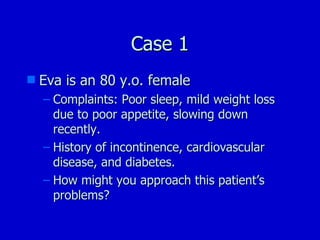
Case 1 Eva is an 80 y.o. female Complaints: Poor sleep, mild weight loss due to poor appetite, slowing down recently. History of incontinence, cardiovascular disease, and diabetes. How might you approach this patient’s problems?
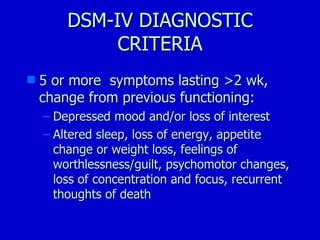
DSM-IV DIAGNOSTIC CRITERIA 5 or more  symptoms lasting >2 wk, change from previous functioning: Depressed mood and/or loss of interest Altered sleep, loss of energy, appetite change or weight loss, feelings of worthlessness/guilt, psychomotor changes, loss of concentration and focus, recurrent thoughts of death
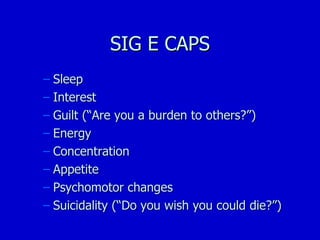
SIG E CAPS Sleep Interest Guilt (“Are you a burden to others?”) Energy Concentration Appetite Psychomotor changes Suicidality (“Do you wish you could die?”)
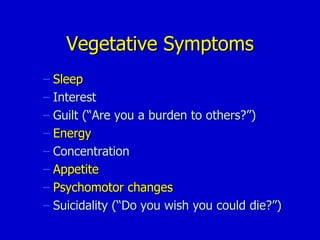
Vegetative Symptoms Sleep Interest Guilt (“Are you a burden to others?”) Energy Concentration Appetite Psychomotor changes Suicidality (“Do you wish you could die?”)
Vegetative Symptoms These can often occur in other medical illnesses Not discriminating or sensitive
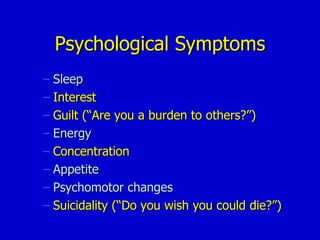
Psychological Symptoms Sleep Interest Guilt (“Are you a burden to others?”) Energy Concentration Appetite Psychomotor changes Suicidality (“Do you wish you could die?”)
Psychological Symptoms More reliable and are independent of age But, elderly patients less willing to talk about psychological problems Pay attention to: anxiety physical discomfort adaptation to a new lifestyle
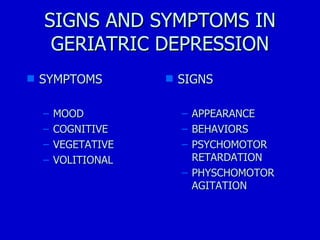
SIGNS AND SYMPTOMS IN GERIATRIC DEPRESSION SYMPTOMS MOOD COGNITIVE VEGETATIVE VOLITIONAL SIGNS APPEARANCE BEHAVIORS PSYCHOMOTOR RETARDATION PHYSCHOMOTOR AGITATION
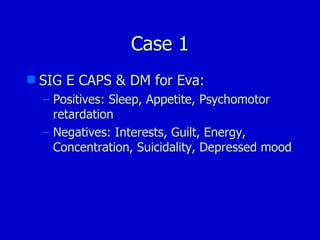
Case 1 SIG E CAPS & DM for Eva: Positives: Sleep, Appetite, Psychomotor retardation Negatives: Interests, Guilt, Energy, Concentration, Suicidality, Depressed mood
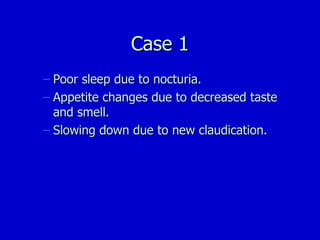
Case 1 Poor sleep due to nocturia. Appetite changes due to decreased taste and smell. Slowing down due to new claudication.
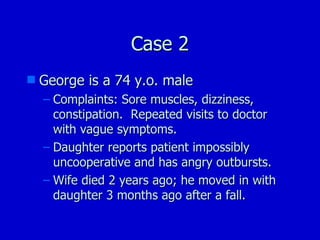
Case 2 George is a 74 y.o. male Complaints: Sore muscles, dizziness, constipation.  Repeated visits to doctor with vague symptoms. Daughter reports patient impossibly uncooperative and has angry outbursts. Wife died 2 years ago; he moved in with daughter 3 months ago after a fall.
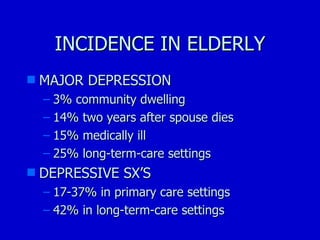
INCIDENCE IN ELDERLY MAJOR DEPRESSION 3% community dwelling 14% two years after spouse dies 15% medically ill 25% long-term-care settings DEPRESSIVE SX’S 17-37% in primary care settings 42% in long-term-care settings
How is Depression Different in the Elderly? Less verbalization of emotions or guilt Minimize or deny depressed mood (“masked depression”) Preoccupied with somatic symptoms 65% have hypochondriacal symptoms Cognitive impairment can be marked Hopelessness appears to be persistent
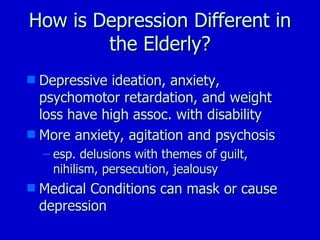
How is Depression Different in the Elderly? Depressive ideation, anxiety, psychomotor retardation, and weight loss have high assoc. with disability More anxiety, agitation and psychosis esp. delusions with themes of guilt, nihilism, persecution, jealousy  Medical Conditions can mask or cause depression
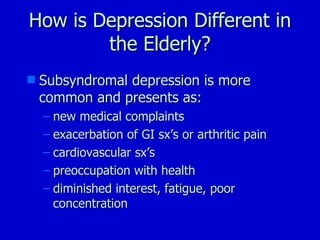
How is Depression Different in the Elderly? Subsyndromal depression is more common and presents as: new medical complaints exacerbation of GI sx’s or arthritic pain cardiovascular sx’s preoccupation with health diminished interest, fatigue, poor concentration
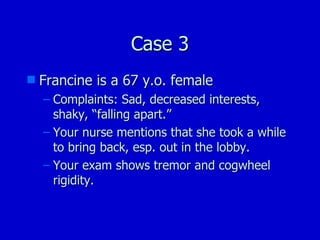
Case 3 Francine is a 67 y.o. female Complaints: Sad, decreased interests, shaky, “falling apart.” Your nurse mentions that she took a while to bring back, esp. out in the lobby. Your exam shows tremor and cogwheel rigidity.
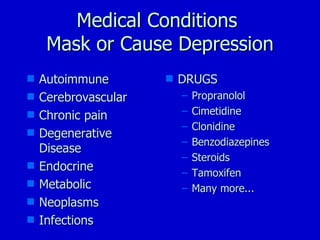
Medical Conditions  Mask or Cause Depression Autoimmune Cerebrovascular  Chronic pain Degenerative Disease Endocrine Metabolic Neoplasms Infections DRUGS Propranolol Cimetidine Clonidine Benzodiazepines Steroids Tamoxifen Many more...
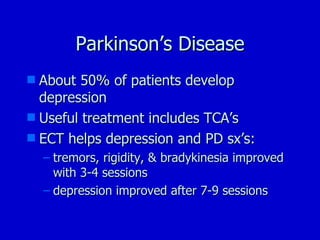
Parkinson’s Disease About 50% of patients develop depression Useful treatment includes TCA’s ECT helps depression and PD sx’s: tremors, rigidity, & bradykinesia improved with 3-4 sessions depression improved after 7-9 sessions
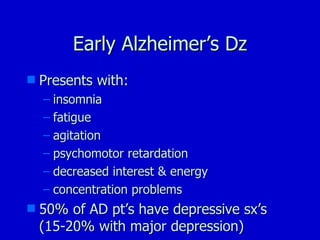
Early Alzheimer’s Dz Presents with: insomnia fatigue agitation psychomotor retardation decreased interest & energy concentration problems 50% of AD pt’s have depressive sx’s (15-20% with major depression)
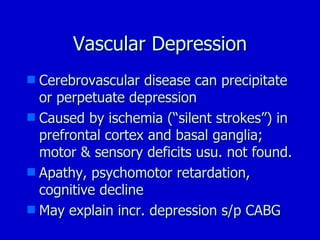
Vascular Depression Cerebrovascular disease can precipitate or perpetuate depression Caused by ischemia (“silent strokes”) in prefrontal cortex and basal ganglia; motor & sensory deficits usu. not found. Apathy, psychomotor retardation, cognitive decline May explain incr. depression s/p CABG
Pseudodementia aka “dementia of depression” cognitive decline that clears if depression is treated however, dementia rate in these patients is still 20%/year even after full recovery of intellectual function
Workup It might include: H & P CBC, TSH, testosterone ESR, renal/liver function U/A EKG brain imaging if tumor or vascular disease suspected
Case 4 Eugene is a 70 y.o. male Dx’d with bladder cancer, had cystectomy and now with Indiana pouch.  Needs to cath through umbilicus q4hr.  His wife recently dx’d with breast cancer. Pt. has single episode of major depression 25 years ago following tough work situation and increased EtOH use.
Case 4 (cont’d) Symptoms: Withdrawn, no interest in activities (not even Mariners games), sleeping excessively, lost 10#, constant worry about cath procedure, belief he is burden to family. Statements like, “I wish I was dead,” and, “my problem will affect this entire hospital.”
Case 4 SIG E CAPS & DM for Eugene: Positives: Sleep, Interests, Guilt/Burden, Energy, Concentration, Appetite, Psychomotor retardation, Suicidal (passive), Depressed mood Additional findings: Nihilistic, Delusional
SUICIDE IS A REAL RISK 25% of all completed suicides are > 65 Suicide rate for depressed men over 65 is 5 times higher than for younger men 20% of older people who committed suicide saw a physician that day Increased risk: financial problems, physical illness, recent loss, EtOH, abuse, isolation
INTERVENTIONS Seek out medical illness Recognize medical side effects Rehab services to maximize remaining function and retrain impaired iADL’s Involve family and caretakers  Counsel re: role transitions, grief, dependency Medications / ECT
GERIATRIC PRESCRIBING PRINCIPLES C Caution, Compliance A Adjust dose for Age R Review, Remove, Reduce E Educate  START LOW & GO SLOW
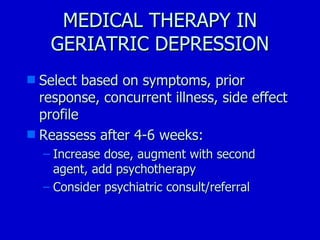
MEDICAL THERAPY IN GERIATRIC DEPRESSION Select based on symptoms, prior response, concurrent illness, side effect profile Reassess after 4-6 weeks: Increase dose, augment with second agent, add psychotherapy Consider psychiatric consult/referral
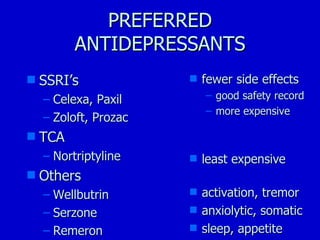
PREFERRED ANTIDEPRESSANTS SSRI’s Celexa, Paxil Zoloft, Prozac TCA Nortriptyline Others Wellbutrin Serzone Remeron fewer side effects good safety record more expensive least expensive  activation, tremor anxiolytic, somatic sleep, appetite
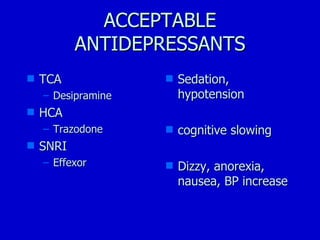
ACCEPTABLE ANTIDEPRESSANTS TCA Desipramine HCA Trazodone SNRI Effexor Sedation, hypotension cognitive slowing Dizzy, anorexia, nausea, BP increase
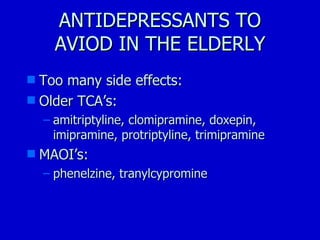
ANTIDEPRESSANTS TO AVIOD IN THE ELDERLY Too many side effects:  Older TCA’s: amitriptyline, clomipramine, doxepin, imipramine, protriptyline, trimipramine MAOI’s: phenelzine, tranylcypromine
Other Drugs Newer atypical anti-psychotics: for “jump start” or behavior issues Risperdal (risperidone), Seroquel (quetiapine), Zyprexa (olanzapine) Psychostimulants for “jump start” or for severe apathy
Electroconvulsive Therapy (ECT) Works well for psychotic depression, high suicide risk, Parkinson’s-related depression, failed drug treatment Very effective short term, but with high relapse rates over next 6-12 months. Drug therapy can reduce relapse

Geriatric Depression

  • 1.
    GERIATRIC DEPRESSION November13, 2001 Eric Troyer, M.D. Swedish Family Medicine
  • 2.
    Case 1 Evais an 80 y.o. female Complaints: Poor sleep, mild weight loss due to poor appetite, slowing down recently. History of incontinence, cardiovascular disease, and diabetes. How might you approach this patient’s problems?
  • 3.
    DSM-IV DIAGNOSTIC CRITERIA5 or more symptoms lasting >2 wk, change from previous functioning: Depressed mood and/or loss of interest Altered sleep, loss of energy, appetite change or weight loss, feelings of worthlessness/guilt, psychomotor changes, loss of concentration and focus, recurrent thoughts of death
  • 4.
    SIG E CAPSSleep Interest Guilt (“Are you a burden to others?”) Energy Concentration Appetite Psychomotor changes Suicidality (“Do you wish you could die?”)
  • 5.
    Vegetative Symptoms SleepInterest Guilt (“Are you a burden to others?”) Energy Concentration Appetite Psychomotor changes Suicidality (“Do you wish you could die?”)
  • 6.
    Vegetative Symptoms Thesecan often occur in other medical illnesses Not discriminating or sensitive
  • 7.
    Psychological Symptoms SleepInterest Guilt (“Are you a burden to others?”) Energy Concentration Appetite Psychomotor changes Suicidality (“Do you wish you could die?”)
  • 8.
    Psychological Symptoms Morereliable and are independent of age But, elderly patients less willing to talk about psychological problems Pay attention to: anxiety physical discomfort adaptation to a new lifestyle
  • 9.
    SIGNS AND SYMPTOMSIN GERIATRIC DEPRESSION SYMPTOMS MOOD COGNITIVE VEGETATIVE VOLITIONAL SIGNS APPEARANCE BEHAVIORS PSYCHOMOTOR RETARDATION PHYSCHOMOTOR AGITATION
  • 10.
    Case 1 SIGE CAPS & DM for Eva: Positives: Sleep, Appetite, Psychomotor retardation Negatives: Interests, Guilt, Energy, Concentration, Suicidality, Depressed mood
  • 11.
    Case 1 Poorsleep due to nocturia. Appetite changes due to decreased taste and smell. Slowing down due to new claudication.
  • 12.
    Case 2 Georgeis a 74 y.o. male Complaints: Sore muscles, dizziness, constipation. Repeated visits to doctor with vague symptoms. Daughter reports patient impossibly uncooperative and has angry outbursts. Wife died 2 years ago; he moved in with daughter 3 months ago after a fall.
  • 13.
    INCIDENCE IN ELDERLYMAJOR DEPRESSION 3% community dwelling 14% two years after spouse dies 15% medically ill 25% long-term-care settings DEPRESSIVE SX’S 17-37% in primary care settings 42% in long-term-care settings
  • 14.
    How is DepressionDifferent in the Elderly? Less verbalization of emotions or guilt Minimize or deny depressed mood (“masked depression”) Preoccupied with somatic symptoms 65% have hypochondriacal symptoms Cognitive impairment can be marked Hopelessness appears to be persistent
  • 15.
    How is DepressionDifferent in the Elderly? Depressive ideation, anxiety, psychomotor retardation, and weight loss have high assoc. with disability More anxiety, agitation and psychosis esp. delusions with themes of guilt, nihilism, persecution, jealousy Medical Conditions can mask or cause depression
  • 16.
    How is DepressionDifferent in the Elderly? Subsyndromal depression is more common and presents as: new medical complaints exacerbation of GI sx’s or arthritic pain cardiovascular sx’s preoccupation with health diminished interest, fatigue, poor concentration
  • 17.
    Case 3 Francineis a 67 y.o. female Complaints: Sad, decreased interests, shaky, “falling apart.” Your nurse mentions that she took a while to bring back, esp. out in the lobby. Your exam shows tremor and cogwheel rigidity.
  • 18.
    Medical Conditions Mask or Cause Depression Autoimmune Cerebrovascular Chronic pain Degenerative Disease Endocrine Metabolic Neoplasms Infections DRUGS Propranolol Cimetidine Clonidine Benzodiazepines Steroids Tamoxifen Many more...
  • 19.
    Parkinson’s Disease About50% of patients develop depression Useful treatment includes TCA’s ECT helps depression and PD sx’s: tremors, rigidity, & bradykinesia improved with 3-4 sessions depression improved after 7-9 sessions
  • 20.
    Early Alzheimer’s DzPresents with: insomnia fatigue agitation psychomotor retardation decreased interest & energy concentration problems 50% of AD pt’s have depressive sx’s (15-20% with major depression)
  • 21.
    Vascular Depression Cerebrovasculardisease can precipitate or perpetuate depression Caused by ischemia (“silent strokes”) in prefrontal cortex and basal ganglia; motor & sensory deficits usu. not found. Apathy, psychomotor retardation, cognitive decline May explain incr. depression s/p CABG
  • 22.
    Pseudodementia aka “dementiaof depression” cognitive decline that clears if depression is treated however, dementia rate in these patients is still 20%/year even after full recovery of intellectual function
  • 23.
    Workup It mightinclude: H & P CBC, TSH, testosterone ESR, renal/liver function U/A EKG brain imaging if tumor or vascular disease suspected
  • 24.
    Case 4 Eugeneis a 70 y.o. male Dx’d with bladder cancer, had cystectomy and now with Indiana pouch. Needs to cath through umbilicus q4hr. His wife recently dx’d with breast cancer. Pt. has single episode of major depression 25 years ago following tough work situation and increased EtOH use.
  • 25.
    Case 4 (cont’d)Symptoms: Withdrawn, no interest in activities (not even Mariners games), sleeping excessively, lost 10#, constant worry about cath procedure, belief he is burden to family. Statements like, “I wish I was dead,” and, “my problem will affect this entire hospital.”
  • 26.
    Case 4 SIGE CAPS & DM for Eugene: Positives: Sleep, Interests, Guilt/Burden, Energy, Concentration, Appetite, Psychomotor retardation, Suicidal (passive), Depressed mood Additional findings: Nihilistic, Delusional
  • 27.
    SUICIDE IS AREAL RISK 25% of all completed suicides are > 65 Suicide rate for depressed men over 65 is 5 times higher than for younger men 20% of older people who committed suicide saw a physician that day Increased risk: financial problems, physical illness, recent loss, EtOH, abuse, isolation
  • 28.
    INTERVENTIONS Seek outmedical illness Recognize medical side effects Rehab services to maximize remaining function and retrain impaired iADL’s Involve family and caretakers Counsel re: role transitions, grief, dependency Medications / ECT
  • 29.
    GERIATRIC PRESCRIBING PRINCIPLESC Caution, Compliance A Adjust dose for Age R Review, Remove, Reduce E Educate START LOW & GO SLOW
  • 30.
    MEDICAL THERAPY INGERIATRIC DEPRESSION Select based on symptoms, prior response, concurrent illness, side effect profile Reassess after 4-6 weeks: Increase dose, augment with second agent, add psychotherapy Consider psychiatric consult/referral
  • 31.
    PREFERRED ANTIDEPRESSANTS SSRI’sCelexa, Paxil Zoloft, Prozac TCA Nortriptyline Others Wellbutrin Serzone Remeron fewer side effects good safety record more expensive least expensive activation, tremor anxiolytic, somatic sleep, appetite
  • 32.
    ACCEPTABLE ANTIDEPRESSANTS TCADesipramine HCA Trazodone SNRI Effexor Sedation, hypotension cognitive slowing Dizzy, anorexia, nausea, BP increase
  • 33.
    ANTIDEPRESSANTS TO AVIODIN THE ELDERLY Too many side effects: Older TCA’s: amitriptyline, clomipramine, doxepin, imipramine, protriptyline, trimipramine MAOI’s: phenelzine, tranylcypromine
  • 34.
    Other Drugs Neweratypical anti-psychotics: for “jump start” or behavior issues Risperdal (risperidone), Seroquel (quetiapine), Zyprexa (olanzapine) Psychostimulants for “jump start” or for severe apathy
  • 35.
    Electroconvulsive Therapy (ECT)Works well for psychotic depression, high suicide risk, Parkinson’s-related depression, failed drug treatment Very effective short term, but with high relapse rates over next 6-12 months. Drug therapy can reduce relapse