Dr. Nidhi Ahya (Asst Prof)
Cardio-Vascular & Respiratory PT
DVVPF College of Physiotherapy
Ahemednagar 414111
Objectives
Introduction to Cardiac Rehabilitation
Definition
Goals of Cardiac Rehabilitation
Benefits of the Program
Indications/Contraindications
Assessment -Pre-enrollment workup
Program Structure- Phase I- Phase IV
Implementation of the Program
Assessment of Outcome
DEFINITION
Cardiac Rehabilitation has been
defined as:
Coordinated, multifaceted
interventions designed to optimize a
cardiac patient’s physical,
psychological, and social
functioning so that they may, by their
own efforts, resume and maintain as
normal a place as possible in the
community
GOALS OF CARDIAC
REHAB
Curtail the pathophysiologic and
psychosocial effects of heart disease
Limit the risk for reinfarction or sudden
death
Relieve cardiac symptoms
Retard or reverse atherosclerosis by
instituting programs for exercise training,
education, counseling, and risk factor
alteration
Reintegrate heart disease patients into
successful functional status in their
families and in society
BENEFITS OF REHAB PROGRAM
Offset deleterious pyschologic and
physiologic effects of bed rest during
hospitalization
Enable patients to return to activities of
daily living within the limits imposed by
their disease
Reduces cardiovascular and total
mortality
Improves myocardial perfusion
Acute myocardial infarction
Coronary artery bypass
grafting
Angioplasty with or without
stenting
Valve replacement or repair
Heart transplantation
Surgery involving the great
vessels
Congestive heart failure
Chronic stable angina pectoris
INDICATIONS
Acute myocardial infarction
Coronary artery bypass
grafting
Angioplasty with or without
stenting
Valve replacement or repair
Heart transplantation
Surgery involving the great
vessels
Congestive heart failure
Chronic stable angina pectoris
INDICATIONS
CONTRAINDICATIONS
Unstable Angina
Uncontrolled Arrhythmias or A-V Block
Resting Systolic Blood Pressure >200
mm hg Resting Diastolic Blood
Pressure >100 mm hg
Recent embolism
Moderate to severe Aortic Stenosis
Acute Systemic illness or fever
Orthopedic problems that would
prohibit exercise
Poorly controlled hypertension
Patients unwilling to exercise 8
CORE COMPONENTS
Patient Assessment
Nutritional Counseling
Weight Management
Blood Pressure Management
Lipid Management
Diabetes Management
Tobacco Cessation
Psychosocial Management
Exercise Training
Physical Activity Counseling 9
REDUCTION IN RISK
FACTORS
Blood lipids
 Significant reductions of total
cholesterol, LDL-cholesterol, and
triglycerides,
 an increase in HDL-cholesterol
with training
10
Hypertension control
 Regular exercise helps keep
arteries elastic (flexible)
 This ensures good blood flow and
normal blood pressure
 Consistent long term exercise can
reslut in atleast 10 to 20mmhg
decrease in both resting and
exercise blood pressure of
hypertension
11
Glucose intolerance
 Lower serum insulin level after
training because of increase in insulin
sensitivity at the cellular level
 Decreased serum triglycerides and
body fat levels
12
CARDIAC REHABILITATION
PROGRAM
PHASE I
Duration: 5 to 7 days.
Components:
– Medical evaluation
– Reassurance and education
– Correction of cardiac misconception
– Risk factor assessment
– Early individualized Mobilization
– Discharge planning
Goals
Assessment of hemodynamic responses to
self-care and progressive ambulation
activities
Determination of the effectiveness of the
patient’s medications in controlling
abnormal responses to activity
Establishment of clinical data that
contribute to the patient’s prognosis and
thus to optimal medical management
Early behavior modification and risk factor
reduction along with family education
Day Protocol
1 Coronary care unit
2 (Stabilization)
3
4 Self-care evaluation
5 Monitored ambulation
6
7 Low-level exercise test
8 Discharge
Step 1- PROM, active ankle exercise,
self-feeding, orientation to program
Step 2- same exercise, legs dangling
at the side of bed
Step 3- AAROM, sitting in chair,
bedside commode, more detailed
explanation of the program, light
recreation, Assissted ADL,Walking
Step 4- minimal resistance, increase
sitting time, patient education, light
activities, independet ADL,walking
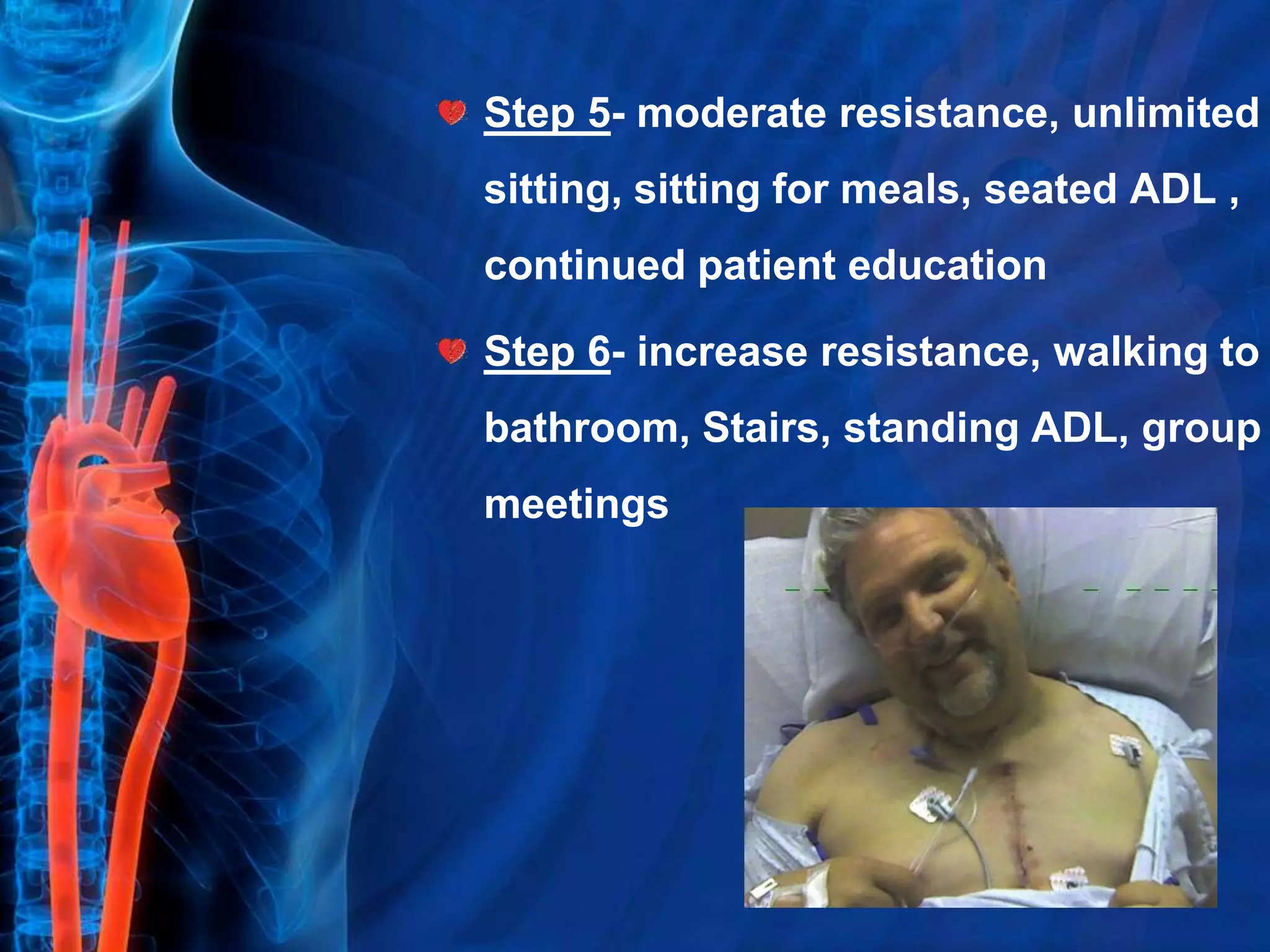
Step 5- moderate resistance, unlimited
sitting, sitting for meals, seated ADL ,
continued patient education
Step 6- increase resistance, walking to
bathroom, Stairs, standing ADL, group
meetings
Step 7- increase exercise program,
review energy-conservation and
pacing techniques.
Step 8- increase exercise with light
weight and increase walking distance,
increase craft activities, discuss home
exercise program
Phase II
Happy to be back HOME……
• Is the immediate post-discharge
phase.
• Duration : 8th day to 6 weeks
• Components:
– Addresses health education
– Exercise
– Stress management
Goals
• Increase exercise capacity and
endurance in a safe and progressive
manner
• Teach the patient to apply
techniques of self-monitoring to
home activities
• Relieve anxiety and depression
• Increase patient’s knowledge
Exercise program
• Frequency: 3-5 times/week
• Intensity: RHR+20 bpm ; RPE<11;
METs=4
• Time: 5-30 minutes; interspersed with
rest periods and progress to about 30
minutes
• Type: sitting/standing functional
activities; ROM exercises; walking
Phase III
The patient has stabilized and requires
ECG monitoring only if signs and
symptoms necessitate.
Duration : 6 weeks to 12 weeks
Begins with symptom limited ETT
Result of this test are used to determine
a target HR for exercise training
Goals
• Improve and maintain physical
fitness
• Provide professional supervision for
exercise
• Continue with educational and
behavioral program
Types of Training
• Steady State Training:
– Is a sustained activity, where
workload and HR are
maintained at a constant sub-
maximal intensity.
– Jogging, walking, stepping and
cycling.
• Interval Training:
– The exercise is followed by a
rest interval.
– Is perceived to be less
demanding than continuous
– High-intensity work can be
achieved as there is
appropriate spacing of work-
relief intervals.
• Circuit Training:
– Employs a series of exercise
activities. At the end of the last
activity, the individual starts from
the beginning and again moves
through the series.
– Improves strength and endurance
by stressing both the aerobic and
anaerobic systems.
Warm-up period
– To increase in muscle
temperature
– Increase need for oxygen
– Dilation of previously constricted
capillaries with increase in
circulation.
– Decreases susceptibility of the
musculoskeletal system to injury
by increasing flexibility.
Exercise Program
• Frequency: 3-4 times/week
• Intensity: 60-70% maximal HR; 12-
13 RPE; 40-60% of VO2 max
• Time: 20-60 minutes; inclusive of
warm up and cool down
• Type: aerobic/endurance training
Cool-down period:
– Prevent pooling of the blood in
the extremities by continuing to
use muscles to maintain
venous return.
– Enhance recovery period with
the oxidation of metabolic
waste and replacement of the
energy stores
Phase IV
Goals
• Continued improvement and
maintenance of fitness.
• Unsupervised exercise program
• Self exercise
• Long term behavioral
modifications
Exercise Program
• Frequency: one session/day;
3-4 days/week
• Intensity: 60-80% of VO2 ; 70-85% of
HRR; RPE 12-15
• Time: desired 30-60 minutes continuous
workout
• Type: dancing, hill walking, resistance
exercise.
Summary
What is Cardiac Rehabilitation
Goals of Cardiac Rehabilitation
Benefits of the Program
Indications & Contraindications
Assessment -Pre-enrollment workup
Program Structure- Phase I- Phase IV
Implementation of the Program
Assessment of Outcome
QUESTION
1. Write the indications, contra indication
and core components of cardiac rehab?
5mrks
2. Write benefits, goals and risk factors of
cardiac rehab? 3mrks
3. Explain phase 1 and phase 2 of cardiac
rehab program? 7mrks
Cardiac rehabilitation

Cardiac rehabilitation

  • 1.
    Dr. Nidhi Ahya(Asst Prof) Cardio-Vascular & Respiratory PT DVVPF College of Physiotherapy Ahemednagar 414111
  • 2.
    Objectives Introduction to CardiacRehabilitation Definition Goals of Cardiac Rehabilitation Benefits of the Program Indications/Contraindications Assessment -Pre-enrollment workup Program Structure- Phase I- Phase IV Implementation of the Program Assessment of Outcome
  • 3.
    DEFINITION Cardiac Rehabilitation hasbeen defined as: Coordinated, multifaceted interventions designed to optimize a cardiac patient’s physical, psychological, and social functioning so that they may, by their own efforts, resume and maintain as normal a place as possible in the community
  • 4.
    GOALS OF CARDIAC REHAB Curtailthe pathophysiologic and psychosocial effects of heart disease Limit the risk for reinfarction or sudden death Relieve cardiac symptoms Retard or reverse atherosclerosis by instituting programs for exercise training, education, counseling, and risk factor alteration Reintegrate heart disease patients into successful functional status in their families and in society
  • 5.
    BENEFITS OF REHABPROGRAM Offset deleterious pyschologic and physiologic effects of bed rest during hospitalization Enable patients to return to activities of daily living within the limits imposed by their disease Reduces cardiovascular and total mortality Improves myocardial perfusion
  • 6.
    Acute myocardial infarction Coronaryartery bypass grafting Angioplasty with or without stenting Valve replacement or repair Heart transplantation Surgery involving the great vessels Congestive heart failure Chronic stable angina pectoris INDICATIONS
  • 7.
    Acute myocardial infarction Coronaryartery bypass grafting Angioplasty with or without stenting Valve replacement or repair Heart transplantation Surgery involving the great vessels Congestive heart failure Chronic stable angina pectoris INDICATIONS
  • 8.
    CONTRAINDICATIONS Unstable Angina Uncontrolled Arrhythmiasor A-V Block Resting Systolic Blood Pressure >200 mm hg Resting Diastolic Blood Pressure >100 mm hg Recent embolism Moderate to severe Aortic Stenosis Acute Systemic illness or fever Orthopedic problems that would prohibit exercise Poorly controlled hypertension Patients unwilling to exercise 8
  • 9.
    CORE COMPONENTS Patient Assessment NutritionalCounseling Weight Management Blood Pressure Management Lipid Management Diabetes Management Tobacco Cessation Psychosocial Management Exercise Training Physical Activity Counseling 9
  • 10.
    REDUCTION IN RISK FACTORS Bloodlipids  Significant reductions of total cholesterol, LDL-cholesterol, and triglycerides,  an increase in HDL-cholesterol with training 10
  • 11.
    Hypertension control  Regularexercise helps keep arteries elastic (flexible)  This ensures good blood flow and normal blood pressure  Consistent long term exercise can reslut in atleast 10 to 20mmhg decrease in both resting and exercise blood pressure of hypertension 11
  • 12.
    Glucose intolerance  Lowerserum insulin level after training because of increase in insulin sensitivity at the cellular level  Decreased serum triglycerides and body fat levels 12
  • 13.
  • 14.
  • 15.
    Duration: 5 to7 days. Components: – Medical evaluation – Reassurance and education – Correction of cardiac misconception – Risk factor assessment – Early individualized Mobilization – Discharge planning
  • 16.
    Goals Assessment of hemodynamicresponses to self-care and progressive ambulation activities Determination of the effectiveness of the patient’s medications in controlling abnormal responses to activity Establishment of clinical data that contribute to the patient’s prognosis and thus to optimal medical management Early behavior modification and risk factor reduction along with family education
  • 17.
    Day Protocol 1 Coronarycare unit 2 (Stabilization) 3 4 Self-care evaluation 5 Monitored ambulation 6 7 Low-level exercise test 8 Discharge
  • 18.
    Step 1- PROM,active ankle exercise, self-feeding, orientation to program Step 2- same exercise, legs dangling at the side of bed Step 3- AAROM, sitting in chair, bedside commode, more detailed explanation of the program, light recreation, Assissted ADL,Walking Step 4- minimal resistance, increase sitting time, patient education, light activities, independet ADL,walking
  • 19.
    Step 5- moderateresistance, unlimited sitting, sitting for meals, seated ADL , continued patient education Step 6- increase resistance, walking to bathroom, Stairs, standing ADL, group meetings
  • 20.
    Step 7- increaseexercise program, review energy-conservation and pacing techniques. Step 8- increase exercise with light weight and increase walking distance, increase craft activities, discuss home exercise program
  • 21.
  • 22.
    Happy to beback HOME…… • Is the immediate post-discharge phase. • Duration : 8th day to 6 weeks • Components: – Addresses health education – Exercise – Stress management
  • 23.
    Goals • Increase exercisecapacity and endurance in a safe and progressive manner • Teach the patient to apply techniques of self-monitoring to home activities • Relieve anxiety and depression • Increase patient’s knowledge
  • 24.
    Exercise program • Frequency:3-5 times/week • Intensity: RHR+20 bpm ; RPE<11; METs=4 • Time: 5-30 minutes; interspersed with rest periods and progress to about 30 minutes • Type: sitting/standing functional activities; ROM exercises; walking
  • 25.
  • 26.
    The patient hasstabilized and requires ECG monitoring only if signs and symptoms necessitate. Duration : 6 weeks to 12 weeks Begins with symptom limited ETT Result of this test are used to determine a target HR for exercise training
  • 27.
    Goals • Improve andmaintain physical fitness • Provide professional supervision for exercise • Continue with educational and behavioral program
  • 28.
    Types of Training •Steady State Training: – Is a sustained activity, where workload and HR are maintained at a constant sub- maximal intensity. – Jogging, walking, stepping and cycling.
  • 29.
    • Interval Training: –The exercise is followed by a rest interval. – Is perceived to be less demanding than continuous – High-intensity work can be achieved as there is appropriate spacing of work- relief intervals.
  • 30.
    • Circuit Training: –Employs a series of exercise activities. At the end of the last activity, the individual starts from the beginning and again moves through the series. – Improves strength and endurance by stressing both the aerobic and anaerobic systems.
  • 31.
    Warm-up period – Toincrease in muscle temperature – Increase need for oxygen – Dilation of previously constricted capillaries with increase in circulation. – Decreases susceptibility of the musculoskeletal system to injury by increasing flexibility.
  • 32.
    Exercise Program • Frequency:3-4 times/week • Intensity: 60-70% maximal HR; 12- 13 RPE; 40-60% of VO2 max • Time: 20-60 minutes; inclusive of warm up and cool down • Type: aerobic/endurance training
  • 33.
    Cool-down period: – Preventpooling of the blood in the extremities by continuing to use muscles to maintain venous return. – Enhance recovery period with the oxidation of metabolic waste and replacement of the energy stores
  • 34.
  • 35.
    Goals • Continued improvementand maintenance of fitness. • Unsupervised exercise program • Self exercise • Long term behavioral modifications
  • 36.
    Exercise Program • Frequency:one session/day; 3-4 days/week • Intensity: 60-80% of VO2 ; 70-85% of HRR; RPE 12-15 • Time: desired 30-60 minutes continuous workout • Type: dancing, hill walking, resistance exercise.
  • 37.
    Summary What is CardiacRehabilitation Goals of Cardiac Rehabilitation Benefits of the Program Indications & Contraindications Assessment -Pre-enrollment workup Program Structure- Phase I- Phase IV Implementation of the Program Assessment of Outcome
  • 38.
    QUESTION 1. Write theindications, contra indication and core components of cardiac rehab? 5mrks 2. Write benefits, goals and risk factors of cardiac rehab? 3mrks 3. Explain phase 1 and phase 2 of cardiac rehab program? 7mrks