What is
DIR/Floortime?
Rachel Emas, Kevin Le, Caitlin Lee,
Taryn Lozon
Rachel Emas
B.A. in Communicative Disorders
M.S. in Occupational Therapy
Kevin Le
B.A. in Liberal Studies
Minor in Mathematics
M.S. in Occupational Therapy
Caitlin Lee
B.S. in Child and Adolescent Studies
M.S. in Occupational Therapy
Taryn Lozon
B.S. in Child and Adolescent Development
M.S. in Occupational Therapy
Objectives
- The learner will become familiar with the DIR model and understand who
DIR is used for
- The learner will recognize the 6 different levels of DIR with the ability to
discuss typical signs of a child at each stage
- The learner will understand the basics of sensory processing
Agenda
Purpose of DIR
What is DIR/Floortime
Key Terms
Parent Education
Population DIR Addresses
ASD
Sensory Processing
6 Levels
Purpose of DIR/ Floortime
- DIR is an approach that addresses the different developmental
milestones of a child.
- Floortime is an umbrella term used under DIR that is used as a technique
to help support children’s emotional and social development
- DIR focuses to:
- Encourage attention and intimacy
- Facilitate two way communication
- Encouraging feelings and logical thoughts
What is DIR/Floortime?
D- “developmental” - the nine distinct levels and different tasks or goals that
are accomplished
I- “Individual-difference”- how each child processes information different
R- “Relation-based”- relationships a child will foster a young age including
parental and therapeutic
DIR/Floortime
Family-first approach during intervention and at home
Built on the foundation of child and parental figures
Treatment is done in child’s naturalistic environment (home or school)
Parents should let child take initiative in activities
Parents should follow child’s lead to promote two way communication
Terms used by Greenspan and Wieder
1. Circle of Communication
a. Child→ adult→ child
2. Functional emotional developmental capacities (FEDC)
a. 6 levels/stages/milestones
3. Affect
a. Expressing emotions through facial expressions, gestures, and body language
4. Affective processing
a. The ability to process and understand thoughts, feelings, and emotions of others
Importance of Parent Education
Parents and/or caregivers know the child best
Can provide ongoing, consistent intervention
Child may respond better to parents
Can help decrease treatment costs
Population DIR Addresses
Normal developing children
DIR can be used to encourage the typical developmental milestone
Autism Spectrum Disorders (ASD)
DIR is typically used with ASD because it addresses social deficits
Developmental Disabilities
ADHD
Intellectual Disability
Fragile X syndrome
Down syndrome
Autism Spectrum Disorder
A developmental disorder that presents itself through deficits in social communication, forming relationships,
repetitive behaviors and function
ASD is considered a spectrum disorder
Symptoms/ behaviors of ASD
Social- emotional reciprocity
Nonverbal communication and behaviors in social interactions and personal relationships
Repetitive motor movements
Inflexibility and patterned behaviors
Fixations
Abnormal responses to sensory stimuli
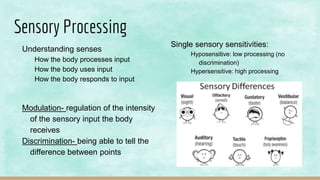
Sensory Processing
Understanding senses
How the body processes input
How the body uses input
How the body responds to input
Modulation- regulation of the intensity
of the sensory input the body
receives
Discrimination- being able to tell the
difference between points
Single sensory sensitivities:
Hyposensitive: low processing (no
discrimination)
Hypersensitive: high processing
6 Levels
1. Self-Regulation and Interest in the World
2. Intimacy, Engagement, and Falling in Love
3. Two-Way Communication
4. Complex Communication,
5. Emotional Ideas
6. Emotional and Logical Thinking
Level 1: Self Regulation & Interest in the World
Mastery age: 3 months
Take interest in world
Receive input through smells, sights, textures, noises, and tastes
Regulate feelings and senses
Translate input into state of calmness and self-regulation
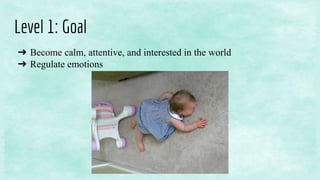
Level 1: Goal
➔ Become calm, attentive, and interested in the world
➔ Regulate emotions
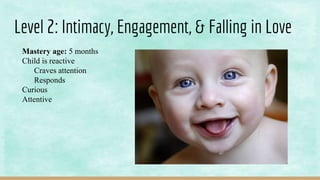
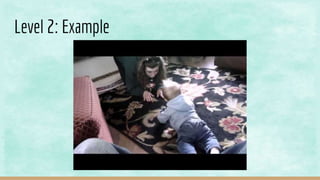
Level 2: Intimacy, Engagement, & Falling in Love
Mastery age: 5 months
Child is reactive
Craves attention
Responds
Curious
Attentive
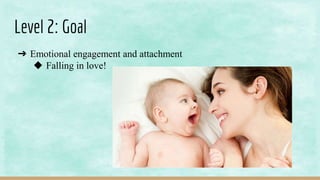
Level 2: Goal
➔ Emotional engagement and attachment
◆ Falling in love!
Level 2: Example
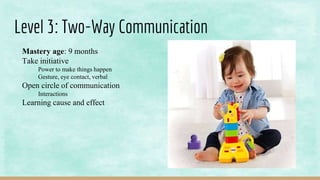
Level 3: Two-Way Communication
Mastery age: 9 months
Take initiative
Power to make things happen
Gesture, eye contact, verbal
Open circle of communication
Interactions
Learning cause and effect
Level 3: Goal
➔ Becoming a two-way communicator
◆ Opening and closing circles of communication
◆ Initiation
◆ Begin to understand affect
● Smile is happy; frown is sad
◆ Begin to understand symbolism
● Stepping stone for verbalization
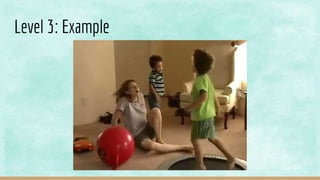
Level 3: Example
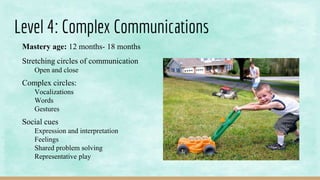
Level 4: Complex Communications
Mastery age: 12 months- 18 months
Stretching circles of communication
Open and close
Complex circles:
Vocalizations
Words
Gestures
Social cues
Expression and interpretation
Feelings
Shared problem solving
Representative play
Level 4: Goal
➔ Using a series of interactive emotional signals or gestures to
communicate
◆ Approx: 10+ circles of communication
◆ Growing patience with their current means of communication
● Specific gestures
● Sounds and words
● Able to initiate communication to deal and resolve distress
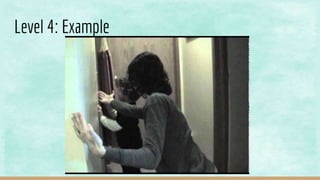
Level 4: Example
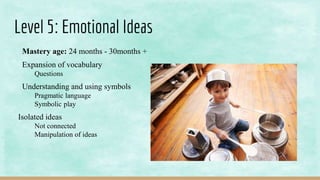
Level 5: Emotional Ideas
Mastery age: 24 months - 30months +
Expansion of vocabulary
Questions
Understanding and using symbols
Pragmatic language
Symbolic play
Isolated ideas
Not connected
Manipulation of ideas
Level 5: Goal
➔ Using symbols or ideas to convey feelings or intentions
◆ Creates dramas and play
◆ Partakes in rule following
● Motor games
◆ Expresses feelings, wishes, and intentions
● Words
● Multiple gestures used
● Touch
● Recovery from distress
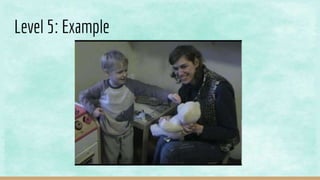
Level 5: Example
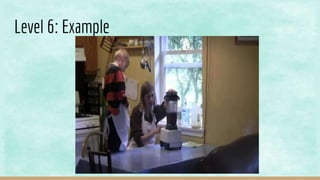
Level 6: Emotional and Logical Thinking
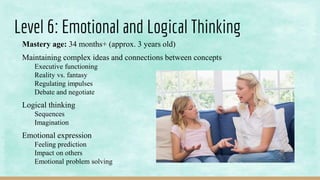
Mastery age: 34 months+ (approx. 3 years old)
Maintaining complex ideas and connections between concepts
Executive functioning
Reality vs. fantasy
Regulating impulses
Debate and negotiate
Logical thinking
Sequences
Imagination
Emotional expression
Feeling prediction
Impact on others
Emotional problem solving
Level 6: Goal
➔ Building bridges between ideas
◆ Even if illogical
➔ Child can connect his/her ideas together
◆ Seeking opinions
◆ Enlarging his/her pretend dramas
● Playing spatial games
● Building off real events
● To recover from stressful situations
➔ Closes 2 or more verbal circles of communication
Level 6: Example
Family dynamics and DIR
Family stress arises when raising a child with a developmental disorder
Stress is shown through rigid and anxiety
Balance is achieved when looking at caregiver’s strengths and weakness
Family Challenges
Hard day at work
Relationship troubles
Displacement (defense mechanism)
Taking anger out on someone/something else
Floortime Coaching
Parents need to remain flexible and calm during DIR/Floortime
Children are able to sense tense and angry voices
Parents need to
Be able to anticipate the child’s next move
Be flexible if the child does not do as expected
Siblings
May feel jealous, anxious, or worried
May play a protective role or aggressive role
Sibling should be involved in family challenges
Avoids exclusion
Can assist parents with DIR/Floortime
Parents can train the sibling in how to open and close the circles of communication
Cultural Considerations
22.9% of US citizens report being a minority
Different beliefs
Personal space
Household responsibilities
Perceptions of authority
Parent Involvement
Language barrier
Difficult understanding therapy and neuroscience jargon
Conclusion
DIR according to Greenspan and Wieder
Developmental disorders
Parent Education
6 Levels
Family Dynamics
Cultural Consideration
Let’s See How Much You Learned!
References
Bastable, S., Gramet, P., Jacobs, K. & Sopczyk, D.L. (2011). Health Professionals as Educator: Teaching and Learning.
Boston, MA: Jones and Bartlett. IBSN 987-0763792787
Davies, A. (2006). [Connecting through play: A parent education workshop]. Unpublished raw data.
DeGangi, G. A., & Greenspan, S. I. (n.d.). Functional Emotional Assessment Scale. Retrieved
from http://www.icdl.com/research/functional-emotional-assessment-scale
Greenspan, S. I. & Wieder, S. (2006). Engaging autism. Philadelphia, PA: Da Capo Press.
U.S. Census Bureau (2015). Population estimates quick facts, United States summary. Washington, DC: Author.

What is DIR / Floortime?

  • 1.
    What is DIR/Floortime? Rachel Emas,Kevin Le, Caitlin Lee, Taryn Lozon
  • 2.
    Rachel Emas B.A. inCommunicative Disorders M.S. in Occupational Therapy
  • 3.
    Kevin Le B.A. inLiberal Studies Minor in Mathematics M.S. in Occupational Therapy
  • 4.
    Caitlin Lee B.S. inChild and Adolescent Studies M.S. in Occupational Therapy
  • 5.
    Taryn Lozon B.S. inChild and Adolescent Development M.S. in Occupational Therapy
  • 6.
    Objectives - The learnerwill become familiar with the DIR model and understand who DIR is used for - The learner will recognize the 6 different levels of DIR with the ability to discuss typical signs of a child at each stage - The learner will understand the basics of sensory processing
  • 7.
    Agenda Purpose of DIR Whatis DIR/Floortime Key Terms Parent Education Population DIR Addresses ASD Sensory Processing 6 Levels
  • 8.
    Purpose of DIR/Floortime - DIR is an approach that addresses the different developmental milestones of a child. - Floortime is an umbrella term used under DIR that is used as a technique to help support children’s emotional and social development - DIR focuses to: - Encourage attention and intimacy - Facilitate two way communication - Encouraging feelings and logical thoughts
  • 9.
    What is DIR/Floortime? D-“developmental” - the nine distinct levels and different tasks or goals that are accomplished I- “Individual-difference”- how each child processes information different R- “Relation-based”- relationships a child will foster a young age including parental and therapeutic
  • 10.
    DIR/Floortime Family-first approach duringintervention and at home Built on the foundation of child and parental figures Treatment is done in child’s naturalistic environment (home or school) Parents should let child take initiative in activities Parents should follow child’s lead to promote two way communication
  • 11.
    Terms used byGreenspan and Wieder 1. Circle of Communication a. Child→ adult→ child 2. Functional emotional developmental capacities (FEDC) a. 6 levels/stages/milestones 3. Affect a. Expressing emotions through facial expressions, gestures, and body language 4. Affective processing a. The ability to process and understand thoughts, feelings, and emotions of others
  • 12.
    Importance of ParentEducation Parents and/or caregivers know the child best Can provide ongoing, consistent intervention Child may respond better to parents Can help decrease treatment costs
  • 13.
    Population DIR Addresses Normaldeveloping children DIR can be used to encourage the typical developmental milestone Autism Spectrum Disorders (ASD) DIR is typically used with ASD because it addresses social deficits Developmental Disabilities ADHD Intellectual Disability Fragile X syndrome Down syndrome
  • 14.
    Autism Spectrum Disorder Adevelopmental disorder that presents itself through deficits in social communication, forming relationships, repetitive behaviors and function ASD is considered a spectrum disorder Symptoms/ behaviors of ASD Social- emotional reciprocity Nonverbal communication and behaviors in social interactions and personal relationships Repetitive motor movements Inflexibility and patterned behaviors Fixations Abnormal responses to sensory stimuli
  • 15.
    Sensory Processing Understanding senses Howthe body processes input How the body uses input How the body responds to input Modulation- regulation of the intensity of the sensory input the body receives Discrimination- being able to tell the difference between points Single sensory sensitivities: Hyposensitive: low processing (no discrimination) Hypersensitive: high processing
  • 16.
    6 Levels 1. Self-Regulationand Interest in the World 2. Intimacy, Engagement, and Falling in Love 3. Two-Way Communication 4. Complex Communication, 5. Emotional Ideas 6. Emotional and Logical Thinking
  • 17.
    Level 1: SelfRegulation & Interest in the World Mastery age: 3 months Take interest in world Receive input through smells, sights, textures, noises, and tastes Regulate feelings and senses Translate input into state of calmness and self-regulation
  • 18.
    Level 1: Goal ➔Become calm, attentive, and interested in the world ➔ Regulate emotions
  • 19.
    Level 2: Intimacy,Engagement, & Falling in Love Mastery age: 5 months Child is reactive Craves attention Responds Curious Attentive
  • 20.
    Level 2: Goal ➔Emotional engagement and attachment ◆ Falling in love!
  • 21.
  • 22.
    Level 3: Two-WayCommunication Mastery age: 9 months Take initiative Power to make things happen Gesture, eye contact, verbal Open circle of communication Interactions Learning cause and effect
  • 23.
    Level 3: Goal ➔Becoming a two-way communicator ◆ Opening and closing circles of communication ◆ Initiation ◆ Begin to understand affect ● Smile is happy; frown is sad ◆ Begin to understand symbolism ● Stepping stone for verbalization
  • 24.
  • 25.
    Level 4: ComplexCommunications Mastery age: 12 months- 18 months Stretching circles of communication Open and close Complex circles: Vocalizations Words Gestures Social cues Expression and interpretation Feelings Shared problem solving Representative play
  • 26.
    Level 4: Goal ➔Using a series of interactive emotional signals or gestures to communicate ◆ Approx: 10+ circles of communication ◆ Growing patience with their current means of communication ● Specific gestures ● Sounds and words ● Able to initiate communication to deal and resolve distress
  • 27.
  • 28.
    Level 5: EmotionalIdeas Mastery age: 24 months - 30months + Expansion of vocabulary Questions Understanding and using symbols Pragmatic language Symbolic play Isolated ideas Not connected Manipulation of ideas
  • 29.
    Level 5: Goal ➔Using symbols or ideas to convey feelings or intentions ◆ Creates dramas and play ◆ Partakes in rule following ● Motor games ◆ Expresses feelings, wishes, and intentions ● Words ● Multiple gestures used ● Touch ● Recovery from distress
  • 30.
  • 31.
    Level 6: Emotionaland Logical Thinking Mastery age: 34 months+ (approx. 3 years old) Maintaining complex ideas and connections between concepts Executive functioning Reality vs. fantasy Regulating impulses Debate and negotiate Logical thinking Sequences Imagination Emotional expression Feeling prediction Impact on others Emotional problem solving
  • 32.
    Level 6: Goal ➔Building bridges between ideas ◆ Even if illogical ➔ Child can connect his/her ideas together ◆ Seeking opinions ◆ Enlarging his/her pretend dramas ● Playing spatial games ● Building off real events ● To recover from stressful situations ➔ Closes 2 or more verbal circles of communication
  • 33.
  • 34.
    Family dynamics andDIR Family stress arises when raising a child with a developmental disorder Stress is shown through rigid and anxiety Balance is achieved when looking at caregiver’s strengths and weakness Family Challenges Hard day at work Relationship troubles Displacement (defense mechanism) Taking anger out on someone/something else
  • 35.
    Floortime Coaching Parents needto remain flexible and calm during DIR/Floortime Children are able to sense tense and angry voices Parents need to Be able to anticipate the child’s next move Be flexible if the child does not do as expected
  • 36.
    Siblings May feel jealous,anxious, or worried May play a protective role or aggressive role Sibling should be involved in family challenges Avoids exclusion Can assist parents with DIR/Floortime Parents can train the sibling in how to open and close the circles of communication
  • 37.
    Cultural Considerations 22.9% ofUS citizens report being a minority Different beliefs Personal space Household responsibilities Perceptions of authority Parent Involvement Language barrier Difficult understanding therapy and neuroscience jargon
  • 38.
    Conclusion DIR according toGreenspan and Wieder Developmental disorders Parent Education 6 Levels Family Dynamics Cultural Consideration
  • 39.
    Let’s See HowMuch You Learned!
  • 40.
    References Bastable, S., Gramet,P., Jacobs, K. & Sopczyk, D.L. (2011). Health Professionals as Educator: Teaching and Learning. Boston, MA: Jones and Bartlett. IBSN 987-0763792787 Davies, A. (2006). [Connecting through play: A parent education workshop]. Unpublished raw data. DeGangi, G. A., & Greenspan, S. I. (n.d.). Functional Emotional Assessment Scale. Retrieved from http://www.icdl.com/research/functional-emotional-assessment-scale Greenspan, S. I. & Wieder, S. (2006). Engaging autism. Philadelphia, PA: Da Capo Press. U.S. Census Bureau (2015). Population estimates quick facts, United States summary. Washington, DC: Author.

Editor's Notes

  • #7 Taryn
  • #8 Taryn
  • #9 Taryn
  • #10 Taryn Development: refers to the growth of a child or individual in routine stages. Individual: Each child develops at their own pace, time frame and with distinct characteristics. Relationship:
  • #11 Taryn
  • #12 Rachel
  • #13 Kevin Study done by Kaiser & Roberts showed that parents who received training in enhanced milieu training increased their use of responsive interaction with their children at home after a year of training was completed
  • #14 Taryn
  • #15 Taryn
  • #16 Caitlin Modulation: Over or under Dysregulation: attention or emotion related behavioral responses Discrimination v modulation when touching two points on a hand: Discrimination: knowing if there is 1, 2, or 3 points being touched. Modulation: Placement of touch (above or below the knuckles) Visual: Movements of eyes and head, working with the vestibular system. Takes into account the all the input from the environment. Olfactory: sensation of smell Gustatory: sensation of taste Vestibular: Auditory: Tactile: Propriception:
  • #17 Kevin
  • #18 Kevin Focuses on self-regulation and taking and interest in the world look at the child engaging and receiving input through smells, sights, textures, noises, and tastes. The child has to learn how to regulate what he or she is sensing and feeling while translating all of the input into a state of calmness and self-regulation. The calming nature behind the actions that the child makes are made also compliment the desire to explore the world around him or her in order to be attentive to the environment. (DeGangi & Greenspan, n.d.)
  • #19 Kevin Still in Level 1: Small event causes dramatic breakdown We, as adults, can sometimes return to Level 1. E.g. bad day → Get cut off → tantrum!
  • #20 Kevin Flirt stage; hold eye gaze; purposeful smile
  • #21 Kevin If child doesn’t want your attention → something may be wrong. E.g. of stuck in Level 2: takes toy to be chased; could be clingy
  • #22 Baby craves attention and responds, but does not initiate communication
  • #23 Kevin Child begins to learn that he/she has an effect on the world and can cause things to happen. Usually the precursor to verbalization. Begin to have a sense of symbolism
  • #24 Kevin Initiate communication; begin to know how to get attention
  • #25 https://www.youtube.com/watch?v=vQW4TncfP7g&feature=player_embedded 1:15
  • #26 Caitlin Natural flow from Level 3 Expressive Non-verbalization to show meaning- But parents encouraging the verbalizations. Taking the two-way communication further is Level 4, which focuses on complex communication.. This takes the reciprocal communication in Level 3 to circles of communication for Level 4. The child should be able to reach out to others and express the things that he or she wants or needs. Gestures can be understood and responded to with physical and emotional gestures or verbal expression. (DeGangi & Greenspan, n.d.)
  • #27 Caitlin
  • #28 Caitlin Someone who is compulsive and can’t regulate their emotions. They have the motor skills to get what they want even if they don’t have the vocabulary to get it. Difficulty having a chain of emotional or social CoC (5 or 6 only) No patter recognition, sense of self, or using of words and symbols May perseverate or repeatative behaviors
  • #29 Caitlin Can use objects for other things than they actually are. Inanimate objects have character and personalities. The spontaneous communication that is brought on in Level 4 is further explored in Level 5 which turns emotional ideas into play. The creative expression of the child is shown through make believe which enhances their ability to express feelings. The ideas are also translated into symbols by understanding and creating the meaning behind them. The manipulation of these ideas and symbols is translated into forms that the child can directly use independently (DeGangi & Greenspan, n.d.).
  • #30 Caitlin
  • #31 Caitlin No creative advancement in words or play Scripted or repetitive in language Sometimes no verbalization- only pictures or visual symbols Concrete thinkers- no imagination Teenagers sometimes. Adults on a bad day.
  • #32 Caitlin ideas are linked together into logical sequences and play, and imagination is also more logically connected. A child at this stage of emotional thinking connects the pieces and relates them to each other. child is able to express a wide range of emotions in play child can predict some of her feelings – “if mom leaves, I will be scared” child begins to see that his/her feelings and behaviors have impact on others – “if I get angry and hit, daddy will be mad” ability to conceptualize space and time – logical bridges verbal and problem-solving abilities rest on emotional problem-solving skills child understands that ideas and feelings can be communicated verbally During Level 6, the individual creative ideas are linked together to create a fluid story focused on emotional and logical thinking. The child starts to do abstract thinking by taking in opinions and ideas of others. The information taken in allows for the debates and discussions to further grow the child’s view of the world . The play scenarios become more realistic and real world driven. (DeGangi & Greenspan, n.d.)
  • #33 Caitlin
  • #34 Caitlin No creative advancement in words or play Scripted or repetitive in language Sometimes no verbalization- only pictures or visual symbols Concrete thinkers- no imagination Possibly no friends. Struggle and get frustrated. Tag alongs. Wants to connect, but can’t because they don’t have the tools to do so.
  • #35 Rachel
  • #36 Rachel
  • #37 Rachel
  • #38 Rachel