Stroke RehabilitationStroke Rehabilitation
Tbilisi state medicialTbilisi state medicial
UniversityUniversity
Goran R.BaizGoran R.Baiz
66thth
yearyear
StrokeStroke
A stroke occurs when the blood supply to 
your brain is interrupted or reduced. This 
deprives your brain of oxygen and nutrients, 
which can cause your brain cells to die. 
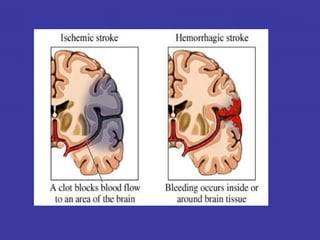
A stroke may be caused by a blocked artery 
(ischemic stroke) or the leaking or bursting of a 
blood vessel (hemorrhagic stroke)
National Stroke AssociationNational Stroke Association
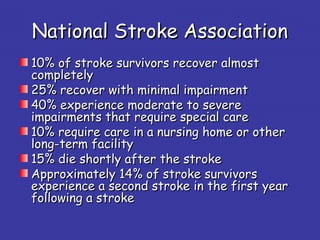
10% of stroke survivors recover almost10% of stroke survivors recover almost
completelycompletely
25% recover with minimal impairment25% recover with minimal impairment
40% experience moderate to severe40% experience moderate to severe
impairments that require special careimpairments that require special care
10% require care in a nursing home or other10% require care in a nursing home or other
long-term facilitylong-term facility
15% die shortly after the stroke15% die shortly after the stroke
Approximately 14% of stroke survivorsApproximately 14% of stroke survivors
experience a second stroke in the first yearexperience a second stroke in the first year
following a strokefollowing a stroke
Effect of a StrokeEffect of a Stroke
1. Weakness on the side of the body opposite the site1. Weakness on the side of the body opposite the site
of the brain affected by the strokeof the brain affected by the stroke
2. Spasticity, stiffness in muscles, painful muscle2. Spasticity, stiffness in muscles, painful muscle
spasmsspasms
3. Problems with balance and/or coordination3. Problems with balance and/or coordination
4. Problems using language, including having difficulty4. Problems using language, including having difficulty
understanding speech or writing(aphasia); and knowingunderstanding speech or writing(aphasia); and knowing
the right words but having trouble saying themthe right words but having trouble saying them
clearly (dysarthria)clearly (dysarthria)
5. Being unaware of or ignoring sensations on one side5. Being unaware of or ignoring sensations on one side
of the body (bodily neglect or inattention)of the body (bodily neglect or inattention)
6. Pain, numbness or odd sensations6. Pain, numbness or odd sensations
Effect of a StrokeEffect of a Stroke ((con’t)con’t)
7. Problems with memory, thinking, attention7. Problems with memory, thinking, attention
or learningor learning
8. Being8. Being unaware of the effects of a strokeunaware of the effects of a stroke
9. Trouble swallowing (dysphagia)9. Trouble swallowing (dysphagia)
10. Problems with bowel or bladder control10. Problems with bowel or bladder control
11. Fatigue11. Fatigue
12. Difficulty controlling emotions (emotional12. Difficulty controlling emotions (emotional
lability)lability)
13. Depression13. Depression
14. Difficulties with daily tasks14. Difficulties with daily tasks
Rehabilitation GoalRehabilitation Goal
To restore lost abilities as much asTo restore lost abilities as much as
possiblepossible
To prevent stroke-related complicationsTo prevent stroke-related complications
To improve the patient's quality of lifeTo improve the patient's quality of life
To educate the patient and family aboutTo educate the patient and family about
how to prevent recurrent strokeshow to prevent recurrent strokes
Promote re-integration into family,Promote re-integration into family,
home, work, leisure and community activihome, work, leisure and community activi
tiesties
Successful RehabilitationSuccessful Rehabilitation
Depend onDepend on
- how early rehabilitation begins- how early rehabilitation begins
- the extent of the brain injury- the extent of the brain injury
- the survivor’s attitude- the survivor’s attitude
- the rehabilitation team’s skill- the rehabilitation team’s skill
- the cooperation of family and- the cooperation of family and
caregivercaregiver
Basic Principles of RehabilitationBasic Principles of Rehabilitation
To begin as possible early (first 24 to 48To begin as possible early (first 24 to 48
hours)hours)
To assess the patient systematically (firstTo assess the patient systematically (first
2-7 day)2-7 day)
To prepare the therapy plan carefullyTo prepare the therapy plan carefully
To build up in stagesTo build up in stages
To include the type of rehabilitation approachTo include the type of rehabilitation approach
specific to deficitsspecific to deficits
To evaluate patient’s progress regularlyTo evaluate patient’s progress regularly
Rehabilitation ManagementRehabilitation Management
MobilityMobility
Activity of daily livingActivity of daily living
CommunicationCommunication
SwallowingSwallowing
OrthosisOrthosis
Shoulder painShoulder pain
SpasticitySpasticity
Cognitive and perceptionCognitive and perception
MoodMood
Bowel and bladder incontinenceBowel and bladder incontinence
1. Mobility1. Mobility
PhysiotherapyPhysiotherapy
– Conventional therapiesConventional therapies
– Neurophysiological therapiesNeurophysiological therapies
AimAim
ImproveImprove
– MovementMovement
– BalanceBalance
– coordinationcoordination
SafetySafety
Basic Physical TherapyBasic Physical Therapy
Bed positioning, mobilityBed positioning, mobility
Range of motion exercises (ROME)Range of motion exercises (ROME)
Sitting/trunk controlSitting/trunk control
TransferTransfer
WalkingWalking
Stair climbingStair climbing
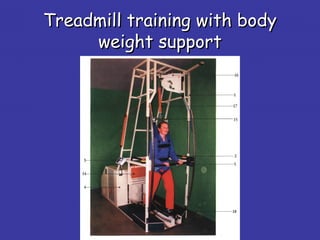
Treadmill training with bodyTreadmill training with body
weight supportweight support
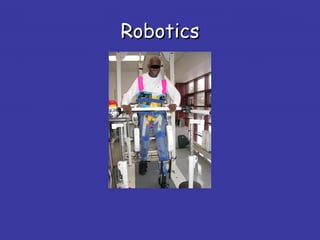
RoboticsRobotics
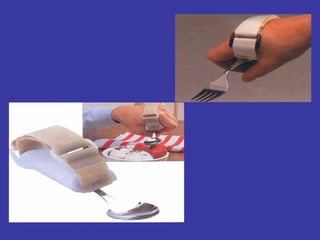
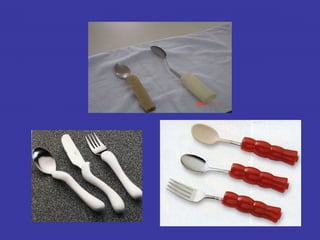
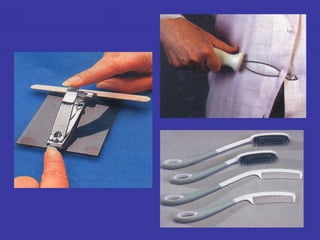
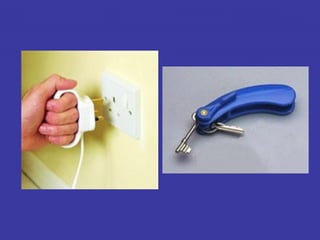
2. Activity of daily living2. Activity of daily living
Occupational therapyOccupational therapy
– Self careSelf care DressingDressing
GroomingGrooming
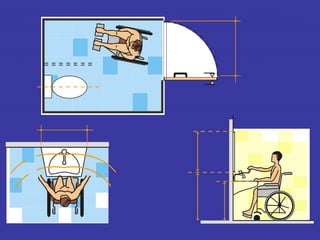
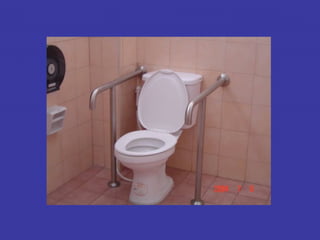
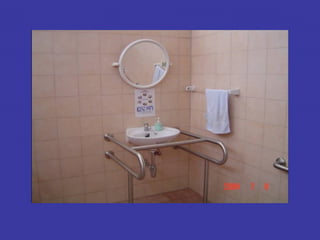
Toilet useToilet use
BathingBathing
EatingEating
– Adapt or specially design deviceAdapt or specially design device
3. Communication3. Communication
Speech and language therapySpeech and language therapy
Common communication disorderCommon communication disorder
– AphasiaAphasia *Receptive*Receptive -- auditoryauditory
- reading- reading
*Expressive*Expressive -- speakingspeaking
- writing- writing
*Global*Global
*Anomic*Anomic -- forget interrelatedforget interrelated
groups of wordsgroups of words
– DysarthriaDysarthria
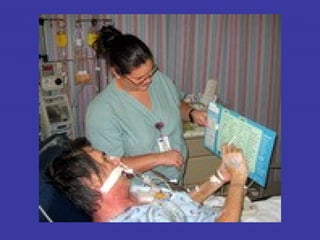
Goal of treatmentGoal of treatment
Facilitate recovery of communicationFacilitate recovery of communication
develop strategies to compensatedevelop strategies to compensate
- Gesture- Gesture
- Picture- Picture
- Communication board- Communication board
- Computer- Computer
4. Swallowing4. Swallowing
Dysphagia : abnormal in swallowing fluidsDysphagia : abnormal in swallowing fluids
or foodor food
– Increase risk of pneumonia and malnutritionIncrease risk of pneumonia and malnutrition
TreatmentTreatment
Posture changePosture change
Heightening sensory inputHeightening sensory input
Swallow maneuversSwallow maneuvers
Active exerciseActive exercise
Diet modificationDiet modification
5. Orthosis5. Orthosis
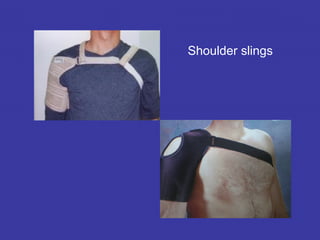
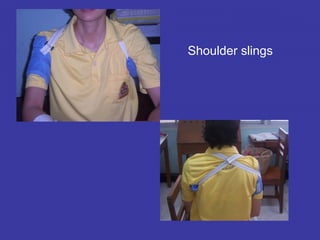
Shoulder slingsShoulder slings
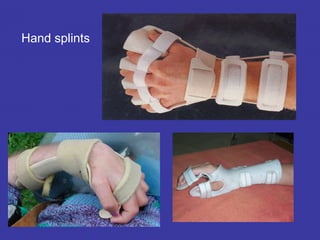
Hand splintHand splint
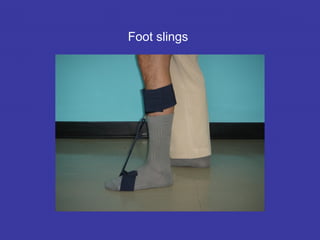
Foot slingsFoot slings
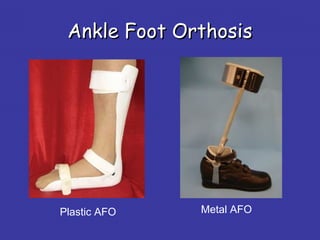
Ankle foot orthosisAnkle foot orthosis
Shoulder slings
Shoulder slings
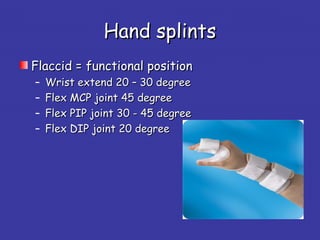
Hand splintsHand splints
Flaccid = functional positionFlaccid = functional position
– Wrist extend 20 – 30 degreeWrist extend 20 – 30 degree
– Flex MCP joint 45 degreeFlex MCP joint 45 degree
– Flex PIP joint 30 - 45 degreeFlex PIP joint 30 - 45 degree
– Flex DIP joint 20 degreeFlex DIP joint 20 degree
Hand splints
Foot slings
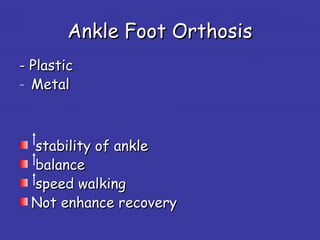
- Plastic- Plastic
- MetalMetal
stability of anklestability of ankle
balancebalance
speed walkingspeed walking
Not enhance recoveryNot enhance recovery
Ankle Foot OrthosisAnkle Foot Orthosis
Plastic AFO Metal AFO
Ankle Foot OrthosisAnkle Foot Orthosis
6. Shoulder pain6. Shoulder pain
Sensorimotor dysfunction of upperSensorimotor dysfunction of upper
extremitiesextremities
72% of stroke patient in first year72% of stroke patient in first year
Delay rehabilitationDelay rehabilitation
TreatmentTreatment
Electrical stimulationElectrical stimulation
Shoulder strappingShoulder strapping
Mobilization (esp. External rotator,Mobilization (esp. External rotator,
abduction) prevent frozen shoulder,abduction) prevent frozen shoulder,
shoulder hand painshoulder hand pain
MedicalMedical
Intraarticular injectionsIntraarticular injections
Modalities : ice, heat, massageModalities : ice, heat, massage
StrengtheningStrengthening
7. Spasticity7. Spasticity
Velocity dependent hyperactivity ofVelocity dependent hyperactivity of
tonic streth reflexestonic streth reflexes
Aim of treatmentAim of treatment
PainPain
ROMROM
CosmaticCosmatic
HygieneHygiene
MobilityMobility
Easy use orthosisEasy use orthosis
Delay surgeryDelay surgery
TreatmentTreatment
Avoid noxious stimuliAvoid noxious stimuli
Positioning, passive stretching, ROMEPositioning, passive stretching, ROME
Splinting, serial casting, surgical correctionSplinting, serial casting, surgical correction
MedicalMedical - tizanidine- tizanidine
- baclofen- baclofen
- dantrolen- dantrolen
- avoid diazepam- avoid diazepam
Botulinum toxin A injectionBotulinum toxin A injection
Phenol / alcoholPhenol / alcohol
Neurosurgical procedure (selective dorsalNeurosurgical procedure (selective dorsal
rhizotomy)rhizotomy)
8. Coginitive and perception8. Coginitive and perception
Attention deficitsAttention deficits
Visual neglectVisual neglect
Unilateral neglectUnilateral neglect
Memory deficitsMemory deficits
Problem solving difficultiesProblem solving difficulties
TreatmentTreatment
OrientationOrientation - time- time
- place- place
- person- person
MemoryMemory
RepetitiveRepetitive
EnvironmentEnvironment
Problem solvingProblem solving
9. Mood9. Mood
1. Post stroke depression (PSD)1. Post stroke depression (PSD)
2. Anxiety2. Anxiety
3. Emotionalism (emotional lability)3. Emotionalism (emotional lability)
– Improve with timeImprove with time
10. Bowel and bladder10. Bowel and bladder
incontinenceincontinence
Urinary incontinenceUrinary incontinence
- 50% incontinence during acute phase- 50% incontinence during acute phase
- with time, ~ 20% at six months- with time, ~ 20% at six months
- Risk: age, stroke severity, diabetes- Risk: age, stroke severity, diabetes
- Indwelling catheter : management of- Indwelling catheter : management of
fluids, prevent urinary retention, skinfluids, prevent urinary retention, skin
breakdownbreakdown
- Use of foley catheter > 48 hours- Use of foley catheter > 48 hours
UTIUTI
Constipation, fecal impactionConstipation, fecal impaction
– More commonMore common
– Immobility, inadequate fluid or food intake,Immobility, inadequate fluid or food intake,
depression or anxiety, cognitive deficitdepression or anxiety, cognitive deficit
ManagementManagement
– Adequate intake of fluidAdequate intake of fluid
– Bulk and fiber foodBulk and fiber food
– Bowel trainingBowel training
References
Davidsons prenceple of medicineDavidsons prenceple of medicine
American stroke associationAmerican stroke association
Medical encyclopediaMedical encyclopedia
PubmatePubmate
Thank
you
Thank
you

Stroke Rehabilitation

  • 1.
    Stroke RehabilitationStroke Rehabilitation Tbilisistate medicialTbilisi state medicial UniversityUniversity Goran R.BaizGoran R.Baiz 66thth yearyear
  • 2.
  • 4.
    National Stroke AssociationNationalStroke Association 10% of stroke survivors recover almost10% of stroke survivors recover almost completelycompletely 25% recover with minimal impairment25% recover with minimal impairment 40% experience moderate to severe40% experience moderate to severe impairments that require special careimpairments that require special care 10% require care in a nursing home or other10% require care in a nursing home or other long-term facilitylong-term facility 15% die shortly after the stroke15% die shortly after the stroke Approximately 14% of stroke survivorsApproximately 14% of stroke survivors experience a second stroke in the first yearexperience a second stroke in the first year following a strokefollowing a stroke
  • 5.
    Effect of aStrokeEffect of a Stroke 1. Weakness on the side of the body opposite the site1. Weakness on the side of the body opposite the site of the brain affected by the strokeof the brain affected by the stroke 2. Spasticity, stiffness in muscles, painful muscle2. Spasticity, stiffness in muscles, painful muscle spasmsspasms 3. Problems with balance and/or coordination3. Problems with balance and/or coordination 4. Problems using language, including having difficulty4. Problems using language, including having difficulty understanding speech or writing(aphasia); and knowingunderstanding speech or writing(aphasia); and knowing the right words but having trouble saying themthe right words but having trouble saying them clearly (dysarthria)clearly (dysarthria) 5. Being unaware of or ignoring sensations on one side5. Being unaware of or ignoring sensations on one side of the body (bodily neglect or inattention)of the body (bodily neglect or inattention) 6. Pain, numbness or odd sensations6. Pain, numbness or odd sensations
  • 6.
    Effect of aStrokeEffect of a Stroke ((con’t)con’t) 7. Problems with memory, thinking, attention7. Problems with memory, thinking, attention or learningor learning 8. Being8. Being unaware of the effects of a strokeunaware of the effects of a stroke 9. Trouble swallowing (dysphagia)9. Trouble swallowing (dysphagia) 10. Problems with bowel or bladder control10. Problems with bowel or bladder control 11. Fatigue11. Fatigue 12. Difficulty controlling emotions (emotional12. Difficulty controlling emotions (emotional lability)lability) 13. Depression13. Depression 14. Difficulties with daily tasks14. Difficulties with daily tasks
  • 7.
    Rehabilitation GoalRehabilitation Goal Torestore lost abilities as much asTo restore lost abilities as much as possiblepossible To prevent stroke-related complicationsTo prevent stroke-related complications To improve the patient's quality of lifeTo improve the patient's quality of life To educate the patient and family aboutTo educate the patient and family about how to prevent recurrent strokeshow to prevent recurrent strokes Promote re-integration into family,Promote re-integration into family, home, work, leisure and community activihome, work, leisure and community activi tiesties
  • 8.
    Successful RehabilitationSuccessful Rehabilitation DependonDepend on - how early rehabilitation begins- how early rehabilitation begins - the extent of the brain injury- the extent of the brain injury - the survivor’s attitude- the survivor’s attitude - the rehabilitation team’s skill- the rehabilitation team’s skill - the cooperation of family and- the cooperation of family and caregivercaregiver
  • 9.
    Basic Principles ofRehabilitationBasic Principles of Rehabilitation To begin as possible early (first 24 to 48To begin as possible early (first 24 to 48 hours)hours) To assess the patient systematically (firstTo assess the patient systematically (first 2-7 day)2-7 day) To prepare the therapy plan carefullyTo prepare the therapy plan carefully To build up in stagesTo build up in stages To include the type of rehabilitation approachTo include the type of rehabilitation approach specific to deficitsspecific to deficits To evaluate patient’s progress regularlyTo evaluate patient’s progress regularly
  • 10.
    Rehabilitation ManagementRehabilitation Management MobilityMobility Activityof daily livingActivity of daily living CommunicationCommunication SwallowingSwallowing OrthosisOrthosis Shoulder painShoulder pain SpasticitySpasticity Cognitive and perceptionCognitive and perception MoodMood Bowel and bladder incontinenceBowel and bladder incontinence
  • 11.
    1. Mobility1. Mobility PhysiotherapyPhysiotherapy –Conventional therapiesConventional therapies – Neurophysiological therapiesNeurophysiological therapies
  • 12.
  • 13.
    Basic Physical TherapyBasicPhysical Therapy Bed positioning, mobilityBed positioning, mobility Range of motion exercises (ROME)Range of motion exercises (ROME) Sitting/trunk controlSitting/trunk control TransferTransfer WalkingWalking Stair climbingStair climbing
  • 14.
    Treadmill training withbodyTreadmill training with body weight supportweight support
  • 15.
  • 16.
    2. Activity ofdaily living2. Activity of daily living Occupational therapyOccupational therapy – Self careSelf care DressingDressing GroomingGrooming Toilet useToilet use BathingBathing EatingEating – Adapt or specially design deviceAdapt or specially design device
  • 24.
    3. Communication3. Communication Speechand language therapySpeech and language therapy Common communication disorderCommon communication disorder – AphasiaAphasia *Receptive*Receptive -- auditoryauditory - reading- reading *Expressive*Expressive -- speakingspeaking - writing- writing *Global*Global *Anomic*Anomic -- forget interrelatedforget interrelated groups of wordsgroups of words – DysarthriaDysarthria
  • 25.
    Goal of treatmentGoalof treatment Facilitate recovery of communicationFacilitate recovery of communication develop strategies to compensatedevelop strategies to compensate - Gesture- Gesture - Picture- Picture - Communication board- Communication board - Computer- Computer
  • 27.
    4. Swallowing4. Swallowing Dysphagia: abnormal in swallowing fluidsDysphagia : abnormal in swallowing fluids or foodor food – Increase risk of pneumonia and malnutritionIncrease risk of pneumonia and malnutrition
  • 28.
    TreatmentTreatment Posture changePosture change Heighteningsensory inputHeightening sensory input Swallow maneuversSwallow maneuvers Active exerciseActive exercise Diet modificationDiet modification
  • 29.
    5. Orthosis5. Orthosis ShoulderslingsShoulder slings Hand splintHand splint Foot slingsFoot slings Ankle foot orthosisAnkle foot orthosis
  • 30.
  • 31.
  • 32.
    Hand splintsHand splints Flaccid= functional positionFlaccid = functional position – Wrist extend 20 – 30 degreeWrist extend 20 – 30 degree – Flex MCP joint 45 degreeFlex MCP joint 45 degree – Flex PIP joint 30 - 45 degreeFlex PIP joint 30 - 45 degree – Flex DIP joint 20 degreeFlex DIP joint 20 degree
  • 33.
  • 34.
  • 35.
    - Plastic- Plastic -MetalMetal stability of anklestability of ankle balancebalance speed walkingspeed walking Not enhance recoveryNot enhance recovery Ankle Foot OrthosisAnkle Foot Orthosis
  • 36.
    Plastic AFO MetalAFO Ankle Foot OrthosisAnkle Foot Orthosis
  • 37.
    6. Shoulder pain6.Shoulder pain Sensorimotor dysfunction of upperSensorimotor dysfunction of upper extremitiesextremities 72% of stroke patient in first year72% of stroke patient in first year Delay rehabilitationDelay rehabilitation
  • 38.
    TreatmentTreatment Electrical stimulationElectrical stimulation ShoulderstrappingShoulder strapping Mobilization (esp. External rotator,Mobilization (esp. External rotator, abduction) prevent frozen shoulder,abduction) prevent frozen shoulder, shoulder hand painshoulder hand pain MedicalMedical Intraarticular injectionsIntraarticular injections Modalities : ice, heat, massageModalities : ice, heat, massage StrengtheningStrengthening
  • 39.
    7. Spasticity7. Spasticity Velocitydependent hyperactivity ofVelocity dependent hyperactivity of tonic streth reflexestonic streth reflexes
  • 40.
    Aim of treatmentAimof treatment PainPain ROMROM CosmaticCosmatic HygieneHygiene MobilityMobility Easy use orthosisEasy use orthosis Delay surgeryDelay surgery
  • 41.
    TreatmentTreatment Avoid noxious stimuliAvoidnoxious stimuli Positioning, passive stretching, ROMEPositioning, passive stretching, ROME Splinting, serial casting, surgical correctionSplinting, serial casting, surgical correction MedicalMedical - tizanidine- tizanidine - baclofen- baclofen - dantrolen- dantrolen - avoid diazepam- avoid diazepam Botulinum toxin A injectionBotulinum toxin A injection Phenol / alcoholPhenol / alcohol Neurosurgical procedure (selective dorsalNeurosurgical procedure (selective dorsal rhizotomy)rhizotomy)
  • 42.
    8. Coginitive andperception8. Coginitive and perception Attention deficitsAttention deficits Visual neglectVisual neglect Unilateral neglectUnilateral neglect Memory deficitsMemory deficits Problem solving difficultiesProblem solving difficulties
  • 43.
    TreatmentTreatment OrientationOrientation - time-time - place- place - person- person MemoryMemory RepetitiveRepetitive EnvironmentEnvironment Problem solvingProblem solving
  • 44.
    9. Mood9. Mood 1.Post stroke depression (PSD)1. Post stroke depression (PSD) 2. Anxiety2. Anxiety 3. Emotionalism (emotional lability)3. Emotionalism (emotional lability) – Improve with timeImprove with time
  • 45.
    10. Bowel andbladder10. Bowel and bladder incontinenceincontinence Urinary incontinenceUrinary incontinence - 50% incontinence during acute phase- 50% incontinence during acute phase - with time, ~ 20% at six months- with time, ~ 20% at six months - Risk: age, stroke severity, diabetes- Risk: age, stroke severity, diabetes - Indwelling catheter : management of- Indwelling catheter : management of fluids, prevent urinary retention, skinfluids, prevent urinary retention, skin breakdownbreakdown - Use of foley catheter > 48 hours- Use of foley catheter > 48 hours UTIUTI
  • 46.
    Constipation, fecal impactionConstipation,fecal impaction – More commonMore common – Immobility, inadequate fluid or food intake,Immobility, inadequate fluid or food intake, depression or anxiety, cognitive deficitdepression or anxiety, cognitive deficit ManagementManagement – Adequate intake of fluidAdequate intake of fluid – Bulk and fiber foodBulk and fiber food – Bowel trainingBowel training
  • 47.
    References Davidsons prenceple ofmedicineDavidsons prenceple of medicine American stroke associationAmerican stroke association Medical encyclopediaMedical encyclopedia PubmatePubmate
  • 48.