The Psychology of Aging Sydney Metrick, PhD
A History Lesson Up to the sixteen hundreds only about 1% of the population was over 65. Three hundred years later, the average life expectancy of a baby born in an industrialized country was 47-55 years.  4% of the population was over 65.
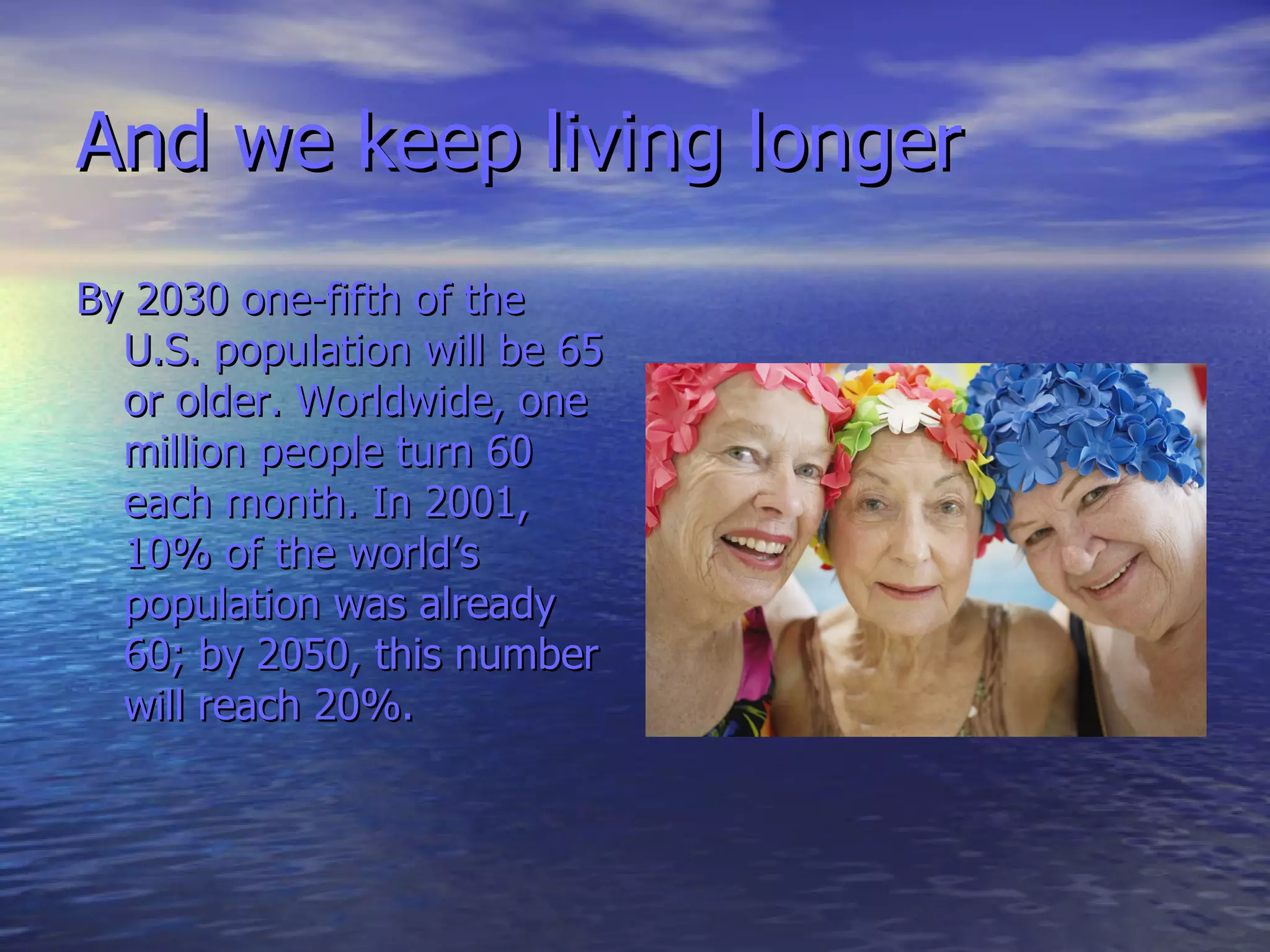
And   we keep living longer By 2030 one-fifth of the U.S. population will be 65 or older. Worldwide, one million people turn 60 each month. In 2001, 10% of the world’s population was already 60; by 2050, this number will reach 20%.
2000   2020   2040
The Graying of America Percent of Total U.S. Population over 65 in 2000 Source of data: U.S. Census Bureau, State Interim Projections by Age and Sex: 2004-2030, 2005.
The Graying of America Percent of Total U.S. Population over 65 in 2030 Source of data: U.S. Census Bureau, State Interim Projections by Age and Sex: 2004-2030, 2005.
But at what age are we  old  ?
There is no single point at which a person becomes “old.” Chronological age is an arbitrary and inaccurate measure.
But we obviously age Aging is affected by: intrinsic factors such as heredity, and  extrinsic factors such as environment, disease, and lifestyle.
Cambridge researcher, Aubrey de Grey argues that aging is a curable disease. His plan, calls for identifying all the components that cause human tissue to age, and designing remedies for each of them — forestalling disease and eventually pushing back death. He calls the approach   Strategies for Engineered Negligible Senescence (SENS) .  http://www.ted.com/index.php/talks/dean_ornish_says_your_genes_are_not_your_fate.html
Yes, we slow down as we get older,  but  our ability to function isn’t necessarily affected.  And each of us ages at a different rate. In the absence of disease, many limiting effects of normal aging often aren’t felt until after age 75.  Even then, an older adult can adapt his or her normal routine to accommodate these  physical-biological  and  social-emotional  changes.
Aging is a process of gradual maturation. The capacity for cell division and the capacity for growth and function are lost over time, ultimately leading to death. This decline process, called senescence, refers to changes that are deleterious. It’s recognized that aging also has positive  developmental components (e.g., increased wisdom, experience, and expertise)
Gene Cohen MD, PhD, renowned psychiatrist and gerontologist, has come up with four phases of growth and development that apply to the second half of life.
Phase I: Re-evaluation, exploration,  and transition (mid-thirties to mid-sixties, but more commonly early forties to late fifties) People serious confront their mortality for the first time. Plans and actions are shaped by a sense of personal discovery or a quest. Increasing bi-lateral brain involvement supports a more balanced perspective on life.
Phase II: Liberation, experimentation, and innovation (mid-fifties to mid-seventies but usually late fifties to early seventies) An “if not now, when?” feeling that brings a sense of liberation to plans and actions. Feeling free to speak one’s mind and act according to needs. New neuron formation in the brain associated with a desire for novelty. Retirement in part or total gives time for trying new things.
Phase III: Recapitulation, resolution, and contribution (late sixties to nineties, usually late sixties through eighties) Motivated to share acquired wisdom. Plans and actions shaped by desire to find meaning in life, a summing up. Often feeling compelled to attend to unfinished business or unresolved conflicts.
Phase IV: Continuation, reflection, and celebration (late seventies to end of life) Plans and actions shaped by desire to restate and reaffirm major life themes and also explore variations on those themes. Further brain changes promote positive emotions and morale. Desire to live well to the end positive impacts family and community.
You  can teach an old  dog  new  tricks
The first multi-site longitudinal study on the impact of professionally conducted, participatory cultural programs on older adults was initiated by the National Endowment for the Arts (NEA) in fall 2001. Dr. Gene Cohen (author of  The Mature Mind ) led a multi-year study to evaluate the effects of participating in cultural programs on older adults’ mental health, general health, overall functioning, and sense of well-being.
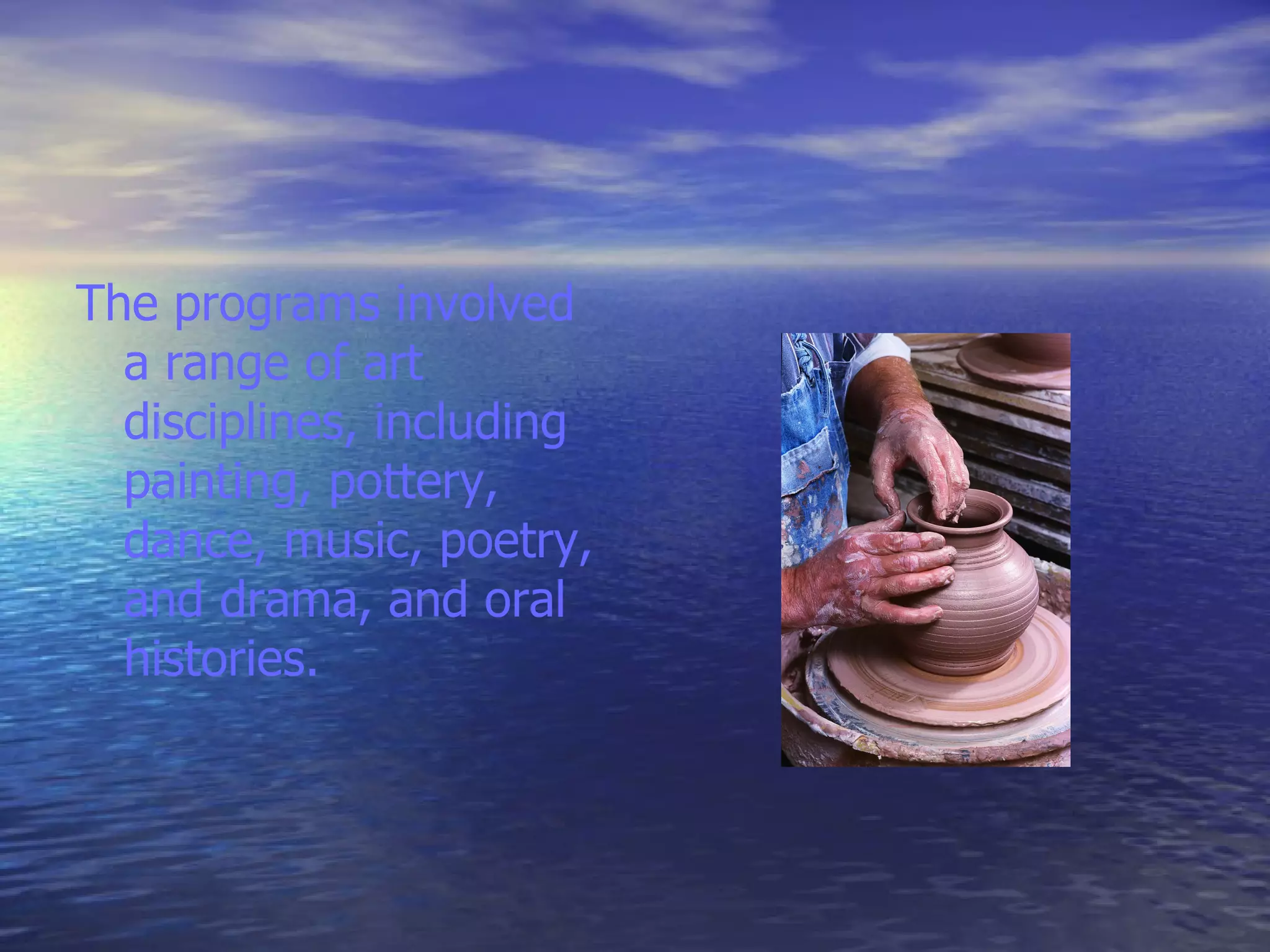
The programs involved a range of art disciplines, including painting, pottery, dance, music, poetry, and drama, and oral histories.
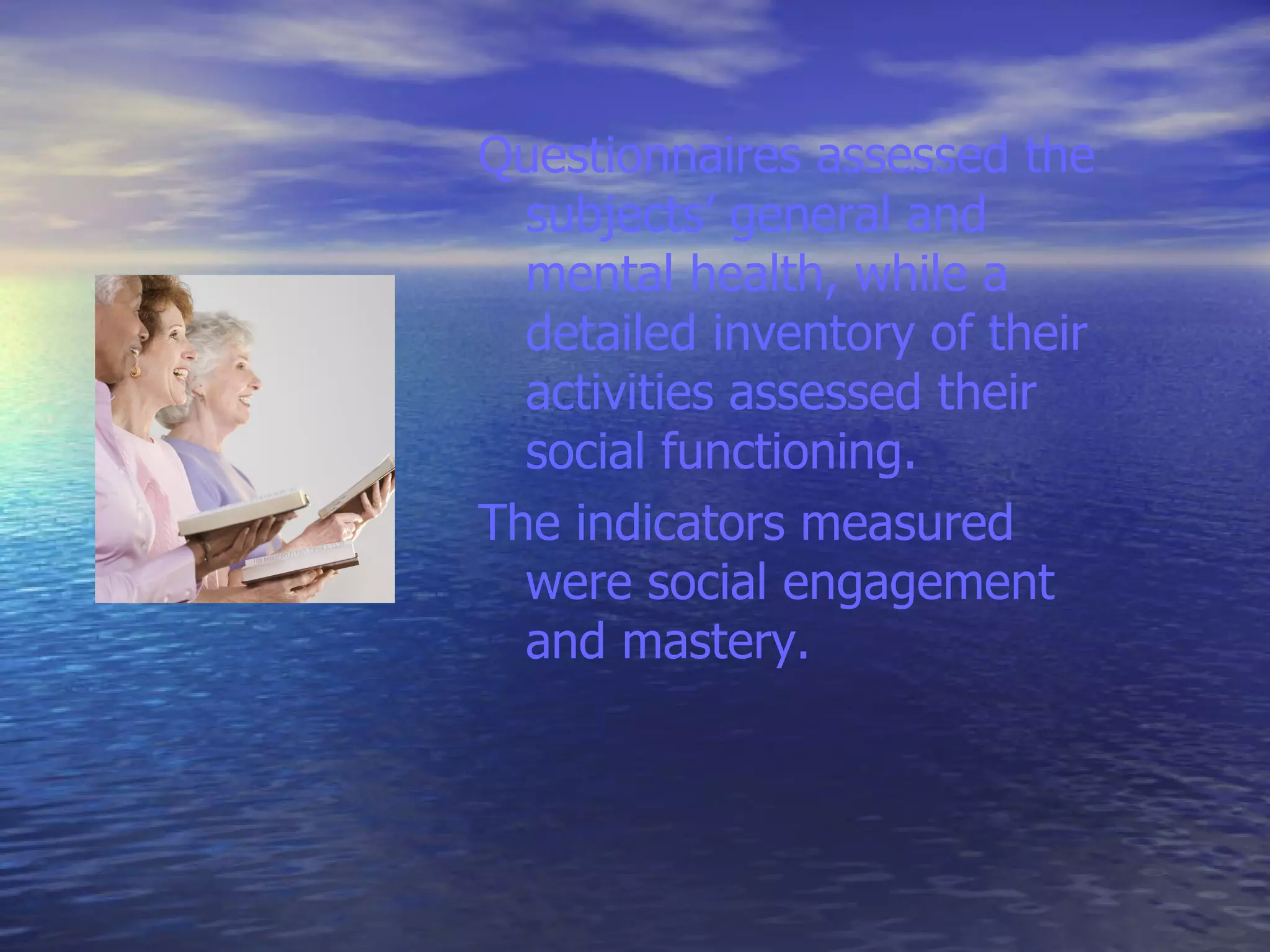
Questionnaires assessed the subjects’ general and mental health, while a detailed inventory of their activities assessed their social functioning. The indicators measured were social engagement and mastery.
In findings that were statistically significant, the study demonstrated that arts participants had: better health, fewer doctor visits, less medication usage, and increased activities and social engagement. Creativity Matters: Arts and Aging in America by Gay Hanna and Susan Perlstein  www.AmericansfortheArts.org
Quality of life goals Mastery Social engagement Health Attitude Exercise
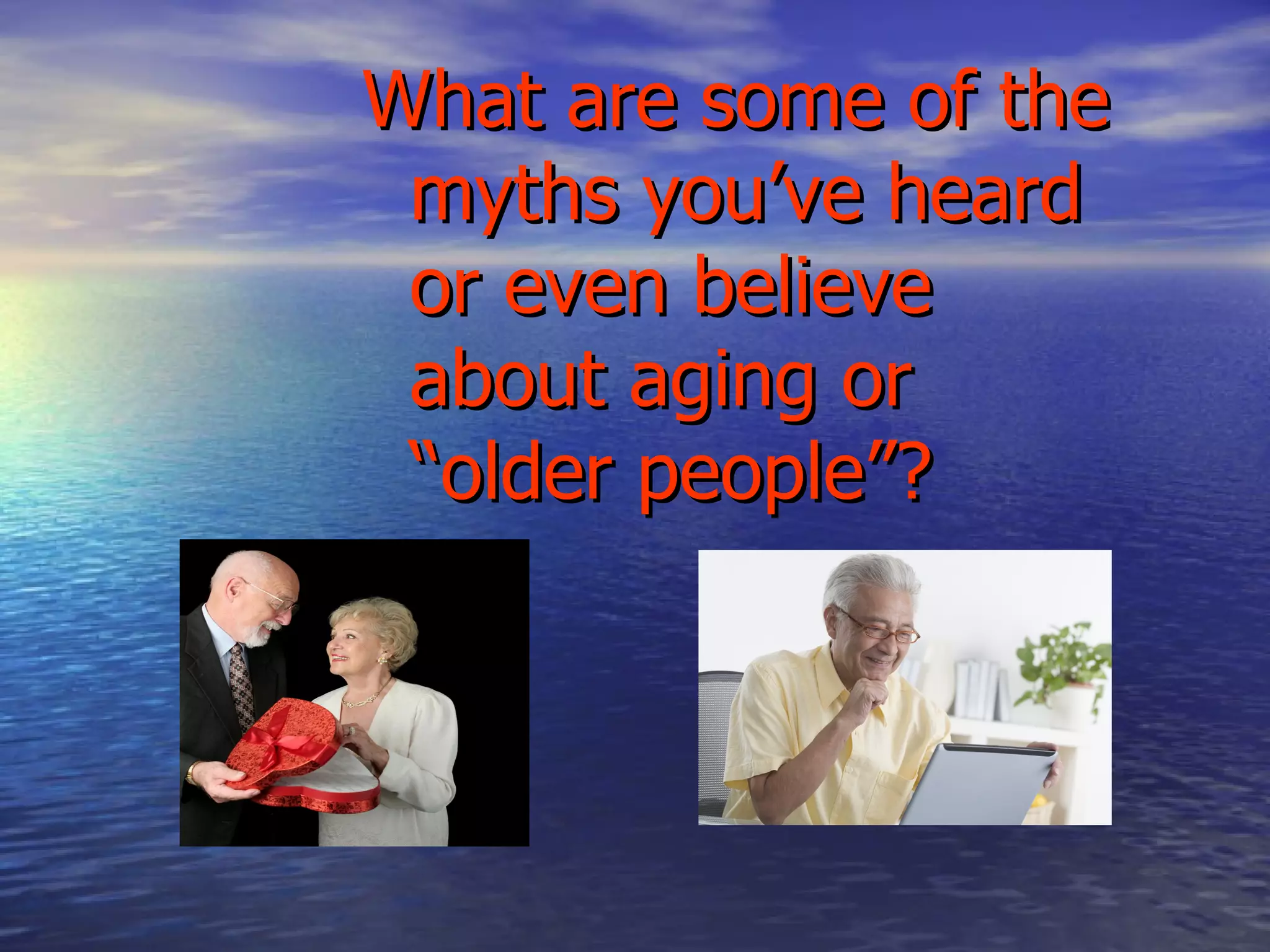
What are some of the myths you’ve heard or even believe about aging or “older people”?
In a 2006 study of 205 adults over age 60 and living in the community, 92 percent rated themselves as aging productively despite having chronic illnesses and some disability. Findings showed that productive aging is not related to age, ethnicity, level of education, marital status, or income, but rather to:
greater participation in activities
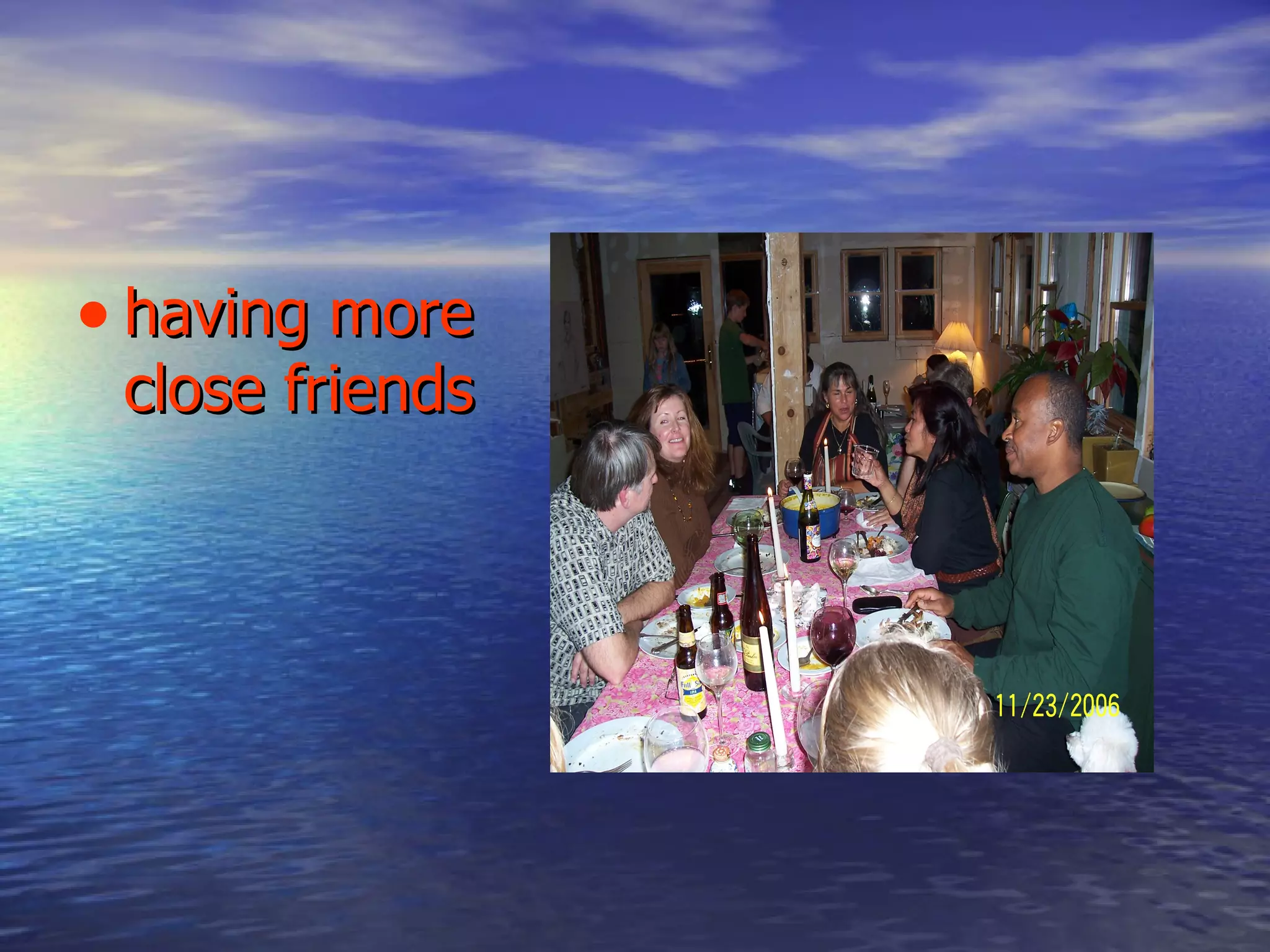
having more close friends
visiting with family
spending time reading and listening to the radio
The percentage of community-dwelling people > 65 who report needing assistance with activities of daily living has decreased over the last 2 decades, as has the percentage of people with debilitating disease. One viable explanation for these changes is an increase in the percentage of people who are aging successfully, although there may be other explanations.
Older people use both sides of the brain for tasks that younger people use only one side to accomplish. The mind grows stronger from use and from being challenged. Our personalities, creativity and psychological concept continues to develop throughout life. Developmental intelligence is expressed in deepening wisdom, judgment, perspective and vision.
As aging researchers have begun looking at the aging mind, they’ve learned that the brain is more flexible and adaptable than once thought.
Our brains our vastly different from the brains of our ancestors.
Everything we do modifies our brain. Reading, studying music, learning new languages.  What complex new skills have you learned in the last five years?
Loss Gain Love Acceptance
So what’s important when it comes to aging and mental health?
Dealing with difficult issues Many older people are hesitant to discuss sensitive subjects, such as urinary incontinence or sexuality with family or health care providers. Physical and mental problems might be covered up for fear of losing one’s independence.  Not many wish to give up one’s driver’s license or move to assisted living.
What may work: Take a universal, non-threatening approach. You might say,  “ Many people your age experience…”  “ Some people taking this medication have trouble with…”  “ Feel, felt, found” “ I have to ask you a lot of questions, some that might seem silly. Please don’t be offended…”
References The Psychology of Aging . Ian Stuart Hamilton U.S. Census Bureau The Mature Mind . Gene D. Cohen, MD, PhD The Brain that Changes Itself.  Norman Doidge, MD “ Creativity Matters: The Arts and Aging Toolkit” “ Creativity Matters: Arts and Aging in America”  www.AmericansfortheArts.org The Merck Manual: www.merck.com /mkgr/mmg/sec1/ch1/ch1a.jsp#ind01-001-0001
Resources Wayne State University Institute of Gerontology:  www.wayne.edu/research.php eng age  The Active Art of Aging:  www.engagedaging.orf/index.html National Center for Creative Aging:  www.creativeaging.org California Commission on Aging:  www.ccoa.ca.gov National Institutes on Aging:  www.nia.nih.gov American Association for Geriatric Psychiatry:  www.aagpgpa.org National Council on Aging, Center for Healthy Aging:  www.healthyagingprograms.org The Methuselah Foundation:  www.mfoundation.org/index.php?pagename=mj_sens_sens

The Psychology Of Aging

  • 1.
    The Psychology ofAging Sydney Metrick, PhD
  • 2.
    A History LessonUp to the sixteen hundreds only about 1% of the population was over 65. Three hundred years later, the average life expectancy of a baby born in an industrialized country was 47-55 years. 4% of the population was over 65.
  • 3.
    And we keep living longer By 2030 one-fifth of the U.S. population will be 65 or older. Worldwide, one million people turn 60 each month. In 2001, 10% of the world’s population was already 60; by 2050, this number will reach 20%.
  • 4.
    2000 2020 2040
  • 5.
    The Graying ofAmerica Percent of Total U.S. Population over 65 in 2000 Source of data: U.S. Census Bureau, State Interim Projections by Age and Sex: 2004-2030, 2005.
  • 6.
    The Graying ofAmerica Percent of Total U.S. Population over 65 in 2030 Source of data: U.S. Census Bureau, State Interim Projections by Age and Sex: 2004-2030, 2005.
  • 7.
    But at whatage are we old ?
  • 8.
    There is nosingle point at which a person becomes “old.” Chronological age is an arbitrary and inaccurate measure.
  • 9.
    But we obviouslyage Aging is affected by: intrinsic factors such as heredity, and extrinsic factors such as environment, disease, and lifestyle.
  • 10.
    Cambridge researcher, Aubreyde Grey argues that aging is a curable disease. His plan, calls for identifying all the components that cause human tissue to age, and designing remedies for each of them — forestalling disease and eventually pushing back death. He calls the approach Strategies for Engineered Negligible Senescence (SENS) . http://www.ted.com/index.php/talks/dean_ornish_says_your_genes_are_not_your_fate.html
  • 11.
    Yes, we slowdown as we get older, but our ability to function isn’t necessarily affected. And each of us ages at a different rate. In the absence of disease, many limiting effects of normal aging often aren’t felt until after age 75. Even then, an older adult can adapt his or her normal routine to accommodate these physical-biological and social-emotional changes.
  • 12.
    Aging is aprocess of gradual maturation. The capacity for cell division and the capacity for growth and function are lost over time, ultimately leading to death. This decline process, called senescence, refers to changes that are deleterious. It’s recognized that aging also has positive developmental components (e.g., increased wisdom, experience, and expertise)
  • 13.
    Gene Cohen MD,PhD, renowned psychiatrist and gerontologist, has come up with four phases of growth and development that apply to the second half of life.
  • 14.
    Phase I: Re-evaluation,exploration, and transition (mid-thirties to mid-sixties, but more commonly early forties to late fifties) People serious confront their mortality for the first time. Plans and actions are shaped by a sense of personal discovery or a quest. Increasing bi-lateral brain involvement supports a more balanced perspective on life.
  • 15.
    Phase II: Liberation,experimentation, and innovation (mid-fifties to mid-seventies but usually late fifties to early seventies) An “if not now, when?” feeling that brings a sense of liberation to plans and actions. Feeling free to speak one’s mind and act according to needs. New neuron formation in the brain associated with a desire for novelty. Retirement in part or total gives time for trying new things.
  • 16.
    Phase III: Recapitulation,resolution, and contribution (late sixties to nineties, usually late sixties through eighties) Motivated to share acquired wisdom. Plans and actions shaped by desire to find meaning in life, a summing up. Often feeling compelled to attend to unfinished business or unresolved conflicts.
  • 17.
    Phase IV: Continuation,reflection, and celebration (late seventies to end of life) Plans and actions shaped by desire to restate and reaffirm major life themes and also explore variations on those themes. Further brain changes promote positive emotions and morale. Desire to live well to the end positive impacts family and community.
  • 18.
    You canteach an old dog new tricks
  • 19.
    The first multi-sitelongitudinal study on the impact of professionally conducted, participatory cultural programs on older adults was initiated by the National Endowment for the Arts (NEA) in fall 2001. Dr. Gene Cohen (author of The Mature Mind ) led a multi-year study to evaluate the effects of participating in cultural programs on older adults’ mental health, general health, overall functioning, and sense of well-being.
  • 20.
    The programs involveda range of art disciplines, including painting, pottery, dance, music, poetry, and drama, and oral histories.
  • 21.
    Questionnaires assessed thesubjects’ general and mental health, while a detailed inventory of their activities assessed their social functioning. The indicators measured were social engagement and mastery.
  • 22.
    In findings thatwere statistically significant, the study demonstrated that arts participants had: better health, fewer doctor visits, less medication usage, and increased activities and social engagement. Creativity Matters: Arts and Aging in America by Gay Hanna and Susan Perlstein www.AmericansfortheArts.org
  • 23.
    Quality of lifegoals Mastery Social engagement Health Attitude Exercise
  • 24.
    What are someof the myths you’ve heard or even believe about aging or “older people”?
  • 25.
    In a 2006study of 205 adults over age 60 and living in the community, 92 percent rated themselves as aging productively despite having chronic illnesses and some disability. Findings showed that productive aging is not related to age, ethnicity, level of education, marital status, or income, but rather to:
  • 26.
  • 27.
  • 28.
  • 29.
    spending time readingand listening to the radio
  • 30.
    The percentage ofcommunity-dwelling people > 65 who report needing assistance with activities of daily living has decreased over the last 2 decades, as has the percentage of people with debilitating disease. One viable explanation for these changes is an increase in the percentage of people who are aging successfully, although there may be other explanations.
  • 31.
    Older people useboth sides of the brain for tasks that younger people use only one side to accomplish. The mind grows stronger from use and from being challenged. Our personalities, creativity and psychological concept continues to develop throughout life. Developmental intelligence is expressed in deepening wisdom, judgment, perspective and vision.
  • 32.
    As aging researchershave begun looking at the aging mind, they’ve learned that the brain is more flexible and adaptable than once thought.
  • 33.
    Our brains ourvastly different from the brains of our ancestors.
  • 34.
    Everything we domodifies our brain. Reading, studying music, learning new languages. What complex new skills have you learned in the last five years?
  • 35.
    Loss Gain LoveAcceptance
  • 36.
    So what’s importantwhen it comes to aging and mental health?
  • 37.
    Dealing with difficultissues Many older people are hesitant to discuss sensitive subjects, such as urinary incontinence or sexuality with family or health care providers. Physical and mental problems might be covered up for fear of losing one’s independence. Not many wish to give up one’s driver’s license or move to assisted living.
  • 38.
    What may work:Take a universal, non-threatening approach. You might say, “ Many people your age experience…” “ Some people taking this medication have trouble with…” “ Feel, felt, found” “ I have to ask you a lot of questions, some that might seem silly. Please don’t be offended…”
  • 39.
    References The Psychologyof Aging . Ian Stuart Hamilton U.S. Census Bureau The Mature Mind . Gene D. Cohen, MD, PhD The Brain that Changes Itself. Norman Doidge, MD “ Creativity Matters: The Arts and Aging Toolkit” “ Creativity Matters: Arts and Aging in America” www.AmericansfortheArts.org The Merck Manual: www.merck.com /mkgr/mmg/sec1/ch1/ch1a.jsp#ind01-001-0001
  • 40.
    Resources Wayne StateUniversity Institute of Gerontology: www.wayne.edu/research.php eng age The Active Art of Aging: www.engagedaging.orf/index.html National Center for Creative Aging: www.creativeaging.org California Commission on Aging: www.ccoa.ca.gov National Institutes on Aging: www.nia.nih.gov American Association for Geriatric Psychiatry: www.aagpgpa.org National Council on Aging, Center for Healthy Aging: www.healthyagingprograms.org The Methuselah Foundation: www.mfoundation.org/index.php?pagename=mj_sens_sens

Editor's Notes

  • #2 Intros. Tick tock. Compare back then and now.