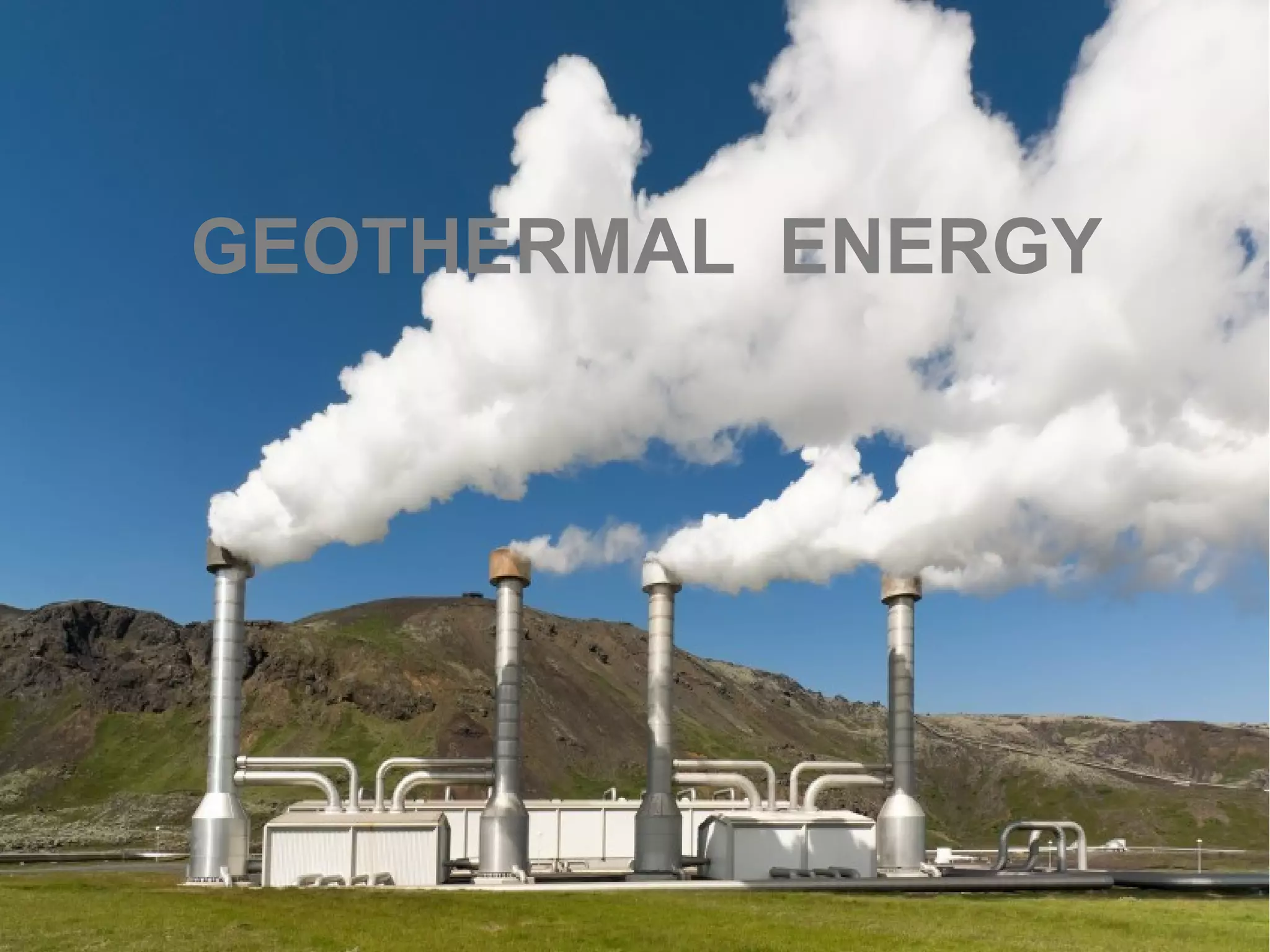
GEOTHERMAL ENERGY
Index
● I: Definition
● II: Types of geothermal reservoirs
● III: How does a geothermal power plant work?
● IV: Diagram of a geothermal power plant
● V: Types of geothermal power plants
● VI: Advantages and disadvantages
● VII: Worldwide production
● VIII: Uses
● IX: Conclusions
I: Definition
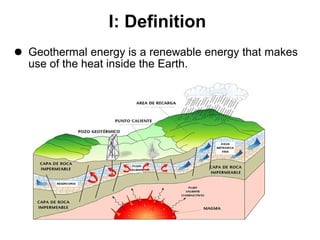
● Geothermal energy is a renewable energy that makes
use of the heat inside the Earth.
II: Types of geothermal reservoirs
●
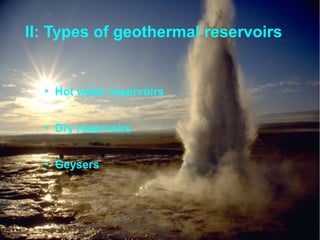
Hot water reservoirs
●
Dry reservoirs
●
Geysers
III: How does a geothermal
power plant work?
The heat inside the Earth heats up a boiler with
water inside. This makes the water’s temperature
rise and transform it into steam. The steam moves a
turbine connected to a generator that produces
electricity. Then, the steam goes to a condenser
where it becomes water which returns to the boiler
again.
IV:Diagram of a geothermal
power plant
V: Types of geothermal
power plants
DRY STEAM POWER PLANTS
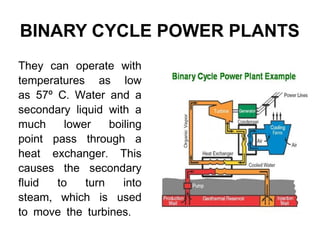
BINARY CYCLE POWER PLANTS
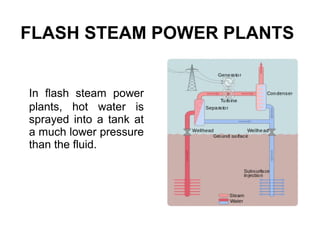
FLASH STEAM POWER PLANTS
DRY STEAM POWER PLANTS
They use steam at a
temperature of 150º C
or higher to run the
turbines.
BINARY CYCLE POWER PLANTS
They can operate with
temperatures as low
.as 57º C Water and a
secondary liquid with a
much lower boiling
point pass through a
.heat exchanger This
causes the secondary
fluid to turn into
,steam which is used
.to move the turbines
FLASH STEAM POWER PLANTS
In flash steam power
plants, hot water is
sprayed into a tank at
a much lower pressure
than the fluid.
VI(1): Advantages
● It is an energy source that reduces the dependence
on fossil fuels
● It causes less environmental impact than the uses
of oil and coal.
● It is a great way to save energy and money.
● It doesn’t generate any noise.
VI(2): Disadvantages
● Hydrogen sulfide emissions
● Pollution of nearby waters
● It damages the landscape
● It’s only avaliable in certains locations
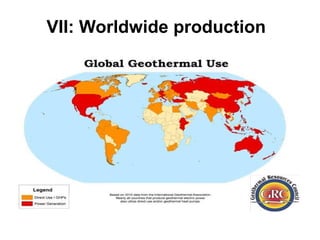
VII: Worldwide production
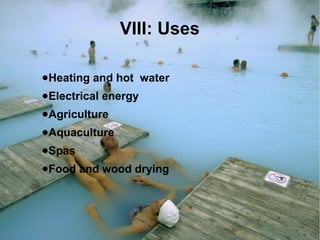
VIII: Uses
●Heating and hot water
●Electrical energy
●Agriculture
●Aquaculture
●Spas
●Food and wood drying
IX: Conclusions
● There is a high initial investment, but after that, less
investment is needed, because it doesn’t use fossil
fuels
● There aren’t any emissions of toxic gases into the
atmosphere
● It produces bad smell
● The employers usually have little experience
● It doesn’t need backup fuel
Done by:
●
Catarina Susana Da Silva Lopes
●
Jorge Piñeiro Bermúdez
●
Jorge Hermo González
Bilingual section of Technology
Group 3º ESO-B
IES Praia Barraña – Boiro (Spain)
March, 2016

Geothermal energy

  • 1.
  • 2.
    Index ● I: Definition ●II: Types of geothermal reservoirs ● III: How does a geothermal power plant work? ● IV: Diagram of a geothermal power plant ● V: Types of geothermal power plants ● VI: Advantages and disadvantages ● VII: Worldwide production ● VIII: Uses ● IX: Conclusions
  • 3.
    I: Definition ● Geothermalenergy is a renewable energy that makes use of the heat inside the Earth.
  • 4.
    II: Types ofgeothermal reservoirs ● Hot water reservoirs ● Dry reservoirs ● Geysers
  • 5.
    III: How doesa geothermal power plant work? The heat inside the Earth heats up a boiler with water inside. This makes the water’s temperature rise and transform it into steam. The steam moves a turbine connected to a generator that produces electricity. Then, the steam goes to a condenser where it becomes water which returns to the boiler again.
  • 6.
    IV:Diagram of ageothermal power plant
  • 7.
    V: Types ofgeothermal power plants DRY STEAM POWER PLANTS BINARY CYCLE POWER PLANTS FLASH STEAM POWER PLANTS
  • 8.
    DRY STEAM POWERPLANTS They use steam at a temperature of 150º C or higher to run the turbines.
  • 9.
    BINARY CYCLE POWERPLANTS They can operate with temperatures as low .as 57º C Water and a secondary liquid with a much lower boiling point pass through a .heat exchanger This causes the secondary fluid to turn into ,steam which is used .to move the turbines
  • 10.
    FLASH STEAM POWERPLANTS In flash steam power plants, hot water is sprayed into a tank at a much lower pressure than the fluid.
  • 11.
    VI(1): Advantages ● Itis an energy source that reduces the dependence on fossil fuels ● It causes less environmental impact than the uses of oil and coal. ● It is a great way to save energy and money. ● It doesn’t generate any noise.
  • 12.
    VI(2): Disadvantages ● Hydrogensulfide emissions ● Pollution of nearby waters ● It damages the landscape ● It’s only avaliable in certains locations
  • 13.
  • 14.
    VIII: Uses ●Heating andhot water ●Electrical energy ●Agriculture ●Aquaculture ●Spas ●Food and wood drying
  • 15.
    IX: Conclusions ● Thereis a high initial investment, but after that, less investment is needed, because it doesn’t use fossil fuels ● There aren’t any emissions of toxic gases into the atmosphere ● It produces bad smell ● The employers usually have little experience ● It doesn’t need backup fuel
  • 16.
    Done by: ● Catarina SusanaDa Silva Lopes ● Jorge Piñeiro Bermúdez ● Jorge Hermo González Bilingual section of Technology Group 3º ESO-B IES Praia Barraña – Boiro (Spain) March, 2016