SEMINAR TOPIC – GEOTHERMAL POWER PLANTS
SUBMITTED BY
PARV KASB
1903051033
6TH SEMESTER
SUBMITTED TO
MISS ADITI SHARMA
Assistant Professor
Electrical Engineering
Introduction
History
Main Components
How it works
Types of Power Plants
About Geothermal power
Advantages
Disadvantages
Applications
Conclusion
References
CONTENT
INTRODUCTION
What is Geothermal Energy ?
Geothermal energy is heat that is
generated within the Earth.
GEO MEANS “EARTH” and
Thermal means “HEAT”
It is a renewable resource that can
be harvested for human use.
HOW HEAT IS
GENERATED
There are three main sources of heat
Heat when planet is
formed and accreted.
Decay of radioactive
elements.
Frictional heating
(caused by denser
core materials sinking
to the centre of the
planet.
HISTORY
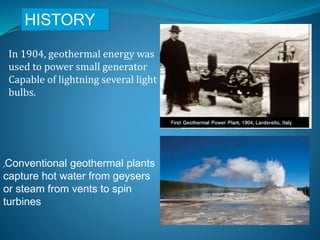
In 1904, geothermal energy was
used to power small generator
Capable of lightning several light
bulbs.
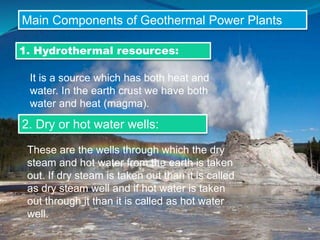
,Conventional geothermal plants
capture hot water from geysers
or steam from vents to spin
turbines
Geothermal power plants are used in
order to generate electricity by the use of
geothermal energy (the Earth's internal
thermal energy).
 They essentially work the same as a
coal or nuclear power plant, the main
difference being the heat source. With
geothermal, the Earth's heat replaces the
boiler of a coal plant or the reactor of a
nuclear plant.
The magma heats the water present inside the
earth and increases its temperature greater than 182
degree Celsius. This hot water from the earth is piping
to the surface of the earth through hot water wells.
The steam from the hot water is separated and made it
to strike on the turbine blade and it starts rotating. A
Generator is coupled to the turbine also starts rotating
and produces electricity.
Working principle of Geothermal
Power Plant
Main Components of Geothermal Power Plants
1. Hydrothermal resources:
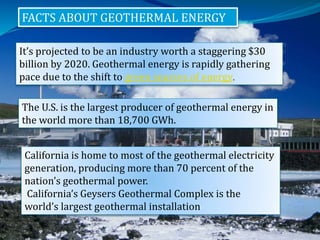
It is a source which has both heat and
water. In the earth crust we have both
water and heat (magma).
2. Dry or hot water wells:
These are the wells through which the dry
steam and hot water from the earth is taken
out. If dry steam is taken out than it is called
as dry steam well and if hot water is taken
out through it than it is called as hot water
well.
3. Steam Separator:
It is a separating device which is used to
separate steam from hot water.
4. Turbine:
It is a rotating device that converts the kinetic
energy of the fast-moving steam into
rotational energy (i.e. Mechanical energy).
5. Generator:
It is coupled to the turbine shaft and converts
mechanical energy of the turbine into electrical
energy.
6. Steam Condenser:
It condenses the exhaust steam from the turbine
and changes it to water.
7. Injection Well:
It is the well that is drilled in the earth to
inject the condensed water again into the
Layout of Geothermal Power PLANT
TYPES
There are mainly three types of geothermal plants
1) DRY STEAM POWER PLANT
2) FLASH STEAM POWER PLANT
3) BINARY CYCLE POWER PLANT
In dry steam power plant, direct steam from the geothermal
reservoir is used to turn the turbine and generator to produce
electricity. The temperature of the geothermal steam needed in
this plant is atleast 150 degree Celsius.
Flash Steam Geothermal Power Plant
Binary cycle plants use the heat from lower-temperature
reservoirs (225 to 360°F) to boil a working fluid, which is
then vaporized in a heat exchanger and used to power a
generator.
Binary Cycle Power Plant
FACTS ABOUT GEOTHERMAL ENERGY
It’s projected to be an industry worth a staggering $30
billion by 2020. Geothermal energy is rapidly gathering
pace due to the shift to green sources of energy.
.
The U.S. is the largest producer of geothermal energy in
the world more than 18,700 GWh.
California is home to most of the geothermal electricity
generation, producing more than 70 percent of the
nation’s geothermal power.
California’s Geysers Geothermal Complex is the
world’s largest geothermal installation
GEOTHERMAL ENERGY IN INDIA
Geological Survey of India has identified about 340
geothermal hot springs in the country. Most of them are
in the low surface temperature range from 370C to 900C,
which is suitable for direct heat applications
Some prominent places where a power plant can be establish
Puga in Ladakh
Manikaran in Himachal
Jalgaon in Maharastra
Tapovan in Uttarakhand
Tuwa in Gujarat
 Godavari Basin
Bakreshwar in West Bengal
Major Geothermal Sites
ADVANTAGES
DISADVANTAGES
1. Location Restricted
2. Environmental side effects
3. Earthquakes
4. High Cost
5. Proper maintenance
6. Low efficiency
PROS CONS
This energy source is more
environmentally friendly than
conventional fuel sources.
The largest single disadvantage of
geothermal energy is that it is location
specific.
A source of renewable energy. Gases are released into the
atmosphere during digging.
The number of exploitable
geothermal resources will
increase with ongoing research and
development in the industry.
Geothermal energy runs the risk of
triggering earthquakes.
A sustainable source of energy as its
always available unlike wind and solar.
Expensive resource to tap into, with high
upfront costs ranging from around $2-$7
million for a plant with a 1 megawatt
capacity.
A reliable source as its easier to
predict the power output from a
geothermal plant with a high degree of
accuracy.
Energy fluid needs to be pumped back into
the underground reservoirs faster than it is
depleted. Management is required to
maintain sustainability.
No fuel is required.
APPLICATIONS
Space heating and cooling.
Generation of electrical power.
Industrial process heat.
Other applications includes desalination of
water, heavy water production, extraction of
minerals from geothermal fluids, timber
seasoning etc.
CONCLUSION
Geothermal energy is clean and cost efficient
form of energy
 Improvements to existing geothermal facilities
are worth considering to lower the construction
cost and improve the efficiency .
In future they will reduce dependency on other
power plants if improvement is done.
It will be great transition towards renewable
energy

THANK YOU

geothermal ppt.pptx

  • 1.
    SEMINAR TOPIC –GEOTHERMAL POWER PLANTS SUBMITTED BY PARV KASB 1903051033 6TH SEMESTER SUBMITTED TO MISS ADITI SHARMA Assistant Professor Electrical Engineering
  • 2.
    Introduction History Main Components How itworks Types of Power Plants About Geothermal power Advantages Disadvantages Applications Conclusion References CONTENT
  • 3.
    INTRODUCTION What is GeothermalEnergy ? Geothermal energy is heat that is generated within the Earth. GEO MEANS “EARTH” and Thermal means “HEAT” It is a renewable resource that can be harvested for human use.
  • 4.
    HOW HEAT IS GENERATED Thereare three main sources of heat Heat when planet is formed and accreted. Decay of radioactive elements. Frictional heating (caused by denser core materials sinking to the centre of the planet.
  • 5.
    HISTORY In 1904, geothermalenergy was used to power small generator Capable of lightning several light bulbs. ,Conventional geothermal plants capture hot water from geysers or steam from vents to spin turbines
  • 6.
    Geothermal power plantsare used in order to generate electricity by the use of geothermal energy (the Earth's internal thermal energy).  They essentially work the same as a coal or nuclear power plant, the main difference being the heat source. With geothermal, the Earth's heat replaces the boiler of a coal plant or the reactor of a nuclear plant.
  • 7.
    The magma heatsthe water present inside the earth and increases its temperature greater than 182 degree Celsius. This hot water from the earth is piping to the surface of the earth through hot water wells. The steam from the hot water is separated and made it to strike on the turbine blade and it starts rotating. A Generator is coupled to the turbine also starts rotating and produces electricity. Working principle of Geothermal Power Plant
  • 8.
    Main Components ofGeothermal Power Plants 1. Hydrothermal resources: It is a source which has both heat and water. In the earth crust we have both water and heat (magma). 2. Dry or hot water wells: These are the wells through which the dry steam and hot water from the earth is taken out. If dry steam is taken out than it is called as dry steam well and if hot water is taken out through it than it is called as hot water well.
  • 9.
    3. Steam Separator: Itis a separating device which is used to separate steam from hot water. 4. Turbine: It is a rotating device that converts the kinetic energy of the fast-moving steam into rotational energy (i.e. Mechanical energy). 5. Generator: It is coupled to the turbine shaft and converts mechanical energy of the turbine into electrical energy.
  • 10.
    6. Steam Condenser: Itcondenses the exhaust steam from the turbine and changes it to water. 7. Injection Well: It is the well that is drilled in the earth to inject the condensed water again into the
  • 11.
  • 12.
    TYPES There are mainlythree types of geothermal plants 1) DRY STEAM POWER PLANT 2) FLASH STEAM POWER PLANT 3) BINARY CYCLE POWER PLANT
  • 13.
    In dry steampower plant, direct steam from the geothermal reservoir is used to turn the turbine and generator to produce electricity. The temperature of the geothermal steam needed in this plant is atleast 150 degree Celsius.
  • 14.
  • 15.
    Binary cycle plantsuse the heat from lower-temperature reservoirs (225 to 360°F) to boil a working fluid, which is then vaporized in a heat exchanger and used to power a generator. Binary Cycle Power Plant
  • 16.
    FACTS ABOUT GEOTHERMALENERGY It’s projected to be an industry worth a staggering $30 billion by 2020. Geothermal energy is rapidly gathering pace due to the shift to green sources of energy. . The U.S. is the largest producer of geothermal energy in the world more than 18,700 GWh. California is home to most of the geothermal electricity generation, producing more than 70 percent of the nation’s geothermal power. California’s Geysers Geothermal Complex is the world’s largest geothermal installation
  • 19.
    GEOTHERMAL ENERGY ININDIA Geological Survey of India has identified about 340 geothermal hot springs in the country. Most of them are in the low surface temperature range from 370C to 900C, which is suitable for direct heat applications Some prominent places where a power plant can be establish Puga in Ladakh Manikaran in Himachal Jalgaon in Maharastra Tapovan in Uttarakhand Tuwa in Gujarat  Godavari Basin Bakreshwar in West Bengal
  • 20.
  • 22.
  • 23.
    DISADVANTAGES 1. Location Restricted 2.Environmental side effects 3. Earthquakes 4. High Cost 5. Proper maintenance 6. Low efficiency
  • 24.
    PROS CONS This energysource is more environmentally friendly than conventional fuel sources. The largest single disadvantage of geothermal energy is that it is location specific. A source of renewable energy. Gases are released into the atmosphere during digging. The number of exploitable geothermal resources will increase with ongoing research and development in the industry. Geothermal energy runs the risk of triggering earthquakes. A sustainable source of energy as its always available unlike wind and solar. Expensive resource to tap into, with high upfront costs ranging from around $2-$7 million for a plant with a 1 megawatt capacity. A reliable source as its easier to predict the power output from a geothermal plant with a high degree of accuracy. Energy fluid needs to be pumped back into the underground reservoirs faster than it is depleted. Management is required to maintain sustainability. No fuel is required.
  • 25.
    APPLICATIONS Space heating andcooling. Generation of electrical power. Industrial process heat. Other applications includes desalination of water, heavy water production, extraction of minerals from geothermal fluids, timber seasoning etc.
  • 26.
    CONCLUSION Geothermal energy isclean and cost efficient form of energy  Improvements to existing geothermal facilities are worth considering to lower the construction cost and improve the efficiency . In future they will reduce dependency on other power plants if improvement is done. It will be great transition towards renewable energy 
  • 27.