Satish kumar Nayak
Roll No:14.ME/46
Group: ME(A)2
Reg.No: 1401225227
OUTLINE
 Introduction
 Geological Background
 Main Components of a Geothermal
Power Plant
 Types of Geothermal Power
Plants
 Advantages of Geothermal Power
Plants
 Summery
Introduction
o Our earth was a burning planet billions of years ago, Still
earth core temperature is above 5000 C.
o Geo means earth andThermal means heat , Geothermal
means earth’s heat
o Geothermal energy is the energy contained as heat in the
earth’s interior.
o Geothermal energy is energy extracted from the heat stored
in the earth.
o Geothermal energy is derived from within the earth's tectonic
activity that occurred since the planet was created. It also
comes from solar thermal absorbed by the earth's surface.
Geological Background
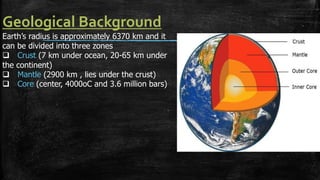
Earth’s radius is approximately 6370 km and it
can be divided into three zones
 Crust (7 km under ocean, 20-65 km under
the continent)
 Mantle (2900 km , lies under the crust)
 Core (center, 4000oC and 3.6 million bars)
Historical
Background
■ Conventional geothermal
plants capture hot water from
geysers or steam from vents to
spin turbines.
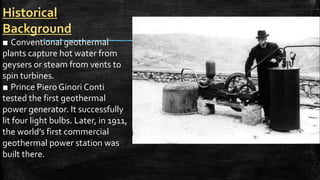
■ Prince Piero Ginori Conti
tested the first geothermal
power generator. It successfully
lit four light bulbs. Later, in 1911,
the world’s first commercial
geothermal power station was
built there.
Main Components of a Geothermal Power Plant
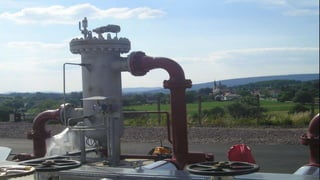
■ Production Well
■ Separator
■ Heat Exchanger
■ SteamTurbine
■ Condenser
■ Generator
■ InjectionWell
Production Well
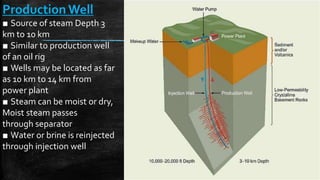
■ Source of steam Depth 3
km to 10 km
■ Similar to production well
of an oil rig
■ Wells may be located as far
as 10 km to 14 km from
power plant
■ Steam can be moist or dry,
Moist steam passes
through separator
■ Water or brine is reinjected
through injection well
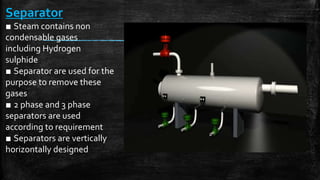
Separator
■ Steam contains non
condensable gases
including Hydrogen
sulphide
■ Separator are used for the
purpose to remove these
gases
■ 2 phase and 3 phase
separators are used
according to requirement
■ Separators are vertically
horizontally designed
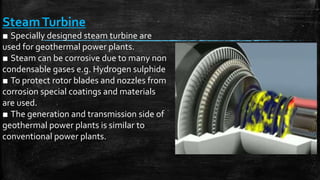
SteamTurbine
■ Specially designed steam turbine are
used for geothermal power plants.

■ Steam can be corrosive due to many non
condensable gases e.g. Hydrogen sulphide
■ To protect rotor blades and nozzles from
corrosion special coatings and materials
are used.
■ The generation and transmission side of
geothermal power plants is similar to
conventional power plants.
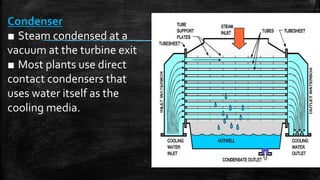
Condenser
■ Steam condensed at a
vacuum at the turbine exit
■ Most plants use direct
contact condensers that
uses water itself as the
cooling media.
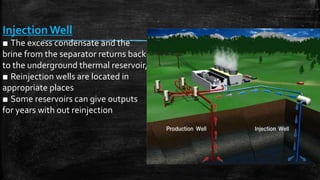
Injection Well
■ The excess condensate and the
brine from the separator returns back
to the underground thermal reservoir,
■ Reinjection wells are located in
appropriate places
■ Some reservoirs can give outputs
for years with out reinjection
How It Works
■ Large holes have to be dug into the earth until a geothermal hotspot is found.
■ Pipes are inserted inside these holes through which water is sent and steam
output is obtained.
■ The production involves two process
1) Converting Geothermal energy into Mechanical energy
2) Converting Mechanical Energy into Electrical Energy
■ The success of the energy production depends on the temperature of the plant
which depends on the temperature of the rocks in earth.
■ The water is sent through the injection well and reaches the rocks and then hot
water comes from the production well.
■ Due to the high pressure when it reaches the topmost of the earth surface it is
converted into steam.
■ The separator is the place where steam that comes from the earth is made
clean by removing the brine and dirt so that they do not damage the turbine
blades.
■ The high pressure and low pressure steam runs the turbine.
■ The generator is coupled with turbine to produce electricity.
■ The condenser is a phase changer where the steam output of the turbine is
given to the condenser and gets converted to hot water.
■ This hot water is then sent to the cooling tower where it loses it heat and then
sent to the geothermal reservoir for further production of steam
Sources of Earth’s Internal Energy
•70% comes from the decay of radioactive nuclei with long half
lives that are embedded within the Earth
•Some energy is from residual heat left over from Earths formation.
•The rest of the energy comes from meteorite impacts.
Different Geothermal Energy Sources
Hot Water Reservoirs: As the name implies these are reservoirs of hot
underground water. There is a large amount of them in the US, but they
are more suited for space heating than for electricity production.
Natural Stem Reservoirs: In this case a hole dug into the ground can
cause steam to come to the surface. This type of resource is rare in the
US.
Geopressured Reservoirs: In this type of reserve, brine completely
saturated with natural gas in stored under pressure from the weight of
overlying rock. This type of resource can be used for both heat and for
natural gas.
Normal Geothermal Gradient: At any place on the planet, there is a
normal temperature gradient of +300C per km dug into the earth. Therefore,
if one digs 20,000 feet the temperature will be about 1900C above the surface
temperature. This difference will be enough to produce electricity. However,
no useful and economical technology has been developed to extracted this
large source of energy.
Hot Dry Rock: This type of condition exists in 5% of the US. It is similar to
Normal Geothermal Gradient, but the gradient is 400C/km dug underground.
Molten Magma: No technology exists to tap into the heat reserves stored
in magma. The best sources for this in the US are in Alaska and Hawaii.
Direct uses of geothermal energy is
appropriate for sources below 1500C
• space heating
• air conditioning
• industrial processes
• drying
• Greenhouses
• Aguaculture
• hot water
• resorts and pools
• melting snow
How Direct UsesWork
•Direct Sources function by sending water down a well to be heated by the
Earth’s warmth.
•Then a heat pump is used to take the heat from the underground water to the
substance that heats the house.
•Then after the water it is cooled is injected back into the Earth.
Types of Geothermal Power Plants
There are three different types of Geothermal power plants
system designs :
■ Dry Steam Power Plants
■ Flash / Steam Plants
■ Binary cycle power plant
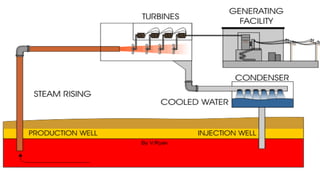
Dry Steam Power Plant
A power plant where steam is released from the pressure of a deep reservoir,
through a rock catcher, and then past the power generator turbines.
■ “Dry” steam extracted from natural reservoir
– 180-225 ºC ( 356-437 ºF)
– 4-8 MPa (580-1160 psi)
■ Steam is used to drive a turbo-generator
■ Steam is condensed and pumped back into the ground
■ Can achieve 1 kWh per 6.5 kg of steam
– A 55 MW plant requires 100 kg/s of steam
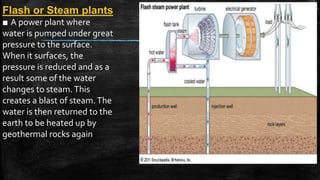
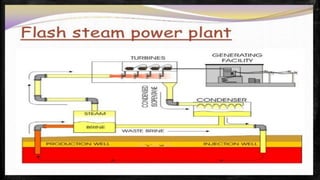
Flash or Steam plants
■ A power plant where
water is pumped under great
pressure to the surface.
When it surfaces, the
pressure is reduced and as a
result some of the water
changes to steam.This
creates a blast of steam.The
water is then returned to the
earth to be heated up by
geothermal rocks again
Flash or Steam plants
■ Steam with water extracted from ground
■ Pressure of mixture drops at surface and more water
“flashes” to steam
■ Steam separated from water
■ Steam drives a turbine
■ Turbine drives an electric generator
■ Generate between 5 and 100 MW
■ Use 6 to 9 tones of steam per hour
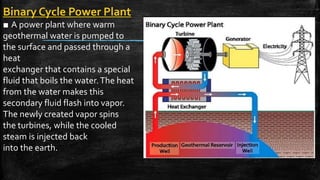
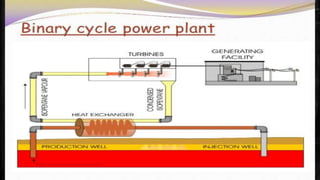
Binary Cycle Power Plant
■ A power plant where warm
geothermal water is pumped to
the surface and passed through a
heat
exchanger that contains a special
fluid that boils the water.The heat
from the water makes this
secondary fluid flash into vapor.
The newly created vapor spins
the turbines, while the cooled
steam is injected back
into the earth.
■ Low temps – 100o and 150oC
■ Use heat to vaporize organic
liquid
– E.g., iso-butane, iso-pentane
■ Use vapor to drive turbine
– Causes vapor to condense
– Recycle continuously
■ Typically 7 to 12 % efficient
■ 0.1 – 40 MW units common
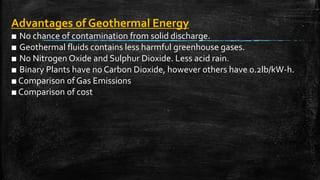
Advantages of Geothermal Energy
■ No chance of contamination from solid discharge.
■ Geothermal fluids contains less harmful greenhouse gases.
■ No Nitrogen Oxide and Sulphur Dioxide. Less acid rain.
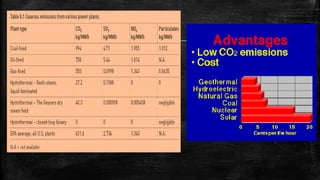
■ Binary Plants have no Carbon Dioxide, however others have 0.2lb/kW-h.
■ Comparison of Gas Emissions
■ Comparison of cost
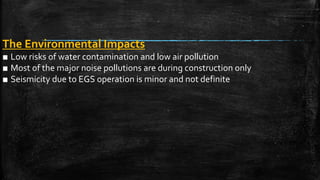
The Environmental Impacts
■ Low risks of water contamination and low air pollution
■ Most of the major noise pollutions are during construction only
■ Seismicity due to EGS operation is minor and not definite
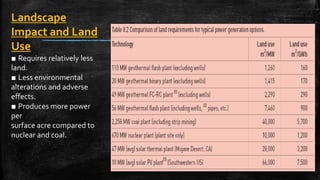
Landscape
Impact and Land
Use
■ Requires relatively less
land.
■ Less environmental
alterations and adverse
effects.
■ Produces more power
per
surface acre compared to
nuclear and coal.
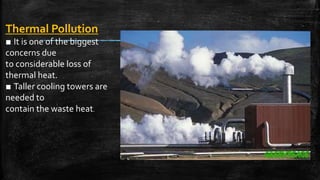
Thermal Pollution
■ It is one of the biggest
concerns due
to considerable loss of
thermal heat.
■ Taller cooling towers are
needed to
contain the waste heat.
Noise Pollution
■ Noise does occur during initial
construction and drilling.
■ Noise is minimum.
0
20
40
60
Immense potential
■ Although Geothermal Energy is not
renewable, the available resource is
large
– 2,000 zettajoules available for extraction.
(MIT) Enough to power human civilization
for thousands of years
– 100,000 MWe is projected to be
extracted
in the next 50 years
Summary
■ Further development of Deep Geothermal Energy
should be highly considered because of its
– Potential to allow new access to large resources
– Environmentally friendly traits
– Competitive costs in the long run
– Ability to use existing technologies to begin
extraction soon
THE END

Geothermal energy..nayak

  • 1.
    Satish kumar Nayak RollNo:14.ME/46 Group: ME(A)2 Reg.No: 1401225227
  • 2.
    OUTLINE  Introduction  GeologicalBackground  Main Components of a Geothermal Power Plant  Types of Geothermal Power Plants  Advantages of Geothermal Power Plants  Summery
  • 3.
    Introduction o Our earthwas a burning planet billions of years ago, Still earth core temperature is above 5000 C. o Geo means earth andThermal means heat , Geothermal means earth’s heat o Geothermal energy is the energy contained as heat in the earth’s interior. o Geothermal energy is energy extracted from the heat stored in the earth. o Geothermal energy is derived from within the earth's tectonic activity that occurred since the planet was created. It also comes from solar thermal absorbed by the earth's surface.
  • 5.
    Geological Background Earth’s radiusis approximately 6370 km and it can be divided into three zones  Crust (7 km under ocean, 20-65 km under the continent)  Mantle (2900 km , lies under the crust)  Core (center, 4000oC and 3.6 million bars)
  • 6.
    Historical Background ■ Conventional geothermal plantscapture hot water from geysers or steam from vents to spin turbines. ■ Prince Piero Ginori Conti tested the first geothermal power generator. It successfully lit four light bulbs. Later, in 1911, the world’s first commercial geothermal power station was built there.
  • 7.
    Main Components ofa Geothermal Power Plant ■ Production Well ■ Separator ■ Heat Exchanger ■ SteamTurbine ■ Condenser ■ Generator ■ InjectionWell
  • 8.
    Production Well ■ Sourceof steam Depth 3 km to 10 km ■ Similar to production well of an oil rig ■ Wells may be located as far as 10 km to 14 km from power plant ■ Steam can be moist or dry, Moist steam passes through separator ■ Water or brine is reinjected through injection well
  • 10.
    Separator ■ Steam containsnon condensable gases including Hydrogen sulphide ■ Separator are used for the purpose to remove these gases ■ 2 phase and 3 phase separators are used according to requirement ■ Separators are vertically horizontally designed
  • 11.
    SteamTurbine ■ Specially designedsteam turbine are used for geothermal power plants. ■ Steam can be corrosive due to many non condensable gases e.g. Hydrogen sulphide ■ To protect rotor blades and nozzles from corrosion special coatings and materials are used. ■ The generation and transmission side of geothermal power plants is similar to conventional power plants.
  • 12.
    Condenser ■ Steam condensedat a vacuum at the turbine exit ■ Most plants use direct contact condensers that uses water itself as the cooling media.
  • 13.
    Injection Well ■ Theexcess condensate and the brine from the separator returns back to the underground thermal reservoir, ■ Reinjection wells are located in appropriate places ■ Some reservoirs can give outputs for years with out reinjection
  • 14.
    How It Works ■Large holes have to be dug into the earth until a geothermal hotspot is found. ■ Pipes are inserted inside these holes through which water is sent and steam output is obtained. ■ The production involves two process 1) Converting Geothermal energy into Mechanical energy 2) Converting Mechanical Energy into Electrical Energy ■ The success of the energy production depends on the temperature of the plant which depends on the temperature of the rocks in earth. ■ The water is sent through the injection well and reaches the rocks and then hot water comes from the production well.
  • 15.
    ■ Due tothe high pressure when it reaches the topmost of the earth surface it is converted into steam. ■ The separator is the place where steam that comes from the earth is made clean by removing the brine and dirt so that they do not damage the turbine blades. ■ The high pressure and low pressure steam runs the turbine. ■ The generator is coupled with turbine to produce electricity. ■ The condenser is a phase changer where the steam output of the turbine is given to the condenser and gets converted to hot water. ■ This hot water is then sent to the cooling tower where it loses it heat and then sent to the geothermal reservoir for further production of steam
  • 16.
    Sources of Earth’sInternal Energy •70% comes from the decay of radioactive nuclei with long half lives that are embedded within the Earth •Some energy is from residual heat left over from Earths formation. •The rest of the energy comes from meteorite impacts.
  • 17.
    Different Geothermal EnergySources Hot Water Reservoirs: As the name implies these are reservoirs of hot underground water. There is a large amount of them in the US, but they are more suited for space heating than for electricity production. Natural Stem Reservoirs: In this case a hole dug into the ground can cause steam to come to the surface. This type of resource is rare in the US. Geopressured Reservoirs: In this type of reserve, brine completely saturated with natural gas in stored under pressure from the weight of overlying rock. This type of resource can be used for both heat and for natural gas.
  • 18.
    Normal Geothermal Gradient:At any place on the planet, there is a normal temperature gradient of +300C per km dug into the earth. Therefore, if one digs 20,000 feet the temperature will be about 1900C above the surface temperature. This difference will be enough to produce electricity. However, no useful and economical technology has been developed to extracted this large source of energy. Hot Dry Rock: This type of condition exists in 5% of the US. It is similar to Normal Geothermal Gradient, but the gradient is 400C/km dug underground. Molten Magma: No technology exists to tap into the heat reserves stored in magma. The best sources for this in the US are in Alaska and Hawaii.
  • 19.
    Direct uses ofgeothermal energy is appropriate for sources below 1500C • space heating • air conditioning • industrial processes • drying • Greenhouses • Aguaculture • hot water • resorts and pools • melting snow
  • 20.
    How Direct UsesWork •DirectSources function by sending water down a well to be heated by the Earth’s warmth. •Then a heat pump is used to take the heat from the underground water to the substance that heats the house. •Then after the water it is cooled is injected back into the Earth.
  • 21.
    Types of GeothermalPower Plants There are three different types of Geothermal power plants system designs : ■ Dry Steam Power Plants ■ Flash / Steam Plants ■ Binary cycle power plant
  • 22.
    Dry Steam PowerPlant A power plant where steam is released from the pressure of a deep reservoir, through a rock catcher, and then past the power generator turbines. ■ “Dry” steam extracted from natural reservoir – 180-225 ºC ( 356-437 ºF) – 4-8 MPa (580-1160 psi) ■ Steam is used to drive a turbo-generator ■ Steam is condensed and pumped back into the ground ■ Can achieve 1 kWh per 6.5 kg of steam – A 55 MW plant requires 100 kg/s of steam
  • 24.
    Flash or Steamplants ■ A power plant where water is pumped under great pressure to the surface. When it surfaces, the pressure is reduced and as a result some of the water changes to steam.This creates a blast of steam.The water is then returned to the earth to be heated up by geothermal rocks again
  • 25.
    Flash or Steamplants ■ Steam with water extracted from ground ■ Pressure of mixture drops at surface and more water “flashes” to steam ■ Steam separated from water ■ Steam drives a turbine ■ Turbine drives an electric generator ■ Generate between 5 and 100 MW ■ Use 6 to 9 tones of steam per hour
  • 27.
    Binary Cycle PowerPlant ■ A power plant where warm geothermal water is pumped to the surface and passed through a heat exchanger that contains a special fluid that boils the water.The heat from the water makes this secondary fluid flash into vapor. The newly created vapor spins the turbines, while the cooled steam is injected back into the earth.
  • 28.
    ■ Low temps– 100o and 150oC ■ Use heat to vaporize organic liquid – E.g., iso-butane, iso-pentane ■ Use vapor to drive turbine – Causes vapor to condense – Recycle continuously ■ Typically 7 to 12 % efficient ■ 0.1 – 40 MW units common
  • 30.
    Advantages of GeothermalEnergy ■ No chance of contamination from solid discharge. ■ Geothermal fluids contains less harmful greenhouse gases. ■ No Nitrogen Oxide and Sulphur Dioxide. Less acid rain. ■ Binary Plants have no Carbon Dioxide, however others have 0.2lb/kW-h. ■ Comparison of Gas Emissions ■ Comparison of cost
  • 32.
    The Environmental Impacts ■Low risks of water contamination and low air pollution ■ Most of the major noise pollutions are during construction only ■ Seismicity due to EGS operation is minor and not definite
  • 33.
    Landscape Impact and Land Use ■Requires relatively less land. ■ Less environmental alterations and adverse effects. ■ Produces more power per surface acre compared to nuclear and coal.
  • 34.
    Thermal Pollution ■ Itis one of the biggest concerns due to considerable loss of thermal heat. ■ Taller cooling towers are needed to contain the waste heat.
  • 35.
    Noise Pollution ■ Noisedoes occur during initial construction and drilling. ■ Noise is minimum. 0 20 40 60
  • 36.
    Immense potential ■ AlthoughGeothermal Energy is not renewable, the available resource is large – 2,000 zettajoules available for extraction. (MIT) Enough to power human civilization for thousands of years – 100,000 MWe is projected to be extracted in the next 50 years
  • 37.
    Summary ■ Further developmentof Deep Geothermal Energy should be highly considered because of its – Potential to allow new access to large resources – Environmentally friendly traits – Competitive costs in the long run – Ability to use existing technologies to begin extraction soon
  • 38.