GEOTHERMAL
ENERGY
Submitted by: Namrata Bordoloi
Ambe Verma
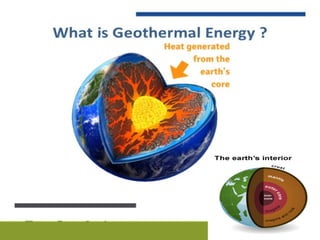
What is Geothermal energy?
It is the heat energy stored in the earth, generated by
natural sources.
From the decay of radioactive nuclei that are
embedded within the Earth.
 From residual heat left over from Earths
formation.
 The rest of the energy comes from meteorite
impacts.
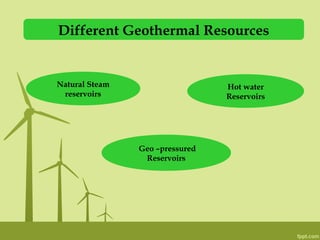
Natural Steam
reservoirs
Geo –pressured
Reservoirs
Hot water
Reservoirs
Different Geothermal Resources
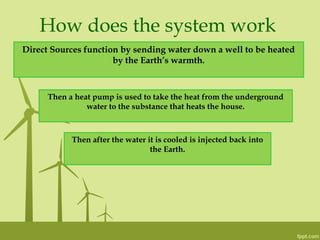
How does the system work
Direct Sources function by sending water down a well to be heated
by the Earth’s warmth.
Then a heat pump is used to take the heat from the underground
water to the substance that heats the house.
Then after the water it is cooled is injected back into
the Earth.
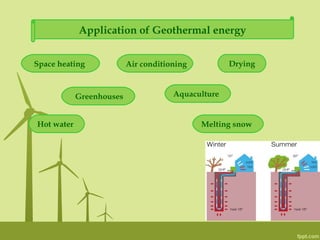
Air conditioning Drying
Greenhouses Aquaculture
Hot water Melting snow
Application of Geothermal energy
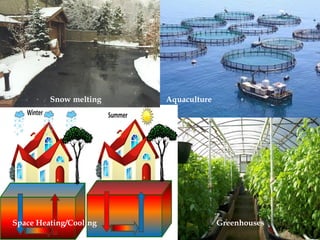
Space heating
Aquaculture
GreenhousesSpace Heating/Cooling
Snow melting
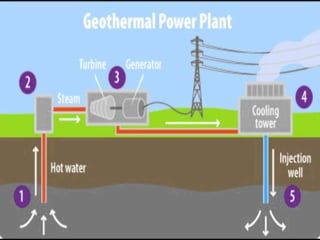
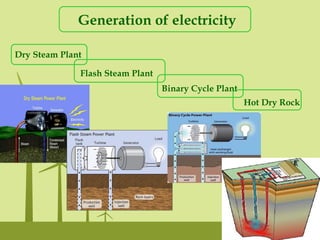
Generation of electricity
Dry Steam Plant
Flash Steam Plant
Binary Cycle Plant
Hot Dry Rock
Advantages
 Homegrown Energy
 Good alternative to fossil fuels
 Less gaseous emission
 Low maintainence
 Saves energy upto 50% in comparison to conventional systems
 Independent of weather
 A sustainable source of energy
Disadvantages
 May cause Land Subsidence, this can lead
to an increase in seismic activity.
 Can salinate the soil if the water is not injected
back into the reserve after the heat is extracted.
 Can release H2S.
Power plants that do not inject the cooled water back into
the ground can release H2S, the “rotten eggs” gas. This gas
can cause problems if large quantities escape because
inhaling too much is fatal.
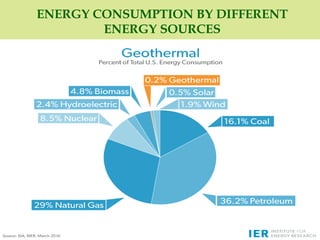
ENERGY CONSUMPTION BY DIFFERENT
ENERGY SOURCES
PROSPECTS OF GEOTHERMAL ENERGY IN INDIA
 About 6.5% of electricity generation in the world is done by geothermal energy
and India can play an important role in the coming years in this direction.
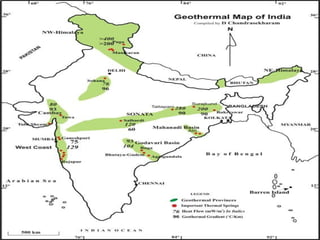
 Geological Survey of India has identified about 340 geothermal hot springs in the
country. Most of them are in the low surface temperature range from 37o
C-90o
C
which is suitable for direct heat applications.
 Grouped into seven geothermal provinces. Himalayan (Puga, Chhumathang),
Sahara Valley, Cambay Basin, Son-Narmada-Tapi (SONATA) lineament belt, West
Coast, Godavari basin and Mahanadi basin.
 A new location of geothermal power energy has also been found in Tattapani in
Chhattisgarh. Gujarat is set to tap geothermal electricity through resources which are
available in Cambay between Narmada and Tapi river.
 India’s first geothermal plant to come up in Chhattisgarh. NTPC has already
started exploratory and preparatory work in this area. It has also started talks with
Oil and Natural Gas Corp and international organisations for drilling operation.
BIGGEST PRODUCERS OF GEOTHERMAL ENERGY:
Italy , Mexico, Philippines , Japan , U.S.A. , Indonesia, New Zealand,
Iceland
 The United States generates  3,386 MW of geothermal electricity. The
largest group of geothermal power plants located at THE GEYSERS,
California.
 The Philippines, which generates 23% of its electricity from geothermal
energy, is the world’s second biggest producer behind the U.S.
 The first geothermal power station was built at Landrello, in Italy, and
the second was at Wairekei in New Zealand.
 In Iceland
- 86% of their space heating uses geothermal energy.
- 16% of their electricity generation uses geothermal energy.
Geothermal energy presentation

Geothermal energy presentation

  • 1.
  • 2.
    What is Geothermalenergy? It is the heat energy stored in the earth, generated by natural sources. From the decay of radioactive nuclei that are embedded within the Earth.  From residual heat left over from Earths formation.  The rest of the energy comes from meteorite impacts.
  • 4.
    Natural Steam reservoirs Geo –pressured Reservoirs Hotwater Reservoirs Different Geothermal Resources
  • 5.
    How does thesystem work Direct Sources function by sending water down a well to be heated by the Earth’s warmth. Then a heat pump is used to take the heat from the underground water to the substance that heats the house. Then after the water it is cooled is injected back into the Earth.
  • 7.
    Air conditioning Drying GreenhousesAquaculture Hot water Melting snow Application of Geothermal energy Space heating
  • 8.
  • 9.
    Generation of electricity DrySteam Plant Flash Steam Plant Binary Cycle Plant Hot Dry Rock
  • 10.
    Advantages  Homegrown Energy Good alternative to fossil fuels  Less gaseous emission  Low maintainence  Saves energy upto 50% in comparison to conventional systems  Independent of weather  A sustainable source of energy
  • 11.
    Disadvantages  May causeLand Subsidence, this can lead to an increase in seismic activity.  Can salinate the soil if the water is not injected back into the reserve after the heat is extracted.  Can release H2S. Power plants that do not inject the cooled water back into the ground can release H2S, the “rotten eggs” gas. This gas can cause problems if large quantities escape because inhaling too much is fatal.
  • 12.
    ENERGY CONSUMPTION BYDIFFERENT ENERGY SOURCES
  • 13.
    PROSPECTS OF GEOTHERMALENERGY IN INDIA  About 6.5% of electricity generation in the world is done by geothermal energy and India can play an important role in the coming years in this direction.  Geological Survey of India has identified about 340 geothermal hot springs in the country. Most of them are in the low surface temperature range from 37o C-90o C which is suitable for direct heat applications.  Grouped into seven geothermal provinces. Himalayan (Puga, Chhumathang), Sahara Valley, Cambay Basin, Son-Narmada-Tapi (SONATA) lineament belt, West Coast, Godavari basin and Mahanadi basin.  A new location of geothermal power energy has also been found in Tattapani in Chhattisgarh. Gujarat is set to tap geothermal electricity through resources which are available in Cambay between Narmada and Tapi river.  India’s first geothermal plant to come up in Chhattisgarh. NTPC has already started exploratory and preparatory work in this area. It has also started talks with Oil and Natural Gas Corp and international organisations for drilling operation.
  • 15.
    BIGGEST PRODUCERS OFGEOTHERMAL ENERGY: Italy , Mexico, Philippines , Japan , U.S.A. , Indonesia, New Zealand, Iceland  The United States generates  3,386 MW of geothermal electricity. The largest group of geothermal power plants located at THE GEYSERS, California.  The Philippines, which generates 23% of its electricity from geothermal energy, is the world’s second biggest producer behind the U.S.  The first geothermal power station was built at Landrello, in Italy, and the second was at Wairekei in New Zealand.  In Iceland - 86% of their space heating uses geothermal energy. - 16% of their electricity generation uses geothermal energy.