

Presentation on
Geothermal
Energy


   By- Archit Parashar
What is Geothermal energy?
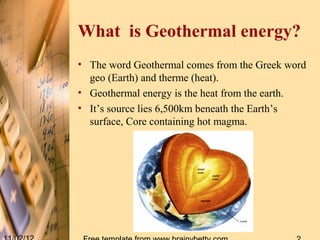
• The word Geothermal comes from the Greek word
  geo (Earth) and therme (heat).
• Geothermal energy is the heat from the earth.
• It’s source lies 6,500km beneath the Earth’s
  surface, Core containing hot magma.
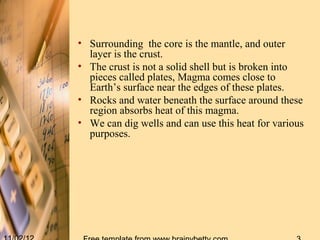
• Surrounding the core is the mantle, and outer
  layer is the crust.
• The crust is not a solid shell but is broken into
  pieces called plates, Magma comes close to
  Earth’s surface near the edges of these plates.
• Rocks and water beneath the surface around these
  region absorbs heat of this magma.
• We can dig wells and can use this heat for various
  purposes.
History of Geothermal energy
• The use of geothermal energy for heating purpose
  is not new.
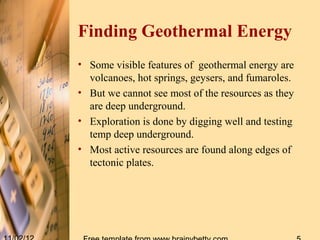
• Ancient people used it for heating and bathing
  through hot springs.


• Using geothermal energy to produce electricity is a
  new industry
• A group of Italians first used it in 1904. The
  Italians used the natural steam erupting from the
  Earth to power a turbine generator.
Finding Geothermal Energy
• Some visible features of geothermal energy are
  volcanoes, hot springs, geysers, and fumaroles.
• But we cannot see most of the resources as they
  are deep underground.
• Exploration is done by digging well and testing
  temp deep underground.
• Most active resources are found along edges of
  tectonic plates.
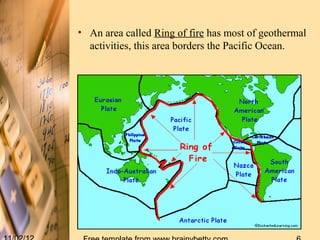
• An area called Ring of fire has most of geothermal
  activities, this area borders the Pacific Ocean.
Uses
 Direct use: geothermal heating and heat pumps

 Indirect use: Electricity production
Direct use
• Heat is directly used.
• Heat is extracted from low temperature source,
  <150 degree Celsius.
• It can be used for space heating, industrial
  processes, drying crops, hot water supply, melting
  snow.
• For space heating, Heat Pump is used.
• It uses little energy for heating thus saves money
  and reduce pollution.
Indirect use: electricity
production
• Source temperature is higher than 150 degree
  Celsius.
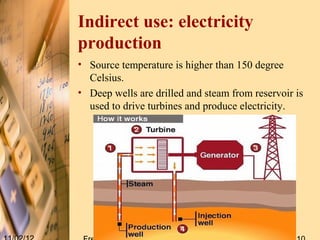
• Deep wells are drilled and steam from reservoir is
  used to drive turbines and produce electricity.
Types of power plants
   Flashed steam plant
   Dry steam plant
   Binary power plant
   Hybrid power plant
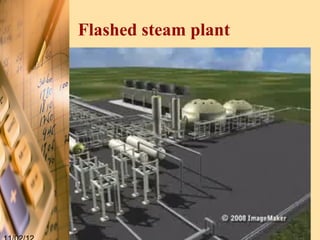
Flashed steam plant
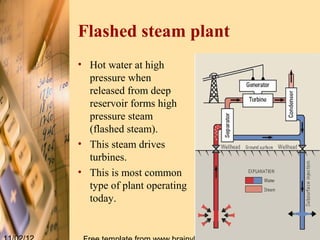
• Hot water at high
  pressure when
  released from deep
  reservoir forms high
  pressure steam
  (flashed steam).
• This steam drives
  turbines.
• This is most common
  type of plant operating
  today.
Flashed steam plant
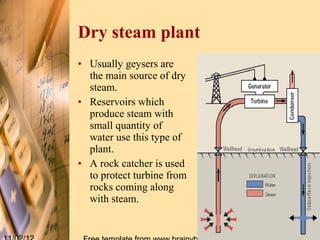
Dry steam plant
• Usually geysers are
  the main source of dry
  steam.
• Reservoirs which
  produce steam with
  small quantity of
  water use this type of
  plant.
• A rock catcher is used
  to protect turbine from
  rocks coming along
  with steam.
Binary power plant
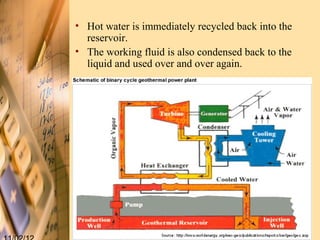
• In this the geothermal water is passed through a
  heat exchanger where its heat is transferred to a
  secondary liquid.
• Liquids having lower boiling point are used as
  secondary liquid such as isobutene, isopentane or
  ammonia–water mixture.
• The vapour of secondary liquid are used to rotate
  turbines.
• The binary system is useful in geothermal
  reservoirs which are relatively low in temperature.
• Heat loss is minimum as system is completely
  closed.
• Hot water is immediately recycled back into the
  reservoir.
• The working fluid is also condensed back to the
  liquid and used over and over again.
Hybrid power plant
• It uses both boiling water as well as steam.
• Steam is directly is used as used in flashed steam
  plant.
• While energy of hot water is used through
  secondary liquid as used in Binary system.
Enhanced geothermal system
• It refers to a variety of engineering techniques
  used to artificially create hydrothermal resources.
• In this the drilling is done in hot dry rocks, and
  cold water at high pressure is pumped in.
• As water travels through cracks in hot dry rock it’s
  temperature is increased.
• Now this very hot water is collected back through
  another drilled hole, converted into steam and
  used.
• This is very promising technology but is still in it’s
  development stage.
• Risk of seismic activities could increase, due to
  artificially fracturing the underground rocks.
Advantages
• Geothermal energy does not produce any
  pollution, and does not contribute to the
  greenhouse effect.
•    The power stations are compact, so there is not
  much impact on the environment.
•    No fuel is needed.
• Once you've built a geothermal power station, the
  energy is almost free.
• It may need a little energy to run a pump, but this
  can be taken from the energy being generated.
Cost, Price and Challenges
• Since it does not use any fuel hence it’s cost is
  unaffected by price fluctuations.
• Primary prices are bit high but once the capital
  costs have been recovered price of power can
  decrease.
• Most of the cost is related to resource exploration
  and plant construction.
• Drilling Costs alone account for as much as one-
  third of total plant cost because rocks in
  geothermal areas are usually extremely hard and
  hot.
• Geothermal power plants must be located near a
  reservoir because it difficult to transport steam or
  hot water over distances.
Barriers
• Finding a suitable build location.
• exploration stage can be extremely capital
  intensive and of high-risk.
• Some areas of land may have the sufficient hot
  rocks to supply hot water to a power station, but
  many of these areas are located in harsh areas of
  the world (near the poles), or high up in
  mountains.
• Harmful gases can escape from deep within the
  earth.
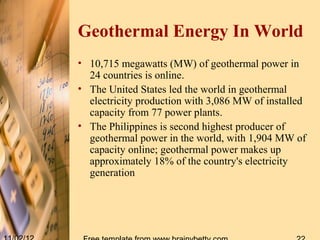
Geothermal Energy In World
• 10,715 megawatts (MW) of geothermal power in
  24 countries is online.
• The United States led the world in geothermal
  electricity production with 3,086 MW of installed
  capacity from 77 power plants.
• The Philippines is second highest producer of
  geothermal power in the world, with 1,904 MW of
  capacity online; geothermal power makes up
  approximately 18% of the country's electricity
  generation
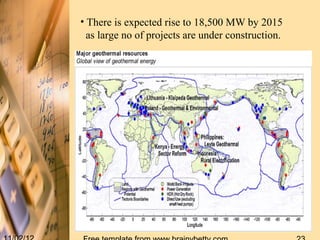
• There is expected rise to 18,500 MW by 2015
  as large no of projects are under construction.
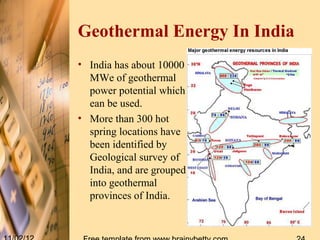
Geothermal Energy In India
• India has about 10000
  MWe of geothermal
  power potential which
  ean be used.
• More than 300 hot
  spring locations have
  been identified by
  Geological survey of
  India, and are grouped
  into geothermal
  provinces of India.
Geothermal Energy and the
Environment
• Geothermal energy does little damage to the
  environment, with very less CO2 emission.
• Transportation of fuel is not required as they are
  located on top of there fuel.
• Geothermal has minimal land requirements.
  Geothermal plants use 404 square meters per
  GWh versus 3,622 and 1,335 square kilometres for
  coal facilities and wind farms respectively.
• They use 20 litres of freshwater per MW·h versus
  over 1000 litres per MW·h for nuclear, coal power
  plants.
• It is one of the most eco-friendly technology.
References
•
•   Www.Wikipedia.com
•   The NEED Project , www.NEED.org
•   Www.indiaenergyportal.org
•   Www.worldenergy.org
THANK YOU

geothermal energy

  • 1.
  • 2.
    What is Geothermalenergy? • The word Geothermal comes from the Greek word geo (Earth) and therme (heat). • Geothermal energy is the heat from the earth. • It’s source lies 6,500km beneath the Earth’s surface, Core containing hot magma.
  • 3.
    • Surrounding thecore is the mantle, and outer layer is the crust. • The crust is not a solid shell but is broken into pieces called plates, Magma comes close to Earth’s surface near the edges of these plates. • Rocks and water beneath the surface around these region absorbs heat of this magma. • We can dig wells and can use this heat for various purposes.
  • 4.
    History of Geothermalenergy • The use of geothermal energy for heating purpose is not new. • Ancient people used it for heating and bathing through hot springs. • Using geothermal energy to produce electricity is a new industry • A group of Italians first used it in 1904. The Italians used the natural steam erupting from the Earth to power a turbine generator.
  • 5.
    Finding Geothermal Energy •Some visible features of geothermal energy are volcanoes, hot springs, geysers, and fumaroles. • But we cannot see most of the resources as they are deep underground. • Exploration is done by digging well and testing temp deep underground. • Most active resources are found along edges of tectonic plates.
  • 6.
    • An areacalled Ring of fire has most of geothermal activities, this area borders the Pacific Ocean.
  • 7.
    Uses  Direct use:geothermal heating and heat pumps  Indirect use: Electricity production
  • 8.
    Direct use • Heatis directly used. • Heat is extracted from low temperature source, <150 degree Celsius. • It can be used for space heating, industrial processes, drying crops, hot water supply, melting snow. • For space heating, Heat Pump is used. • It uses little energy for heating thus saves money and reduce pollution.
  • 10.
    Indirect use: electricity production •Source temperature is higher than 150 degree Celsius. • Deep wells are drilled and steam from reservoir is used to drive turbines and produce electricity.
  • 11.
    Types of powerplants  Flashed steam plant  Dry steam plant  Binary power plant  Hybrid power plant
  • 12.
    Flashed steam plant •Hot water at high pressure when released from deep reservoir forms high pressure steam (flashed steam). • This steam drives turbines. • This is most common type of plant operating today.
  • 13.
  • 14.
    Dry steam plant •Usually geysers are the main source of dry steam. • Reservoirs which produce steam with small quantity of water use this type of plant. • A rock catcher is used to protect turbine from rocks coming along with steam.
  • 15.
    Binary power plant •In this the geothermal water is passed through a heat exchanger where its heat is transferred to a secondary liquid. • Liquids having lower boiling point are used as secondary liquid such as isobutene, isopentane or ammonia–water mixture. • The vapour of secondary liquid are used to rotate turbines. • The binary system is useful in geothermal reservoirs which are relatively low in temperature. • Heat loss is minimum as system is completely closed.
  • 16.
    • Hot wateris immediately recycled back into the reservoir. • The working fluid is also condensed back to the liquid and used over and over again.
  • 17.
    Hybrid power plant •It uses both boiling water as well as steam. • Steam is directly is used as used in flashed steam plant. • While energy of hot water is used through secondary liquid as used in Binary system.
  • 18.
    Enhanced geothermal system •It refers to a variety of engineering techniques used to artificially create hydrothermal resources. • In this the drilling is done in hot dry rocks, and cold water at high pressure is pumped in. • As water travels through cracks in hot dry rock it’s temperature is increased. • Now this very hot water is collected back through another drilled hole, converted into steam and used. • This is very promising technology but is still in it’s development stage. • Risk of seismic activities could increase, due to artificially fracturing the underground rocks.
  • 19.
    Advantages • Geothermal energydoes not produce any pollution, and does not contribute to the greenhouse effect. • The power stations are compact, so there is not much impact on the environment. • No fuel is needed. • Once you've built a geothermal power station, the energy is almost free. • It may need a little energy to run a pump, but this can be taken from the energy being generated.
  • 20.
    Cost, Price andChallenges • Since it does not use any fuel hence it’s cost is unaffected by price fluctuations. • Primary prices are bit high but once the capital costs have been recovered price of power can decrease. • Most of the cost is related to resource exploration and plant construction. • Drilling Costs alone account for as much as one- third of total plant cost because rocks in geothermal areas are usually extremely hard and hot. • Geothermal power plants must be located near a reservoir because it difficult to transport steam or hot water over distances.
  • 21.
    Barriers • Finding asuitable build location. • exploration stage can be extremely capital intensive and of high-risk. • Some areas of land may have the sufficient hot rocks to supply hot water to a power station, but many of these areas are located in harsh areas of the world (near the poles), or high up in mountains. • Harmful gases can escape from deep within the earth.
  • 22.
    Geothermal Energy InWorld • 10,715 megawatts (MW) of geothermal power in 24 countries is online. • The United States led the world in geothermal electricity production with 3,086 MW of installed capacity from 77 power plants. • The Philippines is second highest producer of geothermal power in the world, with 1,904 MW of capacity online; geothermal power makes up approximately 18% of the country's electricity generation
  • 23.
    • There isexpected rise to 18,500 MW by 2015 as large no of projects are under construction.
  • 24.
    Geothermal Energy InIndia • India has about 10000 MWe of geothermal power potential which ean be used. • More than 300 hot spring locations have been identified by Geological survey of India, and are grouped into geothermal provinces of India.
  • 25.
    Geothermal Energy andthe Environment • Geothermal energy does little damage to the environment, with very less CO2 emission. • Transportation of fuel is not required as they are located on top of there fuel. • Geothermal has minimal land requirements. Geothermal plants use 404 square meters per GWh versus 3,622 and 1,335 square kilometres for coal facilities and wind farms respectively. • They use 20 litres of freshwater per MW·h versus over 1000 litres per MW·h for nuclear, coal power plants. • It is one of the most eco-friendly technology.
  • 26.
    References • • Www.Wikipedia.com • The NEED Project , www.NEED.org • Www.indiaenergyportal.org • Www.worldenergy.org
  • 27.