
Index
• Definition
• Diagram of a nuclear power plant
• How does a nuclear power plant operate?
• Advantages and disadvantages
• Nuclear energy in Spain, Europe and worldwide
• Nuclear accidents
• Conclusions
• Credits
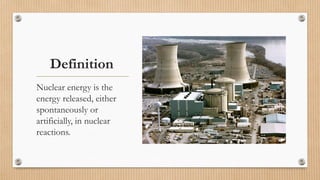
Definition
Nuclear energy is the
energy released, either
spontaneously or
artificially, in nuclear
reactions.
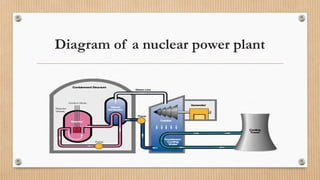
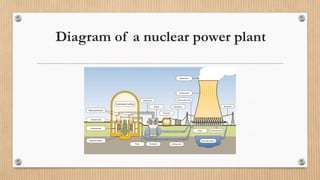
Diagram of a nuclear power plant
How does a nuclear power plant
operate?
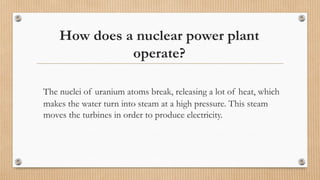
The nuclei of uranium atoms break, releasing a lot of heat, which
makes the water turn into steam at a high pressure. This steam
moves the turbines in order to produce electricity.
Advantages / Disadvantages
• Nuclear energy does not produce CO².
• It reduces the dependence on oil producers.
• It generates part of the electrical energy we
use .
• Under strict control, nuclear power plants
cause very little damage to the environment.
• Nuclear energy produces radioactive waste.
• Nuclear accidents are very dangerous.
• It is difficult to control nuclear weapons.
• Nuclear power plants require a high cost of
construction and maintenance.
• The use of this energy means a dependence
on uranium producers.
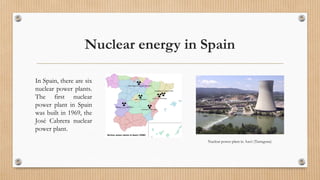
Nuclear energy in Spain
Nuclear power plant in Ascó (Tarragona)
In Spain, there are six
nuclear power plants.
The first nuclear
power plant in Spain
was built in 1969, the
José Cabrera nuclear
power plant.
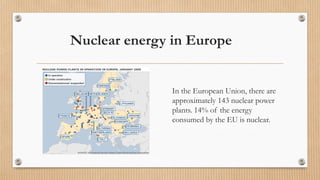
Nuclear energy in Europe
In the European Union, there are
approximately 143 nuclear power
plants. 14% of the energy
consumed by the EU is nuclear.
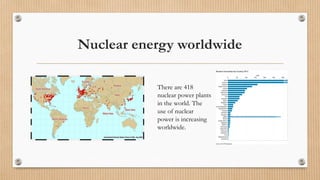
Nuclear energy worldwide
There are 418
nuclear power plants
in the world. The
use of nuclear
power is increasing
worldwide.
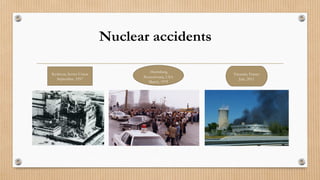
Nuclear accidents
1986 – Chernobyl, Ukraine. The most serious accident
at a power plant in history
2011 – Fukushima, Japan . The second most serious
accident at a nuclear plant
Tricastin, France
July, 2011
Harrisburg,
Pennsylvania, USA
March, 1979
Kyshtym, Soviet Union
September, 1957
Nuclear accidents
Conclusions
• Nuclear energy is good because it does
not pollute and it is a renewable
energy. In addition, it is used in
medical treatments.
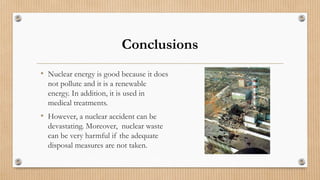
• However, a nuclear accident can be
devastating. Moreover, nuclear waste
can be very harmful if the adequate
disposal measures are not taken.
Credits
By Sandra Martínez, Roi García and Sara Blanco
Bilingual section of Technology
Group 3º ESO-B
IES Praia Barraña – Boiro (Spain)
March, 2016

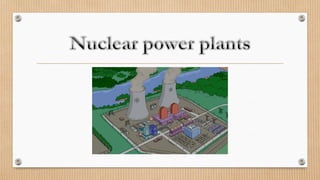
Nuclear power plants

  • 2.
    Index • Definition • Diagramof a nuclear power plant • How does a nuclear power plant operate? • Advantages and disadvantages • Nuclear energy in Spain, Europe and worldwide • Nuclear accidents • Conclusions • Credits
  • 3.
    Definition Nuclear energy isthe energy released, either spontaneously or artificially, in nuclear reactions.
  • 4.
    Diagram of anuclear power plant
  • 5.
    Diagram of anuclear power plant
  • 6.
    How does anuclear power plant operate? The nuclei of uranium atoms break, releasing a lot of heat, which makes the water turn into steam at a high pressure. This steam moves the turbines in order to produce electricity.
  • 7.
    Advantages / Disadvantages •Nuclear energy does not produce CO². • It reduces the dependence on oil producers. • It generates part of the electrical energy we use . • Under strict control, nuclear power plants cause very little damage to the environment. • Nuclear energy produces radioactive waste. • Nuclear accidents are very dangerous. • It is difficult to control nuclear weapons. • Nuclear power plants require a high cost of construction and maintenance. • The use of this energy means a dependence on uranium producers.
  • 8.
    Nuclear energy inSpain Nuclear power plant in Ascó (Tarragona) In Spain, there are six nuclear power plants. The first nuclear power plant in Spain was built in 1969, the José Cabrera nuclear power plant.
  • 9.
    Nuclear energy inEurope In the European Union, there are approximately 143 nuclear power plants. 14% of the energy consumed by the EU is nuclear.
  • 10.
    Nuclear energy worldwide Thereare 418 nuclear power plants in the world. The use of nuclear power is increasing worldwide.
  • 11.
    Nuclear accidents 1986 –Chernobyl, Ukraine. The most serious accident at a power plant in history 2011 – Fukushima, Japan . The second most serious accident at a nuclear plant
  • 12.
    Tricastin, France July, 2011 Harrisburg, Pennsylvania,USA March, 1979 Kyshtym, Soviet Union September, 1957 Nuclear accidents
  • 13.
    Conclusions • Nuclear energyis good because it does not pollute and it is a renewable energy. In addition, it is used in medical treatments. • However, a nuclear accident can be devastating. Moreover, nuclear waste can be very harmful if the adequate disposal measures are not taken.
  • 14.
    Credits By Sandra Martínez,Roi García and Sara Blanco Bilingual section of Technology Group 3º ESO-B IES Praia Barraña – Boiro (Spain) March, 2016