
INTERNET SERVICES
Author: Carlos Cajaraville Lojo. 3ºESO-A.
TYPES OF INTERNET SERVICES
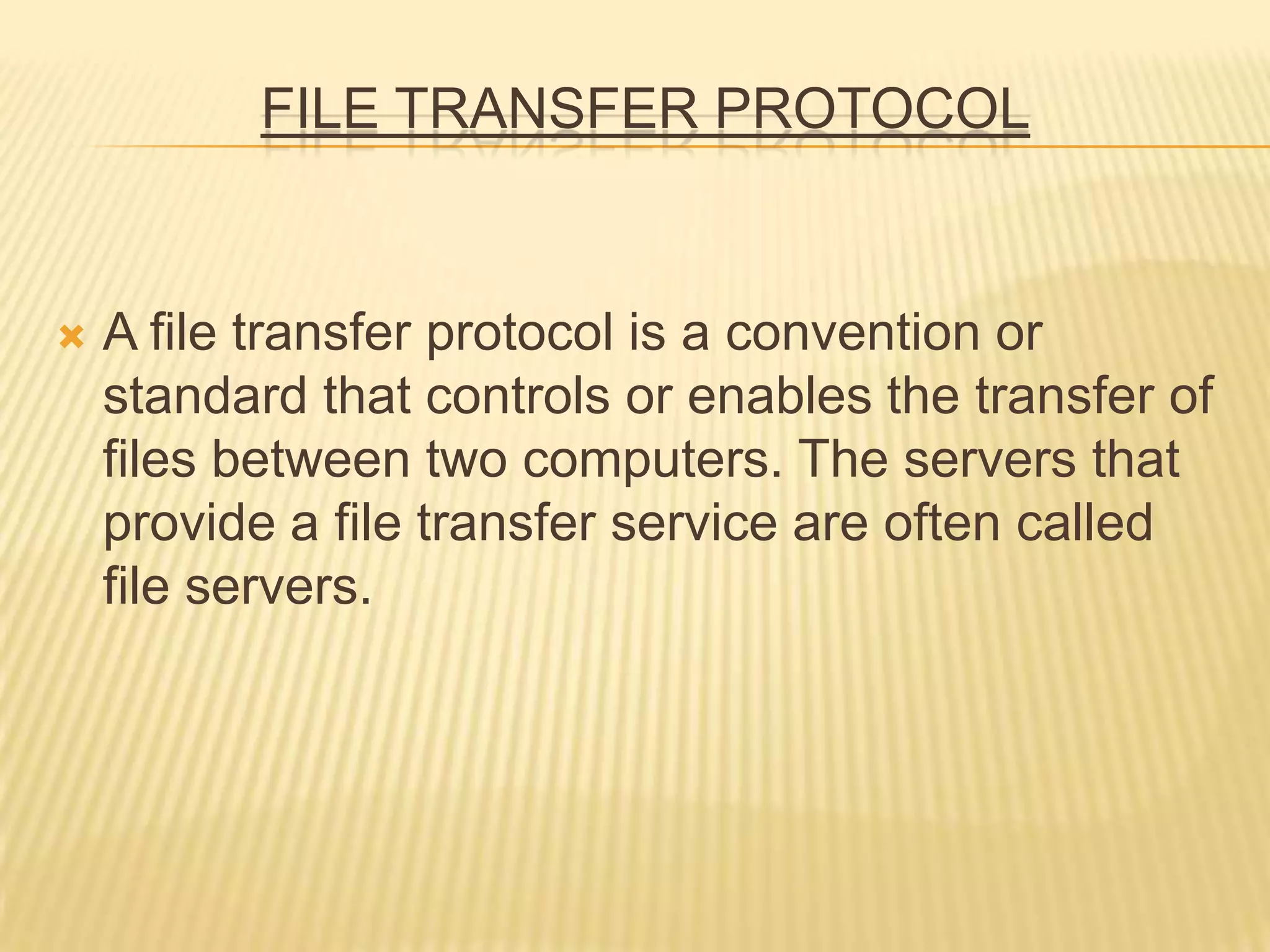
1. Websites.
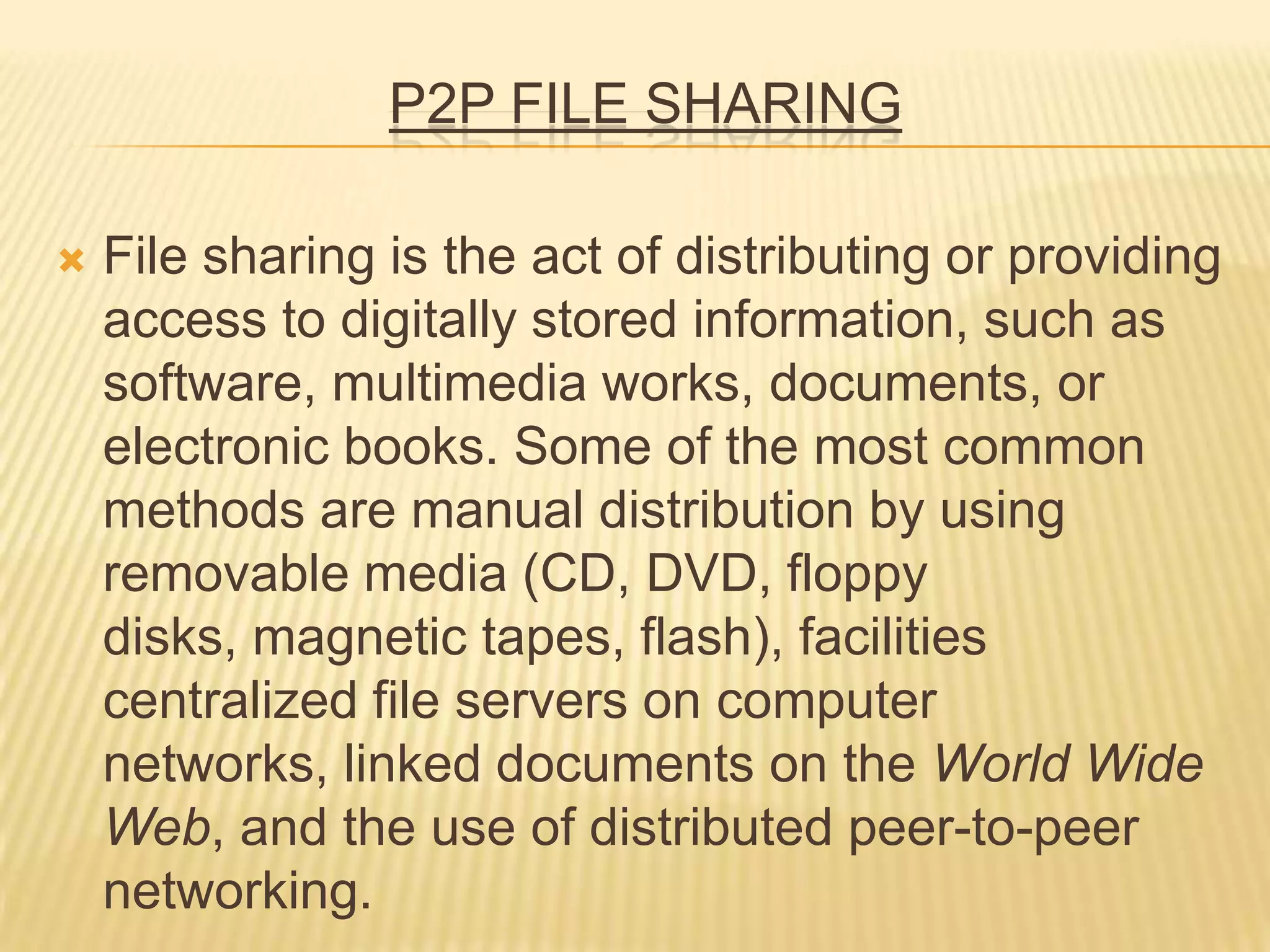
2. Electronic mail (e-mail).
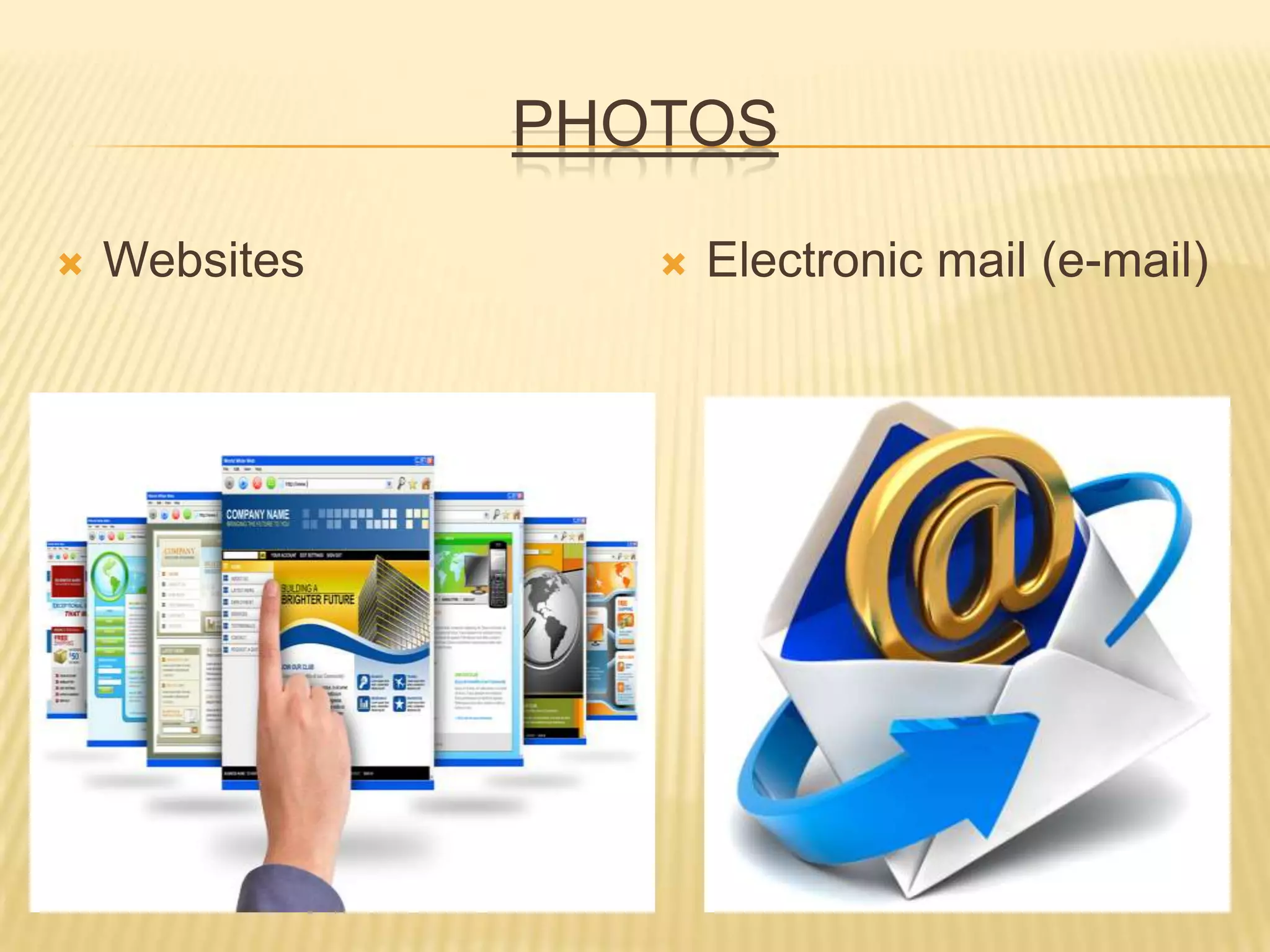
3. Discussion forums and newsgroups.
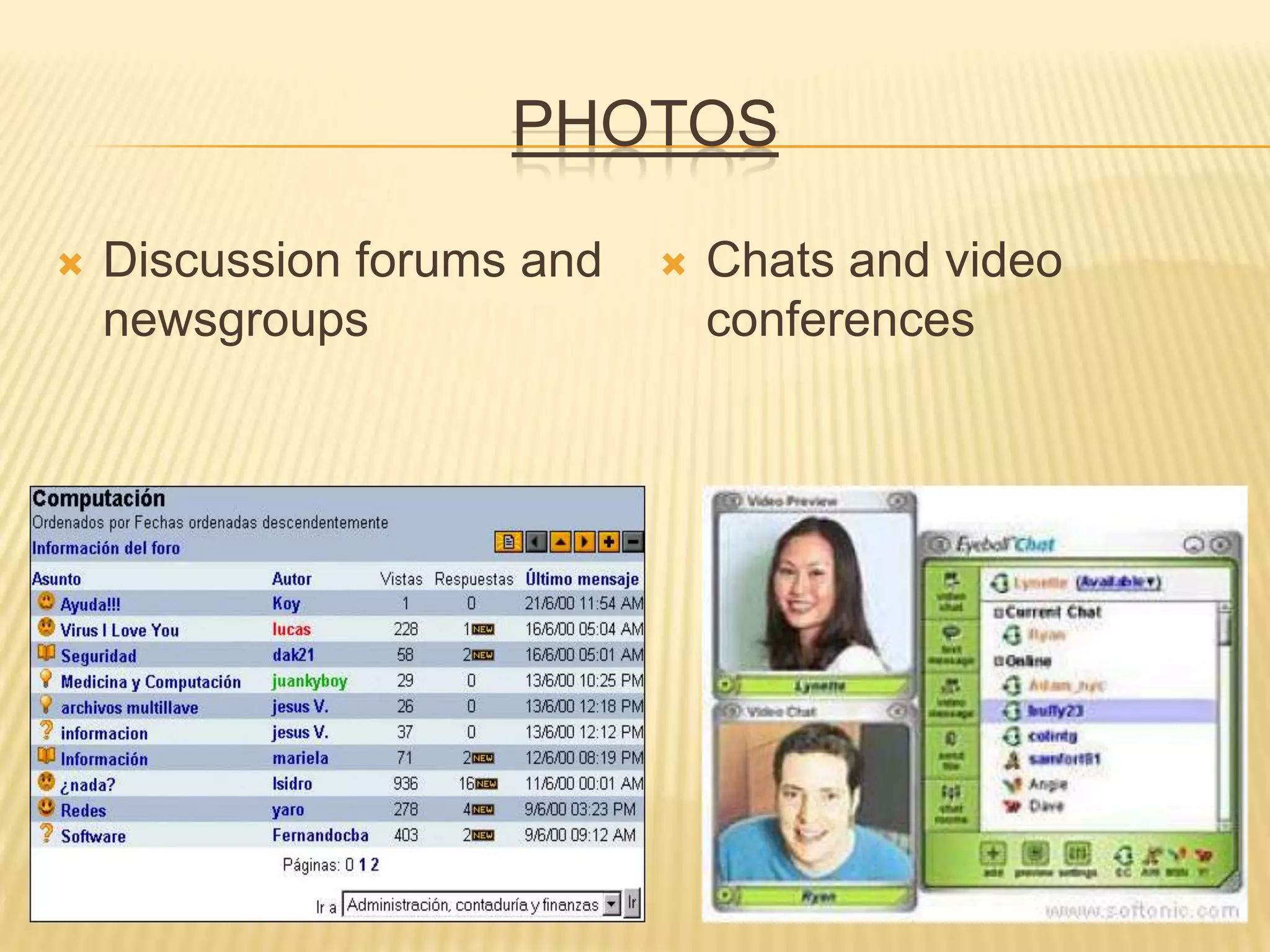
4. Chats and video conferences.
5. Instant messaging.
6. Virtual communities.
7. File transfer protocol (FTP).
8. P2P file sharing.
9. Photos.
10. Biography.
WEB SITES.
 A website is a collection of related web pages. A
web page is an HTML / XHTML file which is
usually accessible via HTTP protocol Internet.
All publicly accessible websites are a huge
World Wide Web of information.
ELECTRONIC MAIL (E-MAIL).
 E-mail (also known as email) is a network
service that allows users to send and receive
messages and files quickly via electronic
communication systems. In 1971, Ray
Tomlinson incorporated the use of the at sign
(@) as a divider between the user and the
computer that hosts the mail.
DISCUSSION FORUMS AND NEWSGROUPS
 Forum: It is a web application which supports
online discussions or opinions, allowing the
users to express their ideas or comments
regarding the subject matter.
 Newsgroups: They are a means of
communication within the Usenet system in
which users read and send text messages to
various boards distributed across servers with
the ability to send and reply to messages.
CHATS AND VIDEO CONFERENCES.
 Chat: A written communication made ​​instantly
by using software and Internet between
two, three or more people, either publicly or
privately.
 Videoconference: A two-way, simultaneous
audio and video communication which allows
different groups to hold meetings at places far
apart. The core technology used in a
videoconferencing system is digital compression
of audio and video streams in real time.
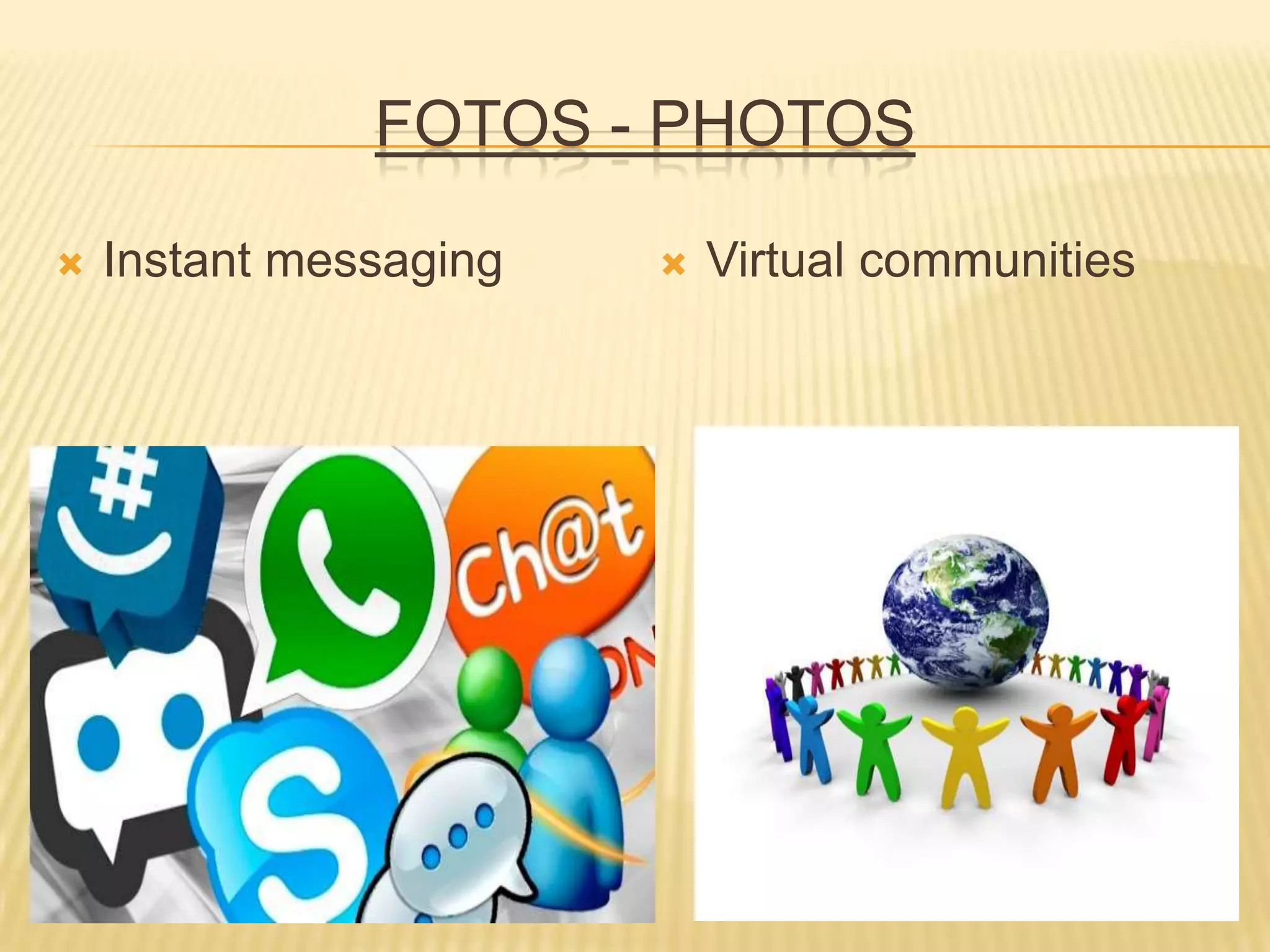
INSTANT MESSAGING
 Instant messaging is a form of real-time
communication between two or more people
based on text. Instant messaging requires the
use of an instant messaging client that performs
the service and differs from e-mail. ICQ was the
first instant messaging system for computers
with the operating system UNIX/LINUX in
November 1996.
VIRTUAL COMMUNITIES
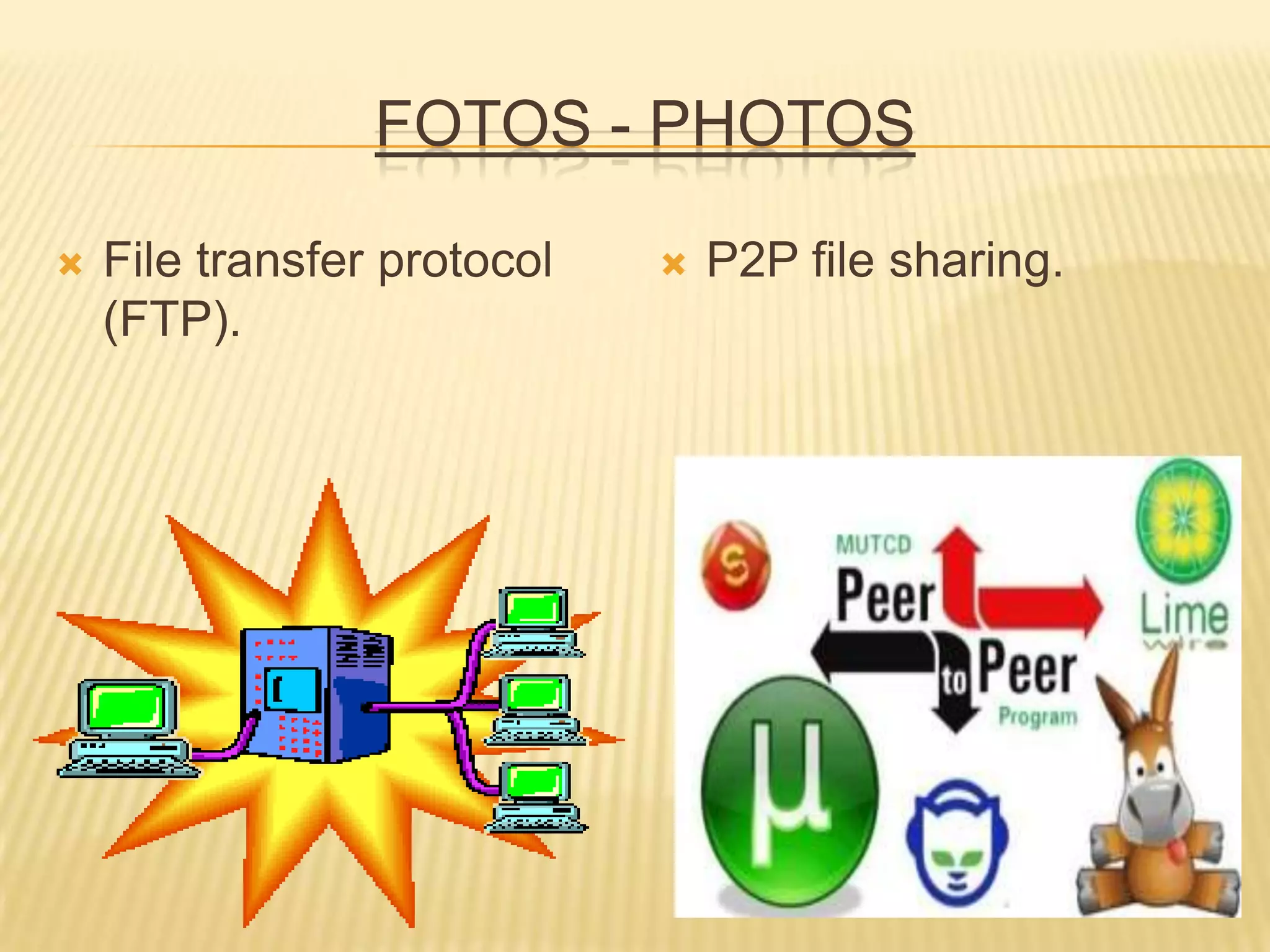
 A virtual community is a community whose
links, interactions and relationships take
place, not in a physical space, but in a virtual
space such as the Internet. The idea of virtual
communities emerged in 1988 when it appeared
online.
FILE TRANSFER PROTOCOL
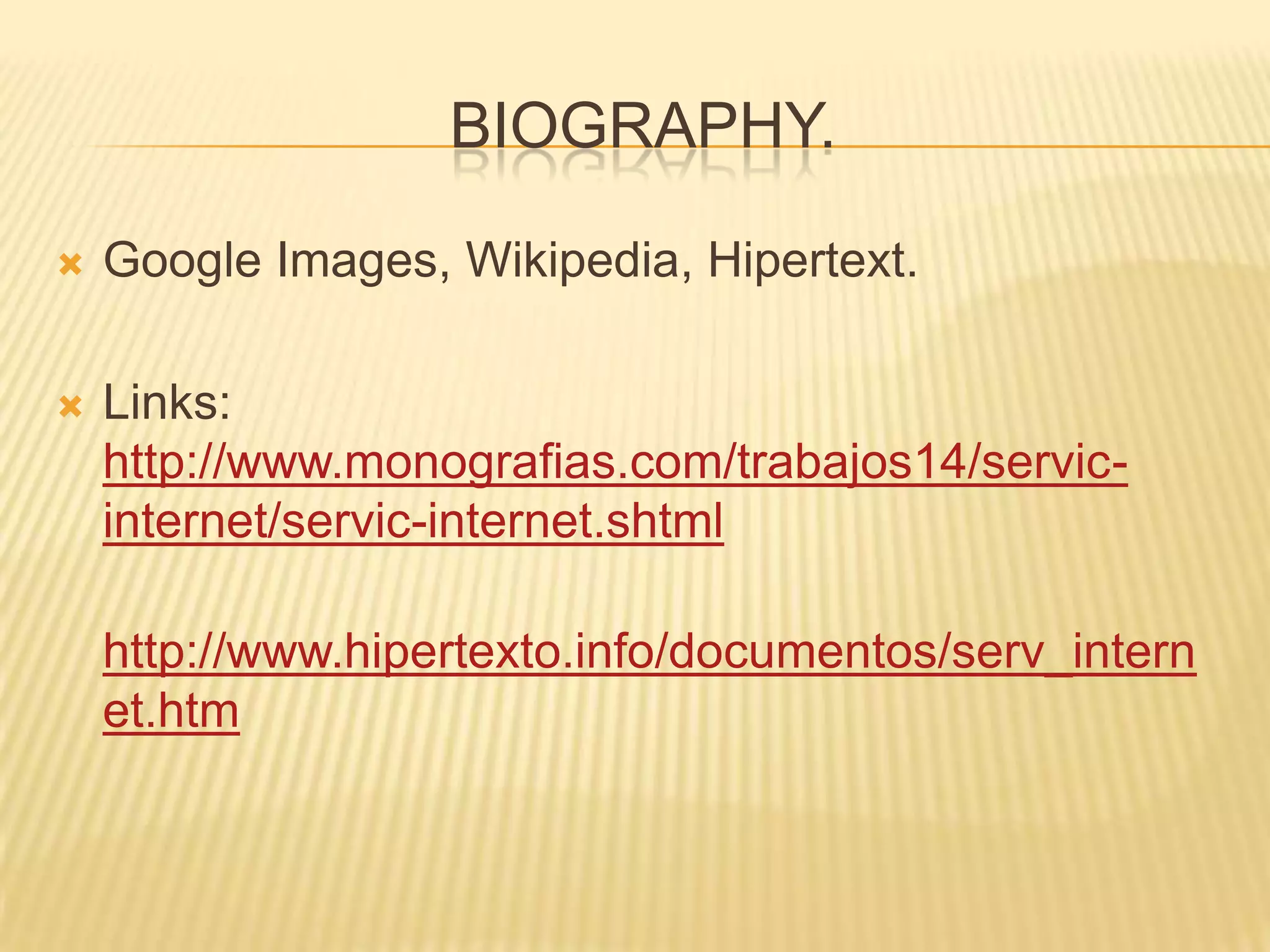
 A file transfer protocol is a convention or
standard that controls or enables the transfer of
files between two computers. The servers that
provide a file transfer service are often called
file servers.
P2P FILE SHARING
 File sharing is the act of distributing or providing
access to digitally stored information, such as
software, multimedia works, documents, or
electronic books. Some of the most common
methods are manual distribution by using
removable media (CD, DVD, floppy
disks, magnetic tapes, flash), facilities
centralized file servers on computer
networks, linked documents on the World Wide
Web, and the use of distributed peer-to-peer
networking.
PHOTOS
 Websites  Electronic mail (e-mail)
PHOTOS
 Discussion forums and
newsgroups
 Chats and video
conferences
FOTOS - PHOTOS
 Instant messaging  Virtual communities
FOTOS - PHOTOS
 File transfer protocol
(FTP).
 P2P file sharing.
BIOGRAPHY.
 Google Images, Wikipedia, Hipertext.
 Links:
http://www.monografias.com/trabajos14/servic-
internet/servic-internet.shtml
http://www.hipertexto.info/documentos/serv_intern
et.htm
END OF WORK

Internet services, by Carlos Cajaraville Lojo

  • 1.
    INTERNET SERVICES Author: CarlosCajaraville Lojo. 3ºESO-A.
  • 2.
    TYPES OF INTERNETSERVICES 1. Websites. 2. Electronic mail (e-mail). 3. Discussion forums and newsgroups. 4. Chats and video conferences. 5. Instant messaging. 6. Virtual communities. 7. File transfer protocol (FTP). 8. P2P file sharing. 9. Photos. 10. Biography.
  • 3.
    WEB SITES.  Awebsite is a collection of related web pages. A web page is an HTML / XHTML file which is usually accessible via HTTP protocol Internet. All publicly accessible websites are a huge World Wide Web of information.
  • 4.
    ELECTRONIC MAIL (E-MAIL). E-mail (also known as email) is a network service that allows users to send and receive messages and files quickly via electronic communication systems. In 1971, Ray Tomlinson incorporated the use of the at sign (@) as a divider between the user and the computer that hosts the mail.
  • 5.
    DISCUSSION FORUMS ANDNEWSGROUPS  Forum: It is a web application which supports online discussions or opinions, allowing the users to express their ideas or comments regarding the subject matter.  Newsgroups: They are a means of communication within the Usenet system in which users read and send text messages to various boards distributed across servers with the ability to send and reply to messages.
  • 6.
    CHATS AND VIDEOCONFERENCES.  Chat: A written communication made ​​instantly by using software and Internet between two, three or more people, either publicly or privately.  Videoconference: A two-way, simultaneous audio and video communication which allows different groups to hold meetings at places far apart. The core technology used in a videoconferencing system is digital compression of audio and video streams in real time.
  • 7.
    INSTANT MESSAGING  Instantmessaging is a form of real-time communication between two or more people based on text. Instant messaging requires the use of an instant messaging client that performs the service and differs from e-mail. ICQ was the first instant messaging system for computers with the operating system UNIX/LINUX in November 1996.
  • 8.
    VIRTUAL COMMUNITIES  Avirtual community is a community whose links, interactions and relationships take place, not in a physical space, but in a virtual space such as the Internet. The idea of virtual communities emerged in 1988 when it appeared online.
  • 9.
    FILE TRANSFER PROTOCOL A file transfer protocol is a convention or standard that controls or enables the transfer of files between two computers. The servers that provide a file transfer service are often called file servers.
  • 10.
    P2P FILE SHARING File sharing is the act of distributing or providing access to digitally stored information, such as software, multimedia works, documents, or electronic books. Some of the most common methods are manual distribution by using removable media (CD, DVD, floppy disks, magnetic tapes, flash), facilities centralized file servers on computer networks, linked documents on the World Wide Web, and the use of distributed peer-to-peer networking.
  • 11.
    PHOTOS  Websites Electronic mail (e-mail)
  • 12.
    PHOTOS  Discussion forumsand newsgroups  Chats and video conferences
  • 13.
    FOTOS - PHOTOS Instant messaging  Virtual communities
  • 14.
    FOTOS - PHOTOS File transfer protocol (FTP).  P2P file sharing.
  • 15.
    BIOGRAPHY.  Google Images,Wikipedia, Hipertext.  Links: http://www.monografias.com/trabajos14/servic- internet/servic-internet.shtml http://www.hipertexto.info/documentos/serv_intern et.htm
  • 16.