Mathematics Secondary Course 557
Trigonometric Ratios of Some Special Angles
Notes
MODULE - 5
Trigonometry
23
TRIGONOMETRIC RATIOS OF SOME
SPECIAL ANGLES
In the last lesson, we have defined trigonometric ratios for acute angles in a right triangle
andalsodevelopedsomerelationshipbetweenthem.Inthislessonweshallfindthevalues
oftrigonometricratiosofanglesof30o
,45o
and60o
byusingourknowledgeofgeometry.
We shall also write the values of trigonometric ratios of 0o
and 90o
and we shall observe
thatsometrigonometricratiosof0o
and90o
arenotdefined.Weshallalsousetheknowledge
oftrigonometrytosolvesimpleproblemsonheightsanddistancesfromdaytodaylife.
OBJECTIVES
Afterstudyingthislesson,youwillbeableto
• find the values of trigonometric ratios of angles of 30o
, 45o
and 60o
;
• write the values of trigonometric ratios of 0o
and 90o
;
• tell, which trigonometric ratios of 0o
and 90o
are not defined;
• solve daily life problems of heights and distances;
EXPECTED BACKGROUND KNOWLEDGE
• PythagorasTheoremi.e.inarightangledtriangleABC,rightangledatB,
AC2
= AB2
+ BC2
.
• InarighttriangleABC,rightangledatB,
Hypotenuse
Ctooppositeside
Csin
∠
= ,
Ctooppositeside
Hypotenuse
Ccosec
∠
=
Hypotenuse
Coadjacent tside
Ccos
∠
= ,
Coadjacent tside
Hypotenuse
Csec
∠
=
Mathematics Secondary Course558
Notes
MODULE - 5
Trigonometry
Trigonometric Ratios of Some Special Angles
Coadjacent tside
Ctooppositeside
Ctan
∠
∠
= and
Ctooppositeside
Coadjacent tside
Ccot
∠
∠
=
cosec C =
Csin
1
, sec C =
Ccos
1
and cot C =
Ctan
1
• sin (90o
– θ) = cos θ, cos (90o
– θ) = sin θ
tan (90o
– θ) = cot θ, cot (90o
– θ) = tan θ
• sec (90o
– θ) = cosec θ and cosec (90o
– θ) = sec θ
23.1 TRIGONOMETRIC RATIOS FOR AN ANGLE OF 45O
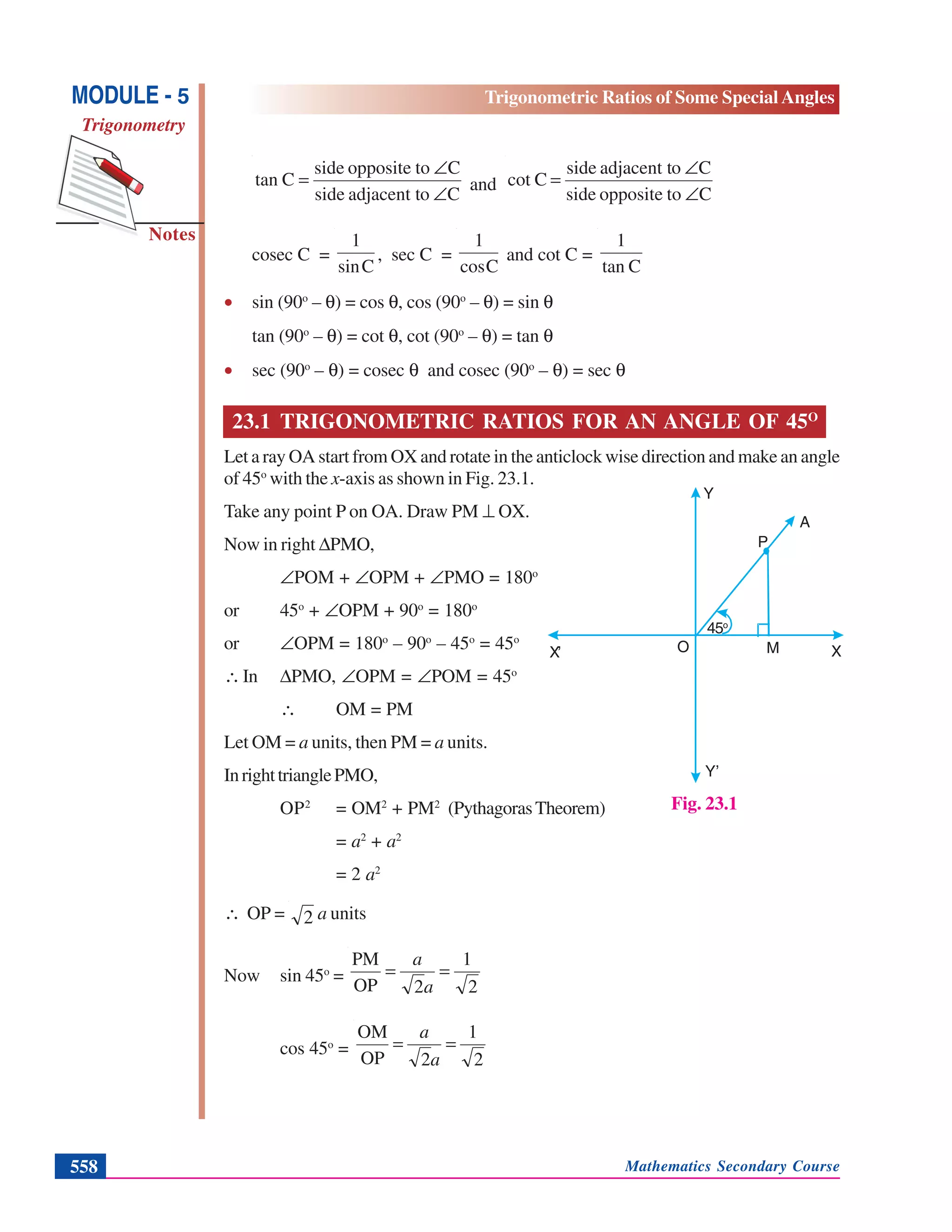
Let a ray OA start from OX and rotate in the anticlock wise direction and make an angle
of 45o
with the x-axis as shown in Fig. 23.1.
Take any point P on OA. Draw PM ⊥ OX.
Now in right ΔPMO,
∠POM + ∠OPM + ∠PMO = 180o
or 45o
+ ∠OPM + 90o
= 180o
or ∠OPM = 180o
– 90o
– 45o
= 45o
∴In ΔPMO, ∠OPM = ∠POM = 45o
∴ OM = PM
Let OM = a units, then PM = a units.
InrighttrianglePMO,
OP2
= OM2
+ PM2
(PythagorasTheorem)
= a2
+ a2
= 2 a2
∴ OP = 2 a units
Now sin 45o
=
2
1
2OP
PM
==
a
a
cos 45o
=
2
1
2OP
OM
==
a
a
Fig. 23.1
X’ X
Y
Y’
O M
P
A
45o
Mathematics Secondary Course 559
Trigonometric Ratios of Some Special Angles
Notes
MODULE - 5
Trigonometry
tan 45o
= 1
OM
PM
==
a
a
cosec 45o
= 2
2/1
1
45sin
1
==o
sec 45o
= 2
2/1
1
45cos
1
==o
and cot 45o
= 1
1
1
45tan
1
==o
23.2 TRIGONOMETRIC RATIOS FOR AN ANGLE OF 30O
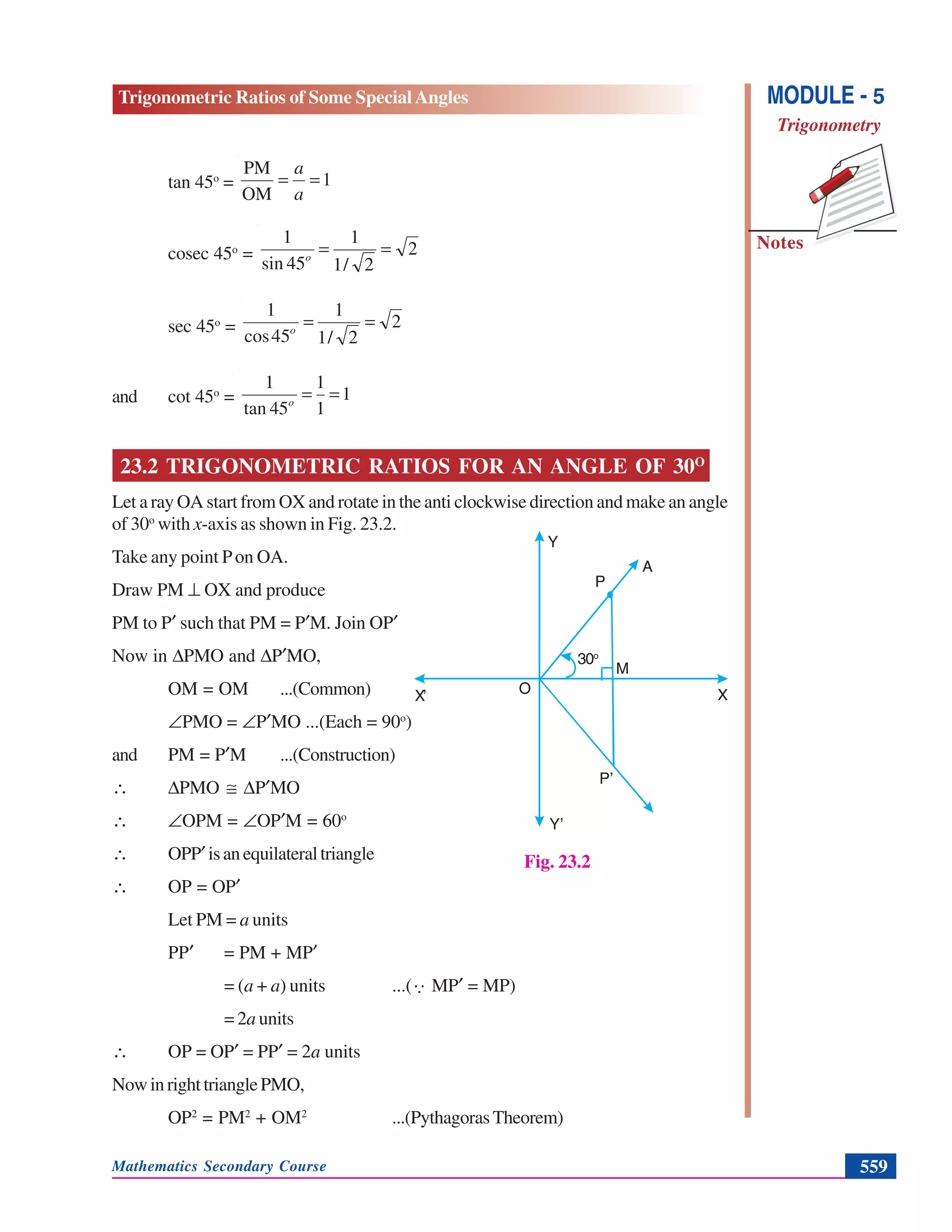
Let a ray OA start from OX and rotate in the anti clockwise direction and make an angle
of 30o
with x-axis as shown in Fig. 23.2.
Take any point Pon OA.
Draw PM ⊥ OX and produce
PM to P′ such that PM = P′M. Join OP′
Now in ΔPMO and ΔP′MO,
OM = OM ...(Common)
∠PMO = ∠P′MO ...(Each = 90o
)
and PM = P′M ...(Construction)
∴ ΔPMO ≅ ΔP′MO
∴ ∠OPM = ∠OP′M = 60o
∴ OPP′isanequilateraltriangle
∴ OP = OP′
Let PM = a units
PP′ = PM + MP′
= (a + a) units ...(Q MP′ = MP)
= 2a units
∴ OP = OP′ = PP′ = 2a units
NowinrighttrianglePMO,
OP2
= PM2
+ OM2
...(PythagorasTheorem)
Fig. 23.2
X’
Y’
X
P’
P
A
Y
M
30o
O
Mathematics Secondary Course560
Notes
MODULE - 5
Trigonometry
Trigonometric Ratios of Some Special Angles
or (2a)2
= a2
+ OM2
∴ OM2
= 3a2
or OM = 3 a units
∴ sin 30o
=
2
1
2OP
PM
==
a
a
cos 30o
=
2
3
2
3
OP
OM
==
a
a
tan 30o
=
3
1
3OM
PM
==
a
a
cosec 30o
= 2
2/1
1
30sin
1
==o
sec 30o
=
3
2
2/3
1
30cos
1
==o
and cot 30o
= 3
3/1
1
30tan
1
==o
23.3 TRIGONOMETRIC RATIOS FOR AN ANGLE OF 60O
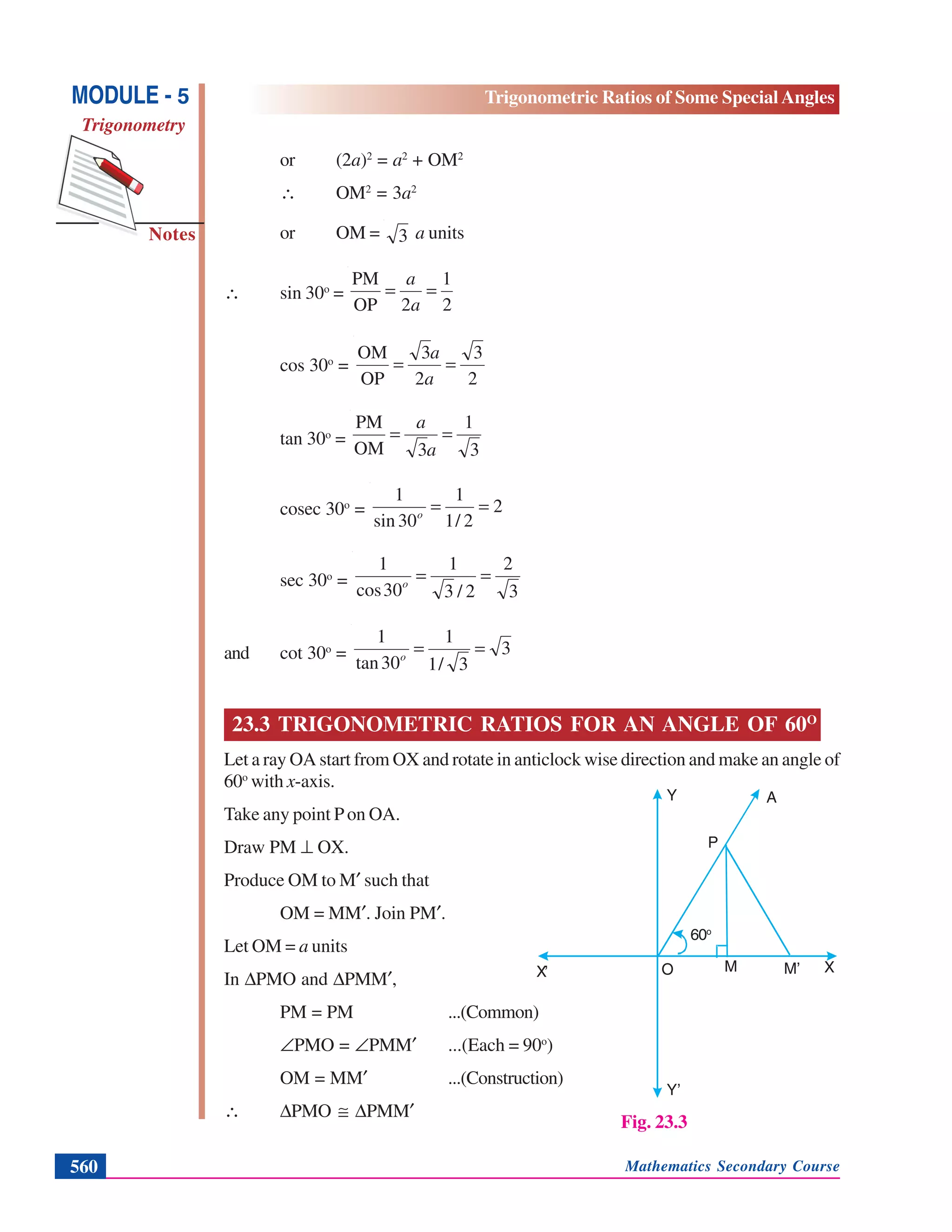
Let a ray OA start from OX and rotate in anticlock wise direction and make an angle of
60o
with x-axis.
Take any point Pon OA.
Draw PM ⊥ OX.
Produce OM to M′ such that
OM = MM′. Join PM′.
Let OM = a units
In ΔPMO and ΔPMM′,
PM = PM ...(Common)
∠PMO = ∠PMM′ ...(Each = 90o
)
OM = MM′ ...(Construction)
∴ ΔPMO ≅ ΔPMM′
Fig. 23.3
X’
Y’
Y A
XM
P
M’
60o
O
Mathematics Secondary Course 561
Trigonometric Ratios of Some Special Angles
Notes
MODULE - 5
Trigonometry
∴ ∠POM = ∠PM′M = 60o
∴ ΔPOM′ is an equilateral triangle.
∴ OP = PM′ = OM′ = 2a units
In right ΔPMO,
OP2
= PM2
+ OM2
...(PythagorusTheorem)
∴ (2a)2
= PM2
+ a2
or PM2
= 3a2
∴ PM = 3 a units
∴ sin 60o
=
2
3
2
3
OP
PM
==
a
a
cos 60o
=
2
1
2OP
OM
==
a
a
tan 60o
= 3
3
OM
PM
==
a
a
cosec 60o
=
3
2
2
3
1
60sin
1
==o
sec 60o
= 2
2/1
1
60cos
1
==o
and cot 60o
=
3
1
60tan
1
0
=
23.4 TRIGONOMETRIC RATIOS FOR ANGLES OF
0O
AND 90O
In Section 23.1, 23.2 and 23.3, we have defined trigonometric ratios for angles of 45o
,
30o
and 60o
. For angles of 0o
and 90o
, we shall assume the following results and we shall
not be discussing the logical proofs of these.
(i) sin 0o
= 0 and therefore cosec 0o
is not defined
(ii) cos 0o
= 1 and therefore sec 0o
= 1
Mathematics Secondary Course562
Notes
MODULE - 5
Trigonometry
Trigonometric Ratios of Some Special Angles
(iii) tan 0o
= 0 therefore cot 0o
is not defined.
(iv) sin 90o
= 1 and therefore cosec 90o
= 1
(v) cos 90o
= 0 and therefore sec 90o
is not defined.
(vi) cot 90o
= 0 and therefore tan 90o
is not defined.
The values of trignometric ratios for 0o
, 30o
, 45o
, 60o
and 90o
can be put in a tabular form
which makes their use simple.The following table also works as an aid to memory.
θ 0o
30o
45o
60o
90o
Trig.ratio
sinθ 0
4
0
=
2
1
4
1
=
2
1
4
2
=
2
3
4
3
= 1
4
4
=
cos θ 1
4
4
=
2
3
4
3
=
2
1
4
2
=
2
1
4
1
= 0
4
0
=
tanθ 0
04
0
=
− 3
1
14
1
=
−
1
24
2
=
−
3
34
3
=
−
Not defined
cot θ Not defined 3
34
3
=
−
1
24
2
=
− 3
1
14
1
=
−
0
04
0
=
−
cosec θ Not defined 2
1
4
= 2
2
4
=
3
2
3
4
= 1
4
4
=
sec θ 1
4
4
=
3
2
3
4
= 2
2
4
= 2
1
4
= Not defined
Let us, now take some examples to illustrate the use of these trigonometric ratios.
Example 23.1: Find the value of tan2
60o
– sin2
30o
.
Solution: We know that tan 60o
= 3 and sin 30o
=
2
1
∴ tan2
60o
– sin2
30o
= ( )
2
2
2
1
3 ⎟
⎠
⎞
⎜
⎝
⎛
−
=
4
1
3− =
4
11
Mathematics Secondary Course 563
Trigonometric Ratios of Some Special Angles
Notes
MODULE - 5
Trigonometry
Example 23.2: Find the value of
cot2
30o
sec2
45o
+ cosec2
45o
cos 60o
Solution: We know that
cot 30o
= 3 , sec 45o
= 2 , cosec 45o
= 2 and cos 60o
=
2
1
∴ cot2
30o
sec2
45o
+ cosec2
45o
cos 60o
= ( ) ( ) ( ) 2
1
.223
222
+
= 3 × 2 + 2 ×
2
1
= 6 + 1
= 7
Example 23.3: Evaluate : 2(cos2
45o
+ tan2
60o
) – 6(sin2
45o
– tan2
30o
)
Solution: 2(cos2
45o
+ tan2
60o
) – 6(sin2
45o
– tan2
30o
)
= ( )
⎥
⎥
⎦
⎤
⎢
⎢
⎣
⎡
⎟
⎠
⎞
⎜
⎝
⎛
−⎟
⎠
⎞
⎜
⎝
⎛
−
⎥
⎥
⎦
⎤
⎢
⎢
⎣
⎡
+⎟
⎠
⎞
⎜
⎝
⎛
22
2
2
3
1
2
1
63
2
1
2
= ⎟
⎠
⎞
⎜
⎝
⎛
−−⎟
⎠
⎞
⎜
⎝
⎛
+
3
1
2
1
63
2
1
2
= 1 + 6 – 3 + 2
= 6
Example 23.4: Verify that
0
0cos2
90sin5
45cot
60sec
30cosec
45tan
o
o
o
o
o
o
=−+
Solution: L.H.S. = o
o
o
o
o
o
0cos2
90sin5
45cot
60sec
30cosec
45tan
−+
=
12
15
1
2
2
1
×
×
−+
=
2
5
2
2
1
−+ = 0 = R.H.S.
Mathematics Secondary Course564
Notes
MODULE - 5
Trigonometry
Trigonometric Ratios of Some Special Angles
Hence, 0
0cos2
90sin5
45cot
60sec
30cosec
45tan
o
o
o
o
o
o
=−+
Example 23.5: Show that
3
10
30tan
4
3
60cosec260sin330cot
3
4 o2o2o2o2
=−−+
Solution: L.H.S. =
o2o2o2o2
30tan
4
3
60cosec260sin330cot
3
4
−−+
= ( )
222
2
3
1
4
3
3
2
2
2
3
33
3
4
⎟
⎠
⎞
⎜
⎝
⎛
−⎟
⎠
⎞
⎜
⎝
⎛
−⎟
⎟
⎠
⎞
⎜
⎜
⎝
⎛
+×
=
3
1
4
3
3
4
2
4
3
33
3
4
×−×−×+×
=
4
1
3
8
4
9
4 −−+
=
12
3322748 −−+
=
3
10
12
40
=
= R.H.S.
Hence,
3
10
30tan
4
3
60cosec260sin330cot
3
4 o2o2o2o2
=−−+
Example 23.6 : Verify that
3
4
45cos30cos
45sin230sec60cot4
o2o2
o2o2o2
=
+
−+
Solution: L.H.S. = o2o2
o2o2o2
45cos30cos
45sin230sec60cot4
+
−+
= 22
222
2
1
2
3
2
1
.2
3
2
3
1
.4
⎟
⎠
⎞
⎜
⎝
⎛
+⎟
⎟
⎠
⎞
⎜
⎜
⎝
⎛
⎟
⎠
⎞
⎜
⎝
⎛
−⎟
⎠
⎞
⎜
⎝
⎛
+⎟
⎠
⎞
⎜
⎝
⎛
Mathematics Secondary Course 565
Trigonometric Ratios of Some Special Angles
Notes
MODULE - 5
Trigonometry
=
2
1
4
3
2
1
2
3
4
3
1
4
+
×−+×
=
4
5
3
5
4
5
1
3
8
=
−
=
3
4
5
4
3
5
=×
= R.H.S.
Hence,
3
4
45cos30cos
45sin230sec60cot4
o2o2
o2o2o2
=
+
−+
Example 23.7: If θ = 30o
, verfity that
θtan1
θtan2
θ2tan 2
−
=
Solution: For θ = 30o
L.H.S. = tan 2θ
= tan (2 × 30o
)
= tan 60o
= 3
and R.H.S. =
θtan1
θtan2
2
−
= o
o
30tan1
30tan2
2
−
= 2
3
1
1
3
1
.2
⎟
⎠
⎞
⎜
⎝
⎛
−
⎟
⎠
⎞
⎜
⎝
⎛
Mathematics Secondary Course566
Notes
MODULE - 5
Trigonometry
Trigonometric Ratios of Some Special Angles
=
3
2
3
2
3
1
1
3
2
=
−
= 3
2
3
3
2
=×
∴ L.H.S. = R.H.S.
Hence,
θtan1
θtan2
θ2tan 2
−
=
Example 23.8: LetA= 30o
. Verify that
sin 3A= 3 sinA– 4 sin3
A
Solution: For A= 30o
,
L.H.S. = sin 3A
= sin (3 × 30o
)
= sin 90o
= 1
and R.H.S. = 3 sinA– 4 sin3
A
= 3 sin 30o
– 4 sin3
30o
=
3
2
1
4
2
1
3 ⎟
⎠
⎞
⎜
⎝
⎛
×−×
=
8
4
2
3
−
=
2
1
2
3
−
= 1
∴ L.H.S. = R.H.S.
Hence, sin 3A= 3 sinA– 4 sin3
A
Example 23.9: Using the formula sin (A– B) = sinAcos B – cosAsin B, find the value
of sin 15o
.
Mathematics Secondary Course 567
Trigonometric Ratios of Some Special Angles
Notes
MODULE - 5
Trigonometry
Solution: sin (A– B) = sinAcos B – cosAsin B ...(i)
Let A = 45o
and B = 30o
∴ From (i),
sin (45o
– 30o
) = sin 45o
cos 30o
– cos 45o
sin 30o
or sin 15o
=
2
1
2
1
2
3
2
1
×−×
=
22
13 −
Hence, sin 15o
=
22
13 −
.
Remark: In the above examples we can also take A = 60o
and B = 45o
.
Example 23.10: If sin (A+ B) = 1 and cos (A– B) = 1, 0o
<A+ B ≤ 90o
,A≥ B, findA
and B.
Solution: Q sin (A + B) = 1 = sin 90o
∴ A + B = 90o
...(i)
Again cos (A – B) = 1 = cos 0o
∴ A – B = 0o
...(ii)
Adding(i)and(ii),weget
2A = 90o
or A = 45o
From (ii), we get
B = A = 45o
Hence, A = 45o
and B = 45o
Example 23.11: If cos (20o
+ x) = sin 30o
, find x.
Solution: cos (20o
+ x) = sin 30o
= = cos 60o
... ⎟
⎠
⎞
⎜
⎝
⎛
=
2
1
60cos o
Q
∴ 20o
+ x = 60o
or x = 60o
– 20o
= 40o
Hence, x = 40o
Mathematics Secondary Course568
Notes
MODULE - 5
Trigonometry
Trigonometric Ratios of Some Special Angles
Example 23.12: In ΔABC, right angled at B, if BC = 5 cm, ∠BAC = 30o
, find the length
of the sidesAB andAC.
Solution: We are given ∠BAC = 30o
i.e., ∠A= 30o
and BC = 5 cm
Now
AC
BC
Asin =
or sin 30o
=
AC
5
or
AC
5
2
1
=
∴ AC = 2 × 5 or 10 cm
ByPythagorasTheorem,
AB = 22
BCAC −
= ( ) 22
510 − cm
= 75 cm
= 35 cm
Hence AC = 10 cm and AB = 35 cm.
Example 23.13: In ΔABC, right angled at C,AC = 4 cm andAB = 8 cm. Find ∠Aand
∠B.
Solution: We are given,AC = 4 cm andAB = 8 cm
Now sin B =
AB
AC
=
2
1
or
8
4
∴ B = 30o
... ⎥⎦
⎤
⎢⎣
⎡
=
2
1
30sin o
Q
Now ∠A = 90o
– ∠B ....[ ]o
90BA =∠+∠Q
Fig. 23.4
C B
A
5 cm
30o
Fig. 23.5
CB
A
8 cm
4 cm
Mathematics Secondary Course 569
Trigonometric Ratios of Some Special Angles
Notes
MODULE - 5
Trigonometry
= 90o
– 30o
= 60o
Hence, ∠A = 60o
and ∠B = 30o
Example 23.14: ΔABC is right angled at B. If ∠ A= ∠C, find the value of
(i) sinAcos C + cosAsin C
(ii) sinAsin B + cosAcos B
Solution: We are given that in ΔABC,
∠B = 90o
∴ ∠A + ∠C = 180o
– 90o
...(Q∠A + ∠B + ∠C = 180o
)
= 90o
Also it is given that ∠A= ∠C
∴ ∠A = ∠C = 45o
(i) sin Acos C + cos Asin C
= sin 45o
cos 45o
+ cos 45o
sin 45o
=
= 1
2
1
2
1
=+
(ii) sinA sin B + cosAcos B
= sin 45o
sin 90o
+ cos 45o
cos 90o
= 0
2
1
1
2
1
×+×
=
2
1
Example 23.15: Find the value of x if tan 2x – 3 = 0.
Solution: We are given
tan 2x – 3 = 0
or tan 2x = 3 = tan 60o
Mathematics Secondary Course570
Notes
MODULE - 5
Trigonometry
Trigonometric Ratios of Some Special Angles
∴ 2x = 60o
or x = 30o
Hence value of x is 30o
.
CHECK YOUR PROGRESS 23.1
1. Evaluateeachofthefollowing:
(i) sin2
60o
+ cos2
45o
(ii) 2 sin2
30o
– 2 cos2
45o
+ tan2
60o
(iii) 4 sin2
60o
+ 3 tan2
30o
– 8 sin2
45o
cos 45o
(iv) 4(sin4
30o
+ cos4
60o
) – 3(cos2
45o
– 2 sin2
45o
)
(v) o
o
o
o
o
o
0cos2
90sin5
45cot
60sec
30cosec
45tan
−+
(vi) o2o2
o2o2o2
30cos30sin
45tan304sec60cos5
+
−+
2. Verifyeachofthefollowing:
(i) cosec3
30o
× cos 60o
× tan3
45o
× sin2
90o
× sec2
45o
× cot 30o
= 8 3
(ii)
6
7
60cot30cos
3
1
45sin
2
1
30tan 2222
=+++ oooo
(iii) cos2
60o
– sin2
60o
= – cos 60o
(iv) 4(sin4
30o
+ cos4
60o
) – 3(cos2
45o
– sin2
90o
) = 2
(v)
o
oo
oo
30tan
30tan60tan1
30tan60tan
=
+
−
3. If ∠A=30o
,verifyeachofthefollowing:
(i) sin 2A =
Atan1
Atan2
2
+
(ii) cos 2A =
Atan1
Atan1
2
2
+
−
(iii) cos 3 A= 4 cos3
A– 3 cos A
Mathematics Secondary Course 571
Trigonometric Ratios of Some Special Angles
Notes
MODULE - 5
Trigonometry
4. IfA= 60o
and B = 30o
, verify each of the following:
(i) sin (A+ B) = sinAcos B + cosAsin B
(ii) ( )
BA tantan1
BtanAtan
BAtan
+
−
=−
5. Taking 2A= 60o
, find sin 30o
and cos 30o
, using cos 2A= 2 cos2
A– 1.
6. Using the formula cos (A+ B) = cosAcos B – sinAsin B, evaluate cos 75o
.
7. If sin (A – B) =
2
1
, cos (A + B) =
2
1
, 0o
< A + B < 90o
, A > B, find A and B.
8. If sin (A+ 2B) =
2
3
and cos (A+ 4 B) = 0, find Aand B.
9. In ΔPQR right angled at Q, PQ = 5 cm and ∠R = 30o
, find QR and PR.
10. In ΔABC, ∠B = 90o
, AB = 6 cm and AC = 12 cm. Find ∠A and ∠C.
11. In ΔABC, ∠B = 90o
. IfA= 30o
, find the value of sinAcos B + cosAsin B.
12. If cos (40o
+ 2x) = sin 30o
, find x.
Choose the correct alternative for each of the following (13-15):
13. The value of sec 30o
is
(A) 2 (B)
2
3
(C)
3
2
(D) 2
14. If sin 2A= 2 sinA, thenAis
(A) 30o
(B) 0o
(C) 60o
(D) 90o
15. o
o
60tan1
60tan2
2
+
is equal to
(A) sin 60o
(B) sin 30o
(C) cos 60o
(D) tan 60o
23.5 APPLICATION OF TRIGONOMETRY
We have so far learnt to define trigonometric ratios of an angle.Also, we have learnt to
determine the values of trigonometric ratios for the angles of 30o
, 45o
and 60o
. We also
know those trigonometric ratios for angles of 0o
and 90o
which are well defined. In this
section,wewilllearnhowtrigonometrycanbeusedtodeterminethedistancebetweenthe
Mathematics Secondary Course572
Notes
MODULE - 5
Trigonometry
Trigonometric Ratios of Some Special Angles
objects or the distance between the objects or the heights of objects by taking examples
fromdaytodaylife.Weshallfirstdefinesometermswhichwillberequiredinthestudyof
heightsanddistances.
23.5.1 Angle of Elevation
Whentheobserverislookingatanobject(P)whichisatagreaterheightthantheobserver
(A),hehastolifthiseyestoseetheobjectandanangleofelevationisformedbetweenthe
lineofsightjoiningtheobserver’seyetotheobjectandtheborizontalline.InFig.23.6,A
istheobserver,Pistheobject,APisthelineofsightandABisthehorizontalline,then∠θ
istheangleofelevation.
Fig. 23.6
23.5.2 Angle of Depression
When the observer (A) (at a greater
height),islookingatanobject(atalesser
height),theangleformedbetweentheline
ofsightandthehorizontallineiscalledan
angle of depression. In Fig. 23.7,AP is
thelineofsightandAKisthehorizontal
line. Here α is the angle of depression.
Example23.16:Aladderleaningagainstawindowofahousemakesanangleof60o
with
theground.Ifthelengthof theladderis6m,findthedistanceofthefootoftheladderfrom
thewall.
Solution: LetACbealadderleaningagainstthewall,ABmakinganangleof60o
withthe
levelgroundBC.
Here AC = 6 m ...(Given)
Now in right angled ΔABC,
o
60cos
AC
BC
=
P Object
BA
Line of sight
θ
Observer Horizontal line
.
.
A
Observer
P
α
(Object)
Horizontal line
.
.
Line of sight
Fig. 23.7
Fig. 23.8
A
BC
60o
B
K
Mathematics Secondary Course 573
Trigonometric Ratios of Some Special Angles
Notes
MODULE - 5
Trigonometry
or
2
1
6
BC
=
or BC =
2
1
× 6 or 3 m
Hence, the foot of the ladder is 3 m away from the wall.
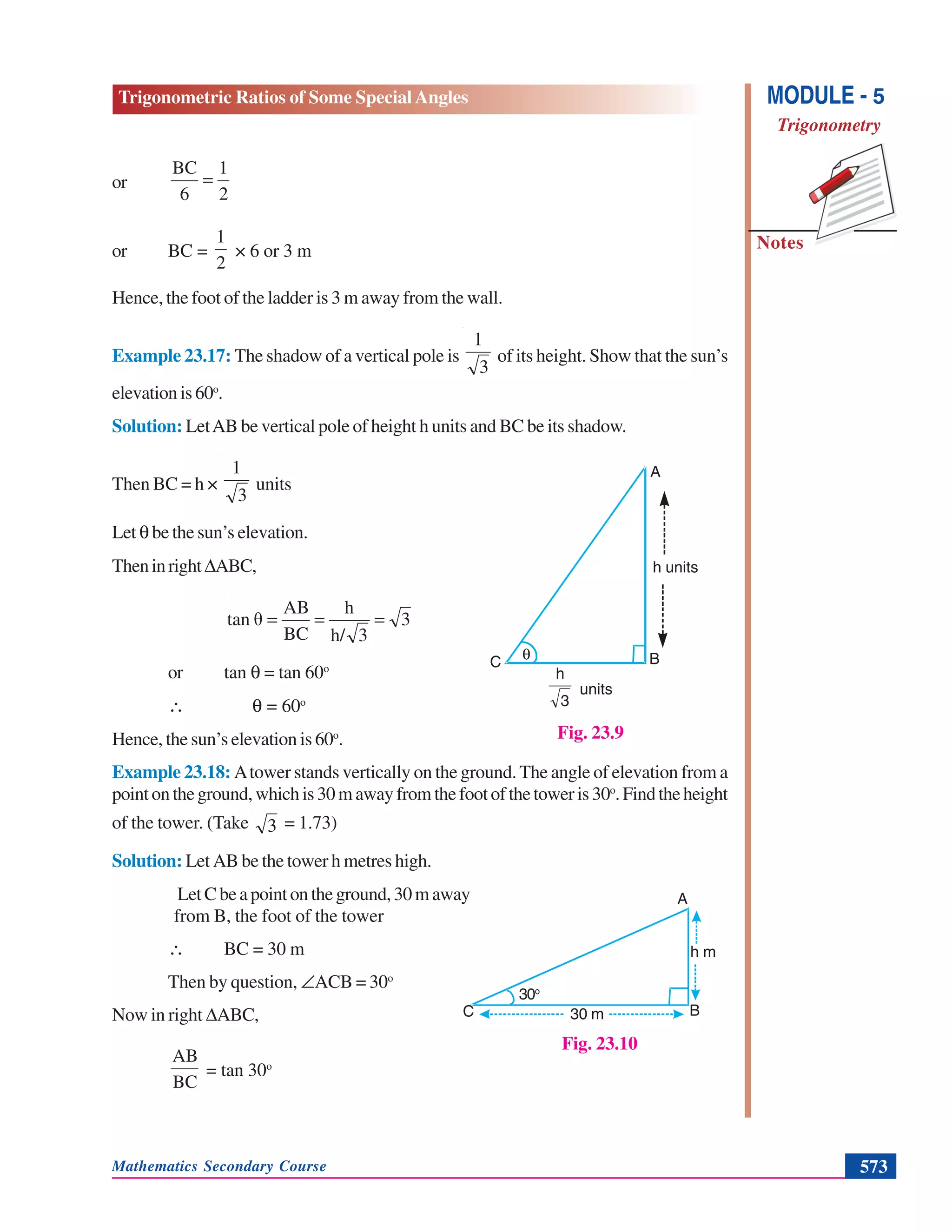
Example 23.17: The shadow of a vertical pole is
3
1
of its height. Show that the sun’s
elevationis60o
.
Solution: LetAB be vertical pole of height h units and BC be its shadow.
Then BC = h ×
3
1
units
Let θ be the sun’s elevation.
TheninrightΔABC,
3
3h/
h
BC
AB
θtan ===
or tan θ = tan 60o
∴ θ = 60o
Hence, the sun’s elevation is 60o
.
Example 23.18: Atower stands vertically on the ground.The angle of elevation from a
pointontheground,whichis30mawayfromthefootofthetoweris30o
.Findtheheight
of the tower. (Take 3 = 1.73)
Solution: Let AB be the tower h metres high.
LetCbeapointontheground,30maway
from B, the foot of the tower
∴ BC = 30 m
Then by question, ∠ACB = 30o
Now in right ΔABC,
BC
AB
= tan 30o
Fig. 23.9
A
BC
θ
h units
3
h
units
Fig. 23.10
BC
A
30 m
h m
30o
Mathematics Secondary Course574
Notes
MODULE - 5
Trigonometry
Trigonometric Ratios of Some Special Angles
or
3
1
30
h
=
∴
3
30
h = m
=
3
3
3
30
× m
= 310 m
= 10 × 1.73 m
= 17.3 m
Hence, height of the tower is 17.3 m.
Example 23.19: Aballoon is connected to a meterological ground station by a cable of
length 100 m inclined at 60o
to the horizontal. Find the height of the balloon from the
ground assuming that there is no slack in the cable.
Solution: LetA be the position of the balloon, attached to the cableAC of length 100 m.
AC makes an angle of 60o
with the level ground BC.
LetAB, the height of the balloon be h metres
Now in right ΔABC,
AC
AB
= sin 60o
or
2
3
100
h
=
or h = 50 3
= 50 × 1.732
= 86.6
Hence, the balloon is at a height of 86.6 metres.
Example23.20: Theupperpartofatreeisbrokenbythestrongwind.Thetopofthetree
makes an angle of 30o
with the horizontal ground. The distance between the base of the
tree and the point where it touches the ground is 10 m. Find the height of the tree.
Solution: LetAB be the tree, which was broken at C, by the wind and the topA of the
Fig. 23.11
B
C
A
100 m
h m
60o
Mathematics Secondary Course 575
Trigonometric Ratios of Some Special Angles
Notes
MODULE - 5
Trigonometry
tree touches the ground at D, making an angle of 30o
with BD and BD= 10 m.
Let BC = x metres
Now in right ΔCBD,
o
30tan
BD
BC
=
or
3
1
10
=
x
or
3
10
=x m ...(i)
AgaininrightΔCBD,
o
30sin
DC
BC
=
or
2
1
DC
=
x
or DC = 2x
=
3
20
m ...[By(i)]
∴ AC = DC =
3
20
...(ii)
Now height of the tree = BC + AC
= ⎟
⎠
⎞
⎜
⎝
⎛
+
3
20
3
10
= m310or
3
30
= 17.32 m
Hence height of the tree = 17.32 m
Example 23.21: The shadown of a tower, when the angle of elevation of the sun is 45o
is
found to be 10 metres longer than when it was 60o
. Find the height of the tower.
Fig. 23.12
B
D
A
10 m
x m
30o
C
.
.
.
Mathematics Secondary Course576
Notes
MODULE - 5
Trigonometry
Trigonometric Ratios of Some Special Angles
Solution: LetAB be the tower h metres high and C and D be the two points where the
angles of elevation are 45o
and 60o
respectively.
Then CD = 10 m, ∠ACB = 45o
and ∠ADB = 60o
Let BD be x metres.
Then BC = BD + CD = (x + 10) m
Now in rt. ∠d ΔABC,
o
45tan
BC
AB
=
or 1
10
=
+x
h
∴ x = (h – 10) m ...(i)
Again in rt ∠d ΔABD,
o
60tan
BD
AB
=
or 3=
x
h
or h = 3 x ...(ii)
From (i) and (ii), we get
h = 3 (h – 10)
or h = 3 h – 10 3
or ( 3 –1)h = 10 3
∴ h =
13
310
−
=
13
310
−
×
( )
( )
( )
2
13310
13
13 +
=
+
+
= 5 3 ( 3 + 1) =15 + 5 × 1.732 = 15 + 8.66 = 23.66
Hence, height of the tower is 23.66 m.
Fig. 23.13
C D B
A
h m
x m10 m
45o
60o
Mathematics Secondary Course 577
Trigonometric Ratios of Some Special Angles
Notes
MODULE - 5
Trigonometry
Example 23.22: An aeroplane when 3000 m high passes vertically above another
aeroplane at an instant when the angles of elevation of the two aeroplanes from the same
point on the ground are 60o
and 45o
respectively. Find the vertical distance between the
two planes.
Solution: Let O be the point of observation.
Let P and Q be the two planes
Then AP = 3000 m and ∠AOQ = 45o
and ∠AOP = 60o
In rt. ∠d ΔQAO,
145tan
AO
AQ o
==
or AQ = AO ...(i)
Again in rt. ∠d ΔPAO,
360tan
AO
PA o
==
∴
3
3000
AOor3
AO
3000
== ...(ii)
From (i) and (ii), we get
AQ = 173231000
3
3
3
3000
==× m
∴ PQ = AP – AQ = (3000 – 1732) m = 1268 m
Hence, the required distance is 1268 m.
Example23.23:Theangleofelevationofthetopofabuildingfromthefootofatoweris
30o
andtheangleofelevationofthetopofthetowerfromthefootofthebuildingis60o
.If
thetoweris50mhigh,findtheheightofthebuilding.
Solution: Let PQ be the tower 50 m high andAB be the building x m high.
Then ∠AQB = 30o
and ∠PBQ = 60o
In rt. ∠d ΔABQ,
o
30tan
BQ
=
x
...(i)
and in rt. ∠d ΔPQB,
o
60tan
BQ
PQ
=
Fig. 23.14
P
A O
Q3000 m
60o
45o
Mathematics Secondary Course578
Notes
MODULE - 5
Trigonometry
Trigonometric Ratios of Some Special Angles
or
o
60tan
BQ
50
= ...(ii)
Dividing(i)by(ii),weget,
3
1
60tan
30tan
50 o
o
==
x
or 16.67
3
50
==x
Hence,heightofthebuildingis16.67m.
Example 23.24: A person standing on the bank of a river observes that the angle of
elevation of the top of a tree standing on the opposite bank is 60o
. When he moves
40 metres away from the bank, he finds the angle be 30o
. Find the height of the tree and
thewidthoftheriver.
Solution: LetAB be a tree of height h metres.
Let BC = x metres represents the width of the
river.
Let C and D be the two points where the tree
subtends angles of 60o
and 30o
respectively
In right ΔABC,
o
60tan
BC
AB
=
or 3=
x
h
or h = 3 x ...(i)
AgaininrightΔABD,
o
30tan
BD
AB
=
or
3
1
40
=
+x
h
...(ii)
From (i) and (ii), we get,
3
1
40
3
=
+x
x
Fig. 23.15
Q B
x m
A
P
50 m
60o
30o
Fig. 23.16
D C B
A
h m
x m40 m
30o
60o
Mathematics Secondary Course 579
Trigonometric Ratios of Some Special Angles
Notes
MODULE - 5
Trigonometry
or 3x = x + 40
or 2x = 40
∴ x = 20
∴ From (i), we get
h = 3 × 20 = 20 × 1.732
= 34.64
Hence, width of the river is 20 m and height of the tree is 34.64 metres.
Example 23.25: Standing on the top of a tower 100 m high, Swati observes two cars on
the opposite sides of the tower. If their angles of depression are 45o
and 60o
, find the
distance between the two cars.
Solution: Let PM be the tower 100 m high. LetAand B be the positions of the two cars.
Let the angle of depression of car at A be 60o
and of the car at B be 45o
as shown in
Fig. 23.17.
Now ∠QPA = 60o
= ∠PAB
and ∠RPB = 45o
= ∠PBA
In right ΔPMB,
o
45tan
MB
PM
=
or 1
MB
100
=
or MB = 100 m ...(i)
Also in right ΔPMA,
o
60tan
MA
PM
=
or 3
MA
100
=
∴ MA =
3
100
=
3
3100
Fig. 23.17
A M B
PQ R
100 m
60o
60o
45o
45o
Mathematics Secondary Course580
Notes
MODULE - 5
Trigonometry
Trigonometric Ratios of Some Special Angles
=
3
732.1100×
= 57.74
∴ MA = 57.74 m ...(ii)
Hence, the distance between the two cars
= MA + MB
= (57.74 + 100) m [By(i)and(ii)]
= 157.74 m
Example 23.26: Two pillars of equal heights are on either side of a road, which is 100 m
wide.At a point on the road between the pillars, the angles of elevation of the top of the
pillars are 60o
and 30o
respectively. Find the position of the point between the pillars and
theheightofeachpillar.
Solution: LetAB and CD be two pillars each of height h metres. Let O be a point on the
road. Let BO = x metres, then
OD = (100 – x) m
By question, ∠AOB = 60o
and ∠COD = 30o
In right ΔABO,
o
60tan
BO
AB
=
or 3=
x
h
or h = 3 x ...(i)
In right ΔCDO,
o
30tan
OD
CD
=
or
3
1
100
=
− x
h
...(ii)
From (i) and (ii), we get
3
1
100
3
=
− x
x
Fig. 23.18
C
DB
A
h m
(100–x) mx m
30o
60o
h m
O
Mathematics Secondary Course 581
Trigonometric Ratios of Some Special Angles
Notes
MODULE - 5
Trigonometry
or 3x = 100 – x
or 4x = 100
∴ x = 25
∴ From (i), we get h = 3 × 25 = 1.732 × 25 or 43.3
∴The required point from one pillar is 25 metres and 75 m from the other.
Height of each pillar = 43.3 m.
Example23.27:Theangleofelevationofanaeroplanefromapointonthegroundis45o
.
After a flight of 15 seconds, the elevation changes to 30o
. If the aeroplane is flying at a
constant height of 3000 metres, find the speed of the plane.
Solution: LetA andBbetwopositionsoftheplaneandletObethepointofobservation.
Let OCD be the horizontal line.
Then ∠AOC = 45o
and ∠BOD = 30o
By question,AC = BD = 3000 m
In rt ∠d ΔACO,
o
45tan
OC
AC
=
or 1
OC
3000
=
or OC = 3000 m ...(i)
In rt ∠d ΔBDO,
o
30tan
OD
BD
=
or
3
1
CDOC
3000
=
+
or 3000 3 = 3000 + CD ...[By(i)]
or CD = 3000 ( 3 – 1)
= 3000 × 0.732
= 2196
∴ Distance covered by the aeroplane in 15 seconds =AB = CD = 2196 m
Fig. 23.19
A B
C D
3000 m
O
45o 30o
Mathematics Secondary Course582
Notes
MODULE - 5
Trigonometry
Trigonometric Ratios of Some Special Angles
∴ Speed of the plane = ⎟
⎠
⎞
⎜
⎝
⎛ ×
×
1000
6060
15
2196
km/h
= 527.04 km/h
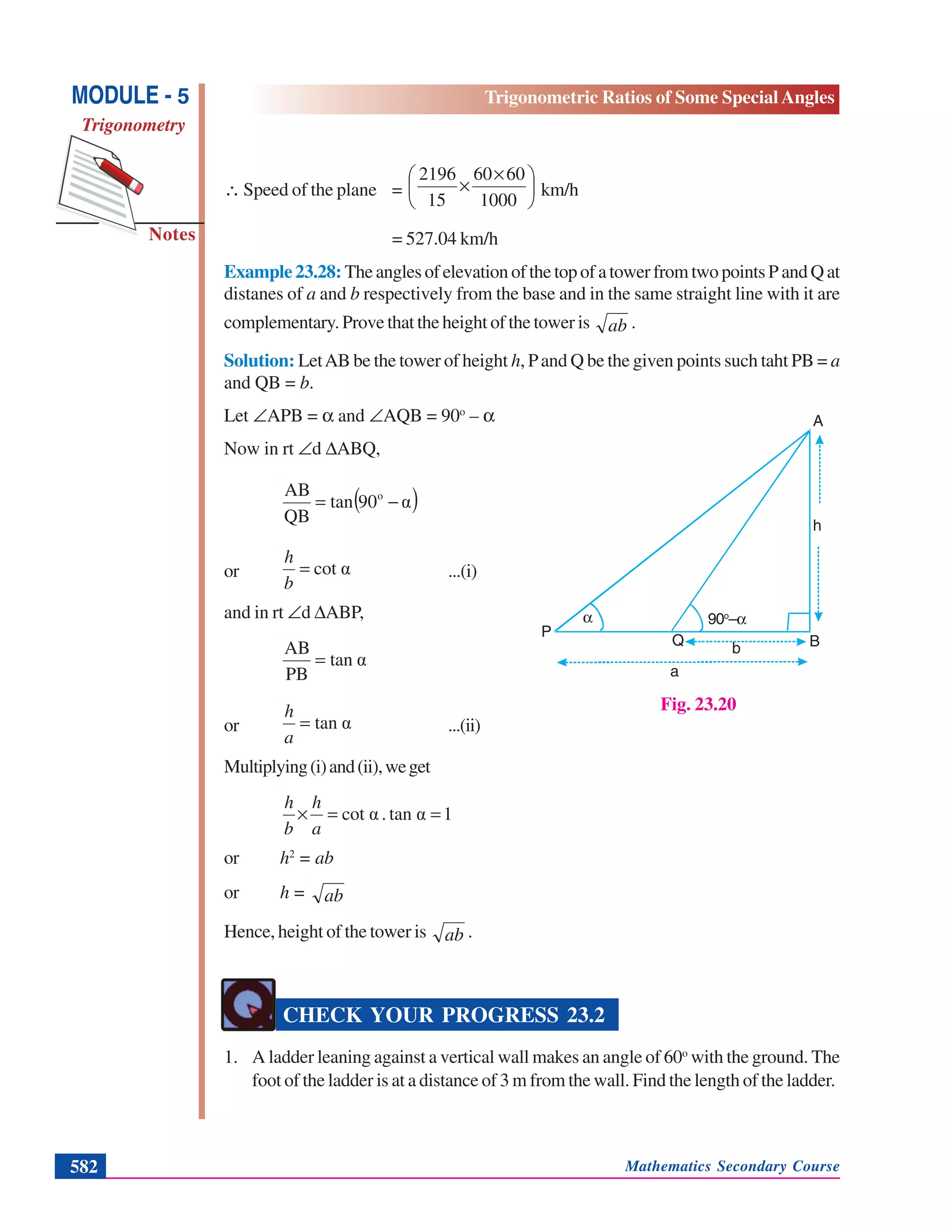
Example 23.28: The angles of elevation of the top of a tower from two points P and Q at
distanes of a and b respectively from the base and in the same straight line with it are
complementary. Prove that the height of the tower is ab .
Solution: LetAB be the tower of height h, Pand Q be the given points such taht PB = a
and QB = b.
Let ∠APB = α and ∠AQB = 90o
– α
Now in rt ∠d ΔABQ,
( )α90tan
QB
AB o
−=
or αcot=
b
h
...(i)
and in rt ∠d ΔABP,
αtan
PB
AB
=
or αtan=
a
h
...(ii)
Multiplying(i)and(ii),weget
1αtan.αcot ==×
a
h
b
h
or h2
= ab
or h = ab
Hence, height of the tower is ab .
CHECK YOUR PROGRESS 23.2
1. A ladder leaning against a vertical wall makes an angle of 60o
with the ground. The
foot of the ladder is at a distance of 3 m from the wall. Find the length of the ladder.
Fig. 23.20
P
Q B
A
h
b
a
α 90o
–α
Mathematics Secondary Course 583
Trigonometric Ratios of Some Special Angles
Notes
MODULE - 5
Trigonometry
2. At a point 50 m away from the base of a tower, an observer measures the angle of
elevation of the top of the tower to be 60o
. Find the height of the tower.
3. Theangleofelevationofthetopofthetoweris30o
,fromapoint150mawayfromits
foot. Find the height of the tower.
4. Thestringofakiteis100mlong.Itmakesanangleof60o
withthehorizontalground.
Findtheheightofthekite,assumingthatthereisnoslackinthestring.
5. Akiteisflyingataheightof100mfromthelevelground.Ifthestringmakesanangle
of60o
withapointontheground,findthelengthofthestringassumingthatthereisno
slackinthestring.
6. Findtheangleofelevationofthetopofatowerwhichis100 3 mhigh,fromapoint
at a distance of 100 m from the foot of the tower on a horizontal plane.
7. A tree 12 m high is broken by the wind in such a way that its tip touches the ground
andmakesanangleof60o
withtheground.Atwhatheightfromtheground,thetreeis
broken by the wind?
8. Atreeisbrokenbythestorminsuchwaythatitstiptouchesthegroundatahorizontal
distance of 10 m from the tree and makes an angle of 45o
with the ground. Find the
heightofthetree.
9. The angle of elevation of a tower at a point is 45o
.After going 40 m towards the foot
of the tower, the angle of elevation becomes 60o
. Find the height of the tower.
10. Two men are on either side of a cliff which is 80 m high.They observe the angles of
elevationofthetopoftheclifftobe30o
and60o
respectively.Findthedistancebetween
the two men.
11. From the top of a building 60 m high, the angles of depression of the top and bottom
of a tower are observed to be 45o
and 60o
respectively. Find the height of the tower
anditsdistancefromthebuilding.
12. A ladder of length 4 m makes an angle of 30o
with the level ground while leaning
against a window of a room. The foot of the ladder is kept fixed on the same point of
the level ground. It is made to lean against a window of another room on its opposite
side, making an angle of 60o
with the level ground. Find the distance between these
rooms.
13. Atapointonthegrounddistant15mfromitsfoot,theangleofelevationofthetopof
the first storey is 30o
. How high the second storey will be, if the angle of elevation of
the top of the second storey at the same point is 45o
?
14. An aeroplane flying horizontal 1 km above the ground is observed at an elevation of
60o
. After 10 seconds its elevation is observed to be 30o
. Find the speed of the
aeroplane.
Mathematics Secondary Course584
Notes
MODULE - 5
Trigonometry
Trigonometric Ratios of Some Special Angles
15. The angle of elevation of the top of a building from the foot of a tower is 30o
and the
angle of elevation of the top of the tower from the foot of the building is 60o
. If the
toweris50mhigh,findtheheightofthebuilding.
LET US SUM UP
• TableofvaluesofTrigonometricRatios
θ 0o
30o
45o
60o
90o
Trig.ratio
sinθ 0
2
1
2
1
2
3
1
cos θ 1
2
3
2
1
2
1
0
tan θ 0
3
1
1 3 Not defined
cot θ Not defined 3 1
3
1
0
cosec θ Not defined 2 2 3
2
1
sec θ 1
3
2
2 2 Not defined
Supportive website:
• http://www.wikipedia.org
• http://mathworld:wolfram.com
TERMINAL EXERCISE
1. Findthevalueofeachofthefollowing:
(i) 4 cos2
60o
+ 4 sin2
45o
– sin2
30o
(ii) sin2
45o
– tan2
45o
+ 3(sin2
90o
+ tan2
30o
)
Mathematics Secondary Course 585
Trigonometric Ratios of Some Special Angles
Notes
MODULE - 5
Trigonometry
(iii) oo2o2
o2o2o2
45tan30cos30sin2
30tan445cos30sin5
+
−+
(iv) oo
o
30cosec30sec
45cot
+
2. Proveeachofthefollowing:
(i) 2 cot2
30o
– 2 cos2
60o
–
4
3
sin2
45o
– 4 sec2
30o
=
24
5
−
(ii) 2 sin2
30o
+ 2 tan2
60o
– 5 cos2
45o
= 4
(iii) cos 60o
cos 45o
+ sin 60o
sin 45o
= sin 45o
cos 30o
+ cos 45o
sin 30o
(iv)
o
oo
oo
90cot
60cot30cot
160cot30cot
=
+
−
3. If θ = 30o
, verify that
(i) sin 2θ = 2 sin θ cos θ
(ii) cos 2θ = 1 – 2 sin2
θ
(iii) tan 2θ =
θtan1
θtan2
2
−
4. IfA= 60o
and B = 30o
, verify that
(i) sin (A+ B) ≠ sinA+ sin B
(ii) sin (A+ B) = sinAcos B + cosAsin B
(iii) cos (A– B) = cos Acos B + sin Asin B
(iv) cos (A+ B) = cos Acos B – sin Asin B
(v) tan A=
Acos
Acos1 2
−
5. Using the formula cos (A– B) = cosAcos B + sinAsin B, find the value of cos 15o
.
6. If sin (A + B) = 1 and cos (A – B) =
2
3
, 0o
< A + B ≤ 90o
, A > B, find A and B.
7. Anobserverstanding40mfromabuildingobservesthattheangleofelevationofthe
top and bottom of a flagstaff, which is surmounted on the building are 60o
and 45o
respectively.Findtheheightofthetowerandthelengthoftheflagstaff.
Mathematics Secondary Course586
Notes
MODULE - 5
Trigonometry
Trigonometric Ratios of Some Special Angles
8. Fromthetopofahill,theanglesofdepressionoftheconsecutivekilometrestonesdue
east are found to be 60o
and 30o
. Find the height of the hill.
9. From the top of a 7 m high building, the angle of elevation of the top of a cable tower
is 60o
and the angle of depression of its foot is 45o
. Find the height of the tower.
10. A man on the top of a tower on the sea shore finds that a boat coming towards him
takes10minutesfortheangleofdepressiontochangefrom30o
to60o
.Howsoonwill
the boat reach the sea shore?
11. Twoboatsapproachalight-housefromoppositedirections.Theangleofelevationof
the top of the lighthouse from the boats are 30o
and45o
. If the distance between these
boats be 100 m, find the height of the lighthouse.
12. The shadow of a tower standing on a level ground is found to be 45 3 m longer
when the sun’s altitude is 30o
than when it was 60o
. Find the height of the tower.
13. The horizontal distance between two towers is 80 m. The angle of depression of the
top of the first tower when seen from the top of the second tower is 30o
. If the height
of the second tower is 160 m, find the height of the first tower.
14. From a window, 10 m high above the ground, of a house in a street, the angles of
elevation and depression of the top and the foot of another house on opposite side of
the street are 60o
and 45o
respectively. Find the height of the opposite house (Take
3 =1.73)
15. Astatue1.6mtallstandsonthetopofapedestalfromapointonthegound,theangle
of elevation of the top of the statue is 60o
and from the same point, the angle of
elevation of the top of the pedestal is 45o
. Find the height of the pedestal.
ANSWERS TO CHECK YOUR PROGRESS
23.1
1. (i)
4
5
(ii)
2
5
(iii)0 (iv)2 (v) 0 (vi)
12
67
5. sin 30o
=
2
1
, cos 30o
=
2
3
6.
22
13 −
7. A = 45o
and B = 15o
Mathematics Secondary Course 587
Trigonometric Ratios of Some Special Angles
Notes
MODULE - 5
Trigonometry
8. A = 30o
and B = 15o
9. QR = 5 3 and PR = 10 cm
10. ∠A = 60o
and ∠C = 30o
11.
2
3
12. x = 10o
13. C
14. B
15. A
23.2
1. 6 m 2. 86.6 m 3. 86.6 m
4. 86.6 m 5. 115.46 m 6. 60o
7. 5.57 m 8. 24.14 m 9. 94.64 m
10. 184.75 m 11. 25.35 m 12. 5.46 m
13. 6.34 m 14. 415.66 km/h 15. 16.67 m
ANSWERS TO TERMINAL EXERCISE
1. (i)
4
11
(ii)
2
7
(iii)
121
40
(iv)
( )132
3
+
5.
22
13 +
6. A = 60o
and B = 30o
7. 40m , 29.28 m
8. 433 m 9. 19.124 m 10. 5 minutes
11. 36.6 m 12. 67.5 m 13. 113.8 m
14. 27.3 m 15. 2.18656 m
Mathematics Secondary Course588
Notes
MODULE - 5
Trigonometry
Trigonometric Ratios of Some Special Angles
Secondary Course
Mathematics
PracticeWork-Trignometry
Maximum Marks: 25 Time : 45 Minutes
Instructions:
1. Answer all the questions on a separate sheet of paper.
2. Givethefollowinginformationsonyouranswersheet
Name
Enrolmentnumber
Subject
Topic of practice work
Address
3. Get your practice work checked by the subject teacher at your study centre so that
you get positive feedback about your performance.
Do not send practice work to National Institute of Open Schooling
1. Intheadjoiningfigure,thevalueofsinAis 1
(A)
13
5
(B)
13
12
(C)
12
5
(D)
12
13
2. If 4 cotA= 3, then value of
cosAsinA
cosAsinA
+
−
is 1
C
A
B12 cm
13 cm
5cm
Mathematics Secondary Course 589
Trigonometric Ratios of Some Special Angles
Notes
MODULE - 5
Trigonometry
(A)
7
1
(B)
7
6
(C)
6
5
(D)
4
3
3. The value of sec 30o
is 1
(A) 2 (B)
2
3
(C)
3
2
(D) 2
4. In ΔABC, right angled at B, ifAB = 6 cm andAC = 12 cm, then ∠Ais 1
(A) 60o
(B) 30o
(C) 45o
(D) 15o
5. Thevalueof 1
o
o
o
o
49cosec3
41sec2
54cos2
36sin
− is
(A) – 1
(B)
6
1
(C) –
6
1
(D) 1
6. If sinA=
2
1
, show that 2
3 cos A – 4 cos3
A = 0
7. Using the formula sin (A– B) = sinAcos B – cosAsin B, find the value of sin 15o.
2
8. Findthevalueof
tan 15o
tan 25o
tan 60o
tan 65o
tan 75o
2
Mathematics Secondary Course590
Notes
MODULE - 5
Trigonometry
Trigonometric Ratios of Some Special Angles
9. Show that tanAsecA
sinA1
sinA1
+=
−
+
2
10. If sin2
θ + sin θ = 1, then show that 2
cos2
θ + cos4
θ = 1
11. Prove that
sinA
cosA1
1Acosec–Acot
1AcoseccotA +
=
+
−+
4
12. An observer standing 40 m from a building notices that the angles of elevation of the
topandthebottomofaflagstaffsurmountedonthebuildingare60o
and45o
respectively.
Findtheheightofthebuildingandtheflagstaff. 6
MODULE 6
Statistics
The modern society is essentially data oriented. It is difficult to imagine any facet of
our life untouched in newspapers, advertisements, magazines, periodicals and other
forms of publicity over radio, television etc. These data may relate to cost of living,
moritality rate, literacy rate, cricket averages, rainfall of different cities, temperatures
of different towns, expenditures in varioius sectors of a five year plan and so on. It
is, therefore, essential to know how to extract ‘meaningful’ information from such
data. This extraction of useful or meaningful information is studied in the branch of
mathematics called statistics.
In the lesson on “Data and their Representations” the learner will be introduced to
different types of data, collection of data, presentation of data in the form of frequency
distributions, cumulative frequency tables, graphical representaitons of data in the
form of bar charts (graphs), histograms and frequency polygons.
Sometimes, we are required to describe the data arithmetically, like describing mean
age of a class of studens, mean height of a group of students, median score or model
shoe size of a group. Thus, we need to find certain measures which summarise the
main features of the data. In lesson on “measures of Central Tendency”, the learner
will be introduced to some measures of central tendency i.e., mean, median, mode of
ungrouped data and mean of grouped data.
In the lesson on “Introduction to Probablity”, the learner will get acquainted with
the concept of theoretical probability as a measure of uncertainity, through games of
chance like tossing a coin, throwing a die etc.

TRIGONOMETRIC RATIOS OF SOME SPECIAL ANGLES

  • 1.
    Mathematics Secondary Course557 Trigonometric Ratios of Some Special Angles Notes MODULE - 5 Trigonometry 23 TRIGONOMETRIC RATIOS OF SOME SPECIAL ANGLES In the last lesson, we have defined trigonometric ratios for acute angles in a right triangle andalsodevelopedsomerelationshipbetweenthem.Inthislessonweshallfindthevalues oftrigonometricratiosofanglesof30o ,45o and60o byusingourknowledgeofgeometry. We shall also write the values of trigonometric ratios of 0o and 90o and we shall observe thatsometrigonometricratiosof0o and90o arenotdefined.Weshallalsousetheknowledge oftrigonometrytosolvesimpleproblemsonheightsanddistancesfromdaytodaylife. OBJECTIVES Afterstudyingthislesson,youwillbeableto • find the values of trigonometric ratios of angles of 30o , 45o and 60o ; • write the values of trigonometric ratios of 0o and 90o ; • tell, which trigonometric ratios of 0o and 90o are not defined; • solve daily life problems of heights and distances; EXPECTED BACKGROUND KNOWLEDGE • PythagorasTheoremi.e.inarightangledtriangleABC,rightangledatB, AC2 = AB2 + BC2 . • InarighttriangleABC,rightangledatB, Hypotenuse Ctooppositeside Csin ∠ = , Ctooppositeside Hypotenuse Ccosec ∠ = Hypotenuse Coadjacent tside Ccos ∠ = , Coadjacent tside Hypotenuse Csec ∠ =
  • 2.
    Mathematics Secondary Course558 Notes MODULE- 5 Trigonometry Trigonometric Ratios of Some Special Angles Coadjacent tside Ctooppositeside Ctan ∠ ∠ = and Ctooppositeside Coadjacent tside Ccot ∠ ∠ = cosec C = Csin 1 , sec C = Ccos 1 and cot C = Ctan 1 • sin (90o – θ) = cos θ, cos (90o – θ) = sin θ tan (90o – θ) = cot θ, cot (90o – θ) = tan θ • sec (90o – θ) = cosec θ and cosec (90o – θ) = sec θ 23.1 TRIGONOMETRIC RATIOS FOR AN ANGLE OF 45O Let a ray OA start from OX and rotate in the anticlock wise direction and make an angle of 45o with the x-axis as shown in Fig. 23.1. Take any point P on OA. Draw PM ⊥ OX. Now in right ΔPMO, ∠POM + ∠OPM + ∠PMO = 180o or 45o + ∠OPM + 90o = 180o or ∠OPM = 180o – 90o – 45o = 45o ∴In ΔPMO, ∠OPM = ∠POM = 45o ∴ OM = PM Let OM = a units, then PM = a units. InrighttrianglePMO, OP2 = OM2 + PM2 (PythagorasTheorem) = a2 + a2 = 2 a2 ∴ OP = 2 a units Now sin 45o = 2 1 2OP PM == a a cos 45o = 2 1 2OP OM == a a Fig. 23.1 X’ X Y Y’ O M P A 45o
  • 3.
    Mathematics Secondary Course559 Trigonometric Ratios of Some Special Angles Notes MODULE - 5 Trigonometry tan 45o = 1 OM PM == a a cosec 45o = 2 2/1 1 45sin 1 ==o sec 45o = 2 2/1 1 45cos 1 ==o and cot 45o = 1 1 1 45tan 1 ==o 23.2 TRIGONOMETRIC RATIOS FOR AN ANGLE OF 30O Let a ray OA start from OX and rotate in the anti clockwise direction and make an angle of 30o with x-axis as shown in Fig. 23.2. Take any point Pon OA. Draw PM ⊥ OX and produce PM to P′ such that PM = P′M. Join OP′ Now in ΔPMO and ΔP′MO, OM = OM ...(Common) ∠PMO = ∠P′MO ...(Each = 90o ) and PM = P′M ...(Construction) ∴ ΔPMO ≅ ΔP′MO ∴ ∠OPM = ∠OP′M = 60o ∴ OPP′isanequilateraltriangle ∴ OP = OP′ Let PM = a units PP′ = PM + MP′ = (a + a) units ...(Q MP′ = MP) = 2a units ∴ OP = OP′ = PP′ = 2a units NowinrighttrianglePMO, OP2 = PM2 + OM2 ...(PythagorasTheorem) Fig. 23.2 X’ Y’ X P’ P A Y M 30o O
  • 4.
    Mathematics Secondary Course560 Notes MODULE- 5 Trigonometry Trigonometric Ratios of Some Special Angles or (2a)2 = a2 + OM2 ∴ OM2 = 3a2 or OM = 3 a units ∴ sin 30o = 2 1 2OP PM == a a cos 30o = 2 3 2 3 OP OM == a a tan 30o = 3 1 3OM PM == a a cosec 30o = 2 2/1 1 30sin 1 ==o sec 30o = 3 2 2/3 1 30cos 1 ==o and cot 30o = 3 3/1 1 30tan 1 ==o 23.3 TRIGONOMETRIC RATIOS FOR AN ANGLE OF 60O Let a ray OA start from OX and rotate in anticlock wise direction and make an angle of 60o with x-axis. Take any point Pon OA. Draw PM ⊥ OX. Produce OM to M′ such that OM = MM′. Join PM′. Let OM = a units In ΔPMO and ΔPMM′, PM = PM ...(Common) ∠PMO = ∠PMM′ ...(Each = 90o ) OM = MM′ ...(Construction) ∴ ΔPMO ≅ ΔPMM′ Fig. 23.3 X’ Y’ Y A XM P M’ 60o O
  • 5.
    Mathematics Secondary Course561 Trigonometric Ratios of Some Special Angles Notes MODULE - 5 Trigonometry ∴ ∠POM = ∠PM′M = 60o ∴ ΔPOM′ is an equilateral triangle. ∴ OP = PM′ = OM′ = 2a units In right ΔPMO, OP2 = PM2 + OM2 ...(PythagorusTheorem) ∴ (2a)2 = PM2 + a2 or PM2 = 3a2 ∴ PM = 3 a units ∴ sin 60o = 2 3 2 3 OP PM == a a cos 60o = 2 1 2OP OM == a a tan 60o = 3 3 OM PM == a a cosec 60o = 3 2 2 3 1 60sin 1 ==o sec 60o = 2 2/1 1 60cos 1 ==o and cot 60o = 3 1 60tan 1 0 = 23.4 TRIGONOMETRIC RATIOS FOR ANGLES OF 0O AND 90O In Section 23.1, 23.2 and 23.3, we have defined trigonometric ratios for angles of 45o , 30o and 60o . For angles of 0o and 90o , we shall assume the following results and we shall not be discussing the logical proofs of these. (i) sin 0o = 0 and therefore cosec 0o is not defined (ii) cos 0o = 1 and therefore sec 0o = 1
  • 6.
    Mathematics Secondary Course562 Notes MODULE- 5 Trigonometry Trigonometric Ratios of Some Special Angles (iii) tan 0o = 0 therefore cot 0o is not defined. (iv) sin 90o = 1 and therefore cosec 90o = 1 (v) cos 90o = 0 and therefore sec 90o is not defined. (vi) cot 90o = 0 and therefore tan 90o is not defined. The values of trignometric ratios for 0o , 30o , 45o , 60o and 90o can be put in a tabular form which makes their use simple.The following table also works as an aid to memory. θ 0o 30o 45o 60o 90o Trig.ratio sinθ 0 4 0 = 2 1 4 1 = 2 1 4 2 = 2 3 4 3 = 1 4 4 = cos θ 1 4 4 = 2 3 4 3 = 2 1 4 2 = 2 1 4 1 = 0 4 0 = tanθ 0 04 0 = − 3 1 14 1 = − 1 24 2 = − 3 34 3 = − Not defined cot θ Not defined 3 34 3 = − 1 24 2 = − 3 1 14 1 = − 0 04 0 = − cosec θ Not defined 2 1 4 = 2 2 4 = 3 2 3 4 = 1 4 4 = sec θ 1 4 4 = 3 2 3 4 = 2 2 4 = 2 1 4 = Not defined Let us, now take some examples to illustrate the use of these trigonometric ratios. Example 23.1: Find the value of tan2 60o – sin2 30o . Solution: We know that tan 60o = 3 and sin 30o = 2 1 ∴ tan2 60o – sin2 30o = ( ) 2 2 2 1 3 ⎟ ⎠ ⎞ ⎜ ⎝ ⎛ − = 4 1 3− = 4 11
  • 7.
    Mathematics Secondary Course563 Trigonometric Ratios of Some Special Angles Notes MODULE - 5 Trigonometry Example 23.2: Find the value of cot2 30o sec2 45o + cosec2 45o cos 60o Solution: We know that cot 30o = 3 , sec 45o = 2 , cosec 45o = 2 and cos 60o = 2 1 ∴ cot2 30o sec2 45o + cosec2 45o cos 60o = ( ) ( ) ( ) 2 1 .223 222 + = 3 × 2 + 2 × 2 1 = 6 + 1 = 7 Example 23.3: Evaluate : 2(cos2 45o + tan2 60o ) – 6(sin2 45o – tan2 30o ) Solution: 2(cos2 45o + tan2 60o ) – 6(sin2 45o – tan2 30o ) = ( ) ⎥ ⎥ ⎦ ⎤ ⎢ ⎢ ⎣ ⎡ ⎟ ⎠ ⎞ ⎜ ⎝ ⎛ −⎟ ⎠ ⎞ ⎜ ⎝ ⎛ − ⎥ ⎥ ⎦ ⎤ ⎢ ⎢ ⎣ ⎡ +⎟ ⎠ ⎞ ⎜ ⎝ ⎛ 22 2 2 3 1 2 1 63 2 1 2 = ⎟ ⎠ ⎞ ⎜ ⎝ ⎛ −−⎟ ⎠ ⎞ ⎜ ⎝ ⎛ + 3 1 2 1 63 2 1 2 = 1 + 6 – 3 + 2 = 6 Example 23.4: Verify that 0 0cos2 90sin5 45cot 60sec 30cosec 45tan o o o o o o =−+ Solution: L.H.S. = o o o o o o 0cos2 90sin5 45cot 60sec 30cosec 45tan −+ = 12 15 1 2 2 1 × × −+ = 2 5 2 2 1 −+ = 0 = R.H.S.
  • 8.
    Mathematics Secondary Course564 Notes MODULE- 5 Trigonometry Trigonometric Ratios of Some Special Angles Hence, 0 0cos2 90sin5 45cot 60sec 30cosec 45tan o o o o o o =−+ Example 23.5: Show that 3 10 30tan 4 3 60cosec260sin330cot 3 4 o2o2o2o2 =−−+ Solution: L.H.S. = o2o2o2o2 30tan 4 3 60cosec260sin330cot 3 4 −−+ = ( ) 222 2 3 1 4 3 3 2 2 2 3 33 3 4 ⎟ ⎠ ⎞ ⎜ ⎝ ⎛ −⎟ ⎠ ⎞ ⎜ ⎝ ⎛ −⎟ ⎟ ⎠ ⎞ ⎜ ⎜ ⎝ ⎛ +× = 3 1 4 3 3 4 2 4 3 33 3 4 ×−×−×+× = 4 1 3 8 4 9 4 −−+ = 12 3322748 −−+ = 3 10 12 40 = = R.H.S. Hence, 3 10 30tan 4 3 60cosec260sin330cot 3 4 o2o2o2o2 =−−+ Example 23.6 : Verify that 3 4 45cos30cos 45sin230sec60cot4 o2o2 o2o2o2 = + −+ Solution: L.H.S. = o2o2 o2o2o2 45cos30cos 45sin230sec60cot4 + −+ = 22 222 2 1 2 3 2 1 .2 3 2 3 1 .4 ⎟ ⎠ ⎞ ⎜ ⎝ ⎛ +⎟ ⎟ ⎠ ⎞ ⎜ ⎜ ⎝ ⎛ ⎟ ⎠ ⎞ ⎜ ⎝ ⎛ −⎟ ⎠ ⎞ ⎜ ⎝ ⎛ +⎟ ⎠ ⎞ ⎜ ⎝ ⎛
  • 9.
    Mathematics Secondary Course565 Trigonometric Ratios of Some Special Angles Notes MODULE - 5 Trigonometry = 2 1 4 3 2 1 2 3 4 3 1 4 + ×−+× = 4 5 3 5 4 5 1 3 8 = − = 3 4 5 4 3 5 =× = R.H.S. Hence, 3 4 45cos30cos 45sin230sec60cot4 o2o2 o2o2o2 = + −+ Example 23.7: If θ = 30o , verfity that θtan1 θtan2 θ2tan 2 − = Solution: For θ = 30o L.H.S. = tan 2θ = tan (2 × 30o ) = tan 60o = 3 and R.H.S. = θtan1 θtan2 2 − = o o 30tan1 30tan2 2 − = 2 3 1 1 3 1 .2 ⎟ ⎠ ⎞ ⎜ ⎝ ⎛ − ⎟ ⎠ ⎞ ⎜ ⎝ ⎛
  • 10.
    Mathematics Secondary Course566 Notes MODULE- 5 Trigonometry Trigonometric Ratios of Some Special Angles = 3 2 3 2 3 1 1 3 2 = − = 3 2 3 3 2 =× ∴ L.H.S. = R.H.S. Hence, θtan1 θtan2 θ2tan 2 − = Example 23.8: LetA= 30o . Verify that sin 3A= 3 sinA– 4 sin3 A Solution: For A= 30o , L.H.S. = sin 3A = sin (3 × 30o ) = sin 90o = 1 and R.H.S. = 3 sinA– 4 sin3 A = 3 sin 30o – 4 sin3 30o = 3 2 1 4 2 1 3 ⎟ ⎠ ⎞ ⎜ ⎝ ⎛ ×−× = 8 4 2 3 − = 2 1 2 3 − = 1 ∴ L.H.S. = R.H.S. Hence, sin 3A= 3 sinA– 4 sin3 A Example 23.9: Using the formula sin (A– B) = sinAcos B – cosAsin B, find the value of sin 15o .
  • 11.
    Mathematics Secondary Course567 Trigonometric Ratios of Some Special Angles Notes MODULE - 5 Trigonometry Solution: sin (A– B) = sinAcos B – cosAsin B ...(i) Let A = 45o and B = 30o ∴ From (i), sin (45o – 30o ) = sin 45o cos 30o – cos 45o sin 30o or sin 15o = 2 1 2 1 2 3 2 1 ×−× = 22 13 − Hence, sin 15o = 22 13 − . Remark: In the above examples we can also take A = 60o and B = 45o . Example 23.10: If sin (A+ B) = 1 and cos (A– B) = 1, 0o <A+ B ≤ 90o ,A≥ B, findA and B. Solution: Q sin (A + B) = 1 = sin 90o ∴ A + B = 90o ...(i) Again cos (A – B) = 1 = cos 0o ∴ A – B = 0o ...(ii) Adding(i)and(ii),weget 2A = 90o or A = 45o From (ii), we get B = A = 45o Hence, A = 45o and B = 45o Example 23.11: If cos (20o + x) = sin 30o , find x. Solution: cos (20o + x) = sin 30o = = cos 60o ... ⎟ ⎠ ⎞ ⎜ ⎝ ⎛ = 2 1 60cos o Q ∴ 20o + x = 60o or x = 60o – 20o = 40o Hence, x = 40o
  • 12.
    Mathematics Secondary Course568 Notes MODULE- 5 Trigonometry Trigonometric Ratios of Some Special Angles Example 23.12: In ΔABC, right angled at B, if BC = 5 cm, ∠BAC = 30o , find the length of the sidesAB andAC. Solution: We are given ∠BAC = 30o i.e., ∠A= 30o and BC = 5 cm Now AC BC Asin = or sin 30o = AC 5 or AC 5 2 1 = ∴ AC = 2 × 5 or 10 cm ByPythagorasTheorem, AB = 22 BCAC − = ( ) 22 510 − cm = 75 cm = 35 cm Hence AC = 10 cm and AB = 35 cm. Example 23.13: In ΔABC, right angled at C,AC = 4 cm andAB = 8 cm. Find ∠Aand ∠B. Solution: We are given,AC = 4 cm andAB = 8 cm Now sin B = AB AC = 2 1 or 8 4 ∴ B = 30o ... ⎥⎦ ⎤ ⎢⎣ ⎡ = 2 1 30sin o Q Now ∠A = 90o – ∠B ....[ ]o 90BA =∠+∠Q Fig. 23.4 C B A 5 cm 30o Fig. 23.5 CB A 8 cm 4 cm
  • 13.
    Mathematics Secondary Course569 Trigonometric Ratios of Some Special Angles Notes MODULE - 5 Trigonometry = 90o – 30o = 60o Hence, ∠A = 60o and ∠B = 30o Example 23.14: ΔABC is right angled at B. If ∠ A= ∠C, find the value of (i) sinAcos C + cosAsin C (ii) sinAsin B + cosAcos B Solution: We are given that in ΔABC, ∠B = 90o ∴ ∠A + ∠C = 180o – 90o ...(Q∠A + ∠B + ∠C = 180o ) = 90o Also it is given that ∠A= ∠C ∴ ∠A = ∠C = 45o (i) sin Acos C + cos Asin C = sin 45o cos 45o + cos 45o sin 45o = = 1 2 1 2 1 =+ (ii) sinA sin B + cosAcos B = sin 45o sin 90o + cos 45o cos 90o = 0 2 1 1 2 1 ×+× = 2 1 Example 23.15: Find the value of x if tan 2x – 3 = 0. Solution: We are given tan 2x – 3 = 0 or tan 2x = 3 = tan 60o
  • 14.
    Mathematics Secondary Course570 Notes MODULE- 5 Trigonometry Trigonometric Ratios of Some Special Angles ∴ 2x = 60o or x = 30o Hence value of x is 30o . CHECK YOUR PROGRESS 23.1 1. Evaluateeachofthefollowing: (i) sin2 60o + cos2 45o (ii) 2 sin2 30o – 2 cos2 45o + tan2 60o (iii) 4 sin2 60o + 3 tan2 30o – 8 sin2 45o cos 45o (iv) 4(sin4 30o + cos4 60o ) – 3(cos2 45o – 2 sin2 45o ) (v) o o o o o o 0cos2 90sin5 45cot 60sec 30cosec 45tan −+ (vi) o2o2 o2o2o2 30cos30sin 45tan304sec60cos5 + −+ 2. Verifyeachofthefollowing: (i) cosec3 30o × cos 60o × tan3 45o × sin2 90o × sec2 45o × cot 30o = 8 3 (ii) 6 7 60cot30cos 3 1 45sin 2 1 30tan 2222 =+++ oooo (iii) cos2 60o – sin2 60o = – cos 60o (iv) 4(sin4 30o + cos4 60o ) – 3(cos2 45o – sin2 90o ) = 2 (v) o oo oo 30tan 30tan60tan1 30tan60tan = + − 3. If ∠A=30o ,verifyeachofthefollowing: (i) sin 2A = Atan1 Atan2 2 + (ii) cos 2A = Atan1 Atan1 2 2 + − (iii) cos 3 A= 4 cos3 A– 3 cos A
  • 15.
    Mathematics Secondary Course571 Trigonometric Ratios of Some Special Angles Notes MODULE - 5 Trigonometry 4. IfA= 60o and B = 30o , verify each of the following: (i) sin (A+ B) = sinAcos B + cosAsin B (ii) ( ) BA tantan1 BtanAtan BAtan + − =− 5. Taking 2A= 60o , find sin 30o and cos 30o , using cos 2A= 2 cos2 A– 1. 6. Using the formula cos (A+ B) = cosAcos B – sinAsin B, evaluate cos 75o . 7. If sin (A – B) = 2 1 , cos (A + B) = 2 1 , 0o < A + B < 90o , A > B, find A and B. 8. If sin (A+ 2B) = 2 3 and cos (A+ 4 B) = 0, find Aand B. 9. In ΔPQR right angled at Q, PQ = 5 cm and ∠R = 30o , find QR and PR. 10. In ΔABC, ∠B = 90o , AB = 6 cm and AC = 12 cm. Find ∠A and ∠C. 11. In ΔABC, ∠B = 90o . IfA= 30o , find the value of sinAcos B + cosAsin B. 12. If cos (40o + 2x) = sin 30o , find x. Choose the correct alternative for each of the following (13-15): 13. The value of sec 30o is (A) 2 (B) 2 3 (C) 3 2 (D) 2 14. If sin 2A= 2 sinA, thenAis (A) 30o (B) 0o (C) 60o (D) 90o 15. o o 60tan1 60tan2 2 + is equal to (A) sin 60o (B) sin 30o (C) cos 60o (D) tan 60o 23.5 APPLICATION OF TRIGONOMETRY We have so far learnt to define trigonometric ratios of an angle.Also, we have learnt to determine the values of trigonometric ratios for the angles of 30o , 45o and 60o . We also know those trigonometric ratios for angles of 0o and 90o which are well defined. In this section,wewilllearnhowtrigonometrycanbeusedtodeterminethedistancebetweenthe
  • 16.
    Mathematics Secondary Course572 Notes MODULE- 5 Trigonometry Trigonometric Ratios of Some Special Angles objects or the distance between the objects or the heights of objects by taking examples fromdaytodaylife.Weshallfirstdefinesometermswhichwillberequiredinthestudyof heightsanddistances. 23.5.1 Angle of Elevation Whentheobserverislookingatanobject(P)whichisatagreaterheightthantheobserver (A),hehastolifthiseyestoseetheobjectandanangleofelevationisformedbetweenthe lineofsightjoiningtheobserver’seyetotheobjectandtheborizontalline.InFig.23.6,A istheobserver,Pistheobject,APisthelineofsightandABisthehorizontalline,then∠θ istheangleofelevation. Fig. 23.6 23.5.2 Angle of Depression When the observer (A) (at a greater height),islookingatanobject(atalesser height),theangleformedbetweentheline ofsightandthehorizontallineiscalledan angle of depression. In Fig. 23.7,AP is thelineofsightandAKisthehorizontal line. Here α is the angle of depression. Example23.16:Aladderleaningagainstawindowofahousemakesanangleof60o with theground.Ifthelengthof theladderis6m,findthedistanceofthefootoftheladderfrom thewall. Solution: LetACbealadderleaningagainstthewall,ABmakinganangleof60o withthe levelgroundBC. Here AC = 6 m ...(Given) Now in right angled ΔABC, o 60cos AC BC = P Object BA Line of sight θ Observer Horizontal line . . A Observer P α (Object) Horizontal line . . Line of sight Fig. 23.7 Fig. 23.8 A BC 60o B K
  • 17.
    Mathematics Secondary Course573 Trigonometric Ratios of Some Special Angles Notes MODULE - 5 Trigonometry or 2 1 6 BC = or BC = 2 1 × 6 or 3 m Hence, the foot of the ladder is 3 m away from the wall. Example 23.17: The shadow of a vertical pole is 3 1 of its height. Show that the sun’s elevationis60o . Solution: LetAB be vertical pole of height h units and BC be its shadow. Then BC = h × 3 1 units Let θ be the sun’s elevation. TheninrightΔABC, 3 3h/ h BC AB θtan === or tan θ = tan 60o ∴ θ = 60o Hence, the sun’s elevation is 60o . Example 23.18: Atower stands vertically on the ground.The angle of elevation from a pointontheground,whichis30mawayfromthefootofthetoweris30o .Findtheheight of the tower. (Take 3 = 1.73) Solution: Let AB be the tower h metres high. LetCbeapointontheground,30maway from B, the foot of the tower ∴ BC = 30 m Then by question, ∠ACB = 30o Now in right ΔABC, BC AB = tan 30o Fig. 23.9 A BC θ h units 3 h units Fig. 23.10 BC A 30 m h m 30o
  • 18.
    Mathematics Secondary Course574 Notes MODULE- 5 Trigonometry Trigonometric Ratios of Some Special Angles or 3 1 30 h = ∴ 3 30 h = m = 3 3 3 30 × m = 310 m = 10 × 1.73 m = 17.3 m Hence, height of the tower is 17.3 m. Example 23.19: Aballoon is connected to a meterological ground station by a cable of length 100 m inclined at 60o to the horizontal. Find the height of the balloon from the ground assuming that there is no slack in the cable. Solution: LetA be the position of the balloon, attached to the cableAC of length 100 m. AC makes an angle of 60o with the level ground BC. LetAB, the height of the balloon be h metres Now in right ΔABC, AC AB = sin 60o or 2 3 100 h = or h = 50 3 = 50 × 1.732 = 86.6 Hence, the balloon is at a height of 86.6 metres. Example23.20: Theupperpartofatreeisbrokenbythestrongwind.Thetopofthetree makes an angle of 30o with the horizontal ground. The distance between the base of the tree and the point where it touches the ground is 10 m. Find the height of the tree. Solution: LetAB be the tree, which was broken at C, by the wind and the topA of the Fig. 23.11 B C A 100 m h m 60o
  • 19.
    Mathematics Secondary Course575 Trigonometric Ratios of Some Special Angles Notes MODULE - 5 Trigonometry tree touches the ground at D, making an angle of 30o with BD and BD= 10 m. Let BC = x metres Now in right ΔCBD, o 30tan BD BC = or 3 1 10 = x or 3 10 =x m ...(i) AgaininrightΔCBD, o 30sin DC BC = or 2 1 DC = x or DC = 2x = 3 20 m ...[By(i)] ∴ AC = DC = 3 20 ...(ii) Now height of the tree = BC + AC = ⎟ ⎠ ⎞ ⎜ ⎝ ⎛ + 3 20 3 10 = m310or 3 30 = 17.32 m Hence height of the tree = 17.32 m Example 23.21: The shadown of a tower, when the angle of elevation of the sun is 45o is found to be 10 metres longer than when it was 60o . Find the height of the tower. Fig. 23.12 B D A 10 m x m 30o C . . .
  • 20.
    Mathematics Secondary Course576 Notes MODULE- 5 Trigonometry Trigonometric Ratios of Some Special Angles Solution: LetAB be the tower h metres high and C and D be the two points where the angles of elevation are 45o and 60o respectively. Then CD = 10 m, ∠ACB = 45o and ∠ADB = 60o Let BD be x metres. Then BC = BD + CD = (x + 10) m Now in rt. ∠d ΔABC, o 45tan BC AB = or 1 10 = +x h ∴ x = (h – 10) m ...(i) Again in rt ∠d ΔABD, o 60tan BD AB = or 3= x h or h = 3 x ...(ii) From (i) and (ii), we get h = 3 (h – 10) or h = 3 h – 10 3 or ( 3 –1)h = 10 3 ∴ h = 13 310 − = 13 310 − × ( ) ( ) ( ) 2 13310 13 13 + = + + = 5 3 ( 3 + 1) =15 + 5 × 1.732 = 15 + 8.66 = 23.66 Hence, height of the tower is 23.66 m. Fig. 23.13 C D B A h m x m10 m 45o 60o
  • 21.
    Mathematics Secondary Course577 Trigonometric Ratios of Some Special Angles Notes MODULE - 5 Trigonometry Example 23.22: An aeroplane when 3000 m high passes vertically above another aeroplane at an instant when the angles of elevation of the two aeroplanes from the same point on the ground are 60o and 45o respectively. Find the vertical distance between the two planes. Solution: Let O be the point of observation. Let P and Q be the two planes Then AP = 3000 m and ∠AOQ = 45o and ∠AOP = 60o In rt. ∠d ΔQAO, 145tan AO AQ o == or AQ = AO ...(i) Again in rt. ∠d ΔPAO, 360tan AO PA o == ∴ 3 3000 AOor3 AO 3000 == ...(ii) From (i) and (ii), we get AQ = 173231000 3 3 3 3000 ==× m ∴ PQ = AP – AQ = (3000 – 1732) m = 1268 m Hence, the required distance is 1268 m. Example23.23:Theangleofelevationofthetopofabuildingfromthefootofatoweris 30o andtheangleofelevationofthetopofthetowerfromthefootofthebuildingis60o .If thetoweris50mhigh,findtheheightofthebuilding. Solution: Let PQ be the tower 50 m high andAB be the building x m high. Then ∠AQB = 30o and ∠PBQ = 60o In rt. ∠d ΔABQ, o 30tan BQ = x ...(i) and in rt. ∠d ΔPQB, o 60tan BQ PQ = Fig. 23.14 P A O Q3000 m 60o 45o
  • 22.
    Mathematics Secondary Course578 Notes MODULE- 5 Trigonometry Trigonometric Ratios of Some Special Angles or o 60tan BQ 50 = ...(ii) Dividing(i)by(ii),weget, 3 1 60tan 30tan 50 o o == x or 16.67 3 50 ==x Hence,heightofthebuildingis16.67m. Example 23.24: A person standing on the bank of a river observes that the angle of elevation of the top of a tree standing on the opposite bank is 60o . When he moves 40 metres away from the bank, he finds the angle be 30o . Find the height of the tree and thewidthoftheriver. Solution: LetAB be a tree of height h metres. Let BC = x metres represents the width of the river. Let C and D be the two points where the tree subtends angles of 60o and 30o respectively In right ΔABC, o 60tan BC AB = or 3= x h or h = 3 x ...(i) AgaininrightΔABD, o 30tan BD AB = or 3 1 40 = +x h ...(ii) From (i) and (ii), we get, 3 1 40 3 = +x x Fig. 23.15 Q B x m A P 50 m 60o 30o Fig. 23.16 D C B A h m x m40 m 30o 60o
  • 23.
    Mathematics Secondary Course579 Trigonometric Ratios of Some Special Angles Notes MODULE - 5 Trigonometry or 3x = x + 40 or 2x = 40 ∴ x = 20 ∴ From (i), we get h = 3 × 20 = 20 × 1.732 = 34.64 Hence, width of the river is 20 m and height of the tree is 34.64 metres. Example 23.25: Standing on the top of a tower 100 m high, Swati observes two cars on the opposite sides of the tower. If their angles of depression are 45o and 60o , find the distance between the two cars. Solution: Let PM be the tower 100 m high. LetAand B be the positions of the two cars. Let the angle of depression of car at A be 60o and of the car at B be 45o as shown in Fig. 23.17. Now ∠QPA = 60o = ∠PAB and ∠RPB = 45o = ∠PBA In right ΔPMB, o 45tan MB PM = or 1 MB 100 = or MB = 100 m ...(i) Also in right ΔPMA, o 60tan MA PM = or 3 MA 100 = ∴ MA = 3 100 = 3 3100 Fig. 23.17 A M B PQ R 100 m 60o 60o 45o 45o
  • 24.
    Mathematics Secondary Course580 Notes MODULE- 5 Trigonometry Trigonometric Ratios of Some Special Angles = 3 732.1100× = 57.74 ∴ MA = 57.74 m ...(ii) Hence, the distance between the two cars = MA + MB = (57.74 + 100) m [By(i)and(ii)] = 157.74 m Example 23.26: Two pillars of equal heights are on either side of a road, which is 100 m wide.At a point on the road between the pillars, the angles of elevation of the top of the pillars are 60o and 30o respectively. Find the position of the point between the pillars and theheightofeachpillar. Solution: LetAB and CD be two pillars each of height h metres. Let O be a point on the road. Let BO = x metres, then OD = (100 – x) m By question, ∠AOB = 60o and ∠COD = 30o In right ΔABO, o 60tan BO AB = or 3= x h or h = 3 x ...(i) In right ΔCDO, o 30tan OD CD = or 3 1 100 = − x h ...(ii) From (i) and (ii), we get 3 1 100 3 = − x x Fig. 23.18 C DB A h m (100–x) mx m 30o 60o h m O
  • 25.
    Mathematics Secondary Course581 Trigonometric Ratios of Some Special Angles Notes MODULE - 5 Trigonometry or 3x = 100 – x or 4x = 100 ∴ x = 25 ∴ From (i), we get h = 3 × 25 = 1.732 × 25 or 43.3 ∴The required point from one pillar is 25 metres and 75 m from the other. Height of each pillar = 43.3 m. Example23.27:Theangleofelevationofanaeroplanefromapointonthegroundis45o . After a flight of 15 seconds, the elevation changes to 30o . If the aeroplane is flying at a constant height of 3000 metres, find the speed of the plane. Solution: LetA andBbetwopositionsoftheplaneandletObethepointofobservation. Let OCD be the horizontal line. Then ∠AOC = 45o and ∠BOD = 30o By question,AC = BD = 3000 m In rt ∠d ΔACO, o 45tan OC AC = or 1 OC 3000 = or OC = 3000 m ...(i) In rt ∠d ΔBDO, o 30tan OD BD = or 3 1 CDOC 3000 = + or 3000 3 = 3000 + CD ...[By(i)] or CD = 3000 ( 3 – 1) = 3000 × 0.732 = 2196 ∴ Distance covered by the aeroplane in 15 seconds =AB = CD = 2196 m Fig. 23.19 A B C D 3000 m O 45o 30o
  • 26.
    Mathematics Secondary Course582 Notes MODULE- 5 Trigonometry Trigonometric Ratios of Some Special Angles ∴ Speed of the plane = ⎟ ⎠ ⎞ ⎜ ⎝ ⎛ × × 1000 6060 15 2196 km/h = 527.04 km/h Example 23.28: The angles of elevation of the top of a tower from two points P and Q at distanes of a and b respectively from the base and in the same straight line with it are complementary. Prove that the height of the tower is ab . Solution: LetAB be the tower of height h, Pand Q be the given points such taht PB = a and QB = b. Let ∠APB = α and ∠AQB = 90o – α Now in rt ∠d ΔABQ, ( )α90tan QB AB o −= or αcot= b h ...(i) and in rt ∠d ΔABP, αtan PB AB = or αtan= a h ...(ii) Multiplying(i)and(ii),weget 1αtan.αcot ==× a h b h or h2 = ab or h = ab Hence, height of the tower is ab . CHECK YOUR PROGRESS 23.2 1. A ladder leaning against a vertical wall makes an angle of 60o with the ground. The foot of the ladder is at a distance of 3 m from the wall. Find the length of the ladder. Fig. 23.20 P Q B A h b a α 90o –α
  • 27.
    Mathematics Secondary Course583 Trigonometric Ratios of Some Special Angles Notes MODULE - 5 Trigonometry 2. At a point 50 m away from the base of a tower, an observer measures the angle of elevation of the top of the tower to be 60o . Find the height of the tower. 3. Theangleofelevationofthetopofthetoweris30o ,fromapoint150mawayfromits foot. Find the height of the tower. 4. Thestringofakiteis100mlong.Itmakesanangleof60o withthehorizontalground. Findtheheightofthekite,assumingthatthereisnoslackinthestring. 5. Akiteisflyingataheightof100mfromthelevelground.Ifthestringmakesanangle of60o withapointontheground,findthelengthofthestringassumingthatthereisno slackinthestring. 6. Findtheangleofelevationofthetopofatowerwhichis100 3 mhigh,fromapoint at a distance of 100 m from the foot of the tower on a horizontal plane. 7. A tree 12 m high is broken by the wind in such a way that its tip touches the ground andmakesanangleof60o withtheground.Atwhatheightfromtheground,thetreeis broken by the wind? 8. Atreeisbrokenbythestorminsuchwaythatitstiptouchesthegroundatahorizontal distance of 10 m from the tree and makes an angle of 45o with the ground. Find the heightofthetree. 9. The angle of elevation of a tower at a point is 45o .After going 40 m towards the foot of the tower, the angle of elevation becomes 60o . Find the height of the tower. 10. Two men are on either side of a cliff which is 80 m high.They observe the angles of elevationofthetopoftheclifftobe30o and60o respectively.Findthedistancebetween the two men. 11. From the top of a building 60 m high, the angles of depression of the top and bottom of a tower are observed to be 45o and 60o respectively. Find the height of the tower anditsdistancefromthebuilding. 12. A ladder of length 4 m makes an angle of 30o with the level ground while leaning against a window of a room. The foot of the ladder is kept fixed on the same point of the level ground. It is made to lean against a window of another room on its opposite side, making an angle of 60o with the level ground. Find the distance between these rooms. 13. Atapointonthegrounddistant15mfromitsfoot,theangleofelevationofthetopof the first storey is 30o . How high the second storey will be, if the angle of elevation of the top of the second storey at the same point is 45o ? 14. An aeroplane flying horizontal 1 km above the ground is observed at an elevation of 60o . After 10 seconds its elevation is observed to be 30o . Find the speed of the aeroplane.
  • 28.
    Mathematics Secondary Course584 Notes MODULE- 5 Trigonometry Trigonometric Ratios of Some Special Angles 15. The angle of elevation of the top of a building from the foot of a tower is 30o and the angle of elevation of the top of the tower from the foot of the building is 60o . If the toweris50mhigh,findtheheightofthebuilding. LET US SUM UP • TableofvaluesofTrigonometricRatios θ 0o 30o 45o 60o 90o Trig.ratio sinθ 0 2 1 2 1 2 3 1 cos θ 1 2 3 2 1 2 1 0 tan θ 0 3 1 1 3 Not defined cot θ Not defined 3 1 3 1 0 cosec θ Not defined 2 2 3 2 1 sec θ 1 3 2 2 2 Not defined Supportive website: • http://www.wikipedia.org • http://mathworld:wolfram.com TERMINAL EXERCISE 1. Findthevalueofeachofthefollowing: (i) 4 cos2 60o + 4 sin2 45o – sin2 30o (ii) sin2 45o – tan2 45o + 3(sin2 90o + tan2 30o )
  • 29.
    Mathematics Secondary Course585 Trigonometric Ratios of Some Special Angles Notes MODULE - 5 Trigonometry (iii) oo2o2 o2o2o2 45tan30cos30sin2 30tan445cos30sin5 + −+ (iv) oo o 30cosec30sec 45cot + 2. Proveeachofthefollowing: (i) 2 cot2 30o – 2 cos2 60o – 4 3 sin2 45o – 4 sec2 30o = 24 5 − (ii) 2 sin2 30o + 2 tan2 60o – 5 cos2 45o = 4 (iii) cos 60o cos 45o + sin 60o sin 45o = sin 45o cos 30o + cos 45o sin 30o (iv) o oo oo 90cot 60cot30cot 160cot30cot = + − 3. If θ = 30o , verify that (i) sin 2θ = 2 sin θ cos θ (ii) cos 2θ = 1 – 2 sin2 θ (iii) tan 2θ = θtan1 θtan2 2 − 4. IfA= 60o and B = 30o , verify that (i) sin (A+ B) ≠ sinA+ sin B (ii) sin (A+ B) = sinAcos B + cosAsin B (iii) cos (A– B) = cos Acos B + sin Asin B (iv) cos (A+ B) = cos Acos B – sin Asin B (v) tan A= Acos Acos1 2 − 5. Using the formula cos (A– B) = cosAcos B + sinAsin B, find the value of cos 15o . 6. If sin (A + B) = 1 and cos (A – B) = 2 3 , 0o < A + B ≤ 90o , A > B, find A and B. 7. Anobserverstanding40mfromabuildingobservesthattheangleofelevationofthe top and bottom of a flagstaff, which is surmounted on the building are 60o and 45o respectively.Findtheheightofthetowerandthelengthoftheflagstaff.
  • 30.
    Mathematics Secondary Course586 Notes MODULE- 5 Trigonometry Trigonometric Ratios of Some Special Angles 8. Fromthetopofahill,theanglesofdepressionoftheconsecutivekilometrestonesdue east are found to be 60o and 30o . Find the height of the hill. 9. From the top of a 7 m high building, the angle of elevation of the top of a cable tower is 60o and the angle of depression of its foot is 45o . Find the height of the tower. 10. A man on the top of a tower on the sea shore finds that a boat coming towards him takes10minutesfortheangleofdepressiontochangefrom30o to60o .Howsoonwill the boat reach the sea shore? 11. Twoboatsapproachalight-housefromoppositedirections.Theangleofelevationof the top of the lighthouse from the boats are 30o and45o . If the distance between these boats be 100 m, find the height of the lighthouse. 12. The shadow of a tower standing on a level ground is found to be 45 3 m longer when the sun’s altitude is 30o than when it was 60o . Find the height of the tower. 13. The horizontal distance between two towers is 80 m. The angle of depression of the top of the first tower when seen from the top of the second tower is 30o . If the height of the second tower is 160 m, find the height of the first tower. 14. From a window, 10 m high above the ground, of a house in a street, the angles of elevation and depression of the top and the foot of another house on opposite side of the street are 60o and 45o respectively. Find the height of the opposite house (Take 3 =1.73) 15. Astatue1.6mtallstandsonthetopofapedestalfromapointonthegound,theangle of elevation of the top of the statue is 60o and from the same point, the angle of elevation of the top of the pedestal is 45o . Find the height of the pedestal. ANSWERS TO CHECK YOUR PROGRESS 23.1 1. (i) 4 5 (ii) 2 5 (iii)0 (iv)2 (v) 0 (vi) 12 67 5. sin 30o = 2 1 , cos 30o = 2 3 6. 22 13 − 7. A = 45o and B = 15o
  • 31.
    Mathematics Secondary Course587 Trigonometric Ratios of Some Special Angles Notes MODULE - 5 Trigonometry 8. A = 30o and B = 15o 9. QR = 5 3 and PR = 10 cm 10. ∠A = 60o and ∠C = 30o 11. 2 3 12. x = 10o 13. C 14. B 15. A 23.2 1. 6 m 2. 86.6 m 3. 86.6 m 4. 86.6 m 5. 115.46 m 6. 60o 7. 5.57 m 8. 24.14 m 9. 94.64 m 10. 184.75 m 11. 25.35 m 12. 5.46 m 13. 6.34 m 14. 415.66 km/h 15. 16.67 m ANSWERS TO TERMINAL EXERCISE 1. (i) 4 11 (ii) 2 7 (iii) 121 40 (iv) ( )132 3 + 5. 22 13 + 6. A = 60o and B = 30o 7. 40m , 29.28 m 8. 433 m 9. 19.124 m 10. 5 minutes 11. 36.6 m 12. 67.5 m 13. 113.8 m 14. 27.3 m 15. 2.18656 m
  • 32.
    Mathematics Secondary Course588 Notes MODULE- 5 Trigonometry Trigonometric Ratios of Some Special Angles Secondary Course Mathematics PracticeWork-Trignometry Maximum Marks: 25 Time : 45 Minutes Instructions: 1. Answer all the questions on a separate sheet of paper. 2. Givethefollowinginformationsonyouranswersheet Name Enrolmentnumber Subject Topic of practice work Address 3. Get your practice work checked by the subject teacher at your study centre so that you get positive feedback about your performance. Do not send practice work to National Institute of Open Schooling 1. Intheadjoiningfigure,thevalueofsinAis 1 (A) 13 5 (B) 13 12 (C) 12 5 (D) 12 13 2. If 4 cotA= 3, then value of cosAsinA cosAsinA + − is 1 C A B12 cm 13 cm 5cm
  • 33.
    Mathematics Secondary Course589 Trigonometric Ratios of Some Special Angles Notes MODULE - 5 Trigonometry (A) 7 1 (B) 7 6 (C) 6 5 (D) 4 3 3. The value of sec 30o is 1 (A) 2 (B) 2 3 (C) 3 2 (D) 2 4. In ΔABC, right angled at B, ifAB = 6 cm andAC = 12 cm, then ∠Ais 1 (A) 60o (B) 30o (C) 45o (D) 15o 5. Thevalueof 1 o o o o 49cosec3 41sec2 54cos2 36sin − is (A) – 1 (B) 6 1 (C) – 6 1 (D) 1 6. If sinA= 2 1 , show that 2 3 cos A – 4 cos3 A = 0 7. Using the formula sin (A– B) = sinAcos B – cosAsin B, find the value of sin 15o. 2 8. Findthevalueof tan 15o tan 25o tan 60o tan 65o tan 75o 2
  • 34.
    Mathematics Secondary Course590 Notes MODULE- 5 Trigonometry Trigonometric Ratios of Some Special Angles 9. Show that tanAsecA sinA1 sinA1 += − + 2 10. If sin2 θ + sin θ = 1, then show that 2 cos2 θ + cos4 θ = 1 11. Prove that sinA cosA1 1Acosec–Acot 1AcoseccotA + = + −+ 4 12. An observer standing 40 m from a building notices that the angles of elevation of the topandthebottomofaflagstaffsurmountedonthebuildingare60o and45o respectively. Findtheheightofthebuildingandtheflagstaff. 6
  • 35.
    MODULE 6 Statistics The modernsociety is essentially data oriented. It is difficult to imagine any facet of our life untouched in newspapers, advertisements, magazines, periodicals and other forms of publicity over radio, television etc. These data may relate to cost of living, moritality rate, literacy rate, cricket averages, rainfall of different cities, temperatures of different towns, expenditures in varioius sectors of a five year plan and so on. It is, therefore, essential to know how to extract ‘meaningful’ information from such data. This extraction of useful or meaningful information is studied in the branch of mathematics called statistics. In the lesson on “Data and their Representations” the learner will be introduced to different types of data, collection of data, presentation of data in the form of frequency distributions, cumulative frequency tables, graphical representaitons of data in the form of bar charts (graphs), histograms and frequency polygons. Sometimes, we are required to describe the data arithmetically, like describing mean age of a class of studens, mean height of a group of students, median score or model shoe size of a group. Thus, we need to find certain measures which summarise the main features of the data. In lesson on “measures of Central Tendency”, the learner will be introduced to some measures of central tendency i.e., mean, median, mode of ungrouped data and mean of grouped data. In the lesson on “Introduction to Probablity”, the learner will get acquainted with the concept of theoretical probability as a measure of uncertainity, through games of chance like tossing a coin, throwing a die etc.