Trapezoid and Kite
Lesson 2
Lesson 2
• proves theorems on trapezoids and kites.
• Solve problems involving kite and trapezoid
Lesson 2
SLIDE
•Parallelogram
•Rectangle
•Square
•Rhombus
•Trapezoid
•Trapezium
•Isosceles Trapezoid
•Kite
Lesson 2
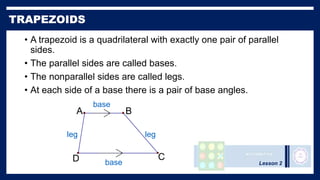
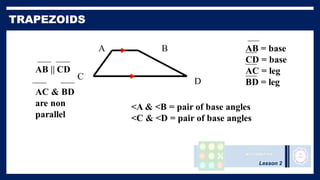
• A trapezoid is a quadrilateral with exactly one pair of parallel
sides.
• The parallel sides are called bases.
• The nonparallel sides are called legs.
• At each side of a base there is a pair of base angles.
A
D C
B
leg leg
base
base
Lesson 2
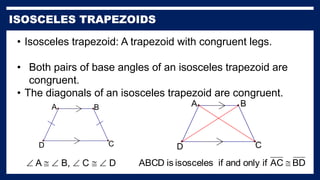
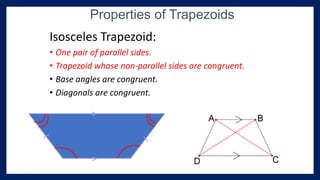
• Isosceles trapezoid: A trapezoid with congruent legs.
• Both pairs of base angles of an isosceles trapezoid are
congruent.
• The diagonals of an isosceles trapezoid are congruent.
A
D C
B
 A   B,  C   D
A
D C
B
BD
AC
if
only
and
if
isosceles
is
ABCD 
Lesson 2
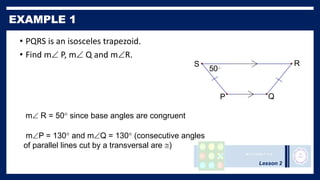
• PQRS is an isosceles trapezoid.
• Find m P, m Q and mR.
50
S R
P Q
m R = 50 since base angles are congruent
mP = 130 and mQ = 130 (consecutive angles
of parallel lines cut by a transversal are )
Lesson 2
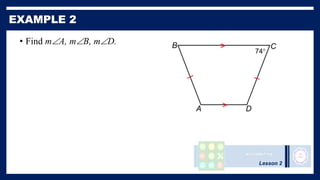
• Find mA, mB, mD.
Lesson 2
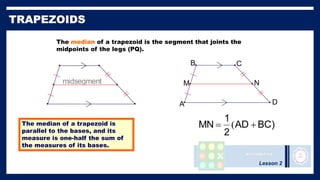
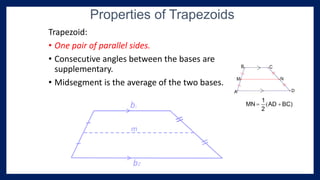
The median of a trapezoid is
parallel to the bases, and its
measure is one-half the sum of
the measures of its bases.
The median of a trapezoid is the segment that joints the
midpoints of the legs (PQ).
midsegment N
M
A D
B C
BC)
AD
2
1
MN
,
BC
ll
MN
AD
ll
MN (
, 

Lesson 2
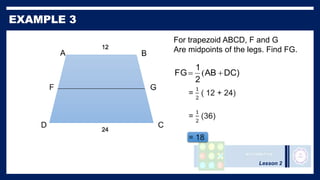
For trapezoid ABCD, F and G
Are midpoints of the legs. Find FG.
DC)
AB
2
1
FG ( 

Lesson 2
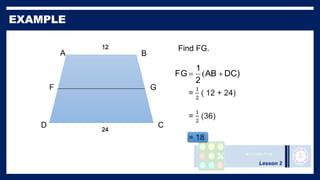
Find FG.
DC)
AB
2
1
FG ( 

Lesson 2
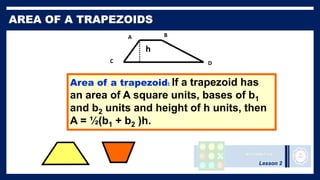
A
C D
B
Area of a trapezoid: If a trapezoid has
an area of A square units, bases of b1
and b2 units and height of h units, then
A = ½(b1 + b2 )h.
h
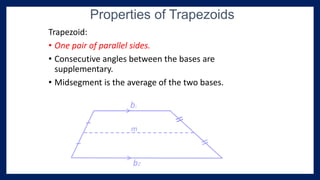
Trapezoid:
• One pair of parallel sides.
• Consecutive angles between the bases are
supplementary.
• Midsegment is the average of the two bases.
Properties of Trapezoids
>
>
b1
b2
m
Trapezoid:
• One pair of parallel sides.
• Consecutive angles between the bases are
supplementary.
• Midsegment is the average of the two bases.
Properties of Trapezoids
>
>
b1
b2
m
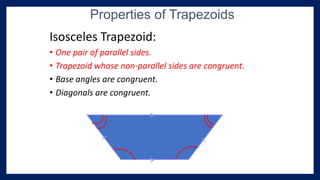
Isosceles Trapezoid:
• One pair of parallel sides.
• Trapezoid whose non-parallel sides are congruent.
• Base angles are congruent.
• Diagonals are congruent.
Properties of Trapezoids
>
>
Isosceles Trapezoid:
• One pair of parallel sides.
• Trapezoid whose non-parallel sides are congruent.
• Base angles are congruent.
• Diagonals are congruent.
Properties of Trapezoids
Lesson 2
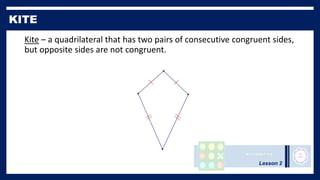
Kite – a quadrilateral that has two pairs of consecutive congruent sides,
but opposite sides are not congruent.
Lesson 2
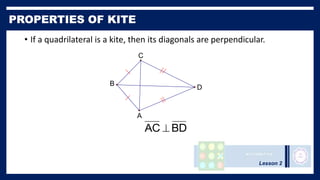
• If a quadrilateral is a kite, then its diagonals are perpendicular.
D
C
A
B
BD
AC 
Lesson 2
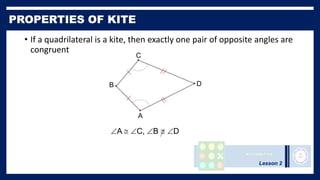
• If a quadrilateral is a kite, then exactly one pair of opposite angles are
congruent
D
C
A
B
A  C, B  D
Lesson 2
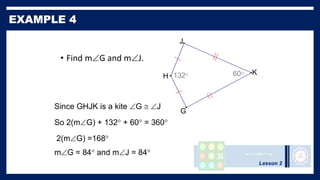
• Find mG and mJ.
60
132
J
G
H
K
Since GHJK is a kite G  J
So 2(mG) + 132 + 60 = 360
2(mG) =168
mG = 84 and mJ = 84
Lesson 2
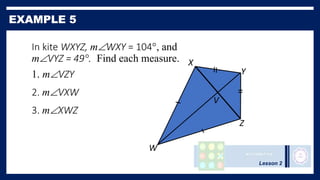
In kite WXYZ, mWXY = 104°, and
mVYZ = 49°. Find each measure.
1. mVZY
2. mVXW
3. mXWZ
W
X
Y
Z
V
Lesson 2
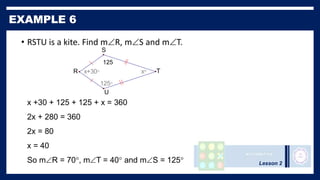
• RSTU is a kite. Find mR, mS and mT.
x
125
x+30
S
U
R T
x +30 + 125 + 125 + x = 360
2x + 280 = 360
2x = 80
x = 40
So mR = 70, mT = 40 and mS = 125
125
Properties of a Kite
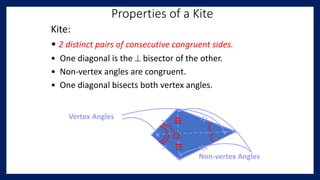
Kite:
• 2 distinct pairs of consecutive congruent sides.
• One diagonal is the  bisector of the other.
• Non-vertex angles are congruent.
• One diagonal bisects both vertex angles.
Vertex Angles
Non-vertex Angles
Properties of a Kite
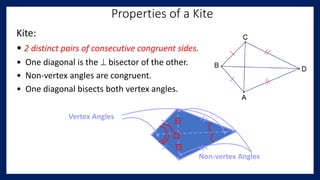
Kite:
• 2 distinct pairs of consecutive congruent sides.
• One diagonal is the  bisector of the other.
• Non-vertex angles are congruent.
• One diagonal bisects both vertex angles.
Vertex Angles
Non-vertex Angles
References
E-Math 9 - Work Text in Mathematics (Rex Book Store)
Math Ideas and Life Applications 9 - Second Edition (Abiva)
Spiral Math 9 – (Trinitas Publishing Inc.)
Lesson 2

Week 2 -Trapezoid and Kite.pptx

  • 1.
  • 2.
    Lesson 2 • provestheorems on trapezoids and kites. • Solve problems involving kite and trapezoid
  • 3.
  • 4.
    Lesson 2 • Atrapezoid is a quadrilateral with exactly one pair of parallel sides. • The parallel sides are called bases. • The nonparallel sides are called legs. • At each side of a base there is a pair of base angles. A D C B leg leg base base
  • 5.
  • 6.
    • Isosceles trapezoid:A trapezoid with congruent legs. • Both pairs of base angles of an isosceles trapezoid are congruent. • The diagonals of an isosceles trapezoid are congruent. A D C B  A   B,  C   D A D C B BD AC if only and if isosceles is ABCD 
  • 7.
    Lesson 2 • PQRSis an isosceles trapezoid. • Find m P, m Q and mR. 50 S R P Q m R = 50 since base angles are congruent mP = 130 and mQ = 130 (consecutive angles of parallel lines cut by a transversal are )
  • 8.
    Lesson 2 • FindmA, mB, mD.
  • 9.
    Lesson 2 The medianof a trapezoid is parallel to the bases, and its measure is one-half the sum of the measures of its bases. The median of a trapezoid is the segment that joints the midpoints of the legs (PQ). midsegment N M A D B C BC) AD 2 1 MN , BC ll MN AD ll MN ( ,  
  • 10.
    Lesson 2 For trapezoidABCD, F and G Are midpoints of the legs. Find FG. DC) AB 2 1 FG (  
  • 11.
  • 12.
    Lesson 2 A C D B Areaof a trapezoid: If a trapezoid has an area of A square units, bases of b1 and b2 units and height of h units, then A = ½(b1 + b2 )h. h
  • 13.
    Trapezoid: • One pairof parallel sides. • Consecutive angles between the bases are supplementary. • Midsegment is the average of the two bases. Properties of Trapezoids > > b1 b2 m
  • 14.
    Trapezoid: • One pairof parallel sides. • Consecutive angles between the bases are supplementary. • Midsegment is the average of the two bases. Properties of Trapezoids > > b1 b2 m
  • 15.
    Isosceles Trapezoid: • Onepair of parallel sides. • Trapezoid whose non-parallel sides are congruent. • Base angles are congruent. • Diagonals are congruent. Properties of Trapezoids > >
  • 16.
    Isosceles Trapezoid: • Onepair of parallel sides. • Trapezoid whose non-parallel sides are congruent. • Base angles are congruent. • Diagonals are congruent. Properties of Trapezoids
  • 17.
    Lesson 2 Kite –a quadrilateral that has two pairs of consecutive congruent sides, but opposite sides are not congruent.
  • 18.
    Lesson 2 • Ifa quadrilateral is a kite, then its diagonals are perpendicular. D C A B BD AC 
  • 19.
    Lesson 2 • Ifa quadrilateral is a kite, then exactly one pair of opposite angles are congruent D C A B A  C, B  D
  • 20.
    Lesson 2 • FindmG and mJ. 60 132 J G H K Since GHJK is a kite G  J So 2(mG) + 132 + 60 = 360 2(mG) =168 mG = 84 and mJ = 84
  • 21.
    Lesson 2 In kiteWXYZ, mWXY = 104°, and mVYZ = 49°. Find each measure. 1. mVZY 2. mVXW 3. mXWZ W X Y Z V
  • 22.
    Lesson 2 • RSTUis a kite. Find mR, mS and mT. x 125 x+30 S U R T x +30 + 125 + 125 + x = 360 2x + 280 = 360 2x = 80 x = 40 So mR = 70, mT = 40 and mS = 125 125
  • 23.
    Properties of aKite Kite: • 2 distinct pairs of consecutive congruent sides. • One diagonal is the  bisector of the other. • Non-vertex angles are congruent. • One diagonal bisects both vertex angles. Vertex Angles Non-vertex Angles
  • 24.
    Properties of aKite Kite: • 2 distinct pairs of consecutive congruent sides. • One diagonal is the  bisector of the other. • Non-vertex angles are congruent. • One diagonal bisects both vertex angles. Vertex Angles Non-vertex Angles
  • 25.
    References E-Math 9 -Work Text in Mathematics (Rex Book Store) Math Ideas and Life Applications 9 - Second Edition (Abiva) Spiral Math 9 – (Trinitas Publishing Inc.) Lesson 2