1
Zest for Progress
Zeal of Partnership
9
Republic of the Philippines
Department of Education
Mathematics
Quarter 3 - Module 4:
Word Problems: Parallelogram, Trapezoid
and Kite
Name of Learner: ___________________________
Grade & Section: ___________________________
Name of School: ___________________________
2
What I Need to Know
The module contains only one lesson:
Lesson 1: Solve problems involving parallelograms, trapezoids and kites.
After going through this module you are expected to:
1. illustrate and solve problems involving parallelograms, trapezoids and kites; and
2. solve problems involving parallelograms, trapezoids and kites.
What I Know
Directions: Encircle the letter of the correct answer.
1. How many pair of base angle has isosceles trapezoid?
A. 1 B. 2 C. 3 D. 4
2. In a parallelogram LEND, LE and ND are parallel sides.
Which of the following properties of a parallelogram can be used to find the length of the
parallel side?
A. In a parallelogram, any two opposite angles are congruent.
B. In a parallelogram, any two opposite sides are congruent.
C. In a parallelogram, any two consecutives angles are supplementary
D. The diagonals of a parallelogram bisect each other.
3. FAME is a parallelogram with angle F measures 400
what will be the measure of its opposite angle?
A. 1400
B. 500
C. 400
D. 300
4. In an isosceles trapezoid CARE, measure of angle C is 500
What is the measure of angle E?
A. 1300
B. 1100
C. 600
D. 500
5. The diagonals of the kite RIDE have the measure of 50cm and 15cm,
What is the area of the kite?
A. 300cm2
B. 325cm2
C. 350cm2
D. 375cm2
6. A quadrilateral MAID is a parallelogram.MA =(2x+3) cm and ID=(x + 5)cm ,
What is the measure of the two sides?
A. 1cm B. 3cm C. 5cm D. 7cm
3
7. An isosceles trapezoid HIDE has a median XZ = 20cm.
HI ‖DE, If HI = (8x-10) cm and DE = (15-x) cm ,
What is the measure of the parallel sides?
A. 12cm B. 10cm C. 8cm D. 6cm
8. Juliano wants to make rectangular swimming pool. If the two parallel sides has a
corresponding measure of (4x-8)cm and (x+13)cm
What is the measure of the sides?
A. 8cm B. 6cm C. 4cm D. 2cm
9. Dr. James property is shaped like an isosceles trapezoid. Dr. James gave the contractor
the following measurements, so that the contractor can build a wall around the entire
property: base 1 = (2x – 5)km , base 2 = (x +7)km and a median of 7km and its leg
measures is 6km,
What is the perimeter of the lot?
A. 20km B. 22km C. 24km D. 26km
10.A kite with an area of 70cm2
and one diagonal measures 10cm and other diagonal
is(2x+4)cm,
Find the length of the other diagonal.
A. 140 cm B. 100cm C. 30cm D. 14cm
What’s In
Activity 1. Match Me In.
Directions: Match column A with column C. Write the letter of the correct answer on the space
provided.
Column A Column A
_____1. Quadrilateral A. a rectangle with all four sides congruent
_____2. Parallelogram B. a quadrilateral with exactly one pair of
opposite sides parallel
_____3. Trapezoid C. a parallelogram with four right angles
_____Rectangle D. a quadrilateral with two pairs of opposite
sides that are parallel
_____5. Square E. a quadrilateral with pairs of congruent and adjacent sides
_____Rhombus F. a parallelogram with all four sides congruent
_____7. Kite G. a closed plain figure consisting of four-line segment
4
What’s New
Activity 2: True or False!
Directions: Write T if the statement is correct and if the statement is false write the correct word to
make the statement correct.
_________1. In a parallelogram, any two opposites sides are congruent (≅).
_________2. In a parallelogram, any two consecutive angles are congruent (≅).
_________3. In a parallelogram, any two consecutive angles are complementary.
_________4. A diagonal of a parallelogram from two congruent triangle.
_________5. The median of a trapezoid is parallel (‖) to each base and its length is one third the
sum of the lengths of the bases.
_________6. The base angles of an isosceles trapezoid are congruent (≅).
_________7. Opposite angles of an isosceles trapezoids are supplementary.
_________8. The diagonals of an isosceles trapezoid are congruent (≅).
_________9. The diagonals of a kite are perpendicular to each other.
________10. The area of a kite is half the product of the lengths of its diagonal.
What is it
Solving Problems involving Parallelograms, Trapezoids and Kites
The figure below shows the different kinds of quadrilateral. Each kind has its own properties.
QUADRILATERAL
Parallelogram Trapezoid
Rectangle Square Rhombus
Kite
• Let us recall on the properties of a parallelogram
Properties of a parallelogram.
1. In a parallelogram, any two opposites sides are congruent (≅).
2. In a parallelogram , any two opposite angles are congruent(≅).
3. In a parallelogram , any two consecutive angles are supplementary.
4. The diagonals of a parallelogram bisect each other.
5. A diagonal of a parallelogram form two congruent triangle.
These properties would help us solve problems involving parallelograms.
5
Let us try a look at this given example 1.
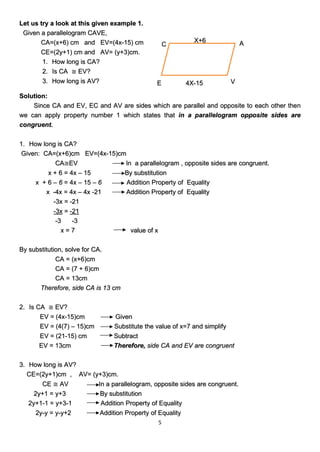
Given a parallelogram CAVE,
CA=(x+6) cm and EV=(4x-15) cm
CE=(2y+1) cm and AV= (y+3)cm.
1. How long is CA?
2. Is CA ≅ EV?
3. How long is AV?
Solution:
Since CA and EV, EC and AV are sides which are parallel and opposite to each other then
we can apply property number 1 which states that in a parallelogram opposite sides are
congruent.
1. How long is CA?
Given: CA=(x+6)cm EV=(4x-15)cm
CA≅EV In a parallelogram , opposite sides are congruent.
x + 6 = 4x – 15 By substitution
x + 6 – 6 = 4x – 15 – 6 Addition Property of Equality
x -4x = 4x – 4x -21 Addition Property of Equality
-3x = -21
-3x = -21
-3 -3
x = 7 value of x
By substitution, solve for CA.
CA = (x+6)cm
CA = (7 + 6)cm
CA = 13cm
Therefore, side CA is 13 cm
2. Is CA ≅ EV?
EV = (4x-15)cm Given
EV = (4(7) – 15)cm Substitute the value of x=7 and simplify
EV = (21-15) cm Subtract
EV = 13cm Therefore, side CA and EV are congruent
3. How long is AV?
CE=(2y+1)cm , AV= (y+3)cm.
CE ≅ AV In a parallelogram, opposite sides are congruent.
2y+1 = y+3 By substitution
2y+1-1 = y+3-1 Addition Property of Equality
2y-y = y-y+2 Addition Property of Equality
X+6
4X-15
C A
V
E
6
Y = 2 value of y
By substitution
AV = (y + 3)cm Substitute the value y=2
AV = (2 + 3)cm Add
AV = 5cm
Since, side AV is 5 cm
Therefore, side CE and AV are congruent.
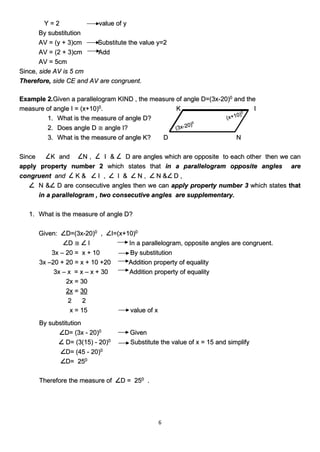
Example 2.Given a parallelogram KIND , the measure of angle D=(3x-20)0
and the
measure of angle I = (x+10)0
. K I
1. What is the measure of angle D?
2. Does angle D ≅ angle I?
3. What is the measure of angle K? D N
Since K and N , I & D are angles which are opposite to each other then we can
apply property number 2 which states that in a parallelogram opposite angles are
congruent and K & I , I & N , N & D ,
N & D are consecutive angles then we can apply property number 3 which states that
in a parallelogram , two consecutive angles are supplementary.
1. What is the measure of angle D?
Given: D=(3x-20)0
, I=(x+10)0
D ≅ I In a parallelogram, opposite angles are congruent.
3x – 20 = x + 10 By substitution
3x –20 + 20 = x + 10 +20 Addition property of equality
3x – x = x – x + 30 Addition property of equality
2x = 30
2x = 30
2 2
x = 15 value of x
By substitution
D= (3x - 20)0
Given
D= (3(15) - 20)0
Substitute the value of x = 15 and simplify
D= (45 - 20)0
D= 250
Therefore the measure of D = 250
.
7
2. Does angle D ≅ angle I?
I = (x+10)0
Given
I = (15+10)0
Substitute the value of x = 15 and simplify
I = 250
Therefore, D and I are congruent.
3. What is the measure of angle K?
K and I are consecutive angles
m K + m I = 1800
In a parallelogram , two consecutive
angles are supplementary.
m K + 250
= 1800
Substitute the measure of I
m K + 250
- 250
= 1800
- 250
Addition Property of Equality
m K = 1550
Therefore the measure of K = 1550
.
Property number 4 says that the diagonal in a parallelogram bisect each other.
Let us try a look at this given example 3.
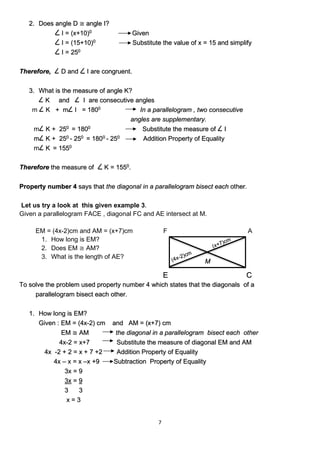
Given a parallelogram FACE , diagonal FC and AE intersect at M.
EM = (4x-2)cm and AM = (x+7)cm F A
1. How long is EM?
2. Does EM ≅ AM?
3. What is the length of AE?
To solve the problem used property number 4 which states that the diagonals of a
parallelogram bisect each other.
1. How long is EM?
Given : EM = (4x-2) cm and AM = (x+7) cm
EM ≅ AM the diagonal in a parallelogram bisect each other
4x-2 = x+7 Substitute the measure of diagonal EM and AM
4x -2 + 2 = x + 7 +2 Addition Property of Equality
4x – x = x –x +9 Subtraction Property of Equality
3x = 9
3x = 9
3 3
x = 3
C
E
M
8
By substitution
EM = (4x-2) cm
EM = (4(3) – 2) cm
EM = (12 – 2) cm
EM = 10 cm
Therefore, EM is 10 cm long
2. Does EM ≅ AM?
Given: EM = (4x-2) cm and AM = (x+7) cm
EM = AM
4x - 2 = x + 7
4(3) - 2 = 3 + 7
12 – 2 = 10
10 = 10
Therefore, the length of EM and AM are congruent.
3. What is the length of AE?
AE = AM + AE
AE = 10 cm + 10 cm
AE = 20 cm the length of diagonal AE
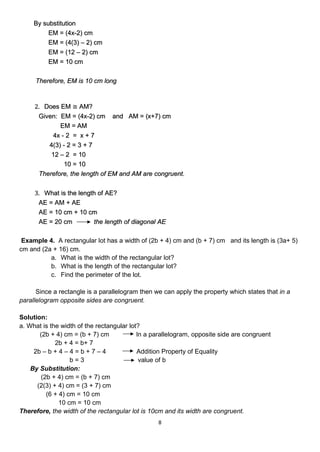
Example 4. A rectangular lot has a width of (2b + 4) cm and (b + 7) cm and its length is (3a+ 5)
cm and (2a + 16) cm.
a. What is the width of the rectangular lot?
b. What is the length of the rectangular lot?
c. Find the perimeter of the lot.
Since a rectangle is a parallelogram then we can apply the property which states that in a
parallelogram opposite sides are congruent.
Solution:
a. What is the width of the rectangular lot?
(2b + 4) cm = (b + 7) cm In a parallelogram, opposite side are congruent
2b + 4 = b+ 7
2b – b + 4 – 4 = b + 7 – 4 Addition Property of Equality
b = 3 value of b
By Substitution:
(2b + 4) cm = (b + 7) cm
(2(3) + 4) cm = (3 + 7) cm
(6 + 4) cm = 10 cm
10 cm = 10 cm
Therefore, the width of the rectangular lot is 10cm and its width are congruent.
9
b. What is the length of the rectangular lot?
(3a+ 5) cm = (2a + 16) cm In a parallelogram, opposite side are congruent
3a+ 5= 2a + 16
3a-2a+5-5=2a-2a+16-5 Addition and Subtraction Property of Equality
a=11 value of a
By Substitution:
(3a+ 5) cm = (2a + 16) cm
(3(11) + 5) cm = (2(11) + 16) cm
(33+5) cm = (22+16) cm
38cm = 38 cm
Therefore the length of the rectangular lot is 38cm and are congruent.
c. Find the perimeter of the lot.
P = 2Lenght + 2Width Formula of finding the perimeter
P = 2(38cm) + 2(10cm) By substitution
P = 76cm + 20cm Add
P = 96cm The perimeter of the rectangular lot.
Trapezoid
What is the difference between a parallelogram and a trapezoid?
• Parallelogram is a quadrilateral with 2 pairs of opposite sides which are parallel(‖)
and congruent(≅).
• Trapezoid is a quadrilateral with exactly one(1) pair of parallel(‖) sides.
The parallel sides of the trapezoid are the bases and the two nonparallel sides are the
legs. The angles that include the base are called the base angles. Every trapezoids has two
pairs of base angles.If the legs of a trapezoid are congruent , then the trapezoid is isosceles.
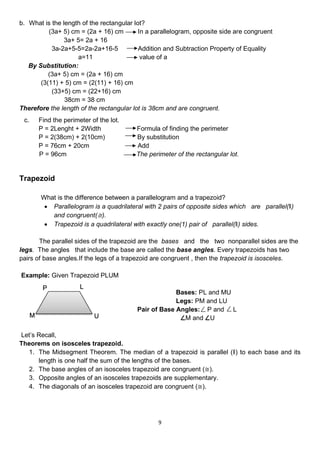
Example: Given Trapezoid PLUM
Bases: PL and MU
Legs: PM and LU
Pair of Base Angles: P and L
M and U
Let’s Recall,
Theorems on isosceles trapezoid.
1. The Midsegment Theorem. The median of a trapezoid is parallel (‖) to each base and its
length is one half the sum of the lengths of the bases.
2. The base angles of an isosceles trapezoid are congruent (≅).
3. Opposite angles of an isosceles trapezoids are supplementary.
4. The diagonals of an isosceles trapezoid are congruent (≅).
P L
U
M
10
Example 1. Quadrilateral HEAT is an isosceles trapezoid with HE ‖ TA. BD is its median. If
HE=(x+10) cm , A = (3x – 2) cm and BD = 20 cm,
find the length of the two bases.
Using property number 1 and 2:
1. The Midsegment Theorem. The median of trapezoid is parallel(‖) to each base and its
length is one half the sum of the lengths of the bases.
2. The base angles of an isosceles trapezoid are congruent (≅).
Solution:
BD = 1(HE + TA) Formula
2
20cm = 1[(x+10)cm + (3x-2)cm] Substitute the value
2
2(20) = 1(2)(x+10 + 3x -2) Multiply both sides by 2 which is the
2 reciprocals of ½ to eliminate fraction.
40 = 2(4x + 8) Simplify
2
40 = 4x + 8
40 – 8 = 4x +8 - 8 Addition Property of Equality
32 = 4x
32 = 4x
4 4
x=8 the value of x
The two bases of the isosceles trapezoid.
1. HE=(x+10)cm Given
HE=(8+10)cm Substitute the value of x = 8
HE=18cm Length of base HE
2. TA=(3x – 2)cm Given
TA=(3(8) – 2)cm Substitute the value of x = 8
TA=(32 – 2)cm Simplify
TA= 32cm Length of base TA
Example 2. In this given example, we will apply the property number 3 and 4 of an isosceles
trapezoid.
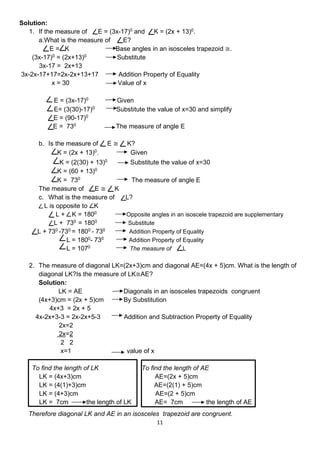
Given: Quadrilateral LAKE is an isosceles trapezoid with
pair of base angle: L and A, E and K.
1. If the measure of E = (3x-17)0
and K = (2x + 13)0
.
a. What is the measure of E?
b. Is the measure of E ≅ K?
c. What is the measure of L?
2. The measure of diagonal LK=(2x+3)cm and diagonal AE=(4x – 5)cm. What is the
length of diagonal LK?Is the measure of LK≅AE?
E
L A
K
11
Solution:
1. If the measure of E = (3x-17)0
and K = (2x + 13)0
.
a.What is the measure of E?
E = K Base angles in an isosceles trapezoid ≅.
(3x-17)0
= (2x+13)0
Substitute
3x-17 = 2x+13
3x-2x-17+17=2x-2x+13+17 Addition Property of Equality
x = 30 Value of x
E = (3x-17)0
Given
E= (3(30)-17)0
Substitute the value of x=30 and simplify
E = (90-17)0
E = 730
The measure of angle E
b. Is the measure of E ≅ K?
K = (2x + 13)0
. Given
K = (2(30) + 13)0
Substitute the value of x=30
K = (60 + 13)0
K = 730
The measure of angle E
The measure of E ≅ K
c. What is the measure of L?
L is opposite to K
L + K = 1800
Opposite angles in an isoscele trapezoid are supplementary
L + 730
= 1800
Substitute
L + 730
-730
= 1800
- 730
Addition Property of Equality
L = 1800
- 730
Addition Property of Equality
L = 1070
The measure of L
2. The measure of diagonal LK=(2x+3)cm and diagonal AE=(4x + 5)cm. What is the length of
diagonal LK?Is the measure of LK≅AE?
Solution:
LK = AE Diagonals in an isosceles trapezoids congruent
(4x+3)cm = (2x + 5)cm By Substitution
4x+3 = 2x + 5
4x-2x+3-3 = 2x-2x+5-3 Addition and Subtraction Property of Equality
2x=2
2x=2
2 2
x=1 value of x
To find the length of LK To find the length of AE
LK = (4x+3)cm AE=(2x + 5)cm
LK = (4(1)+3)cm AE=(2(1) + 5)cm
LK = (4+3)cm AE=(2 + 5)cm
LK = 7cm the length of LK AE= 7cm the length of AE
Therefore diagonal LK and AE in an isosceles trapezoid are congruent.
12
Example 3. Anna wants to make a flower pot in the form of an isosceles trapezoid with the leg
measures (2x-3)cm and (x+4)cm. Its bases measures (5x-9)cm and (2x+6)cm with a median of
30cm long. Find the length of its leg.
Solution:
Find the length of the leg.
(2x-3)cm = (x+4)cm The legs of an isosceles trapezoid are congruent.
2x-3 = x+4
2x-x-3+3 = x-x+4+3 Addition Property of Equality
x = 7 value of x
To find the length of the legs substitute the value of x and simplify.
leg1=(2x-3)cm leg2=(7+4)cm
leg1=(2(7)-3)cm leg2=11cm
leg1=(14-3)cm
leg1=11cm
Therefore the length of the legs of the isosceles trapezoid are 11cm and are congruent.
Kite
Did you know that a simple kite is a Quadrilateral?
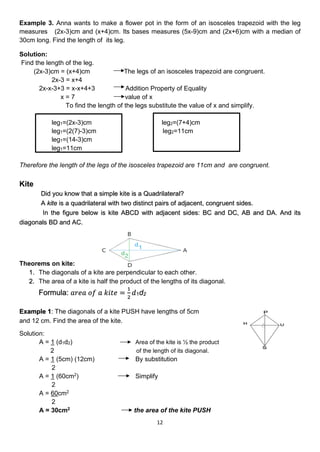
A kite is a quadrilateral with two distinct pairs of adjacent, congruent sides.
In the figure below is kite ABCD with adjacent sides: BC and DC, AB and DA. And its
diagonals BD and AC.
Theorems on kite:
1. The diagonals of a kite are perpendicular to each other.
2. The area of a kite is half the product of the lengths of its diagonal.
Formula: 𝑎𝑎𝑎𝑎𝑎𝑎𝑎𝑎 𝑜𝑜𝑜𝑜 𝑎𝑎 𝑘𝑘𝑘𝑘𝑘𝑘𝑘𝑘 =
1
2
𝑑𝑑1d2
Example 1: The diagonals of a kite PUSH have lengths of 5cm
and 12 cm. Find the area of the kite.
Solution:
A = 1 (d1d2) Area of the kite is ½ the product
2 of the length of its diagonal.
A = 1 (5cm) (12cm) By substitution
2
A = 1 (60cm2
) Simplify
2
A = 60cm2
2
A = 30cm2
the area of the kite PUSH
13
Example 2. The area of the kite is 90cm2
and the length of the diagonal is 18cm.How long is the
other diagonal?
Solution:
A = 1 (d1d2) Area of the kite is ½ the product of the
2 length of its diagonal.
90cm2
= 1 (18cm) (d2) By substitution
2
90cm2
= 18cm (d2) Simplify
2
90cm2
= 9cm (d2)
90cm2
= 9cm (d2)
9cm 9cm
10cm = d2
d2 = 10cm the length of the other diagonal in a kite.
What’s More
Activity 3: Try Me!
Directions: Solve the following problems involving parallelograms, trapezoid and kite. State the
property used to solve the problems. Write your answer on the space provided and use extra
sheets for your solution.
1. A quadrilateral MAID is a parallelogram.MA =(2x+3) cm and ID= (x + 6) cm, what is the
length of the two sides?
____________________
2. BEAR is a parallelogram with measure of angle B = (3x+1)0
and the measure of
angle A = (2x-5)0
. What is the measure of angle E?
____________________
3. An isosceles trapezoid HIDE has a median XZ = 20cm.HI ‖DE, If HI = (8x-10) cm and DE =
(15-x) cm, find the measure of the parallel sides.
____________________
4. The diagonals of a kite are 8cm and 3cm. What is the area of the kite?
____________________
5. A kite with an area of 70cm2
and one diagonal measures 10cm and other diagonal is(2x+4)
cm, find the length of the other diagonal?
____________________
What I Have Learned
Activity 4. Paired Me Up
Directions: Choose your answer in the box. Write the correct answer on the space provided.
480
56cm 800
7cm 45cm
____1. The diagonals of a kite have lengths of 14cm and 8cm. Find the area of the kite.
____2. If the measure of one angle of an isosceles trapezoid is x0
and the angle opposite it
is (x+20)0
, what is the measure of the smaller angle?
____3. Liza wishes to bake a rectangular cake with the parallel side measures (3x+4) cm and
(2x + 5) cm, what is the length of the side?
14
____4. An isosceles trapezoid MILD where MI ‖ DL with AB as median. If MI=(2x+7) cm,
LD=(x-3) cm and AB= 34 cm. How long is DL?
____5. ABCD is a kite. AB is adjacent to BC and diagonal AC and BD intersect at E. If
BEA =(15x)0
and BAE = 8x-6, find the m ABC.
What I Can Do
Activity 5: Feel Me!
Direction: Illustrate the problem and solve. Write your answer on the space provided and use
extra sheets for your solution.
1. Dexter wants to make rectangular swimming pool. If the two parallel sides has a
corresponding measure of (4x-8) cm and (x+13) cm, what is the measure of the sides?
______________
2. Dr. James property is shaped like an isosceles trapezoid. Dr. James gave the contractor
the following measurements, so that the contractor can build a wall around the entire
property: base 1 = (2x – 5) km, base 2 = (x +7) km and a median of 7km and its leg
measures 3km. What is the perimeter of wall?
______________
3. My father makes a kite with an area of 25m2
. One of its diagonals is 5m, what is the length
of the other diagonal?
______________
Assessment
Multiple Choice Test: Encircle the letter of the correct answer.
1. Which property of a parallelogram is to be use to find the measure of its opposite angle?
A. In a parallelogram, any two opposite sides are congruent.
B. In a parallelogram, any two opposite angles are congruent.
C. In a parallelogram, any two consecutive angles are supplementary
D. The diagonals of a parallelogram bisect each other.
2. LIFE is a kite. What are its two diagonals?
A. LI and FE B. LE and FI C. IE and LF D. L and E
3. In a parallelogram SITE, the length of SI=12cm.
What is the length of ET?
A. 3cm B. 6cm C. 12cm D. 24cm
4. If the measure of angle B in a parallelogram BITE is 1200
,
what is the measure of angle I?
A. 100
B. 200
C. 400
D. 600
5. A quadrilateral FERN is a parallelogram. If measure of FE= (3x + 3) cm and RN = (x +13) cm.
How long is RN?
A. 5cm B. 8cm C. 10cm D. 18cm
15
6. A quadrilateral MILO is a parallelogram. If m M= (2x-10)0
and m L=(x+12)0
.
What is the m I?
A. 220
B. 340
C. 1460
D. 1700
7. FARE is a kite with an area of 56cm2
and one of its diagonals is 16cm
What the length of the other diagonal?
A. 112cm B. 9 cm C.10 cm D. 7cm
8. The design of a coffee shop of Mr. Lee is an isosceles trapezoid. If the median is (4x+4) cm
and the base measures (2x+6) cm and (x+8) cm.
What is the measure of its median?
A. 7cm B. 8cmm C. 9cm D. 10cm
9. Lester join the kite exhibits. One of the criteria is the area of the kite. The kite should have
an area of 70cm2
and the diagonal measures 20cm,
What should be the length of the other diagonal?
A. 20cm B. 15cm C. 10cm D. 7cm
10.What is the measure of the angle of an isosceles trapezoid if two of the angles has a
measure in the ratio 2:3?
A. 600
and 1200
B. 400
and 1400
C. 720
and 1080
D. 950
and 850
Scoring Rubrics
Score Descriptors
6
Poses a more complex problem with 2 or more correct possible solutions and communicates
ideas unmistakably, shows in-depth comprehension of the pertinent concepts and/or process
and provides explanation whenever appropriate.
5
Poses a more complex problem and finishes all significant parts of the solution and
communicates ideas unmistakably, shows in-depth comprehension of the pertinent concepts
and/or processes.
4 Poses a complex problem and finishes all significant parts of the solution and communicates
ideas unmistakably, shows in-depth comprehension of the pertinent concepts and/or
processes.
3 Poses a complex problem and finishes most significant parts of the solution and
communicates ideas unmistakably, shows comprehension of major concepts although
neglects or misinterprets less significant ideas or details.
2 Poses a problem and finishes some significant parts of the solution and communicates ideas
unmistakably but shows gaps on theoretical comprehension.
1 Poses a problem but demonstrates minor comprehension, not being able to develop an
approach.
16
References:
Bryant, Merden L., Leonides E. Bulalayao, Melvin M. Callanta, Jerry D. Cruz, et al. Mathematics Learner’s
Material 9. Pasig City: Department of Education, 2014.
Bryant, Merden L., Leonides E. Bulalayao, Melvin M. Callanta, Jerry D. Cruz, et al. Mathematics Teachers Guide 9.
Pasig City: Department of Education, 2014
Bernabe, Julieta G., Soledad Jose-Dilao and Fernando B Orines, Quadrilaterals Geometry, 1251 Gregorio
Araneta Avenue, Quezon City: SD Publications Inc., 2009.
Development Team
Writer: ANALIZA S. LAPAD
Diplahan National High School
Editor/QA: Eugenio E. Balasabas
Ressme M. Bulay-og
Mary Jane I. Yeban
Reviewer: Gina I. Lihao
EPS-Mathematics
Illustrator:
Layout Artist:
Management Team: Evelyn F. Importante
OIC-CID Chief EPS
Jerry c. Bokingkito
OIC-Assistant SDS
Aurelio A. Santisas, CESE
OIC- Assistant SDS
Jenelyn A. Aleman, CESO VI
OIC- Schools Division Superintendent

RO Q3 M4 MATH9 pdf.pdf

  • 1.
    1 Zest for Progress Zealof Partnership 9 Republic of the Philippines Department of Education Mathematics Quarter 3 - Module 4: Word Problems: Parallelogram, Trapezoid and Kite Name of Learner: ___________________________ Grade & Section: ___________________________ Name of School: ___________________________
  • 2.
    2 What I Needto Know The module contains only one lesson: Lesson 1: Solve problems involving parallelograms, trapezoids and kites. After going through this module you are expected to: 1. illustrate and solve problems involving parallelograms, trapezoids and kites; and 2. solve problems involving parallelograms, trapezoids and kites. What I Know Directions: Encircle the letter of the correct answer. 1. How many pair of base angle has isosceles trapezoid? A. 1 B. 2 C. 3 D. 4 2. In a parallelogram LEND, LE and ND are parallel sides. Which of the following properties of a parallelogram can be used to find the length of the parallel side? A. In a parallelogram, any two opposite angles are congruent. B. In a parallelogram, any two opposite sides are congruent. C. In a parallelogram, any two consecutives angles are supplementary D. The diagonals of a parallelogram bisect each other. 3. FAME is a parallelogram with angle F measures 400 what will be the measure of its opposite angle? A. 1400 B. 500 C. 400 D. 300 4. In an isosceles trapezoid CARE, measure of angle C is 500 What is the measure of angle E? A. 1300 B. 1100 C. 600 D. 500 5. The diagonals of the kite RIDE have the measure of 50cm and 15cm, What is the area of the kite? A. 300cm2 B. 325cm2 C. 350cm2 D. 375cm2 6. A quadrilateral MAID is a parallelogram.MA =(2x+3) cm and ID=(x + 5)cm , What is the measure of the two sides? A. 1cm B. 3cm C. 5cm D. 7cm
  • 3.
    3 7. An isoscelestrapezoid HIDE has a median XZ = 20cm. HI ‖DE, If HI = (8x-10) cm and DE = (15-x) cm , What is the measure of the parallel sides? A. 12cm B. 10cm C. 8cm D. 6cm 8. Juliano wants to make rectangular swimming pool. If the two parallel sides has a corresponding measure of (4x-8)cm and (x+13)cm What is the measure of the sides? A. 8cm B. 6cm C. 4cm D. 2cm 9. Dr. James property is shaped like an isosceles trapezoid. Dr. James gave the contractor the following measurements, so that the contractor can build a wall around the entire property: base 1 = (2x – 5)km , base 2 = (x +7)km and a median of 7km and its leg measures is 6km, What is the perimeter of the lot? A. 20km B. 22km C. 24km D. 26km 10.A kite with an area of 70cm2 and one diagonal measures 10cm and other diagonal is(2x+4)cm, Find the length of the other diagonal. A. 140 cm B. 100cm C. 30cm D. 14cm What’s In Activity 1. Match Me In. Directions: Match column A with column C. Write the letter of the correct answer on the space provided. Column A Column A _____1. Quadrilateral A. a rectangle with all four sides congruent _____2. Parallelogram B. a quadrilateral with exactly one pair of opposite sides parallel _____3. Trapezoid C. a parallelogram with four right angles _____Rectangle D. a quadrilateral with two pairs of opposite sides that are parallel _____5. Square E. a quadrilateral with pairs of congruent and adjacent sides _____Rhombus F. a parallelogram with all four sides congruent _____7. Kite G. a closed plain figure consisting of four-line segment
  • 4.
    4 What’s New Activity 2:True or False! Directions: Write T if the statement is correct and if the statement is false write the correct word to make the statement correct. _________1. In a parallelogram, any two opposites sides are congruent (≅). _________2. In a parallelogram, any two consecutive angles are congruent (≅). _________3. In a parallelogram, any two consecutive angles are complementary. _________4. A diagonal of a parallelogram from two congruent triangle. _________5. The median of a trapezoid is parallel (‖) to each base and its length is one third the sum of the lengths of the bases. _________6. The base angles of an isosceles trapezoid are congruent (≅). _________7. Opposite angles of an isosceles trapezoids are supplementary. _________8. The diagonals of an isosceles trapezoid are congruent (≅). _________9. The diagonals of a kite are perpendicular to each other. ________10. The area of a kite is half the product of the lengths of its diagonal. What is it Solving Problems involving Parallelograms, Trapezoids and Kites The figure below shows the different kinds of quadrilateral. Each kind has its own properties. QUADRILATERAL Parallelogram Trapezoid Rectangle Square Rhombus Kite • Let us recall on the properties of a parallelogram Properties of a parallelogram. 1. In a parallelogram, any two opposites sides are congruent (≅). 2. In a parallelogram , any two opposite angles are congruent(≅). 3. In a parallelogram , any two consecutive angles are supplementary. 4. The diagonals of a parallelogram bisect each other. 5. A diagonal of a parallelogram form two congruent triangle. These properties would help us solve problems involving parallelograms.
  • 5.
    5 Let us trya look at this given example 1. Given a parallelogram CAVE, CA=(x+6) cm and EV=(4x-15) cm CE=(2y+1) cm and AV= (y+3)cm. 1. How long is CA? 2. Is CA ≅ EV? 3. How long is AV? Solution: Since CA and EV, EC and AV are sides which are parallel and opposite to each other then we can apply property number 1 which states that in a parallelogram opposite sides are congruent. 1. How long is CA? Given: CA=(x+6)cm EV=(4x-15)cm CA≅EV In a parallelogram , opposite sides are congruent. x + 6 = 4x – 15 By substitution x + 6 – 6 = 4x – 15 – 6 Addition Property of Equality x -4x = 4x – 4x -21 Addition Property of Equality -3x = -21 -3x = -21 -3 -3 x = 7 value of x By substitution, solve for CA. CA = (x+6)cm CA = (7 + 6)cm CA = 13cm Therefore, side CA is 13 cm 2. Is CA ≅ EV? EV = (4x-15)cm Given EV = (4(7) – 15)cm Substitute the value of x=7 and simplify EV = (21-15) cm Subtract EV = 13cm Therefore, side CA and EV are congruent 3. How long is AV? CE=(2y+1)cm , AV= (y+3)cm. CE ≅ AV In a parallelogram, opposite sides are congruent. 2y+1 = y+3 By substitution 2y+1-1 = y+3-1 Addition Property of Equality 2y-y = y-y+2 Addition Property of Equality X+6 4X-15 C A V E
  • 6.
    6 Y = 2value of y By substitution AV = (y + 3)cm Substitute the value y=2 AV = (2 + 3)cm Add AV = 5cm Since, side AV is 5 cm Therefore, side CE and AV are congruent. Example 2.Given a parallelogram KIND , the measure of angle D=(3x-20)0 and the measure of angle I = (x+10)0 . K I 1. What is the measure of angle D? 2. Does angle D ≅ angle I? 3. What is the measure of angle K? D N Since K and N , I & D are angles which are opposite to each other then we can apply property number 2 which states that in a parallelogram opposite angles are congruent and K & I , I & N , N & D , N & D are consecutive angles then we can apply property number 3 which states that in a parallelogram , two consecutive angles are supplementary. 1. What is the measure of angle D? Given: D=(3x-20)0 , I=(x+10)0 D ≅ I In a parallelogram, opposite angles are congruent. 3x – 20 = x + 10 By substitution 3x –20 + 20 = x + 10 +20 Addition property of equality 3x – x = x – x + 30 Addition property of equality 2x = 30 2x = 30 2 2 x = 15 value of x By substitution D= (3x - 20)0 Given D= (3(15) - 20)0 Substitute the value of x = 15 and simplify D= (45 - 20)0 D= 250 Therefore the measure of D = 250 .
  • 7.
    7 2. Does angleD ≅ angle I? I = (x+10)0 Given I = (15+10)0 Substitute the value of x = 15 and simplify I = 250 Therefore, D and I are congruent. 3. What is the measure of angle K? K and I are consecutive angles m K + m I = 1800 In a parallelogram , two consecutive angles are supplementary. m K + 250 = 1800 Substitute the measure of I m K + 250 - 250 = 1800 - 250 Addition Property of Equality m K = 1550 Therefore the measure of K = 1550 . Property number 4 says that the diagonal in a parallelogram bisect each other. Let us try a look at this given example 3. Given a parallelogram FACE , diagonal FC and AE intersect at M. EM = (4x-2)cm and AM = (x+7)cm F A 1. How long is EM? 2. Does EM ≅ AM? 3. What is the length of AE? To solve the problem used property number 4 which states that the diagonals of a parallelogram bisect each other. 1. How long is EM? Given : EM = (4x-2) cm and AM = (x+7) cm EM ≅ AM the diagonal in a parallelogram bisect each other 4x-2 = x+7 Substitute the measure of diagonal EM and AM 4x -2 + 2 = x + 7 +2 Addition Property of Equality 4x – x = x –x +9 Subtraction Property of Equality 3x = 9 3x = 9 3 3 x = 3 C E M
  • 8.
    8 By substitution EM =(4x-2) cm EM = (4(3) – 2) cm EM = (12 – 2) cm EM = 10 cm Therefore, EM is 10 cm long 2. Does EM ≅ AM? Given: EM = (4x-2) cm and AM = (x+7) cm EM = AM 4x - 2 = x + 7 4(3) - 2 = 3 + 7 12 – 2 = 10 10 = 10 Therefore, the length of EM and AM are congruent. 3. What is the length of AE? AE = AM + AE AE = 10 cm + 10 cm AE = 20 cm the length of diagonal AE Example 4. A rectangular lot has a width of (2b + 4) cm and (b + 7) cm and its length is (3a+ 5) cm and (2a + 16) cm. a. What is the width of the rectangular lot? b. What is the length of the rectangular lot? c. Find the perimeter of the lot. Since a rectangle is a parallelogram then we can apply the property which states that in a parallelogram opposite sides are congruent. Solution: a. What is the width of the rectangular lot? (2b + 4) cm = (b + 7) cm In a parallelogram, opposite side are congruent 2b + 4 = b+ 7 2b – b + 4 – 4 = b + 7 – 4 Addition Property of Equality b = 3 value of b By Substitution: (2b + 4) cm = (b + 7) cm (2(3) + 4) cm = (3 + 7) cm (6 + 4) cm = 10 cm 10 cm = 10 cm Therefore, the width of the rectangular lot is 10cm and its width are congruent.
  • 9.
    9 b. What isthe length of the rectangular lot? (3a+ 5) cm = (2a + 16) cm In a parallelogram, opposite side are congruent 3a+ 5= 2a + 16 3a-2a+5-5=2a-2a+16-5 Addition and Subtraction Property of Equality a=11 value of a By Substitution: (3a+ 5) cm = (2a + 16) cm (3(11) + 5) cm = (2(11) + 16) cm (33+5) cm = (22+16) cm 38cm = 38 cm Therefore the length of the rectangular lot is 38cm and are congruent. c. Find the perimeter of the lot. P = 2Lenght + 2Width Formula of finding the perimeter P = 2(38cm) + 2(10cm) By substitution P = 76cm + 20cm Add P = 96cm The perimeter of the rectangular lot. Trapezoid What is the difference between a parallelogram and a trapezoid? • Parallelogram is a quadrilateral with 2 pairs of opposite sides which are parallel(‖) and congruent(≅). • Trapezoid is a quadrilateral with exactly one(1) pair of parallel(‖) sides. The parallel sides of the trapezoid are the bases and the two nonparallel sides are the legs. The angles that include the base are called the base angles. Every trapezoids has two pairs of base angles.If the legs of a trapezoid are congruent , then the trapezoid is isosceles. Example: Given Trapezoid PLUM Bases: PL and MU Legs: PM and LU Pair of Base Angles: P and L M and U Let’s Recall, Theorems on isosceles trapezoid. 1. The Midsegment Theorem. The median of a trapezoid is parallel (‖) to each base and its length is one half the sum of the lengths of the bases. 2. The base angles of an isosceles trapezoid are congruent (≅). 3. Opposite angles of an isosceles trapezoids are supplementary. 4. The diagonals of an isosceles trapezoid are congruent (≅). P L U M
  • 10.
    10 Example 1. QuadrilateralHEAT is an isosceles trapezoid with HE ‖ TA. BD is its median. If HE=(x+10) cm , A = (3x – 2) cm and BD = 20 cm, find the length of the two bases. Using property number 1 and 2: 1. The Midsegment Theorem. The median of trapezoid is parallel(‖) to each base and its length is one half the sum of the lengths of the bases. 2. The base angles of an isosceles trapezoid are congruent (≅). Solution: BD = 1(HE + TA) Formula 2 20cm = 1[(x+10)cm + (3x-2)cm] Substitute the value 2 2(20) = 1(2)(x+10 + 3x -2) Multiply both sides by 2 which is the 2 reciprocals of ½ to eliminate fraction. 40 = 2(4x + 8) Simplify 2 40 = 4x + 8 40 – 8 = 4x +8 - 8 Addition Property of Equality 32 = 4x 32 = 4x 4 4 x=8 the value of x The two bases of the isosceles trapezoid. 1. HE=(x+10)cm Given HE=(8+10)cm Substitute the value of x = 8 HE=18cm Length of base HE 2. TA=(3x – 2)cm Given TA=(3(8) – 2)cm Substitute the value of x = 8 TA=(32 – 2)cm Simplify TA= 32cm Length of base TA Example 2. In this given example, we will apply the property number 3 and 4 of an isosceles trapezoid. Given: Quadrilateral LAKE is an isosceles trapezoid with pair of base angle: L and A, E and K. 1. If the measure of E = (3x-17)0 and K = (2x + 13)0 . a. What is the measure of E? b. Is the measure of E ≅ K? c. What is the measure of L? 2. The measure of diagonal LK=(2x+3)cm and diagonal AE=(4x – 5)cm. What is the length of diagonal LK?Is the measure of LK≅AE? E L A K
  • 11.
    11 Solution: 1. If themeasure of E = (3x-17)0 and K = (2x + 13)0 . a.What is the measure of E? E = K Base angles in an isosceles trapezoid ≅. (3x-17)0 = (2x+13)0 Substitute 3x-17 = 2x+13 3x-2x-17+17=2x-2x+13+17 Addition Property of Equality x = 30 Value of x E = (3x-17)0 Given E= (3(30)-17)0 Substitute the value of x=30 and simplify E = (90-17)0 E = 730 The measure of angle E b. Is the measure of E ≅ K? K = (2x + 13)0 . Given K = (2(30) + 13)0 Substitute the value of x=30 K = (60 + 13)0 K = 730 The measure of angle E The measure of E ≅ K c. What is the measure of L? L is opposite to K L + K = 1800 Opposite angles in an isoscele trapezoid are supplementary L + 730 = 1800 Substitute L + 730 -730 = 1800 - 730 Addition Property of Equality L = 1800 - 730 Addition Property of Equality L = 1070 The measure of L 2. The measure of diagonal LK=(2x+3)cm and diagonal AE=(4x + 5)cm. What is the length of diagonal LK?Is the measure of LK≅AE? Solution: LK = AE Diagonals in an isosceles trapezoids congruent (4x+3)cm = (2x + 5)cm By Substitution 4x+3 = 2x + 5 4x-2x+3-3 = 2x-2x+5-3 Addition and Subtraction Property of Equality 2x=2 2x=2 2 2 x=1 value of x To find the length of LK To find the length of AE LK = (4x+3)cm AE=(2x + 5)cm LK = (4(1)+3)cm AE=(2(1) + 5)cm LK = (4+3)cm AE=(2 + 5)cm LK = 7cm the length of LK AE= 7cm the length of AE Therefore diagonal LK and AE in an isosceles trapezoid are congruent.
  • 12.
    12 Example 3. Annawants to make a flower pot in the form of an isosceles trapezoid with the leg measures (2x-3)cm and (x+4)cm. Its bases measures (5x-9)cm and (2x+6)cm with a median of 30cm long. Find the length of its leg. Solution: Find the length of the leg. (2x-3)cm = (x+4)cm The legs of an isosceles trapezoid are congruent. 2x-3 = x+4 2x-x-3+3 = x-x+4+3 Addition Property of Equality x = 7 value of x To find the length of the legs substitute the value of x and simplify. leg1=(2x-3)cm leg2=(7+4)cm leg1=(2(7)-3)cm leg2=11cm leg1=(14-3)cm leg1=11cm Therefore the length of the legs of the isosceles trapezoid are 11cm and are congruent. Kite Did you know that a simple kite is a Quadrilateral? A kite is a quadrilateral with two distinct pairs of adjacent, congruent sides. In the figure below is kite ABCD with adjacent sides: BC and DC, AB and DA. And its diagonals BD and AC. Theorems on kite: 1. The diagonals of a kite are perpendicular to each other. 2. The area of a kite is half the product of the lengths of its diagonal. Formula: 𝑎𝑎𝑎𝑎𝑎𝑎𝑎𝑎 𝑜𝑜𝑜𝑜 𝑎𝑎 𝑘𝑘𝑘𝑘𝑘𝑘𝑘𝑘 = 1 2 𝑑𝑑1d2 Example 1: The diagonals of a kite PUSH have lengths of 5cm and 12 cm. Find the area of the kite. Solution: A = 1 (d1d2) Area of the kite is ½ the product 2 of the length of its diagonal. A = 1 (5cm) (12cm) By substitution 2 A = 1 (60cm2 ) Simplify 2 A = 60cm2 2 A = 30cm2 the area of the kite PUSH
  • 13.
    13 Example 2. Thearea of the kite is 90cm2 and the length of the diagonal is 18cm.How long is the other diagonal? Solution: A = 1 (d1d2) Area of the kite is ½ the product of the 2 length of its diagonal. 90cm2 = 1 (18cm) (d2) By substitution 2 90cm2 = 18cm (d2) Simplify 2 90cm2 = 9cm (d2) 90cm2 = 9cm (d2) 9cm 9cm 10cm = d2 d2 = 10cm the length of the other diagonal in a kite. What’s More Activity 3: Try Me! Directions: Solve the following problems involving parallelograms, trapezoid and kite. State the property used to solve the problems. Write your answer on the space provided and use extra sheets for your solution. 1. A quadrilateral MAID is a parallelogram.MA =(2x+3) cm and ID= (x + 6) cm, what is the length of the two sides? ____________________ 2. BEAR is a parallelogram with measure of angle B = (3x+1)0 and the measure of angle A = (2x-5)0 . What is the measure of angle E? ____________________ 3. An isosceles trapezoid HIDE has a median XZ = 20cm.HI ‖DE, If HI = (8x-10) cm and DE = (15-x) cm, find the measure of the parallel sides. ____________________ 4. The diagonals of a kite are 8cm and 3cm. What is the area of the kite? ____________________ 5. A kite with an area of 70cm2 and one diagonal measures 10cm and other diagonal is(2x+4) cm, find the length of the other diagonal? ____________________ What I Have Learned Activity 4. Paired Me Up Directions: Choose your answer in the box. Write the correct answer on the space provided. 480 56cm 800 7cm 45cm ____1. The diagonals of a kite have lengths of 14cm and 8cm. Find the area of the kite. ____2. If the measure of one angle of an isosceles trapezoid is x0 and the angle opposite it is (x+20)0 , what is the measure of the smaller angle? ____3. Liza wishes to bake a rectangular cake with the parallel side measures (3x+4) cm and (2x + 5) cm, what is the length of the side?
  • 14.
    14 ____4. An isoscelestrapezoid MILD where MI ‖ DL with AB as median. If MI=(2x+7) cm, LD=(x-3) cm and AB= 34 cm. How long is DL? ____5. ABCD is a kite. AB is adjacent to BC and diagonal AC and BD intersect at E. If BEA =(15x)0 and BAE = 8x-6, find the m ABC. What I Can Do Activity 5: Feel Me! Direction: Illustrate the problem and solve. Write your answer on the space provided and use extra sheets for your solution. 1. Dexter wants to make rectangular swimming pool. If the two parallel sides has a corresponding measure of (4x-8) cm and (x+13) cm, what is the measure of the sides? ______________ 2. Dr. James property is shaped like an isosceles trapezoid. Dr. James gave the contractor the following measurements, so that the contractor can build a wall around the entire property: base 1 = (2x – 5) km, base 2 = (x +7) km and a median of 7km and its leg measures 3km. What is the perimeter of wall? ______________ 3. My father makes a kite with an area of 25m2 . One of its diagonals is 5m, what is the length of the other diagonal? ______________ Assessment Multiple Choice Test: Encircle the letter of the correct answer. 1. Which property of a parallelogram is to be use to find the measure of its opposite angle? A. In a parallelogram, any two opposite sides are congruent. B. In a parallelogram, any two opposite angles are congruent. C. In a parallelogram, any two consecutive angles are supplementary D. The diagonals of a parallelogram bisect each other. 2. LIFE is a kite. What are its two diagonals? A. LI and FE B. LE and FI C. IE and LF D. L and E 3. In a parallelogram SITE, the length of SI=12cm. What is the length of ET? A. 3cm B. 6cm C. 12cm D. 24cm 4. If the measure of angle B in a parallelogram BITE is 1200 , what is the measure of angle I? A. 100 B. 200 C. 400 D. 600 5. A quadrilateral FERN is a parallelogram. If measure of FE= (3x + 3) cm and RN = (x +13) cm. How long is RN? A. 5cm B. 8cm C. 10cm D. 18cm
  • 15.
    15 6. A quadrilateralMILO is a parallelogram. If m M= (2x-10)0 and m L=(x+12)0 . What is the m I? A. 220 B. 340 C. 1460 D. 1700 7. FARE is a kite with an area of 56cm2 and one of its diagonals is 16cm What the length of the other diagonal? A. 112cm B. 9 cm C.10 cm D. 7cm 8. The design of a coffee shop of Mr. Lee is an isosceles trapezoid. If the median is (4x+4) cm and the base measures (2x+6) cm and (x+8) cm. What is the measure of its median? A. 7cm B. 8cmm C. 9cm D. 10cm 9. Lester join the kite exhibits. One of the criteria is the area of the kite. The kite should have an area of 70cm2 and the diagonal measures 20cm, What should be the length of the other diagonal? A. 20cm B. 15cm C. 10cm D. 7cm 10.What is the measure of the angle of an isosceles trapezoid if two of the angles has a measure in the ratio 2:3? A. 600 and 1200 B. 400 and 1400 C. 720 and 1080 D. 950 and 850 Scoring Rubrics Score Descriptors 6 Poses a more complex problem with 2 or more correct possible solutions and communicates ideas unmistakably, shows in-depth comprehension of the pertinent concepts and/or process and provides explanation whenever appropriate. 5 Poses a more complex problem and finishes all significant parts of the solution and communicates ideas unmistakably, shows in-depth comprehension of the pertinent concepts and/or processes. 4 Poses a complex problem and finishes all significant parts of the solution and communicates ideas unmistakably, shows in-depth comprehension of the pertinent concepts and/or processes. 3 Poses a complex problem and finishes most significant parts of the solution and communicates ideas unmistakably, shows comprehension of major concepts although neglects or misinterprets less significant ideas or details. 2 Poses a problem and finishes some significant parts of the solution and communicates ideas unmistakably but shows gaps on theoretical comprehension. 1 Poses a problem but demonstrates minor comprehension, not being able to develop an approach.
  • 16.
    16 References: Bryant, Merden L.,Leonides E. Bulalayao, Melvin M. Callanta, Jerry D. Cruz, et al. Mathematics Learner’s Material 9. Pasig City: Department of Education, 2014. Bryant, Merden L., Leonides E. Bulalayao, Melvin M. Callanta, Jerry D. Cruz, et al. Mathematics Teachers Guide 9. Pasig City: Department of Education, 2014 Bernabe, Julieta G., Soledad Jose-Dilao and Fernando B Orines, Quadrilaterals Geometry, 1251 Gregorio Araneta Avenue, Quezon City: SD Publications Inc., 2009. Development Team Writer: ANALIZA S. LAPAD Diplahan National High School Editor/QA: Eugenio E. Balasabas Ressme M. Bulay-og Mary Jane I. Yeban Reviewer: Gina I. Lihao EPS-Mathematics Illustrator: Layout Artist: Management Team: Evelyn F. Importante OIC-CID Chief EPS Jerry c. Bokingkito OIC-Assistant SDS Aurelio A. Santisas, CESE OIC- Assistant SDS Jenelyn A. Aleman, CESO VI OIC- Schools Division Superintendent