PARENT STUDY GUIDE

YES   NO   I   know the formula for the area of triangle
YES   NO   I   know the formula for the area of a parallelogram
YES   NO   I   know the formula for the surface area of a parallelogram
YES   NO   I   know the formula for volume
YES   NO   I   know the formula for the area of a circle
YES   NO   I   know the formula for the circumference of a circle
YES   NO   I   know the numerical value for pi
YES   NO   I   know how to find the area of triangle
YES   NO   I   know how to find the area of a parallelogram
YES   NO   I   know how to find the surface area of a parallelogram
YES   NO   I   know how to find volume
YES   NO   I   know how to find the area of a circle
YES   NO   I   know how to find the circumference of a circle
YES   NO   I   know the definition of face for a three-dimensional figure
YES   NO   I   know the definition of vertex for a three-dimensional figure
YES   NO   I   know the definition of edge for a three-dimensional figure
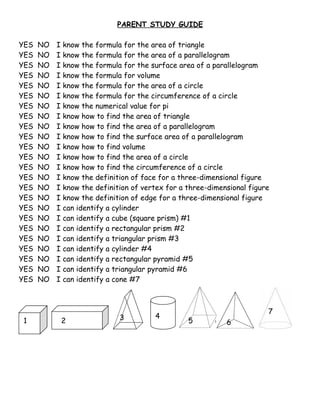
YES   NO   I   can identify a cylinder
YES   NO   I   can identify a cube (square prism) #1
YES   NO   I   can identify a rectangular prism #2
YES   NO   I   can identify a triangular prism #3
YES   NO   I   can identify a cylinder #4
YES   NO   I   can identify a rectangular pyramid #5
YES   NO   I   can identify a triangular pyramid #6
YES   NO   I   can identify a cone #7


                                                                          7
                               3         4
1              2                                   5          6
Cover this right side with a sheet of looeseleaf, try to solve each example, and
       then check your work.

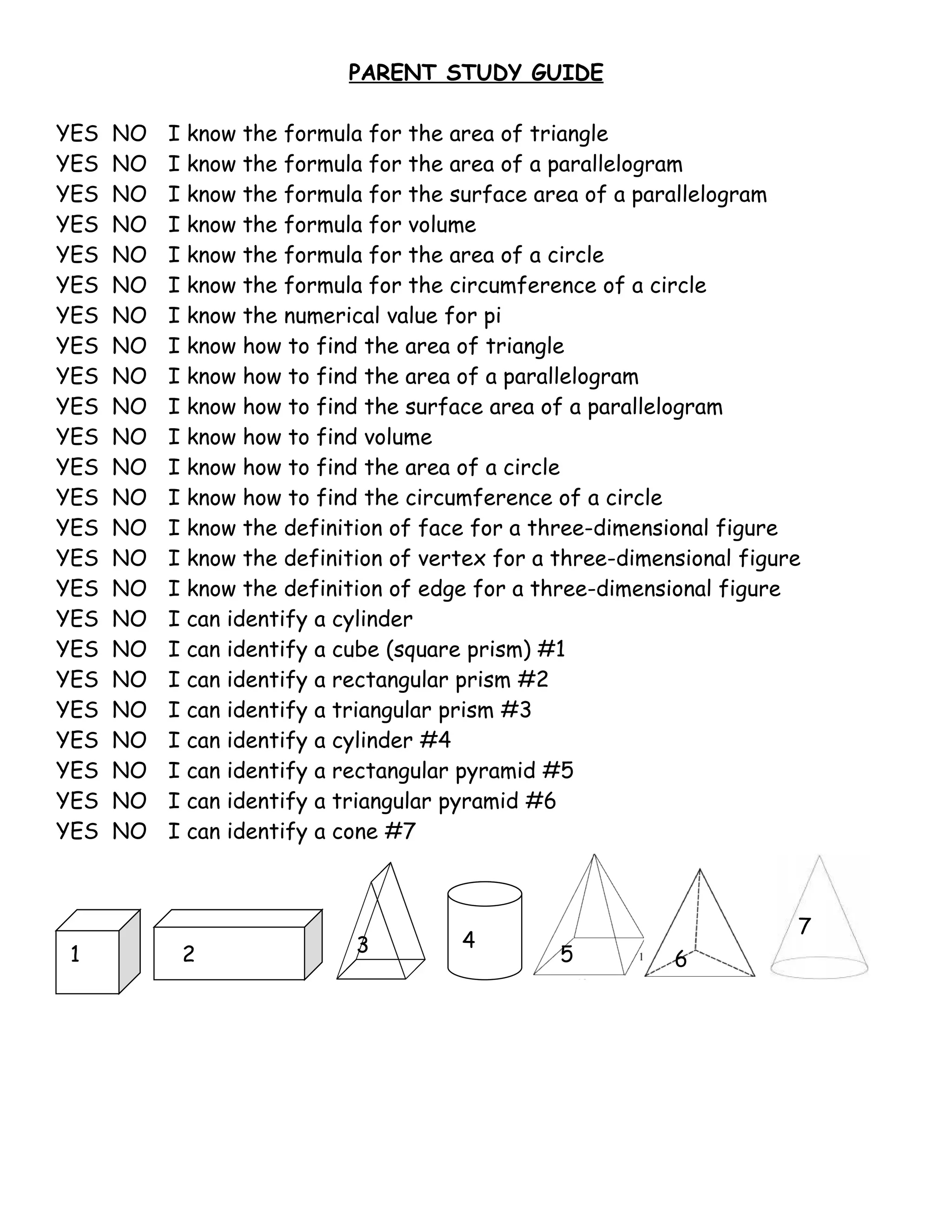
       Lesson 10- 2
       area of a triangle
                                        A   = ½bh (Area = ½ base x height)
                                        A   = ½•4•8
8 in
                                        A   = ½• 32
                       in
                            4           A   = 16 inches2 or A = 16 square inches
8 in

       Lesson 10- 2
       area of a parallelogram
              7 ft.

                                3 ft.
                                                    A = bh (Area = base x height)
                    7 ft.                           A = 7•3
            3 ft.                                   A = 21 square feet or A = 21 feet2


       Lesson 10- 3
       area of a composite figure


       Area =         lw                                    Area =        bh
       Area =         4x6                                   Area =        2x4
       Area =         24                                    Area =        8
                        Area = 108                        +     8
                                                Area = 116 ft2
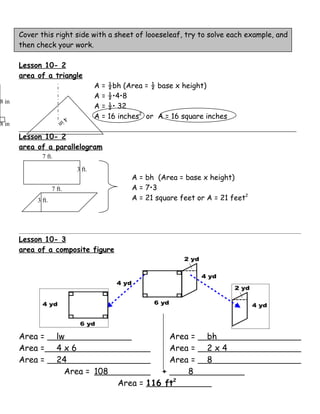
Lesson 10- 4
Comparing Area & Perimeter


  When the original figure’s length and width multiplies by __2________, the
  perimeter multiplies by ____2____ and the area multiplies by ___22(4)_____.

Lesson 10-5
Circles                                                     E
Name the circle A                                                     D
Name the two radii of the circle. AB, AC, AD
                                                            A
Name the chord of the circle. EC                    C                     B

What does the diameter measure? 4cm                         4cm

What does the radius measure? 2cm
circumference of a circle
     (know how to solve when the diameter & radius are given)
                          C=   πd (Circumference = pi x diameter)
                                      (Cherry Pie is delicious)
    18 cm                 C = 3.14 x 18
                          C = 56.62 cm


area of a circle
     (know how to solve when the diameter & radius are given)
                     A = πr2 (Area = pi x radius squared)
                                 (Apple pies are too2)
   4 ft.             A = 3.14 x 42
                     A = 3.14 x 16 (be sure you do 4 x 4 NOT 4 x 2)
                     A = 50.24 ft2 or A = 50.24 square feet
Lesson 10-6
Solid Figures

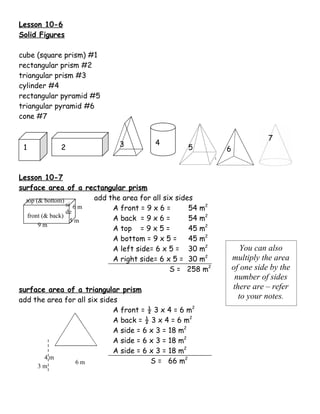
cube (square prism) #1
rectangular prism #2
triangular prism #3
cylinder #4
rectangular pyramid #5
triangular pyramid #6
cone #7

                                                                             7
                              3          4
 1           2                                      5         6


Lesson 10-7
surface area of a rectangular prism
  top (& bottom)         add the area for all six sides
                  si 6 m
                  de
                              A front = 9 x 6 =       54 m2
   front (& back)             A back = 9 x 6 =        54 m2
                    5m
       9m
                              A top = 9 x 5 =         45 m2
                              A bottom = 9 x 5 =      45 m2
                              A left side= 6 x 5 = 30 m2             You can also
                              A right side= 6 x 5 = 30 m2         multiply the area
                                                S = 258 m2        of one side by the
                                                                   number of sides
surface area of a triangular prism                                there are – refer
add the area for all six sides                                      to your notes.
                             A front = ½ 3 x 4 = 6 m2
                             A back = ½ 3 x 4 = 6 m2
                             A side = 6 x 3 = 18 m2
                             A side = 6 x 3 = 18 m2
                             A side = 6 x 3 = 18 m2
       4m
                6m                      S = 66 m2
     3m
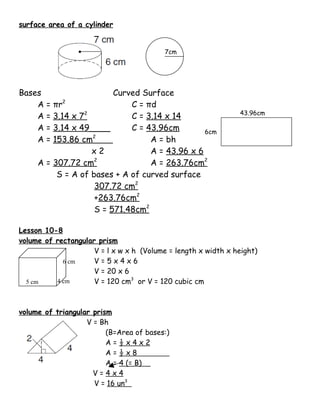
surface area of a cylinder


                                          7cm


Bases                    Curved Surface
    A=   πr2                 C = πd
                                                               43.96cm
    A=   3.14 x 72           C = 3.14 x 14
    A=   3.14 x 49____       C = 43.96cm        6cm
                   2
    A=   153.86 cm                A = bh
                   x2             A = 43.96 x 6
     A = 307.72 cm2               A = 263.76cm2
          S = A of bases + A of curved surface
                    307.72 cm2
                    +263.76cm2
                    S = 571.48cm2

Lesson 10-8
volume of rectangular prism
                     V = l x w x h (Volume = length x width x height)
            6 cm     V=5x4x6
                     V = 20 x 6
  5 cm    4 cm       V = 120 cm3 or V = 120 cubic cm


volume of triangular prism
                   V = Bh
                         (B=Area of bases:)
                         A=½x4x2
                         A=½x8
                         A = 4 (= B)
                     V=4x4
                     V = 16 un3
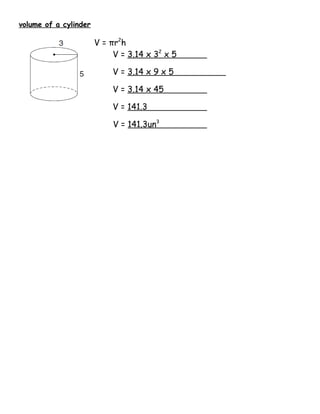
volume of a cylinder

                       V = πr2h
                            V = 3.14 x 32 x 5

                           V = 3.14 x 9 x 5

                           V = 3.14 x 45

                           V = 141.3

                            V = 141.3un3

Ch 10 study guide

  • 1.
    PARENT STUDY GUIDE YES NO I know the formula for the area of triangle YES NO I know the formula for the area of a parallelogram YES NO I know the formula for the surface area of a parallelogram YES NO I know the formula for volume YES NO I know the formula for the area of a circle YES NO I know the formula for the circumference of a circle YES NO I know the numerical value for pi YES NO I know how to find the area of triangle YES NO I know how to find the area of a parallelogram YES NO I know how to find the surface area of a parallelogram YES NO I know how to find volume YES NO I know how to find the area of a circle YES NO I know how to find the circumference of a circle YES NO I know the definition of face for a three-dimensional figure YES NO I know the definition of vertex for a three-dimensional figure YES NO I know the definition of edge for a three-dimensional figure YES NO I can identify a cylinder YES NO I can identify a cube (square prism) #1 YES NO I can identify a rectangular prism #2 YES NO I can identify a triangular prism #3 YES NO I can identify a cylinder #4 YES NO I can identify a rectangular pyramid #5 YES NO I can identify a triangular pyramid #6 YES NO I can identify a cone #7 7 3 4 1 2 5 6
  • 2.
    Cover this rightside with a sheet of looeseleaf, try to solve each example, and then check your work. Lesson 10- 2 area of a triangle A = ½bh (Area = ½ base x height) A = ½•4•8 8 in A = ½• 32 in 4 A = 16 inches2 or A = 16 square inches 8 in Lesson 10- 2 area of a parallelogram 7 ft. 3 ft. A = bh (Area = base x height) 7 ft. A = 7•3 3 ft. A = 21 square feet or A = 21 feet2 Lesson 10- 3 area of a composite figure Area = lw Area = bh Area = 4x6 Area = 2x4 Area = 24 Area = 8 Area = 108 + 8 Area = 116 ft2
  • 3.
    Lesson 10- 4 ComparingArea & Perimeter When the original figure’s length and width multiplies by __2________, the perimeter multiplies by ____2____ and the area multiplies by ___22(4)_____. Lesson 10-5 Circles E Name the circle A D Name the two radii of the circle. AB, AC, AD A Name the chord of the circle. EC C B What does the diameter measure? 4cm 4cm What does the radius measure? 2cm circumference of a circle (know how to solve when the diameter & radius are given) C= πd (Circumference = pi x diameter) (Cherry Pie is delicious) 18 cm C = 3.14 x 18 C = 56.62 cm area of a circle (know how to solve when the diameter & radius are given) A = πr2 (Area = pi x radius squared) (Apple pies are too2) 4 ft. A = 3.14 x 42 A = 3.14 x 16 (be sure you do 4 x 4 NOT 4 x 2) A = 50.24 ft2 or A = 50.24 square feet
  • 4.
    Lesson 10-6 Solid Figures cube(square prism) #1 rectangular prism #2 triangular prism #3 cylinder #4 rectangular pyramid #5 triangular pyramid #6 cone #7 7 3 4 1 2 5 6 Lesson 10-7 surface area of a rectangular prism top (& bottom) add the area for all six sides si 6 m de A front = 9 x 6 = 54 m2 front (& back) A back = 9 x 6 = 54 m2 5m 9m A top = 9 x 5 = 45 m2 A bottom = 9 x 5 = 45 m2 A left side= 6 x 5 = 30 m2 You can also A right side= 6 x 5 = 30 m2 multiply the area S = 258 m2 of one side by the number of sides surface area of a triangular prism there are – refer add the area for all six sides to your notes. A front = ½ 3 x 4 = 6 m2 A back = ½ 3 x 4 = 6 m2 A side = 6 x 3 = 18 m2 A side = 6 x 3 = 18 m2 A side = 6 x 3 = 18 m2 4m 6m S = 66 m2 3m
  • 5.
    surface area ofa cylinder 7cm Bases Curved Surface A= πr2 C = πd 43.96cm A= 3.14 x 72 C = 3.14 x 14 A= 3.14 x 49____ C = 43.96cm 6cm 2 A= 153.86 cm A = bh x2 A = 43.96 x 6 A = 307.72 cm2 A = 263.76cm2 S = A of bases + A of curved surface 307.72 cm2 +263.76cm2 S = 571.48cm2 Lesson 10-8 volume of rectangular prism V = l x w x h (Volume = length x width x height) 6 cm V=5x4x6 V = 20 x 6 5 cm 4 cm V = 120 cm3 or V = 120 cubic cm volume of triangular prism V = Bh (B=Area of bases:) A=½x4x2 A=½x8 A = 4 (= B) V=4x4 V = 16 un3
  • 6.
    volume of acylinder V = πr2h V = 3.14 x 32 x 5 V = 3.14 x 9 x 5 V = 3.14 x 45 V = 141.3 V = 141.3un3