UNIT -2: Geometric Modeling
®Educational Purpose Only
By
Dr.D.Sreeramulu,
Professor,
AITAM, Tekkali.
®Educational Purpose Only
Introduction
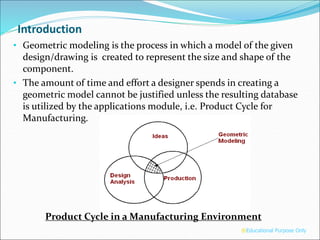
• Geometric modeling is the process in which a model of the given
design/drawing is created to represent the size and shape of the
component.
• The amount of time and effort a designer spends in creating a
geometric model cannot be justified unless the resulting database
is utilized by the applications module, i.e. Product Cycle for
Manufacturing.
Product Cycle in a Manufacturing Environment
Requirements
The functions that are expected of geometric modeling are:
• Design and Design Analysis
 Evaluation of areas and volumes.
Evaluation of mass and inertia properties.
Interference checking in assemblies.
Analysis of tolerance build-up in assemblies.
Analysis of kinematics – mechanics, robotics.
Automatic mesh generation for finite element analysis.
• Drafting
 Automatic planar cross sectioning
 Automatic hidden line and surface removal.
 Automatic production of shaded images.
 Automatic dimensioning.
 Automatic creation of exploded views for technical illustrations.
®Educational Purpose Only
• Manufacturing
 Parts classification.
 Process planning.
 Numerical control data generation and verification.
 Robot program generation.
• Production Engineering:
 Bill of materials.
 Material requirement.
 Manufacturing resource requirement.
 Scheduling.
• Inspection and Quality control
Program generation for inspection machines.
Comparison of produced part with design.
Requirements
®Educational Purpose Only
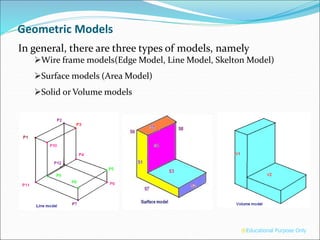
Geometric Models
In general, there are three types of models, namely
Wire frame models(Edge Model, Line Model, Skelton Model)
Surface models (Area Model)
Solid or Volume models
®Educational Purpose Only
WireFrame Models
• A wire frame model of an object is the simplest, but verbose,
geometric model that can be used to represent it mathematically
in the computer.
• Typically, a wire frame model consists entirely of points, lines,
arcs, and circles, conics, and curves.
• Advantages:-
 Wire frame models are simple and ease to create
 They require relatively little computer time and memory.
 It’s considered as the natural extension of traditional
methods drafting.
 These can forms the basis for the surface models.
•Disadvantage:- These are ambiguous representations of the real
objects
®Educational Purpose Only
Wireframe Models
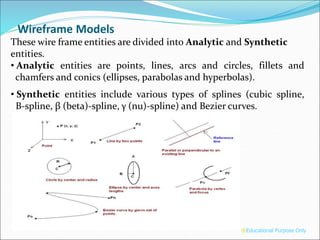
These wire frame entities are divided into Analytic and Synthetic
entities.
• Analytic entities are points, lines, arcs and circles, fillets and
chamfers and conics (ellipses, parabolas and hyperbolas).
• Synthetic entities include various types of splines (cubic spline,
B-spline, β (beta)-spline, γ (nu)-spline) and Bezier curves.
®Educational Purpose Only
Surface Models
• A Surface model of an object can be built by defining the surfaces
on the wire frame model. It represents only an envelope of part
geometry.(Hollow)
• Typically, a surface model consists of analytic and synthetic entities like
Plane surface, Ruled (lofted) surface, Surface of revolution, Tabulated
cylinder, Bezier surface, B-spline surface, Coons patch and Offset surface.
• Advantages:-
 These are less ambiguous than wire frame models
 Surface Models are richer in its associated geometric constraints,
which makes more suitable for engineering and design
applications.
•Disadvantages:-
 These don’t lend themselves to drafting background.
 More training and mathematical background is needed by
the user
 More CPU time and more storage space compared to wireframe.
 At times, there is a scope of confusion for identifying between
surface and solid models.
®Educational Purpose Only
Surface Models
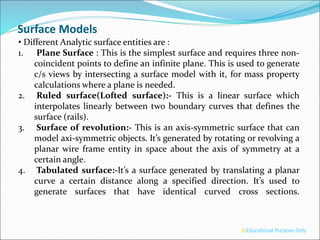
• Different Analytic surface entities are :
1. Plane Surface : This is the simplest surface and requires three non-
coincident points to define an infinite plane. This is used to generate
c/s views by intersecting a surface model with it, for mass property
calculations where a plane is needed.
2. Ruled surface(Lofted surface):- This is a linear surface which
interpolates linearly between two boundary curves that defines the
surface (rails).
3. Surface of revolution:- This is an axis-symmetric surface that can
model axi-symmetric objects. It’s generated by rotating or revolving a
planar wire frame entity in space about the axis of symmetry at a
certain angle.
4. Tabulated surface:-It’s a surface generated by translating a planar
curve a certain distance along a specified direction. It’s used to
generate surfaces that have identical curved cross sections.
®Educational Purpose Only
Surface Models
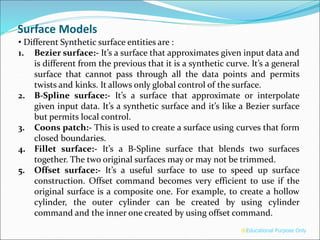
• Different Synthetic surface entities are :
1. Bezier surface:- It’s a surface that approximates given input data and
is different from the previous that it is a synthetic curve. It’s a general
surface that cannot pass through all the data points and permits
twists and kinks. It allows only global control of the surface.
2. B-Spline surface:- It’s a surface that approximate or interpolate
given input data. It’s a synthetic surface and it’s like a Bezier surface
but permits local control.
3. Coons patch:- This is used to create a surface using curves that form
closed boundaries.
4. Fillet surface:- It’s a B-Spline surface that blends two surfaces
together. The two original surfaces may or may not be trimmed.
5. Offset surface:- It’s a useful surface to use to speed up surface
construction. Offset command becomes very efficient to use if the
original surface is a composite one. For example, to create a hollow
cylinder, the outer cylinder can be created by using cylinder
command and the inner one created by using offset command.
®Educational Purpose Only
Surface Models
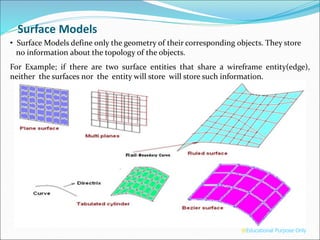
• Surface Models define only the geometry of their corresponding objects. They store
no information about the topology of the objects.
For Example; if there are two surface entities that share a wireframe entity(edge),
neither the surfaces nor the entity will store will store such information.
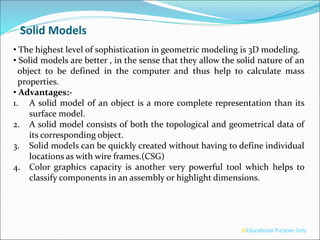
• The highest level of sophistication in geometric modeling is 3D modeling.
• Solid models are better , in the sense that they allow the solid nature of an
object to be defined in the computer and thus help to calculate mass
properties.
• Advantages:-
1. A solid model of an object is a more complete representation than its
surface model.
2. A solid model consists of both the topological and geometrical data of
its corresponding object.
3. Solid models can be quickly created without having to define individual
locations as with wire frames.(CSG)
4. Color graphics capacity is another very powerful tool which helps to
classify components in an assembly or highlight dimensions.
Solid Models
®Educational Purpose Only
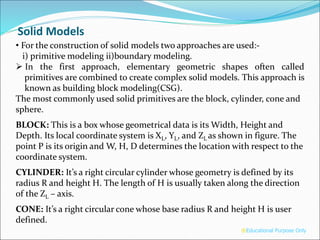
• For the construction of solid models two approaches are used:-
i) primitive modeling ii)boundary modeling.
 In the first approach, elementary geometric shapes often called
primitives are combined to create complex solid models. This approach is
known as building block modeling(CSG).
The most commonly used solid primitives are the block, cylinder, cone and
sphere.
BLOCK: This is a box whose geometrical data is its Width, Height and
Depth. Its local coordinate system is XL, YL, and ZL as shown in figure. The
point P is its origin and W, H, D determines the location with respect to the
coordinate system.
CYLINDER: It’s a right circular cylinder whose geometry is defined by its
radius R and height H. The length of H is usually taken along the direction
of the ZL – axis.
CONE: It’s a right circular cone whose base radius R and height H is user
defined.
®Educational Purpose Only
Solid Models
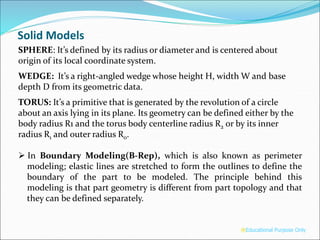
SPHERE: It’s defined by its radius or diameter and is centered about
origin of its local coordinate system.
WEDGE: It’s a right-angled wedge whose height H, width W and base
depth D from its geometric data.
TORUS: It’s a primitive that is generated by the revolution of a circle
about an axis lying in its plane. Its geometry can be defined either by the
body radius R1 and the torus body centerline radius R2 or by its inner
radius R1 and outer radius R0.
 In Boundary Modeling(B-Rep), which is also known as perimeter
modeling; elastic lines are stretched to form the outlines to define the
boundary of the part to be modeled. The principle behind this
modeling is that part geometry is different from part topology and that
they can be defined separately.
®Educational Purpose Only
Solid Models
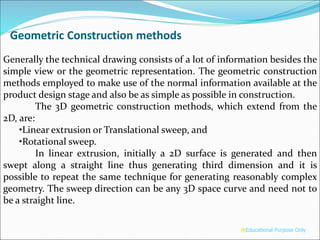
Generally the technical drawing consists of a lot of information besides the
simple view or the geometric representation. The geometric construction
methods employed to make use of the normal information available at the
product design stage and also be as simple as possible in construction.
The 3D geometric construction methods, which extend from the
2D, are:
•Linear extrusion or Translational sweep, and
•Rotational sweep.
In linear extrusion, initially a 2D surface is generated and then
swept along a straight line thus generating third dimension and it is
possible to repeat the same technique for generating reasonably complex
geometry. The sweep direction can be any 3D space curve and need not to
be a straight line.
Geometric Construction methods
®Educational Purpose Only
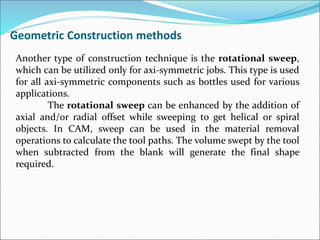
Another type of construction technique is the rotational sweep,
which can be utilized only for axi-symmetric jobs. This type is used
for all axi-symmetric components such as bottles used for various
applications.
The rotational sweep can be enhanced by the addition of
axial and/or radial offset while sweeping to get helical or spiral
objects. In CAM, sweep can be used in the material removal
operations to calculate the tool paths. The volume swept by the tool
when subtracted from the blank will generate the final shape
required.
Geometric Construction methods
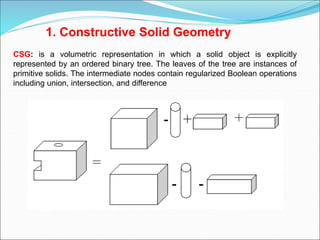
CSG: is a volumetric representation in which a solid object is explicitly
represented by an ordered binary tree. The leaves of the tree are instances of
primitive solids. The intermediate nodes contain regularized Boolean operations
including union, intersection, and difference
1. Constructive Solid Geometry
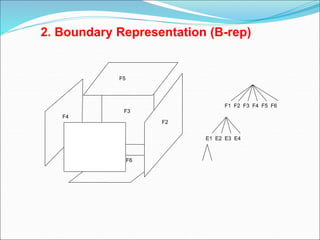
2. Boundary Representation (B-rep)
F2
F3
F4
F5
F6
F1 F2 F3 F4 F5 F6
E1 E2 E3 E4
Thank you
®Educational Purpose Only

Geometric modeling

  • 1.
    UNIT -2: GeometricModeling ®Educational Purpose Only By Dr.D.Sreeramulu, Professor, AITAM, Tekkali.
  • 2.
    ®Educational Purpose Only Introduction •Geometric modeling is the process in which a model of the given design/drawing is created to represent the size and shape of the component. • The amount of time and effort a designer spends in creating a geometric model cannot be justified unless the resulting database is utilized by the applications module, i.e. Product Cycle for Manufacturing. Product Cycle in a Manufacturing Environment
  • 3.
    Requirements The functions thatare expected of geometric modeling are: • Design and Design Analysis  Evaluation of areas and volumes. Evaluation of mass and inertia properties. Interference checking in assemblies. Analysis of tolerance build-up in assemblies. Analysis of kinematics – mechanics, robotics. Automatic mesh generation for finite element analysis. • Drafting  Automatic planar cross sectioning  Automatic hidden line and surface removal.  Automatic production of shaded images.  Automatic dimensioning.  Automatic creation of exploded views for technical illustrations. ®Educational Purpose Only
  • 4.
    • Manufacturing  Partsclassification.  Process planning.  Numerical control data generation and verification.  Robot program generation. • Production Engineering:  Bill of materials.  Material requirement.  Manufacturing resource requirement.  Scheduling. • Inspection and Quality control Program generation for inspection machines. Comparison of produced part with design. Requirements ®Educational Purpose Only
  • 5.
    Geometric Models In general,there are three types of models, namely Wire frame models(Edge Model, Line Model, Skelton Model) Surface models (Area Model) Solid or Volume models ®Educational Purpose Only
  • 6.
    WireFrame Models • Awire frame model of an object is the simplest, but verbose, geometric model that can be used to represent it mathematically in the computer. • Typically, a wire frame model consists entirely of points, lines, arcs, and circles, conics, and curves. • Advantages:-  Wire frame models are simple and ease to create  They require relatively little computer time and memory.  It’s considered as the natural extension of traditional methods drafting.  These can forms the basis for the surface models. •Disadvantage:- These are ambiguous representations of the real objects ®Educational Purpose Only
  • 7.
    Wireframe Models These wireframe entities are divided into Analytic and Synthetic entities. • Analytic entities are points, lines, arcs and circles, fillets and chamfers and conics (ellipses, parabolas and hyperbolas). • Synthetic entities include various types of splines (cubic spline, B-spline, β (beta)-spline, γ (nu)-spline) and Bezier curves. ®Educational Purpose Only
  • 8.
    Surface Models • ASurface model of an object can be built by defining the surfaces on the wire frame model. It represents only an envelope of part geometry.(Hollow) • Typically, a surface model consists of analytic and synthetic entities like Plane surface, Ruled (lofted) surface, Surface of revolution, Tabulated cylinder, Bezier surface, B-spline surface, Coons patch and Offset surface. • Advantages:-  These are less ambiguous than wire frame models  Surface Models are richer in its associated geometric constraints, which makes more suitable for engineering and design applications. •Disadvantages:-  These don’t lend themselves to drafting background.  More training and mathematical background is needed by the user  More CPU time and more storage space compared to wireframe.  At times, there is a scope of confusion for identifying between surface and solid models. ®Educational Purpose Only
  • 9.
    Surface Models • DifferentAnalytic surface entities are : 1. Plane Surface : This is the simplest surface and requires three non- coincident points to define an infinite plane. This is used to generate c/s views by intersecting a surface model with it, for mass property calculations where a plane is needed. 2. Ruled surface(Lofted surface):- This is a linear surface which interpolates linearly between two boundary curves that defines the surface (rails). 3. Surface of revolution:- This is an axis-symmetric surface that can model axi-symmetric objects. It’s generated by rotating or revolving a planar wire frame entity in space about the axis of symmetry at a certain angle. 4. Tabulated surface:-It’s a surface generated by translating a planar curve a certain distance along a specified direction. It’s used to generate surfaces that have identical curved cross sections. ®Educational Purpose Only
  • 10.
    Surface Models • DifferentSynthetic surface entities are : 1. Bezier surface:- It’s a surface that approximates given input data and is different from the previous that it is a synthetic curve. It’s a general surface that cannot pass through all the data points and permits twists and kinks. It allows only global control of the surface. 2. B-Spline surface:- It’s a surface that approximate or interpolate given input data. It’s a synthetic surface and it’s like a Bezier surface but permits local control. 3. Coons patch:- This is used to create a surface using curves that form closed boundaries. 4. Fillet surface:- It’s a B-Spline surface that blends two surfaces together. The two original surfaces may or may not be trimmed. 5. Offset surface:- It’s a useful surface to use to speed up surface construction. Offset command becomes very efficient to use if the original surface is a composite one. For example, to create a hollow cylinder, the outer cylinder can be created by using cylinder command and the inner one created by using offset command. ®Educational Purpose Only
  • 11.
    ®Educational Purpose Only SurfaceModels • Surface Models define only the geometry of their corresponding objects. They store no information about the topology of the objects. For Example; if there are two surface entities that share a wireframe entity(edge), neither the surfaces nor the entity will store will store such information.
  • 12.
    • The highestlevel of sophistication in geometric modeling is 3D modeling. • Solid models are better , in the sense that they allow the solid nature of an object to be defined in the computer and thus help to calculate mass properties. • Advantages:- 1. A solid model of an object is a more complete representation than its surface model. 2. A solid model consists of both the topological and geometrical data of its corresponding object. 3. Solid models can be quickly created without having to define individual locations as with wire frames.(CSG) 4. Color graphics capacity is another very powerful tool which helps to classify components in an assembly or highlight dimensions. Solid Models ®Educational Purpose Only
  • 13.
    • For theconstruction of solid models two approaches are used:- i) primitive modeling ii)boundary modeling.  In the first approach, elementary geometric shapes often called primitives are combined to create complex solid models. This approach is known as building block modeling(CSG). The most commonly used solid primitives are the block, cylinder, cone and sphere. BLOCK: This is a box whose geometrical data is its Width, Height and Depth. Its local coordinate system is XL, YL, and ZL as shown in figure. The point P is its origin and W, H, D determines the location with respect to the coordinate system. CYLINDER: It’s a right circular cylinder whose geometry is defined by its radius R and height H. The length of H is usually taken along the direction of the ZL – axis. CONE: It’s a right circular cone whose base radius R and height H is user defined. ®Educational Purpose Only Solid Models
  • 14.
    SPHERE: It’s definedby its radius or diameter and is centered about origin of its local coordinate system. WEDGE: It’s a right-angled wedge whose height H, width W and base depth D from its geometric data. TORUS: It’s a primitive that is generated by the revolution of a circle about an axis lying in its plane. Its geometry can be defined either by the body radius R1 and the torus body centerline radius R2 or by its inner radius R1 and outer radius R0.  In Boundary Modeling(B-Rep), which is also known as perimeter modeling; elastic lines are stretched to form the outlines to define the boundary of the part to be modeled. The principle behind this modeling is that part geometry is different from part topology and that they can be defined separately. ®Educational Purpose Only Solid Models
  • 15.
    Generally the technicaldrawing consists of a lot of information besides the simple view or the geometric representation. The geometric construction methods employed to make use of the normal information available at the product design stage and also be as simple as possible in construction. The 3D geometric construction methods, which extend from the 2D, are: •Linear extrusion or Translational sweep, and •Rotational sweep. In linear extrusion, initially a 2D surface is generated and then swept along a straight line thus generating third dimension and it is possible to repeat the same technique for generating reasonably complex geometry. The sweep direction can be any 3D space curve and need not to be a straight line. Geometric Construction methods ®Educational Purpose Only
  • 16.
    Another type ofconstruction technique is the rotational sweep, which can be utilized only for axi-symmetric jobs. This type is used for all axi-symmetric components such as bottles used for various applications. The rotational sweep can be enhanced by the addition of axial and/or radial offset while sweeping to get helical or spiral objects. In CAM, sweep can be used in the material removal operations to calculate the tool paths. The volume swept by the tool when subtracted from the blank will generate the final shape required. Geometric Construction methods
  • 17.
    CSG: is avolumetric representation in which a solid object is explicitly represented by an ordered binary tree. The leaves of the tree are instances of primitive solids. The intermediate nodes contain regularized Boolean operations including union, intersection, and difference 1. Constructive Solid Geometry
  • 18.
    2. Boundary Representation(B-rep) F2 F3 F4 F5 F6 F1 F2 F3 F4 F5 F6 E1 E2 E3 E4
  • 19.