IPE-409 CAD/CAM
Dr. Nafis Ahmad
Professor
Department of IPE, BUET
Email:nafis@ipe.buet.ac.bd
Ch#2.
Defining the model
2
Defining the Model
• Introduction
• Types of Models
• Established design representation
• Representation of form using drawing(Descriptive geometry, Mongian
projection, today etc.); Representation of structure; Strengths and
weakness of conventional rep.
• Computer representation
• Computer-aided draughting(Geometric entities, method for point, line and
arc construction); Computer aide schematic drawing
• Three dimensional modelling schemes
• Wire-frame geometry; surface representation-tabulated , ruled,
swept, sculptured or curved mesh surfaces, surface of revolution
• solid modelling-CSG, boundary representation
Introduction
• Models of form and models of structure
• Form-Drawing of components and their arrangement in
assemblies. Mechanical drawing of a part
• Diagram to show components of a system and how
they are connected. Electronic circuit, chemical process
etc.
Establishing design representation
Representation of form
• Representing 3D forms in 2D space by means of engg.
Drawing on paper or display; Parallel projection
• Gaspard Monge-1746-1818, introduced projecting views in
mutually perpendicular planes- vertical plane to know the
elevation and a horizontal plan
• Now 3D forms a represented in 2D by mapping points on
the object in multiple mutually perpendicular planes
• Different line style meaning; Section view
• Third angle projection vs. First angle projection
• Pictorial projection; Perspective projection
• Dimension; Thread gear representation
Cont..
Cont..
Strength and weakness of
traditional representations
?
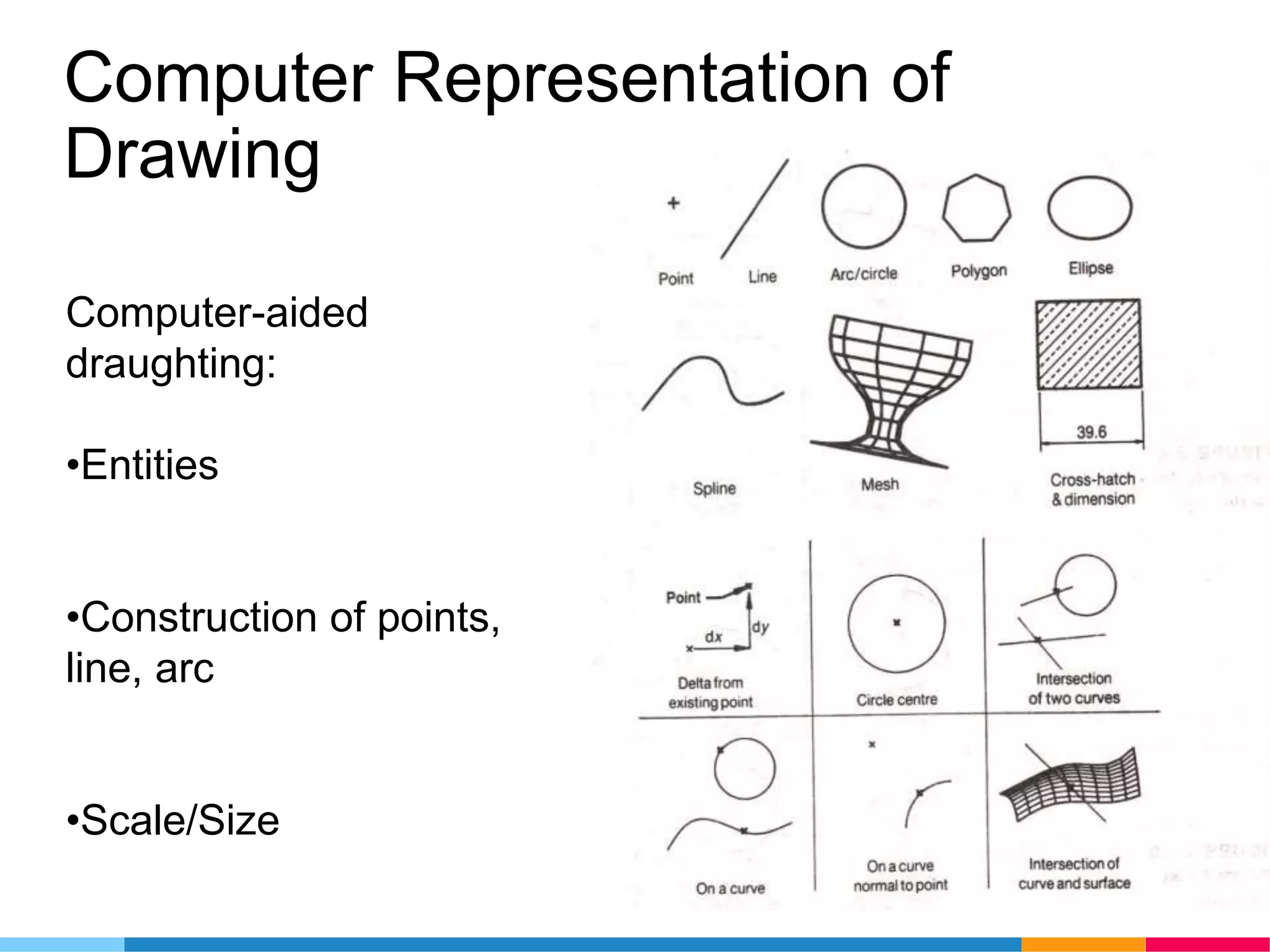
Computer Representation of
Drawing
Computer-aided
draughting:
•Entities
•Construction of points,
line, arc
•Scale/Size
Cont..
•Constructio
n of line, arc
2.4 3D Modelling Schemes
•Coordinate systems: Cartesian coordinate system, ??
•Global coordinate system (GCS), Work coordinate
system (WCS)
•Defining local coordinate system
•Wire-frame modelling
Wire-frame geometry
•Relatively straight forward,
less computer resource
hungry
•But –ve sides are:
Ambiguity in representation,
deficiency in pictorial
representation, limited
ability to calculate geometric
intersections or mechanical
properties, has limited value
as a basis for manufacture
or analysis
Cont..
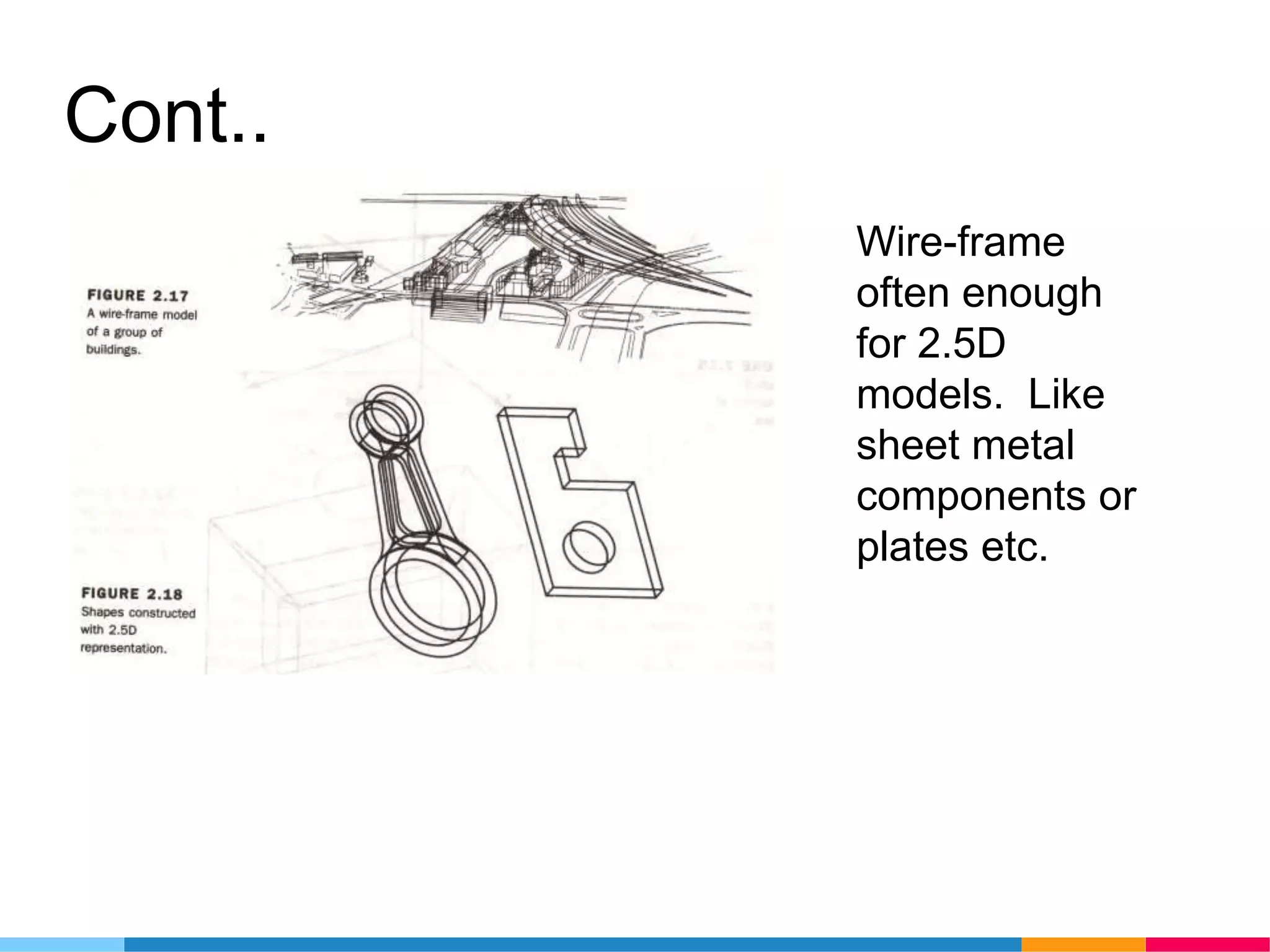
Wire-frame
often enough
for 2.5D
models. Like
sheet metal
components or
plates etc.
Surface representation
scheme...
• Many ambiguity is are overcome by Surface modelling
which involves representating the model by specifying
some or all of the surfaces of the component.
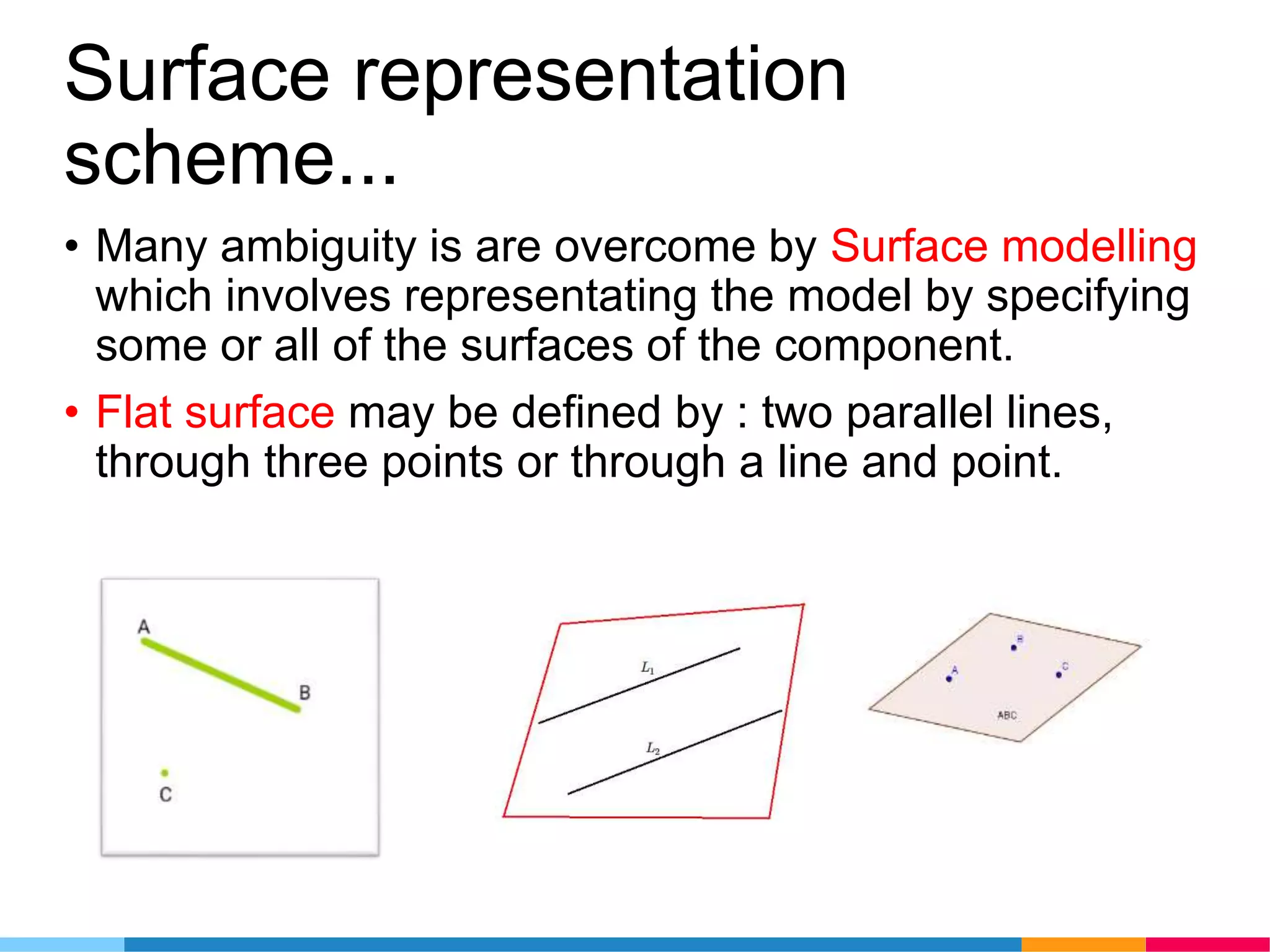
• Flat surface may be defined by : two parallel lines,
through three points or through a line and point.
Surface representation
scheme...
• Many ambiguity is are overcome by Surface modelling which
involves representating the model by specifying some or all of
the surfaces of the component.
• Flat surface may be defined by : two parallel lines, through three
points or through a line and point.
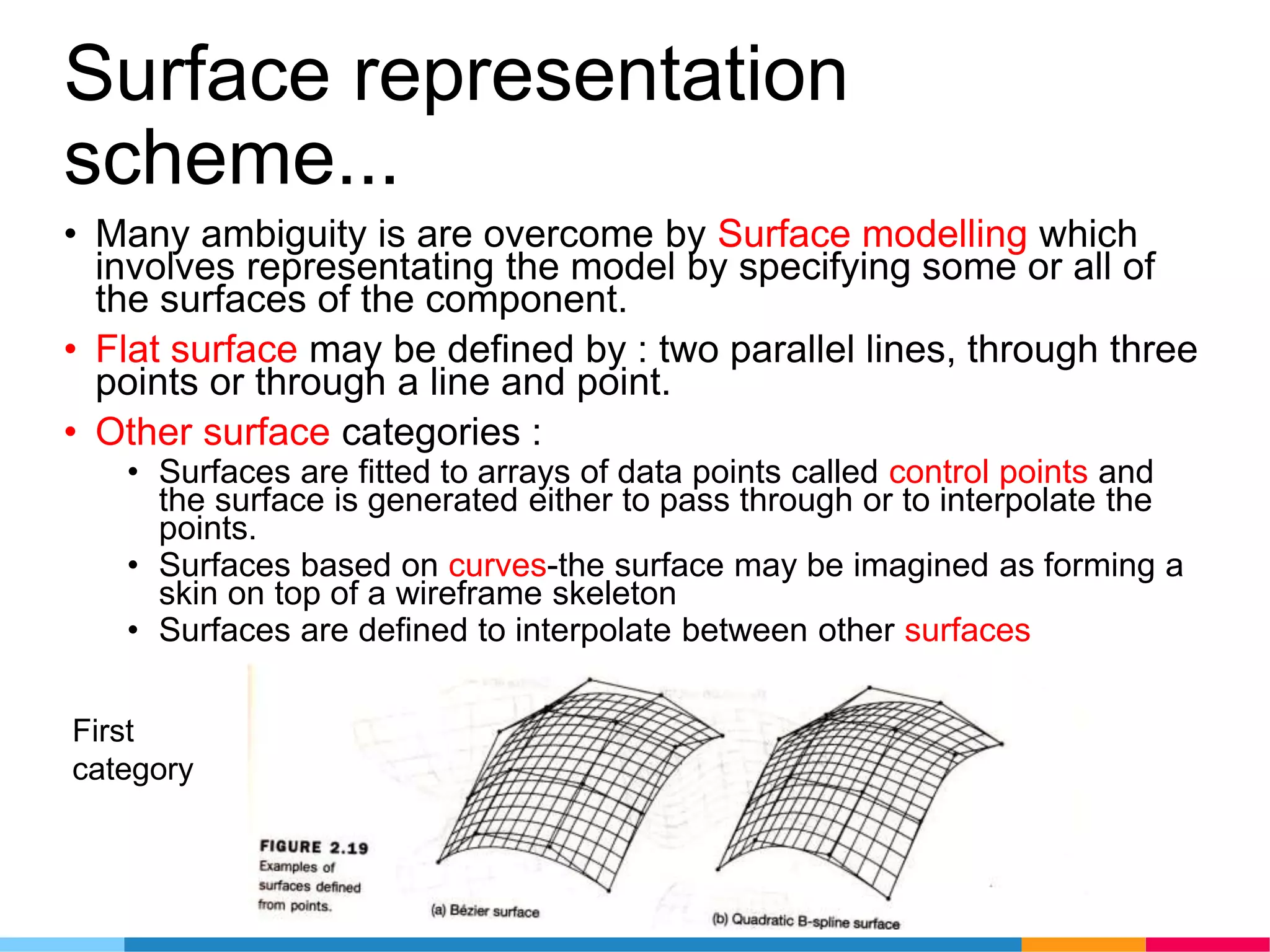
• Other surface categories :
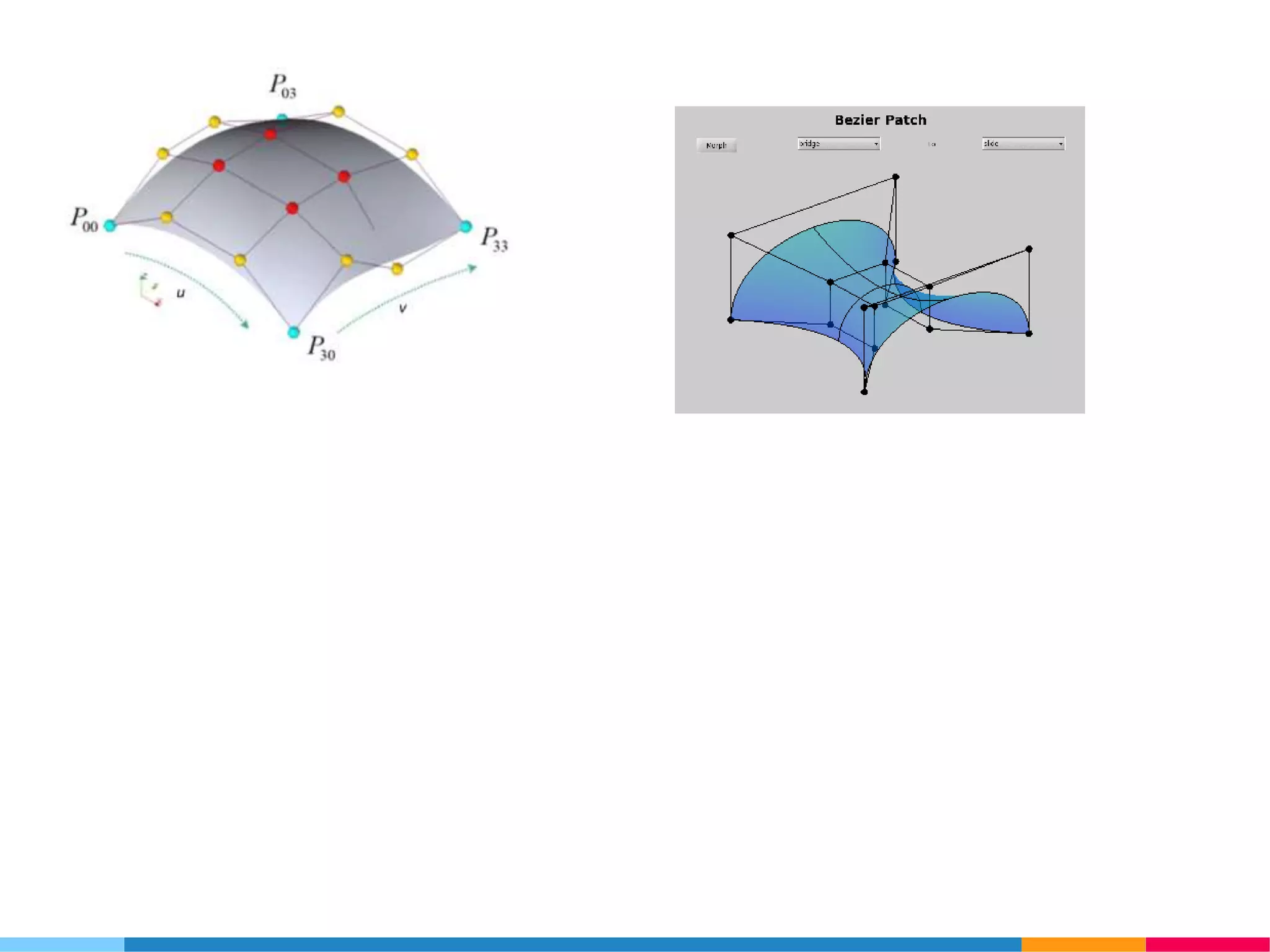
• Surfaces are fitted to arrays of data points called control points and
the surface is generated either to pass through or to interpolate the
points.
• Surfaces based on curves-the surface may be imagined as forming a
skin on top of a wireframe skeleton
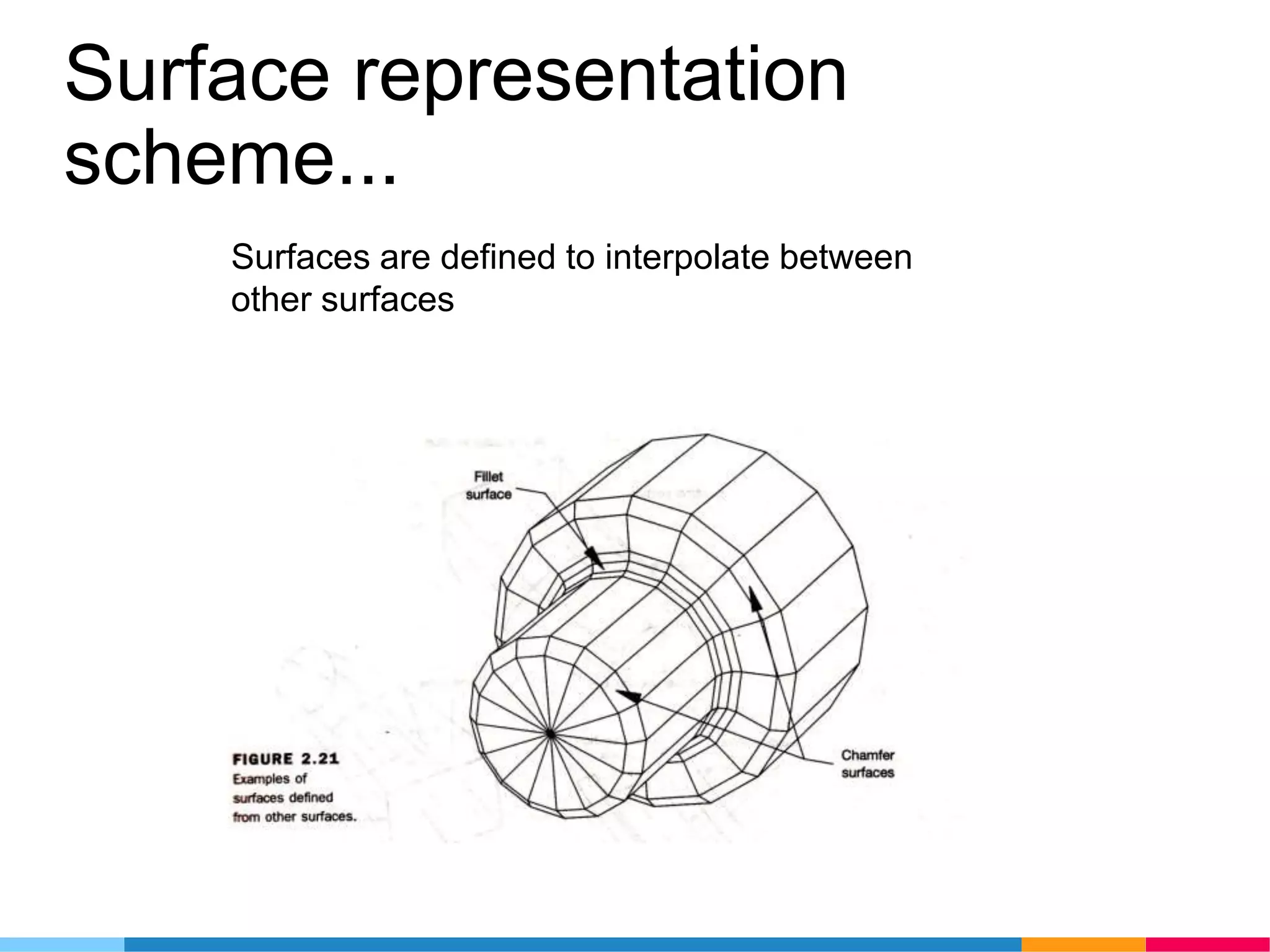
• Surfaces are defined to interpolate between other surfaces
First
category
Surface representation
scheme...
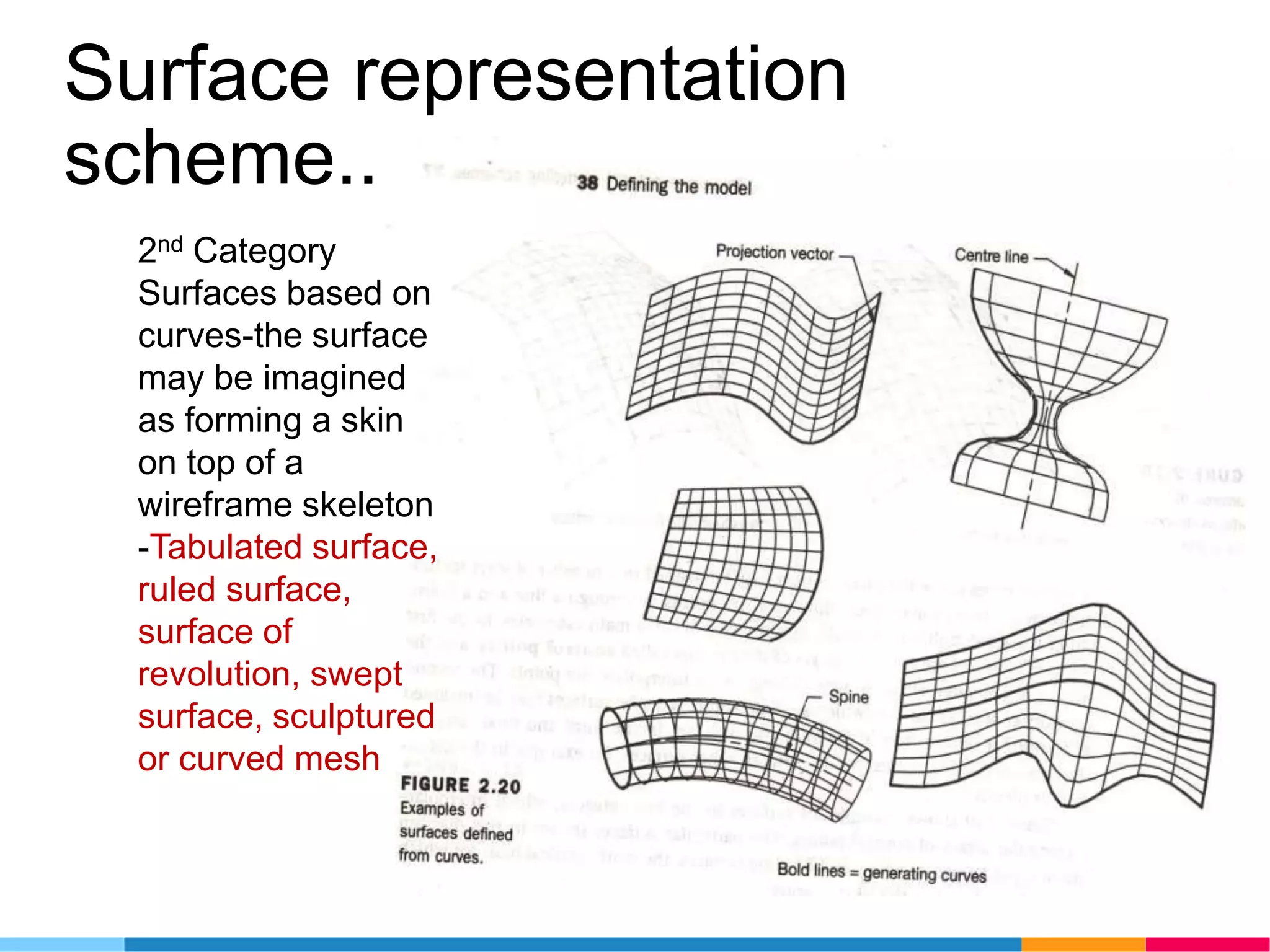
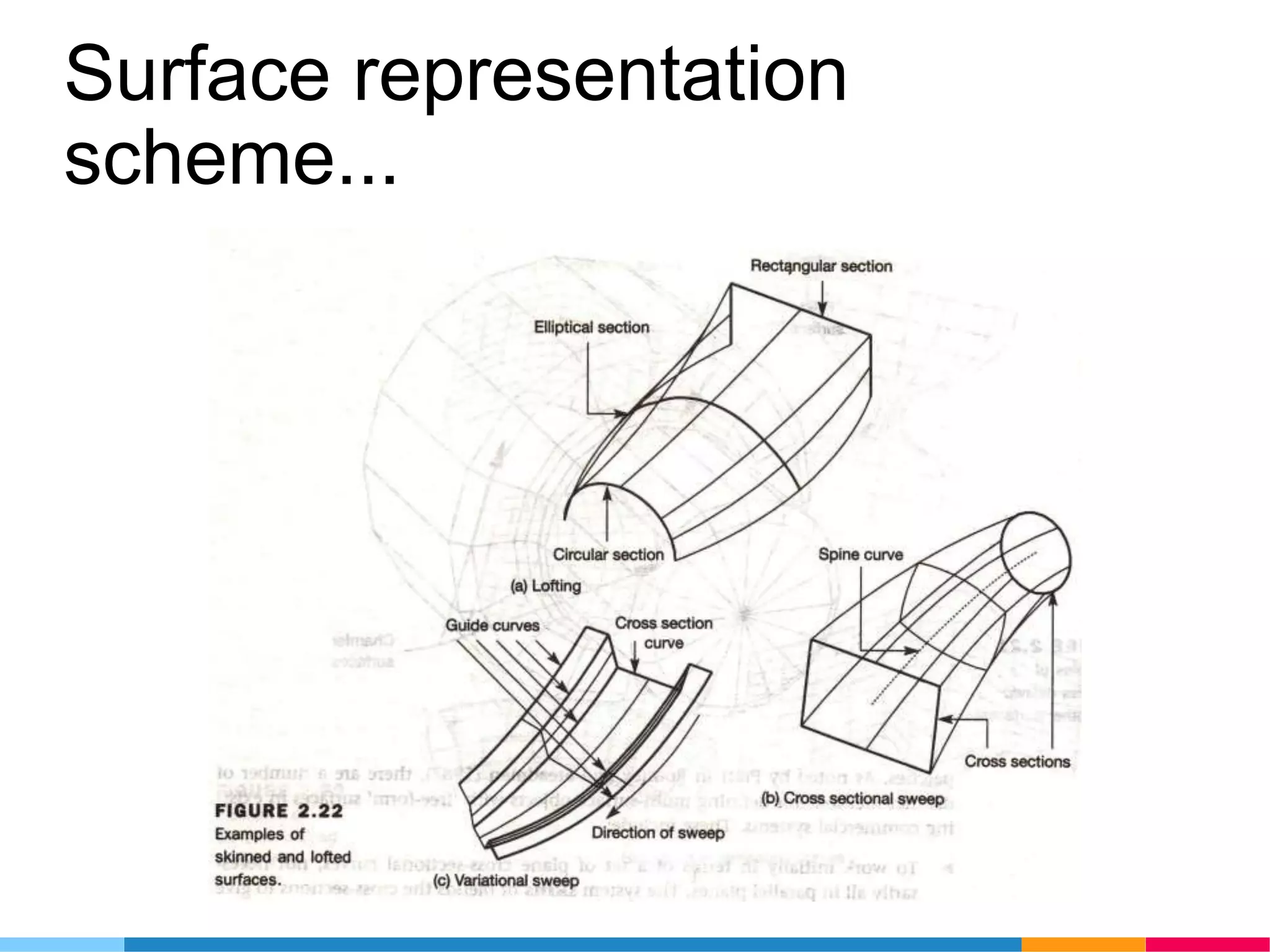
2nd Category
Surfaces based on
curves-the surface
may be imagined
as forming a skin
on top of a
wireframe skeleton
-Tabulated surface,
ruled surface,
surface of
revolution, swept
surface, sculptured
or curved mesh
Surface representation
scheme...
Surfaces are defined to interpolate between
other surfaces
Surface representation
scheme...
• Surfaces are continuous, with every point on the
surface defined by mathematical relationship used
in its definition
• In general real artefacts are represented using
surface geometry by an assemble of surface
patch. A car body may require hundred of patched.
• Methods of multisurface objects in commercial
systems..
Surface representation
scheme...
Surface representation
scheme...
Cont..
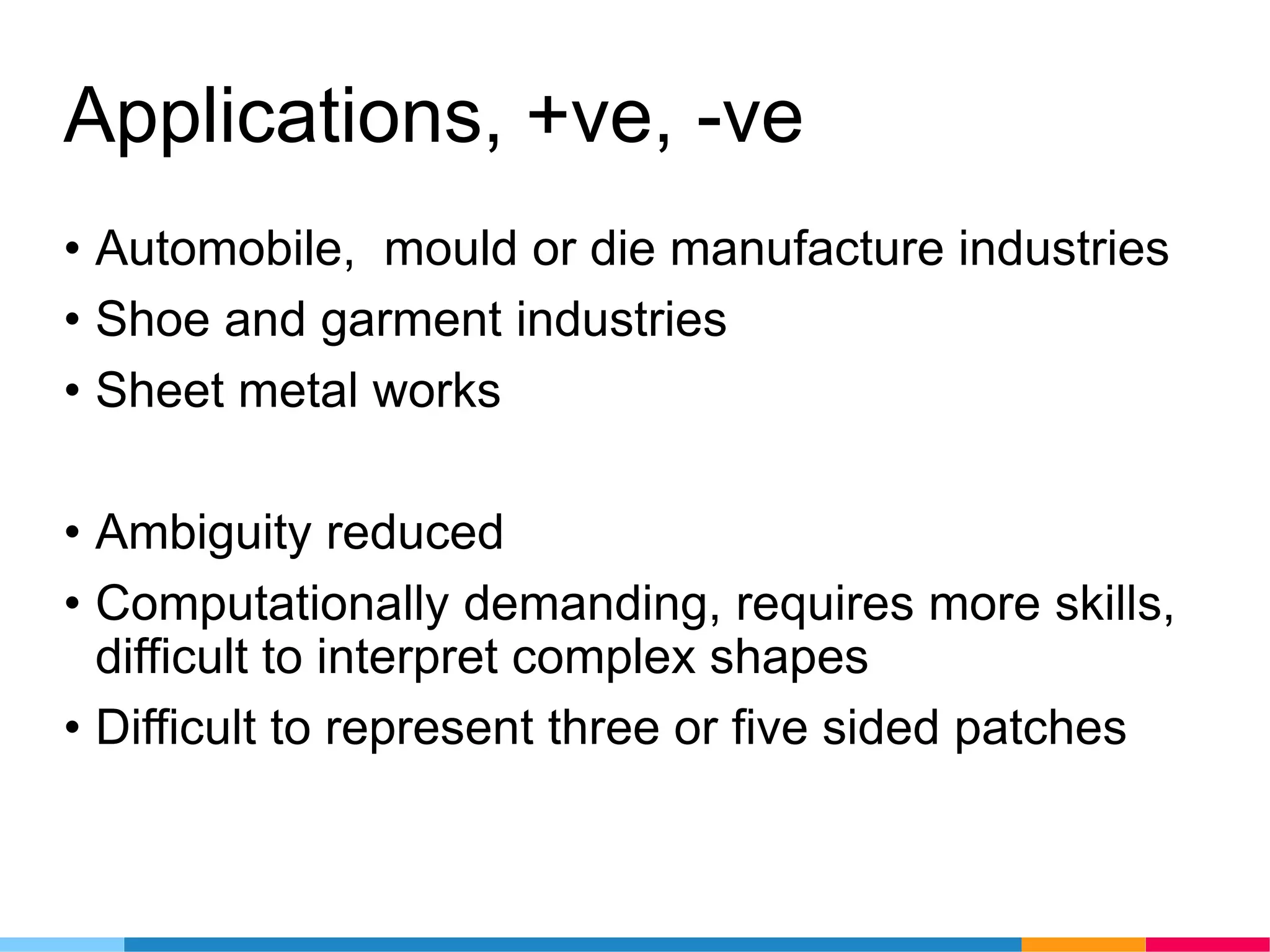
Applications, +ve, -ve
• Automobile, mould or die manufacture industries
• Shoe and garment industries
• Sheet metal works
• Ambiguity reduced
• Computationally demanding, requires more skills,
difficult to interpret complex shapes
• Difficult to represent three or five sided patches
Turbine Blades
Solid Modelling
• Engineering analysis and generation of
manufacturing information requires solid models.
• More complete the representation by Solid
models. Smaller the risk of transcription errors
• Conditions for successful representation
• Complete and unambiguous
• Appropriate for engineering objects
• Practical to use with computers
• Two major classes for solid modelling methods
• Constructive Solid Geometry (CSG)
• Boundary Representation (B-Rep)
CSG
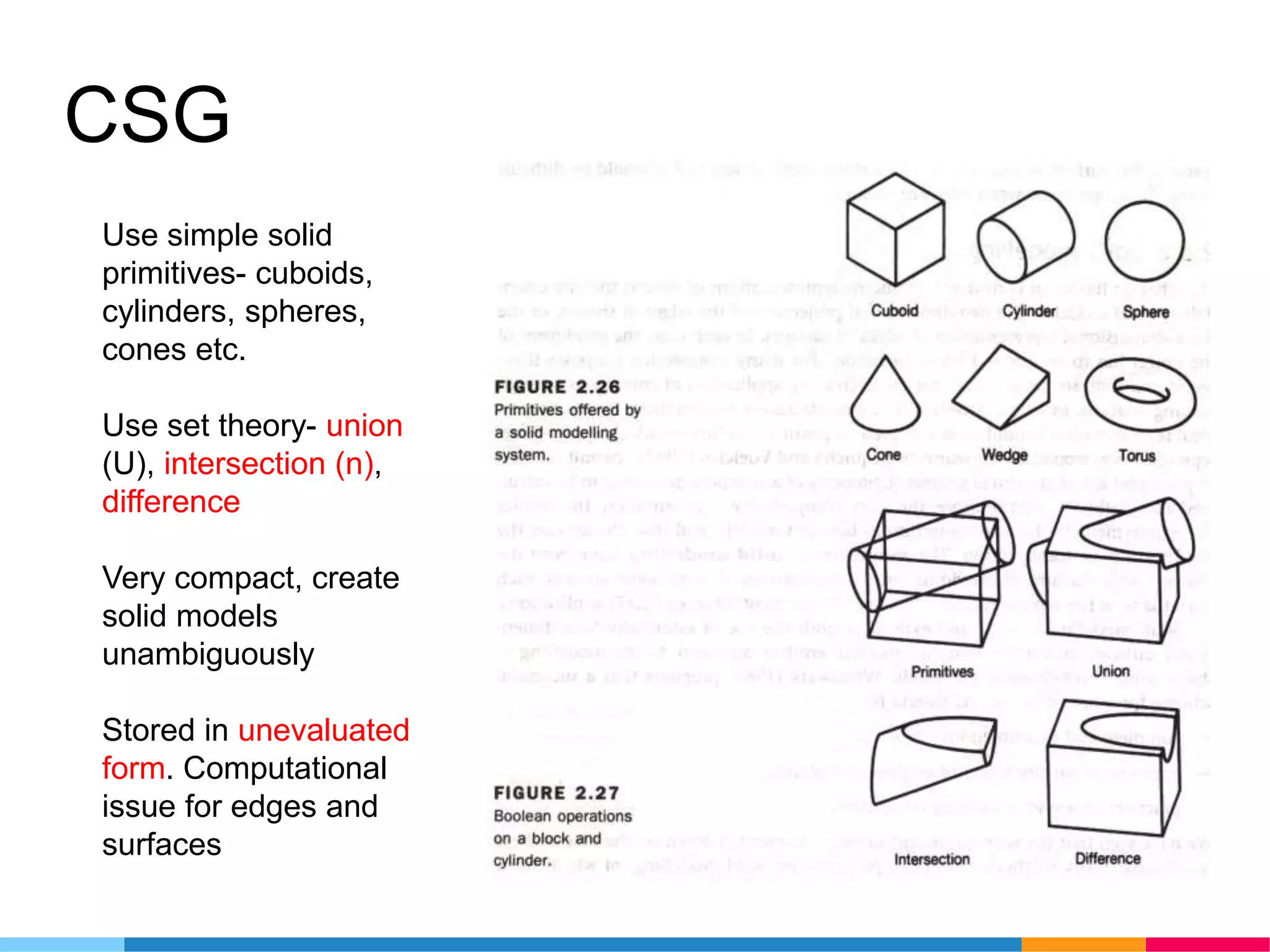
Use simple solid
primitives- cuboids,
cylinders, spheres,
cones etc.
Use set theory- union
(U), intersection (n),
difference
Very compact, create
solid models
unambiguously
Stored in unevaluated
form. Computational
issue for edges and
surfaces
CSG Cont..
How
many
boolean
operation
required
?
B-Rep
Topological/ Geometric
consistency?
•Faces of the model do not
intersect other except at
common vertices and edges
•Boundaries are simple loops
of edges
•Set of faces of the model
close to form the complete
skin of the model with no
missing parts
CSG Example
Advantages and Disadvantages
of each system
• CSG- Robust and have performance advantages
where membership test is required
• B-rep is better for display generation.
Why B-rep is more popular than
CSG?
• First: Geometric limitations of CSG
• Second: Conversion CSG- B-Rep easy but
CSG<- B-Rep
• Third: Tendency for combining solid modeling with
surface modeling and wire frame modeling
Practical systems??

Defining the model

  • 1.
    IPE-409 CAD/CAM Dr. NafisAhmad Professor Department of IPE, BUET Email:nafis@ipe.buet.ac.bd
  • 2.
  • 3.
    Defining the Model •Introduction • Types of Models • Established design representation • Representation of form using drawing(Descriptive geometry, Mongian projection, today etc.); Representation of structure; Strengths and weakness of conventional rep. • Computer representation • Computer-aided draughting(Geometric entities, method for point, line and arc construction); Computer aide schematic drawing • Three dimensional modelling schemes • Wire-frame geometry; surface representation-tabulated , ruled, swept, sculptured or curved mesh surfaces, surface of revolution • solid modelling-CSG, boundary representation
  • 4.
    Introduction • Models ofform and models of structure • Form-Drawing of components and their arrangement in assemblies. Mechanical drawing of a part • Diagram to show components of a system and how they are connected. Electronic circuit, chemical process etc.
  • 5.
    Establishing design representation Representationof form • Representing 3D forms in 2D space by means of engg. Drawing on paper or display; Parallel projection • Gaspard Monge-1746-1818, introduced projecting views in mutually perpendicular planes- vertical plane to know the elevation and a horizontal plan • Now 3D forms a represented in 2D by mapping points on the object in multiple mutually perpendicular planes • Different line style meaning; Section view • Third angle projection vs. First angle projection • Pictorial projection; Perspective projection • Dimension; Thread gear representation
  • 6.
  • 7.
  • 8.
    Strength and weaknessof traditional representations ?
  • 9.
  • 10.
  • 11.
    2.4 3D ModellingSchemes •Coordinate systems: Cartesian coordinate system, ?? •Global coordinate system (GCS), Work coordinate system (WCS) •Defining local coordinate system •Wire-frame modelling
  • 12.
    Wire-frame geometry •Relatively straightforward, less computer resource hungry •But –ve sides are: Ambiguity in representation, deficiency in pictorial representation, limited ability to calculate geometric intersections or mechanical properties, has limited value as a basis for manufacture or analysis
  • 13.
    Cont.. Wire-frame often enough for 2.5D models.Like sheet metal components or plates etc.
  • 14.
    Surface representation scheme... • Manyambiguity is are overcome by Surface modelling which involves representating the model by specifying some or all of the surfaces of the component. • Flat surface may be defined by : two parallel lines, through three points or through a line and point.
  • 15.
    Surface representation scheme... • Manyambiguity is are overcome by Surface modelling which involves representating the model by specifying some or all of the surfaces of the component. • Flat surface may be defined by : two parallel lines, through three points or through a line and point. • Other surface categories : • Surfaces are fitted to arrays of data points called control points and the surface is generated either to pass through or to interpolate the points. • Surfaces based on curves-the surface may be imagined as forming a skin on top of a wireframe skeleton • Surfaces are defined to interpolate between other surfaces First category
  • 17.
    Surface representation scheme... 2nd Category Surfacesbased on curves-the surface may be imagined as forming a skin on top of a wireframe skeleton -Tabulated surface, ruled surface, surface of revolution, swept surface, sculptured or curved mesh
  • 19.
    Surface representation scheme... Surfaces aredefined to interpolate between other surfaces
  • 20.
    Surface representation scheme... • Surfacesare continuous, with every point on the surface defined by mathematical relationship used in its definition • In general real artefacts are represented using surface geometry by an assemble of surface patch. A car body may require hundred of patched. • Methods of multisurface objects in commercial systems..
  • 21.
  • 22.
  • 23.
  • 24.
    Applications, +ve, -ve •Automobile, mould or die manufacture industries • Shoe and garment industries • Sheet metal works • Ambiguity reduced • Computationally demanding, requires more skills, difficult to interpret complex shapes • Difficult to represent three or five sided patches
  • 25.
  • 26.
    Solid Modelling • Engineeringanalysis and generation of manufacturing information requires solid models. • More complete the representation by Solid models. Smaller the risk of transcription errors • Conditions for successful representation • Complete and unambiguous • Appropriate for engineering objects • Practical to use with computers • Two major classes for solid modelling methods • Constructive Solid Geometry (CSG) • Boundary Representation (B-Rep)
  • 27.
    CSG Use simple solid primitives-cuboids, cylinders, spheres, cones etc. Use set theory- union (U), intersection (n), difference Very compact, create solid models unambiguously Stored in unevaluated form. Computational issue for edges and surfaces
  • 28.
  • 29.
    B-Rep Topological/ Geometric consistency? •Faces ofthe model do not intersect other except at common vertices and edges •Boundaries are simple loops of edges •Set of faces of the model close to form the complete skin of the model with no missing parts
  • 30.
  • 31.
    Advantages and Disadvantages ofeach system • CSG- Robust and have performance advantages where membership test is required • B-rep is better for display generation.
  • 32.
    Why B-rep ismore popular than CSG? • First: Geometric limitations of CSG • Second: Conversion CSG- B-Rep easy but CSG<- B-Rep • Third: Tendency for combining solid modeling with surface modeling and wire frame modeling
  • 33.