

Introduction
Dip and Strike
Folds
Faults
Joints
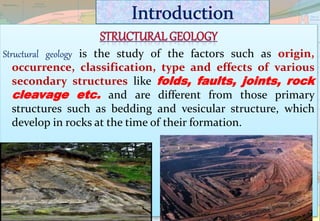
Structural geology is the study of the factors such as origin,
occurrence, classification, type and effects of various
secondary structures like folds, faults, joints, rock
cleavage etc. and are different from those primary
structures such as bedding and vesicular structure, which
develop in rocks at the time of their formation.
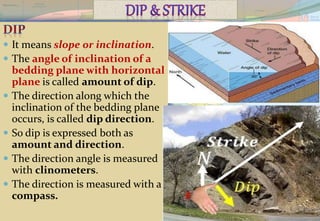
 It means slope or inclination.
 The angle of inclination of a
bedding plane with horizontal
plane is called amount of dip.
 The direction along which the
inclination of the bedding plane
occurs, is called dip direction.
 So dip is expressed both as
amount and direction.
 The direction angle is measured
with clinometers.
 The direction is measured with a
compass.
 It’s defined as the direction of a line
formed by the intersection of a
bedding plane and a horizontal
plane.
 It’s always at right angle with the
true dip direction.
 It is a horizontal line on a surface of
rock beds.
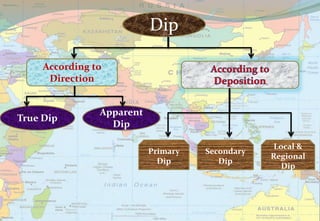
Dip
According to
Direction
True Dip
Apparent
Dip
Local &
Regional
Dip
Primary
Dip
Secondary
Dip
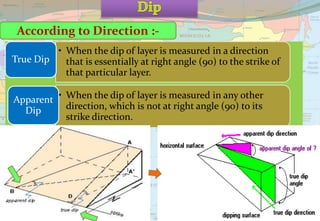
• When the dip of layer is measured in a direction
that is essentially at right angle (90) to the strike of
that particular layer.
True Dip
• When the dip of layer is measured in any other
direction, which is not at right angle (90) to its
strike direction.
Apparent
Dip
According to Direction :-
According to Deposition :-
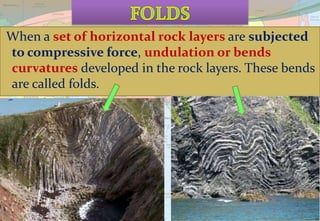
When a set of horizontal rock layers are subjected
to compressive force, undulation or bends
curvatures developed in the rock layers. These bends
are called folds.
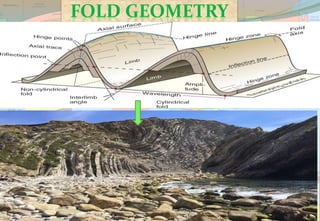
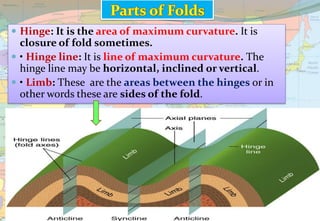
 Hinge: It is the area of maximum curvature. It is
closure of fold sometimes.
 • Hinge line: It is line of maximum curvature. The
hinge line may be horizontal, inclined or vertical.
 • Limb: These are the areas between the hinges or in
other words these are sides of the fold.
 Axial plane: The imaginary plane which is equidistant from each
limb of a fold and which also bisects the angle between the two.
The axial plane actually cuts the hinge zone of the fold along a line,
which is termed as fold axis or axis.
 Plunge: The attitude of the fold axis is measured as the angle
between the axis and horizontal.
 Crest & Trugh: The line running through the highest pints in an up
arched fold defines its Crest. A corresponding line through the lowest
pint in a down arched folds makes its Trough.
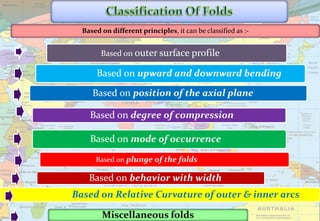
Based on outer surface profile
Based on upward and downward bending
Based on position of the axial plane
Based on degree of compression
Based on mode of occurrence
Based on plunge of the folds
Based on behavior with width
Based on Relative Curvature of outer & inner arcs
Based on different principles, it can be classified as :-
Miscellaneous folds
1 Based on upward and downward bending, It can be classified as:-
1 2
When the beds are bent upwards, the
resulting fold is called anticline. This fold
is convex upwards. Naturally, in such a
fold, the older beds occur towards the
concave side, In a simple case, the limbs of
anticline slope in opposite directions with
reference to its axial plane. But when the
anticline is refolded, the inclined character
of limbs will be complicated.
Syncline is just opposite to anticline in
its nature, i.e. when the beds are bent
downwards the resulting fold is called
syncline. This fold is convex downwards.
In this the younger beds occur towards
the concave side and, in a simple type of
syncline, its limbs dip towards each
other with reference to the axial plane.
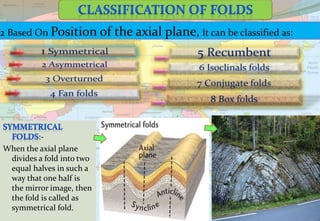
2 Based On Position of the axial plane, It can be classified as:
:-
When the axial plane
divides a fold into two
equal halves in such a
way that one half is
the mirror image, then
the fold is called as
symmetrical fold.
If the compressive forces
responsible for folding are not
of the same magnitude,
asymmetrical folds are formed.
2 Based On Position of the axial plane, It can be classified as:
Overturned Fold
Usually, in simple folds, the limbs show the
order of superposition. But when one of the
limb is overturned, the order of
superposition of beds in that limb will be in
reverse order and such a fold is called an
overturned fold.
2 Based On Position of the axial plane, It can be classified as:
Usually the folds have inclined limbs, i.e. the
limbs will be mutually diverging or
converging with reference to axial planes. But
in some folds, the limbs will be mutually
parallel to a great extent. Such folds are
called isoclinals folds. These folds may be
vertical inclined or horizontal.
Box Fold
Box fold are special type of fold with
exceptionally flattened top and
steeply inclined limbs almost
forming 3 sides of a rectangle.
2 Based On Position of the axial plane, It can be classified as:
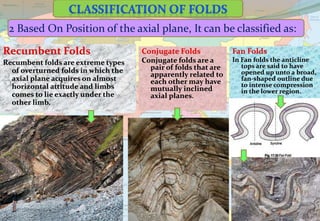
Fan Folds
In Fan folds the anticline
tops are said to have
opened up unto a broad,
fan-shaped outline due
to intense compression
in the lower region.
Conjugate Folds
Conjugate folds are a
pair of folds that are
apparently related to
each other may have
mutually inclined
axial planes.
Recumbent Folds
Recumbent folds are extreme types
of overturned folds in which the
axial plane acquires on almost
horizontal attitude and limbs
comes to lie exactly under the
other limb.
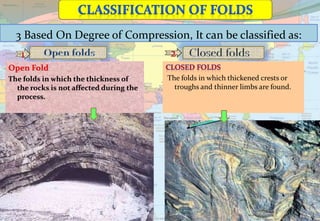
3 Based On Degree of Compression, It can be classified as:
1 2
The folds in which thickened crests or
troughs and thinner limbs are found.
Open Fold
The folds in which the thickness of
the rocks is not affected during the
process.
4 Based On Mode Of Occurrence, It can be classified as:
1 2
Synclinorium is the reverse of
anticlinorium & may defined as an
extensive system of folds having
clearly down-arched folding trend.
Anticlinorium
Anticlinorium is a system of
exceptionally large sixed folds running
often for several hundred km in length
& several km in width and having up-
arched folding trend.
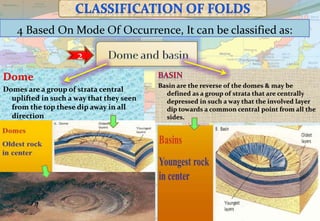
4 Based On Mode Of Occurrence, It can be classified as:
2
Dome
Domes are a group of strata central
uplifted in such a way that they seen
from the top these dip away in all
direction
Basin are the reverse of the domes & may be
defined as a group of strata that are centrally
depressed in such a way that the involved layer
dip towards a common central point from all the
sides.
5 Based On Plunge Of the Folds, It can be classified as:
1 2
Plunging folds
Any fold in which fold axis is not
horizontal.
Non-Plunging folds
Any fold in which fold axis is
essentially horizontal.
6 Based On outer surface profile, It can be classified as:
1
3
Conjugate folds
Conjugate folds are composite folds
characterised with 2-hinges & 3
planner limbs in which the central
limb is exceptionally flattened.
Cheveron folds
These are characterized with well-
defined, sharp hinge points & straight
planner limbs.
4
2
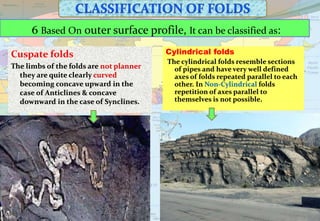
6 Based On outer surface profile, It can be classified as:
Cylindrical folds
The cylindrical folds resemble sections
of pipes and have very well defined
axes of folds repeated parallel to each
other. In Non-Cylindrical folds
repetition of axes parallel to
themselves is not possible.
Cuspate folds
The limbs of the folds are not planner
they are quite clearly curved
becoming concave upward in the
case of Anticlines & concave
downward in the case of Synclines.
7 Based On Behaviour with depth, It can be classified as:
1
3 Supertanuous folds
These showing differences in
thickness at crestal and the
trough regions, not induced
by folding process but
essentially being due to
erosional & depositional
processes operating in the
folding regions.
Concentric folds
The strata in concentric or parallel
folds has reacted to the
effecting tangential
compression in such a way that
the thickness of the involved
layer remained uniform and
constant even after folding.
2
Similar folds
Those folds in which
the degree of
folding is observed
to be similar for
indefinite depths
are grouped as
similar folds.
8 Based On Relative curvature of outer & inner arcs, It can be classified as:
1
3 Class 2 folds
All those folds in which the
degree of curvature in
the outer arc (o) of the
fold is equal to that of
the inner arc (i). {o = i}
Class 1 folds
All those folds in which
the degree of
curvature in the outer
arc (o) of the fold is
less than that of the
inner arc (i). {o < i}
2
Class 3 folds
All those folds in which the
degree of curvature in the
outer arc (o) of the fold is
greater than that of the
inner arc (i). {o > i}
9 Miscellaneous :-
 Most of the important folds, as already pointed out, are due to tectonic
causes. But a few folds of a minor type are due to non-tectonic causes.
 Non-tectonic causes like landslides, creeping, differential compaction, isostatic
setting and glaciations too are responsible for some folds. These are minor in
terms of frequency of occurrence and magnitude.
A fault may be defined as a fracture surface along which relative
movement of adjacent blocks has taken place.
Or Fault are those fractures along which there has been relative
movement of the blocks past each other .
Faulting is entire process of development of fracture & displacement of
the blocks against each other.
 Faults occur when brittle
rocks fracture and there
is an offset along the
fracture.
 When the offset is small, the
displacement can be easily
measured, but sometimes the
displacement is so large that it is
difficult to measure.
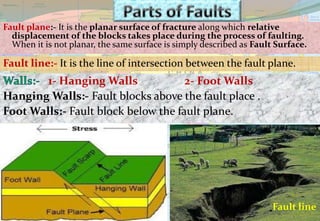
Fault plane:- It is the planar surface of fracture along which relative
displacement of the blocks takes place during the process of faulting.
When it is not planar, the same surface is simply described as Fault Surface.
Fault line:- It is the line of intersection between the fault plane.
1- Hanging Walls 2- Foot Walls
Hanging Walls:- Fault blocks above the fault place .
Foot Walls:- Fault block below the fault plane.
Fault line
Faults are classified on the basis of :-
1
3
1- Normal Faults:-
In normal faults hanging wall has apparently
moved down with respect to foot wall.
2
1 Based On Apparent movement of fault blocks, It can be classified as:-
Horst
Vertical
Fault
Garben
4
Normal Faults
3- Strike-slip Faults:-
In this faulted blocks have
been moved against each
other in an essentially
horizontal direction. I is
found in large scale like in
oceanic ridge.
2- Reverse Faults:-
In this hanging wall appears
to have moved up with
respect to the foot wall.
4- Hinge Faults:-
Hinge faults are characterised
by a movement of the
disrupted faults along a
medial point . The
movement is therefore
rotational .
1 32
2 Based On Attitude of fault plane, It can be classified as:-
2- Dip Faults:-
Dip faults develop parallel
to the dip of the strata.
1- Strike Faults:-
These are the faults that
develop parallel to the
strike of the strata.
3- Oblique Faults:-
Oblique faults strike make an
oblique angle with the
strike of the rocks in which
it has it has caused the
displacement.
1
3
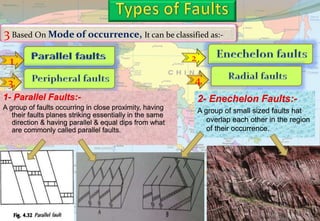
1- Parallel Faults:-
A group of faults occurring in close proximity, having
their faults planes striking essentially in the same
direction & having parallel & equal dips from what
are commonly called parallel faults.
2
3 Based On Mode of occurrence, It can be classified as:-
4
2- Enechelon Faults:-
A group of small sized faults hat
overlap each other in the region
of their occurrence.
3 Based On Mode of occurrence, It can be classified as:-
4- Radial Faults:-
A group of faults appear emerging outward
from a common central region are
classed as radial faults.
3- Peripheral Faults:-
When in any given region the majority
of faults are concentrated along the
border or margin of the area.
1 32
4 Based On slip, It can be classified as:-
2- Dip-slip Faults:-
All those faults in which the
net slip has taken place
parallel to the dip of the
faults, also called Normal-
dip-faults.
1- Strike –slip Faults:-
In which net slip is
essentially parallel to
the strike of the faults,
the slip along the dip
being almost absent.
3- Oblique –slip Faults:-
In which the direction of net
slip is neither parallel to the
dip of the faults nor to the
strike of the fault bur is
inclined to both these
direction.
Faulting change in the elevation of the ground.
Omission of some strata where they are normally expected.
Repetition of some strata in a given direction against the normal order of super-position.
Displacement & shifts in the continuity of the same rocks in the certain regions.
Kashmir Himalayas Garhwal HimalayasShimla Thrust
Example of faults-
Joints are defined as divisional planes or fractures along which
there has been no relative displacement.
Or Any fracture, without any movement is called as joint.
Nature of
Joints:-
1. Open joints
2. Close joints
3. Smooth joints
4. Rough joints
5. Small joints
6. Master joints
Joints are
classified
on the
basis of :-
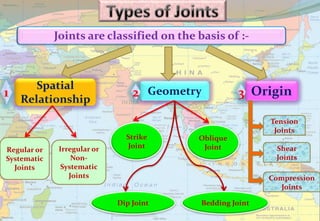
Joints are classified on the basis of :-
Spatial
Relationship
1 Geometry2 Origin3
Regular or
Systematic
Joints
Irregular or
Non-
Systematic
Joints
Tension
Joints
Shear
Joints
Compression
Joints
Strike
Joint
Dip Joint
Oblique
Joint
Bedding Joint
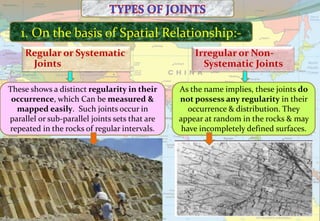
1. On the basis of Spatial Relationship:-
Regular or Systematic
Joints
Irregular or Non-
Systematic Joints
These shows a distinct regularity in their
occurrence, which Can be measured &
mapped easily. Such joints occur in
parallel or sub-parallel joints sets that are
repeated in the rocks of regular intervals.
As the name implies, these joints do
not possess any regularity in their
occurrence & distribution. They
appear at random in the rocks & may
have incompletely defined surfaces.
2. On the basis of Ge0metry:-
Dip Joint
When joints sets
strike, parallel to
the dip direction
of the rocks, they
are called Strike
Joints.
Oblique Joint
When strike of the joints
is at any angle
between the dip &
strike of the layers,
these are also called
Diagonal Joints
3. On the basis of Origin:-
Shear Joint
Joints those are commonly
observed in the near of
faults planes & shear
zones where the
relationship with shearing
forces is clearly established.
Structural Geology

Structural Geology

  • 5.
  • 6.
    Structural geology isthe study of the factors such as origin, occurrence, classification, type and effects of various secondary structures like folds, faults, joints, rock cleavage etc. and are different from those primary structures such as bedding and vesicular structure, which develop in rocks at the time of their formation.
  • 7.
     It meansslope or inclination.  The angle of inclination of a bedding plane with horizontal plane is called amount of dip.  The direction along which the inclination of the bedding plane occurs, is called dip direction.  So dip is expressed both as amount and direction.  The direction angle is measured with clinometers.  The direction is measured with a compass.
  • 8.
     It’s definedas the direction of a line formed by the intersection of a bedding plane and a horizontal plane.  It’s always at right angle with the true dip direction.  It is a horizontal line on a surface of rock beds.
  • 9.
    Dip According to Direction True Dip Apparent Dip Local& Regional Dip Primary Dip Secondary Dip
  • 10.
    • When thedip of layer is measured in a direction that is essentially at right angle (90) to the strike of that particular layer. True Dip • When the dip of layer is measured in any other direction, which is not at right angle (90) to its strike direction. Apparent Dip According to Direction :-
  • 11.
  • 12.
    When a setof horizontal rock layers are subjected to compressive force, undulation or bends curvatures developed in the rock layers. These bends are called folds.
  • 14.
     Hinge: Itis the area of maximum curvature. It is closure of fold sometimes.  • Hinge line: It is line of maximum curvature. The hinge line may be horizontal, inclined or vertical.  • Limb: These are the areas between the hinges or in other words these are sides of the fold.
  • 15.
     Axial plane:The imaginary plane which is equidistant from each limb of a fold and which also bisects the angle between the two. The axial plane actually cuts the hinge zone of the fold along a line, which is termed as fold axis or axis.  Plunge: The attitude of the fold axis is measured as the angle between the axis and horizontal.  Crest & Trugh: The line running through the highest pints in an up arched fold defines its Crest. A corresponding line through the lowest pint in a down arched folds makes its Trough.
  • 16.
    Based on outersurface profile Based on upward and downward bending Based on position of the axial plane Based on degree of compression Based on mode of occurrence Based on plunge of the folds Based on behavior with width Based on Relative Curvature of outer & inner arcs Based on different principles, it can be classified as :- Miscellaneous folds
  • 17.
    1 Based onupward and downward bending, It can be classified as:- 1 2 When the beds are bent upwards, the resulting fold is called anticline. This fold is convex upwards. Naturally, in such a fold, the older beds occur towards the concave side, In a simple case, the limbs of anticline slope in opposite directions with reference to its axial plane. But when the anticline is refolded, the inclined character of limbs will be complicated. Syncline is just opposite to anticline in its nature, i.e. when the beds are bent downwards the resulting fold is called syncline. This fold is convex downwards. In this the younger beds occur towards the concave side and, in a simple type of syncline, its limbs dip towards each other with reference to the axial plane.
  • 18.
    2 Based OnPosition of the axial plane, It can be classified as: :- When the axial plane divides a fold into two equal halves in such a way that one half is the mirror image, then the fold is called as symmetrical fold.
  • 19.
    If the compressiveforces responsible for folding are not of the same magnitude, asymmetrical folds are formed. 2 Based On Position of the axial plane, It can be classified as: Overturned Fold Usually, in simple folds, the limbs show the order of superposition. But when one of the limb is overturned, the order of superposition of beds in that limb will be in reverse order and such a fold is called an overturned fold.
  • 20.
    2 Based OnPosition of the axial plane, It can be classified as: Usually the folds have inclined limbs, i.e. the limbs will be mutually diverging or converging with reference to axial planes. But in some folds, the limbs will be mutually parallel to a great extent. Such folds are called isoclinals folds. These folds may be vertical inclined or horizontal. Box Fold Box fold are special type of fold with exceptionally flattened top and steeply inclined limbs almost forming 3 sides of a rectangle.
  • 21.
    2 Based OnPosition of the axial plane, It can be classified as: Fan Folds In Fan folds the anticline tops are said to have opened up unto a broad, fan-shaped outline due to intense compression in the lower region. Conjugate Folds Conjugate folds are a pair of folds that are apparently related to each other may have mutually inclined axial planes. Recumbent Folds Recumbent folds are extreme types of overturned folds in which the axial plane acquires on almost horizontal attitude and limbs comes to lie exactly under the other limb.
  • 22.
    3 Based OnDegree of Compression, It can be classified as: 1 2 The folds in which thickened crests or troughs and thinner limbs are found. Open Fold The folds in which the thickness of the rocks is not affected during the process.
  • 23.
    4 Based OnMode Of Occurrence, It can be classified as: 1 2 Synclinorium is the reverse of anticlinorium & may defined as an extensive system of folds having clearly down-arched folding trend. Anticlinorium Anticlinorium is a system of exceptionally large sixed folds running often for several hundred km in length & several km in width and having up- arched folding trend.
  • 24.
    4 Based OnMode Of Occurrence, It can be classified as: 2 Dome Domes are a group of strata central uplifted in such a way that they seen from the top these dip away in all direction Basin are the reverse of the domes & may be defined as a group of strata that are centrally depressed in such a way that the involved layer dip towards a common central point from all the sides.
  • 25.
    5 Based OnPlunge Of the Folds, It can be classified as: 1 2 Plunging folds Any fold in which fold axis is not horizontal. Non-Plunging folds Any fold in which fold axis is essentially horizontal.
  • 26.
    6 Based Onouter surface profile, It can be classified as: 1 3 Conjugate folds Conjugate folds are composite folds characterised with 2-hinges & 3 planner limbs in which the central limb is exceptionally flattened. Cheveron folds These are characterized with well- defined, sharp hinge points & straight planner limbs. 4 2
  • 27.
    6 Based Onouter surface profile, It can be classified as: Cylindrical folds The cylindrical folds resemble sections of pipes and have very well defined axes of folds repeated parallel to each other. In Non-Cylindrical folds repetition of axes parallel to themselves is not possible. Cuspate folds The limbs of the folds are not planner they are quite clearly curved becoming concave upward in the case of Anticlines & concave downward in the case of Synclines.
  • 28.
    7 Based OnBehaviour with depth, It can be classified as: 1 3 Supertanuous folds These showing differences in thickness at crestal and the trough regions, not induced by folding process but essentially being due to erosional & depositional processes operating in the folding regions. Concentric folds The strata in concentric or parallel folds has reacted to the effecting tangential compression in such a way that the thickness of the involved layer remained uniform and constant even after folding. 2 Similar folds Those folds in which the degree of folding is observed to be similar for indefinite depths are grouped as similar folds.
  • 29.
    8 Based OnRelative curvature of outer & inner arcs, It can be classified as: 1 3 Class 2 folds All those folds in which the degree of curvature in the outer arc (o) of the fold is equal to that of the inner arc (i). {o = i} Class 1 folds All those folds in which the degree of curvature in the outer arc (o) of the fold is less than that of the inner arc (i). {o < i} 2 Class 3 folds All those folds in which the degree of curvature in the outer arc (o) of the fold is greater than that of the inner arc (i). {o > i}
  • 30.
  • 31.
     Most ofthe important folds, as already pointed out, are due to tectonic causes. But a few folds of a minor type are due to non-tectonic causes.  Non-tectonic causes like landslides, creeping, differential compaction, isostatic setting and glaciations too are responsible for some folds. These are minor in terms of frequency of occurrence and magnitude.
  • 32.
    A fault maybe defined as a fracture surface along which relative movement of adjacent blocks has taken place. Or Fault are those fractures along which there has been relative movement of the blocks past each other . Faulting is entire process of development of fracture & displacement of the blocks against each other.
  • 33.
     Faults occurwhen brittle rocks fracture and there is an offset along the fracture.  When the offset is small, the displacement can be easily measured, but sometimes the displacement is so large that it is difficult to measure.
  • 34.
    Fault plane:- Itis the planar surface of fracture along which relative displacement of the blocks takes place during the process of faulting. When it is not planar, the same surface is simply described as Fault Surface. Fault line:- It is the line of intersection between the fault plane. 1- Hanging Walls 2- Foot Walls Hanging Walls:- Fault blocks above the fault place . Foot Walls:- Fault block below the fault plane. Fault line
  • 35.
    Faults are classifiedon the basis of :-
  • 36.
    1 3 1- Normal Faults:- Innormal faults hanging wall has apparently moved down with respect to foot wall. 2 1 Based On Apparent movement of fault blocks, It can be classified as:- Horst Vertical Fault Garben 4 Normal Faults
  • 37.
    3- Strike-slip Faults:- Inthis faulted blocks have been moved against each other in an essentially horizontal direction. I is found in large scale like in oceanic ridge. 2- Reverse Faults:- In this hanging wall appears to have moved up with respect to the foot wall. 4- Hinge Faults:- Hinge faults are characterised by a movement of the disrupted faults along a medial point . The movement is therefore rotational .
  • 38.
    1 32 2 BasedOn Attitude of fault plane, It can be classified as:- 2- Dip Faults:- Dip faults develop parallel to the dip of the strata. 1- Strike Faults:- These are the faults that develop parallel to the strike of the strata. 3- Oblique Faults:- Oblique faults strike make an oblique angle with the strike of the rocks in which it has it has caused the displacement.
  • 39.
    1 3 1- Parallel Faults:- Agroup of faults occurring in close proximity, having their faults planes striking essentially in the same direction & having parallel & equal dips from what are commonly called parallel faults. 2 3 Based On Mode of occurrence, It can be classified as:- 4 2- Enechelon Faults:- A group of small sized faults hat overlap each other in the region of their occurrence.
  • 40.
    3 Based OnMode of occurrence, It can be classified as:- 4- Radial Faults:- A group of faults appear emerging outward from a common central region are classed as radial faults. 3- Peripheral Faults:- When in any given region the majority of faults are concentrated along the border or margin of the area.
  • 41.
    1 32 4 BasedOn slip, It can be classified as:- 2- Dip-slip Faults:- All those faults in which the net slip has taken place parallel to the dip of the faults, also called Normal- dip-faults. 1- Strike –slip Faults:- In which net slip is essentially parallel to the strike of the faults, the slip along the dip being almost absent. 3- Oblique –slip Faults:- In which the direction of net slip is neither parallel to the dip of the faults nor to the strike of the fault bur is inclined to both these direction.
  • 42.
    Faulting change inthe elevation of the ground. Omission of some strata where they are normally expected. Repetition of some strata in a given direction against the normal order of super-position. Displacement & shifts in the continuity of the same rocks in the certain regions. Kashmir Himalayas Garhwal HimalayasShimla Thrust Example of faults-
  • 43.
    Joints are definedas divisional planes or fractures along which there has been no relative displacement. Or Any fracture, without any movement is called as joint. Nature of Joints:- 1. Open joints 2. Close joints 3. Smooth joints 4. Rough joints 5. Small joints 6. Master joints
  • 44.
  • 45.
    Joints are classifiedon the basis of :- Spatial Relationship 1 Geometry2 Origin3 Regular or Systematic Joints Irregular or Non- Systematic Joints Tension Joints Shear Joints Compression Joints Strike Joint Dip Joint Oblique Joint Bedding Joint
  • 46.
    1. On thebasis of Spatial Relationship:- Regular or Systematic Joints Irregular or Non- Systematic Joints These shows a distinct regularity in their occurrence, which Can be measured & mapped easily. Such joints occur in parallel or sub-parallel joints sets that are repeated in the rocks of regular intervals. As the name implies, these joints do not possess any regularity in their occurrence & distribution. They appear at random in the rocks & may have incompletely defined surfaces.
  • 47.
    2. On thebasis of Ge0metry:- Dip Joint When joints sets strike, parallel to the dip direction of the rocks, they are called Strike Joints. Oblique Joint When strike of the joints is at any angle between the dip & strike of the layers, these are also called Diagonal Joints
  • 48.
    3. On thebasis of Origin:- Shear Joint Joints those are commonly observed in the near of faults planes & shear zones where the relationship with shearing forces is clearly established.