PRESENTATION ON OPHIOLITES BY HAFIZ SHAHID HUSSAIN  YOUSAFZAI BS 3 rd  year  University of Peshawar Pakistan
OPHIOLITES Ophio  is Greek for "snake",  lite  means "stone" from the Greek  lithos . The name is given because ophiolites have similarity in colour and texture with snakes, some greenish colour.
Definition An Ophiolite is a section of the Earth's  oceanic crust  and the underlying upper  mantle  that has been uplifted or emplaced to be exposed within  continental crustal  rocks
History of term Ophiolite The term ophiolite was originally used by  Alexandre Brongniart  (1813) for an assemblage of green rocks ( serpentine ,  diabase ) in the  Alps   Steinmann (1927) later modified its use to include serpentine,  pillow lava , and  chert  ("Steinmann's trinity"), again based on occurrences in the Alps The term was little used in other areas until the late 1950s to early 1960s, with the recognition that this assemblage provided an analog for oceanic crust and the process of  seafloor spreading .
This recognition was tied to two events:  the observation of magnetic anomaly stripes on the seafloor, parallel to  oceanic ridge  systems, interpreted by  Frederick Vine  and  Drummond Matthews  (1963) to represent the formation of new crust at the oceanic ridge and its subsequent spreading away from that ridge,  the observation of a  sheeted dike complex  within the  Troodos ophiolite  ( Cyprus ) which must have formed by 100% intrusion of new magma, since no older wall rocks are preserved within the complex (Gass 1968). Moores and Vine (1971) concluded that the sheeted dike complex at Troodos could only form by a process similar to the seafloor spreading Thus, it became widely accepted that ophiolites represent oceanic crust that had been emplaced on land.
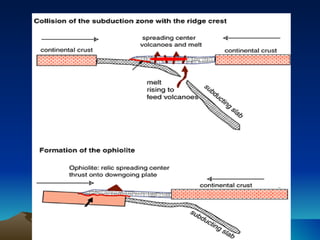
Formation of Ophiolites Ophilites are fragments of oceanic crust and upper mantle that have been uplifted and emplaced on continental margins.
 
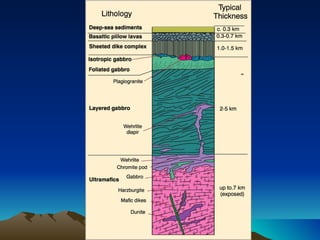
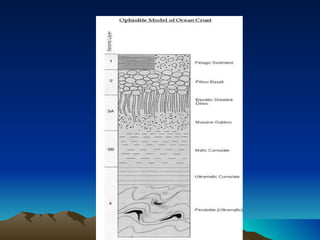
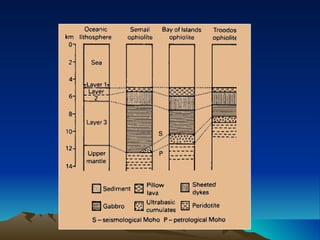
Lithology of Ophiolites Ophiolites consist of five distinct layers. The first layer is the youngest and is primarily sediment that was accumulated on the seafloor
The second layer is pillow basalt. Pillow basalt is characterized by large pillow or cloud shaped blobs. When erupting lava encounters the cold sea water, the outside of the lava immediately crystallizes, forming a thick crust. The extremely hot lava still inside the blob, oozes out of the crust and instantly crystallizes again. As this process of cooling continues, the result is a very thick succession of pillow shaped blobs.
The next layer consists of sheeted dikes. Sheeted dikes form by rising magma within the earth's crust. As the sheeted dikes cool fractures and cracks occur in the rock. As more magma rises, the magma intrudes through the weak cracks and form new dikes, as this process continues the result is a wall of sheeted dikes
Sheeted dikes are underlain by gabbro, which is compositionally similar to basalt, but more coarse grained due to the slow cooling process.  The bottommost layer is peridotite, which is believed to be mantle rock composition
 
 
Types of ophiolites Most ophiolites can be divided into two groups:  Tethyan ophiolites are characteristic of those that occur in the eastern Mediterranean sea area, e.g., Troodos in Cyprus and Semail in Oman, which consist of relatively complete rock series corresponding to the classic ophiolite assemblage and which have been emplaced onto a passive  continental margin  more or less intact (Tethys is the name given to the ancient sea that once separated Europe and Africa).
Cordilleran ophiolites are characteristic of those that occur in the mountain belts of western North America (the "Cordillera" or backbone of the continent). These ophiolites sit on subduction zone accretionary complexes (subduction complexes) and have no association with a passive continental margin. These include the Coast Range ophiolite of California, the Josephine ophiolite of the Klamath Mountains (California, Oregon), and ophiolites in the southern Andes of South America. Despite their differences in mode of emplacement, both types of ophiolite are exclusively SSZ in origin (e.g., Shervais, 2001).
Similarity b/w oceanic crust and ophiolites
 
Difference between Oceanic crust and Ophiolites Thickness Age Density Compostion
Density The density of the oceanic crust is low as compare to the ophiolite sequence
Age the age of ophiolite formation is often surprisingly close to the age of their emplacement into the continental crust  In addition, no ocean crust is older than about 200 million years
thickness Ophiolites do not have any contrast thickness. They may have even more or less thickness while oceanic crust have 5-7 km thickness.
Compostion Ophiolite lavas are dominated by arc tholeiites, back arc basalt, andesite etc which are different from oceanic crust lavas
Ophiolites in pakistan Indain palte collision with eurasian plate and afghan plate. East-west trending ophiolites due to I.P collision with E.P. North-south trending ophiolites due to I.P collision with A.P
Eurasian block ophiolites Dargai Mingora – bajaware Chilas etc.
Afghan block ophiolites Waziristan Zhob Muslim Bagh Bela etc.
conclusion Ophiolites are slabs of ancient oceanic crust obducted/preseved onto the continental crust/earth surface. They are located in collisional boundaries. Their compostion is sediments, lavas, sheeted dikes, gabbros, and ultramafic rocks. Have similarity with oceanic crust.
The End

Presentation On Ophiolites

  • 1.
    PRESENTATION ON OPHIOLITESBY HAFIZ SHAHID HUSSAIN YOUSAFZAI BS 3 rd year University of Peshawar Pakistan
  • 2.
    OPHIOLITES Ophio is Greek for "snake", lite means "stone" from the Greek lithos . The name is given because ophiolites have similarity in colour and texture with snakes, some greenish colour.
  • 3.
    Definition An Ophioliteis a section of the Earth's oceanic crust and the underlying upper mantle that has been uplifted or emplaced to be exposed within continental crustal rocks
  • 4.
    History of termOphiolite The term ophiolite was originally used by Alexandre Brongniart (1813) for an assemblage of green rocks ( serpentine , diabase ) in the Alps Steinmann (1927) later modified its use to include serpentine, pillow lava , and chert ("Steinmann's trinity"), again based on occurrences in the Alps The term was little used in other areas until the late 1950s to early 1960s, with the recognition that this assemblage provided an analog for oceanic crust and the process of seafloor spreading .
  • 5.
    This recognition wastied to two events: the observation of magnetic anomaly stripes on the seafloor, parallel to oceanic ridge systems, interpreted by Frederick Vine and Drummond Matthews (1963) to represent the formation of new crust at the oceanic ridge and its subsequent spreading away from that ridge, the observation of a sheeted dike complex within the Troodos ophiolite ( Cyprus ) which must have formed by 100% intrusion of new magma, since no older wall rocks are preserved within the complex (Gass 1968). Moores and Vine (1971) concluded that the sheeted dike complex at Troodos could only form by a process similar to the seafloor spreading Thus, it became widely accepted that ophiolites represent oceanic crust that had been emplaced on land.
  • 6.
    Formation of OphiolitesOphilites are fragments of oceanic crust and upper mantle that have been uplifted and emplaced on continental margins.
  • 7.
  • 8.
    Lithology of OphiolitesOphiolites consist of five distinct layers. The first layer is the youngest and is primarily sediment that was accumulated on the seafloor
  • 9.
    The second layeris pillow basalt. Pillow basalt is characterized by large pillow or cloud shaped blobs. When erupting lava encounters the cold sea water, the outside of the lava immediately crystallizes, forming a thick crust. The extremely hot lava still inside the blob, oozes out of the crust and instantly crystallizes again. As this process of cooling continues, the result is a very thick succession of pillow shaped blobs.
  • 10.
    The next layerconsists of sheeted dikes. Sheeted dikes form by rising magma within the earth's crust. As the sheeted dikes cool fractures and cracks occur in the rock. As more magma rises, the magma intrudes through the weak cracks and form new dikes, as this process continues the result is a wall of sheeted dikes
  • 11.
    Sheeted dikes areunderlain by gabbro, which is compositionally similar to basalt, but more coarse grained due to the slow cooling process. The bottommost layer is peridotite, which is believed to be mantle rock composition
  • 12.
  • 13.
  • 14.
    Types of ophiolitesMost ophiolites can be divided into two groups: Tethyan ophiolites are characteristic of those that occur in the eastern Mediterranean sea area, e.g., Troodos in Cyprus and Semail in Oman, which consist of relatively complete rock series corresponding to the classic ophiolite assemblage and which have been emplaced onto a passive continental margin more or less intact (Tethys is the name given to the ancient sea that once separated Europe and Africa).
  • 15.
    Cordilleran ophiolites arecharacteristic of those that occur in the mountain belts of western North America (the "Cordillera" or backbone of the continent). These ophiolites sit on subduction zone accretionary complexes (subduction complexes) and have no association with a passive continental margin. These include the Coast Range ophiolite of California, the Josephine ophiolite of the Klamath Mountains (California, Oregon), and ophiolites in the southern Andes of South America. Despite their differences in mode of emplacement, both types of ophiolite are exclusively SSZ in origin (e.g., Shervais, 2001).
  • 16.
    Similarity b/w oceaniccrust and ophiolites
  • 17.
  • 18.
    Difference between Oceaniccrust and Ophiolites Thickness Age Density Compostion
  • 19.
    Density The densityof the oceanic crust is low as compare to the ophiolite sequence
  • 20.
    Age the ageof ophiolite formation is often surprisingly close to the age of their emplacement into the continental crust In addition, no ocean crust is older than about 200 million years
  • 21.
    thickness Ophiolites donot have any contrast thickness. They may have even more or less thickness while oceanic crust have 5-7 km thickness.
  • 22.
    Compostion Ophiolite lavasare dominated by arc tholeiites, back arc basalt, andesite etc which are different from oceanic crust lavas
  • 23.
    Ophiolites in pakistanIndain palte collision with eurasian plate and afghan plate. East-west trending ophiolites due to I.P collision with E.P. North-south trending ophiolites due to I.P collision with A.P
  • 24.
    Eurasian block ophiolitesDargai Mingora – bajaware Chilas etc.
  • 25.
    Afghan block ophiolitesWaziristan Zhob Muslim Bagh Bela etc.
  • 26.
    conclusion Ophiolites areslabs of ancient oceanic crust obducted/preseved onto the continental crust/earth surface. They are located in collisional boundaries. Their compostion is sediments, lavas, sheeted dikes, gabbros, and ultramafic rocks. Have similarity with oceanic crust.
  • 27.