FOLDS ND FOLDING
Folds.ppt
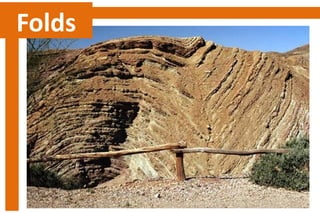
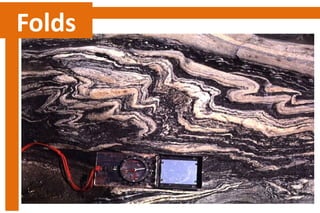
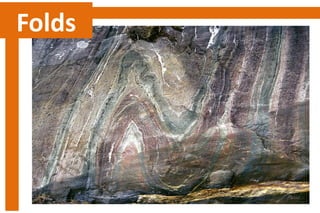
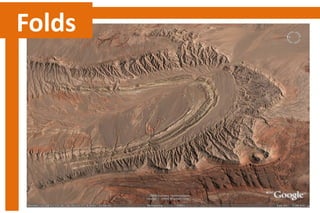
 FOLD:- it may be defined as UNDULATIONS OR BENDS OR
CURVATURES developed in a rocks because of STRESSES
witch are acting on rocks from time to time in past history of the
earth.
 The shape and extent of a folds depends upon a no. of factors;-
- nature - magnitude
- direction and duration of forces act upon the rocks
- and on nature of the rocks.
PARTS OF FOLDS LIMBS :- these are the sides or flanks of the folds.
 HINGE :- in folded layer a point at curvature is maximum is called
hinge point.
 HINGE LINE :- rocks occur in a sequence and their all hinge
points are joined together, they make a line called hinge line.
 AXIAL PLAIN :- an axial plane is that imaginary plane that
passes through all the points of maximum curvature in a folded
sequence
 PLUNGE OF FOLD :- plunge is angle which axis line makes with
a horizontal plane.
PARTS OF FOLDS
 CREST AND TROUGH :- the line running through the highest
points in an up arched fold defines as CREST.
 THE line running through the lowest point in a down arched fold
make its THROUGH.
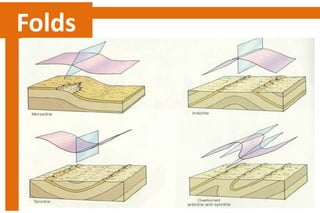
Folds
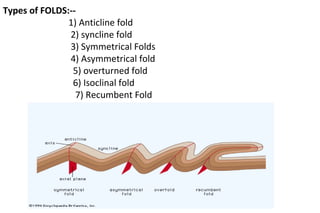
Types of FOLDS:--
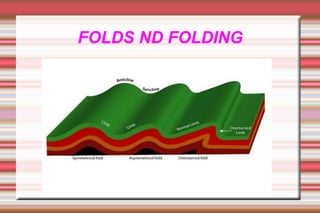
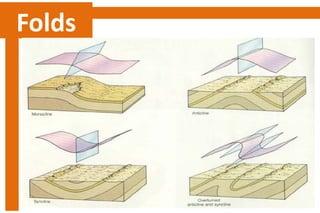
1) Anticline fold
2) syncline fold
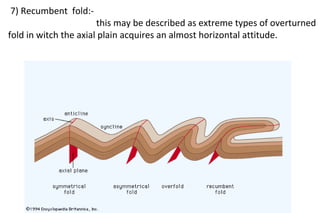
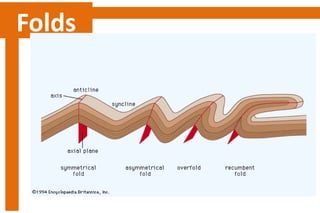
3) Symmetrical Folds
4) Asymmetrical fold
5) overturned fold
6) Isoclinal fold
7) Recumbent Fold
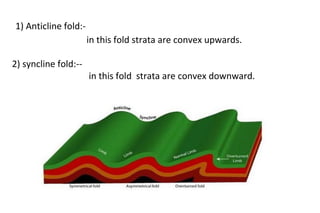
1) Anticline fold:-
in this fold strata are convex upwards.
2) syncline fold:--
in this fold strata are convex downward.
3) Symmetrical fold:-
this are also called normal folds . Axial plane is
essentially vertical. The limbs are equal in length and dip equaly in in
opposite directions.
4) Asymmetrical fold:-
in this folds limbs are unequal in length and dip are of
different angle. Are termed as Asymmetrical folds.
5) Overturned fold:-
these are folds with inclined axial plains in witch both
limbs are dipping essentially in the same general direction.
6)Isoclinal folds:-
these are group of folds in witch all the axial plains are
parallel. They may b made up of series of anticlines and synclines.
7) Recumbent fold:-
this may be described as extreme types of overturned
fold in witch the axial plain acquires an almost horizontal attitude.
Folds
Folds
Folds
Folds
Folds
Folds
Folds
Folds
Folds

Folds new

  • 1.
  • 2.
     FOLD:- itmay be defined as UNDULATIONS OR BENDS OR CURVATURES developed in a rocks because of STRESSES witch are acting on rocks from time to time in past history of the earth.  The shape and extent of a folds depends upon a no. of factors;- - nature - magnitude - direction and duration of forces act upon the rocks - and on nature of the rocks.
  • 3.
    PARTS OF FOLDSLIMBS :- these are the sides or flanks of the folds.  HINGE :- in folded layer a point at curvature is maximum is called hinge point.  HINGE LINE :- rocks occur in a sequence and their all hinge points are joined together, they make a line called hinge line.  AXIAL PLAIN :- an axial plane is that imaginary plane that passes through all the points of maximum curvature in a folded sequence  PLUNGE OF FOLD :- plunge is angle which axis line makes with a horizontal plane.
  • 4.
    PARTS OF FOLDS CREST AND TROUGH :- the line running through the highest points in an up arched fold defines as CREST.  THE line running through the lowest point in a down arched fold make its THROUGH.
  • 5.
  • 6.
    Types of FOLDS:-- 1)Anticline fold 2) syncline fold 3) Symmetrical Folds 4) Asymmetrical fold 5) overturned fold 6) Isoclinal fold 7) Recumbent Fold
  • 7.
    1) Anticline fold:- inthis fold strata are convex upwards. 2) syncline fold:-- in this fold strata are convex downward.
  • 8.
    3) Symmetrical fold:- thisare also called normal folds . Axial plane is essentially vertical. The limbs are equal in length and dip equaly in in opposite directions. 4) Asymmetrical fold:- in this folds limbs are unequal in length and dip are of different angle. Are termed as Asymmetrical folds. 5) Overturned fold:- these are folds with inclined axial plains in witch both limbs are dipping essentially in the same general direction. 6)Isoclinal folds:- these are group of folds in witch all the axial plains are parallel. They may b made up of series of anticlines and synclines.
  • 9.
    7) Recumbent fold:- thismay be described as extreme types of overturned fold in witch the axial plain acquires an almost horizontal attitude.
  • 10.
  • 11.
  • 12.
  • 13.
  • 14.
  • 15.
  • 16.
  • 17.
  • 18.