Fold
Dr. D. Satheesh Herbert Singh
Folds
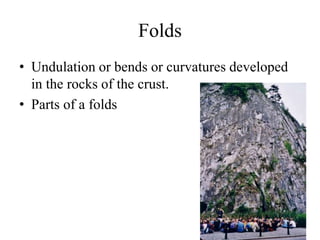
• Undulation or bends or curvatures developed
in the rocks of the crust.
• Parts of a folds
The different parts or elements of a
fold
Fold morphology comprises of components/
elements like:
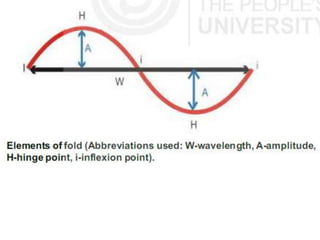
• Wavelength of fold: The folds are the wave like
undulations found in the layered rocks.
Wavelength of the fold is the minimum distance
between its two successive points of same phase.
It can also be defined as the distance between two
alternating inflection points. For practical
purposes the distance between two successive
inflection points is considered as half wavelength
of the fold
• Amplitude of fold: It is the length of perpendicular
drawn from hinge point of the fold on the line joining
the two successive inflection points of the fold.
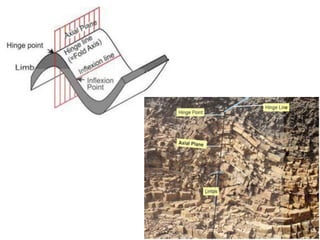
• Hinge point: It is the point of maximum curvature
on the profile section of a fold. The profile of the fold
is a cross section or transverse section across the
hinge line of the fold.
• Hinge zone: Sometimes the maximum curvature of
the fold is not at a point but in a zone called hinge
zone. A hinge zone is a region where the dip of the
folded surface changes over small distance. Such a
region is also called a fold closure.
• Hinge line: It is the locus of hinge points of a
particular bedding plane. Hinge line of a fold is the
line of maximum curvature in the folded bed In other
words, we can say that hinge line is a line along
which change in the direction of dip takes place, and
on many folds this coincides with the amount of
maximum curvature.
• Fold axis: It is an imaginary line which by moving
parallel to itself generates the fold. The hinge line of a
fold is equivalent to ‘fold axis’ if it is straight and the
fold is cylindrical in nature.
• Inflexion point: It is a point of the fold with zero
curvature where its form changes. That is to say, it is
the point where an antiform changes into synform on
cross section of the fold or vice- versa.
• Inflexion line: This line is obtained by joining the
inflexion points of a folded layer. In other words, the
inflexion line is that line from where an antiform
changes into a synform or vice-versa.
• Limb: It is a portion of a fold between inflexion
point and hinge.
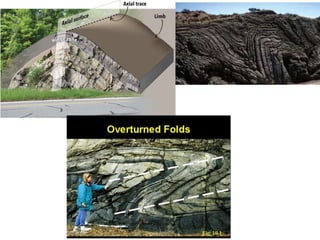
• Axial surface/ Plane: It is a surface formed by
joining of fold hinge lines of successive beds. When
the axial surface forms a plane it is called axial plane.
• Crest: It is that point which is located highest in the
profile section of the fold.
• Trough: It is that point which is located lowest in the
profile section of a fold.
• Crestal line: This is located highest in the fold and is
obtained by joining the crestal points of its layer.
• Trough line: This is located lowest in the fold and is
obtained by joining the trough points its folded layer.
• Interlimb angle: the smallest angle between two
limbs
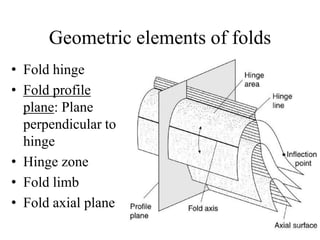
Geometric elements of folds
• Fold hinge
• Fold profile
plane: Plane
perpendicular to
hinge
• Hinge zone
• Fold limb
• Fold axial plane
• Fold closure indicates the direction in which the
limbs converge which is also referred sometimes by
the terms like arching and nose of the fold. The
shape of the fold closure depends on how the
curvature of the folded surface changes around the
hinge. The hinge may be very sharp and the limbs
may be relatively straight, or can have curvature
which is smoother around the fold
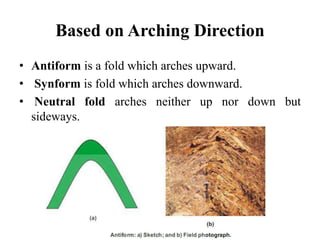
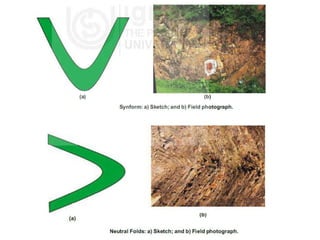
Based on Arching Direction
• Antiform is a fold which arches upward.
• Synform is fold which arches downward.
• Neutral fold arches neither up nor down but
sideways.
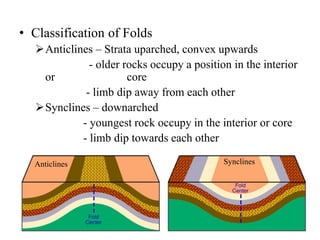
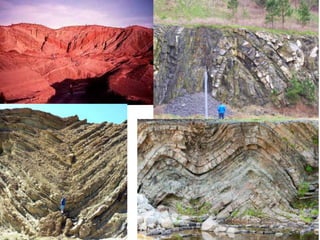
• Classification of Folds
Anticlines – Strata uparched, convex upwards
- older rocks occupy a position in the interior
or core
- limb dip away from each other
Synclines – downarched
- youngest rock occupy in the interior or core
- limb dip towards each other
Anticlines Synclines
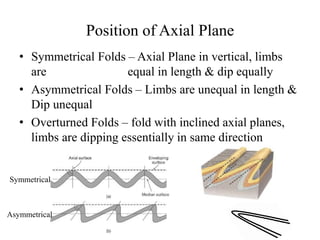
Position of Axial Plane
• Symmetrical Folds – Axial Plane in vertical, limbs
are equal in length & dip equally
• Asymmetrical Folds – Limbs are unequal in length &
Dip unequal
• Overturned Folds – fold with inclined axial planes,
limbs are dipping essentially in same direction
Symmetrical
Asymmetrical
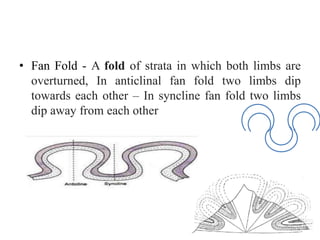
• Fan Fold - A fold of strata in which both limbs are
overturned, In anticlinal fan fold two limbs dip
towards each other – In syncline fan fold two limbs
dip away from each other
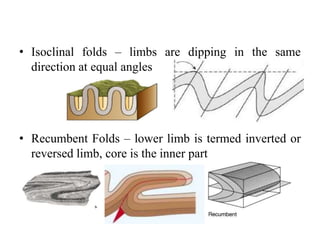
• Isoclinal folds – limbs are dipping in the same
direction at equal angles
• Recumbent Folds – lower limb is termed inverted or
reversed limb, core is the inner part
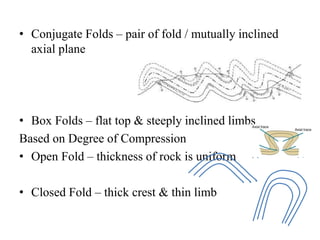
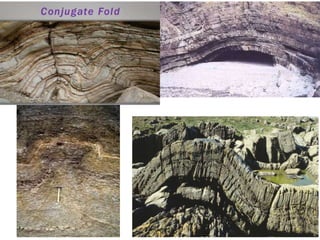
• Conjugate Folds – pair of fold / mutually inclined
axial plane
• Box Folds – flat top & steeply inclined limbs
Based on Degree of Compression
• Open Fold – thickness of rock is uniform
• Closed Fold – thick crest & thin limb
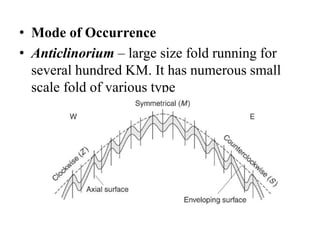
• Mode of Occurrence
• Anticlinorium – large size fold running for
several hundred KM. It has numerous small
scale fold of various type
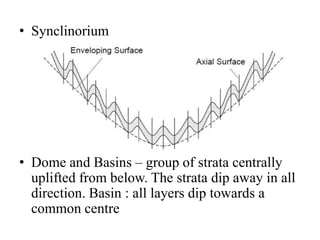
• Synclinorium
• Dome and Basins – group of strata centrally
uplifted from below. The strata dip away in all
direction. Basin : all layers dip towards a
common centre
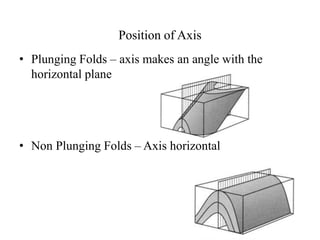
Position of Axis
• Plunging Folds – axis makes an angle with the
horizontal plane
• Non Plunging Folds – Axis horizontal
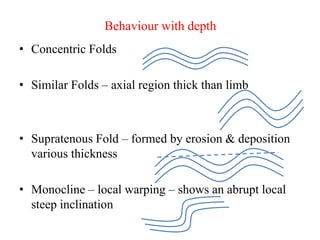
Behaviour with depth
• Concentric Folds
• Similar Folds – axial region thick than limb
• Supratenous Fold – formed by erosion & deposition
various thickness
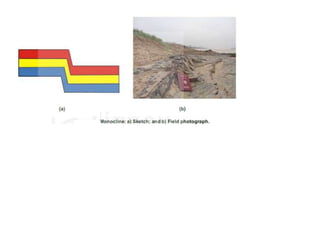
• Monocline – local warping – shows an abrupt local
steep inclination
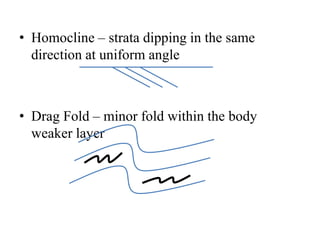
• Homocline – strata dipping in the same
direction at uniform angle
• Drag Fold – minor fold within the body
weaker layer
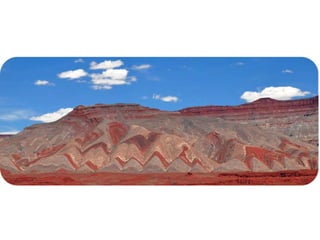
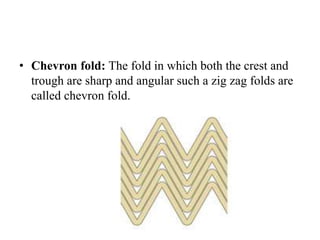
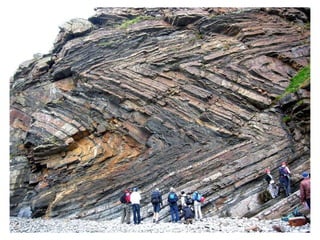
• Chevron fold: The fold in which both the crest and
trough are sharp and angular such a zig zag folds are
called chevron fold.
Controlling Factors of Fold
Geometry
1. Composition and rheological properties of the
competent layer
2. Change in rheological properties of the layer as
P-T change during folding
3. Nature of the less competent matrix
4. Competence contrast (viscosity ratio) between
the layer and the matrix
5. Mechanical properties of the interface between
competent layers (welded or detached)
6. Thickness of the competent layer
7. Thickness contrast between the competent
and the incompetent lay layers
8. Presence (or absence) of multi-layer sequence
9. Orientation of the layer (with respect to the
strain ellipse)
10.Magnitude of stress and scale of folding
CAUSES OF FOLDING
• Tectonic Causes: The tectonic reasons developed due to
compressive forces may include orogenic (mountain
building) forces and endogentic forces which are
generated within the Earth.
• Non-tectonic causes: The non-tectonic reasons which
may cause local folding may be due to hill side creep,
collapse or gravity sliding, erosion of certain bed, glacial
ice push, solution, differential compaction and
contemporaneous or synsedimentary deformation
(deformation occurring at the time of sedimentation).
CRITERIA FOR RECOGNITION
OF FOLDS
• Rock Weathering that geological agencies like wind,
river, glacier, underground water, etc. causes
weathering and erosion resulting in the lowering of
uplifted surfaces.
• The effect of erosion on folded strata is to produce
outcrops such that the succession of beds of one limb
is repeated (though of course in the reverse order) in
the other limb.
• In an eroded anticline, the oldest bed outcrops in the
centre of the fold and as we move outwards,
successively younger beds are found in the outcrop.
• In the eroded syncline, conversely, the youngest bed
outcrops at the centre of the structure, with
successively older beds outcropping to the either side.
• Folds are often visible on the surface and can be
recognised with naked eye but at sometimes it is not
possible to recognise folds.
• There are certain other deformations which alter the
surface, making it difficult to directly recognise the
fold.
The following criteria may be used to recognise or
detect folds in the field:
• Direct observation: Folds may be recognised by
direct observations on the outcrops exposed along the
valley walls, stream, road or railway cuttings,
quarries or tunnels.
• By measuring the attitudes of beds: If the folds are
larger than outcrops they are recognised by
measurements of dip and strike data of bedding
planes.
• By repetition patterns of beds: A symmetric
repetition of beds helps in recognising the fold in the
field. For example, on a linear path if the repetition
occurs in the pattern DCBCD, this would mean that
the fold axis is located in bed B which divides the
rock sequence into 2 halves which are mirror image
to each other.
• By variation in thickness: If the thickness of the bed
is gradually increasing or decreasing, there might be
fold.
• By cleavage- bedding relationship: The cleavage
bedding relation criteria can be used to find the fold.
The top bottom of bed can also be used to identify the
folds.
• When the types of folds are to be recognized on
the basis of the age consideration of the beds, the
top and bottom of beds are determined by taking
into account the nature, and form of the features
occurring on the beds itself. Accordingly some
types of folds have been inferred.
• It is usually observed that streams follows the axis
portion of the anticline ridges and high lands and
damped-structures occur along the axis of the
synclines. So; sometimes the direction flow of
stream or river shows the presence of a fold.

Fold .pptx

  • 1.
    Fold Dr. D. SatheeshHerbert Singh
  • 2.
    Folds • Undulation orbends or curvatures developed in the rocks of the crust. • Parts of a folds
  • 3.
    The different partsor elements of a fold Fold morphology comprises of components/ elements like: • Wavelength of fold: The folds are the wave like undulations found in the layered rocks. Wavelength of the fold is the minimum distance between its two successive points of same phase. It can also be defined as the distance between two alternating inflection points. For practical purposes the distance between two successive inflection points is considered as half wavelength of the fold
  • 5.
    • Amplitude offold: It is the length of perpendicular drawn from hinge point of the fold on the line joining the two successive inflection points of the fold. • Hinge point: It is the point of maximum curvature on the profile section of a fold. The profile of the fold is a cross section or transverse section across the hinge line of the fold. • Hinge zone: Sometimes the maximum curvature of the fold is not at a point but in a zone called hinge zone. A hinge zone is a region where the dip of the folded surface changes over small distance. Such a region is also called a fold closure.
  • 6.
    • Hinge line:It is the locus of hinge points of a particular bedding plane. Hinge line of a fold is the line of maximum curvature in the folded bed In other words, we can say that hinge line is a line along which change in the direction of dip takes place, and on many folds this coincides with the amount of maximum curvature. • Fold axis: It is an imaginary line which by moving parallel to itself generates the fold. The hinge line of a fold is equivalent to ‘fold axis’ if it is straight and the fold is cylindrical in nature.
  • 7.
    • Inflexion point:It is a point of the fold with zero curvature where its form changes. That is to say, it is the point where an antiform changes into synform on cross section of the fold or vice- versa. • Inflexion line: This line is obtained by joining the inflexion points of a folded layer. In other words, the inflexion line is that line from where an antiform changes into a synform or vice-versa. • Limb: It is a portion of a fold between inflexion point and hinge. • Axial surface/ Plane: It is a surface formed by joining of fold hinge lines of successive beds. When the axial surface forms a plane it is called axial plane.
  • 9.
    • Crest: Itis that point which is located highest in the profile section of the fold. • Trough: It is that point which is located lowest in the profile section of a fold. • Crestal line: This is located highest in the fold and is obtained by joining the crestal points of its layer. • Trough line: This is located lowest in the fold and is obtained by joining the trough points its folded layer. • Interlimb angle: the smallest angle between two limbs
  • 10.
    Geometric elements offolds • Fold hinge • Fold profile plane: Plane perpendicular to hinge • Hinge zone • Fold limb • Fold axial plane
  • 11.
    • Fold closureindicates the direction in which the limbs converge which is also referred sometimes by the terms like arching and nose of the fold. The shape of the fold closure depends on how the curvature of the folded surface changes around the hinge. The hinge may be very sharp and the limbs may be relatively straight, or can have curvature which is smoother around the fold
  • 12.
    Based on ArchingDirection • Antiform is a fold which arches upward. • Synform is fold which arches downward. • Neutral fold arches neither up nor down but sideways.
  • 14.
    • Classification ofFolds Anticlines – Strata uparched, convex upwards - older rocks occupy a position in the interior or core - limb dip away from each other Synclines – downarched - youngest rock occupy in the interior or core - limb dip towards each other Anticlines Synclines
  • 16.
    Position of AxialPlane • Symmetrical Folds – Axial Plane in vertical, limbs are equal in length & dip equally • Asymmetrical Folds – Limbs are unequal in length & Dip unequal • Overturned Folds – fold with inclined axial planes, limbs are dipping essentially in same direction Symmetrical Asymmetrical
  • 18.
    • Fan Fold- A fold of strata in which both limbs are overturned, In anticlinal fan fold two limbs dip towards each other – In syncline fan fold two limbs dip away from each other
  • 19.
    • Isoclinal folds– limbs are dipping in the same direction at equal angles • Recumbent Folds – lower limb is termed inverted or reversed limb, core is the inner part
  • 21.
    • Conjugate Folds– pair of fold / mutually inclined axial plane • Box Folds – flat top & steeply inclined limbs Based on Degree of Compression • Open Fold – thickness of rock is uniform • Closed Fold – thick crest & thin limb
  • 23.
    • Mode ofOccurrence • Anticlinorium – large size fold running for several hundred KM. It has numerous small scale fold of various type
  • 25.
    • Synclinorium • Domeand Basins – group of strata centrally uplifted from below. The strata dip away in all direction. Basin : all layers dip towards a common centre
  • 26.
    Position of Axis •Plunging Folds – axis makes an angle with the horizontal plane • Non Plunging Folds – Axis horizontal
  • 27.
    Behaviour with depth •Concentric Folds • Similar Folds – axial region thick than limb • Supratenous Fold – formed by erosion & deposition various thickness • Monocline – local warping – shows an abrupt local steep inclination
  • 29.
    • Homocline –strata dipping in the same direction at uniform angle • Drag Fold – minor fold within the body weaker layer
  • 30.
    • Chevron fold:The fold in which both the crest and trough are sharp and angular such a zig zag folds are called chevron fold.
  • 32.
    Controlling Factors ofFold Geometry 1. Composition and rheological properties of the competent layer 2. Change in rheological properties of the layer as P-T change during folding 3. Nature of the less competent matrix 4. Competence contrast (viscosity ratio) between the layer and the matrix 5. Mechanical properties of the interface between competent layers (welded or detached)
  • 33.
    6. Thickness ofthe competent layer 7. Thickness contrast between the competent and the incompetent lay layers 8. Presence (or absence) of multi-layer sequence 9. Orientation of the layer (with respect to the strain ellipse) 10.Magnitude of stress and scale of folding
  • 34.
    CAUSES OF FOLDING •Tectonic Causes: The tectonic reasons developed due to compressive forces may include orogenic (mountain building) forces and endogentic forces which are generated within the Earth. • Non-tectonic causes: The non-tectonic reasons which may cause local folding may be due to hill side creep, collapse or gravity sliding, erosion of certain bed, glacial ice push, solution, differential compaction and contemporaneous or synsedimentary deformation (deformation occurring at the time of sedimentation).
  • 35.
    CRITERIA FOR RECOGNITION OFFOLDS • Rock Weathering that geological agencies like wind, river, glacier, underground water, etc. causes weathering and erosion resulting in the lowering of uplifted surfaces. • The effect of erosion on folded strata is to produce outcrops such that the succession of beds of one limb is repeated (though of course in the reverse order) in the other limb. • In an eroded anticline, the oldest bed outcrops in the centre of the fold and as we move outwards, successively younger beds are found in the outcrop.
  • 36.
    • In theeroded syncline, conversely, the youngest bed outcrops at the centre of the structure, with successively older beds outcropping to the either side. • Folds are often visible on the surface and can be recognised with naked eye but at sometimes it is not possible to recognise folds. • There are certain other deformations which alter the surface, making it difficult to directly recognise the fold.
  • 37.
    The following criteriamay be used to recognise or detect folds in the field: • Direct observation: Folds may be recognised by direct observations on the outcrops exposed along the valley walls, stream, road or railway cuttings, quarries or tunnels. • By measuring the attitudes of beds: If the folds are larger than outcrops they are recognised by measurements of dip and strike data of bedding planes.
  • 38.
    • By repetitionpatterns of beds: A symmetric repetition of beds helps in recognising the fold in the field. For example, on a linear path if the repetition occurs in the pattern DCBCD, this would mean that the fold axis is located in bed B which divides the rock sequence into 2 halves which are mirror image to each other. • By variation in thickness: If the thickness of the bed is gradually increasing or decreasing, there might be fold. • By cleavage- bedding relationship: The cleavage bedding relation criteria can be used to find the fold. The top bottom of bed can also be used to identify the folds.
  • 39.
    • When thetypes of folds are to be recognized on the basis of the age consideration of the beds, the top and bottom of beds are determined by taking into account the nature, and form of the features occurring on the beds itself. Accordingly some types of folds have been inferred. • It is usually observed that streams follows the axis portion of the anticline ridges and high lands and damped-structures occur along the axis of the synclines. So; sometimes the direction flow of stream or river shows the presence of a fold.