IGCSEGEOGRAPHY
POPULATIONANDMIGRATION
PRESENTATION 1
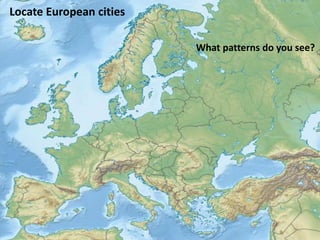
Locate European cities
What patterns do you see?
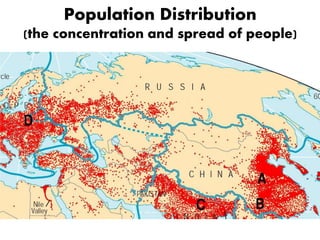
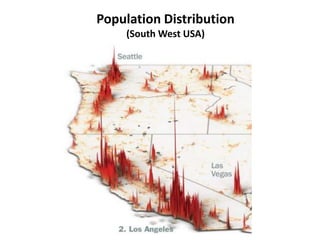
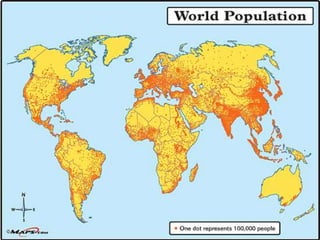
Population Distribution
(the concentration and spread of people)
Population Distribution
(South West USA)
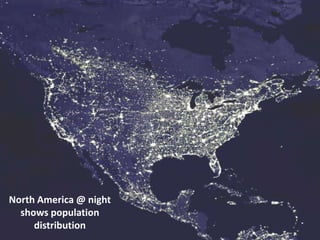
North America @ night
shows population
distribution
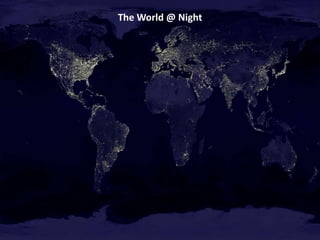
The World @ Night
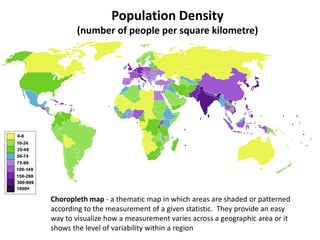
Population Density
(number of people per square kilometre)
Choropleth map - a thematic map in which areas are shaded or patterned
according to the measurement of a given statistic. They provide an easy
way to visualize how a measurement varies across a geographic area or it
shows the level of variability within a region
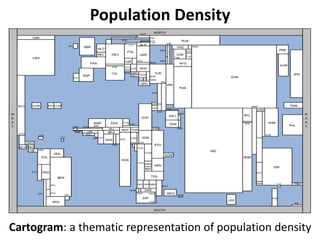
Population Density
Cartogram: a thematic representation of population density
Natural & Social Factors that affect
population density and distribution
Natural…
• Relief
• Climate
• Vegetation
• Soil
• Natural resources
• Water supply
• Natural routes
How would each of
these factors affect
population density
& distribution?
Human…
• Economic
• Political
• Social
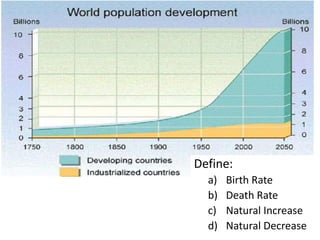
Population Growth
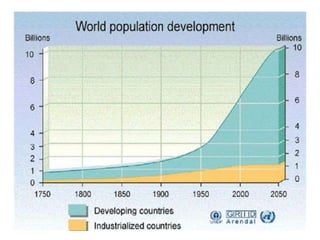
The growth of the world’s population was
slow until the beginning of the 19th
Century (1800’s). Since then it has grown
much faster…
Why could this be…?
But in some countries there is evidence
that population growth is slowing down…
Why could this be…?
Population Change
A growth or decline
of a population
depends on BR and
DR, and to a lesser
extent on migration.
What is???
• Birth Rate
• Death Rate
• Migration
Imagine the
population is the
water in this cup
Births
Deaths
If what is going in
(births)…
is equal to what is
going out
(deaths)…
then the water
level (population)
stays the same
Births
Deaths
If the birth rate is greater
than the death rate…
then the population will
increase.
This is called NATURAL
INCREASE: where birth
rate is higher than death
rate causing the
population to grow.
Births
Deaths
If the death rate is greater
than the birth rate…
then the population will
decrease
This is called NATURAL
DECREASE: where birth
rate is less than death rate
then the population will
decline.
Define:
a) Birth Rate
b) Death Rate
c) Natural Increase
d) Natural Decrease
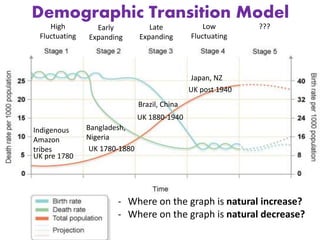
Demographic Transition Model
- Where on the graph is natural increase?
- Where on the graph is natural decrease?
High
Fluctuating
Late
Expanding
Low
Fluctuating
???Early
Expanding
Indigenous
Amazon
tribes
UK pre 1780
Bangladesh,
Nigeria
UK 1780-1880
Brazil, China
UK 1880-1940
Japan, NZ
UK post 1940
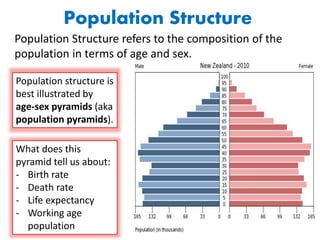
Population Structure
Population Structure refers to the composition of the
population in terms of age and sex.
Population structure is
best illustrated by
age-sex pyramids (aka
population pyramids).
What does this
pyramid tell us about:
- Birth rate
- Death rate
- Life expectancy
- Working age
population
POPULATION PYRAMIDS…
• graphically display a population's age
and gender composition;
• are bar graphs;
• show numbers or proportions of males
and females in each age group;
• show gains of cohort members due to
immigration and birth, and loss of cohort
members due to emigration and death;
• reflect population growth or decline
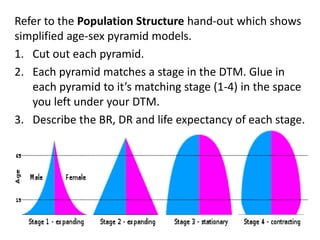
Refer to the Population Structure hand-out which shows
simplified age-sex pyramid models.
1. Cut out each pyramid.
2. Each pyramid matches a stage in the DTM. Glue in
each pyramid to it’s matching stage (1-4) in the space
you left under your DTM.
3. Describe the BR, DR and life expectancy of each stage.
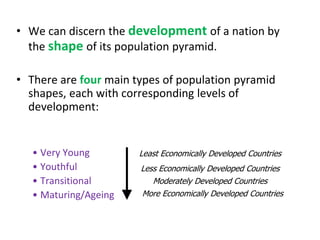
• We can discern the development of a nation by
the shape of its population pyramid.
• There are four main types of population pyramid
shapes, each with corresponding levels of
development:
• Very Young
• Youthful
• Transitional
• Maturing/Ageing
Least Economically Developed Countries
Moderately Developed Countries
Less Economically Developed Countries
More Economically Developed Countries
23
Very Young Youthful
Transitional Mature
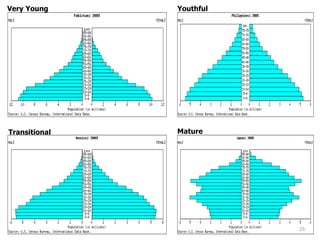
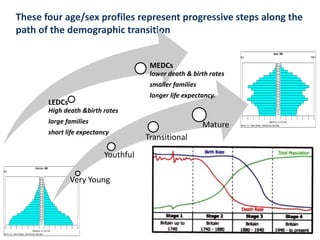
These four age/sex profiles represent progressive steps along the
path of the demographic transition
Very Young
Youthful
Transitional
Mature
LEDCs
High death &birth rates
large families
short life expectancy
MEDCs
lower death & birth rates
smaller families
longer life expectancy.
In countries with a Mature/Ageing
structure...
WHAT IF...
...fertility & death rates continued to drop?
...life expectancies continued to increase?
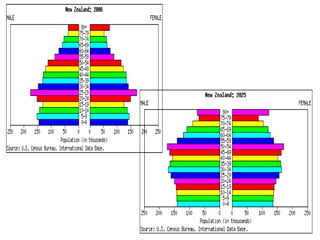
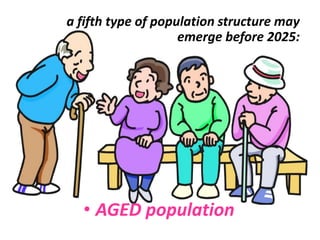
a fifth type of population structure may
emerge before 2025:
• AGED population
27
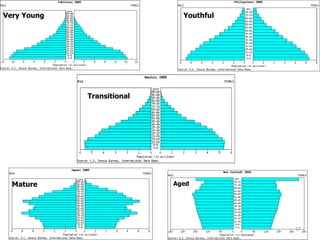
Very Young Youthful
Transitional
Mature Aged
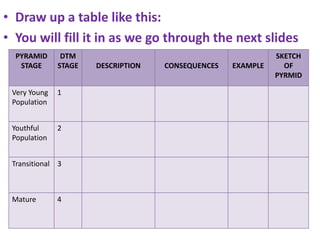
• Draw up a table like this:
• You will fill it in as we go through the next slides
PYRAMID
STAGE
DTM
STAGE DESCRIPTION CONSEQUENCES EXAMPLE
SKETCH
OF
PYRMID
Very Young
Population
1
Youthful
Population
2
Transitional 3
Mature 4
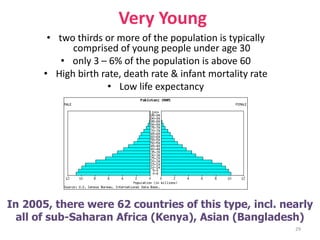
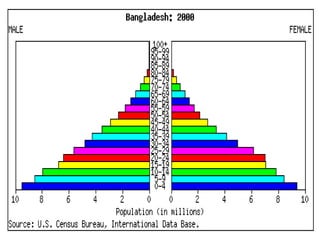
Very Young
• two thirds or more of the population is typically
comprised of young people under age 30
• only 3 – 6% of the population is above 60
• High birth rate, death rate & infant mortality rate
• Low life expectancy
29
In 2005, there were 62 countries of this type, incl. nearly
all of sub-Saharan Africa (Kenya), Asian (Bangladesh)
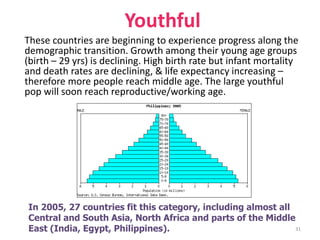
Youthful
These countries are beginning to experience progress along the
demographic transition. Growth among their young age groups
(birth – 29 yrs) is declining. High birth rate but infant mortality
and death rates are declining, & life expectancy increasing –
therefore more people reach middle age. The large youthful
pop will soon reach reproductive/working age.
31
In 2005, 27 countries fit this category, including almost all
Central and South Asia, North Africa and parts of the Middle
East (India, Egypt, Philippines).
Transitional
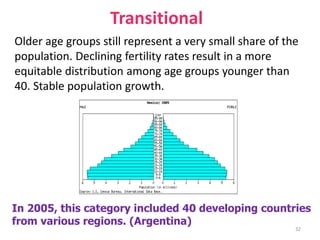
Older age groups still represent a very small share of the
population. Declining fertility rates result in a more
equitable distribution among age groups younger than
40. Stable population growth.
32
In 2005, this category included 40 developing countries
from various regions. (Argentina)
Mature
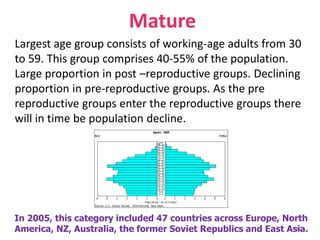
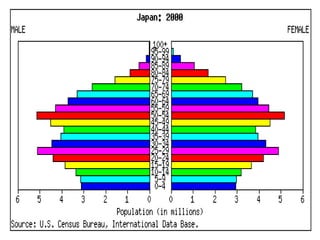
Largest age group consists of working-age adults from 30
to 59. This group comprises 40-55% of the population.
Large proportion in post –reproductive groups. Declining
proportion in pre-reproductive groups. As the pre
reproductive groups enter the reproductive groups there
will in time be population decline.
33
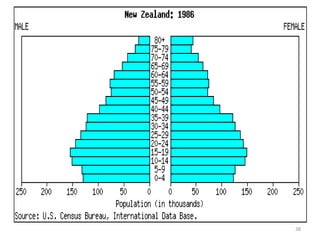
In 2005, this category included 47 countries across Europe, North
America, NZ, Australia, the former Soviet Republics and East Asia.
Dependent population
The Dependent Population are those
aged 0-14 years (youthful dependents)
and 65+ years (elderly dependents).
These people depend on the working
age (15-64) population for economical
support.
Aged Population Structure =
Elderly Dependent Population
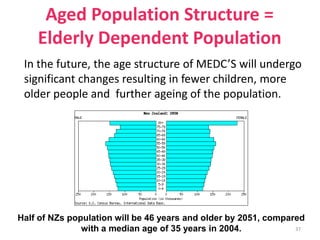
In the future, the age structure of MEDC’S will undergo
significant changes resulting in fewer children, more
older people and further ageing of the population.
37
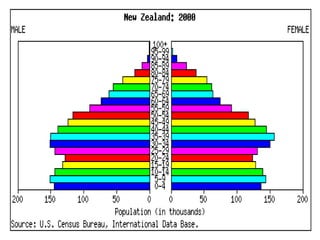
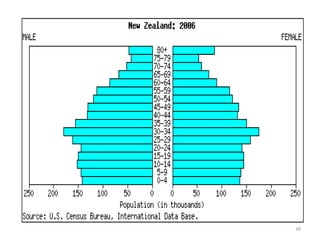
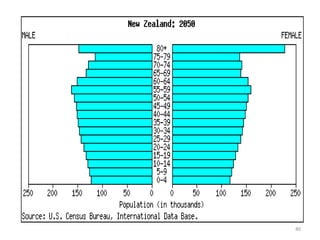
Half of NZs population will be 46 years and older by 2051, compared
with a median age of 35 years in 2004.
38
39
40
41
Population growth and age structure
Working age
group
Young
People
Older
People
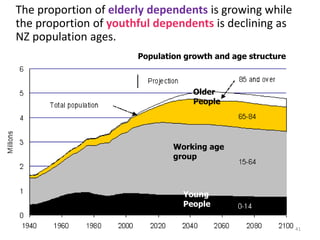
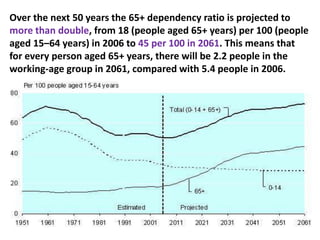
The proportion of elderly dependents is growing while
the proportion of youthful dependents is declining as
NZ population ages.
Over the next 50 years the 65+ dependency ratio is projected to
more than double, from 18 (people aged 65+ years) per 100 (people
aged 15–64 years) in 2006 to 45 per 100 in 2061. This means that
for every person aged 65+ years, there will be 2.2 people in the
working-age group in 2061, compared with 5.4 people in 2006.
What would be the
CONSEQUENCES of
of an ageing
population?
What would be
some plausible
SOLUTIONS to these
consequences?
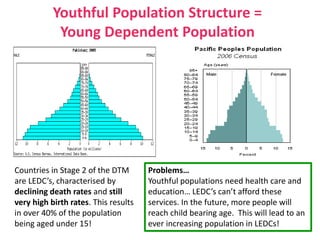
Youthful Population Structure =
Young Dependent Population
Countries in Stage 2 of the DTM
are LEDC’s, characterised by
declining death rates and still
very high birth rates. This results
in over 40% of the population
being aged under 15!
Problems…
Youthful populations need health care and
education… LEDC’s can’t afford these
services. In the future, more people will
reach child bearing age. This will lead to an
ever increasing population in LEDCs!
Population Trends
• Before the 18th century the population growth was very slow
(almost zero) because the high birth rate was cancelled out
by widespread disease, wars and famines (high death rate).
• During the 19th century the population growth was still low,
about 2% each year.
• However since the 20th Century, due to rapid medical and
technological advances, the death rate has fallen rapidly
while the birth rate has remained high =
• This pattern of decreasing death rates, but still very
high birth rates (Stage 2 DTM) is evident in LEDC’s,
who consequently have contributed to this global
population explosion.
Population Explosion
China
China is an ideal example of how government policies can change the
trajectory of pop growth & population structure:
Read the hand out on China’s one-child policy
1. Why was the BR and FR high during the mid-20th Century?
2. What was the BR and average family size during this time?
3. By how much did the BR and family size decline between 1950 –
1975?
4. Describe the main conditions of the One-Child Policy
5. Describe the effects of the One-Child Policy to China’s population.
6. Why has the Government recently relaxed the policy?
7. What are these amendments to the policy?
8. Sketch the population pyramid of China 2008, and what it would
have looked like without the One Child Policy.
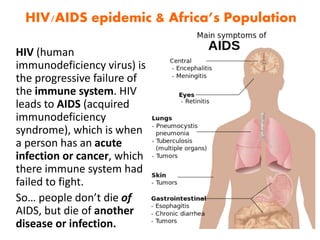
HIV (human
immunodeficiency virus) is
the progressive failure of
the immune system. HIV
leads to AIDS (acquired
immunodeficiency
syndrome), which is when
a person has an acute
infection or cancer, which
there immune system had
failed to fight.
So… people don’t die of
AIDS, but die of another
disease or infection.
HIV/AIDS epidemic & Africa’s Population
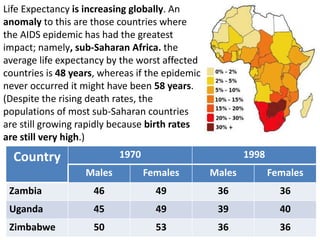
Country 1970 1998
Males Females Males Females
Zambia 46 49 36 36
Uganda 45 49 39 40
Zimbabwe 50 53 36 36
Life Expectancy is increasing globally. An
anomaly to this are those countries where
the AIDS epidemic has had the greatest
impact; namely, sub-Saharan Africa. the
average life expectancy by the worst affected
countries is 48 years, whereas if the epidemic
never occurred it might have been 58 years.
(Despite the rising death rates, the
populations of most sub-Saharan countries
are still growing rapidly because birth rates
are still very high.)
Activities
1. Groups of 3
a) Read through the Impact of HIV/AIDS hand-out
b) Summarise the impacts of HIV/AIDS
2. The Food and Agricultural Organization says
“The disease is no longer just a health
problem but has become a
development issue as well.” Explain this
statement – give examples.
3. How might poverty exacerbate the HIV/AIDS
problem and increase individual
vulnerabilities to the disease?
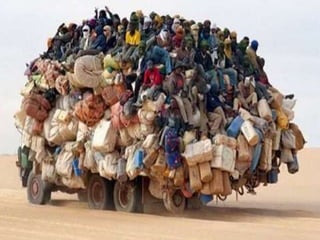
Population & Resources
Overpopulation:
This occurs when there are too many people living in an
area for the resources and technology available for them to
maintain an acceptable standard of living.
EG; most of sub-Saharan Africa = insufficient food, minerals and
energy resources to sustain their exponentially growing
population.
Resources are exploited which leads to famine, desertification,
deforestation and drought. Characterised by poverty.
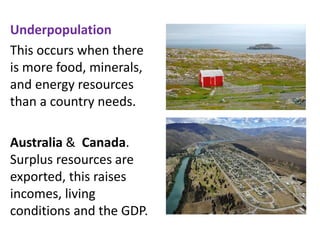
Underpopulation
This occurs when there
is more food, minerals,
and energy resources
than a country needs.
Australia & Canada.
Surplus resources are
exported, this raises
incomes, living
conditions and the GDP.
Activities
1. What is “optimum population”?
2. With reference to population density, explain why the
concepts of over and under are populating complex.
3. Read through the National Geographic article on
Overpopulation.
a) How much has Africa, Asia, Latin America, North America and
Europe’s populations grown since 1960?
b) What % of the worlds pop’n live in LEDC’s
c) By how much do LEDC’s contribute to global pop’n growth?
d) What is likely to be the cause for population growth in
MEDC’s?
e) Provide 3 pieces of evidence of overpopulation in LEDC’s.
f) What developments have allowed increases in food
production?
g) What is the major challenge for governments and industry in
providing food resources for the worlds growing population?
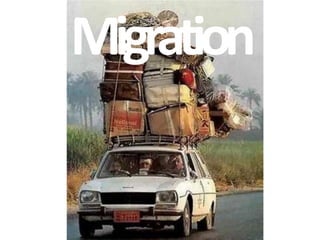
Migration
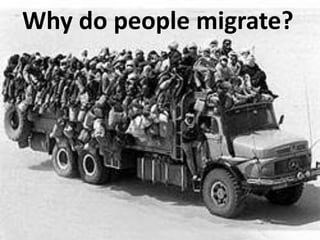
Why do people migrate?
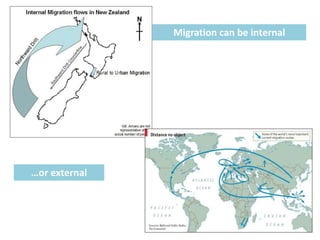
Migration can be internal
…or external
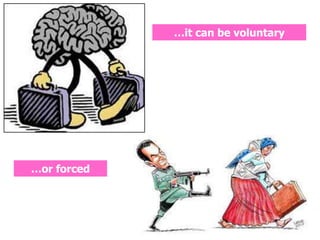
…it can be voluntary
…or forced
Activities
1. What is the difference between:
a) Voluntary and forced migration?
b) Permanent and temporary migration?
2. What is net migration loss and net migration
gain?
3. List at least 3 examples of voluntary migration.
4. List at leas 3 examples of forced migration
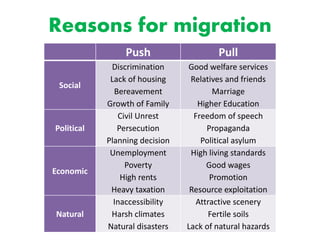
Reasons for migration
Push Pull
Social
Discrimination
Lack of housing
Bereavement
Growth of Family
Good welfare services
Relatives and friends
Marriage
Higher Education
Political
Civil Unrest
Persecution
Planning decision
Freedom of speech
Propaganda
Political asylum
Economic
Unemployment
Poverty
High rents
Heavy taxation
High living standards
Good wages
Promotion
Resource exploitation
Natural
Inaccessibility
Harsh climates
Natural disasters
Attractive scenery
Fertile soils
Lack of natural hazards
Refugees
1. What is a refugee?
2. Why are the UN estimates of refugee’s likely to be
inaccurate?
3. Why are most refugee’s women & children?
4. Describe the plight of refugees.
5. Study Figure 5.4. which continent has the greatest
number of refugees?
6. What percentage of refugee’s are from LEDC’s?
7. Why do refugee’s from LEDC’s tend to move to other
LEDC’s?
8. What are the main causes of refugee moments
increasing since 1980?
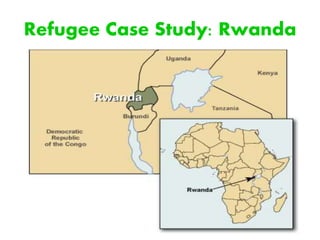
Refugee Case Study: Rwanda
Voluntary Migration Case Study:
Mexicans -> California
1. Why do many Mexicans try to entre the USA
illegally?
2. Give two reasons why the USA:
a) Tries to restrict Mexican migration
b) Needs to attract seasonal Mexican labour
3. Many Mexicans move to LA. Describe the
types of accommodation and jobs they are
likely to find there
Obama has recently loosed the deportation law for Young Mexican
Immigrants. This will affect up to 800,000 young Mexican’s in USA.
WHO STAYS
• Illegal immigrants will be immune from deportation if:
– They were brought to the US before they turned 16 and are
younger than 30.
– Have been in the country for at least five continuous years.
– Have no criminal history.
– Graduated from a US high school.
– Or earned an equivalent diploma or certificate.
– Or served in the military.
How do you think this law change will affect:
- Young Mexican’s in the USA?
- Illegal Mexican immigration?
- USA population structure?

GEOGRAPHY CAMBRIDGE IGCSE: POPULATION AND MIGRATION

  • 1.
  • 2.
    Locate European cities Whatpatterns do you see?
  • 3.
  • 4.
  • 5.
    North America @night shows population distribution
  • 6.
  • 8.
    Population Density (number ofpeople per square kilometre) Choropleth map - a thematic map in which areas are shaded or patterned according to the measurement of a given statistic. They provide an easy way to visualize how a measurement varies across a geographic area or it shows the level of variability within a region
  • 9.
    Population Density Cartogram: athematic representation of population density
  • 10.
    Natural & SocialFactors that affect population density and distribution Natural… • Relief • Climate • Vegetation • Soil • Natural resources • Water supply • Natural routes How would each of these factors affect population density & distribution? Human… • Economic • Political • Social
  • 11.
    Population Growth The growthof the world’s population was slow until the beginning of the 19th Century (1800’s). Since then it has grown much faster… Why could this be…? But in some countries there is evidence that population growth is slowing down… Why could this be…?
  • 12.
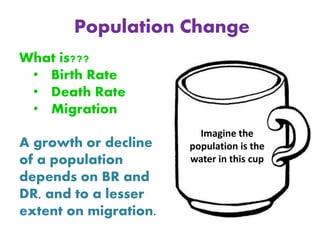
    Population Change A growthor decline of a population depends on BR and DR, and to a lesser extent on migration. What is??? • Birth Rate • Death Rate • Migration Imagine the population is the water in this cup
  • 13.
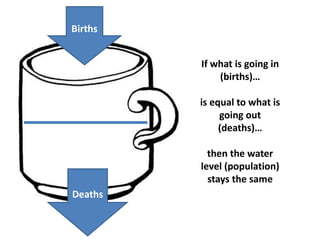
    Births Deaths If what isgoing in (births)… is equal to what is going out (deaths)… then the water level (population) stays the same
  • 14.
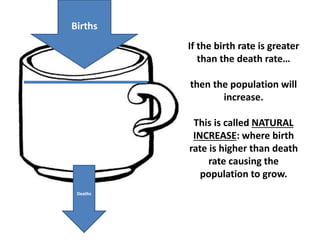
    Births Deaths If the birthrate is greater than the death rate… then the population will increase. This is called NATURAL INCREASE: where birth rate is higher than death rate causing the population to grow.
  • 15.
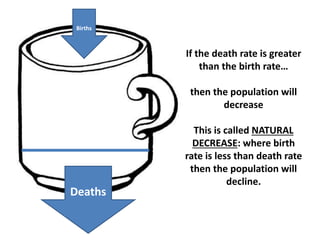
    Births Deaths If the deathrate is greater than the birth rate… then the population will decrease This is called NATURAL DECREASE: where birth rate is less than death rate then the population will decline.
  • 16.
    Define: a) Birth Rate b)Death Rate c) Natural Increase d) Natural Decrease
  • 17.
    Demographic Transition Model -Where on the graph is natural increase? - Where on the graph is natural decrease? High Fluctuating Late Expanding Low Fluctuating ???Early Expanding Indigenous Amazon tribes UK pre 1780 Bangladesh, Nigeria UK 1780-1880 Brazil, China UK 1880-1940 Japan, NZ UK post 1940
  • 18.
    Population Structure Population Structurerefers to the composition of the population in terms of age and sex. Population structure is best illustrated by age-sex pyramids (aka population pyramids). What does this pyramid tell us about: - Birth rate - Death rate - Life expectancy - Working age population
  • 19.
    POPULATION PYRAMIDS… • graphicallydisplay a population's age and gender composition; • are bar graphs; • show numbers or proportions of males and females in each age group; • show gains of cohort members due to immigration and birth, and loss of cohort members due to emigration and death; • reflect population growth or decline
  • 21.
    Refer to thePopulation Structure hand-out which shows simplified age-sex pyramid models. 1. Cut out each pyramid. 2. Each pyramid matches a stage in the DTM. Glue in each pyramid to it’s matching stage (1-4) in the space you left under your DTM. 3. Describe the BR, DR and life expectancy of each stage.
  • 22.
    • We candiscern the development of a nation by the shape of its population pyramid. • There are four main types of population pyramid shapes, each with corresponding levels of development: • Very Young • Youthful • Transitional • Maturing/Ageing Least Economically Developed Countries Moderately Developed Countries Less Economically Developed Countries More Economically Developed Countries
  • 23.
  • 24.
    These four age/sexprofiles represent progressive steps along the path of the demographic transition Very Young Youthful Transitional Mature LEDCs High death &birth rates large families short life expectancy MEDCs lower death & birth rates smaller families longer life expectancy.
  • 25.
    In countries witha Mature/Ageing structure... WHAT IF... ...fertility & death rates continued to drop? ...life expectancies continued to increase?
  • 26.
    a fifth typeof population structure may emerge before 2025: • AGED population
  • 27.
  • 28.
    • Draw upa table like this: • You will fill it in as we go through the next slides PYRAMID STAGE DTM STAGE DESCRIPTION CONSEQUENCES EXAMPLE SKETCH OF PYRMID Very Young Population 1 Youthful Population 2 Transitional 3 Mature 4
  • 29.
    Very Young • twothirds or more of the population is typically comprised of young people under age 30 • only 3 – 6% of the population is above 60 • High birth rate, death rate & infant mortality rate • Low life expectancy 29 In 2005, there were 62 countries of this type, incl. nearly all of sub-Saharan Africa (Kenya), Asian (Bangladesh)
  • 31.
    Youthful These countries arebeginning to experience progress along the demographic transition. Growth among their young age groups (birth – 29 yrs) is declining. High birth rate but infant mortality and death rates are declining, & life expectancy increasing – therefore more people reach middle age. The large youthful pop will soon reach reproductive/working age. 31 In 2005, 27 countries fit this category, including almost all Central and South Asia, North Africa and parts of the Middle East (India, Egypt, Philippines).
  • 32.
    Transitional Older age groupsstill represent a very small share of the population. Declining fertility rates result in a more equitable distribution among age groups younger than 40. Stable population growth. 32 In 2005, this category included 40 developing countries from various regions. (Argentina)
  • 33.
    Mature Largest age groupconsists of working-age adults from 30 to 59. This group comprises 40-55% of the population. Large proportion in post –reproductive groups. Declining proportion in pre-reproductive groups. As the pre reproductive groups enter the reproductive groups there will in time be population decline. 33 In 2005, this category included 47 countries across Europe, North America, NZ, Australia, the former Soviet Republics and East Asia.
  • 36.
    Dependent population The DependentPopulation are those aged 0-14 years (youthful dependents) and 65+ years (elderly dependents). These people depend on the working age (15-64) population for economical support.
  • 37.
    Aged Population Structure= Elderly Dependent Population In the future, the age structure of MEDC’S will undergo significant changes resulting in fewer children, more older people and further ageing of the population. 37 Half of NZs population will be 46 years and older by 2051, compared with a median age of 35 years in 2004.
  • 38.
  • 39.
  • 40.
  • 41.
    41 Population growth andage structure Working age group Young People Older People The proportion of elderly dependents is growing while the proportion of youthful dependents is declining as NZ population ages.
  • 42.
    Over the next50 years the 65+ dependency ratio is projected to more than double, from 18 (people aged 65+ years) per 100 (people aged 15–64 years) in 2006 to 45 per 100 in 2061. This means that for every person aged 65+ years, there will be 2.2 people in the working-age group in 2061, compared with 5.4 people in 2006.
  • 43.
    What would bethe CONSEQUENCES of of an ageing population? What would be some plausible SOLUTIONS to these consequences?
  • 44.
    Youthful Population Structure= Young Dependent Population Countries in Stage 2 of the DTM are LEDC’s, characterised by declining death rates and still very high birth rates. This results in over 40% of the population being aged under 15! Problems… Youthful populations need health care and education… LEDC’s can’t afford these services. In the future, more people will reach child bearing age. This will lead to an ever increasing population in LEDCs!
  • 45.
    Population Trends • Beforethe 18th century the population growth was very slow (almost zero) because the high birth rate was cancelled out by widespread disease, wars and famines (high death rate). • During the 19th century the population growth was still low, about 2% each year. • However since the 20th Century, due to rapid medical and technological advances, the death rate has fallen rapidly while the birth rate has remained high = • This pattern of decreasing death rates, but still very high birth rates (Stage 2 DTM) is evident in LEDC’s, who consequently have contributed to this global population explosion. Population Explosion
  • 47.
    China China is anideal example of how government policies can change the trajectory of pop growth & population structure: Read the hand out on China’s one-child policy 1. Why was the BR and FR high during the mid-20th Century? 2. What was the BR and average family size during this time? 3. By how much did the BR and family size decline between 1950 – 1975? 4. Describe the main conditions of the One-Child Policy 5. Describe the effects of the One-Child Policy to China’s population. 6. Why has the Government recently relaxed the policy? 7. What are these amendments to the policy? 8. Sketch the population pyramid of China 2008, and what it would have looked like without the One Child Policy.
  • 48.
    HIV (human immunodeficiency virus)is the progressive failure of the immune system. HIV leads to AIDS (acquired immunodeficiency syndrome), which is when a person has an acute infection or cancer, which there immune system had failed to fight. So… people don’t die of AIDS, but die of another disease or infection. HIV/AIDS epidemic & Africa’s Population
  • 49.
    Country 1970 1998 MalesFemales Males Females Zambia 46 49 36 36 Uganda 45 49 39 40 Zimbabwe 50 53 36 36 Life Expectancy is increasing globally. An anomaly to this are those countries where the AIDS epidemic has had the greatest impact; namely, sub-Saharan Africa. the average life expectancy by the worst affected countries is 48 years, whereas if the epidemic never occurred it might have been 58 years. (Despite the rising death rates, the populations of most sub-Saharan countries are still growing rapidly because birth rates are still very high.)
  • 50.
    Activities 1. Groups of3 a) Read through the Impact of HIV/AIDS hand-out b) Summarise the impacts of HIV/AIDS 2. The Food and Agricultural Organization says “The disease is no longer just a health problem but has become a development issue as well.” Explain this statement – give examples. 3. How might poverty exacerbate the HIV/AIDS problem and increase individual vulnerabilities to the disease?
  • 51.
    Population & Resources Overpopulation: Thisoccurs when there are too many people living in an area for the resources and technology available for them to maintain an acceptable standard of living. EG; most of sub-Saharan Africa = insufficient food, minerals and energy resources to sustain their exponentially growing population. Resources are exploited which leads to famine, desertification, deforestation and drought. Characterised by poverty.
  • 53.
    Underpopulation This occurs whenthere is more food, minerals, and energy resources than a country needs. Australia & Canada. Surplus resources are exported, this raises incomes, living conditions and the GDP.
  • 54.
    Activities 1. What is“optimum population”? 2. With reference to population density, explain why the concepts of over and under are populating complex. 3. Read through the National Geographic article on Overpopulation. a) How much has Africa, Asia, Latin America, North America and Europe’s populations grown since 1960? b) What % of the worlds pop’n live in LEDC’s c) By how much do LEDC’s contribute to global pop’n growth? d) What is likely to be the cause for population growth in MEDC’s? e) Provide 3 pieces of evidence of overpopulation in LEDC’s. f) What developments have allowed increases in food production? g) What is the major challenge for governments and industry in providing food resources for the worlds growing population?
  • 55.
  • 56.
    Why do peoplemigrate?
  • 57.
    Migration can beinternal …or external
  • 58.
    …it can bevoluntary …or forced
  • 59.
    Activities 1. What isthe difference between: a) Voluntary and forced migration? b) Permanent and temporary migration? 2. What is net migration loss and net migration gain? 3. List at least 3 examples of voluntary migration. 4. List at leas 3 examples of forced migration
  • 60.
    Reasons for migration PushPull Social Discrimination Lack of housing Bereavement Growth of Family Good welfare services Relatives and friends Marriage Higher Education Political Civil Unrest Persecution Planning decision Freedom of speech Propaganda Political asylum Economic Unemployment Poverty High rents Heavy taxation High living standards Good wages Promotion Resource exploitation Natural Inaccessibility Harsh climates Natural disasters Attractive scenery Fertile soils Lack of natural hazards
  • 61.
    Refugees 1. What isa refugee? 2. Why are the UN estimates of refugee’s likely to be inaccurate? 3. Why are most refugee’s women & children? 4. Describe the plight of refugees. 5. Study Figure 5.4. which continent has the greatest number of refugees? 6. What percentage of refugee’s are from LEDC’s? 7. Why do refugee’s from LEDC’s tend to move to other LEDC’s? 8. What are the main causes of refugee moments increasing since 1980?
  • 62.
  • 63.
    Voluntary Migration CaseStudy: Mexicans -> California 1. Why do many Mexicans try to entre the USA illegally? 2. Give two reasons why the USA: a) Tries to restrict Mexican migration b) Needs to attract seasonal Mexican labour 3. Many Mexicans move to LA. Describe the types of accommodation and jobs they are likely to find there
  • 64.
    Obama has recentlyloosed the deportation law for Young Mexican Immigrants. This will affect up to 800,000 young Mexican’s in USA. WHO STAYS • Illegal immigrants will be immune from deportation if: – They were brought to the US before they turned 16 and are younger than 30. – Have been in the country for at least five continuous years. – Have no criminal history. – Graduated from a US high school. – Or earned an equivalent diploma or certificate. – Or served in the military. How do you think this law change will affect: - Young Mexican’s in the USA? - Illegal Mexican immigration? - USA population structure?

Editor's Notes

  • #3 Volunteer students to locate main cities: give them a blue-tacked label with the following cities: London Rome Paris Athens Dublin Berlin Oslo (Norway) Stockholm (Sweden) Helsinski (Finland) Amsterdam Madrid Lisbon (Portugal)
  • #18 Class discussion of each stage… What might be happening in each stage?
  • #30 Draw up a table Youthful – Transitional – Mature – Aged. Under each column have a row for description, example, and a picture.
  • #44 Consequences: Pressure on: Housing Education Food supplies Health services Woking populations Also – potential for further population growth (population explosion, as this generation grows has children etc…)
  • #48 Chinese Govt encouraged large families – it was believed a large population = a strong country Average family size was 5 children Average family size was 3 children … Major drop in youthful dependents… will lead to an inverse population structure.. An again population … Youthful/Transitional
  • #55 The number of ppl living in given area can maximise the use for resources in order to obtain the highest possible standard of living and quality of life. High density of a population does not necessarily equate to overpopulation, ie; parts of California have a very high pop density yet are classed as under populated (b/c it’s about the resources available for that pop). Similarly, low density does not equate to under population, ie; parts of Brazil and Ethiopia have a very low density, yet are considered overpopulated b/c there are inadequate resources even for the few who live there. 3) Africa = 300%. Asia, Latin America & Caribbean = 200%. North America = 50%. Europe = 20% Currently 80%, risen from 70% in 1960 95% Migration 3/5ths of the 4.8 billion people in LEDC’s have no basic sanitation and limited access to clean water. ¼ have inadequate housing. 1/5 no health services Mechanisation of faming, development of fertilizers & pesticides, and understanding of plant diseases, genetic modification. Partnership between governments and industries; environmentally sustainable methods of food production; efficient methods of food production; diplomatic regulation
  • #60 3. Pop groups to the USA NZ tradesmen to Australia Mexicans into California Elderly to Tauranga Development of British colonies 4. a) Africans to the USA b) Palestinian Arabs from Israel c) Jews from Nazi Germany d) Rwandans into the Democratic Republic of Congo e) Refugees
  • #63 - How many is too many – clickview dvd