GENITAL WARTS
HAMISI MKINDI,MD5
INTRODUCTION
• Genital warts are an epidermal manifestation
attributed to the epidermotropic human
papillomavirus (HPV).
• > than 100 types of double-stranded HPV
papovaviruses have been isolated thus far,
and, of these, about 35 types have affinity to
genital sites
INTRODUCTION
• 2 general categories of genital human
papillomavirus (HPV) exist:
– low-risk benign HPV lesions and high-risk
neoplastic HPV lesions.
– The low-risk strains are responsible for genital
warts and recurrent respiratory papillomatosis
(RRP), as well as low-grade cervical lesions.
– Two types, 6 and 11, account for more than 90%
of genital warts and most cases of RRP.
– These are least likely to have malignant potential.
• Thirteen human papillomavirus (HPV) types
(ie, 33, 35, 39, 40, 43, 45, 51-56, 58):
-have a moderate risk for neoplastic
conversion;
-HPV-16 and HPV-18 are considered high
risk; more than 70% of cervical, vaginal, and
penile cancers are caused from 2 types
PATHOPHYSIOLOGY
• Human papillomavirus (HPV) invades cells of the basal layer
of the epidermis, penetrating skin and mucosal micro
abrasions in the genital area.
• A latency period of 3 weeks to 9 months may ensue.
Following that period, viral DNA, capsids, and particles are
produced. Host cells become infected and develop the
morphologic atypical koilocytosis of genital warts.
• When epithelia cells are infected by HPV, they undergo a
transformation in which they divide continuously causing a
buildup of abnormal tissue that eventually becomes a wart
PATHOPHYSIOLOGY
• Most frequently affected are the penis, vulva, vagina,
cervix, perineum, and perianal area. These mucosal
lesions occasionally can be found in the oropharynx,
larynx, and trachea. HPV-6 even has been reported in
other uncommon areas (e.g., extremities).
• Multiple simultaneous lesions are common and may
involve subclinical states as well as different anatomic
sites. Subclinical infections have an infectious and
oncogenic potential. However, most infections are
transient and clear up within 2 years without
intervention.
TRANSMISSION
• Genital warts are very contagious.
Infection is Acquired:
• oral,
• vaginal, or
• anal sex .
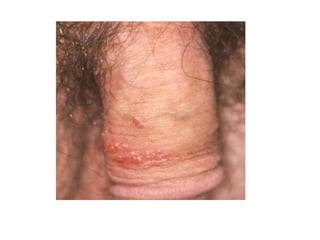
• soft, moist, or flesh colored
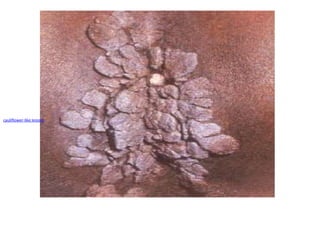
• appear in clusters that resemble
cauliflower-like bumps,
• either raised or flat, small or large
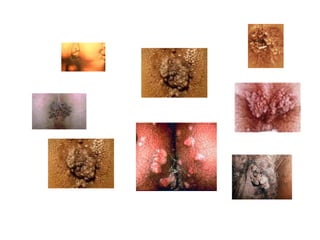
Features of CONDYLOMATA
cauliflower-like lesions
Symptoms of HPV
• discharge,
• pruritis,
• difficulty with defecation,
• anal pain,
• tenesmus,
• foul odor, and
• rectal bleeding
MANIFESTATIONS
• Warts are usually, small,
• discrete, elevated.
• For the cauliflower-like lesions, clinical
presentation is enough.
• These must be differentiated from condyloma
lata and molluscum contagiosum.
• cytology
• PCR
• immunofluorescence
• electron microscopy
Diagnosis
LOCATION of GENITAL WARTS
• Although genital warts are most often found
on or inside the genitals, they can also be
found on the mouth, eyelid, lip, nipple, and
around the anus.
Male locations: Genital Warts
• Anal verge/canal
• just inside the opening of the urethra,
• frenulum,
• head of the penis,
• coronal ridge,
• inner surface of the foreskin,
• along the penile shaft.
Female locations: Genital Warts
• Opening to the vagina,
• inner third of the vagina,
• and cervix.
• .
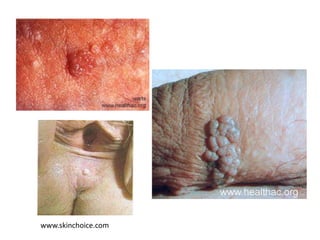
www.skinchoice.com
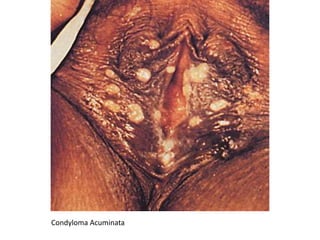
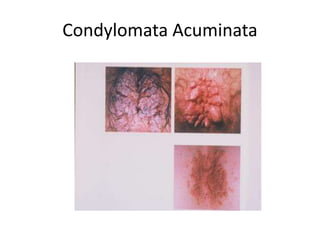
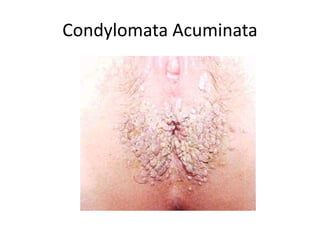
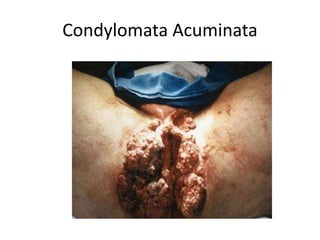
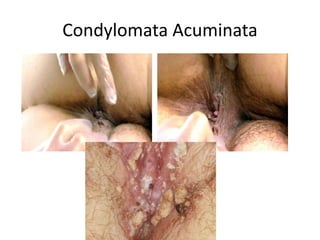
Condyloma Acuminata
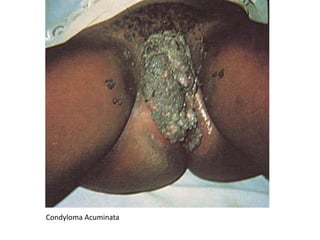
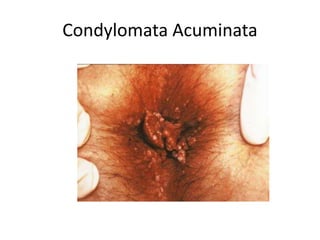
Condyloma Acuminata
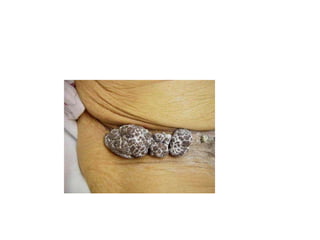
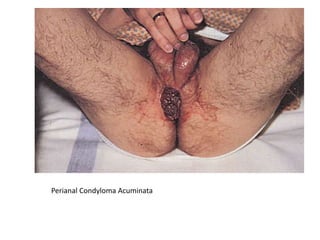
Perianal Condyloma Acuminata
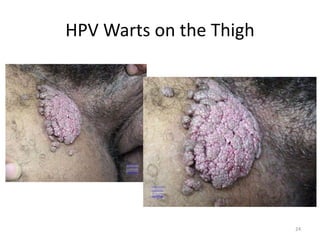
HPV Warts on the Thigh
24
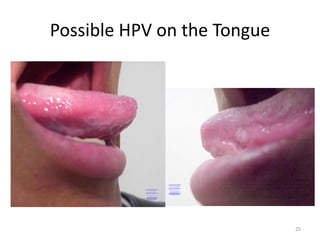
Possible HPV on the Tongue
25
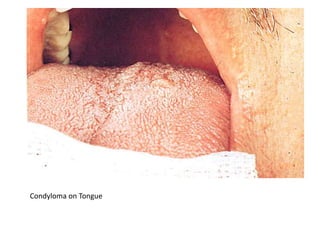
Condyloma on Tongue
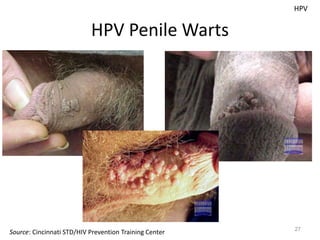
HPV Penile Warts
27
Source: Cincinnati STD/HIV Prevention Training Center
HPV
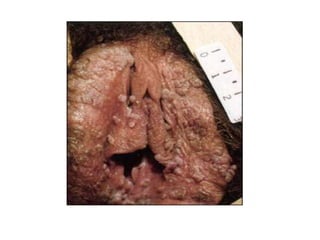
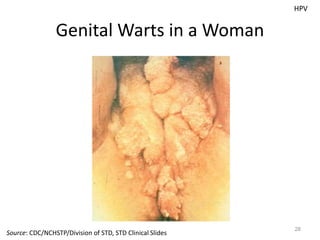
Genital Warts in a Woman
28
HPV
Source: CDC/NCHSTP/Division of STD, STD Clinical Slides
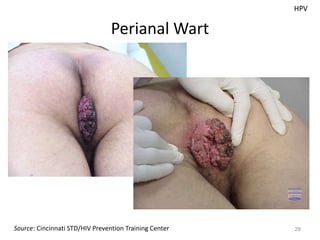
Perianal Wart
29Source: Cincinnati STD/HIV Prevention Training Center
HPV
Condylomata Acuminata
• Successful therapy requires accurate diagnosis and
eradication of all warts
• All patients undergo anoscopy and genital
examination
• Once identified, there are many different treatments
depending on disease progression
• Each treatment has advantages and disadvantages
Treatment Modalities
KERATOLYTICS
- These agents cause the cornified epithelium to swell,
soften, macerate, and then desquamate.
PODOPHYLLIN- cytotoxic chemical agent very toxic to
normal skin. Can only be used on external warts.
• Local complications include necrosis, fistula, and anal
stenosis
• Multiple treatments are usually required
• Other caustic agents are available
• Eg. Bichloracetic Acid
VACCINES
• HPV vaccines are now available for prevention of HPV-
associated dysplasias and neoplasia including cervical
cancer, genital warts (condyloma acuminata), and
precancerous genital lesions.
 GARDASIL:
• Papillomavirus vaccine is a quadrivalent HPV recombinant
vaccine.
• It is indicated for prevention of condyloma acuminata
caused by HPV types 6 and 11 in boys, men, girls, and
women aged 9-26 years.
• It is recommended as part of routine vaccination in girls
and boys aged 11-12 years.
IMMUNE RESPONSE MODIFIERS
• These agents are indicated for treatment of genital
warts. Induces secretion of interferon alpha and other
cytokines; mechanisms of action are unknown. They
may be more effective in women than in men.
• Diamantis et al note that complete clearance of warts
occurred in 50% of patients treated with imiquimod 5%
cream (administered once-daily, 3 times/wk, up to 16
wk.
IMIQUIMOD(ALDARA)5% CREAM
Imiquimod induces secretion of interferon alpha and
other cytokines; the mechanisms of action are unknown.
Ablative therapy
 Cryotherapy- topical application of Liquid Nitrogen
commonly used by dermatologists for the treatment of
conventional warts
 Laser Therapy- work through thermonecrosis
• Success rate from 88-95%
• Higher rate of recurrence seen than electrocoagulation
• No difference in healing time, pain or scarring reported

Genital Warts

  • 1.
  • 2.
    INTRODUCTION • Genital wartsare an epidermal manifestation attributed to the epidermotropic human papillomavirus (HPV). • > than 100 types of double-stranded HPV papovaviruses have been isolated thus far, and, of these, about 35 types have affinity to genital sites
  • 3.
    INTRODUCTION • 2 generalcategories of genital human papillomavirus (HPV) exist: – low-risk benign HPV lesions and high-risk neoplastic HPV lesions. – The low-risk strains are responsible for genital warts and recurrent respiratory papillomatosis (RRP), as well as low-grade cervical lesions. – Two types, 6 and 11, account for more than 90% of genital warts and most cases of RRP. – These are least likely to have malignant potential.
  • 4.
    • Thirteen humanpapillomavirus (HPV) types (ie, 33, 35, 39, 40, 43, 45, 51-56, 58): -have a moderate risk for neoplastic conversion; -HPV-16 and HPV-18 are considered high risk; more than 70% of cervical, vaginal, and penile cancers are caused from 2 types
  • 5.
    PATHOPHYSIOLOGY • Human papillomavirus(HPV) invades cells of the basal layer of the epidermis, penetrating skin and mucosal micro abrasions in the genital area. • A latency period of 3 weeks to 9 months may ensue. Following that period, viral DNA, capsids, and particles are produced. Host cells become infected and develop the morphologic atypical koilocytosis of genital warts. • When epithelia cells are infected by HPV, they undergo a transformation in which they divide continuously causing a buildup of abnormal tissue that eventually becomes a wart
  • 6.
    PATHOPHYSIOLOGY • Most frequentlyaffected are the penis, vulva, vagina, cervix, perineum, and perianal area. These mucosal lesions occasionally can be found in the oropharynx, larynx, and trachea. HPV-6 even has been reported in other uncommon areas (e.g., extremities). • Multiple simultaneous lesions are common and may involve subclinical states as well as different anatomic sites. Subclinical infections have an infectious and oncogenic potential. However, most infections are transient and clear up within 2 years without intervention.
  • 7.
    TRANSMISSION • Genital wartsare very contagious. Infection is Acquired: • oral, • vaginal, or • anal sex .
  • 8.
    • soft, moist,or flesh colored • appear in clusters that resemble cauliflower-like bumps, • either raised or flat, small or large Features of CONDYLOMATA
  • 9.
  • 10.
    Symptoms of HPV •discharge, • pruritis, • difficulty with defecation, • anal pain, • tenesmus, • foul odor, and • rectal bleeding
  • 11.
    MANIFESTATIONS • Warts areusually, small, • discrete, elevated.
  • 12.
    • For thecauliflower-like lesions, clinical presentation is enough. • These must be differentiated from condyloma lata and molluscum contagiosum. • cytology • PCR • immunofluorescence • electron microscopy Diagnosis
  • 13.
    LOCATION of GENITALWARTS • Although genital warts are most often found on or inside the genitals, they can also be found on the mouth, eyelid, lip, nipple, and around the anus.
  • 14.
    Male locations: GenitalWarts • Anal verge/canal • just inside the opening of the urethra, • frenulum, • head of the penis, • coronal ridge, • inner surface of the foreskin, • along the penile shaft.
  • 19.
    Female locations: GenitalWarts • Opening to the vagina, • inner third of the vagina, • and cervix. • .
  • 20.
  • 21.
  • 22.
  • 23.
  • 24.
    HPV Warts onthe Thigh 24
  • 25.
    Possible HPV onthe Tongue 25
  • 26.
  • 27.
    HPV Penile Warts 27 Source:Cincinnati STD/HIV Prevention Training Center HPV
  • 28.
    Genital Warts ina Woman 28 HPV Source: CDC/NCHSTP/Division of STD, STD Clinical Slides
  • 29.
    Perianal Wart 29Source: CincinnatiSTD/HIV Prevention Training Center HPV
  • 30.
  • 31.
  • 32.
  • 33.
  • 34.
  • 35.
    Condylomata Acuminata • Successfultherapy requires accurate diagnosis and eradication of all warts • All patients undergo anoscopy and genital examination • Once identified, there are many different treatments depending on disease progression • Each treatment has advantages and disadvantages
  • 36.
    Treatment Modalities KERATOLYTICS - Theseagents cause the cornified epithelium to swell, soften, macerate, and then desquamate. PODOPHYLLIN- cytotoxic chemical agent very toxic to normal skin. Can only be used on external warts. • Local complications include necrosis, fistula, and anal stenosis • Multiple treatments are usually required • Other caustic agents are available • Eg. Bichloracetic Acid
  • 37.
    VACCINES • HPV vaccinesare now available for prevention of HPV- associated dysplasias and neoplasia including cervical cancer, genital warts (condyloma acuminata), and precancerous genital lesions.  GARDASIL: • Papillomavirus vaccine is a quadrivalent HPV recombinant vaccine. • It is indicated for prevention of condyloma acuminata caused by HPV types 6 and 11 in boys, men, girls, and women aged 9-26 years. • It is recommended as part of routine vaccination in girls and boys aged 11-12 years.
  • 38.
    IMMUNE RESPONSE MODIFIERS •These agents are indicated for treatment of genital warts. Induces secretion of interferon alpha and other cytokines; mechanisms of action are unknown. They may be more effective in women than in men. • Diamantis et al note that complete clearance of warts occurred in 50% of patients treated with imiquimod 5% cream (administered once-daily, 3 times/wk, up to 16 wk. IMIQUIMOD(ALDARA)5% CREAM Imiquimod induces secretion of interferon alpha and other cytokines; the mechanisms of action are unknown.
  • 39.
    Ablative therapy  Cryotherapy-topical application of Liquid Nitrogen commonly used by dermatologists for the treatment of conventional warts  Laser Therapy- work through thermonecrosis • Success rate from 88-95% • Higher rate of recurrence seen than electrocoagulation • No difference in healing time, pain or scarring reported