GENITAL WARTS
  PROF:AKMAL JAMAL
    FCPS;FRCSEd:
    30 APRIL 2012
Condyloma acuminata
HPV
Human Papilloma Virus
 Condyloma  Acuminata represents
  the most common STI
 Caused by a DNA virus that is a
  member of the Papovirus group-
  HPV
 Most Commonly seen in
  Homosexual Male population
Human Papilloma Virus
 19 % of patients with HIV have been found to
  have anal condyloma
 It is recommended
 that all patients with anal condyloma undergo
  HIV testing
Genital Warts (HPV)
 There   is NO cure for the virus.

   can spread the virus to anyone you
    have sex with.

.
     can still get HPV even when you
    use a condom.
HPV


         Human Papillomavirus

 Many types of Human Papillomavirus (HPV),
  some of which infect the genital area
 Incubation period unclear

 Can infect men, women, and newborns

 The person can easily pass it on to sex
  partners


                                              6
HPV


          Genital HPV: Two Types

   The types of HPV that infect the genital area
    are labeled “low-risk” or “high-risk”
    depending on whether they can cause cancer
    or not.
 Low-risk     HPV types can cause genital
  warts.
 High-risk HPV types can cause serious
  cervical lesions, cervical cancer, and other
  genital cancers.

                                                 7
Condylomata Acuminata
   Over 40 subtypes of HPV
 Most     common 6 and 11
   16, 18, 31, and 32 are associated with
    squamous cell carcinoma
TRANSMISSION
 Genital  warts are very
    contagious.

 Infection is Acquired
 oral,

 vaginal, or

 anal sex .
Epidemiology
·    Genital warts caused by HPV 6
and 11 are the most common
·    Direct contact with the lesion is
believed to result in spread of the
disease.

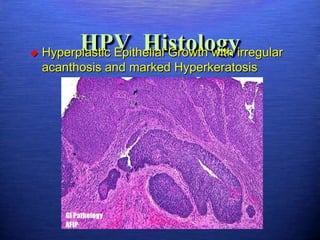
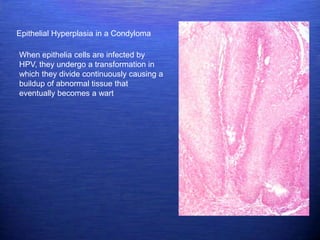
           HPV Histology
    Hyperplastic Epithelial Growth with irregular
    acanthosis and marked Hyperkeratosis
Epithelial Hyperplasia in a Condyloma

When epithelia cells are infected by
HPV, they undergo a transformation in
which they divide continuously causing a
buildup of abnormal tissue that
eventually becomes a wart
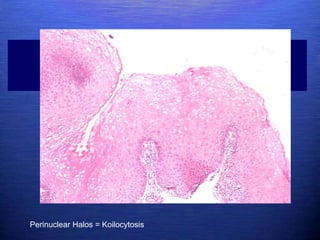
Perinuclear Halos = Koilocytosis
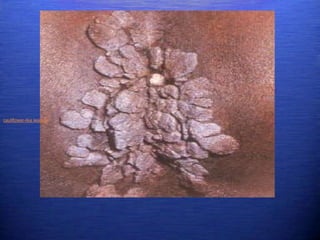
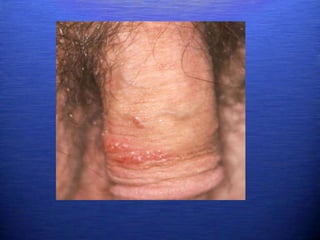
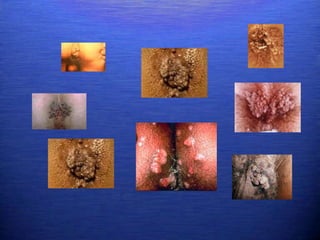
Features of
   CONDYLOMATA
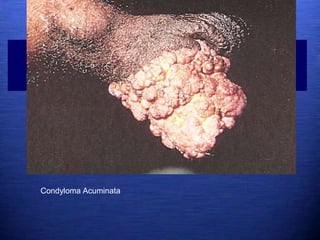
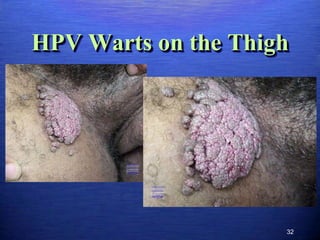
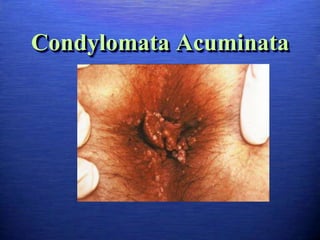
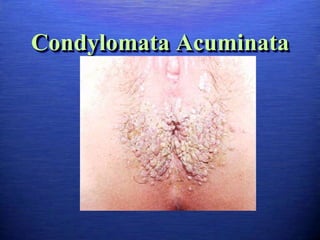
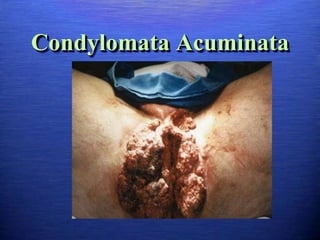
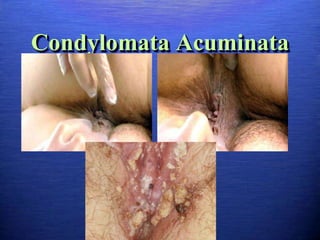
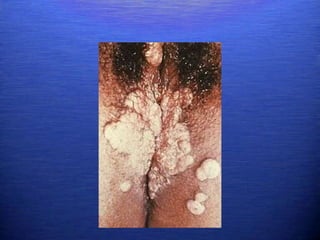
soft, moist, or flesh colored
 appear in clusters that resemble
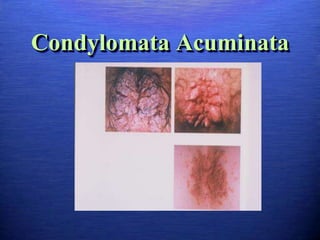
cauliflower-like bumps,
either raised or flat, small or large
cauliflower-like lesions
Symptoms of HPV
  discharge,
 pruritis,

 difficulty with defecation,

 anal pain,

 tenesmus,

 foul odor, and

 rectal bleeding
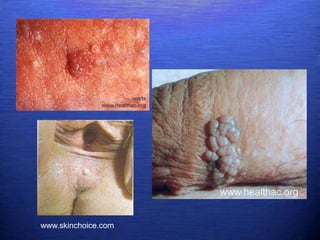
Manifestations
Warts are usually, small,
discrete, elevated pink to grey vegetative
excrescences

   ·   Soft, fleshy,
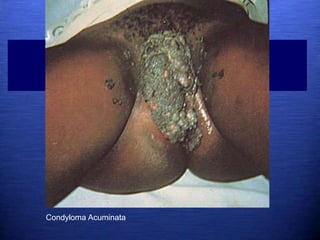
   cauliflower-like lesions on the skin,
   genitalia, perineum, and perianal
   regions   .
Diagnosis
For the cauliflower-like lesions, clinical
presentation is enough.
These must be differentiated from condyloma
lata and molluscum contagiosum.

cytology
  PCR
  immunofluorescence
  electron microscopy
   COMPLICATIONS

Cancer
  cervical cancer.
 vulvar cancer,

 anal cancer, and

 cancer of the penis (a rare cancer).

.
LOCATION of
       GENITAL WARTS
   Although genital warts are most often found
    on or inside the genitals, they can also be
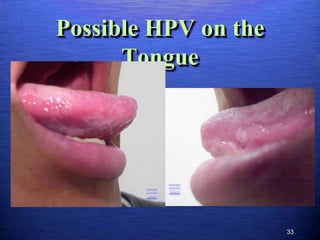
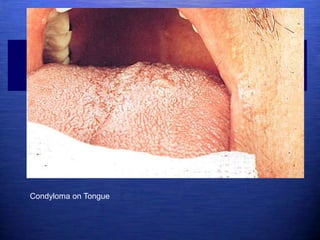
    found on the mouth, eyelid, lip, nipple, and
    around the anus.
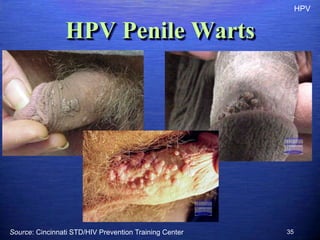
Male locations: Genital Warts

: Anal verge/canal
just inside the opening of the urethra,
 frenulum,
 head of the penis,
 coronal ridge,
 inner surface of the foreskin,
along the penile shaft.
Female locations: Genital
Warts

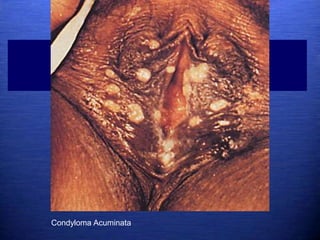
   Opening to the vagina,
   inner third of the vagina,
   and cervix.
   .
www.skinchoice.com
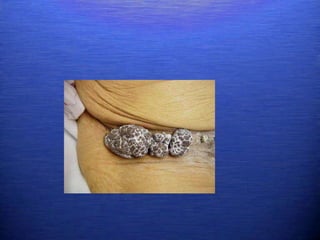
Condyloma Acuminata
Condyloma Acuminata
Condyloma Acuminata
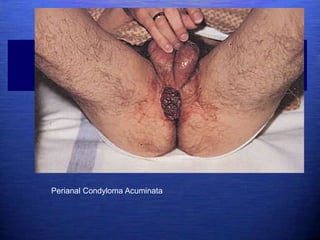
Perianal Condyloma Acuminata
HPV Warts on the Thigh


                     32
Possible HPV on the
      Tongue


                      33
Condyloma on Tongue
HPV


                 HPV Penile Warts


Source: Cincinnati STD/HIV Prevention Training Center   35
HPV


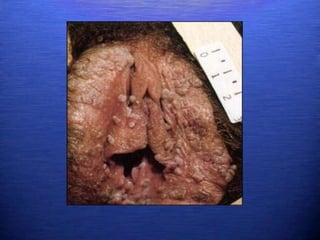
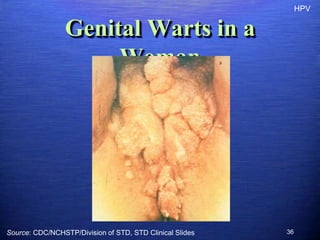
                 Genital Warts in a
                      Woman


Source: CDC/NCHSTP/Division of STD, STD Clinical Slides   36
HPV


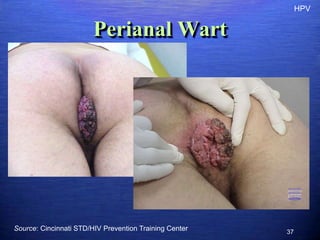
                        Perianal Wart


Source: Cincinnati STD/HIV Prevention Training Center   37
Condylomata Acuminata
 Successful therapy requires accurate
  diagnosis and eradication of all warts
 All patients undergo anoscopy and genital
  examination
 Once identified, there are many different
  treatments depending on disease progression
 Each treatment has advantages and
  disadvantages
Treatment Modalities
 1. Podophyllin- cytotoxic chemical agent
  very toxic to normal skin. Can only be used
  on external warts.
.
 Local complications include necrosis, fistula,
  and anal stenosis
 Multiple treatments are usually required
 Other caustic agents are available
 Eg. Bichloracetic Acid
Immunotherapy
   2. A Vaccine is created and the patient is
    vaccinated with six consecutive weekly
    injections
HPV Vaccine - Gardisil
   Approved for use in women only, 9-26
       Recommended at ages 11-12
       Catch-up older patients
       3 vaccine series (0,2,6 mo)
   Efficacy varies, outcomes studied vary
       But efficacy in the 90+ percentile for reduction of
        type-specific dysplasia
   Targets HPV 6/11,16/18
       Based on primary capsid proteins
Immunomodulators
     (Imiquimod/Aldara)
 3. Imidazoquinolines- a new class of
  immune-response modulators
 Mechanism of action unknown, but thought to
  play a role in cytokine-induced activation of
  the immune system
 Application 3/week qhs x 16weeks
Condylomata Acuminata
 Two therapies that are more commonly
  practiced today are interferon injections
  and Aldara (imiquimod) cream
 Both therapies are very potent with many
  side-effects
 LFT’s should be checked routinely with
  interferon injections
 Aldara should be used every other day,
  because it can burn normal tissue and make
  it necrotic
Topical Cytostatics
 4. Chemotherapeutic agents such as 5-FU,
  Thiotepa and Bleomycin
 Bleomycin is given as an intra-lesional
  injection q2-3weeks
 70% success rate reported
Cryotherapy and Laser
                Therapy
    5. Cryotherapy- topical application of Liquid
    Nitrogen commonly used by dermatologists for the
    treatment of conventional warts


   6. Laser Therapy- work through
    thermonecrosis
   Success rate from 88-95%
   Higher rate of recurrence seen than
    electrocoagulation
   No difference in healing time, pain or scarring
    reported
Fulgaration/Electrocoagu
         lation
 7. Fulgaration with excision of a portion to
  send to pathology
 Gold Standard
 Very Painful if done too deeply, should not be
  into the dermis or fat
 Risk of stricture formation if a large area is to
  be treated
 Less than 50% have full resolution after one
  treatment
Anal Condylomata
          Summary
 External Condylomata without evidence of
  Internal Warts can usually be effectively
  treated by chemical means
 If the response is unsatisfactory, physical
  destruction by electrocoagulation is the
  preferred approach
 Obtaining tissue for pathologic confirmation,
  especially with respect to premalignant or
  malignant change is a a prudent philosophy
Sores

     Secondary Syphilis -
    Clinical Manifestations
 Represents hematogenous dissemination of
  spirochetes
 Usually 2-8 weeks after chancre appears
 Findings:
       rash - whole body (includes palms/soles)
       mucous patches
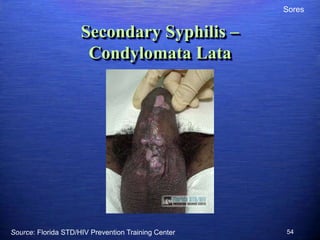
       condylomata lata - HIGHLY INFECTIOUS
       constitutional symptoms
   Sn/Sx resolve in 2-10 weeks
                                                   53
Sores


                     Secondary Syphilis –
                      Condylomata Lata


Source: Florida STD/HIV Prevention Training Center   54
MOLLUSCUM
      CONTAGIOSUM
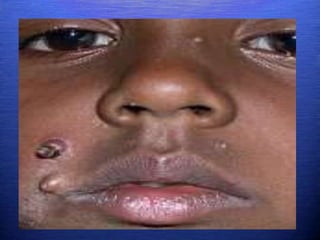
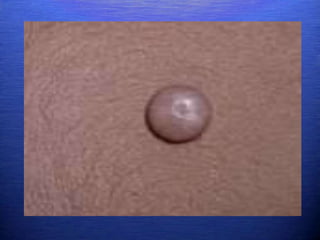
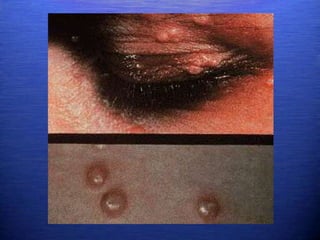
 Molluscum contagiosum (MC) is a common,
  self-limited, benign viral infection of the skin
  caused by a member of the pox-virus group.
 MC is transmitted by close personal contact
  including sexual contact
DIAGNOSIS


   Diagnosis is usually done on clinical grounds
    alone by the typical appearance of the lesions.

   Expression of materials stained with Giemsa,
    Wright or Gram stain reveals molluscum bodies.

   Biopsy, which shows characteristic features of
    epidermal hyperplasia.
Complications:


 Secondary infections
 Eczematization

 Conjunctivitis/keratitis from eyelid infection
DIFFERENTIAL
          DIAGNOSIS
   Acne whiteheads
    Warts
    Pyoderma
    Cryptococcosis
Questions?

Genital Warts.PROF:AKMAL JAMAL

  • 1.
    GENITAL WARTS PROF:AKMAL JAMAL FCPS;FRCSEd: 30 APRIL 2012
  • 2.
  • 3.
    Human Papilloma Virus Condyloma Acuminata represents the most common STI  Caused by a DNA virus that is a member of the Papovirus group- HPV  Most Commonly seen in Homosexual Male population
  • 4.
    Human Papilloma Virus 19 % of patients with HIV have been found to have anal condyloma  It is recommended  that all patients with anal condyloma undergo HIV testing
  • 5.
    Genital Warts (HPV) There is NO cure for the virus.  can spread the virus to anyone you have sex with. . can still get HPV even when you use a condom.
  • 6.
    HPV Human Papillomavirus  Many types of Human Papillomavirus (HPV), some of which infect the genital area  Incubation period unclear  Can infect men, women, and newborns  The person can easily pass it on to sex partners 6
  • 7.
    HPV Genital HPV: Two Types  The types of HPV that infect the genital area are labeled “low-risk” or “high-risk” depending on whether they can cause cancer or not.  Low-risk HPV types can cause genital warts.  High-risk HPV types can cause serious cervical lesions, cervical cancer, and other genital cancers. 7
  • 8.
    Condylomata Acuminata  Over 40 subtypes of HPV  Most common 6 and 11  16, 18, 31, and 32 are associated with squamous cell carcinoma
  • 9.
    TRANSMISSION  Genital warts are very contagious.  Infection is Acquired  oral,  vaginal, or  anal sex .
  • 10.
    Epidemiology · Genital warts caused by HPV 6 and 11 are the most common · Direct contact with the lesion is believed to result in spread of the disease.
  • 11.
    HPV Histology Hyperplastic Epithelial Growth with irregular acanthosis and marked Hyperkeratosis
  • 12.
    Epithelial Hyperplasia ina Condyloma When epithelia cells are infected by HPV, they undergo a transformation in which they divide continuously causing a buildup of abnormal tissue that eventually becomes a wart
  • 13.
    Perinuclear Halos =Koilocytosis
  • 14.
    Features of CONDYLOMATA soft, moist, or flesh colored appear in clusters that resemble cauliflower-like bumps, either raised or flat, small or large
  • 15.
  • 16.
    Symptoms of HPV  discharge,  pruritis,  difficulty with defecation,  anal pain,  tenesmus,  foul odor, and  rectal bleeding
  • 17.
    Manifestations Warts are usually,small, discrete, elevated pink to grey vegetative excrescences · Soft, fleshy, cauliflower-like lesions on the skin, genitalia, perineum, and perianal regions .
  • 18.
    Diagnosis For the cauliflower-likelesions, clinical presentation is enough. These must be differentiated from condyloma lata and molluscum contagiosum. cytology PCR immunofluorescence electron microscopy
  • 19.
    COMPLICATIONS Cancer  cervical cancer.  vulvar cancer,  anal cancer, and  cancer of the penis (a rare cancer). .
  • 20.
    LOCATION of GENITAL WARTS  Although genital warts are most often found on or inside the genitals, they can also be found on the mouth, eyelid, lip, nipple, and around the anus.
  • 21.
    Male locations: GenitalWarts : Anal verge/canal just inside the opening of the urethra, frenulum, head of the penis, coronal ridge, inner surface of the foreskin, along the penile shaft.
  • 26.
    Female locations: Genital Warts Opening to the vagina, inner third of the vagina, and cervix. .
  • 27.
  • 28.
  • 29.
  • 30.
  • 31.
  • 32.
    HPV Warts onthe Thigh 32
  • 33.
    Possible HPV onthe Tongue 33
  • 34.
  • 35.
    HPV HPV Penile Warts Source: Cincinnati STD/HIV Prevention Training Center 35
  • 36.
    HPV Genital Warts in a Woman Source: CDC/NCHSTP/Division of STD, STD Clinical Slides 36
  • 37.
    HPV Perianal Wart Source: Cincinnati STD/HIV Prevention Training Center 37
  • 38.
  • 39.
  • 40.
  • 41.
  • 42.
  • 43.
    Condylomata Acuminata  Successfultherapy requires accurate diagnosis and eradication of all warts  All patients undergo anoscopy and genital examination  Once identified, there are many different treatments depending on disease progression  Each treatment has advantages and disadvantages
  • 44.
    Treatment Modalities  1.Podophyllin- cytotoxic chemical agent very toxic to normal skin. Can only be used on external warts. .  Local complications include necrosis, fistula, and anal stenosis  Multiple treatments are usually required  Other caustic agents are available  Eg. Bichloracetic Acid
  • 45.
    Immunotherapy  2. A Vaccine is created and the patient is vaccinated with six consecutive weekly injections
  • 46.
    HPV Vaccine -Gardisil  Approved for use in women only, 9-26  Recommended at ages 11-12  Catch-up older patients  3 vaccine series (0,2,6 mo)  Efficacy varies, outcomes studied vary  But efficacy in the 90+ percentile for reduction of type-specific dysplasia  Targets HPV 6/11,16/18  Based on primary capsid proteins
  • 47.
    Immunomodulators (Imiquimod/Aldara)  3. Imidazoquinolines- a new class of immune-response modulators  Mechanism of action unknown, but thought to play a role in cytokine-induced activation of the immune system  Application 3/week qhs x 16weeks
  • 48.
    Condylomata Acuminata  Twotherapies that are more commonly practiced today are interferon injections and Aldara (imiquimod) cream  Both therapies are very potent with many side-effects  LFT’s should be checked routinely with interferon injections  Aldara should be used every other day, because it can burn normal tissue and make it necrotic
  • 49.
    Topical Cytostatics  4.Chemotherapeutic agents such as 5-FU, Thiotepa and Bleomycin  Bleomycin is given as an intra-lesional injection q2-3weeks  70% success rate reported
  • 50.
    Cryotherapy and Laser  Therapy 5. Cryotherapy- topical application of Liquid Nitrogen commonly used by dermatologists for the treatment of conventional warts  6. Laser Therapy- work through thermonecrosis  Success rate from 88-95%  Higher rate of recurrence seen than electrocoagulation  No difference in healing time, pain or scarring reported
  • 51.
    Fulgaration/Electrocoagu lation  7. Fulgaration with excision of a portion to send to pathology  Gold Standard  Very Painful if done too deeply, should not be into the dermis or fat  Risk of stricture formation if a large area is to be treated  Less than 50% have full resolution after one treatment
  • 52.
    Anal Condylomata Summary  External Condylomata without evidence of Internal Warts can usually be effectively treated by chemical means  If the response is unsatisfactory, physical destruction by electrocoagulation is the preferred approach  Obtaining tissue for pathologic confirmation, especially with respect to premalignant or malignant change is a a prudent philosophy
  • 53.
    Sores Secondary Syphilis - Clinical Manifestations  Represents hematogenous dissemination of spirochetes  Usually 2-8 weeks after chancre appears  Findings:  rash - whole body (includes palms/soles)  mucous patches  condylomata lata - HIGHLY INFECTIOUS  constitutional symptoms  Sn/Sx resolve in 2-10 weeks 53
  • 54.
    Sores Secondary Syphilis – Condylomata Lata Source: Florida STD/HIV Prevention Training Center 54
  • 56.
    MOLLUSCUM CONTAGIOSUM  Molluscum contagiosum (MC) is a common, self-limited, benign viral infection of the skin caused by a member of the pox-virus group.  MC is transmitted by close personal contact including sexual contact
  • 57.
    DIAGNOSIS   Diagnosis is usually done on clinical grounds alone by the typical appearance of the lesions.  Expression of materials stained with Giemsa, Wright or Gram stain reveals molluscum bodies.  Biopsy, which shows characteristic features of epidermal hyperplasia.
  • 61.
    Complications:   Secondary infections Eczematization  Conjunctivitis/keratitis from eyelid infection
  • 62.
    DIFFERENTIAL DIAGNOSIS  Acne whiteheads Warts Pyoderma Cryptococcosis
  • 63.