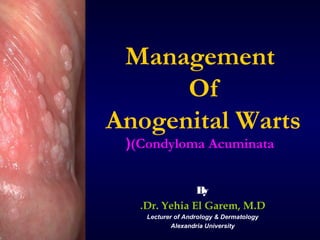
Management
Of
Anogenital Warts
((Condyloma Acuminata
B
y
.Dr. Yehia El Garem, M.D
Lecturer of Andrology & Dermatology
Alexandria University
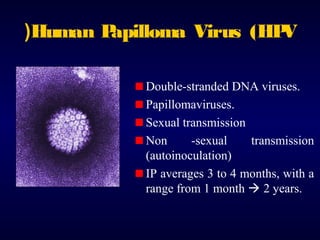
(Human P
apilloma Virus (HP
V
Double-stranded DNA viruses.
Papillomaviruses.
Sexual transmission
Non
-sexual
transmission
(autoinoculation)
IP averages 3 to 4 months, with a
range from 1 month  2 years.
HP Genotypes Causing
V
Condyloma Acuminata
Low risk HPV: 6, 11
42, 43, 44

High risk HPV: 16, 18
31, 33, 35, 39, 45, 55,
58.
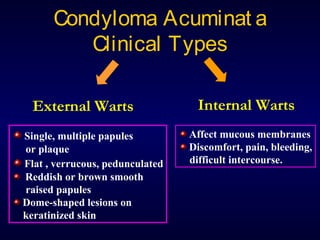
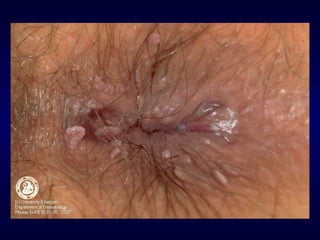
Condyloma Acuminat a
Clinical Types
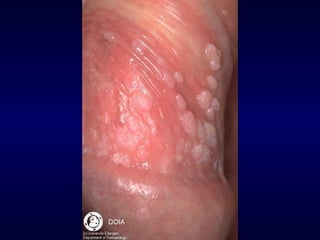
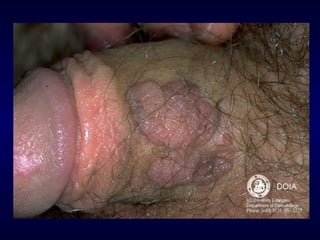
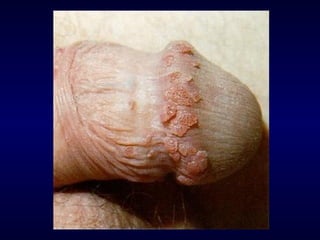
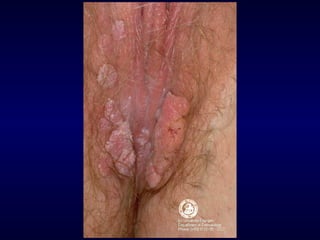
External Warts
Single, multiple papules
or plaque
Flat , verrucous, pedunculated
Reddish or brown smooth
raised papules
Dome-shaped lesions on
keratinized skin

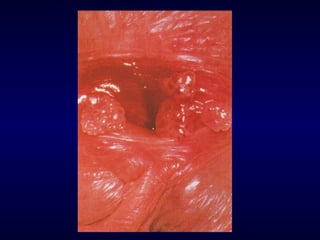
Internal Warts
Affect mucous membranes
Discomfort, pain, bleeding,
difficult intercourse.
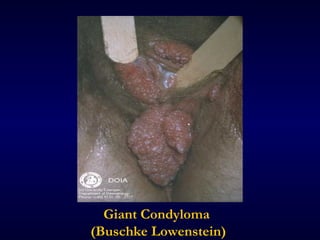
Giant Condyloma
(Buschke Lowenstein)
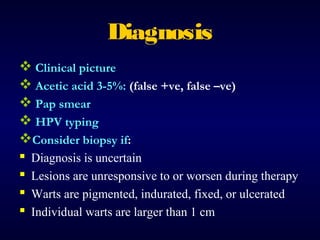
Diagnosis
 Clinical picture
 Acetic acid 3-5%: (false +ve, false –ve)
 Pap smear
 HPV typing
Consider biopsy if:
 Diagnosis is uncertain
 Lesions are unresponsive to or worsen during therapy
 Warts are pigmented, indurated, fixed, or ulcerated
 Individual warts are larger than 1 cm
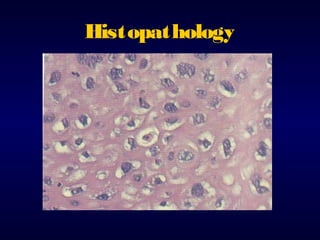
Histopathology
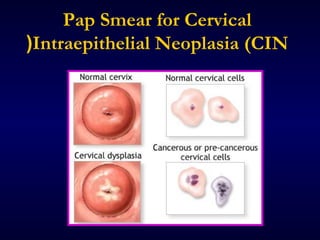
Pap Smear for Cervical
(Intraepithelial Neoplasia (CIN
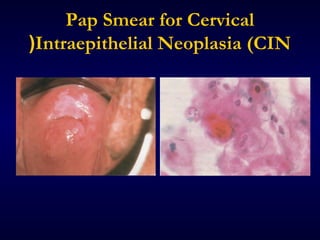
Pap Smear for Cervical
(Intraepithelial Neoplasia (CIN
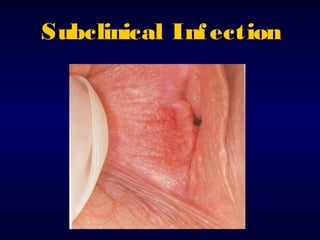
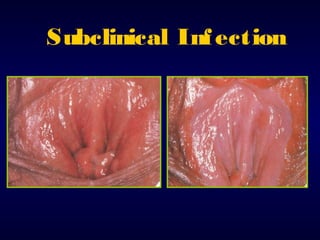
Subclinical Genital HPV Infection
(Without Exophytic Warts)

(Condyloma P
lana)
 Manifestations of infection in the absence of
genital warts.
 Infection is detected on the cervix by Pap test,
or biopsy.
 Appearance of white areas after application of
acetic acid.
Subclinical Inf ection
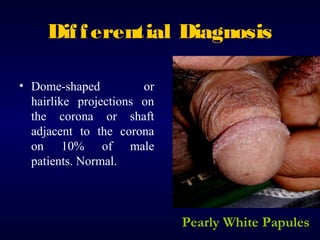
Dif f erential Diagnosis
• Dome-shaped
or
hairlike projections on
the corona or shaft
adjacent to the corona
on 10% of male
patients. Normal.

Pearly White Papules
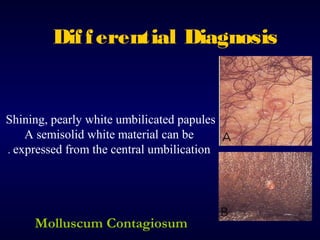
Dif f erential Diagnosis

Shining, pearly white umbilicated papules
A semisolid white material can be
. expressed from the central umbilication

Molluscum Contagiosum
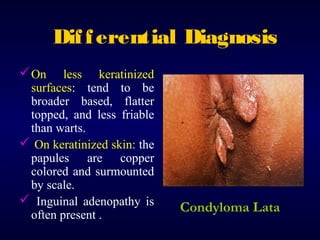
Dif f erential Diagnosis
 On

less keratinized
surfaces: tend to be
broader based, flatter
topped, and less friable
than warts.
 On keratinized skin: the
papules are copper
colored and surmounted
by scale.
 Inguinal adenopathy is
often present .

Condyloma Lata
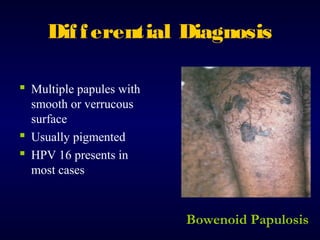
Dif f erential Diagnosis
 Multiple papules with
smooth or verrucous
surface
 Usually pigmented
 HPV 16 presents in
most cases

Bowenoid Papulosis
Rec om ended Regi m
m
ens f or
Ext er nal Geni t al W t s
ar
• Patient-Applied:
• Podofilox 0.5% solution or gel:

 Antimitotic drug that destroys wart
 Twice a day for 3 days, followed by 4 days of no therapy/
four cycles.
 The total wart area treated should not exceed 10 cm2/
podofilox limited to 0.5 mL per day.
 Most patients experience mild/moderate pain or local
irritation after treatment.
Rec om ended Regi m
m
ens f or
Ext er nal Geni t al W t s
ar
Imiquimod 5% cream:

 Topically active immune enhancer that stimulates
production of interferon and other cytokines
 Three times a week for up to 16 weeks.
 The treatment area should be washed with soap and
water 6--10 hours after the application.
 Moderate erythema, erosions and tenderness.
Rec om ended Regi m
m
ens f or
Ext er nal Geni t al W t s
ar
• Provider-Administered:
Cryotherapy with liquid nitrogen or cryoprobe.
• Causes epidermal necrosis
• Repeat applications every 1--2 weeks.
Rec om ended Regi m
m
ens f or
Ext er nal Geni t al W t s
ar
Podophyllin resin 10%-25% in a compound tincture
of benzoin:

 Cytotoxic, antimitotic
 A small amount should be applied to each wart and

allowed to air dry.
 The treatment can be repeated weekly, if necessary.
 To avoid the possibility of complications  application
be limited to <0.5 mL or an area of <10 cm2 of warts per
session.
 The preparation should be thoroughly washed off 1-4
hours after application to reduce local irritation.
R
ecommended R
egimens f or
External Genital Warts
• Trichloroacetic acid (TCA) 80%--90%.

 Destroy warts by chemical coagulation of the protein
 A small amount should be applied only to warts and
allowed to dry  white "frosting" develops.
 The treated area should washed by sodium bicarbonate to
remove unreacted acid.
 This treatment can be repeated weekly, if necessary.

 Intense burning sensation, ulceration.
R
ecommended R
egimens f or
External Genital Warts
Surgical removal
Electrocautery.
Care must be taken to control the depth of
electrocautery to prevent scarring.
Tangential excision with a pair of fine
scissors or a scalpel or by curettage.
Carbon dioxide LASER
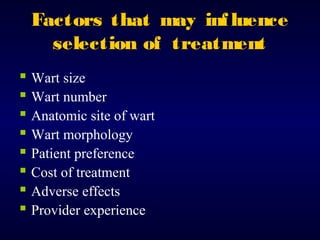
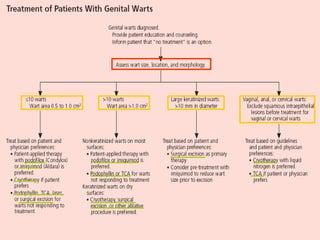
Factors that may inf luence
selection of treatment
 Wart size
 Wart number
 Anatomic site of wart
 Wart morphology
 Patient preference
 Cost of treatment
 Adverse effects
 Provider experience
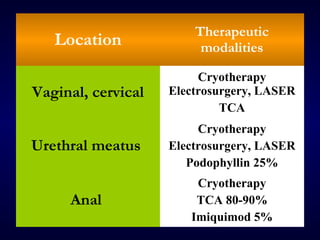
Location

Therapeutic
modalities

Vaginal, cervical

Cryotherapy
Electrosurgery, LASER
TCA

Urethral meatus

Cryotherapy
Electrosurgery, LASER
Podophyllin 25%

Anal

Cryotherapy
TCA 80-90%
Imiquimod 5%
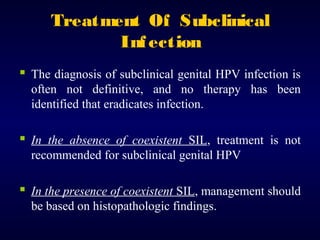
Treatment Of Subclinical
Inf ection
 The diagnosis of subclinical genital HPV infection is
often not definitive, and no therapy has been
identified that eradicates infection.

 In the absence of coexistent SIL, treatment is not
recommended for subclinical genital HPV

 In the presence of coexistent SIL, management should
be based on histopathologic findings.
Pr egnancy
The physiologically impaired immune status of the
mother enhances the grow of genital warts.
The choice of therapy must not endanger the fetus.
 Do not use imiquimod, podophyllin, or podofilox in
pregnant women because of potential risk to the fetus.
Physician-applied topical treatment with TCA,
freezing with liquid nitrogen, or electrocautery
Patient Education: General Information
Reassure the patient that HPV is a common viral
infection and that is not a result of poor hygiene.

Inform the patient that warts may disappear by
themselves or may recur after treatment.

Explain that HPV infection may or may not persist
Explain that the goal of treatment is to get rid of the
warts, not to eliminate the HPV infection.
 Discuss and explain available treatments: Explain
each treatment and its limitations and side effects.
 Explain that healing after wart treatment takes time,
and that abstinence or condom use are needed until
the area is completely healed.
 Explain that the patient sexual partner is almost
certainly infected with HPV (and may even have
transmitted it to the patient).
 Stress the importance of female patients and female
sexual partners having regular Pap smears because
HPV can cause cervical cancer.
 Explain to the patient and his or her sexual partner
that genital warts do not necessarily imply infidelity,
because it is usually not possible to determine when
the virus was initially acquired.

Anogeneital warts

  • 1.
    Management Of Anogenital Warts ((Condyloma Acuminata B y .Dr.Yehia El Garem, M.D Lecturer of Andrology & Dermatology Alexandria University
  • 2.
    (Human P apilloma Virus(HP V Double-stranded DNA viruses. Papillomaviruses. Sexual transmission Non -sexual transmission (autoinoculation) IP averages 3 to 4 months, with a range from 1 month  2 years.
  • 3.
    HP Genotypes Causing V CondylomaAcuminata Low risk HPV: 6, 11 42, 43, 44 High risk HPV: 16, 18 31, 33, 35, 39, 45, 55, 58.
  • 4.
    Condyloma Acuminat a ClinicalTypes External Warts Single, multiple papules or plaque Flat , verrucous, pedunculated Reddish or brown smooth raised papules Dome-shaped lesions on keratinized skin Internal Warts Affect mucous membranes Discomfort, pain, bleeding, difficult intercourse.
  • 11.
  • 12.
    Diagnosis  Clinical picture Acetic acid 3-5%: (false +ve, false –ve)  Pap smear  HPV typing Consider biopsy if:  Diagnosis is uncertain  Lesions are unresponsive to or worsen during therapy  Warts are pigmented, indurated, fixed, or ulcerated  Individual warts are larger than 1 cm
  • 13.
  • 14.
    Pap Smear forCervical (Intraepithelial Neoplasia (CIN
  • 15.
    Pap Smear forCervical (Intraepithelial Neoplasia (CIN
  • 16.
    Subclinical Genital HPVInfection (Without Exophytic Warts) (Condyloma P lana)  Manifestations of infection in the absence of genital warts.  Infection is detected on the cervix by Pap test, or biopsy.  Appearance of white areas after application of acetic acid.
  • 17.
  • 18.
  • 19.
    Dif f erentialDiagnosis • Dome-shaped or hairlike projections on the corona or shaft adjacent to the corona on 10% of male patients. Normal. Pearly White Papules
  • 20.
    Dif f erentialDiagnosis Shining, pearly white umbilicated papules A semisolid white material can be . expressed from the central umbilication Molluscum Contagiosum
  • 21.
    Dif f erentialDiagnosis  On less keratinized surfaces: tend to be broader based, flatter topped, and less friable than warts.  On keratinized skin: the papules are copper colored and surmounted by scale.  Inguinal adenopathy is often present . Condyloma Lata
  • 22.
    Dif f erentialDiagnosis  Multiple papules with smooth or verrucous surface  Usually pigmented  HPV 16 presents in most cases Bowenoid Papulosis
  • 23.
    Rec om endedRegi m m ens f or Ext er nal Geni t al W t s ar • Patient-Applied: • Podofilox 0.5% solution or gel:  Antimitotic drug that destroys wart  Twice a day for 3 days, followed by 4 days of no therapy/ four cycles.  The total wart area treated should not exceed 10 cm2/ podofilox limited to 0.5 mL per day.  Most patients experience mild/moderate pain or local irritation after treatment.
  • 24.
    Rec om endedRegi m m ens f or Ext er nal Geni t al W t s ar Imiquimod 5% cream:  Topically active immune enhancer that stimulates production of interferon and other cytokines  Three times a week for up to 16 weeks.  The treatment area should be washed with soap and water 6--10 hours after the application.  Moderate erythema, erosions and tenderness.
  • 25.
    Rec om endedRegi m m ens f or Ext er nal Geni t al W t s ar • Provider-Administered: Cryotherapy with liquid nitrogen or cryoprobe. • Causes epidermal necrosis • Repeat applications every 1--2 weeks.
  • 26.
    Rec om endedRegi m m ens f or Ext er nal Geni t al W t s ar Podophyllin resin 10%-25% in a compound tincture of benzoin:  Cytotoxic, antimitotic  A small amount should be applied to each wart and allowed to air dry.  The treatment can be repeated weekly, if necessary.  To avoid the possibility of complications  application be limited to <0.5 mL or an area of <10 cm2 of warts per session.  The preparation should be thoroughly washed off 1-4 hours after application to reduce local irritation.
  • 27.
    R ecommended R egimens for External Genital Warts • Trichloroacetic acid (TCA) 80%--90%.  Destroy warts by chemical coagulation of the protein  A small amount should be applied only to warts and allowed to dry  white "frosting" develops.  The treated area should washed by sodium bicarbonate to remove unreacted acid.  This treatment can be repeated weekly, if necessary.  Intense burning sensation, ulceration.
  • 28.
    R ecommended R egimens for External Genital Warts Surgical removal Electrocautery. Care must be taken to control the depth of electrocautery to prevent scarring. Tangential excision with a pair of fine scissors or a scalpel or by curettage. Carbon dioxide LASER
  • 29.
    Factors that mayinf luence selection of treatment  Wart size  Wart number  Anatomic site of wart  Wart morphology  Patient preference  Cost of treatment  Adverse effects  Provider experience
  • 31.
    Location Therapeutic modalities Vaginal, cervical Cryotherapy Electrosurgery, LASER TCA Urethralmeatus Cryotherapy Electrosurgery, LASER Podophyllin 25% Anal Cryotherapy TCA 80-90% Imiquimod 5%
  • 32.
    Treatment Of Subclinical Infection  The diagnosis of subclinical genital HPV infection is often not definitive, and no therapy has been identified that eradicates infection.  In the absence of coexistent SIL, treatment is not recommended for subclinical genital HPV  In the presence of coexistent SIL, management should be based on histopathologic findings.
  • 33.
    Pr egnancy The physiologicallyimpaired immune status of the mother enhances the grow of genital warts. The choice of therapy must not endanger the fetus.  Do not use imiquimod, podophyllin, or podofilox in pregnant women because of potential risk to the fetus. Physician-applied topical treatment with TCA, freezing with liquid nitrogen, or electrocautery
  • 34.
    Patient Education: GeneralInformation Reassure the patient that HPV is a common viral infection and that is not a result of poor hygiene. Inform the patient that warts may disappear by themselves or may recur after treatment. Explain that HPV infection may or may not persist Explain that the goal of treatment is to get rid of the warts, not to eliminate the HPV infection.
  • 35.
     Discuss andexplain available treatments: Explain each treatment and its limitations and side effects.  Explain that healing after wart treatment takes time, and that abstinence or condom use are needed until the area is completely healed.  Explain that the patient sexual partner is almost certainly infected with HPV (and may even have transmitted it to the patient).
  • 36.
     Stress theimportance of female patients and female sexual partners having regular Pap smears because HPV can cause cervical cancer.  Explain to the patient and his or her sexual partner that genital warts do not necessarily imply infidelity, because it is usually not possible to determine when the virus was initially acquired.