PAPILOMAVIRUSES:-HUMAN
PAPILOMAVIRUS
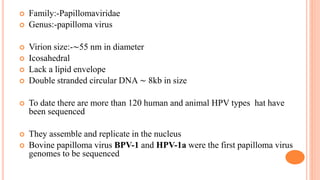
 Family:-Papillomaviridae
 Genus:-papilloma virus
 Virion size:-∼55 nm in diameter
 Icosahedral
 Lack a lipid envelope
 Double stranded circular DNA ∼ 8kb in size
 To date there are more than 120 human and animal HPV types hat have
been sequenced
 They assemble and replicate in the nucleus
 Bovine papilloma virus BPV-1 and HPV-1a were the first papilloma virus
genomes to be sequenced
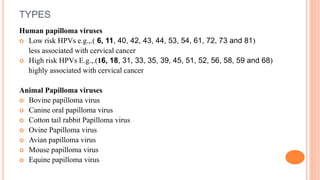
TYPES
Human papilloma viruses
 Low risk HPVs e.g.,.( 6, 11, 40, 42, 43, 44, 53, 54, 61, 72, 73 and 81)
less associated with cervical cancer
 High risk HPVs E.g.,.(16, 18, 31, 33, 35, 39, 45, 51, 52, 56, 58, 59 and 68)
highly associated with cervical cancer
Animal Papilloma viruses
 Bovine papilloma virus
 Canine oral papilloma virus
 Cotton tail rabbit Papilloma virus
 Ovine Papilloma virus
 Avian papilloma virus
 Mouse papilloma virus
 Equine papilloma virus
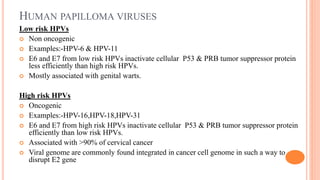
HUMAN PAPILLOMA VIRUSES
Low risk HPVs
 Non oncogenic
 Examples:-HPV-6 & HPV-11
 E6 and E7 from low risk HPVs inactivate cellular P53 & PRB tumor suppressor protein
less efficiently than high risk HPVs.
 Mostly associated with genital warts.
High risk HPVs
 Oncogenic
 Examples:-HPV-16,HPV-18,HPV-31
 E6 and E7 from high risk HPVs inactivate cellular P53 & PRB tumor suppressor protein
efficiently than low risk HPVs.
 Associated with >90% of cervical cancer
 Viral genome are commonly found integrated in cancer cell genome in such a way to
disrupt E2 gene
STRUCTURE
VIRAL PROTEINS
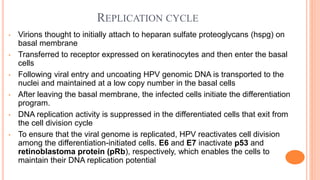
REPLICATION CYCLE
• Virions thought to initially attach to heparan sulfate proteoglycans (hspg) on
basal membrane
• Transferred to receptor expressed on keratinocytes and then enter the basal
cells
• Following viral entry and uncoating HPV genomic DNA is transported to the
nuclei and maintained at a low copy number in the basal cells
• After leaving the basal membrane, the infected cells initiate the differentiation
program.
• DNA replication activity is suppressed in the differentiated cells that exit from
the cell division cycle
• To ensure that the viral genome is replicated, HPV reactivates cell division
among the differentiation-initiated cells. E6 and E7 inactivate p53 and
retinoblastoma protein (pRb), respectively, which enables the cells to
maintain their DNA replication potential
REPLICATION CYCLE
• Following the genome amplification, in the terminally differentiated cells,
the synthesis of capsid proteins is triggered. The capsid proteins
assemble into virions that encapsidate viral genomic DNA. The
progenitor virions are released externally with peeled keratinocytes.
• Lifecycle of HPV is differentiation-dependent and is controlled at
multiple levels, such as transcription, post-transcriptional processing,
translation, and DNA replication
REPLICATION CYCLE
REPLICATION CYCLE
PATHOGENESIS
• Risk factors for Persistent HPV,are multiple sexual partners, smoking &
immunosuppression
• HPV is spread by direct skin to skin contact,Vaginal & anal sex
• Occasionally it can spread from mother to child during pregnancy.
• Perinatal transmission of HPV type 6 & 11 can result in the development
of juvenile onset recurrent respiratory Papillomatosis.
• The virus is capable of hiding for many decades
• The virus infects the basal cells in the stratified epithelium as a result of
minor skin abrasions/disturbed epithelial barrier
• The virus replicates via a differentiation dependent manner and released
as a result of degeneration of desquamated cells of keratinocytes
PATHOGENESIS
• E6 & E7 are expressed early in the HPV life cycle
• The E6 oncoproteins of high risk HPV interfere with the function of the cellular tumor-
suppressor protein p53 through the induction of increased proteasome-dependent p53
degradation leading to inactivation of p53.
• E7 disrupts the interaction between Rb and E2F, resulting in the release of E2F factors in
their transcriptionally active forms.
• E2Fs in their active forms stimulates replication and cell-division.
• As a result of Rapid growth of cells stimulated by stimulation of E2F warts develop on the
outer layer of the skin,, this can be found in the hands /feet, they can also occur in the
elbow and knees.
• Genital warts is HPV infection of the skin in the genital area
EPIDEMIOLOGY
 Current estimates indicate that every year 4802 women are diagnosed with
cervical cancer and 2451 die from the disease in kenya(7/27/2017).
 In US it is estimated 12,820 women in the United States will be diagnosed with
cervical cancer. It is also estimated that 4,210 deaths from the disease will
occur this year.
 In 2017, it is estimated that 912 new cases of cervical cancer will be diagnosed
in Australia
 An estimated 1,550 Canadian women will be diagnosed with cervical
cancer in 2017. An estimated 400 will die from it.
CLINICAL MANIFESTATION
• More than 40 types of HPV affect the genitals,
• While most people don't have symptoms from HPV, some will develop
warts, or papillomas. This symptom varies, depending on the type of
virus, and can include genital warts, plantar warts and common warts.
• According to the CDC, HPV infection can cause cervical, vaginal and
vulvar cancers in women and penile cancer in men. Anal cancer,
cancer of the back, of the throat (oropharynx) and genital warts can
also be caused by HPV in both men and women.
CLINICAL MANIFESTATION
• Low-risk HPVs,They do not cause cancer but can cause
skin warts known as condylomata acuminata on or around
the genitals and anus. For example, HPV types 6 and 11
cause 90% of all genital warts. HPV types 6 and 11 also
cause recurrent respiratory Papillomatosis, a less
common disease in which benign tumors grow in the air
passages leading from the nose and mouth into the lungs.
CLINICAL MANIFESTATION
• High-risk HPVs, which can cause cancer have about a
dozen high-risk HPV types that have been identified. Two of
these, HPV types 16 and 18, are responsible for most HPV-
caused cancers
DIAGNOSIS
LAB DIAGNOSIS
• Colposcopy and acetic acid test
Colposcopy is the examination of the cervix, vagina, and in some instances
the vulva after the application of acetic acid solution
• Biopsy
• A biopsy is a medical procedure, during which a small sample of tissue is
removed from a part of the body. The sample of tissue is then examined
under the microscope to look for abnormal cells.
• DNA test (PCR,HPV/DNA test Hc2)
this tests involve detection of low-level virus copy numbers in clinical
samples
• Pap smear
A Pap smear, also called a Pap test, is a screening procedure for cervical
cancer. It tests for the presence of precancerous or cancerous cells on the
cervix.
DIAGNOSIS
The use of colposcopy screening is only to be recommended for
 Immunosuppressed transplant recipients.
 Human immunodeficiency virus (HIV) positive women.
 Women with three consecutive inadequate samples.
 Positive cervical cytology for malignant cells or suspicious cells but
clinically normal looking cervix.
 Women must be referred after two tests reported as mild dyskaryosis.
 Women must be referred for colposcopy after one test reported as
moderate dyskaryosis or severe dyskaryosis, at least 90% of women with
such test results should be seen in a colposcopy clinic within four weeks of
referral. Women must be referred for colposcopy after one test reported as
possible invasion or reported as glandular neoplasia, and 90% should be
seen urgently within two weeks of referral
PREVENTION AND TREATMENT
• Circumcision
• Minimising the number of sexual partners
• If a person has warts they should avoid picking wart or
biting their nails
• Women who are sexually active should have regular pap
smear tests
• Vaccination
PREVENTION AND TREATMENT
• Vaccinations have been developed to protect people from types 16 and
18 of HPV that can cause 70% of cervical cancers. One vaccine protects
against two types, HPV – 6 and 11, that cause 90% of warts.
• It is approved for anyone between 9 years and 26 years of age
• The vaccine is given in multiple doses (shots) over 6 to 12 months.
Children age 9 to 14 receive 2 doses. Those 15 or older receive 3 doses
• Gardasil 9:-indicated in boy,girls,men and women(9-26yrs)
both high and low risk HPVs,precancerous/dysplastic lesions caused by
HPVs
• Others include cervarix and gardasil.
TREATMENT
• There is no cure or treatment for the virus itself. In many men and
women, HPV goes away on its own without causing any health problems.
There are treatments for the conditions the virus causes. These include
genital warts & precancerous cells
• Genital warts:-Imiquimod(aldara,zyclara),Condylox, Trichloroacetic
acid(TCA),Sinechatechins(Vegera)
• Precancerous conditions:-hysterectomy, cryosurgery,
loop electrosurgical excision procedure (LEEP) & laser surgery
GENITAL WARTS
Imiquimod (Aldara, Zyclara). Its a cream which is indicated for large
warts.
Trichloroacetic acid.:- it is a topical application recommended to treat
small warts that are very hard.
Podofilox (Condylox) it is also a topical application recommended to
treat clusters of small warts.
Sinechatechins/(Vegera) Its an ointment used to treat warts on and
around the genitals and anus.
PRECANCEROUS CONDITIONS
hysterectomy involves removing the womb and cervix, and occasionally the fallopian
tubes and ovaries. hysterectomy is only suitable for women with very early-stage
cervical cancer (stage 1A1).
Cryosurgery is a procedure that uses freezing gas (liquid nitrogen) to destroy
precancerous cells on the cervix.
loop electrosurgical excision procedure (LEEP) is a way to remove abnormal tissue
from the cervix. It is done using a fine wire loop that has a low-voltage electrical current.
LEEP may be done after colposcopy and cervical biopsy have confirmed an abnormal
Pap test result.
Laser surgery A focused laser beam, directed through the vagina, is used to vaporize
(burn off) abnormal cells or to remove a small piece of tissue for study
END

Hpv

  • 1.
  • 2.
     Family:-Papillomaviridae  Genus:-papillomavirus  Virion size:-∼55 nm in diameter  Icosahedral  Lack a lipid envelope  Double stranded circular DNA ∼ 8kb in size  To date there are more than 120 human and animal HPV types hat have been sequenced  They assemble and replicate in the nucleus  Bovine papilloma virus BPV-1 and HPV-1a were the first papilloma virus genomes to be sequenced
  • 3.
    TYPES Human papilloma viruses Low risk HPVs e.g.,.( 6, 11, 40, 42, 43, 44, 53, 54, 61, 72, 73 and 81) less associated with cervical cancer  High risk HPVs E.g.,.(16, 18, 31, 33, 35, 39, 45, 51, 52, 56, 58, 59 and 68) highly associated with cervical cancer Animal Papilloma viruses  Bovine papilloma virus  Canine oral papilloma virus  Cotton tail rabbit Papilloma virus  Ovine Papilloma virus  Avian papilloma virus  Mouse papilloma virus  Equine papilloma virus
  • 4.
    HUMAN PAPILLOMA VIRUSES Lowrisk HPVs  Non oncogenic  Examples:-HPV-6 & HPV-11  E6 and E7 from low risk HPVs inactivate cellular P53 & PRB tumor suppressor protein less efficiently than high risk HPVs.  Mostly associated with genital warts. High risk HPVs  Oncogenic  Examples:-HPV-16,HPV-18,HPV-31  E6 and E7 from high risk HPVs inactivate cellular P53 & PRB tumor suppressor protein efficiently than low risk HPVs.  Associated with >90% of cervical cancer  Viral genome are commonly found integrated in cancer cell genome in such a way to disrupt E2 gene
  • 5.
  • 6.
  • 7.
    REPLICATION CYCLE • Virionsthought to initially attach to heparan sulfate proteoglycans (hspg) on basal membrane • Transferred to receptor expressed on keratinocytes and then enter the basal cells • Following viral entry and uncoating HPV genomic DNA is transported to the nuclei and maintained at a low copy number in the basal cells • After leaving the basal membrane, the infected cells initiate the differentiation program. • DNA replication activity is suppressed in the differentiated cells that exit from the cell division cycle • To ensure that the viral genome is replicated, HPV reactivates cell division among the differentiation-initiated cells. E6 and E7 inactivate p53 and retinoblastoma protein (pRb), respectively, which enables the cells to maintain their DNA replication potential
  • 8.
    REPLICATION CYCLE • Followingthe genome amplification, in the terminally differentiated cells, the synthesis of capsid proteins is triggered. The capsid proteins assemble into virions that encapsidate viral genomic DNA. The progenitor virions are released externally with peeled keratinocytes. • Lifecycle of HPV is differentiation-dependent and is controlled at multiple levels, such as transcription, post-transcriptional processing, translation, and DNA replication
  • 9.
  • 10.
  • 11.
    PATHOGENESIS • Risk factorsfor Persistent HPV,are multiple sexual partners, smoking & immunosuppression • HPV is spread by direct skin to skin contact,Vaginal & anal sex • Occasionally it can spread from mother to child during pregnancy. • Perinatal transmission of HPV type 6 & 11 can result in the development of juvenile onset recurrent respiratory Papillomatosis. • The virus is capable of hiding for many decades • The virus infects the basal cells in the stratified epithelium as a result of minor skin abrasions/disturbed epithelial barrier • The virus replicates via a differentiation dependent manner and released as a result of degeneration of desquamated cells of keratinocytes
  • 12.
    PATHOGENESIS • E6 &E7 are expressed early in the HPV life cycle • The E6 oncoproteins of high risk HPV interfere with the function of the cellular tumor- suppressor protein p53 through the induction of increased proteasome-dependent p53 degradation leading to inactivation of p53. • E7 disrupts the interaction between Rb and E2F, resulting in the release of E2F factors in their transcriptionally active forms. • E2Fs in their active forms stimulates replication and cell-division. • As a result of Rapid growth of cells stimulated by stimulation of E2F warts develop on the outer layer of the skin,, this can be found in the hands /feet, they can also occur in the elbow and knees. • Genital warts is HPV infection of the skin in the genital area
  • 13.
    EPIDEMIOLOGY  Current estimatesindicate that every year 4802 women are diagnosed with cervical cancer and 2451 die from the disease in kenya(7/27/2017).  In US it is estimated 12,820 women in the United States will be diagnosed with cervical cancer. It is also estimated that 4,210 deaths from the disease will occur this year.  In 2017, it is estimated that 912 new cases of cervical cancer will be diagnosed in Australia  An estimated 1,550 Canadian women will be diagnosed with cervical cancer in 2017. An estimated 400 will die from it.
  • 14.
    CLINICAL MANIFESTATION • Morethan 40 types of HPV affect the genitals, • While most people don't have symptoms from HPV, some will develop warts, or papillomas. This symptom varies, depending on the type of virus, and can include genital warts, plantar warts and common warts. • According to the CDC, HPV infection can cause cervical, vaginal and vulvar cancers in women and penile cancer in men. Anal cancer, cancer of the back, of the throat (oropharynx) and genital warts can also be caused by HPV in both men and women.
  • 15.
    CLINICAL MANIFESTATION • Low-riskHPVs,They do not cause cancer but can cause skin warts known as condylomata acuminata on or around the genitals and anus. For example, HPV types 6 and 11 cause 90% of all genital warts. HPV types 6 and 11 also cause recurrent respiratory Papillomatosis, a less common disease in which benign tumors grow in the air passages leading from the nose and mouth into the lungs.
  • 16.
    CLINICAL MANIFESTATION • High-riskHPVs, which can cause cancer have about a dozen high-risk HPV types that have been identified. Two of these, HPV types 16 and 18, are responsible for most HPV- caused cancers
  • 17.
    DIAGNOSIS LAB DIAGNOSIS • Colposcopyand acetic acid test Colposcopy is the examination of the cervix, vagina, and in some instances the vulva after the application of acetic acid solution • Biopsy • A biopsy is a medical procedure, during which a small sample of tissue is removed from a part of the body. The sample of tissue is then examined under the microscope to look for abnormal cells. • DNA test (PCR,HPV/DNA test Hc2) this tests involve detection of low-level virus copy numbers in clinical samples • Pap smear A Pap smear, also called a Pap test, is a screening procedure for cervical cancer. It tests for the presence of precancerous or cancerous cells on the cervix.
  • 18.
    DIAGNOSIS The use ofcolposcopy screening is only to be recommended for  Immunosuppressed transplant recipients.  Human immunodeficiency virus (HIV) positive women.  Women with three consecutive inadequate samples.  Positive cervical cytology for malignant cells or suspicious cells but clinically normal looking cervix.  Women must be referred after two tests reported as mild dyskaryosis.  Women must be referred for colposcopy after one test reported as moderate dyskaryosis or severe dyskaryosis, at least 90% of women with such test results should be seen in a colposcopy clinic within four weeks of referral. Women must be referred for colposcopy after one test reported as possible invasion or reported as glandular neoplasia, and 90% should be seen urgently within two weeks of referral
  • 19.
    PREVENTION AND TREATMENT •Circumcision • Minimising the number of sexual partners • If a person has warts they should avoid picking wart or biting their nails • Women who are sexually active should have regular pap smear tests • Vaccination
  • 20.
    PREVENTION AND TREATMENT •Vaccinations have been developed to protect people from types 16 and 18 of HPV that can cause 70% of cervical cancers. One vaccine protects against two types, HPV – 6 and 11, that cause 90% of warts. • It is approved for anyone between 9 years and 26 years of age • The vaccine is given in multiple doses (shots) over 6 to 12 months. Children age 9 to 14 receive 2 doses. Those 15 or older receive 3 doses • Gardasil 9:-indicated in boy,girls,men and women(9-26yrs) both high and low risk HPVs,precancerous/dysplastic lesions caused by HPVs • Others include cervarix and gardasil.
  • 21.
    TREATMENT • There isno cure or treatment for the virus itself. In many men and women, HPV goes away on its own without causing any health problems. There are treatments for the conditions the virus causes. These include genital warts & precancerous cells • Genital warts:-Imiquimod(aldara,zyclara),Condylox, Trichloroacetic acid(TCA),Sinechatechins(Vegera) • Precancerous conditions:-hysterectomy, cryosurgery, loop electrosurgical excision procedure (LEEP) & laser surgery
  • 22.
    GENITAL WARTS Imiquimod (Aldara,Zyclara). Its a cream which is indicated for large warts. Trichloroacetic acid.:- it is a topical application recommended to treat small warts that are very hard. Podofilox (Condylox) it is also a topical application recommended to treat clusters of small warts. Sinechatechins/(Vegera) Its an ointment used to treat warts on and around the genitals and anus.
  • 23.
    PRECANCEROUS CONDITIONS hysterectomy involvesremoving the womb and cervix, and occasionally the fallopian tubes and ovaries. hysterectomy is only suitable for women with very early-stage cervical cancer (stage 1A1). Cryosurgery is a procedure that uses freezing gas (liquid nitrogen) to destroy precancerous cells on the cervix. loop electrosurgical excision procedure (LEEP) is a way to remove abnormal tissue from the cervix. It is done using a fine wire loop that has a low-voltage electrical current. LEEP may be done after colposcopy and cervical biopsy have confirmed an abnormal Pap test result. Laser surgery A focused laser beam, directed through the vagina, is used to vaporize (burn off) abnormal cells or to remove a small piece of tissue for study
  • 24.