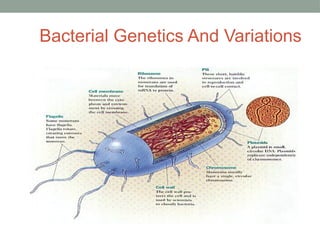
The Bacterial Genome
•Isin a single, giant, circular loop of
DNA called a Bacterial chromosome.
•lacks a nuclear membrane
•lies naked in cytoplasm
•located in a region of the cell known
as the nucleoid.
•Is made up of about 3000-6000
genes
4.
What is aGene?
•Genes are distinct DNA
sequences specifying the
sequences of amino acids in a
polypeptide chain
5.
Characteristics of agene
• Each gene determines a particular type of
amino acid assembly.
• The chain of nucleotides that constitute a
gene are composed of groups of bases
called Purines and Pyrimidines
• Gene function can be altered or the entire
gene deleted by genetic mutation
6.
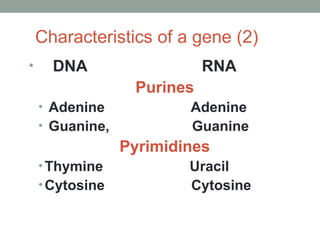
Characteristics of agene (2)
• DNA RNA
Purines
• Adenine Adenine
• Guanine, Guanine
Pyrimidines
•Thymine Uracil
•Cytosine Cytosine
7.
Characteristics of abacterial
genome (2)
Bacteria are haploid.
Have unpaired chromosomes so no
heterozygotes occur
Do not show dominance
Each bacterium can be regarded as a
clone (genetically identical to
daughter cells)
8.
Characteristics of abacterial
genome (3)
• Each set of three bases is known as a codon
• AAC, GCT, TAG etc.
• Each codon codes for a specific amino acid.
e.g., leucine, valine
• There are over 64 different triplet sequences and
20 amino acids
9.
Characteristics of abacterial
genome (4)
•Undirected spontaneous mutation
occurs
• Associated with rate of growth
• Accentuated by generation time
10.
Control of proteins
•The synthesis of proteins is therefore
controlled by DNA.
• The design of each protein is transmitted
from DNA to mRNA (transcription),
• which then instructs the cellular machinery
(tRNA and rRNA etc) (translation) to
assemble a protein
11.
Control of proteins(2)
• Proteins
• determine structural and metabolic function
• structural
• Enzymes
•
• Total genetic potential of DNA is the
GENOTYPE
• Part that is manifest or discernable is the
PHENOTYPE.
12.
GENETIC VARIATION.
• Variationseasily detected because
• Rapid rate of reproduction
• Large bacterial populations) are easily detected.
• Two types-
• Phenotypic
• Genotypic
13.
Phenotypic Variation
• anon-heritable variation,
• Temporary adjustment to changes in the environment
• Normally involves all the cells of a culture
• Respond physiologically within the range of potential
of the genotype
14.
Phenotypic Variation (2)
•May manifest as changes in
• Morphology (size, shape, staining reactions)
• metabolism and chemical reactions,
• induction of an enzyme, e.g., -lactamase by the presence of
penicillin
• repression of enzymes due to the presence of the end
products in the system.
• Revert back to type when the inducing
circumstance is removed.
Mutation
• Important partof Bacterial evolution.
• Spontaneous mutation is common
• rate between 1 in 107
and 1 in 1010
• Environment not really important
• may favour or select for the variant, which may then grow
and replace the wild type
17.
Effect of Mutation
•Morphology
• size of a cell, colonial appearance
• Ability to form spores, flagella or capsules),
• Nutritional requirements,
• Antigenic properties,
• Ability to produce toxins,
• Drug sensitivity/resistance
• Loss of Capsule
• Smooth-Rough (S-R) variation
• Becomes less virulent.
• Best seen in Pneumococci, Salmonellae and Shigellae
• Occurs when bacteria are grown for a long time on artificial
media
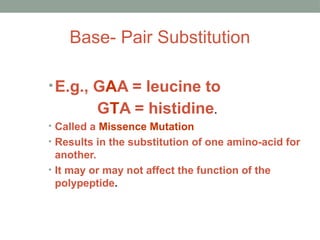
Base- Pair Substitution
•E.g.,GAA = leucine to
GTA = histidine.
• Called a Missence Mutation
• Results in the substitution of one amino-acid for
another.
• It may or may not affect the function of the
polypeptide.
20.
Insertion or deletion
•The insertion or deletion of a base will lead to a
frame shift mutation
• Deletion of a base unless it is compensated for, by
the insertion of a new base very close to the
deleted base, will lead to a new polypeptide being
formed.
21.
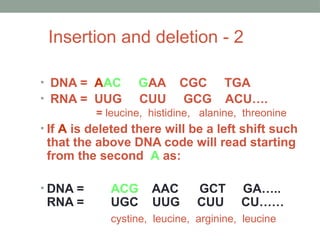
Insertion and deletion- 2
• DNA = AAC GAA CGC TGA
• RNA = UUG CUU GCG ACU….
= leucine, histidine, alanine, threonine
• If A is deleted there will be a left shift such
that the above DNA code will read starting
from the second A as:
• DNA = ACG AAC GCT GA…..
RNA = UGC UUG CUU CU……
cystine, leucine, arginine, leucine
22.
Gene exchange (genetictransfer)
• In eukaryotes
• occurs by sexual reproduction
• haploid gametes fuse to become a diploid zygote
• In Bacteria,
• NO DIPLOID zygotes are formed
• processes exist that allow for the acquisition of foreign DNA
23.
Methods of Geneexchange (genetic
transfer)
• Transformation
• gene transfer resulting from the uptake by a recipient
cell of naked DNA from a donor cell.
• Transduction
• Transfer of foreign genes by bacteriophages
• Conjugation
• Direct transfer of DNA from one organism to another
through a modified fimbriae (pilus) called a sex pilus
24.
Transferable genetic materials
•Foreign DNA being transferred may be
• Plasmids
• Viral DNA
• Parts of host chromosome
• Transposable Elements
• Transposons
• Insertional Sequences
25.
Plasmids
• Closed circularmolecules
• Double stranded DNA
• Size from 2-3000 kilobases (100,000-150,000 base
pairs)
• Can replicate independently of the bacterial
chromosome.
• Code for various characteristics
• Fertility (F),
• drug resistance transfer (R),
• toxin production
26.
Plasmids (2)
• Twocategories
• Transmissible by conjugation (usually Large plasmids)
• Transmissible by transducing phages
• May be lost during growth
• Some cell characteristics they confer are
unstable
• e.g., erythrogenic toxin in some Group A -haemolytic
Streptococci.
• Information is often in the form of
transposable genetic elements called
Transposons
27.
Transposons- (Jumping genes)
•Segments of DNA
• Usually containing several gene s
• Easily transferable into the DNA of bacterial
chromosomes, plasmids and infecting
phages.
• incapable of autonomous replication.
• Have special sequences at the end of their
DNA called terminal sequences
• about 15-40 base pairs
• are inverted repeats
• Sticky
28.
Insertion sequences
(IS elements)
•Can also be transferred from plasmids to
chromosomes
• Short segments of DNA
• usually about 100-1000 bases (usually less than 1,500)
•
• Contain no instructions for protein synthesis
• Act as gene inactivators when inserted in the middle of
a gene structure
• Presence is noted only when interference with function of the
chromosomal gene occurs.
29.
Implication
• Some toxin-,drug-inactivating enzyme can
be on different plasmids or phages.
• E.g., -lactamase of E. coli, N.gonorrhoea and H. influenzae
are on different plasmids which all have the same
transposon.
• heat stable enterotoxin of E.coli is on a transposon that is
also found in Yersinia enterolitica
30.
Transformation-
• Initially regardedas a laboratory phenomenon
• Artificial transformation has been achieved in members of the
Enterobacteriaceae (e.g. Escherichia coli, Klebsiella spp.)
• Certain bacteria (e.g. Bacillus, Haemophilus, Neisseria,
Pneumococcus) can take up DNA from the environment
• DNA that is taken up can be incorporated into the recipient's chromosome
31.
Transformation
• First detectedin the pneumococcus in 1928 by
Griffith
• R (rough, non-virulent) strains converted to the corresponding
parental S (smooth, virulent) type
• Also transformed to a different S-type by heat-killed
cells of that type.
32.
Factors affecting transformation
•DNA size state
• Double stranded DNA of at least 5 X 10⁵
daltons works
best.
• Competence of the recipient –
• Some bacteria are able to take up DNA naturally.
• By producing a specific protein called a competence
factor.
• Other bacteria are not able to take up DNA naturally.
• competence can be induced in vitro by treatment with
chemicals (e.g. CaCl2
)
33.
Steps in transformation
Uptakeof DNA
• Uptake of DNA by Gram+ and Gram- bacteria
differs.
• Gram Positive bacteria
• Take up single stranded DNA
• Complementary strand is made in the recipient.
• Gram Negative bacteria
• Take up double stranded DNA.
34.
Significance of transformation
•Transformation occurs in nature and it can lead to
increased
• virulence.
• Drug resistance
• Widely used in recombinant DNA technology
35.
Transduction-1
• Transfer ofgenes by infection with a non-lethal
(temperate) phage.
• Involves transfer of DNA from the host bacteria
to another bacterium.
• First discovered in salmonellae by Lederberg
and Zinder
• Not all phages can mediate transduction.
36.
Transduction-2
• Gene transfer- usually between members of
the same bacterial species.
• Range of species determined by Phage host
range.
• if a particular phage has a wide host range then transfer
between species can occur.
• Ability of a phage to mediate transduction is
related to the life cycle of the phage
37.
Types of Transduction
•Generalized Transduction
• Potentially any bacterial gene from the donor can be
transferred to the recipient.
• Specialized transduction
• only certain donor genes can be transferred to the
recipient.
38.
Significance
• Lysogenic (phage)conversion occurs in nature and is
the source of virulent strains of bacteria
• Responsible for penicillin-resistant strains of
Staphylococcus aureus
39.
Conjugation-1
[ A-B-] +[C-D-] = [A+B+C+D+]
a1
a2
a3
• First reported in 1946,
Lederberg while investigating
genetic recombination in E.coli
K12,
• Mated two doubly auxotrophic
strains, (a1
& a2
), each different
in its requirements for two
essential nutrients.
• Got a prototroph that did not
require any of these nutrients
40.
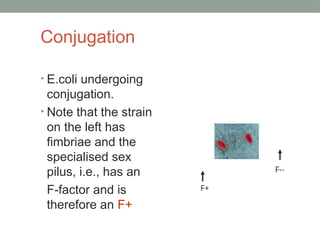
Conjugation -2
• Itwas discovered that transfer of DNA was by
direct contact
• Process called conjugation.
• Conjugation is a quasisexual introduction of
donor DNA into a recipient through a modified
pilus (fimbriae) called a sex pilus.
41.
Conjugation-4
• In bacteriatwo mating types
• donor (male )
• recipient (female)
• Direction of transfer of genetic material is one way
• from a donor to a recipient
42.
Mating Types
• Donor
•Has a plasmid called the F factor or fertility factor or sex factor.(F+)
• Recipient
• Lacks the F factor. (F-)
43.
F-Factor
• Plasmid
• Hasgenes needed for its replication and for
its ability to transfer DNA to a recipient.
• codes for the ability to produce a sex pilus
(F pilus)
Effect of Genetransfer
• Never leads to the formation of a zygote as in
eukaryotic cell.
• At best, a merozygote is formed
• part of a donor bacterium’s genome (exogenote is
transferred to an intact DNA of a recipient
• Recombination then takes place
• replacement of resident genes by exogenote genes
• or the addition of exogenote genes to the resident pool.
• exogenote genes may lie separate from the chromosome
or may be integrated into it.
46.
Recombinant- DNA TechniquesOr
Cloning
Transfer of a gene from one
bacterium,virus or animal cell into DNA
of a living bacterium where it will
replicate and instruct the cell.
47.
Recombinant- DNA techniques
Usually done between closely related
organisms.
New bacteria are known as recombinant
organisms.
Applications
From novel strains of E.coli
Insulin,
Growth hormone,
Components for vaccines (hepatitis B, H.influenzae and
foot and mouth disease.),
Interferon,
Bloodclotting factor 8,
DNA probes for the detection of specific sequences of
particular pathogens

![Conjugation-1
[ A-B-] + [C-D-] = [A+B+C+D+]
a1
a2
a3
• First reported in 1946,
Lederberg while investigating
genetic recombination in E.coli
K12,
• Mated two doubly auxotrophic
strains, (a1
& a2
), each different
in its requirements for two
essential nutrients.
• Got a prototroph that did not
require any of these nutrients](https://image.slidesharecdn.com/bacterial-genetics-variation-new1-250302162802-023b78a6/85/bacterial-genetics-variation-new-1-pptx-39-320.jpg)


![ONFH[AVN HIP] -TRIPLE REGIME -A NOVAL SURGICAL CONCEPT .pptx](https://cdn.slidesharecdn.com/ss_thumbnails/onfhavnhip2026koaconcalicutdrgokuldevdrmashraf-260210064517-213ec005-thumbnail.jpg?width=640&height=640&fit=bounds)