
Lesson 1
 application
 design of components
 material protection (from corrosion,
damage, etc.)
1. Physical properties
2. Mechanical properties
3. Chemical properties
 colour –light wave length
 specific heat – the heat required to raise
the temperature of one gram of a
substance by one degree centigrade
(J/kg K)
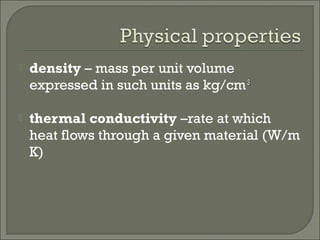
 density – mass per unit volume
expressed in such units as kg/cm33
 thermal conductivity –rate at which
heat flows through a given material (W/m
K)
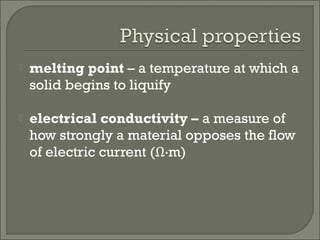
 melting point – a temperature at which a
solid begins to liquify
 electrical conductivity – a measure of
how strongly a material opposes the flow
of electric current (Ω⋅m)
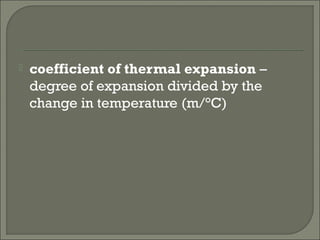
 coefficient of thermal expansion –
degree of expansion divided by the
change in temperature (m/°C)
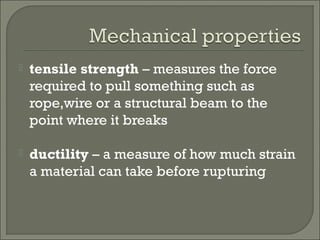
 tensile strength – measures the force
required to pull something such as
rope,wire or a structural beam to the
point where it breaks
 ductility – a measure of how much strain
a material can take before rupturing
 malleability – the property of a material
that can be worked or hammered or
shaped without breaking
 brittleness –breaking or shattering of a
material when subjected to stress (when
force is applied to it)
 elasticity – the property of a material
that returns to its original shape after
stress (e.g. external forces) that made it
deform or distort is removed
 plasticity - the deformation of a material
undergoing non-reversible changes of
shape in response to applied forces
 toughness – the ability of a material to
absorb energy and plastically deform
without fracturing
 hardness – the property of being rigid
and resistant to pressure; not easily
scratched
 machinability – the property of a
material that can be shaped by
hammering, pressing, rolling
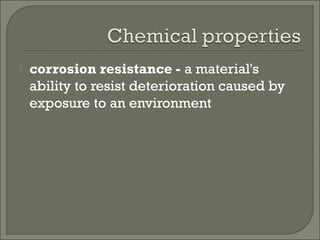
 corrosion resistance - a material's
ability to resist deterioration caused by
exposure to an environment
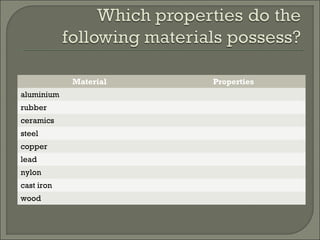
Material Properties
aluminium
rubber
ceramics
steel
copper
lead
nylon
cast iron
wood
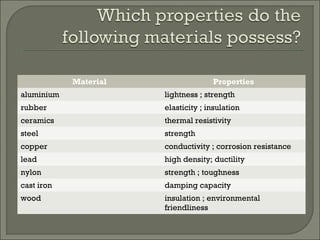
Material Properties
aluminium lightness ; strength
rubber elasticity ; insulation
ceramics thermal resistivity
steel strength
copper conductivity ; corrosion resistance
lead high density; ductility
nylon strength ; toughness
cast iron damping capacity
wood insulation ; environmental
friendliness
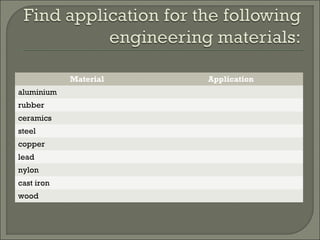
Material Application
aluminium
rubber
ceramics
steel
copper
lead
nylon
cast iron
wood
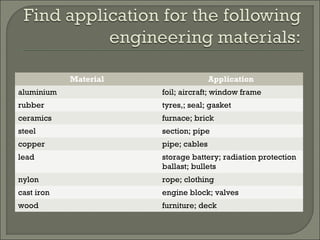
Material Application
aluminium foil; aircraft; window frame
rubber tyres,; seal; gasket
ceramics furnace; brick
steel section; pipe
copper pipe; cables
lead storage battery; radiation protection
ballast; bullets
nylon rope; clothing
cast iron engine block; valves
wood furniture; deck
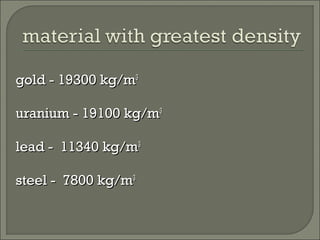
gold -gold - 19300 kg/m19300 kg/m33
uranium -uranium - 19100 kg/m19100 kg/m33
lead -lead - 11340 kg/m11340 kg/m33
steel -steel - 7800 kg/m7800 kg/m33
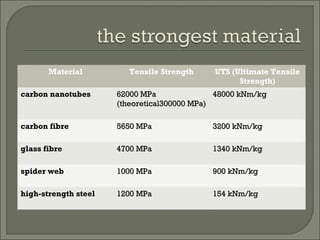
Material Tensile Strength UTS (Ultimate Tensile
Strength)
carbon nanotubes 62000 M62000 MPPaa
((theoreticaltheoretical300000 M300000 MPPa)a)
48000 kNm/kg48000 kNm/kg
carbon fibre 5650 MPa5650 MPa 3200 kNm/kg3200 kNm/kg
glass fibre 4700 M4700 MPPaa 1340 kNm/kg1340 kNm/kg
spider web 1000 MPa1000 MPa 900 kNm/kg900 kNm/kg
high-strength steel 1200 M1200 MPPaa 154 kNm/kg154 kNm/kg
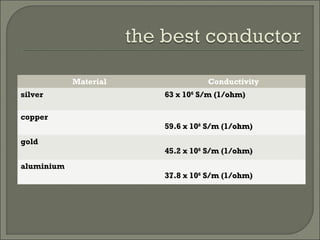
Material Conductivity
silver 63 x 1063 x 1066
S/m (1/ohm)S/m (1/ohm)
copper
59.6 x 1059.6 x 1066
S/m (1/ohm)S/m (1/ohm)
gold
45.2 x 1045.2 x 1066
S/m (1/ohm)S/m (1/ohm)
aluminium
37.8 x 1037.8 x 1066
S/m (1/ohm)S/m (1/ohm)
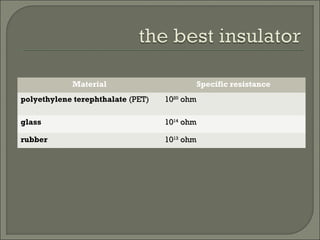
Material Specific resistance
polyethylene terephthalate (PET(PET)) 10102020
ohmohm
glass 10101414
ohmohm
rubber 10101313
ohmohm
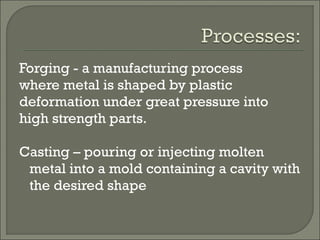
Forging - a manufacturing process
where metal is shaped by plastic
deformation under great pressure into
high strength parts.
Casting – pouring or injecting molten
metal into a mold containing a cavity with
the desired shape

General properties

  • 1.
  • 2.
     application  designof components  material protection (from corrosion, damage, etc.)
  • 3.
    1. Physical properties 2.Mechanical properties 3. Chemical properties
  • 4.
     colour –lightwave length  specific heat – the heat required to raise the temperature of one gram of a substance by one degree centigrade (J/kg K)
  • 5.
     density –mass per unit volume expressed in such units as kg/cm33  thermal conductivity –rate at which heat flows through a given material (W/m K)
  • 6.
     melting point– a temperature at which a solid begins to liquify  electrical conductivity – a measure of how strongly a material opposes the flow of electric current (Ω⋅m)
  • 7.
     coefficient ofthermal expansion – degree of expansion divided by the change in temperature (m/°C)
  • 8.
     tensile strength– measures the force required to pull something such as rope,wire or a structural beam to the point where it breaks  ductility – a measure of how much strain a material can take before rupturing
  • 9.
     malleability –the property of a material that can be worked or hammered or shaped without breaking  brittleness –breaking or shattering of a material when subjected to stress (when force is applied to it)
  • 10.
     elasticity –the property of a material that returns to its original shape after stress (e.g. external forces) that made it deform or distort is removed  plasticity - the deformation of a material undergoing non-reversible changes of shape in response to applied forces
  • 11.
     toughness –the ability of a material to absorb energy and plastically deform without fracturing  hardness – the property of being rigid and resistant to pressure; not easily scratched
  • 12.
     machinability –the property of a material that can be shaped by hammering, pressing, rolling
  • 13.
     corrosion resistance- a material's ability to resist deterioration caused by exposure to an environment
  • 14.
  • 15.
    Material Properties aluminium lightness; strength rubber elasticity ; insulation ceramics thermal resistivity steel strength copper conductivity ; corrosion resistance lead high density; ductility nylon strength ; toughness cast iron damping capacity wood insulation ; environmental friendliness
  • 16.
  • 17.
    Material Application aluminium foil;aircraft; window frame rubber tyres,; seal; gasket ceramics furnace; brick steel section; pipe copper pipe; cables lead storage battery; radiation protection ballast; bullets nylon rope; clothing cast iron engine block; valves wood furniture; deck
  • 18.
    gold -gold -19300 kg/m19300 kg/m33 uranium -uranium - 19100 kg/m19100 kg/m33 lead -lead - 11340 kg/m11340 kg/m33 steel -steel - 7800 kg/m7800 kg/m33
  • 19.
    Material Tensile StrengthUTS (Ultimate Tensile Strength) carbon nanotubes 62000 M62000 MPPaa ((theoreticaltheoretical300000 M300000 MPPa)a) 48000 kNm/kg48000 kNm/kg carbon fibre 5650 MPa5650 MPa 3200 kNm/kg3200 kNm/kg glass fibre 4700 M4700 MPPaa 1340 kNm/kg1340 kNm/kg spider web 1000 MPa1000 MPa 900 kNm/kg900 kNm/kg high-strength steel 1200 M1200 MPPaa 154 kNm/kg154 kNm/kg
  • 20.
    Material Conductivity silver 63x 1063 x 1066 S/m (1/ohm)S/m (1/ohm) copper 59.6 x 1059.6 x 1066 S/m (1/ohm)S/m (1/ohm) gold 45.2 x 1045.2 x 1066 S/m (1/ohm)S/m (1/ohm) aluminium 37.8 x 1037.8 x 1066 S/m (1/ohm)S/m (1/ohm)
  • 21.
    Material Specific resistance polyethyleneterephthalate (PET(PET)) 10102020 ohmohm glass 10101414 ohmohm rubber 10101313 ohmohm
  • 22.
    Forging - amanufacturing process where metal is shaped by plastic deformation under great pressure into high strength parts. Casting – pouring or injecting molten metal into a mold containing a cavity with the desired shape