LECTURE ON
INTRODUCTION TO
MATERIAL PROPERTIES
HEAT TREATMENT
FITS AND TOLERANCES
MACHINE DESIGN
Presented by:
Debolina Mukherjee
(Mtech Mechanical
Engineering)
Introduction:
 The subject machine Design is the
creation of new and better machines
and improving the existing ones
 A new or better machine is one which
is more economical in the overall cost
and production and operation
 The knowledge of materials and their
properties is of great significance for
a design engineer
Mechanical Properties of
Metals:
 Elasticity: It is the property of a
material to regain its original shape
after deformation when the external
forces are removed
 Plasticity: It is the property of a
material which retains the deformation
produced under load permanently
 Ductility: It is the property of a material
enabling it to be drawn into wire with
the application of a tensile force
Mechanical Properties of
Metals:
 Brittleness: It is the property of a
material enabling it to be drawn into
wire with the application of a tensile
force
 Malleability: It is the property of
breaking of a material to be rolled or
hammered into thin sheets
 Toughness: It is the property of a
material to resist fracture due to high
impact loads like hammer blows
Ferrous materials:
 The ferrous materials are those which
have iron as their main constituent
 The ferrous metals commonly used in
engineering practice are cast iron,
wrought iron, steels and alloy steels
Cast Iron: The carbon contents in
cast iron varies from 1.7 % to 4.5 % . It
also contains small amount of siicon ,
manganese, phosphorus and sulphur
 Grey Cast Iron : 3 to 3.5 % carbon
 White Cast Iron: 1.75 to 2.3 % carbon
 Mottled cast iron
 Malleable Cast Iron
Wrought Iron: It is the purest iron
which contains at least 99% iron.
Properties:
 Tough
 Malleable Ductile material
 Wrought iron cannot stand sudden and
excessive shocks
 Can be easily forged or welded
Use:
Chains, crane hooks, railway couplings,
water
and steam pipes
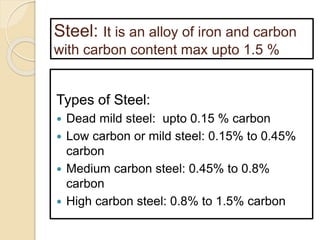
Steel: It is an alloy of iron and carbon
with carbon content max upto 1.5 %
Types of Steel:
 Dead mild steel: upto 0.15 % carbon
 Low carbon or mild steel: 0.15% to 0.45%
carbon
 Medium carbon steel: 0.45% to 0.8%
carbon
 High carbon steel: 0.8% to 1.5% carbon
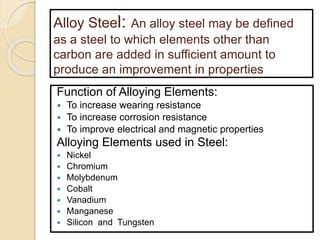
Alloy Steel: An alloy steel may be defined
as a steel to which elements other than
carbon are added in sufficient amount to
produce an improvement in properties
Function of Alloying Elements:
 To increase wearing resistance
 To increase corrosion resistance
 To improve electrical and magnetic properties
Alloying Elements used in Steel:
 Nickel
 Chromium
 Molybdenum
 Cobalt
 Vanadium
 Manganese
 Silicon and Tungsten
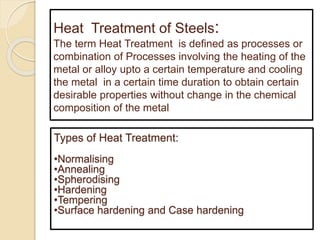
Heat Treatment of Steels:
The term Heat Treatment is defined as processes or
combination of Processes involving the heating of the
metal or alloy upto a certain temperature and cooling
the metal in a certain time duration to obtain certain
desirable properties without change in the chemical
composition of the metal
Types of Heat Treatment:
•Normalising
•Annealing
•Spherodising
•Hardening
•Tempering
•Surface hardening and Case hardening
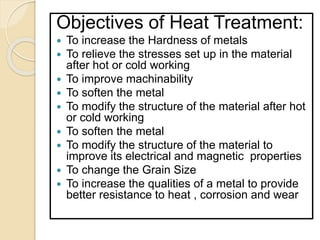
Objectives of Heat Treatment:
 To increase the Hardness of metals
 To relieve the stresses set up in the material
after hot or cold working
 To improve machinability
 To soften the metal
 To modify the structure of the material after hot
or cold working
 To soften the metal
 To modify the structure of the material to
improve its electrical and magnetic properties
 To change the Grain Size
 To increase the qualities of a metal to provide
better resistance to heat , corrosion and wear
Fits and Tolerance:
The degree of tightness or looseness between two
assembly component is known as Fit of the part
Types of Fits:
Clearance Fit
Interference Fit
Transition Fit
Basis of Limit System:
 Hole Base System: When the Hole is kept as the
constant member and different fits are obtained by
varying the shaft , then the limit system is said to
be on Hole Basis
 Shaft Base System: When the shaft is kept as a
constant member and different fits are obtained by
varying the Hole size, then the limit system is said
to be on a Shaft Basis
Interchangeability:
The term interchangeability is Normally employed for
the mass production of identical items within the
prescribed limits of the sizes. In order to control the
size of finished part with due allowance for error for
interchangeable parts is called LIMIT SYSTEM.
According to Indian standards, the system of limits
and fits comprise 18 grades of fundamental
tolerances which are designated as IT01. IT0, and IT1
to IT16.
These are called standard tolerances.
Terminology in interchangeable system:
 Normal size:
 Basic size
 Actual size
 Limits of sizes
 Allowance
 Tolerance
 Tolerance zone
 Zero line
 Upper deviation
 Lower deviation
 Actual deviation
 Mean deviation
 Fundamental deviation

Lecture on machine design and material: Mechanical Engineering

  • 1.
    LECTURE ON INTRODUCTION TO MATERIALPROPERTIES HEAT TREATMENT FITS AND TOLERANCES MACHINE DESIGN Presented by: Debolina Mukherjee (Mtech Mechanical Engineering)
  • 2.
    Introduction:  The subjectmachine Design is the creation of new and better machines and improving the existing ones  A new or better machine is one which is more economical in the overall cost and production and operation  The knowledge of materials and their properties is of great significance for a design engineer
  • 3.
    Mechanical Properties of Metals: Elasticity: It is the property of a material to regain its original shape after deformation when the external forces are removed  Plasticity: It is the property of a material which retains the deformation produced under load permanently  Ductility: It is the property of a material enabling it to be drawn into wire with the application of a tensile force
  • 4.
    Mechanical Properties of Metals: Brittleness: It is the property of a material enabling it to be drawn into wire with the application of a tensile force  Malleability: It is the property of breaking of a material to be rolled or hammered into thin sheets  Toughness: It is the property of a material to resist fracture due to high impact loads like hammer blows
  • 5.
    Ferrous materials:  Theferrous materials are those which have iron as their main constituent  The ferrous metals commonly used in engineering practice are cast iron, wrought iron, steels and alloy steels
  • 6.
    Cast Iron: Thecarbon contents in cast iron varies from 1.7 % to 4.5 % . It also contains small amount of siicon , manganese, phosphorus and sulphur  Grey Cast Iron : 3 to 3.5 % carbon  White Cast Iron: 1.75 to 2.3 % carbon  Mottled cast iron  Malleable Cast Iron
  • 7.
    Wrought Iron: Itis the purest iron which contains at least 99% iron. Properties:  Tough  Malleable Ductile material  Wrought iron cannot stand sudden and excessive shocks  Can be easily forged or welded Use: Chains, crane hooks, railway couplings, water and steam pipes
  • 8.
    Steel: It isan alloy of iron and carbon with carbon content max upto 1.5 % Types of Steel:  Dead mild steel: upto 0.15 % carbon  Low carbon or mild steel: 0.15% to 0.45% carbon  Medium carbon steel: 0.45% to 0.8% carbon  High carbon steel: 0.8% to 1.5% carbon
  • 9.
    Alloy Steel: Analloy steel may be defined as a steel to which elements other than carbon are added in sufficient amount to produce an improvement in properties Function of Alloying Elements:  To increase wearing resistance  To increase corrosion resistance  To improve electrical and magnetic properties Alloying Elements used in Steel:  Nickel  Chromium  Molybdenum  Cobalt  Vanadium  Manganese  Silicon and Tungsten
  • 10.
    Heat Treatment ofSteels: The term Heat Treatment is defined as processes or combination of Processes involving the heating of the metal or alloy upto a certain temperature and cooling the metal in a certain time duration to obtain certain desirable properties without change in the chemical composition of the metal Types of Heat Treatment: •Normalising •Annealing •Spherodising •Hardening •Tempering •Surface hardening and Case hardening
  • 11.
    Objectives of HeatTreatment:  To increase the Hardness of metals  To relieve the stresses set up in the material after hot or cold working  To improve machinability  To soften the metal  To modify the structure of the material after hot or cold working  To soften the metal  To modify the structure of the material to improve its electrical and magnetic properties  To change the Grain Size  To increase the qualities of a metal to provide better resistance to heat , corrosion and wear
  • 12.
    Fits and Tolerance: Thedegree of tightness or looseness between two assembly component is known as Fit of the part Types of Fits: Clearance Fit Interference Fit Transition Fit Basis of Limit System:  Hole Base System: When the Hole is kept as the constant member and different fits are obtained by varying the shaft , then the limit system is said to be on Hole Basis  Shaft Base System: When the shaft is kept as a constant member and different fits are obtained by varying the Hole size, then the limit system is said to be on a Shaft Basis
  • 13.
    Interchangeability: The term interchangeabilityis Normally employed for the mass production of identical items within the prescribed limits of the sizes. In order to control the size of finished part with due allowance for error for interchangeable parts is called LIMIT SYSTEM. According to Indian standards, the system of limits and fits comprise 18 grades of fundamental tolerances which are designated as IT01. IT0, and IT1 to IT16. These are called standard tolerances.
  • 14.
    Terminology in interchangeablesystem:  Normal size:  Basic size  Actual size  Limits of sizes  Allowance  Tolerance  Tolerance zone  Zero line  Upper deviation  Lower deviation  Actual deviation  Mean deviation  Fundamental deviation