Material properties
1. Physical properties
2. Mechanical properties
3. Chemical properties
Physical properties
1. Colour
2. Specific Heat
3. Density
4. Thermal Conductivity
5. Electrical Conductivity
6. Melting
Physical properties
Colour – light wave length
Specific heat – the heat required to r
aise the temperature of one gram of a s
ubstance by one degree centigrade (J/k
g K)
Density – mass per unit volume expresse
d in such units as kg/cm 3
D = m/v.
The mass of atoms, their size, and how th
ey are arranged determine the density of
a substance.
Objects with the same volume but differe
nt mass have different densities.
DENSITY OF DIFFERENT SUBSTANCES
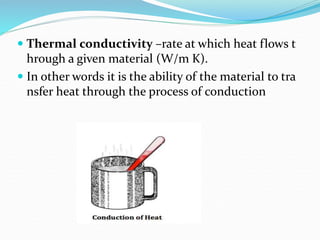
 Thermal conductivity –rate at which heat flows t
hrough a given material (W/m K).
 In other words it is the ability of the material to tra
nsfer heat through the process of conduction
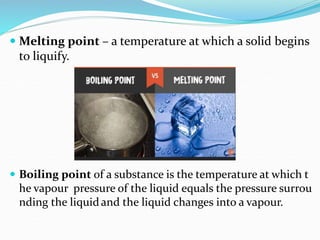
 Melting point – a temperature at which a solid begins
to liquify.
 Boiling point of a substance is the temperature at which t
he vapour pressure of the liquid equals the pressure surrou
nding the liquidand the liquid changes into a vapour.
 Electrical conductivity is the ability o
f electric current to flow through a mater
ial.
 Conductors, such as copper, other metal
s have a high electrical conductivity and
therefore can easily have electrons pass t
hrough them.
Mechanical properties
1. Tensile Strength
2. Ductility
3. Malleability
4. Brittleness
5. Elasticity
6. Plasticity
7. Toughness
8. Hardness
9. Machinability
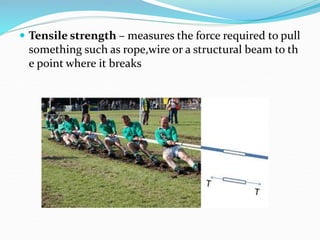
 Tensile strength – measures the force required to pull
something such as rope,wire or a structural beam to th
e point where it breaks
Ductility
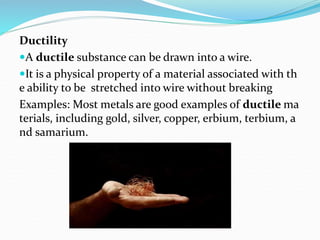
A ductile substance can be drawn into a wire.
It is a physical property of a material associated with th
e ability to be stretched into wire without breaking
Examples: Most metals are good examples of ductile ma
terials, including gold, silver, copper, erbium, terbium, a
nd samarium.
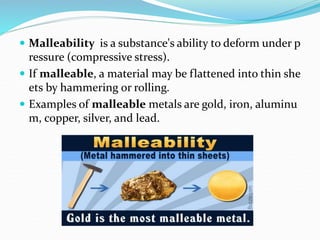
 Malleability is a substance's ability to deform under p
ressure (compressive stress).
 If malleable, a material may be flattened into thin she
ets by hammering or rolling.
 Examples of malleable metals are gold, iron, aluminu
m, copper, silver, and lead.
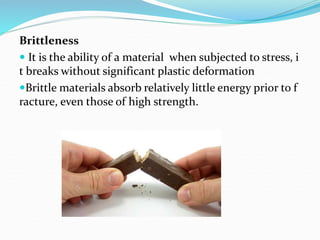
Brittleness
 It is the ability of a material when subjected to stress, i
t breaks without significant plastic deformation
Brittle materials absorb relatively little energy prior to f
racture, even those of high strength.
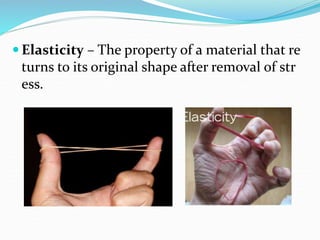
 Elasticity – The property of a material that re
turns to its original shape after removal of str
ess.
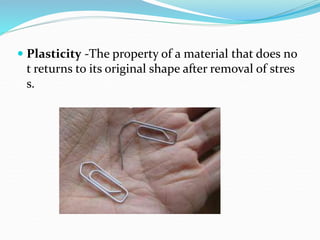
 Plasticity -The property of a material that does no
t returns to its original shape after removal of stres
s.
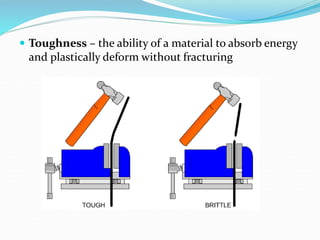
 Toughness – the ability of a material to absorb energy
and plastically deform without fracturing
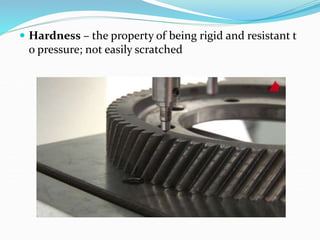
 Hardness – the property of being rigid and resistant t
o pressure; not easily scratched
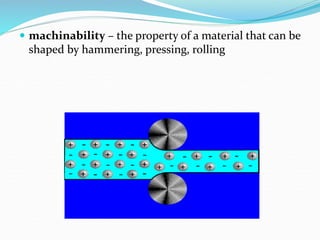
 machinability – the property of a material that can be
shaped by hammering, pressing, rolling
Chemical properties
 Corrosion resistance
 Errosion resistance
Chemical properties
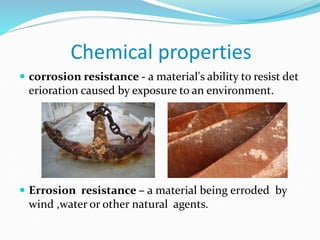
 corrosion resistance - a material's ability to resist det
erioration caused by exposure to an environment.
 Errosion resistance – a material being erroded by
wind ,water or other natural agents.
Properties of material

Properties of material

  • 1.
    Material properties 1. Physicalproperties 2. Mechanical properties 3. Chemical properties
  • 2.
    Physical properties 1. Colour 2.Specific Heat 3. Density 4. Thermal Conductivity 5. Electrical Conductivity 6. Melting
  • 3.
    Physical properties Colour –light wave length Specific heat – the heat required to r aise the temperature of one gram of a s ubstance by one degree centigrade (J/k g K)
  • 4.
    Density – massper unit volume expresse d in such units as kg/cm 3 D = m/v. The mass of atoms, their size, and how th ey are arranged determine the density of a substance. Objects with the same volume but differe nt mass have different densities.
  • 5.
  • 6.
     Thermal conductivity–rate at which heat flows t hrough a given material (W/m K).  In other words it is the ability of the material to tra nsfer heat through the process of conduction
  • 7.
     Melting point– a temperature at which a solid begins to liquify.  Boiling point of a substance is the temperature at which t he vapour pressure of the liquid equals the pressure surrou nding the liquidand the liquid changes into a vapour.
  • 8.
     Electrical conductivityis the ability o f electric current to flow through a mater ial.  Conductors, such as copper, other metal s have a high electrical conductivity and therefore can easily have electrons pass t hrough them.
  • 9.
    Mechanical properties 1. TensileStrength 2. Ductility 3. Malleability 4. Brittleness 5. Elasticity 6. Plasticity 7. Toughness 8. Hardness 9. Machinability
  • 10.
     Tensile strength– measures the force required to pull something such as rope,wire or a structural beam to th e point where it breaks
  • 11.
    Ductility A ductile substancecan be drawn into a wire. It is a physical property of a material associated with th e ability to be stretched into wire without breaking Examples: Most metals are good examples of ductile ma terials, including gold, silver, copper, erbium, terbium, a nd samarium.
  • 12.
     Malleability isa substance's ability to deform under p ressure (compressive stress).  If malleable, a material may be flattened into thin she ets by hammering or rolling.  Examples of malleable metals are gold, iron, aluminu m, copper, silver, and lead.
  • 13.
    Brittleness  It isthe ability of a material when subjected to stress, i t breaks without significant plastic deformation Brittle materials absorb relatively little energy prior to f racture, even those of high strength.
  • 14.
     Elasticity –The property of a material that re turns to its original shape after removal of str ess.
  • 15.
     Plasticity -Theproperty of a material that does no t returns to its original shape after removal of stres s.
  • 16.
     Toughness –the ability of a material to absorb energy and plastically deform without fracturing
  • 17.
     Hardness –the property of being rigid and resistant t o pressure; not easily scratched
  • 18.
     machinability –the property of a material that can be shaped by hammering, pressing, rolling
  • 19.
    Chemical properties  Corrosionresistance  Errosion resistance
  • 20.
    Chemical properties  corrosionresistance - a material's ability to resist det erioration caused by exposure to an environment.  Errosion resistance – a material being erroded by wind ,water or other natural agents.