Presented By
Piyush Jindal
(Jindal Classes)
Govt. Polytechnic
Kashipur
MATERIAL PROPERTIES
CLASSIFICATION OF
MATERIALS
Material can be classify mainly into three
Groups:-
1. General Classification
 Metallic Material
 Ferrous Metals (e.g. Iron, Steel, Alloys)
 Non-Ferrous Metals (e.g. CU, Brass, Al etc.)
 Non-Metallic Materials
(e.g.: Plastic, Rubber, Glass etc.)
Properties of Material
Mechanical Properties
 Elasticity:- Elasticity is the ability of a body to resist a
distorting influence and to return to its original size and
shape when that influence or force is removed. Solid objects
will deform when adequate forces are applied on them.
 Plasticity:- Plasticity describes the deformation of a (solid)
material undergoing non-reversible changes of shape in
response to applied forces.
 Toughness:- toughness is the ability of a material to
absorb energy and plastically deform without fracturing.
One definition of material toughness is the amount of energy
per unit volume that a material can absorb before rupturing.
Mechanical
Properties(contd…)
 Stiffness:- Stiffness is the rigidity of an object — the
extent to which it resists deformation in response to an
applied force. The complementary concept is flexibility or
pliability: the more flexible an object is, the less stiff it is.
 Ductility:- Ductility, Capacity of a material to deform
permanently (e.g., stretch, bend, or spread) in response to
stress. Most common steels, for example, are quite
ductile and hence can accommodate local stress
concentrations.
 Malleability:- Malleability is a substance's ability to
deform under pressure (compressive stress). If malleable,
a material may be flattened into thin sheets by hammering
or rolling. These materials can be flattened into metal leaf.
Mechanical
Properties(contd…)
 Hardness:- Resistance of a material to deformation,
indentation, or penetration by means such as abrasion, drilling,
impact, scratching, and/or wear, measured by hardness tests
such as Brinell, Knoop, Rockwell, or Vickers.
 Brittleness:- A material is brittle if, when subjected to stress, it
breaks without significant plastic deformation. Brittle materials
absorb relatively little energy prior to fracture, even those of
high strength. Breaking is often accompanied by a snapping
sound. Brittle materials include
most ceramics and glasses (which do not deform plastically) and
some polymers, such as PMMA and polystyrene.
 Flexibility:- Stiffness is the rigidity of an object — the extent to
which it resists deformation in response to an applied force. The
complementary concept is flexibility or pliability:
Mechanical
Properties(contd…)
 Strength:- Strength, ability to withstand an applied stress without
failure. Compressive strength, capacity to withstand axially directed
pushing forces. Tensile strength, maximum stress while being
stretched or pulled before necking. Shear strength, the ability to
withstand shearing.
 Machinability:- machinability refers to the ease with which a
metal can be cut (machined) permitting the removal of the material
with a satisfactory finish at low cost.
 Tenacity:- The greatest longitudinal stress a substance can
bear without tearing asunder, -- usually expressed with reference
to a unit area of the cross section of the substance, as the
number of pounds per square inch, or kilograms per square
centimeter, necessary to produce rupture.
Mechanical
Properties(contd…)
 Fatigue:- fatigue is the weakening of a material caused by
repeatedly applied loads. It is the progressive and localized
structural damage that occurs when a material is subjected to
cyclic loading.
 Creep:- creep (sometimes called cold flow) is the tendency of
a solid material to move slowly or deform permanently under the
influence of mechanical stresses. It can occur as a result of long-
term exposure to high levels of stress that are still below the
yield strength of the material.
 Resilience:- resilience is the ability of a material to absorb
energy when it is deformed elastically, and release that
energy upon unloading. Proof resilience is defined as the
maximum energy that can be absorbed up to the elastic limit,
without creating a permanent distortion.
Thermal Properties
Heat Capacity
A solid material’s potential energy is stored as its
heat energy.
Temperature of a solid is a measure its potential
energy.
External energy required to increase temperature of
a solid mass is known as the material’s heat
capacity. it is defined as its ability to absorb heat
energy.
C= dQ/dT
Heat capacity has units as J/mol-K or Cal/mol-K.
Heat capacity is not an intrinsic property i.e. it
changes with material volume/mass.
Thermal Properties
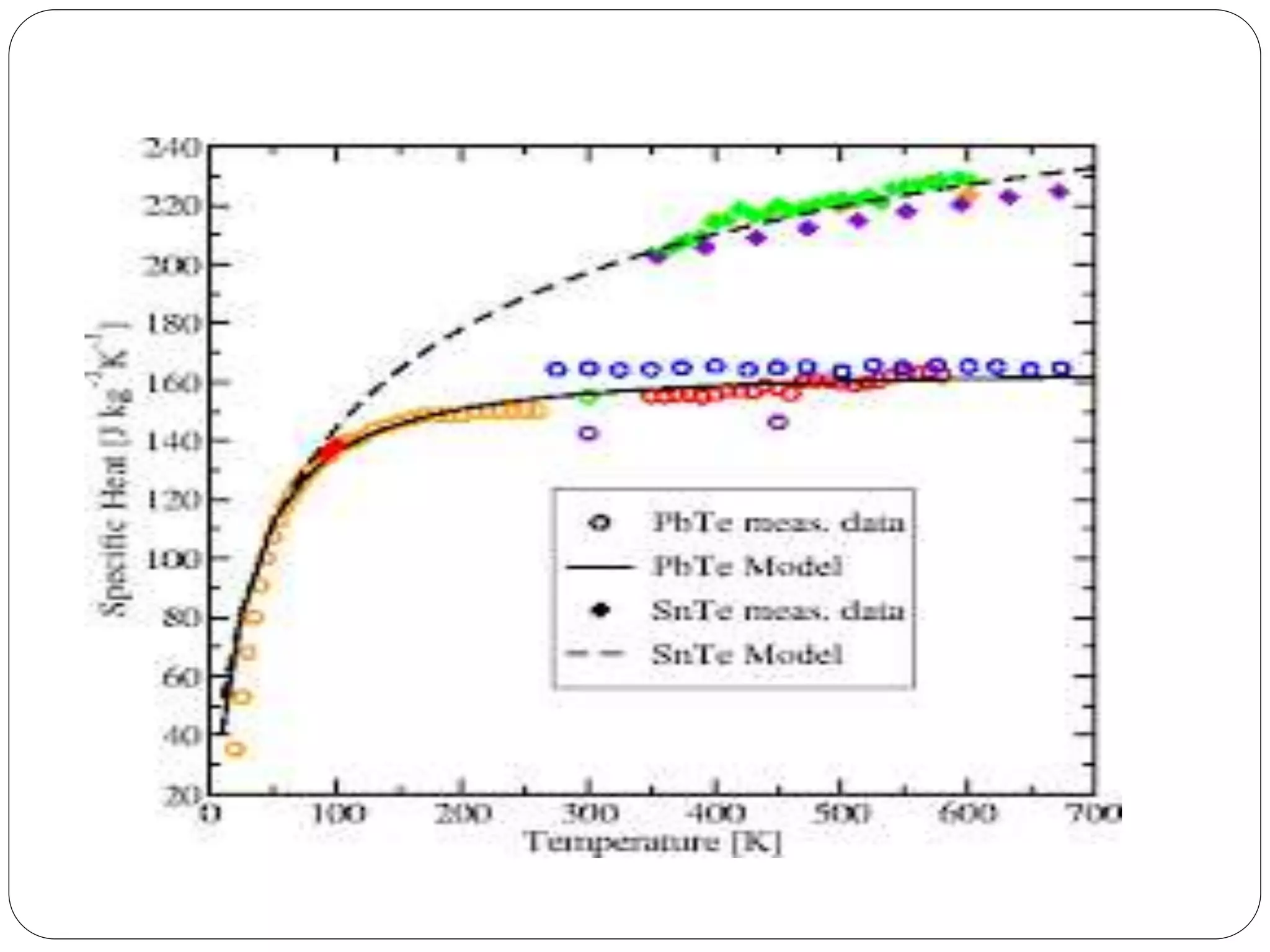
Specific Heat
 For comparison of different materials, heat capacity
has been rationalized.
Specific heat is heat capacity per unit mass. It has
units as J/kg-K or Cal/kg-K.
With increase of heat energy, dimensional changes
may occur. Hence, two heat capacities are usually
defined.
Heat capacity at constant pressure, Cp , is always
higher than heat capacity at constant volume, Cv.
Heat is absorbed through different mechanisms:
lattice vibrations and electronic contribution.
Thermal Properties
Thermal Expansion
 Increase in temperature may cause dimensional
changes.
 Linear coefficient of thermal expansion (α)
defined as the change in the dimensions of the
material per unit length.
 Changes in dimensions with temperature are due
to change in inter-atomic distance, rather than
increase in vibrational amplitude.
Technological Properties
Castability
Weldability
Formability
Machinability

Mechanical properties of Material

  • 1.
    Presented By Piyush Jindal (JindalClasses) Govt. Polytechnic Kashipur MATERIAL PROPERTIES
  • 2.
    CLASSIFICATION OF MATERIALS Material canbe classify mainly into three Groups:- 1. General Classification  Metallic Material  Ferrous Metals (e.g. Iron, Steel, Alloys)  Non-Ferrous Metals (e.g. CU, Brass, Al etc.)  Non-Metallic Materials (e.g.: Plastic, Rubber, Glass etc.)
  • 3.
    Properties of Material MechanicalProperties  Elasticity:- Elasticity is the ability of a body to resist a distorting influence and to return to its original size and shape when that influence or force is removed. Solid objects will deform when adequate forces are applied on them.  Plasticity:- Plasticity describes the deformation of a (solid) material undergoing non-reversible changes of shape in response to applied forces.  Toughness:- toughness is the ability of a material to absorb energy and plastically deform without fracturing. One definition of material toughness is the amount of energy per unit volume that a material can absorb before rupturing.
  • 4.
    Mechanical Properties(contd…)  Stiffness:- Stiffnessis the rigidity of an object — the extent to which it resists deformation in response to an applied force. The complementary concept is flexibility or pliability: the more flexible an object is, the less stiff it is.  Ductility:- Ductility, Capacity of a material to deform permanently (e.g., stretch, bend, or spread) in response to stress. Most common steels, for example, are quite ductile and hence can accommodate local stress concentrations.  Malleability:- Malleability is a substance's ability to deform under pressure (compressive stress). If malleable, a material may be flattened into thin sheets by hammering or rolling. These materials can be flattened into metal leaf.
  • 5.
    Mechanical Properties(contd…)  Hardness:- Resistanceof a material to deformation, indentation, or penetration by means such as abrasion, drilling, impact, scratching, and/or wear, measured by hardness tests such as Brinell, Knoop, Rockwell, or Vickers.  Brittleness:- A material is brittle if, when subjected to stress, it breaks without significant plastic deformation. Brittle materials absorb relatively little energy prior to fracture, even those of high strength. Breaking is often accompanied by a snapping sound. Brittle materials include most ceramics and glasses (which do not deform plastically) and some polymers, such as PMMA and polystyrene.  Flexibility:- Stiffness is the rigidity of an object — the extent to which it resists deformation in response to an applied force. The complementary concept is flexibility or pliability:
  • 6.
    Mechanical Properties(contd…)  Strength:- Strength,ability to withstand an applied stress without failure. Compressive strength, capacity to withstand axially directed pushing forces. Tensile strength, maximum stress while being stretched or pulled before necking. Shear strength, the ability to withstand shearing.  Machinability:- machinability refers to the ease with which a metal can be cut (machined) permitting the removal of the material with a satisfactory finish at low cost.  Tenacity:- The greatest longitudinal stress a substance can bear without tearing asunder, -- usually expressed with reference to a unit area of the cross section of the substance, as the number of pounds per square inch, or kilograms per square centimeter, necessary to produce rupture.
  • 7.
    Mechanical Properties(contd…)  Fatigue:- fatigueis the weakening of a material caused by repeatedly applied loads. It is the progressive and localized structural damage that occurs when a material is subjected to cyclic loading.  Creep:- creep (sometimes called cold flow) is the tendency of a solid material to move slowly or deform permanently under the influence of mechanical stresses. It can occur as a result of long- term exposure to high levels of stress that are still below the yield strength of the material.  Resilience:- resilience is the ability of a material to absorb energy when it is deformed elastically, and release that energy upon unloading. Proof resilience is defined as the maximum energy that can be absorbed up to the elastic limit, without creating a permanent distortion.
  • 8.
    Thermal Properties Heat Capacity Asolid material’s potential energy is stored as its heat energy. Temperature of a solid is a measure its potential energy. External energy required to increase temperature of a solid mass is known as the material’s heat capacity. it is defined as its ability to absorb heat energy. C= dQ/dT Heat capacity has units as J/mol-K or Cal/mol-K. Heat capacity is not an intrinsic property i.e. it changes with material volume/mass.
  • 10.
    Thermal Properties Specific Heat For comparison of different materials, heat capacity has been rationalized. Specific heat is heat capacity per unit mass. It has units as J/kg-K or Cal/kg-K. With increase of heat energy, dimensional changes may occur. Hence, two heat capacities are usually defined. Heat capacity at constant pressure, Cp , is always higher than heat capacity at constant volume, Cv. Heat is absorbed through different mechanisms: lattice vibrations and electronic contribution.
  • 11.
    Thermal Properties Thermal Expansion Increase in temperature may cause dimensional changes.  Linear coefficient of thermal expansion (α) defined as the change in the dimensions of the material per unit length.  Changes in dimensions with temperature are due to change in inter-atomic distance, rather than increase in vibrational amplitude.
  • 12.