BASIC MECHANICAL
BASIC MECHANICAL
ENGINEERING
ENGINEERING
BT 203
BT 203
INTRODUCTION
to
ENGINEERING MATERIALS
INTRDUCTION :
INTRDUCTION :
ENGINEERING MATERIALS
 The knowledge of Engineering Material is
very vital for their effective use in the
manufacturing of products.
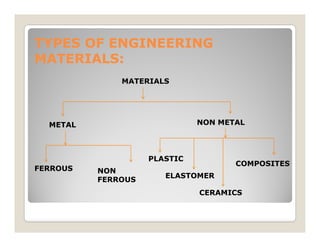
TYPES OF ENGINEERING
MATERIALS:
MATERIALS:
MATERIALS
METAL NON METAL
METAL NON METAL
FERROUS NON
FERROUS
PLASTIC
ELASTOMER
CERAMICS
COMPOSITES
Properties of Metal
Properties of Metal
 Good machinibility and ductility.
 Good electrical and thermal conductivity.
 Form alloys.
 Available in solid form in room
temperature.
 Shinning appearance.
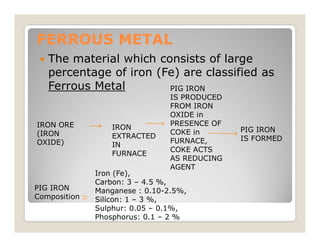
FERROUS METAL
FERROUS METAL
 The material which consists of large
percentage of iron (Fe) are classified as
Ferrous Metal
IRON ORE IRON
PIG IRON
IS PRODUCED
FROM IRON
OXIDE in
PRESENCE OF
IRON ORE
(IRON
OXIDE)
IRON
EXTRACTED
IN
FURNACE
PRESENCE OF
COKE in
FURNACE,
COKE ACTS
AS REDUCING
AGENT
PIG IRON
IS FORMED
PIG IRON
Composition
Iron (Fe),
Carbon: 3 – 4.5 %,
Manganese : 0.10-2.5%,
Silicon: 1 – 3 %,
Sulphur: 0.05 – 0.1%,
Phosphorus: 0.1 – 2 %
Non Ferrous Metal
Non Ferrous Metal
 Materials which do not contain Iron (Fe)
or posses very small percentage of Iron,
are classified as Non- Ferrous Metals.
 Examples :
Aluminum, Copper, Nickel, Titanium, Zinc,
etc.
Non Metal
Non Metal
Examples of Non- Metal:
 Wood
 Ceramics
 Composites
 Polymers/Plastics
 Available in solid, liquid, gaseous form.
 Do not form Alloy.
 Poor Electrical and Thermal conductivity.
Properties of Non Metal
 Polymers/Plastics
Ceramics
Ceramics
 The term “Ceramics” is taken from the greek word “ fired
material”
 Example of Ceramic material:
 Porcelain
 Glass
 Cement
 Cement
 Brick
 Earthenware
 Refractories
 Abrasives
Ceramics Consists of Metals and Non- Metals bonded
together chemically.
Applications: Furnace linings, etc.
Composites
Composites
 A composite material is composed of two
or more materials bonded together in
which one material serves as a matrix
surrounding the particles (or fibers) of the
other materials.
other materials.
Properties of Composites:
•High Strength
•Good Toughness
•High Stiffness
•Light in Weight
•Excellent resistance to corrosion.
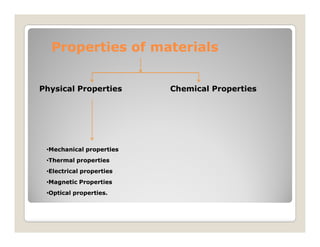
Properties of materials
Physical Properties
Physical Properties Chemical Properties
Chemical Properties
•
•Mechanical
Mechanical properties
properties
•
•Thermal properties
Thermal properties
•
•Electrical
Electrical properties
properties
•
•Magnetic Properties
Magnetic Properties
•
•Optical properties.
Optical properties.
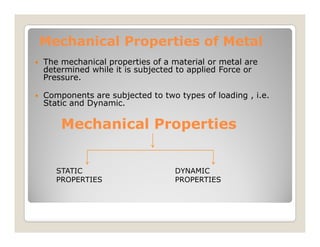
Mechanical Properties of Metal
 The mechanical properties of a material or metal are
determined while it is subjected to applied Force or
Pressure.
 Components are subjected to two types of loading , i.e.
Static and Dynamic.
Mechanical Properties
STATIC
PROPERTIES
DYNAMIC
PROPERTIES
Static Properties
Static Properties
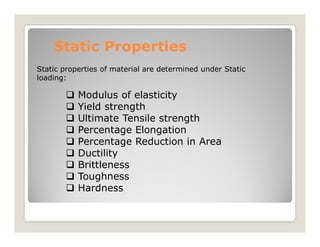
 Modulus of elasticity
 Yield strength
 Ultimate Tensile strength
Percentage Elongation
Static properties of material are determined under Static
loading:

 Percentage Elongation
 Percentage Reduction in Area
 Ductility
 Brittleness
 Toughness
 Hardness
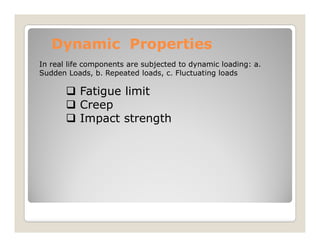
Dynamic Properties
Dynamic Properties
 Fatigue limit
 Creep
 Impact strength
In real life components are subjected to dynamic loading: a.
Sudden Loads, b. Repeated loads, c. Fluctuating loads
 Impact strength
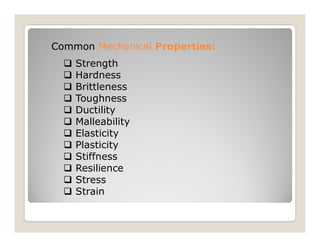
Common
Common Mechanical
Mechanical Properties:
Properties:
 Strength
 Hardness
 Brittleness
 Toughness
 Ductility
 Malleability
 Malleability
 Elasticity
 Plasticity
 Stiffness
 Resilience
 Stress
 Strain
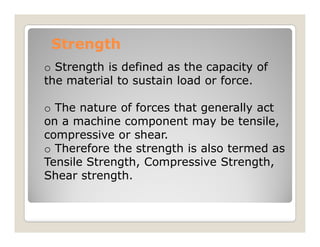
Strength
Strength
o Strength is defined as the capacity of
the material to sustain load or force.
o The nature of forces that generally act
on a machine component may be tensile,
compressive or shear.
o Therefore the strength is also termed as
Tensile Strength, Compressive Strength,
Shear strength.
H
Hardness
ardness
o Hardness is a measure of the
resistance of a material to
permanent deformation (or abration
or indentation)
Brittleness
Brittleness
o Brittleness is defined as the tendency
of a material to fracture when subjected
to shocking load.
o Material having less than 5%
elongation can be considered as Brittle.
Toughness
Toughness
oToughness is defined as the ability of a
material to resist fracture under shock
loading when loading has crossed elastic
limit.
Ductility
Ductility
oDuctility is defined as the ability of
material to be drawn into wire.
o Ductility can be measured by
determining the percentage elongation.
o Material having 15% or more
percentage elongation can be
considered as Ductile material.
Malleability
Malleability
oMalleability is defined as the ability of
material to withstand the deformation in
all direction without cracking when load
is applied.
o The property of malleability is
considered when forming of material
into sheets.
Elasticity
Elasticity
o Elasticity is defined as the property of
the material to return to its initial shape
and size after the removal of Force.
Stiffness
Stiffness
o Stiffness is defined as the property of
the material which enables to deform
deformation.
Plasticity
Plasticity
oPlasticity is defined as the ability to be
be deformed permanently without
fracture by application of Force after the
force is removed.
Resilience
Resilience
o Resilence is defined as the ability of a
material to store energy and to resist
shock and impact.
Stress
Stress
oStress is the internal resistance offered
by the material under application of
force (load).
o Stress = Load/ Unit Area
o Stress, σ = F/ Ao
oUnit of Stress: Newton/ m²
Strain
Strain
oStain is defined as Change in length to
the original length of the specimen
under Load.
oStrain = (Lf – Lo) / Lo = Δ L / Lo

introduction to engineering materials

  • 1.
    BASIC MECHANICAL BASIC MECHANICAL ENGINEERING ENGINEERING BT203 BT 203 INTRODUCTION to ENGINEERING MATERIALS
  • 2.
    INTRDUCTION : INTRDUCTION : ENGINEERINGMATERIALS ENGINEERING MATERIALS  The knowledge of Engineering Material is very vital for their effective use in the very vital for their effective use in the manufacturing of products.
  • 3.
    TYPES OF ENGINEERING TYPESOF ENGINEERING MATERIALS: MATERIALS: MATERIALS METAL NON METAL METAL NON METAL FERROUS NON FERROUS PLASTIC ELASTOMER CERAMICS COMPOSITES
  • 4.
    Properties of Metal Propertiesof Metal  Good machinibility and ductility.  Good electrical and thermal conductivity.  Form alloys.  Available in solid form in room  Available in solid form in room temperature.  Shinning appearance.
  • 5.
    FERROUS METAL FERROUS METAL The material which consists of large percentage of iron (Fe) are classified as Ferrous Metal IRON ORE IRON PIG IRON IS PRODUCED FROM IRON OXIDE in PRESENCE OF IRON ORE (IRON OXIDE) IRON EXTRACTED IN FURNACE PRESENCE OF COKE in FURNACE, COKE ACTS AS REDUCING AGENT PIG IRON IS FORMED PIG IRON Composition Iron (Fe), Carbon: 3 – 4.5 %, Manganese : 0.10-2.5%, Silicon: 1 – 3 %, Sulphur: 0.05 – 0.1%, Phosphorus: 0.1 – 2 %
  • 6.
    Non Ferrous Metal NonFerrous Metal  Materials which do not contain Iron (Fe) or posses very small percentage of Iron, are classified as Non- Ferrous Metals.  Examples : Aluminum, Copper, Nickel, Titanium, Zinc, etc.
  • 7.
    Non Metal Non Metal Examplesof Non- Metal:  Wood  Ceramics  Composites  Polymers/Plastics  Available in solid, liquid, gaseous form.  Do not form Alloy.  Poor Electrical and Thermal conductivity. Properties of Non Metal Properties of Non Metal  Polymers/Plastics
  • 8.
    Ceramics Ceramics  The term“Ceramics” is taken from the greek word “ fired material”  Example of Ceramic material:  Porcelain  Glass  Cement  Cement  Brick  Earthenware  Refractories  Abrasives Ceramics Consists of Metals and Non- Metals bonded together chemically. Applications: Furnace linings, etc.
  • 9.
    Composites Composites  A compositematerial is composed of two or more materials bonded together in which one material serves as a matrix surrounding the particles (or fibers) of the other materials. other materials. Properties of Composites: •High Strength •Good Toughness •High Stiffness •Light in Weight •Excellent resistance to corrosion.
  • 10.
    Properties of materials Propertiesof materials Physical Properties Physical Properties Chemical Properties Chemical Properties • •Mechanical Mechanical properties properties • •Thermal properties Thermal properties • •Electrical Electrical properties properties • •Magnetic Properties Magnetic Properties • •Optical properties. Optical properties.
  • 11.
    Mechanical Properties ofMetal Mechanical Properties of Metal  The mechanical properties of a material or metal are determined while it is subjected to applied Force or Pressure.  Components are subjected to two types of loading , i.e. Static and Dynamic. Mechanical Properties Mechanical Properties Mechanical Properties Mechanical Properties STATIC PROPERTIES DYNAMIC PROPERTIES
  • 12.
    Static Properties Static Properties Modulus of elasticity  Yield strength  Ultimate Tensile strength Percentage Elongation Static properties of material are determined under Static loading:   Percentage Elongation  Percentage Reduction in Area  Ductility  Brittleness  Toughness  Hardness
  • 13.
    Dynamic Properties Dynamic Properties Fatigue limit  Creep  Impact strength In real life components are subjected to dynamic loading: a. Sudden Loads, b. Repeated loads, c. Fluctuating loads  Impact strength
  • 14.
    Common Common Mechanical Mechanical Properties: Properties: Strength  Hardness  Brittleness  Toughness  Ductility  Malleability  Malleability  Elasticity  Plasticity  Stiffness  Resilience  Stress  Strain
  • 15.
    Strength Strength o Strength isdefined as the capacity of the material to sustain load or force. o The nature of forces that generally act on a machine component may be tensile, on a machine component may be tensile, compressive or shear. o Therefore the strength is also termed as Tensile Strength, Compressive Strength, Shear strength.
  • 16.
    H Hardness ardness o Hardness isa measure of the resistance of a material to permanent deformation (or abration or indentation)
  • 17.
    Brittleness Brittleness o Brittleness isdefined as the tendency of a material to fracture when subjected to shocking load. o Material having less than 5% o Material having less than 5% elongation can be considered as Brittle.
  • 18.
    Toughness Toughness oToughness is definedas the ability of a material to resist fracture under shock loading when loading has crossed elastic limit.
  • 19.
    Ductility Ductility oDuctility is definedas the ability of material to be drawn into wire. o Ductility can be measured by determining the percentage elongation. o Material having 15% or more o Material having 15% or more percentage elongation can be considered as Ductile material.
  • 20.
    Malleability Malleability oMalleability is definedas the ability of material to withstand the deformation in all direction without cracking when load is applied. o The property of malleability is o The property of malleability is considered when forming of material into sheets.
  • 21.
    Elasticity Elasticity o Elasticity isdefined as the property of the material to return to its initial shape and size after the removal of Force.
  • 22.
    Stiffness Stiffness o Stiffness isdefined as the property of the material which enables to deform deformation.
  • 23.
    Plasticity Plasticity oPlasticity is definedas the ability to be be deformed permanently without fracture by application of Force after the force is removed.
  • 24.
    Resilience Resilience o Resilence isdefined as the ability of a material to store energy and to resist shock and impact.
  • 25.
    Stress Stress oStress is theinternal resistance offered by the material under application of force (load). o Stress = Load/ Unit Area o Stress = Load/ Unit Area o Stress, σ = F/ Ao oUnit of Stress: Newton/ m²
  • 26.
    Strain Strain oStain is definedas Change in length to the original length of the specimen under Load. oStrain = (Lf – Lo) / Lo = Δ L / Lo oStrain = (Lf – Lo) / Lo = Δ L / Lo