AUTONOMIC
NEUROTRANSMISSION AND
CHOLINERGIC DRUGS -1
Nervous system
• Central nervous system (CNS)
• Peripheral nervous system
1. autonomic nervous system, which includes the enteric nervous
system
2. somatic efferent nerves, innervating skeletal muscle
3. somatic and visceral afferent nerves
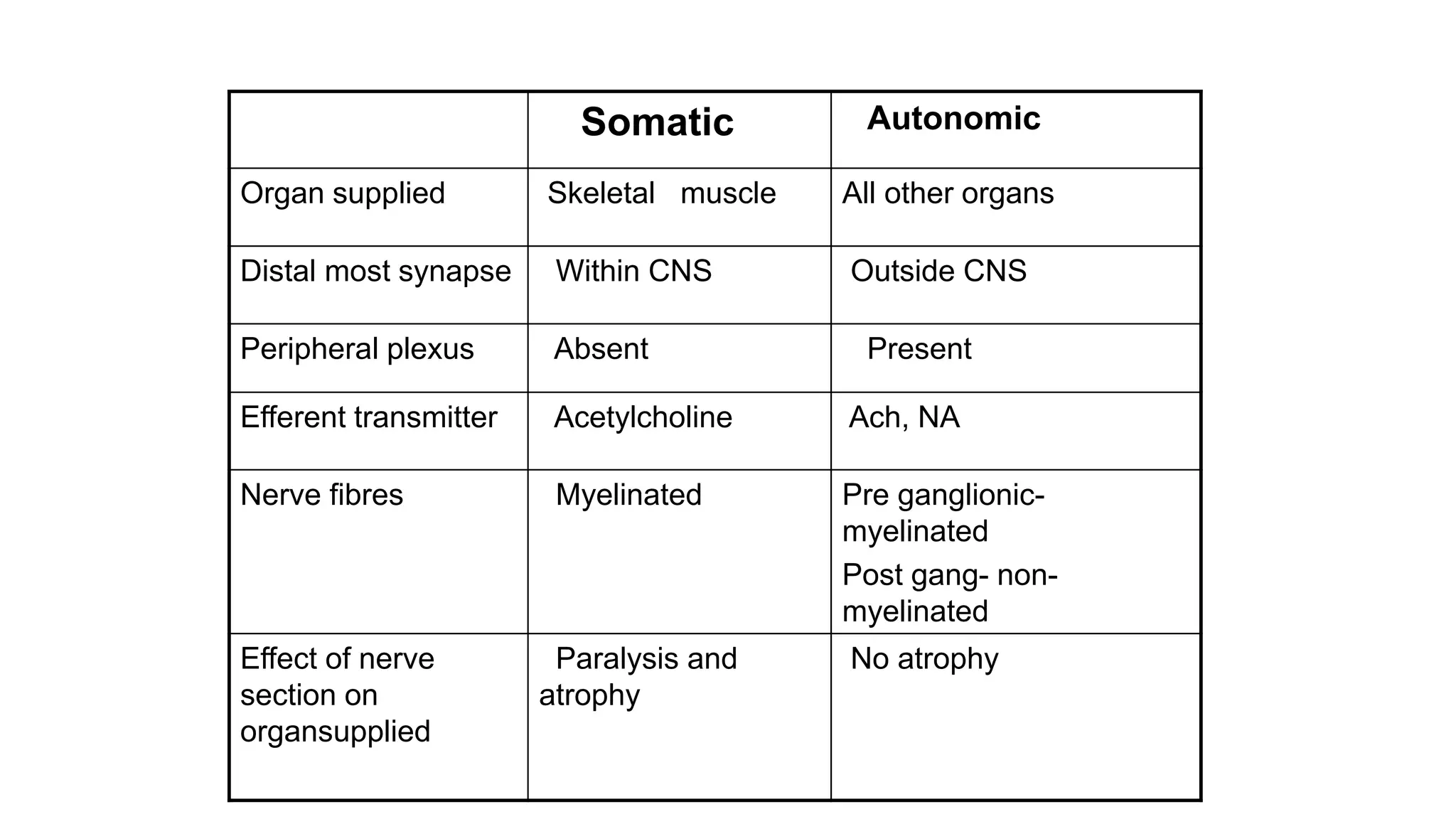
Somatic Autonomic
Organ supplied Skeletal muscle All other organs
Distal most synapse Within CNS Outside CNS
Peripheral plexus Absent Present
Efferent transmitter Acetylcholine Ach, NA
Nerve fibres Myelinated Pre ganglionic-
myelinated
Post gang- non-
myelinated
Effect of nerve
section on
organsupplied
Paralysis and
atrophy
No atrophy
ANATOMY OF THE AUTONOMIC NERVOUS
SYSTEM
(1) The sympathetic or thoracolumbar outflow
(2) The parasympathetic or craniosacral outflow
Sympathetic Parasympathetic
Origin Thoraco-lumbar(T1-L3) Craniosacral (3,7,9,10;S2-4)
Distribution wide Head, neck and trunk
Ganglia Away from organs On or close to the organ
Post gangl fibre long short
Transmitter NA (major) Ach( minor) Ach
Stability of
transmitter
NA stable, diffuses for wide
action
Ach-rapidly destroyed locally
Important
function
Tackling stress and
emergency
“fight or flight” responses
Assimilation of food,
conservation of energy
”rest and digest” responses
ENTERIC NERVOUS SYSTEM (ENS)
neurons lying in the intramural plexuses of the gastrointestinal
tract
inputs from sympathetic and parasympathetic systems
can act on its own to control the motor and secretory functions
of the intestine.
Comparison of Sympathetic, Parasympathetic, and Motor
Nerves
Neurochemical Transmission
Steps Involved in Neurotransmission
• Impulse conduction
• Transmitter release
• Transmitter action on post junctional membrane
• Post junctional activity
• Termination of transmitter action
1. Impulse conduction
RMP- -70 mV
Arrival of an electrical impulse  Na+conductance
Depolarization (+20mV)K + efflux repolarization
Blockers – Tetrodotoxin , Saxitoxin
Activators - Batrachotoxin
2. Transmitter release
AP Release of transmitter stored in prejunctional nerve endings
within synaptic vesicles
Fusion of synaptic and vesicular membranes
Ca 2+ entry exocytosis of all contents
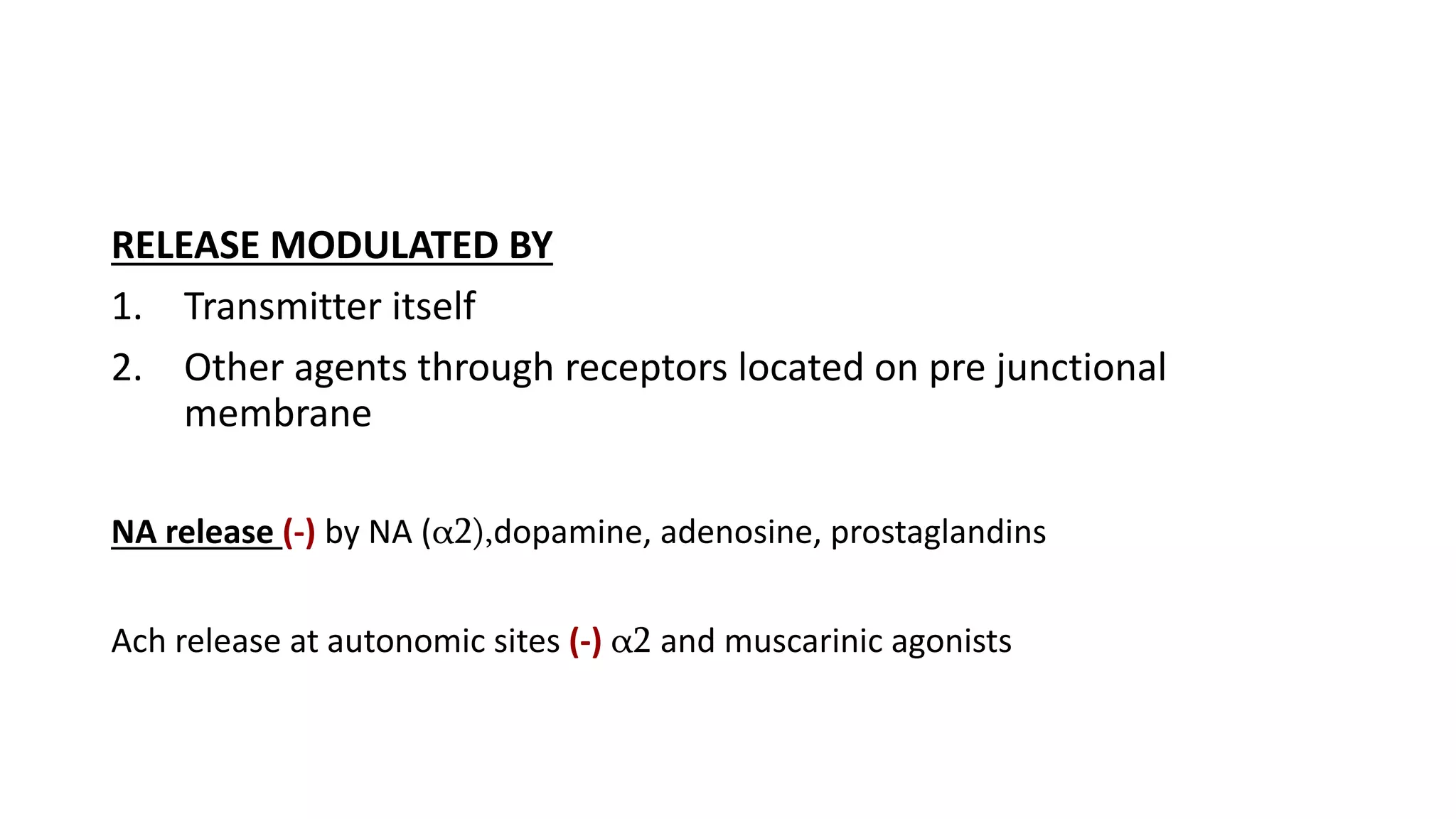
RELEASE MODULATED BY
1. Transmitter itself
2. Other agents through receptors located on pre junctional
membrane
NA release (-) by NA (α2),dopamine, adenosine, prostaglandins
Ach release at autonomic sites (-) α2 and muscarinic agonists
3.Transmitter action on post junctional
membrane
Transmitter combines with receptor on post jnl membrane EPSP or
IPSP
EPSP  permeability to all cationsNa+ or Ca 2+ influx  depolarization
followed by K+ efflux
IPSP  permeability to smaller ions, I .e Cl
Cl- influx hyperpolarization
Excitatory and inhibitory neurohumoral
transmission
4. Post junctional activity
Suprathreshold EPSP propagated post junctional AP nerve
impulse/contraction/secretion
IPSP stabilizes the post junctional membrane , resists depolarizing
stimuli
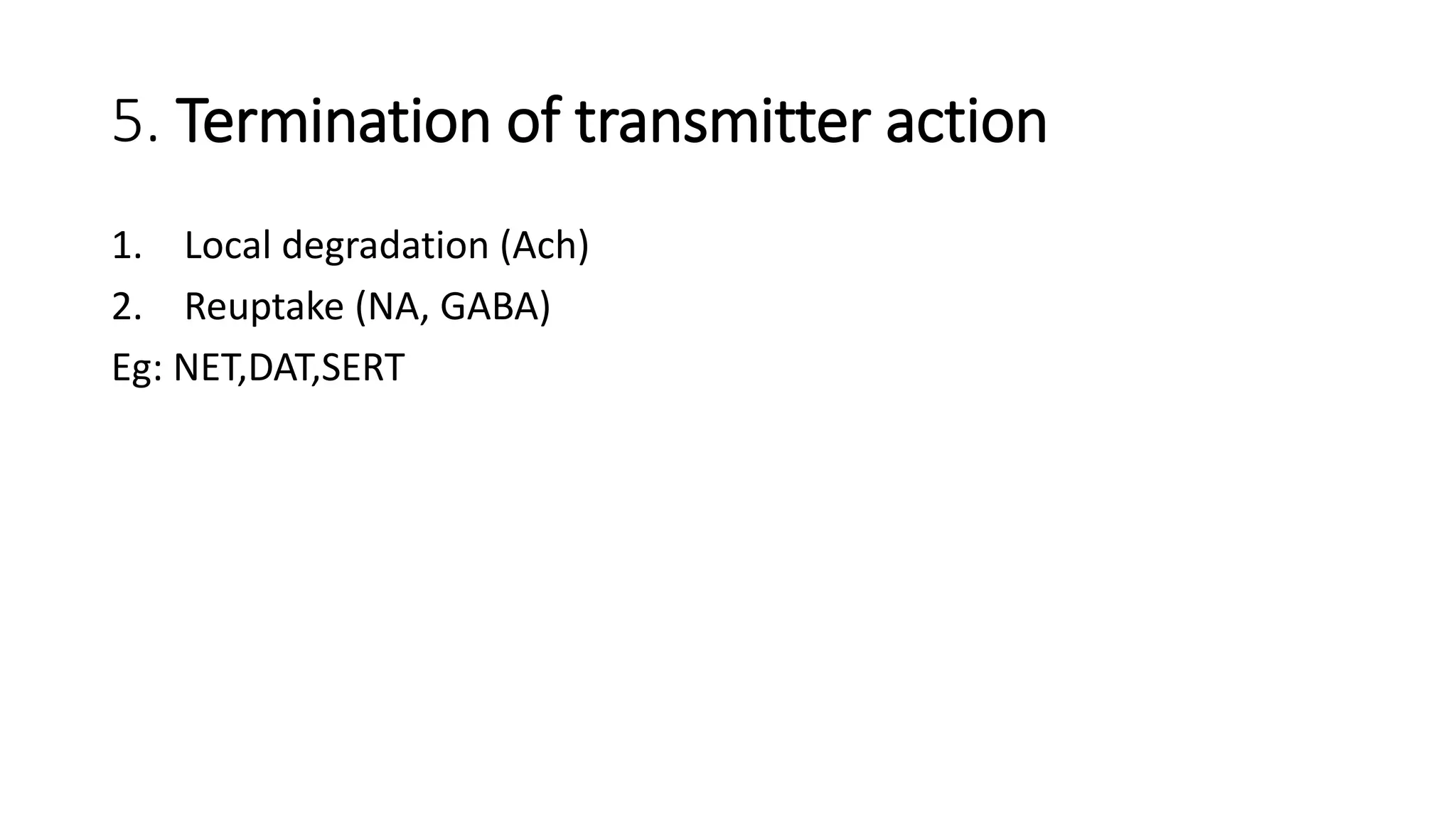
5. Termination of transmitter action
1. Local degradation (Ach)
2. Reuptake (NA, GABA)
Eg: NET,DAT,SERT
Mechanisms of termination of transmitter
action
Mechanisms of termination of transmitter
action
Mechanisms of termination of transmitter
action
Cotransmission
• On stimulation most peripheral and central neurons have been shown
to release more than one active substance
• Purines (ATP, adenosine)
• Peptides ( VIP, NPY, substance P)
• NO, prostaglandins
VIPAch
ATP Ach, NA
Vasc adrenergic nerves NPY
Cotransmission
Cholinergic Transmission
• All preganglionic nerve endings
• All parasympathetic postganglionic nerves
• Few sympathetic postganglionic nerves
• To the neuromuscular junction
Synthesis ,storage and release of ACh
• Transport of Choline into the vesicle
• Synthesis of Acetyl choline from Acetyl CoA & Choline
• Transport of Acetyl choline into the vesicle
Botulinum toxin
• Clostridium botulinum
• long-lasting loss of cholinergic transmission
• (BOTOX) or its haemagglutinin complex (DYSPORT)
• blepharospasm, spastic cerebral palsy, strabismus.
CHOLINERGIC TRANSMISSION
• Choline transported into the neuron by a Na-choline cotransporter .
the rate-limiting step in acetylcholine synthesis.
• blocked by hemicholiniums.
• Ach is syn in the cytoplasm from acetyl-CoA & choline by choline
acetyltransferase (ChAT).
• transported from the cytoplasm into the vesicles by a vesicle-
associated transporter (VAT)
• This antiporter can be blocked vesamicol.
• Vesicles interaction of so-called SNARE proteins on the
vesicle (esp synaptobrevin) & on the inside of the terminal
cell membrane (esp syntaxin and SNAP-25).
• Release from the vesicles  AP triggers sufficient influx of
Ca ions via N-type Ca channels
• Ca interacts with the VAMP synaptotagmin & triggers fusion
 results in exocytotic expulsion –
• The release process is blocked - botulinum toxin
• Massive release is & depletion – Black widow spider toxin
• Ach binds to : postsynaptic/ presynaptic receptors
• Action  rapidly terminated, because
acetylcholinesterase cleaves Ach to choline & acetate in
the synaptic cleft
Ach esterase Butyrylcholine esterase
Distrib All cholinergic sites
RBC, Gray matter
Plasma. Liver, int,white
matter
Hydrolysis
Ach
Methacholine
Benzoylcholine
Butyrylcholine
Very fast
Slower than Ach
Not Hydrolysed
Not Hydrolysed
Slow
Not Hydrolysed
Hydrolysed
Hydrolysed
Inhibition Physostigmine OP
Function Term of Ach action Hydrolysis of ingested esters
Cholinergic receptors
• Nicotinic ( ligand gated receptor)
• Muscarinic ( G protein coupled receptor)
NICOTINIC ACETYLCHOLINE RECEPTOR
Molecular structure
• Nicotinic acetylcholine receptor- pentameric ( α, β, γ and δ)
• 2 acetylcholine binding sites.
• Each subunit contains 4 membrane-spanning α-helices.
Gating mechanism
Ligand binding
Conformational change
Channel opening
Ion influx/efflux
Depolarization/hyperpolarization
NM receptor
Location Skeletal NMJ
Molecular
mechanism
↑ Cation permeability (Na,K)
Functional
response
Skeletal muscle contraction
Agonists PTMA
SCh
Antagonists Atracurium
tubocurarine
Alpha-bungarotoxin
NN receptor
Location 1)Autonomic ganglia
2)Adrenal medulla
Molecular
mechanism
↑ Cation permeability (Na,K)
Functional
response
Firing of postganglionic neuron
Secretion of catacholamine
Agonists Nicotine
DMPP
Antagonists Trimethophan
Hexamethonium
• M1
• M2
• M3
• M4
• M5
MUSCARINIC RECEPTORS
M1
Location 1) CNS
2) Autonomic ganglia
3) Gastric glands
Molecular
mechanism
Gq → PROTEIN COUPLED
Functional
response
↑ cognitive function(learning &memory)
↑ motor activity
↓in dopamine release
↑ depolarisation of autonomic ganglia
↑ acid secretion
Agonists Oxotremorine
Antagonists Pirenzepine,
telenzepine
M2
Location 1)Heart
2)Smooth muscle
4)CNS
Molecular
mechanism
Gi, ↓ cAMP (Activation of K+channel)
Functional
response
HEART –depressant
Smooth muscle - ↑contraction
CNS - inhibition
Agonists Methacholine
Antagonists Methoctramine,
Tripitramine
M3
Location 1)Glands
2)Smooth muscle
3)Heart
4)CNS
5) Iris,ciliary muscle
Molecular
mechanism
Similar to M1
Functional
response
Smooth muscle contraction
BV-relaxation
↓ dopamine release,
Pupil constriction , ciliary contraction
Agonists Bethanechol
Antagonists Darifenacin
solifenacin
M4
Location CNS(forebrain)
Molecular mechanism Similar to M2
Functional response Inhibit transmitter release
Facilitate dopamine release
Location Substantia nigra
Molecular
mechanism
Similar to M1 & 3
Functional
response
Cerebral vasodilatation
Facilitates DA release :Drug seeking behaviour
M5
ACTIONS (Ach)
MUSCARINIC
HEART
• Hyperpolarises SA node -↓ diastolic depolarisation :↓ HR
• AV node - ↓ conduction & RP ↑: ↑PR interval
• Atria - ↓contraction & RP ↓  Non uniform vagal innervation : AF
• Ventricle- ↓ contraction but not marked
SMOOTH MUSCLE
• ↑contraction ( M3)
• Tone & peristalisis in GIT ↑, Sphincters relax Abd cramps &
evacuation of bowel
• Ureter peristalsis↑, Detrusor contracts, Bladder trigone &
sphincter relax: Voiding
• Bronchospasm
BLOOD VESSELS
• All blood vessels dilated
• Fall in BP & flushing
• EDRF
• Erection – releasing NO & dilating cavernosal vessels : M3
GLANDS
• Secretion from all glands↑
• Salivation , Sweating, lacrimation, Gastric & Tracheobronchial
secretion
• Secretion of milk & bile not affected
EYE
• Contraction of circular muscle of iris MIOSIS M3
• Contraction of ciliary muscle  Spasm of accomod, ↑outflow
facility ,↓ IOP
NICOTINIC
1. AUTONOMIC GANGLIA
• Symp + Para symp stim( only at high doses)
• If higher dose of Ach given after atropine ↑ BP & HR
2. SKELETAL MUSCLES
• Contraction of fibre
3. CNS
• IV – no effect
• Direct inj into brain – complex pattern of stimulation followed by
depression
CHOLINERGIC DRUGS
DIRECTLY ACTING PARASYMPATHATOMIMETICS
• Choline Esters
• Cholinomimetic Alkaloids
INDIRECTLY ACTING PARASYMPATHATOMIMETICS
• Anti choline Esterases
DIRECTLY ACTING CHOLINERGIC DRUGS
•CHOLINE ESTERS
• Acetylcholine
• Bethanechol
• Carbachol
• Methacholine
•ALKALOIDS
• Muscarine
• Pilocarpine
• Arecholine
CHOLINE ESTERS
USES
BETHANECHOL
• GI smooth muscle stimulant
• postoperative abdominal distention
• paralytic ileus
• esophageal reflux; promotes increased esophageal motility
• Urinary bladder stimulant
• post-operative; post-partum urinary retention
• Alternative to pilocarpine to treat diminished salivation
secondary e.g. To radiation
• SE : Belching , colic, Flushing , Sewating, ↓BP
CHOLINOMIMETIC ALKALOIDS
PILOCARPINE
• Leaves of Pilocarpus Microphyllus
• Tertiary amine  Crosses BBB
• Dominant Muscarinic action – M3 & NN
• ADR – Pulm Edema
↑ sweating, salivation & other secr
USES
1. EYE -
Penetrates cornea – Miosis, Ciliary muscle contraction, ↓IOP lasting
4 – 8 hrs
• 3rd line drug - POAG
• S/E : Initial stinging sensation,
• Painful spasm of accomodation
• To counteract Mydriatics
• Prev adhesions by altering with mydriatics
2. As SIALOGOGUE
MUSCARINE
• Obt from poisonous mushrooms
• Amanita muscaria & Inocybe
• only muscarinic actions
• No therapeutic indications
• Quarternary alkaloid BBB penetration
MUSHROOM POISONING
• 3 types of mushroom poisoning
MUSCARINE TYPE
• Inocybe
• Symp appear within an hour of eating
• Reversed by ATROPINE
HALLUCINOGENIC TYPE
PHALLOIDIN TYPE
HALLUCINOGENIC TYPE
• Muscimol & other Isoxazole compds  A muscaria
• Compds activate amino acid receptors & block muscarinic receptors in
brain – HALLUCINOGENIC
• Manifestation – central
• No specific Rx. Atropine is CI
• Another hallucinogenic – Psilocybe mexicana
• Active principle : PSILOCYBINE - Tryptaminergic
PHALLOIDIN TYPE
• PEPTIDE TOXINS
• Found in A phalloides, Galerina
• (-) RNA & protein syn
• Symp start after many hrs & due to damage: GI mucosa , Liver & Kidney
• Rx : Supportive measures
• Thioctic acid : Antidotal effect
ARECOLINE
• Betel nut
• Predominant M + slight N
• Prominent CNS effect
• Enhancer of cognitive dementia
Anticholinesterases
CHEMISTRY
• Either esters of carbamic acid or derivatives of phosphoric
acid
CARBAMATES
• R1 : Non polar tertiary amino eg : Physostigmine : lipid
soluble
• : Quarternary N⁺ eg : Neostigmine : Lipid insoluble
OP
• All highly lipid soluble except
• Ecothiophate Which is water soluble
Chemistry
MECHANISM OF ACTION
The active site contains:
• Aromatic anionic site ( Tryptophan)
• Esteratic site ( Serine, Glutamate, Histidine)
• Carbamylates  carbamylate
• OP  Phosphorylate
A E
The carbamylated enz reacts slowly
The phosphorylated enz reacts extremely slowly
1. Hydrolysis of Ach involves electrostatic attraction
of N⁺ of Ach to aromatic site
2. Nucleophilic attack by serine OH
3. Acetylated enz reacts with water rapidly  acetic
acid & choline
Carbamates
• Binds to both sites
OP
• Binds to esteratic site
EDROPHONIUM
TACRINE
• Hydrostatic bond
EA
A
E
E
A
PHARMACOLOGICAL ACTIONS
LIPID SOLUBLE – ( Physostigmine & OP)
• Marked Muscarinic & CNS effects
• Stimulate ganglia but action on skeletal mus ↓
LIPID INSOLUBLE – ( Neostigmine & Quarternary)
• Effect on Skeletal mus & stimulate ganglia
• Muscarinic effects ↓
• Dont penetrate CNS & have no central effects
GANGLIA
• Local hydrolysis less imp in ganglia
• Inactivation occurs
• Partly by diffusion
• Hydrolysis in plasma
• Anti CHE stimulate ganglia: muscarinic receptors
• High doses Persistent depolarisation  Blockade
SKELETAL MUSCLE
• Ach released not degraded – Rebinds to same R  activates pre
junctional fibresrepititive firing  Twitching & Fasciculations
• Force of contraction in partially curarised & myasthenic muscles ↑
• High doses  Persistent depolarisation in end plate  Blockade of
NM transmission weakness & paralysis
CVS
• Effects complex
• M : ↓HR & BP
• Ganglia : ↑HR & BP
OTHER EFFECTS
• Stimulation of smooth mus & glands of GIT
PHYSOSTIGMINE NEOSTIGMINE
Natural Alkaloid from
Physostigma
Venenosum
Synthetic
Tertiary amine Quarternary ammonium
Oral abs  Good
CNS action +
Penetrates cornea
Oral abs  Poor
CNS action (-)
(-)
No DIRECT action on NM +
Prom effect on
autonomic effectors
Skeletal muscle
IMP USE : MIOTIC MYASTHENIA GRAVIS
PYRIDOSTIGMINE
• -- Neostigmine
• LESS Potent
• Longer acting
EDROPHONIUM
• Brief dur( 10- 30 min)
• Diagnostic agent in Myasthenia
• Post operative Decurarization
RIVASTIGMINE
• Lipophilic
• Relative cerebroselective
• Alzheimers disease
GALANTAMINE
• Natural Alkaloid
• Weak agonistic action on N
• Used in Alzheimers
TACRINE
• Lipophilic acridine compd
• Crosses BBB
• Longer duration of action
• ↑Brain Ach- partial improvement in AD
DONEPEZIL
• Centrally acting
• Cognitive & behavioural improvement in AD
ECHOTHIOPHATE
• OP + Quarternary structure
• Water soluble, Local irritant ↓
• Long acting
DYFLOS
• Very potent, Long acting
• Used as miotic
• Not used now - Irritant
USES
• AS MIOTIC
A) GLAUCOMA
• ↑ tone of ciliary mus ( attached to scleral spur) &
• ↑ tone of Sphincter pupillae  pull on & improve
alignment of trabeculae  outflow facility is ↑
Cont…….
• Pilocarpine : Rapid & short lasting ,
↓vision in dim light, spasm of accomod , Brow pain.
Sys SE : N, D, Sweating & Bronchospasm
• Physostigmine (0.1 %)
• Aphakic glaucoma
B ) TO REVERSE EFFECT OF MYDRIATICS
C ) TO PREVENT FORMATION OF ADHESIONS
MYASTHENIA GRAVIS
Anticholinesterases
• Edrophonium, neostigmine, and pyridostigmine
Immunosuppression
• Immediate – IV Ig or plasmapheresis
• Intermediate (1-3 months) – glucocorticoids, cyclosporine.
• Many months (6-12) – azathioprine, cyclosporine.
Thymectomy
POST OP PARALYTIC ILEUS / URINARY RETENTION
• Neostigmine(0.5-1mg) s/c
POST OP DECURARIZATION
• Neostigmine(0.5-2 mg) iv preceded by atropine/
glycopyrrolate
COBRA BITE
• Neostigmine + Atropine  prev Resp Paralysis
Cont……
BELLADONA POISONING
• Physostigmine(0.5-2 mg iv )
ANTI CHOLINERGIC OVERDOSAGE
• TCAD, Phenothiazine, Anti Histamine – Physostigmine.
ALZHEIMERS DISEASE
• Tacrine , Donepezil , Rivastigmine, Galantamine
ANTI CHOLINE ESTERASE POISONING
• Local M effects  Systemic effects M, N & Central
• Irritation of eye, lacrimation, salivation, sweating , copious
Tracheo-bronchial secretion, miosis, blurring of vision,
breathlessness, colic, invol defecation & urination
Cont…..
• ↓ BP, Bradycardia / Tachycardia, cardiac arrhythmias , vascular
collapse
• Muscle fasciculations, weakness, resp paralysis
• Excitement , tremor, ataxia, convulsions, coma & death (  RESP
FAILURE)
TREATMENT
• Termination of further exposure to poison – fresh air,
wash the skin & mucous membrane with soap & water,
gastric lavage
• Maintain patent airway, PPV if its failing
• Supportive measures – Maintain BP, Hydration , control
of convculsions with judicious use of diazepam
SPECIFIC ANTIDOTES
1. ATROPINE
• Highly effective in counteracting M symp, but higher
doses req to antagonise central effects
• Doesnt reverse peripheral muscle paralysis
• 2 mg IV repeated every 10 min till dryness of mouth
• Maintenance dose may be req for 1- 2 weeks
CHOLINE ESTERASE REACTIVATORS
• OXIMES – Restore NM transmission
• Phosphorylated enz reacts very slowly with water
• PRALIDOXIME
• Quarternary N : Attaches to Anionic site – which
remains unoccupied in OP poisoning
Mechanism
• Its oxime end reacts with Phosphorous atom attached to
anionic site: Oxime Phosphonate  diffuses away leaving
reactivated Ach E
• Not effective in Carbamate poisoning
• Given within 24 hrs B4 aging sets in
• OBIDOXIME ( more potent )
Summary
• Steps in neurohumoral transmission
• Cholinergic transmission
• Cholinergic receptors
• Cholinergic drugs
• Anticholinesterase poisoning
Thank you

ANS pharmacology ppt

  • 1.
  • 2.
    Nervous system • Centralnervous system (CNS) • Peripheral nervous system 1. autonomic nervous system, which includes the enteric nervous system 2. somatic efferent nerves, innervating skeletal muscle 3. somatic and visceral afferent nerves
  • 3.
    Somatic Autonomic Organ suppliedSkeletal muscle All other organs Distal most synapse Within CNS Outside CNS Peripheral plexus Absent Present Efferent transmitter Acetylcholine Ach, NA Nerve fibres Myelinated Pre ganglionic- myelinated Post gang- non- myelinated Effect of nerve section on organsupplied Paralysis and atrophy No atrophy
  • 4.
    ANATOMY OF THEAUTONOMIC NERVOUS SYSTEM (1) The sympathetic or thoracolumbar outflow (2) The parasympathetic or craniosacral outflow
  • 5.
    Sympathetic Parasympathetic Origin Thoraco-lumbar(T1-L3)Craniosacral (3,7,9,10;S2-4) Distribution wide Head, neck and trunk Ganglia Away from organs On or close to the organ Post gangl fibre long short Transmitter NA (major) Ach( minor) Ach Stability of transmitter NA stable, diffuses for wide action Ach-rapidly destroyed locally Important function Tackling stress and emergency “fight or flight” responses Assimilation of food, conservation of energy ”rest and digest” responses
  • 6.
    ENTERIC NERVOUS SYSTEM(ENS) neurons lying in the intramural plexuses of the gastrointestinal tract inputs from sympathetic and parasympathetic systems can act on its own to control the motor and secretory functions of the intestine.
  • 8.
    Comparison of Sympathetic,Parasympathetic, and Motor Nerves
  • 9.
  • 10.
    Steps Involved inNeurotransmission • Impulse conduction • Transmitter release • Transmitter action on post junctional membrane • Post junctional activity • Termination of transmitter action
  • 11.
    1. Impulse conduction RMP--70 mV Arrival of an electrical impulse  Na+conductance Depolarization (+20mV)K + efflux repolarization Blockers – Tetrodotoxin , Saxitoxin Activators - Batrachotoxin
  • 12.
    2. Transmitter release APRelease of transmitter stored in prejunctional nerve endings within synaptic vesicles Fusion of synaptic and vesicular membranes Ca 2+ entry exocytosis of all contents
  • 13.
    RELEASE MODULATED BY 1.Transmitter itself 2. Other agents through receptors located on pre junctional membrane NA release (-) by NA (α2),dopamine, adenosine, prostaglandins Ach release at autonomic sites (-) α2 and muscarinic agonists
  • 14.
    3.Transmitter action onpost junctional membrane Transmitter combines with receptor on post jnl membrane EPSP or IPSP EPSP  permeability to all cationsNa+ or Ca 2+ influx  depolarization followed by K+ efflux IPSP  permeability to smaller ions, I .e Cl Cl- influx hyperpolarization
  • 15.
    Excitatory and inhibitoryneurohumoral transmission
  • 16.
    4. Post junctionalactivity Suprathreshold EPSP propagated post junctional AP nerve impulse/contraction/secretion IPSP stabilizes the post junctional membrane , resists depolarizing stimuli
  • 17.
    5. Termination oftransmitter action 1. Local degradation (Ach) 2. Reuptake (NA, GABA) Eg: NET,DAT,SERT
  • 18.
    Mechanisms of terminationof transmitter action
  • 19.
    Mechanisms of terminationof transmitter action
  • 20.
    Mechanisms of terminationof transmitter action
  • 21.
    Cotransmission • On stimulationmost peripheral and central neurons have been shown to release more than one active substance • Purines (ATP, adenosine) • Peptides ( VIP, NPY, substance P) • NO, prostaglandins VIPAch ATP Ach, NA Vasc adrenergic nerves NPY
  • 22.
  • 23.
    Cholinergic Transmission • Allpreganglionic nerve endings • All parasympathetic postganglionic nerves • Few sympathetic postganglionic nerves • To the neuromuscular junction
  • 24.
    Synthesis ,storage andrelease of ACh • Transport of Choline into the vesicle • Synthesis of Acetyl choline from Acetyl CoA & Choline • Transport of Acetyl choline into the vesicle
  • 26.
    Botulinum toxin • Clostridiumbotulinum • long-lasting loss of cholinergic transmission • (BOTOX) or its haemagglutinin complex (DYSPORT) • blepharospasm, spastic cerebral palsy, strabismus.
  • 27.
    CHOLINERGIC TRANSMISSION • Cholinetransported into the neuron by a Na-choline cotransporter . the rate-limiting step in acetylcholine synthesis. • blocked by hemicholiniums. • Ach is syn in the cytoplasm from acetyl-CoA & choline by choline acetyltransferase (ChAT). • transported from the cytoplasm into the vesicles by a vesicle- associated transporter (VAT) • This antiporter can be blocked vesamicol.
  • 28.
    • Vesicles interactionof so-called SNARE proteins on the vesicle (esp synaptobrevin) & on the inside of the terminal cell membrane (esp syntaxin and SNAP-25). • Release from the vesicles  AP triggers sufficient influx of Ca ions via N-type Ca channels • Ca interacts with the VAMP synaptotagmin & triggers fusion  results in exocytotic expulsion – • The release process is blocked - botulinum toxin • Massive release is & depletion – Black widow spider toxin
  • 29.
    • Ach bindsto : postsynaptic/ presynaptic receptors • Action  rapidly terminated, because acetylcholinesterase cleaves Ach to choline & acetate in the synaptic cleft Ach esterase Butyrylcholine esterase Distrib All cholinergic sites RBC, Gray matter Plasma. Liver, int,white matter Hydrolysis Ach Methacholine Benzoylcholine Butyrylcholine Very fast Slower than Ach Not Hydrolysed Not Hydrolysed Slow Not Hydrolysed Hydrolysed Hydrolysed Inhibition Physostigmine OP Function Term of Ach action Hydrolysis of ingested esters
  • 30.
    Cholinergic receptors • Nicotinic( ligand gated receptor) • Muscarinic ( G protein coupled receptor)
  • 31.
    NICOTINIC ACETYLCHOLINE RECEPTOR Molecularstructure • Nicotinic acetylcholine receptor- pentameric ( α, β, γ and δ) • 2 acetylcholine binding sites. • Each subunit contains 4 membrane-spanning α-helices.
  • 32.
    Gating mechanism Ligand binding Conformationalchange Channel opening Ion influx/efflux Depolarization/hyperpolarization
  • 33.
    NM receptor Location SkeletalNMJ Molecular mechanism ↑ Cation permeability (Na,K) Functional response Skeletal muscle contraction Agonists PTMA SCh Antagonists Atracurium tubocurarine Alpha-bungarotoxin
  • 34.
    NN receptor Location 1)Autonomicganglia 2)Adrenal medulla Molecular mechanism ↑ Cation permeability (Na,K) Functional response Firing of postganglionic neuron Secretion of catacholamine Agonists Nicotine DMPP Antagonists Trimethophan Hexamethonium
  • 35.
    • M1 • M2 •M3 • M4 • M5 MUSCARINIC RECEPTORS
  • 36.
    M1 Location 1) CNS 2)Autonomic ganglia 3) Gastric glands Molecular mechanism Gq → PROTEIN COUPLED Functional response ↑ cognitive function(learning &memory) ↑ motor activity ↓in dopamine release ↑ depolarisation of autonomic ganglia ↑ acid secretion Agonists Oxotremorine Antagonists Pirenzepine, telenzepine
  • 37.
    M2 Location 1)Heart 2)Smooth muscle 4)CNS Molecular mechanism Gi,↓ cAMP (Activation of K+channel) Functional response HEART –depressant Smooth muscle - ↑contraction CNS - inhibition Agonists Methacholine Antagonists Methoctramine, Tripitramine
  • 38.
    M3 Location 1)Glands 2)Smooth muscle 3)Heart 4)CNS 5)Iris,ciliary muscle Molecular mechanism Similar to M1 Functional response Smooth muscle contraction BV-relaxation ↓ dopamine release, Pupil constriction , ciliary contraction Agonists Bethanechol Antagonists Darifenacin solifenacin
  • 39.
    M4 Location CNS(forebrain) Molecular mechanismSimilar to M2 Functional response Inhibit transmitter release Facilitate dopamine release Location Substantia nigra Molecular mechanism Similar to M1 & 3 Functional response Cerebral vasodilatation Facilitates DA release :Drug seeking behaviour M5
  • 40.
    ACTIONS (Ach) MUSCARINIC HEART • HyperpolarisesSA node -↓ diastolic depolarisation :↓ HR • AV node - ↓ conduction & RP ↑: ↑PR interval • Atria - ↓contraction & RP ↓  Non uniform vagal innervation : AF • Ventricle- ↓ contraction but not marked
  • 41.
    SMOOTH MUSCLE • ↑contraction( M3) • Tone & peristalisis in GIT ↑, Sphincters relax Abd cramps & evacuation of bowel • Ureter peristalsis↑, Detrusor contracts, Bladder trigone & sphincter relax: Voiding • Bronchospasm
  • 42.
    BLOOD VESSELS • Allblood vessels dilated • Fall in BP & flushing • EDRF • Erection – releasing NO & dilating cavernosal vessels : M3
  • 43.
    GLANDS • Secretion fromall glands↑ • Salivation , Sweating, lacrimation, Gastric & Tracheobronchial secretion • Secretion of milk & bile not affected EYE • Contraction of circular muscle of iris MIOSIS M3 • Contraction of ciliary muscle  Spasm of accomod, ↑outflow facility ,↓ IOP
  • 45.
    NICOTINIC 1. AUTONOMIC GANGLIA •Symp + Para symp stim( only at high doses) • If higher dose of Ach given after atropine ↑ BP & HR 2. SKELETAL MUSCLES • Contraction of fibre 3. CNS • IV – no effect • Direct inj into brain – complex pattern of stimulation followed by depression
  • 46.
    CHOLINERGIC DRUGS DIRECTLY ACTINGPARASYMPATHATOMIMETICS • Choline Esters • Cholinomimetic Alkaloids INDIRECTLY ACTING PARASYMPATHATOMIMETICS • Anti choline Esterases
  • 47.
    DIRECTLY ACTING CHOLINERGICDRUGS •CHOLINE ESTERS • Acetylcholine • Bethanechol • Carbachol • Methacholine •ALKALOIDS • Muscarine • Pilocarpine • Arecholine
  • 48.
  • 49.
    USES BETHANECHOL • GI smoothmuscle stimulant • postoperative abdominal distention • paralytic ileus • esophageal reflux; promotes increased esophageal motility • Urinary bladder stimulant • post-operative; post-partum urinary retention • Alternative to pilocarpine to treat diminished salivation secondary e.g. To radiation • SE : Belching , colic, Flushing , Sewating, ↓BP
  • 50.
    CHOLINOMIMETIC ALKALOIDS PILOCARPINE • Leavesof Pilocarpus Microphyllus • Tertiary amine  Crosses BBB • Dominant Muscarinic action – M3 & NN • ADR – Pulm Edema ↑ sweating, salivation & other secr
  • 51.
    USES 1. EYE - Penetratescornea – Miosis, Ciliary muscle contraction, ↓IOP lasting 4 – 8 hrs • 3rd line drug - POAG • S/E : Initial stinging sensation, • Painful spasm of accomodation • To counteract Mydriatics • Prev adhesions by altering with mydriatics 2. As SIALOGOGUE
  • 52.
    MUSCARINE • Obt frompoisonous mushrooms • Amanita muscaria & Inocybe • only muscarinic actions • No therapeutic indications • Quarternary alkaloid BBB penetration
  • 53.
    MUSHROOM POISONING • 3types of mushroom poisoning MUSCARINE TYPE • Inocybe • Symp appear within an hour of eating • Reversed by ATROPINE HALLUCINOGENIC TYPE PHALLOIDIN TYPE
  • 54.
    HALLUCINOGENIC TYPE • Muscimol& other Isoxazole compds  A muscaria • Compds activate amino acid receptors & block muscarinic receptors in brain – HALLUCINOGENIC • Manifestation – central • No specific Rx. Atropine is CI • Another hallucinogenic – Psilocybe mexicana • Active principle : PSILOCYBINE - Tryptaminergic
  • 55.
    PHALLOIDIN TYPE • PEPTIDETOXINS • Found in A phalloides, Galerina • (-) RNA & protein syn • Symp start after many hrs & due to damage: GI mucosa , Liver & Kidney • Rx : Supportive measures • Thioctic acid : Antidotal effect
  • 56.
    ARECOLINE • Betel nut •Predominant M + slight N • Prominent CNS effect • Enhancer of cognitive dementia
  • 57.
  • 59.
    CHEMISTRY • Either estersof carbamic acid or derivatives of phosphoric acid CARBAMATES • R1 : Non polar tertiary amino eg : Physostigmine : lipid soluble • : Quarternary N⁺ eg : Neostigmine : Lipid insoluble OP • All highly lipid soluble except • Ecothiophate Which is water soluble
  • 60.
  • 61.
    MECHANISM OF ACTION Theactive site contains: • Aromatic anionic site ( Tryptophan) • Esteratic site ( Serine, Glutamate, Histidine) • Carbamylates  carbamylate • OP  Phosphorylate
  • 62.
    A E The carbamylatedenz reacts slowly The phosphorylated enz reacts extremely slowly 1. Hydrolysis of Ach involves electrostatic attraction of N⁺ of Ach to aromatic site 2. Nucleophilic attack by serine OH 3. Acetylated enz reacts with water rapidly  acetic acid & choline
  • 63.
    Carbamates • Binds toboth sites OP • Binds to esteratic site EDROPHONIUM TACRINE • Hydrostatic bond EA A E E A
  • 64.
    PHARMACOLOGICAL ACTIONS LIPID SOLUBLE– ( Physostigmine & OP) • Marked Muscarinic & CNS effects • Stimulate ganglia but action on skeletal mus ↓ LIPID INSOLUBLE – ( Neostigmine & Quarternary) • Effect on Skeletal mus & stimulate ganglia • Muscarinic effects ↓ • Dont penetrate CNS & have no central effects
  • 65.
    GANGLIA • Local hydrolysisless imp in ganglia • Inactivation occurs • Partly by diffusion • Hydrolysis in plasma • Anti CHE stimulate ganglia: muscarinic receptors • High doses Persistent depolarisation  Blockade
  • 66.
    SKELETAL MUSCLE • Achreleased not degraded – Rebinds to same R  activates pre junctional fibresrepititive firing  Twitching & Fasciculations • Force of contraction in partially curarised & myasthenic muscles ↑ • High doses  Persistent depolarisation in end plate  Blockade of NM transmission weakness & paralysis
  • 67.
    CVS • Effects complex •M : ↓HR & BP • Ganglia : ↑HR & BP OTHER EFFECTS • Stimulation of smooth mus & glands of GIT
  • 68.
    PHYSOSTIGMINE NEOSTIGMINE Natural Alkaloidfrom Physostigma Venenosum Synthetic Tertiary amine Quarternary ammonium Oral abs  Good CNS action + Penetrates cornea Oral abs  Poor CNS action (-) (-) No DIRECT action on NM + Prom effect on autonomic effectors Skeletal muscle IMP USE : MIOTIC MYASTHENIA GRAVIS
  • 69.
    PYRIDOSTIGMINE • -- Neostigmine •LESS Potent • Longer acting EDROPHONIUM • Brief dur( 10- 30 min) • Diagnostic agent in Myasthenia • Post operative Decurarization
  • 70.
    RIVASTIGMINE • Lipophilic • Relativecerebroselective • Alzheimers disease GALANTAMINE • Natural Alkaloid • Weak agonistic action on N • Used in Alzheimers
  • 71.
    TACRINE • Lipophilic acridinecompd • Crosses BBB • Longer duration of action • ↑Brain Ach- partial improvement in AD DONEPEZIL • Centrally acting • Cognitive & behavioural improvement in AD
  • 72.
    ECHOTHIOPHATE • OP +Quarternary structure • Water soluble, Local irritant ↓ • Long acting DYFLOS • Very potent, Long acting • Used as miotic • Not used now - Irritant
  • 73.
    USES • AS MIOTIC A)GLAUCOMA • ↑ tone of ciliary mus ( attached to scleral spur) & • ↑ tone of Sphincter pupillae  pull on & improve alignment of trabeculae  outflow facility is ↑
  • 74.
    Cont……. • Pilocarpine :Rapid & short lasting , ↓vision in dim light, spasm of accomod , Brow pain. Sys SE : N, D, Sweating & Bronchospasm • Physostigmine (0.1 %) • Aphakic glaucoma B ) TO REVERSE EFFECT OF MYDRIATICS C ) TO PREVENT FORMATION OF ADHESIONS
  • 75.
    MYASTHENIA GRAVIS Anticholinesterases • Edrophonium,neostigmine, and pyridostigmine Immunosuppression • Immediate – IV Ig or plasmapheresis • Intermediate (1-3 months) – glucocorticoids, cyclosporine. • Many months (6-12) – azathioprine, cyclosporine. Thymectomy
  • 77.
    POST OP PARALYTICILEUS / URINARY RETENTION • Neostigmine(0.5-1mg) s/c POST OP DECURARIZATION • Neostigmine(0.5-2 mg) iv preceded by atropine/ glycopyrrolate COBRA BITE • Neostigmine + Atropine  prev Resp Paralysis
  • 78.
    Cont…… BELLADONA POISONING • Physostigmine(0.5-2mg iv ) ANTI CHOLINERGIC OVERDOSAGE • TCAD, Phenothiazine, Anti Histamine – Physostigmine. ALZHEIMERS DISEASE • Tacrine , Donepezil , Rivastigmine, Galantamine
  • 79.
    ANTI CHOLINE ESTERASEPOISONING • Local M effects  Systemic effects M, N & Central • Irritation of eye, lacrimation, salivation, sweating , copious Tracheo-bronchial secretion, miosis, blurring of vision, breathlessness, colic, invol defecation & urination
  • 80.
    Cont….. • ↓ BP,Bradycardia / Tachycardia, cardiac arrhythmias , vascular collapse • Muscle fasciculations, weakness, resp paralysis • Excitement , tremor, ataxia, convulsions, coma & death (  RESP FAILURE)
  • 81.
    TREATMENT • Termination offurther exposure to poison – fresh air, wash the skin & mucous membrane with soap & water, gastric lavage • Maintain patent airway, PPV if its failing • Supportive measures – Maintain BP, Hydration , control of convculsions with judicious use of diazepam
  • 82.
    SPECIFIC ANTIDOTES 1. ATROPINE •Highly effective in counteracting M symp, but higher doses req to antagonise central effects • Doesnt reverse peripheral muscle paralysis • 2 mg IV repeated every 10 min till dryness of mouth • Maintenance dose may be req for 1- 2 weeks
  • 83.
    CHOLINE ESTERASE REACTIVATORS •OXIMES – Restore NM transmission • Phosphorylated enz reacts very slowly with water • PRALIDOXIME • Quarternary N : Attaches to Anionic site – which remains unoccupied in OP poisoning
  • 84.
  • 85.
    • Its oximeend reacts with Phosphorous atom attached to anionic site: Oxime Phosphonate  diffuses away leaving reactivated Ach E • Not effective in Carbamate poisoning • Given within 24 hrs B4 aging sets in • OBIDOXIME ( more potent )
  • 86.
    Summary • Steps inneurohumoral transmission • Cholinergic transmission • Cholinergic receptors • Cholinergic drugs • Anticholinesterase poisoning
  • 87.