© Oxford University Press, 2013
DRUG DESIGN
OPTIMIZING TARGET INTERACTIONS
Patrick: An Introduction
to Medicinal Chemistry 6e
Chapter 13
© Oxford University Press, 2013
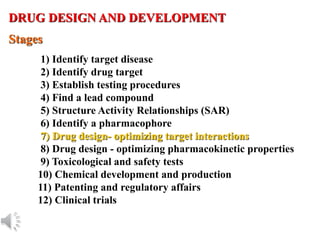
DRUG DESIGN AND DEVELOPMENT
Stages
1) Identify target disease
2) Identify drug target
3) Establish testing procedures
4) Find a lead compound
5) Structure Activity Relationships (SAR)
6) Identify a pharmacophore
7) Drug design- optimizing target interactions
8) Drug design - optimizing pharmacokinetic properties
9) Toxicological and safety tests
10) Chemical development and production
11) Patenting and regulatory affairs
12) Clinical trials
© Oxford University Press, 2013
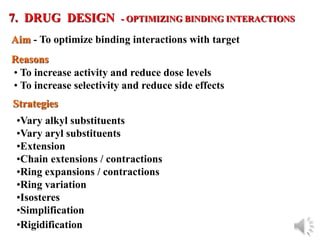
7. DRUG DESIGN - OPTIMIZING BINDING INTERACTIONS
Aim - To optimize binding interactions with target
• To increase activity and reduce dose levels
• To increase selectivity and reduce side effects
Strategies
•Vary alkyl substituents
•Vary aryl substituents
•Extension
•Chain extensions / contractions
•Ring expansions / contractions
•Ring variation
•Isosteres
•Simplification
•Rigidification
Reasons
© Oxford University Press, 2013
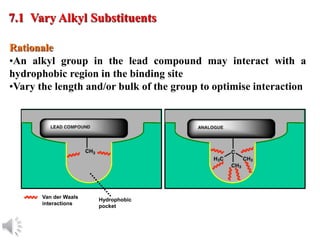
7.1 Vary Alkyl Substituents
Rationale
•An alkyl group in the lead compound may interact with a
hydrophobic region in the binding site
•Vary the length and/or bulk of the group to optimise interaction
Van der Waals
interactions
Hydrophobic
pocket
© Oxford University Press, 2013
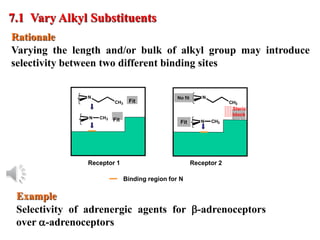
Rationale
Varying the length and/or bulk of alkyl group may introduce
selectivity between two different binding sites
7.1 Vary Alkyl Substituents
Binding region for N
Receptor 1 Receptor 2
Fit
Fit
N
CH3
N CH3
Fit
No Fit
Steric
Block
N CH3
CH3
N
Fit
Fit
No fit
Fit
Steric
block
Example
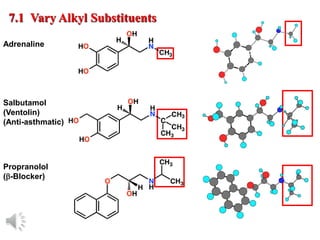
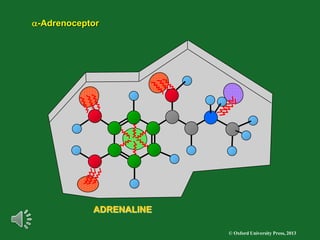
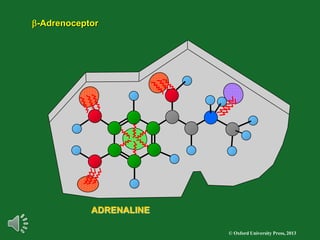
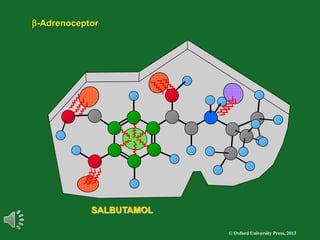
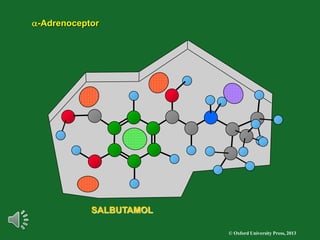
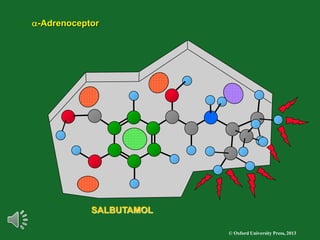
Selectivity of adrenergic agents for b-adrenoceptors
over a-adrenoceptors
© Oxford University Press, 2013
7.1 Vary Alkyl Substituents
Propranolol
(b-Blocker)
Salbutamol
(Ventolin)
(Anti-asthmatic)
Adrenaline
© Oxford University Press, 2013
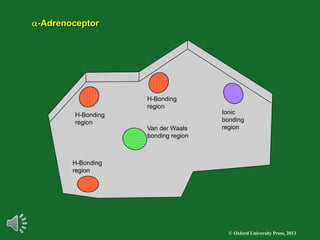
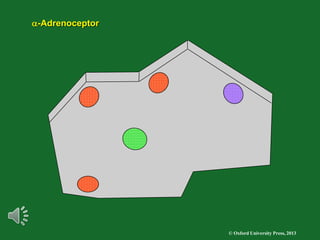
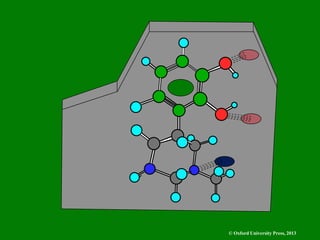
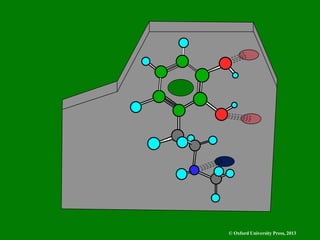
a-Adrenoceptor
H-Bonding
region
H-Bonding
region
H-Bonding
region
Van der Waals
bonding region
Ionic
bonding
region
© Oxford University Press, 2013
ADRENALINE
a-Adrenoceptor
© Oxford University Press, 2013
a-Adrenoceptor
© Oxford University Press, 2013
b-Adrenoceptor
ADRENALINE
© Oxford University Press, 2013
SALBUTAMOL
b-Adrenoceptor
© Oxford University Press, 2013
a-Adrenoceptor
SALBUTAMOL
© Oxford University Press, 2013
a-Adrenoceptor
SALBUTAMOL
© Oxford University Press, 2013
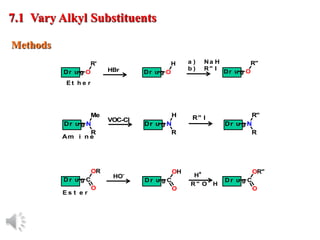
7.1 Vary Alkyl Substituents
Synthetic feasibility of analogues
•Feasible to replace alkyl substituents on heteroatoms with other
alkyl substituents
•Difficult to modify alkyl substituents attached to the carbon
skeleton of a lead compound.
•Total synthesis usually required to vary alkyl substituents that
are attached to the carbon skeleton
© Oxford University Press, 2013
C
OR
D r u g C
OH
D r u g C
OR"
D r u g
O O O
E s t e r
HO- H+
R " O H
N
Me
Dr u g N
H
Dr u g N
R"
Dr u g
R R R
Am i n e
VOC-Cl R" I
O
R'
Dr u g O
H
Dr u g O
R"
Dr u g
E t h e r
HBr
a ) Na H
b ) R" I
7.1 Vary Alkyl Substituents
Methods
© Oxford University Press, 2013
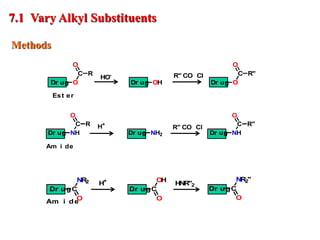
O
C
Dr ug
O
R
OH
Dr ug O
C
Dr ug
O
R"
Est er
R" CO Cl
HO-
NH
C
Dr ug
O
R
NH2
Dr ug NH
C
Dr ug
O
R"
Am i de
R" CO Cl
H+
C
NR2
Dr ug C
O
H
Dr ug C
NR2"
Dr ug
O O O
Am i de
H+
HNR"2
7.1 Vary Alkyl Substituents
Methods
© Oxford University Press, 2013
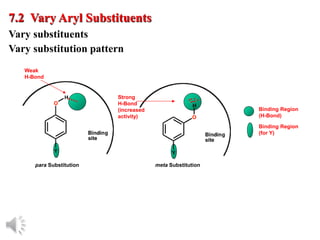
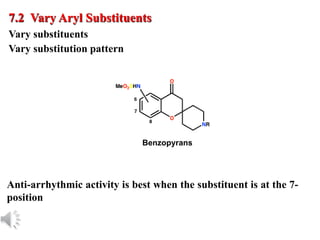
7.2 Vary Aryl Substituents
Vary substituents
Vary substitution pattern
Binding Region
(H-Bond)
Binding Region
(for Y)
para Substitution meta Substitution
Weak
H-Bond
Strong
H-Bond
(increased
activity)
© Oxford University Press, 2013
7.2 Vary Aryl Substituents
Anti-arrhythmic activity is best when the substituent is at the 7-
position
Vary substituents
Vary substitution pattern
Benzopyrans
© Oxford University Press, 2013
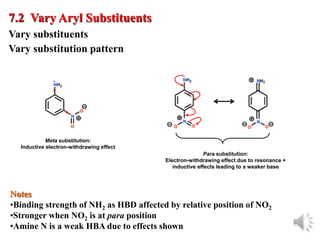
7.2 Vary Aryl Substituents
Notes
•Binding strength of NH2 as HBD affected by relative position of NO2
•Stronger when NO2 is at para position
•Amine N is a weak HBA due to effects shown
Meta substitution:
Inductive electron-withdrawing effect
Para substitution:
Electron-withdrawing effect due to resonance +
inductive effects leading to a weaker base
Vary substituents
Vary substitution pattern
© Oxford University Press, 2013
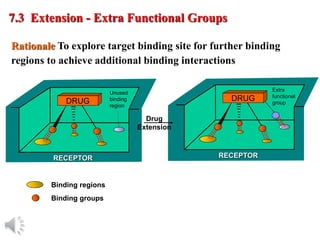
RECEPTOR
Rationale To explore target binding site for further binding
regions to achieve additional binding interactions
7.3 Extension - Extra Functional Groups
Unused
binding
region
DRUG
RECEPTOR
DRUG
Extra
functional
group
Binding regions
Binding groups
Drug
Extension
© Oxford University Press, 2013
N
H
N
O CO2
O
O
CH3
(I)
Binding
site
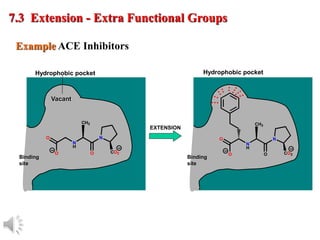
Example ACE Inhibitors
7.3 Extension - Extra Functional Groups
Hydrophobic pocket
Vacant
Hydrophobic pocket
Binding
site
N
H
N
O CO2
O
O
CH3
EXTENSION
© Oxford University Press, 2013
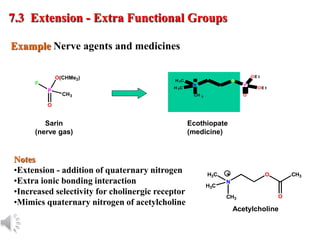
Example Nerve agents and medicines
7.3 Extension - Extra Functional Groups
Notes
•Extension - addition of quaternary nitrogen
•Extra ionic bonding interaction
•Increased selectivity for cholinergic receptor
•Mimics quaternary nitrogen of acetylcholine
Sarin
(nerve gas)
O
P
F
O(CHMe2)
CH3
Acetylcholine
O
N
CH3
H3C
H3C
CH3
O
Ecothiopate
(medicine)
O
P
S
N
CH 3
H 3C
H 3C
OE t
OE t
© Oxford University Press, 2013
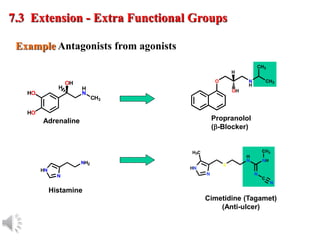
Example Antagonists from agonists
7.3 Extension - Extra Functional Groups
HO
HO
H
N
CH3
OH
H
Adrenaline
N
HN
NH2
Histamine
Propranolol
(b-Blocker)
OH
O N
H
CH3
CH3
H
Cimetidine (Tagamet)
(Anti-ulcer)
© Oxford University Press, 2013
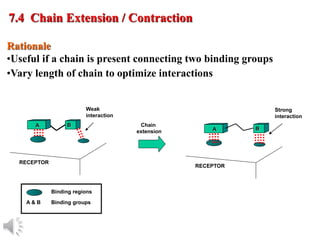
Rationale
•Useful if a chain is present connecting two binding groups
•Vary length of chain to optimize interactions
7.4 Chain Extension / Contraction
RECEPTOR
A B
A B
RECEPTOR
Binding regions
Binding groups
A & B
Weak
interaction
Strong
interaction
Chain
extension
© Oxford University Press, 2013
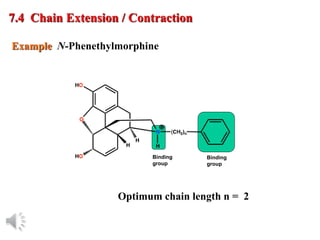
Example N-Phenethylmorphine
7.4 Chain Extension / Contraction
Optimum chain length n = 2
Binding
group
Binding
group
© Oxford University Press, 2013
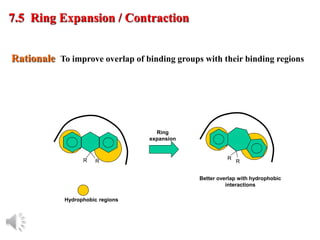
Rationale To improve overlap of binding groups with their binding regions
7.5 Ring Expansion / Contraction
Hydrophobic regions
R R
R
R
Ring
expansion
Better overlap with hydrophobic
interactions
© Oxford University Press, 2013
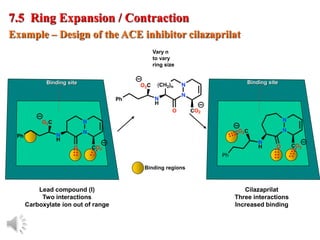
Binding site
Binding regions
Binding site
Example – Design of the ACE inhibitor cilazaprilat
7.5 Ring Expansion / Contraction
Vary n
to vary
ring size
Cilazaprilat
Three interactions
Increased binding
Lead compound (I)
Two interactions
Carboxylate ion out of range
© Oxford University Press, 2013
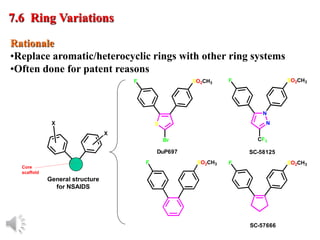
Rationale
•Replace aromatic/heterocyclic rings with other ring systems
•Often done for patent reasons
7.6 Ring Variations
X
X
General structure
for NSAIDS
Core
scaffold
S
Br
F SO2CH3
N
N
CF3
F SO2CH3
F SO2CH3
DuP697
F SO2CH3
SC-58125
SC-57666
© Oxford University Press, 2013
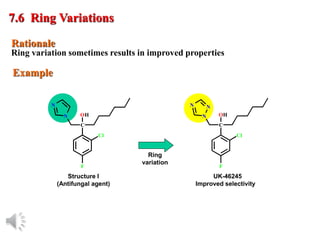
Rationale
7.6 Ring Variations
Example
Structure I
(Antifungal agent)
Cl
F
C
OH
N
N
UK-46245
Improved selectivity
Ring
variation
Cl
F
C
OH
N
N
N
Ring variation sometimes results in improved properties
© Oxford University Press, 2013
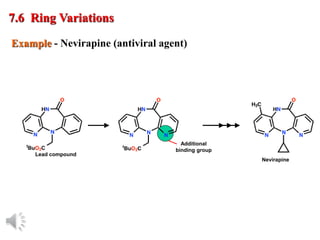
Example - Nevirapine (antiviral agent)
7.6 Ring Variations
Additional
binding group
Lead compound
Nevirapine
© Oxford University Press, 2013
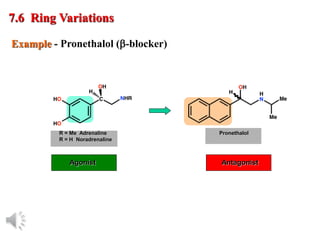
Antagonist
Example - Pronethalol (b-blocker)
7.6 Ring Variations
Agonist
R = Me Adrenaline
R = H Noradrenaline
Pronethalol
© Oxford University Press, 2013
Rationale for isosteres
•Replace a functional group with a group of same valency (isostere)
e.g. OH replaced by SH, NH2, CH3
e.g. O replaced by S, NH, CH2
•Leads to more controlled changes in steric/electronic properties
•May affect binding and / or stability
7.7 Isosteres and Bio-isosteres
© Oxford University Press, 2013
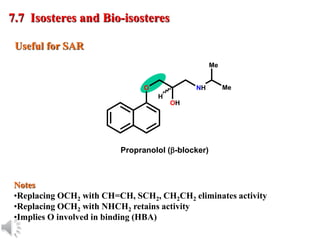
Useful for SAR
Notes
•Replacing OCH2 with CH=CH, SCH2, CH2CH2 eliminates activity
•Replacing OCH2 with NHCH2 retains activity
•Implies O involved in binding (HBA)
7.7 Isosteres and Bio-isosteres
Propranolol (b-blocker)
OH
O
H
NH
Me
Me
© Oxford University Press, 2013
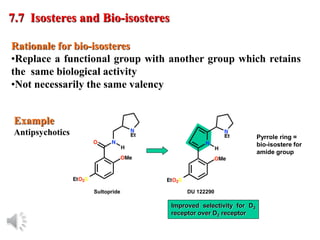
Rationale for bio-isosteres
•Replace a functional group with another group which retains
the same biological activity
•Not necessarily the same valency
7.7 Isosteres and Bio-isosteres
Example
Antipsychotics
Improved selectivity for D3
receptor over D2 receptor
Pyrrole ring =
bio-isostere for
amide group
Sultopride DU 122290
© Oxford University Press, 2013
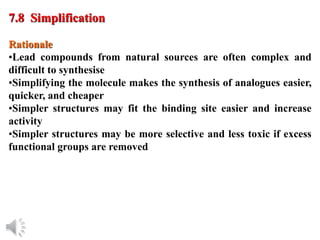
Rationale
•Lead compounds from natural sources are often complex and
difficult to synthesise
•Simplifying the molecule makes the synthesis of analogues easier,
quicker, and cheaper
•Simpler structures may fit the binding site easier and increase
activity
•Simpler structures may be more selective and less toxic if excess
functional groups are removed
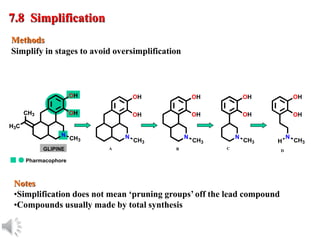
7.8 Simplification
© Oxford University Press, 2013
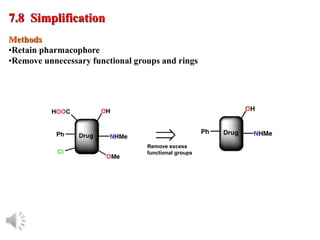
Methods
•Retain pharmacophore
•Remove unnecessary functional groups and rings
7.8 Simplification
Remove excess
functional groups
© Oxford University Press, 2013
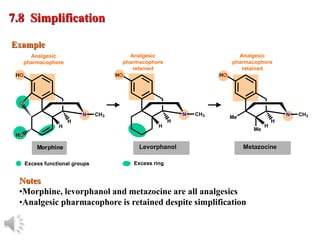
Excess functional groups
Analgesic
pharmacophore
retained
Analgesic
pharmacophore
Analgesic
pharmacophore
retained
Excess ring
7.8 Simplification
Example
HO
O
HO
N CH3
H
H
Morphine
Notes
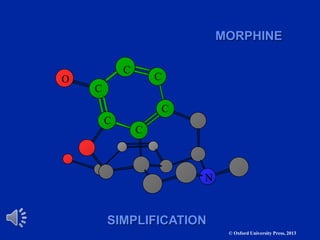
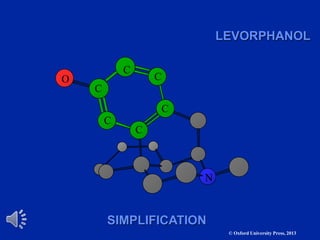
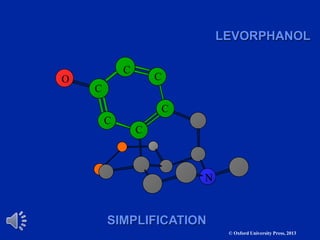
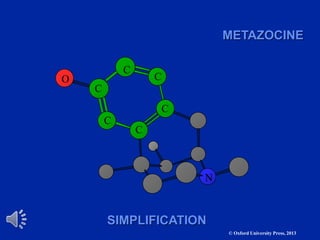
•Morphine, levorphanol and metazocine are all analgesics
•Analgesic pharmacophore is retained despite simplification
HO
N CH3
H
H
Lev orphanol
Levorphanol
HO
Me
Me
N CH3
H
H
Metazocine
Metazocine
© Oxford University Press, 2013
Methods
7.8 Simplification
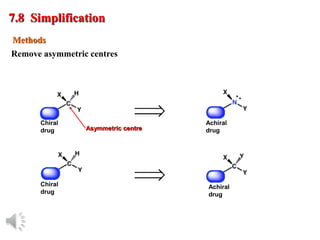
Remove asymmetric centres
Asymmetric centre
Chiral
drug
Achiral
drug
Chiral
drug
Achiral
drug
© Oxford University Press, 2013
Methods
7.8 Simplification
Notes
•Simplification does not mean ‘pruning groups’ off the lead compound
•Compounds usually made by total synthesis
A
OH
OH
N
CH3
B
N
CH3
OH
OH
C
OH
OH
N
CH3
D
N
CH3
H
OH
OH
Simplify in stages to avoid oversimplification
Pharmacophore
GLIPINE
OH
CH3 OH
H3C
N
CH3
GLIPINE
OH
CH3 OH
H3C
N
CH3
GLIPINE
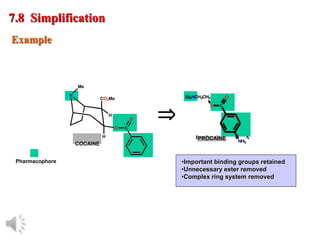
© Oxford University Press, 2013
Example
•Important binding groups retained
•Unnecessary ester removed
•Complex ring system removed
7.8 Simplification
Pharmacophore
P R O C A I N E
C
NH2
O
O
Et2NCH2CH2
PROCAINE
COCAINE
N
H
O
Me
C
CO2Me
H
O
COCAINE
© Oxford University Press, 2013
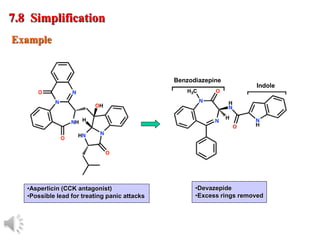
Example
7.8 Simplification
•Asperlicin (CCK antagonist)
•Possible lead for treating panic attacks
•Devazepide
•Excess rings removed
Benzodiazepine
Indole
© Oxford University Press, 2013
Disadvantages
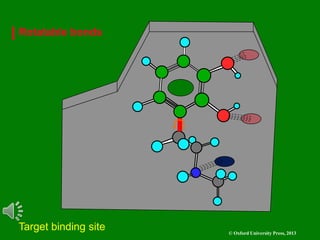
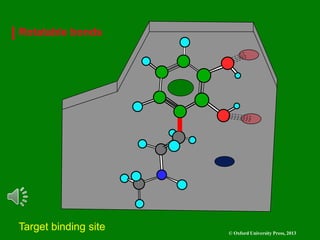
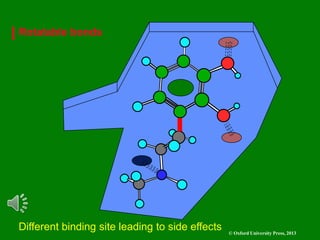
•Oversimplification may result in decreased activity andselectivity
•Simpler molecules have more conformations
•More likely to interact with more than one target binding site
•May result in increased side effects
7.8 Simplification
© Oxford University Press, 2013
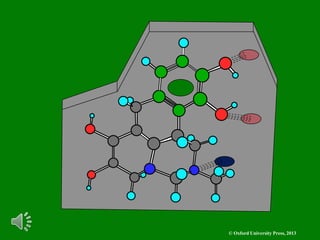
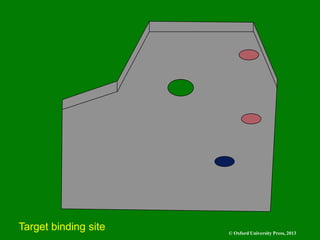
Target binding site
© Oxford University Press, 2013
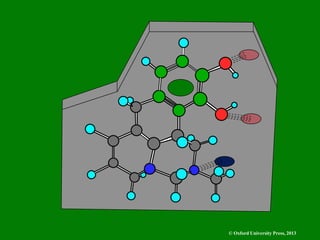
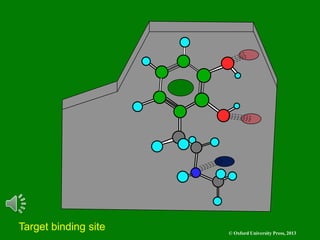
Target binding site
© Oxford University Press, 2013
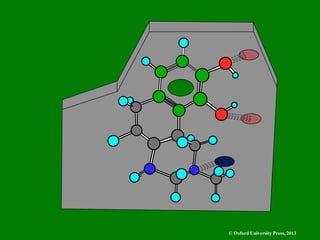
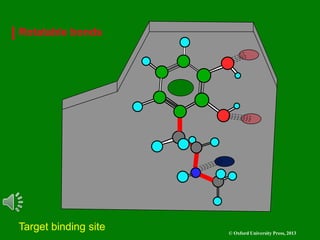
Target binding site
Rotatable bonds
© Oxford University Press, 2013
Target binding site
Rotatable bonds
© Oxford University Press, 2013
Target binding site
Rotatable bonds
© Oxford University Press, 2013
Different binding site leading to side effects
Rotatable bonds
© Oxford University Press, 2013
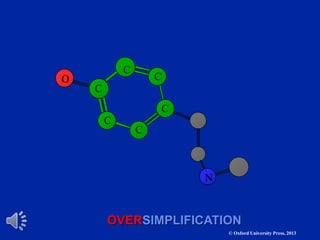
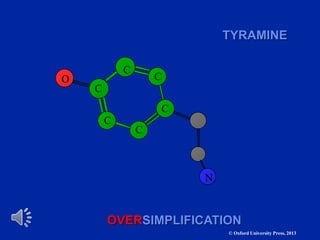
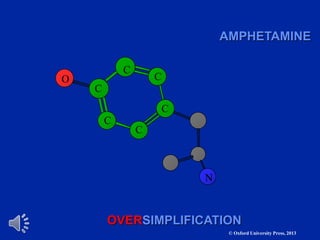
Oversimplification of opioids
7.8 Simplification
© Oxford University Press, 2013
MORPHINE
SIMPLIFICATION
C
C
C
C
C
C
O
N
© Oxford University Press, 2013
LEVORPHANOL
SIMPLIFICATION
C
C
C
C
C
C
O
N
© Oxford University Press, 2013
LEVORPHANOL
SIMPLIFICATION
C
C
C
C
C
C
O
N
© Oxford University Press, 2013
METAZOCINE
SIMPLIFICATION
C
C
C
C
C
C
O
N
© Oxford University Press, 2013
C
C
C
C
C
C
O
N
OVERSIMPLIFICATION
© Oxford University Press, 2013
C
C
C
C
C
C
O
N
OVERSIMPLIFICATION
TYRAMINE
© Oxford University Press, 2013
C
C
C
C
C
C
O
N
OVERSIMPLIFICATION
AMPHETAMINE
© Oxford University Press, 2013
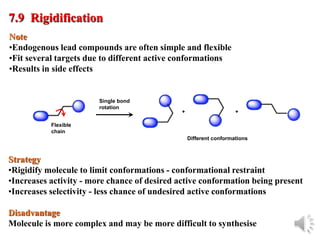
Note
•Endogenous lead compounds are often simple and flexible
•Fit several targets due to different active conformations
•Results in side effects
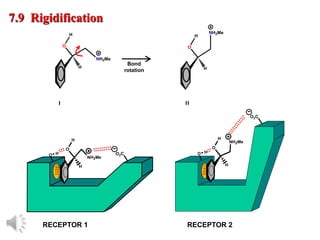
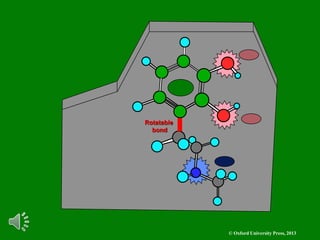
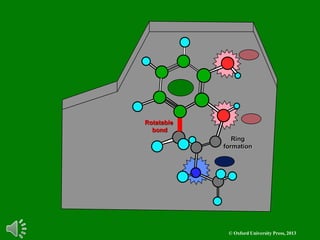
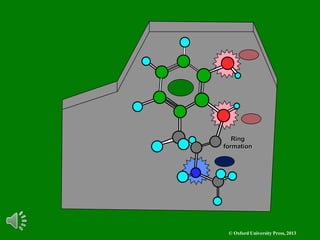
7.9 Rigidification
Strategy
•Rigidify molecule to limit conformations - conformational restraint
•Increases activity - more chance of desired active conformation being present
•Increases selectivity - less chance of undesired active conformations
Disadvantage
Molecule is more complex and may be more difficult to synthesise
Flexible
chain
Single bond
rotation
Different conformations
+ +
© Oxford University Press, 2013
O H
RECEPTOR 2
-O2C
O H
RECEPTOR 1
O2C
-
7.9 Rigidification
O
H
H
NH2Me
O
NH2Me
H
H
I
O
NH2Me
H
H
II
O
H
H
NH2Me
Bond
rotation
© Oxford University Press, 2013
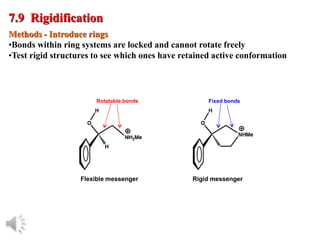
Methods - Introduce rings
•Bonds within ring systems are locked and cannot rotate freely
•Test rigid structures to see which ones have retained active conformation
7.9 Rigidification
Rotatable bonds
Flexible messenger
Fixed bonds
Rigid messenger
© Oxford University Press, 2013
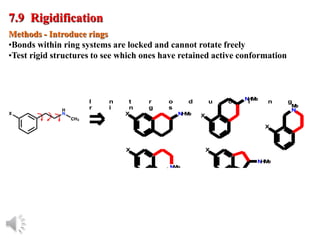
7.9 Rigidification
Methods - Introduce rings
•Bonds within ring systems are locked and cannot rotate freely
•Test rigid structures to see which ones have retained active conformation
X N
H
M
e X
N
H
M
e
X
M
e
N
X
N
M
e
X
N
H
M
e
I n t r o d u c i n g
r i n g s
© Oxford University Press, 2013
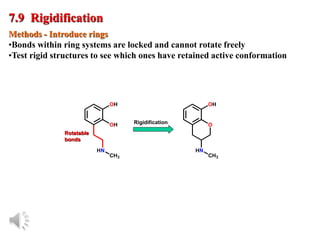
7.9 Rigidification
OH
OH
HN
CH3
OH
O
HN
CH3
Rigidification
Rotatable
bonds
Methods - Introduce rings
•Bonds within ring systems are locked and cannot rotate freely
•Test rigid structures to see which ones have retained active conformation
© Oxford University Press, 2013
Rotatable
bond
© Oxford University Press, 2013
Rotatable
bond
Ring
formation
© Oxford University Press, 2013
Ring
formation
© Oxford University Press, 2013
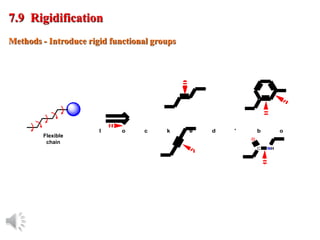
Methods - Introduce rigid functional groups
7.9 Rigidification
C NH
O
'
l o c k e d ' b o n
Flexible
chain
© Oxford University Press, 2013
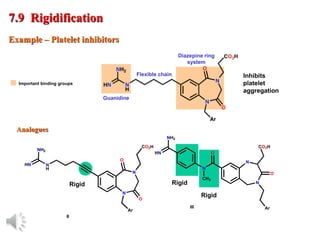
Rigid
Rigid
Important binding groups
Rigid
Example – Platelet inhibitors
7.9 Rigidification
Inhibits
platelet
aggregation
N
N
CO2H
O
O
N
H
HN
NH2
Ar
II
Analogues
N
N
CO2H
O
Ar
N
O
CH3
HN
NH2
III
Guanidine
Flexible chain
Diazepine ring
system
© Oxford University Press, 2013
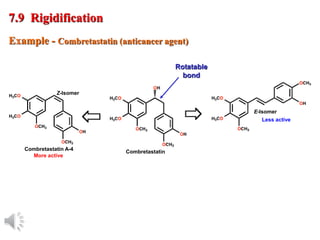
Example - Combretastatin (anticancer agent)
7.9 Rigidification
More active
Less active
Rotatable
bond
Combretastatin
E-Isomer
Z-Isomer
Combretastatin A-4
© Oxford University Press, 2013
Y
X
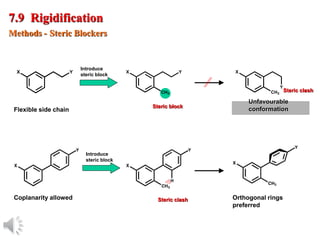
Methods - Steric Blockers
7.9 Rigidification
Flexible side chain
Coplanarity allowed
Steric block
Introduce
steric block
Y
X
CH3
Steric clash
Introduce
steric block
Steric clash
Orthogonal rings
preferred
X
CH3
Y
Unfavourableconformation
Unfavourable
conformation
© Oxford University Press, 2013
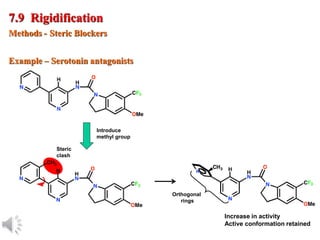
Steric
clash
7.9 Rigidification
Increase in activity
Active conformation retained
Methods - Steric Blockers
Example – Serotonin antagonists
Introduce
methyl group
Orthogonal
rings
© Oxford University Press, 2013
Steric clash
7.9 Rigidification
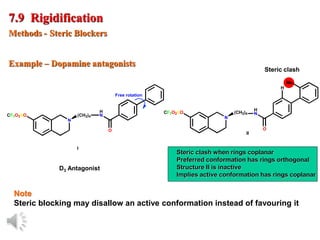
N
(CH2)4
H
N
O
CF3O2SO
I
D3 Antagonist
Steric clash when rings coplanar
Preferred conformation has rings orthogonal
Structure II is inactive
Implies active conformation has rings coplanar
Methods - Steric Blockers
Note
Steric blocking may disallow an active conformation instead of favouring it
N
(CH2)4
H
N
O
CF3O2SO
Me
II
H
Example – Dopamine antagonists
Free rotation
© Oxford University Press, 2013
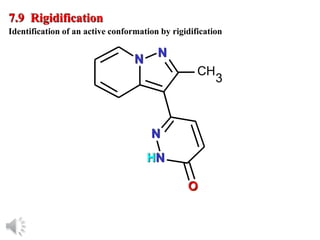
N
N
CH
3
N
HN
O
7.9 Rigidification
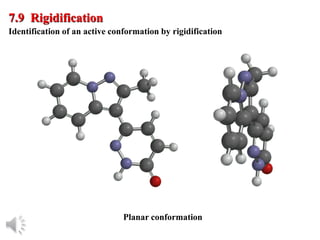
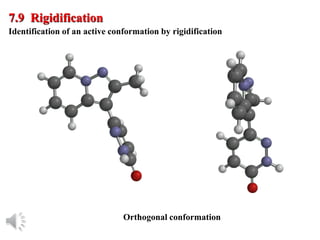
Identification of an active conformation by rigidification
© Oxford University Press, 2013
7.9 Rigidification
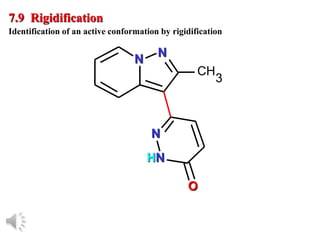
Identification of an active conformation by rigidification
N
N
CH
N
HN
O
3
© Oxford University Press, 2013
7.9 Rigidification
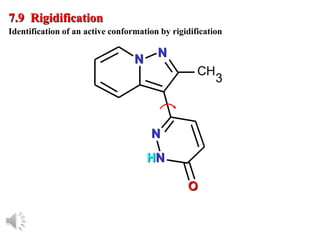
Identification of an active conformation by rigidification
N
N
CH
N
HN
O
3
© Oxford University Press, 2013
7.9 Rigidification
Identification of an active conformation by rigidification
Planar conformation
© Oxford University Press, 2013
7.9 Rigidification
Identification of an active conformation by rigidification
Orthogonal conformation
© Oxford University Press, 2013
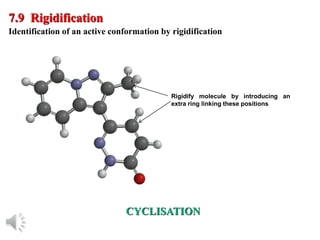
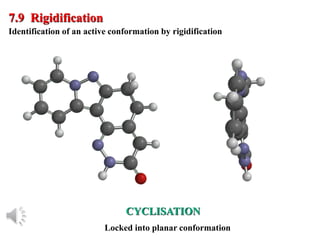
CYCLISATION
7.9 Rigidification
Identification of an active conformation by rigidification
Rigidify molecule by introducing an
extra ring linking these positions
© Oxford University Press, 2013
7.9 Rigidification
Identification of an active conformation by rigidification
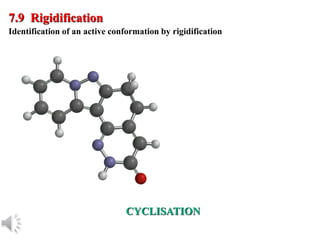
CYCLISATION
© Oxford University Press, 2013
7.9 Rigidification
Identification of an active conformation by rigidification
CYCLISATION
Locked into planar conformation
© Oxford University Press, 2013
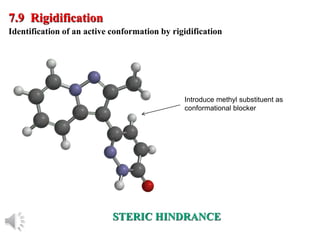
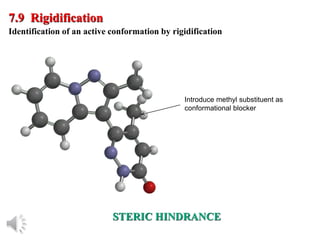
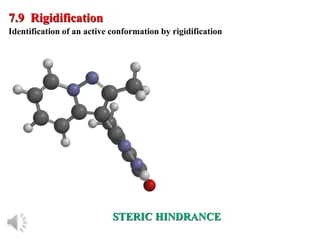
STERIC HINDRANCE
7.9 Rigidification
Identification of an active conformation by rigidification
Introduce methyl substituent as
conformational blocker
© Oxford University Press, 2013
7.9 Rigidification
Identification of an active conformation by rigidification
STERIC HINDRANCE
Introduce methyl substituent as
conformational blocker
© Oxford University Press, 2013
7.9 Rigidification
Identification of an active conformation by rigidification
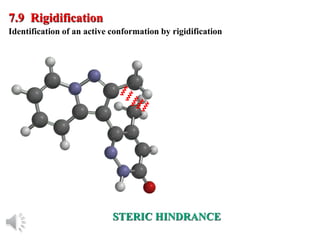
STERIC HINDRANCE
© Oxford University Press, 2013
7.9 Rigidification
Identification of an active conformation by rigidification
STERIC HINDRANCE
© Oxford University Press, 2013
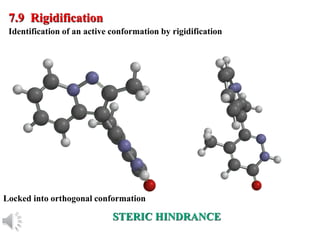
7.9 Rigidification
Identification of an active conformation by rigidification
STERIC HINDRANCE
Locked into orthogonal conformation
© Oxford University Press, 2013
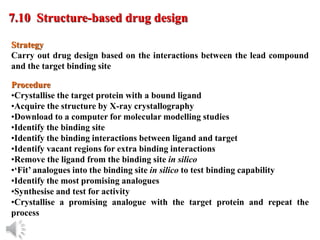
7.10 Structure-based drug design
Procedure
•Crystallise the target protein with a bound ligand
•Acquire the structure by X-ray crystallography
•Download to a computer for molecular modelling studies
•Identify the binding site
•Identify the binding interactions between ligand and target
•Identify vacant regions for extra binding interactions
•Remove the ligand from the binding site in silico
•‘Fit’ analogues into the binding site in silico to test binding capability
•Identify the most promising analogues
•Synthesise and test for activity
•Crystallise a promising analogue with the target protein and repeat the
process
Strategy
Carry out drug design based on the interactions between the lead compound
and the target binding site
© Oxford University Press, 2013
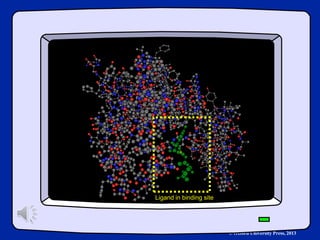
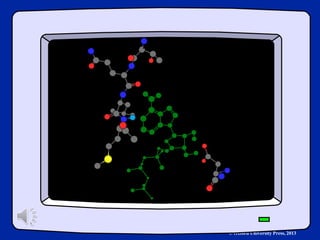
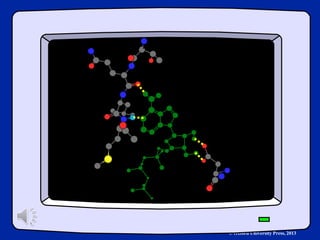
Ligand in binding site
© Oxford University Press, 2013
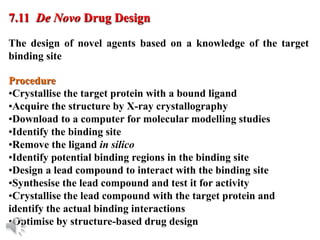
The design of novel agents based on a knowledge of the target
binding site
7.11 De Novo Drug Design
Procedure
•Crystallise the target protein with a bound ligand
•Acquire the structure by X-ray crystallography
•Download to a computer for molecular modelling studies
•Identify the binding site
•Remove the ligand in silico
•Identify potential binding regions in the binding site
•Design a lead compound to interact with the binding site
•Synthesise the lead compound and test it for activity
•Crystallise the lead compound with the target protein and
identify the actual binding interactions
•Optimise by structure-based drug design

Annotated Lecture 6 - Drug Design Optimizing Target Interactions.pptx

  • 1.
    © Oxford UniversityPress, 2013 DRUG DESIGN OPTIMIZING TARGET INTERACTIONS Patrick: An Introduction to Medicinal Chemistry 6e Chapter 13
  • 2.
    © Oxford UniversityPress, 2013 DRUG DESIGN AND DEVELOPMENT Stages 1) Identify target disease 2) Identify drug target 3) Establish testing procedures 4) Find a lead compound 5) Structure Activity Relationships (SAR) 6) Identify a pharmacophore 7) Drug design- optimizing target interactions 8) Drug design - optimizing pharmacokinetic properties 9) Toxicological and safety tests 10) Chemical development and production 11) Patenting and regulatory affairs 12) Clinical trials
  • 3.
    © Oxford UniversityPress, 2013 7. DRUG DESIGN - OPTIMIZING BINDING INTERACTIONS Aim - To optimize binding interactions with target • To increase activity and reduce dose levels • To increase selectivity and reduce side effects Strategies •Vary alkyl substituents •Vary aryl substituents •Extension •Chain extensions / contractions •Ring expansions / contractions •Ring variation •Isosteres •Simplification •Rigidification Reasons
  • 4.
    © Oxford UniversityPress, 2013 7.1 Vary Alkyl Substituents Rationale •An alkyl group in the lead compound may interact with a hydrophobic region in the binding site •Vary the length and/or bulk of the group to optimise interaction Van der Waals interactions Hydrophobic pocket
  • 5.
    © Oxford UniversityPress, 2013 Rationale Varying the length and/or bulk of alkyl group may introduce selectivity between two different binding sites 7.1 Vary Alkyl Substituents Binding region for N Receptor 1 Receptor 2 Fit Fit N CH3 N CH3 Fit No Fit Steric Block N CH3 CH3 N Fit Fit No fit Fit Steric block Example Selectivity of adrenergic agents for b-adrenoceptors over a-adrenoceptors
  • 6.
    © Oxford UniversityPress, 2013 7.1 Vary Alkyl Substituents Propranolol (b-Blocker) Salbutamol (Ventolin) (Anti-asthmatic) Adrenaline
  • 7.
    © Oxford UniversityPress, 2013 a-Adrenoceptor H-Bonding region H-Bonding region H-Bonding region Van der Waals bonding region Ionic bonding region
  • 8.
    © Oxford UniversityPress, 2013 ADRENALINE a-Adrenoceptor
  • 9.
    © Oxford UniversityPress, 2013 a-Adrenoceptor
  • 10.
    © Oxford UniversityPress, 2013 b-Adrenoceptor ADRENALINE
  • 11.
    © Oxford UniversityPress, 2013 SALBUTAMOL b-Adrenoceptor
  • 12.
    © Oxford UniversityPress, 2013 a-Adrenoceptor SALBUTAMOL
  • 13.
    © Oxford UniversityPress, 2013 a-Adrenoceptor SALBUTAMOL
  • 14.
    © Oxford UniversityPress, 2013 7.1 Vary Alkyl Substituents Synthetic feasibility of analogues •Feasible to replace alkyl substituents on heteroatoms with other alkyl substituents •Difficult to modify alkyl substituents attached to the carbon skeleton of a lead compound. •Total synthesis usually required to vary alkyl substituents that are attached to the carbon skeleton
  • 15.
    © Oxford UniversityPress, 2013 C OR D r u g C OH D r u g C OR" D r u g O O O E s t e r HO- H+ R " O H N Me Dr u g N H Dr u g N R" Dr u g R R R Am i n e VOC-Cl R" I O R' Dr u g O H Dr u g O R" Dr u g E t h e r HBr a ) Na H b ) R" I 7.1 Vary Alkyl Substituents Methods
  • 16.
    © Oxford UniversityPress, 2013 O C Dr ug O R OH Dr ug O C Dr ug O R" Est er R" CO Cl HO- NH C Dr ug O R NH2 Dr ug NH C Dr ug O R" Am i de R" CO Cl H+ C NR2 Dr ug C O H Dr ug C NR2" Dr ug O O O Am i de H+ HNR"2 7.1 Vary Alkyl Substituents Methods
  • 17.
    © Oxford UniversityPress, 2013 7.2 Vary Aryl Substituents Vary substituents Vary substitution pattern Binding Region (H-Bond) Binding Region (for Y) para Substitution meta Substitution Weak H-Bond Strong H-Bond (increased activity)
  • 18.
    © Oxford UniversityPress, 2013 7.2 Vary Aryl Substituents Anti-arrhythmic activity is best when the substituent is at the 7- position Vary substituents Vary substitution pattern Benzopyrans
  • 19.
    © Oxford UniversityPress, 2013 7.2 Vary Aryl Substituents Notes •Binding strength of NH2 as HBD affected by relative position of NO2 •Stronger when NO2 is at para position •Amine N is a weak HBA due to effects shown Meta substitution: Inductive electron-withdrawing effect Para substitution: Electron-withdrawing effect due to resonance + inductive effects leading to a weaker base Vary substituents Vary substitution pattern
  • 20.
    © Oxford UniversityPress, 2013 RECEPTOR Rationale To explore target binding site for further binding regions to achieve additional binding interactions 7.3 Extension - Extra Functional Groups Unused binding region DRUG RECEPTOR DRUG Extra functional group Binding regions Binding groups Drug Extension
  • 21.
    © Oxford UniversityPress, 2013 N H N O CO2 O O CH3 (I) Binding site Example ACE Inhibitors 7.3 Extension - Extra Functional Groups Hydrophobic pocket Vacant Hydrophobic pocket Binding site N H N O CO2 O O CH3 EXTENSION
  • 22.
    © Oxford UniversityPress, 2013 Example Nerve agents and medicines 7.3 Extension - Extra Functional Groups Notes •Extension - addition of quaternary nitrogen •Extra ionic bonding interaction •Increased selectivity for cholinergic receptor •Mimics quaternary nitrogen of acetylcholine Sarin (nerve gas) O P F O(CHMe2) CH3 Acetylcholine O N CH3 H3C H3C CH3 O Ecothiopate (medicine) O P S N CH 3 H 3C H 3C OE t OE t
  • 23.
    © Oxford UniversityPress, 2013 Example Antagonists from agonists 7.3 Extension - Extra Functional Groups HO HO H N CH3 OH H Adrenaline N HN NH2 Histamine Propranolol (b-Blocker) OH O N H CH3 CH3 H Cimetidine (Tagamet) (Anti-ulcer)
  • 24.
    © Oxford UniversityPress, 2013 Rationale •Useful if a chain is present connecting two binding groups •Vary length of chain to optimize interactions 7.4 Chain Extension / Contraction RECEPTOR A B A B RECEPTOR Binding regions Binding groups A & B Weak interaction Strong interaction Chain extension
  • 25.
    © Oxford UniversityPress, 2013 Example N-Phenethylmorphine 7.4 Chain Extension / Contraction Optimum chain length n = 2 Binding group Binding group
  • 26.
    © Oxford UniversityPress, 2013 Rationale To improve overlap of binding groups with their binding regions 7.5 Ring Expansion / Contraction Hydrophobic regions R R R R Ring expansion Better overlap with hydrophobic interactions
  • 27.
    © Oxford UniversityPress, 2013 Binding site Binding regions Binding site Example – Design of the ACE inhibitor cilazaprilat 7.5 Ring Expansion / Contraction Vary n to vary ring size Cilazaprilat Three interactions Increased binding Lead compound (I) Two interactions Carboxylate ion out of range
  • 28.
    © Oxford UniversityPress, 2013 Rationale •Replace aromatic/heterocyclic rings with other ring systems •Often done for patent reasons 7.6 Ring Variations X X General structure for NSAIDS Core scaffold S Br F SO2CH3 N N CF3 F SO2CH3 F SO2CH3 DuP697 F SO2CH3 SC-58125 SC-57666
  • 29.
    © Oxford UniversityPress, 2013 Rationale 7.6 Ring Variations Example Structure I (Antifungal agent) Cl F C OH N N UK-46245 Improved selectivity Ring variation Cl F C OH N N N Ring variation sometimes results in improved properties
  • 30.
    © Oxford UniversityPress, 2013 Example - Nevirapine (antiviral agent) 7.6 Ring Variations Additional binding group Lead compound Nevirapine
  • 31.
    © Oxford UniversityPress, 2013 Antagonist Example - Pronethalol (b-blocker) 7.6 Ring Variations Agonist R = Me Adrenaline R = H Noradrenaline Pronethalol
  • 32.
    © Oxford UniversityPress, 2013 Rationale for isosteres •Replace a functional group with a group of same valency (isostere) e.g. OH replaced by SH, NH2, CH3 e.g. O replaced by S, NH, CH2 •Leads to more controlled changes in steric/electronic properties •May affect binding and / or stability 7.7 Isosteres and Bio-isosteres
  • 33.
    © Oxford UniversityPress, 2013 Useful for SAR Notes •Replacing OCH2 with CH=CH, SCH2, CH2CH2 eliminates activity •Replacing OCH2 with NHCH2 retains activity •Implies O involved in binding (HBA) 7.7 Isosteres and Bio-isosteres Propranolol (b-blocker) OH O H NH Me Me
  • 34.
    © Oxford UniversityPress, 2013 Rationale for bio-isosteres •Replace a functional group with another group which retains the same biological activity •Not necessarily the same valency 7.7 Isosteres and Bio-isosteres Example Antipsychotics Improved selectivity for D3 receptor over D2 receptor Pyrrole ring = bio-isostere for amide group Sultopride DU 122290
  • 35.
    © Oxford UniversityPress, 2013 Rationale •Lead compounds from natural sources are often complex and difficult to synthesise •Simplifying the molecule makes the synthesis of analogues easier, quicker, and cheaper •Simpler structures may fit the binding site easier and increase activity •Simpler structures may be more selective and less toxic if excess functional groups are removed 7.8 Simplification
  • 36.
    © Oxford UniversityPress, 2013 Methods •Retain pharmacophore •Remove unnecessary functional groups and rings 7.8 Simplification Remove excess functional groups
  • 37.
    © Oxford UniversityPress, 2013 Excess functional groups Analgesic pharmacophore retained Analgesic pharmacophore Analgesic pharmacophore retained Excess ring 7.8 Simplification Example HO O HO N CH3 H H Morphine Notes •Morphine, levorphanol and metazocine are all analgesics •Analgesic pharmacophore is retained despite simplification HO N CH3 H H Lev orphanol Levorphanol HO Me Me N CH3 H H Metazocine Metazocine
  • 38.
    © Oxford UniversityPress, 2013 Methods 7.8 Simplification Remove asymmetric centres Asymmetric centre Chiral drug Achiral drug Chiral drug Achiral drug
  • 39.
    © Oxford UniversityPress, 2013 Methods 7.8 Simplification Notes •Simplification does not mean ‘pruning groups’ off the lead compound •Compounds usually made by total synthesis A OH OH N CH3 B N CH3 OH OH C OH OH N CH3 D N CH3 H OH OH Simplify in stages to avoid oversimplification Pharmacophore GLIPINE OH CH3 OH H3C N CH3 GLIPINE OH CH3 OH H3C N CH3 GLIPINE
  • 40.
  • 41.
  • 42.
  • 43.
  • 44.
  • 45.
    © Oxford UniversityPress, 2013 Example •Important binding groups retained •Unnecessary ester removed •Complex ring system removed 7.8 Simplification Pharmacophore P R O C A I N E C NH2 O O Et2NCH2CH2 PROCAINE COCAINE N H O Me C CO2Me H O COCAINE
  • 46.
    © Oxford UniversityPress, 2013 Example 7.8 Simplification •Asperlicin (CCK antagonist) •Possible lead for treating panic attacks •Devazepide •Excess rings removed Benzodiazepine Indole
  • 47.
    © Oxford UniversityPress, 2013 Disadvantages •Oversimplification may result in decreased activity andselectivity •Simpler molecules have more conformations •More likely to interact with more than one target binding site •May result in increased side effects 7.8 Simplification
  • 48.
    © Oxford UniversityPress, 2013 Target binding site
  • 49.
    © Oxford UniversityPress, 2013 Target binding site
  • 50.
    © Oxford UniversityPress, 2013 Target binding site Rotatable bonds
  • 51.
    © Oxford UniversityPress, 2013 Target binding site Rotatable bonds
  • 52.
    © Oxford UniversityPress, 2013 Target binding site Rotatable bonds
  • 53.
    © Oxford UniversityPress, 2013 Different binding site leading to side effects Rotatable bonds
  • 54.
    © Oxford UniversityPress, 2013 Oversimplification of opioids 7.8 Simplification
  • 55.
    © Oxford UniversityPress, 2013 MORPHINE SIMPLIFICATION C C C C C C O N
  • 56.
    © Oxford UniversityPress, 2013 LEVORPHANOL SIMPLIFICATION C C C C C C O N
  • 57.
    © Oxford UniversityPress, 2013 LEVORPHANOL SIMPLIFICATION C C C C C C O N
  • 58.
    © Oxford UniversityPress, 2013 METAZOCINE SIMPLIFICATION C C C C C C O N
  • 59.
    © Oxford UniversityPress, 2013 C C C C C C O N OVERSIMPLIFICATION
  • 60.
    © Oxford UniversityPress, 2013 C C C C C C O N OVERSIMPLIFICATION TYRAMINE
  • 61.
    © Oxford UniversityPress, 2013 C C C C C C O N OVERSIMPLIFICATION AMPHETAMINE
  • 62.
    © Oxford UniversityPress, 2013 Note •Endogenous lead compounds are often simple and flexible •Fit several targets due to different active conformations •Results in side effects 7.9 Rigidification Strategy •Rigidify molecule to limit conformations - conformational restraint •Increases activity - more chance of desired active conformation being present •Increases selectivity - less chance of undesired active conformations Disadvantage Molecule is more complex and may be more difficult to synthesise Flexible chain Single bond rotation Different conformations + +
  • 63.
    © Oxford UniversityPress, 2013 O H RECEPTOR 2 -O2C O H RECEPTOR 1 O2C - 7.9 Rigidification O H H NH2Me O NH2Me H H I O NH2Me H H II O H H NH2Me Bond rotation
  • 64.
    © Oxford UniversityPress, 2013 Methods - Introduce rings •Bonds within ring systems are locked and cannot rotate freely •Test rigid structures to see which ones have retained active conformation 7.9 Rigidification Rotatable bonds Flexible messenger Fixed bonds Rigid messenger
  • 65.
    © Oxford UniversityPress, 2013 7.9 Rigidification Methods - Introduce rings •Bonds within ring systems are locked and cannot rotate freely •Test rigid structures to see which ones have retained active conformation X N H M e X N H M e X M e N X N M e X N H M e I n t r o d u c i n g r i n g s
  • 66.
    © Oxford UniversityPress, 2013 7.9 Rigidification OH OH HN CH3 OH O HN CH3 Rigidification Rotatable bonds Methods - Introduce rings •Bonds within ring systems are locked and cannot rotate freely •Test rigid structures to see which ones have retained active conformation
  • 67.
    © Oxford UniversityPress, 2013 Rotatable bond
  • 68.
    © Oxford UniversityPress, 2013 Rotatable bond Ring formation
  • 69.
    © Oxford UniversityPress, 2013 Ring formation
  • 70.
    © Oxford UniversityPress, 2013 Methods - Introduce rigid functional groups 7.9 Rigidification C NH O ' l o c k e d ' b o n Flexible chain
  • 71.
    © Oxford UniversityPress, 2013 Rigid Rigid Important binding groups Rigid Example – Platelet inhibitors 7.9 Rigidification Inhibits platelet aggregation N N CO2H O O N H HN NH2 Ar II Analogues N N CO2H O Ar N O CH3 HN NH2 III Guanidine Flexible chain Diazepine ring system
  • 72.
    © Oxford UniversityPress, 2013 Example - Combretastatin (anticancer agent) 7.9 Rigidification More active Less active Rotatable bond Combretastatin E-Isomer Z-Isomer Combretastatin A-4
  • 73.
    © Oxford UniversityPress, 2013 Y X Methods - Steric Blockers 7.9 Rigidification Flexible side chain Coplanarity allowed Steric block Introduce steric block Y X CH3 Steric clash Introduce steric block Steric clash Orthogonal rings preferred X CH3 Y Unfavourableconformation Unfavourable conformation
  • 74.
    © Oxford UniversityPress, 2013 Steric clash 7.9 Rigidification Increase in activity Active conformation retained Methods - Steric Blockers Example – Serotonin antagonists Introduce methyl group Orthogonal rings
  • 75.
    © Oxford UniversityPress, 2013 Steric clash 7.9 Rigidification N (CH2)4 H N O CF3O2SO I D3 Antagonist Steric clash when rings coplanar Preferred conformation has rings orthogonal Structure II is inactive Implies active conformation has rings coplanar Methods - Steric Blockers Note Steric blocking may disallow an active conformation instead of favouring it N (CH2)4 H N O CF3O2SO Me II H Example – Dopamine antagonists Free rotation
  • 76.
    © Oxford UniversityPress, 2013 N N CH 3 N HN O 7.9 Rigidification Identification of an active conformation by rigidification
  • 77.
    © Oxford UniversityPress, 2013 7.9 Rigidification Identification of an active conformation by rigidification N N CH N HN O 3
  • 78.
    © Oxford UniversityPress, 2013 7.9 Rigidification Identification of an active conformation by rigidification N N CH N HN O 3
  • 79.
    © Oxford UniversityPress, 2013 7.9 Rigidification Identification of an active conformation by rigidification Planar conformation
  • 80.
    © Oxford UniversityPress, 2013 7.9 Rigidification Identification of an active conformation by rigidification Orthogonal conformation
  • 81.
    © Oxford UniversityPress, 2013 CYCLISATION 7.9 Rigidification Identification of an active conformation by rigidification Rigidify molecule by introducing an extra ring linking these positions
  • 82.
    © Oxford UniversityPress, 2013 7.9 Rigidification Identification of an active conformation by rigidification CYCLISATION
  • 83.
    © Oxford UniversityPress, 2013 7.9 Rigidification Identification of an active conformation by rigidification CYCLISATION Locked into planar conformation
  • 84.
    © Oxford UniversityPress, 2013 STERIC HINDRANCE 7.9 Rigidification Identification of an active conformation by rigidification Introduce methyl substituent as conformational blocker
  • 85.
    © Oxford UniversityPress, 2013 7.9 Rigidification Identification of an active conformation by rigidification STERIC HINDRANCE Introduce methyl substituent as conformational blocker
  • 86.
    © Oxford UniversityPress, 2013 7.9 Rigidification Identification of an active conformation by rigidification STERIC HINDRANCE
  • 87.
    © Oxford UniversityPress, 2013 7.9 Rigidification Identification of an active conformation by rigidification STERIC HINDRANCE
  • 88.
    © Oxford UniversityPress, 2013 7.9 Rigidification Identification of an active conformation by rigidification STERIC HINDRANCE Locked into orthogonal conformation
  • 89.
    © Oxford UniversityPress, 2013 7.10 Structure-based drug design Procedure •Crystallise the target protein with a bound ligand •Acquire the structure by X-ray crystallography •Download to a computer for molecular modelling studies •Identify the binding site •Identify the binding interactions between ligand and target •Identify vacant regions for extra binding interactions •Remove the ligand from the binding site in silico •‘Fit’ analogues into the binding site in silico to test binding capability •Identify the most promising analogues •Synthesise and test for activity •Crystallise a promising analogue with the target protein and repeat the process Strategy Carry out drug design based on the interactions between the lead compound and the target binding site
  • 90.
    © Oxford UniversityPress, 2013 Ligand in binding site
  • 91.
  • 92.
  • 93.
    © Oxford UniversityPress, 2013 The design of novel agents based on a knowledge of the target binding site 7.11 De Novo Drug Design Procedure •Crystallise the target protein with a bound ligand •Acquire the structure by X-ray crystallography •Download to a computer for molecular modelling studies •Identify the binding site •Remove the ligand in silico •Identify potential binding regions in the binding site •Design a lead compound to interact with the binding site •Synthesise the lead compound and test it for activity •Crystallise the lead compound with the target protein and identify the actual binding interactions •Optimise by structure-based drug design

Editor's Notes