SEMINAR ON
ANALOG DESIGN
PRESENTED BY
Mr. Shivaling m p
M.Pharm 1st semester
Dept. Of Pharmaceutical Chemistry
HSK COP, Bagalakote.
PRESENTED TO:
Dr. S. R. Deshpande
Professor and Head Of
Dept. Of Pharmaceutical Chemistry
HSK COP, Bagalakote.
CONTENTS
• INTRUDUCTION
• CLASSICAL AND NON CLASSICAL BIO ISOSTERIC REPLACEMENT
STRATERGIES
• RIGID ANALOGS
• ALTERATION OF CHAIN BRANCHING
• CHANGES IN RING SIZE
• RING POSITION ISOMERS
• FRAGMENTS OF LEAD MOLECULES
• VARIATION IN INTERATOMIC DISTANCE
Analog design, molecular modification of lead compound can involve one or more of the
following
• 1.Biosteric replacement
• 2.Design of rigid analogs
• 3.Homologation of alkyl side chain or alteration of chain branching, design of aromatic
ring side chain.
• 4.Alteration of stereochemistry or design of geometric isomers or stereomers.
• 5.Design fragments of the lead molecule that contain the pharmacophoric group
• 6.Alteration of distances within the pharmacophoric group or in other parts of the molecule
BIOISOSTERISM
• Replacement of atom or group in a hit molecule in order to prepare a lead molecule without
significant change in its biological and chemical activity.
• It can be done either to reduce toxicity or improve biological activity.
• Bio isosteric replacement is a principle guide followed by medicinal chemist in developing
analogues of the lead compound weather as agonist or antagonist.
• Friedmann defined the definition of bio isosterism “ Phenomenon by which compound
usually fit broadest definition of isosteres and possesses the same type of biological activity.
• Bio isosteres are the group or atom which have chemical and physical similarities producing
broadly similar biological activity.
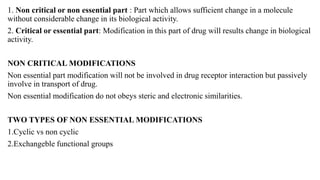
1. Non critical or non essential part : Part which allows sufficient change in a molecule
without considerable change in its biological activity.
2. Critical or essential part: Modification in this part of drug will results change in biological
activity.
NON CRITICAL MODIFICATIONS
Non essential part modification will not be involved in drug receptor interaction but passively
involve in transport of drug.
Non essential modification do not obeys steric and electronic similarities.
TWO TYPES OF NON ESSENTIAL MODIFICATIONS
1.Cyclic vs non cyclic
2.Exchangeble functional groups
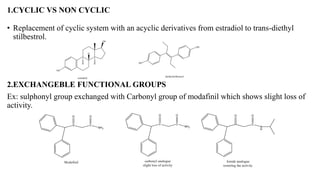
1.CYCLIC VS NON CYCLIC
• Replacement of cyclic system with an acyclic derivatives from estradiol to trans-diethyl
stilbestrol.
2.EXCHANGEBLE FUNCTIONAL GROUPS
Ex: sulphonyl group exchanged with Carbonyl group of modafinil which shows slight loss of
activity.
CLASSICAL OR ESSENTIAL PART MODIFICATION
Critical or essential part: Modification in this part of drug will results change in biological
activity.
Atoms or groups which have similarity in electronic, steric and solubility characteristics can be
interchanged.
MONOVALENT SUBSTITUTION
F atom with H atom, -OH group with –NH group, -F, OH or –CH3 with H, -SH group with -
OH, Cl, Br with CF3.
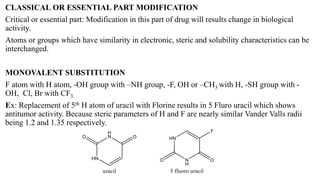
Ex: Replacement of 5th H atom of uracil with Florine results in 5 Fluro uracil which shows
antitumor activity. Because steric parameters of H and F are nearly similar Vander Valls radii
being 1.2 and 1.35 respectively.
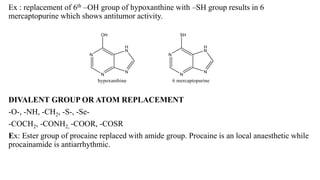
Ex : replacement of 6th –OH group of hypoxanthine with –SH group results in 6
mercaptopurine which shows antitumor activity.
DIVALENT GROUP OR ATOM REPLACEMENT
-O-, -NH, -CH2, -S-, -Se-
-COCH2, -CONH2, -COOR, -COSR
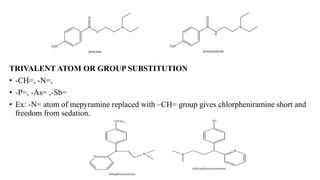
Ex: Ester group of procaine replaced with amide group. Procaine is an local anaesthetic while
procainamide is antiarrhythmic.
TRIVALENT ATOM OR GROUP SUBSTITUTION
• -CH=, -N=,
• -P=, -As= ,-Sb=
• Ex: -N= atom of mepyramine replaced with –CH= group gives chlorpheniramine short and
freedom from sedation.
TETRAVALENT REPLACEMENT
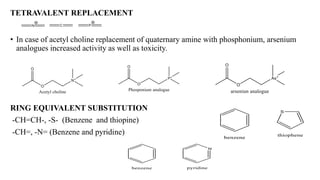
• In case of acetyl choline replacement of quaternary amine with phosphonium, arsenium
analogues increased activity as well as toxicity.
RING EQUIVALENT SUBSTITUTION
-CH=CH-, -S- (Benzene and thiopine)
-CH=, -N= (Benzene and pyridine)
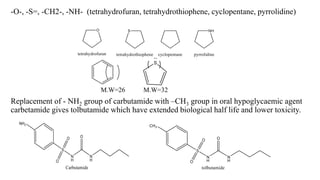
-O-, -S=, -CH2-, -NH- (tetrahydrofuran, tetrahydrothiophene, cyclopentane, pyrrolidine)
M.W=26 M.W=32
Replacement of - NH2 group of carbutamide with –CH3 group in oral hypoglycaemic agent
carbetamide gives tolbutamide which have extended biological half life and lower toxicity.
RIGID ANALOGUES
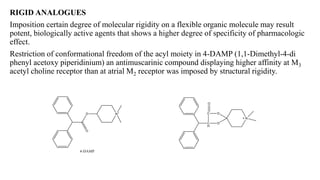
Imposition certain degree of molecular rigidity on a flexible organic molecule may result
potent, biologically active agents that shows a higher degree of specificity of pharmacologic
effect.
Restriction of conformational freedom of the acyl moiety in 4-DAMP (1,1-Dimethyl-4-di
phenyl acetoxy piperidinium) an antimuscarinic compound displaying higher affinity at M3
acetyl choline receptor than at atrial M2 receptor was imposed by structural rigidity.
ALTERATION OF CHAIN BRANCHING
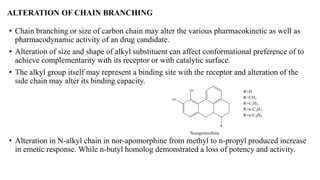
• Chain branching or size of carbon chain may alter the various pharmacokinetic as well as
pharmacodynamic activity of an drug candidate.
• Alteration of size and shape of alkyl substituent can affect conformational preference of to
achieve complementarity with its receptor or with catalytic surface.
• The alkyl group itself may represent a binding site with the receptor and alteration of the
side chain may alter its binding capacity.
• Alteration in N-alkyl chain in nor-apomorphine from methyl to n-propyl produced increase
in emetic response. While n-butyl homolog demonstrated a loss of potency and activity.
ALTERATION IN RING POSITION ISOMERS
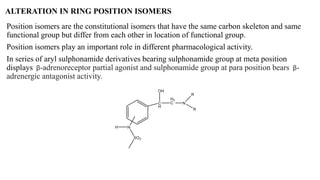
Position isomers are the constitutional isomers that have the same carbon skeleton and same
functional group but differ from each other in location of functional group.
Position isomers play an important role in different pharmacological activity.
In series of aryl sulphonamide derivatives bearing sulphonamide group at meta position
displays β-adrenoreceptor partial agonist and sulphonamide group at para position bears β-
adrenergic antagonist activity.
STEREO ISOMERS
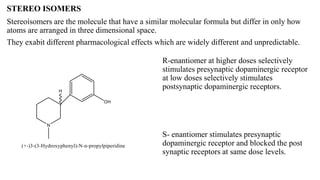
Stereoisomers are the molecule that have a similar molecular formula but differ in only how
atoms are arranged in three dimensional space.
They exabit different pharmacological effects which are widely different and unpredictable.
R-enantiomer at higher doses selectively
stimulates presynaptic dopaminergic receptor
at low doses selectively stimulates
postsynaptic dopaminergic receptors.
S- enantiomer stimulates presynaptic
dopaminergic receptor and blocked the post
synaptic receptors at same dose levels.
GEOMETRIC ISOMERISM
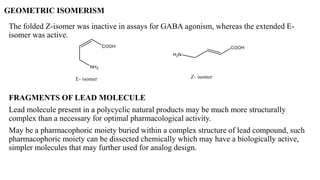
The folded Z-isomer was inactive in assays for GABA agonism, whereas the extended E-
isomer was active.
FRAGMENTS OF LEAD MOLECULE
Lead molecule present in a polycyclic natural products may be much more structurally
complex than a necessary for optimal pharmacological activity.
May be a pharmacophoric moiety buried within a complex structure of lead compound, such
pharmacophoric moiety can be dissected chemically which may have a biologically active,
simpler molecules that may further used for analog design.
STRATERGY FOR ANALOG DESIGN FROM FRAGMENTS OF LEAD
MOLECULE
A bond disconnection strategy may be employed in which bonds in polycyclic structural
molecule are broken or removed to destroy one or more of the rings.
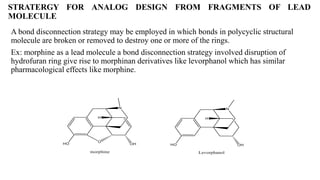
Ex: morphine as a lead molecule a bond disconnection strategy involved disruption of
hydrofuran ring give rise to morphinan derivatives like levorphanol which has similar
pharmacological effects like morphine.
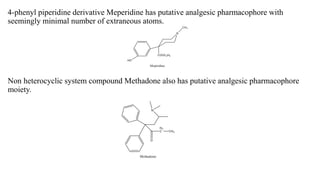
4-phenyl piperidine derivative Meperidine has putative analgesic pharmacophore with
seemingly minimal number of extraneous atoms.
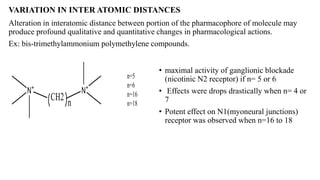
Non heterocyclic system compound Methadone also has putative analgesic pharmacophore
moiety.
VARIATION IN INTER ATOMIC DISTANCES
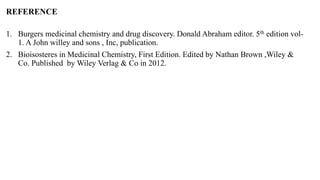
Alteration in interatomic distance between portion of the pharmacophore of molecule may
produce profound qualitative and quantitative changes in pharmacological actions.
Ex: bis-trimethylammonium polymethylene compounds.
• maximal activity of ganglionic blockade
(nicotinic N2 receptor) if n= 5 or 6
• Effects were drops drastically when n= 4 or
7
• Potent effect on N1(myoneural junctions)
receptor was observed when n=16 to 18
REFERENCE
1. Burgers medicinal chemistry and drug discovery. Donald Abraham editor. 5th edition vol-
1. A John willey and sons , Inc, publication.
2. Bioisosteres in Medicinal Chemistry, First Edition. Edited by Nathan Brown ,Wiley &
Co. Published by Wiley Verlag & Co in 2012.
ANALOG DESIGN.pdf

ANALOG DESIGN.pdf

  • 1.
    SEMINAR ON ANALOG DESIGN PRESENTEDBY Mr. Shivaling m p M.Pharm 1st semester Dept. Of Pharmaceutical Chemistry HSK COP, Bagalakote. PRESENTED TO: Dr. S. R. Deshpande Professor and Head Of Dept. Of Pharmaceutical Chemistry HSK COP, Bagalakote.
  • 2.
    CONTENTS • INTRUDUCTION • CLASSICALAND NON CLASSICAL BIO ISOSTERIC REPLACEMENT STRATERGIES • RIGID ANALOGS • ALTERATION OF CHAIN BRANCHING • CHANGES IN RING SIZE • RING POSITION ISOMERS • FRAGMENTS OF LEAD MOLECULES • VARIATION IN INTERATOMIC DISTANCE
  • 3.
    Analog design, molecularmodification of lead compound can involve one or more of the following • 1.Biosteric replacement • 2.Design of rigid analogs • 3.Homologation of alkyl side chain or alteration of chain branching, design of aromatic ring side chain. • 4.Alteration of stereochemistry or design of geometric isomers or stereomers. • 5.Design fragments of the lead molecule that contain the pharmacophoric group • 6.Alteration of distances within the pharmacophoric group or in other parts of the molecule
  • 4.
    BIOISOSTERISM • Replacement ofatom or group in a hit molecule in order to prepare a lead molecule without significant change in its biological and chemical activity. • It can be done either to reduce toxicity or improve biological activity. • Bio isosteric replacement is a principle guide followed by medicinal chemist in developing analogues of the lead compound weather as agonist or antagonist. • Friedmann defined the definition of bio isosterism “ Phenomenon by which compound usually fit broadest definition of isosteres and possesses the same type of biological activity. • Bio isosteres are the group or atom which have chemical and physical similarities producing broadly similar biological activity.
  • 5.
    1. Non criticalor non essential part : Part which allows sufficient change in a molecule without considerable change in its biological activity. 2. Critical or essential part: Modification in this part of drug will results change in biological activity. NON CRITICAL MODIFICATIONS Non essential part modification will not be involved in drug receptor interaction but passively involve in transport of drug. Non essential modification do not obeys steric and electronic similarities. TWO TYPES OF NON ESSENTIAL MODIFICATIONS 1.Cyclic vs non cyclic 2.Exchangeble functional groups
  • 6.
    1.CYCLIC VS NONCYCLIC • Replacement of cyclic system with an acyclic derivatives from estradiol to trans-diethyl stilbestrol. 2.EXCHANGEBLE FUNCTIONAL GROUPS Ex: sulphonyl group exchanged with Carbonyl group of modafinil which shows slight loss of activity.
  • 7.
    CLASSICAL OR ESSENTIALPART MODIFICATION Critical or essential part: Modification in this part of drug will results change in biological activity. Atoms or groups which have similarity in electronic, steric and solubility characteristics can be interchanged. MONOVALENT SUBSTITUTION F atom with H atom, -OH group with –NH group, -F, OH or –CH3 with H, -SH group with - OH, Cl, Br with CF3. Ex: Replacement of 5th H atom of uracil with Florine results in 5 Fluro uracil which shows antitumor activity. Because steric parameters of H and F are nearly similar Vander Valls radii being 1.2 and 1.35 respectively.
  • 8.
    Ex : replacementof 6th –OH group of hypoxanthine with –SH group results in 6 mercaptopurine which shows antitumor activity. DIVALENT GROUP OR ATOM REPLACEMENT -O-, -NH, -CH2, -S-, -Se- -COCH2, -CONH2, -COOR, -COSR Ex: Ester group of procaine replaced with amide group. Procaine is an local anaesthetic while procainamide is antiarrhythmic.
  • 9.
    TRIVALENT ATOM ORGROUP SUBSTITUTION • -CH=, -N=, • -P=, -As= ,-Sb= • Ex: -N= atom of mepyramine replaced with –CH= group gives chlorpheniramine short and freedom from sedation.
  • 10.
    TETRAVALENT REPLACEMENT • Incase of acetyl choline replacement of quaternary amine with phosphonium, arsenium analogues increased activity as well as toxicity. RING EQUIVALENT SUBSTITUTION -CH=CH-, -S- (Benzene and thiopine) -CH=, -N= (Benzene and pyridine)
  • 11.
    -O-, -S=, -CH2-,-NH- (tetrahydrofuran, tetrahydrothiophene, cyclopentane, pyrrolidine) M.W=26 M.W=32 Replacement of - NH2 group of carbutamide with –CH3 group in oral hypoglycaemic agent carbetamide gives tolbutamide which have extended biological half life and lower toxicity.
  • 12.
    RIGID ANALOGUES Imposition certaindegree of molecular rigidity on a flexible organic molecule may result potent, biologically active agents that shows a higher degree of specificity of pharmacologic effect. Restriction of conformational freedom of the acyl moiety in 4-DAMP (1,1-Dimethyl-4-di phenyl acetoxy piperidinium) an antimuscarinic compound displaying higher affinity at M3 acetyl choline receptor than at atrial M2 receptor was imposed by structural rigidity.
  • 13.
    ALTERATION OF CHAINBRANCHING • Chain branching or size of carbon chain may alter the various pharmacokinetic as well as pharmacodynamic activity of an drug candidate. • Alteration of size and shape of alkyl substituent can affect conformational preference of to achieve complementarity with its receptor or with catalytic surface. • The alkyl group itself may represent a binding site with the receptor and alteration of the side chain may alter its binding capacity. • Alteration in N-alkyl chain in nor-apomorphine from methyl to n-propyl produced increase in emetic response. While n-butyl homolog demonstrated a loss of potency and activity.
  • 14.
    ALTERATION IN RINGPOSITION ISOMERS Position isomers are the constitutional isomers that have the same carbon skeleton and same functional group but differ from each other in location of functional group. Position isomers play an important role in different pharmacological activity. In series of aryl sulphonamide derivatives bearing sulphonamide group at meta position displays β-adrenoreceptor partial agonist and sulphonamide group at para position bears β- adrenergic antagonist activity.
  • 15.
    STEREO ISOMERS Stereoisomers arethe molecule that have a similar molecular formula but differ in only how atoms are arranged in three dimensional space. They exabit different pharmacological effects which are widely different and unpredictable. R-enantiomer at higher doses selectively stimulates presynaptic dopaminergic receptor at low doses selectively stimulates postsynaptic dopaminergic receptors. S- enantiomer stimulates presynaptic dopaminergic receptor and blocked the post synaptic receptors at same dose levels.
  • 16.
    GEOMETRIC ISOMERISM The foldedZ-isomer was inactive in assays for GABA agonism, whereas the extended E- isomer was active. FRAGMENTS OF LEAD MOLECULE Lead molecule present in a polycyclic natural products may be much more structurally complex than a necessary for optimal pharmacological activity. May be a pharmacophoric moiety buried within a complex structure of lead compound, such pharmacophoric moiety can be dissected chemically which may have a biologically active, simpler molecules that may further used for analog design.
  • 17.
    STRATERGY FOR ANALOGDESIGN FROM FRAGMENTS OF LEAD MOLECULE A bond disconnection strategy may be employed in which bonds in polycyclic structural molecule are broken or removed to destroy one or more of the rings. Ex: morphine as a lead molecule a bond disconnection strategy involved disruption of hydrofuran ring give rise to morphinan derivatives like levorphanol which has similar pharmacological effects like morphine.
  • 18.
    4-phenyl piperidine derivativeMeperidine has putative analgesic pharmacophore with seemingly minimal number of extraneous atoms. Non heterocyclic system compound Methadone also has putative analgesic pharmacophore moiety.
  • 19.
    VARIATION IN INTERATOMIC DISTANCES Alteration in interatomic distance between portion of the pharmacophore of molecule may produce profound qualitative and quantitative changes in pharmacological actions. Ex: bis-trimethylammonium polymethylene compounds. • maximal activity of ganglionic blockade (nicotinic N2 receptor) if n= 5 or 6 • Effects were drops drastically when n= 4 or 7 • Potent effect on N1(myoneural junctions) receptor was observed when n=16 to 18
  • 20.
    REFERENCE 1. Burgers medicinalchemistry and drug discovery. Donald Abraham editor. 5th edition vol- 1. A John willey and sons , Inc, publication. 2. Bioisosteres in Medicinal Chemistry, First Edition. Edited by Nathan Brown ,Wiley & Co. Published by Wiley Verlag & Co in 2012.