General
Anaesthetics
DR. ANSHU CHAUDHARY DUDHE
NAGPUR COLLEGE OF PHARMACY, NAGPUR
1
General Anaesthesia
 General anesthetics are drugs which produce
reversible loss of all sensation and consciousness.
 These drugs are used in surgical operations to induce
unconsciousness and therefore abolish the sensation of
the pain.
 The important features of general anaesthesia are:
 Loss of all sensation, especially pain
 Sleep (unconsciousness) and amnesia
 Immobility and muscle relaxation
 Abolition of reflexes.
2
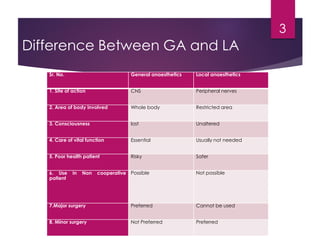
Difference Between GA and LA
Sr. No. General anaesthetics Local anaesthetics
1. Site of action CNS Peripheral nerves
2. Area of body involved Whole body Restricted area
3. Consciousness lost Unaltered
4. Care of vital function Essential Usually not needed
5. Poor health patient Risky Safer
6. Use in Non cooperative
patient
Possible Not possible
7.Major surgery Preferred Cannot be used
8. Minor surgery Not Preferred Preferred
3
Stages of General Anesthesia
 Stage of Analgesia (Stage I): Starts from beginning of
anesthetic inhalation and lasts upto the loss of consciousness.
Pain is progressively abolished. Patient remains conscious, can
hear and see, and feels a dream like state; amnesia develops
by the end of this stage. Reflexes and respiration remain
normal. Though some minor operations can be carried out
during this stage.
 Stage of delirium (Stage II). From loss of consciousness to
beginning of regular respiration. Apparent excitement is
seen—patient may shout, struggle and hold his breath; muscle
tone increases, jaws are tightly closed, breathing is jerky;
vomiting, involuntary micturition or defecation may occur.
Heart rate and BP may rise and pupils dilate due to
sympathetic stimulation. This stage can be cut short by rapid
induction.
4
 Stage of Surgical Anesthesia (Stage III):Extends from
onset of regular respiration to cessation of spontaneous
breathing. This stage is divided into four planes.
 Plane 1 – Roving eyeballs. This plane ends when eyes
become fixed.
 Plane 2 – Loss of corneal and laryngeal reflexes.
 Plane 3 – Pupil starts dilating and light reflex is lost.
 Plane 4 – Intercostal paralysis, shallow abdominal
respiration, dilated pupil.
 Medullary paralysis or Impending Death (Stage IV):
Cessation of breathing to failure of circulation and
death. Pupil is widely dilated, muscles are totally flabby,
pulse is thready or imperceptible and BP is very low.
5
CLASSIFICATION
 Inhalational Anaesthetics

Gas
 Nitrous oxide
 Volatile liquids
 Ether
 Halothane
 Enflurane
 Isoflurane
 Desflurane
6
 Intravenous
 Inducing agents
 Thiopentone sod.
 Methohexitone sod.
 Propofol
 Etomidate
 Slower acting drugs
 Benzodiazepines
 Diazepam
 Lorazepam
 Midazolam
 Dissociative anaesthesia
 Ketamine
 Opioid analgesia
 Fentanyl
7
INhalational ANAESTHETICS:
HALOTHANE
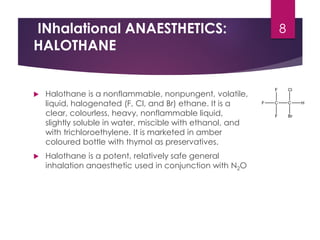
 Halothane is a nonflammable, nonpungent, volatile,
liquid, halogenated (F, Cl, and Br) ethane. It is a
clear, colourless, heavy, nonflammable liquid,
slightly soluble in water, miscible with ethanol, and
with trichloroethylene. It is marketed in amber
coloured bottle with thymol as preservatives.
 Halothane is a potent, relatively safe general
inhalation anaesthetic used in conjunction with N2O
8
Halothane
 Halothane is a popular anesthetic in developing countries,
because it is relatively cheap and nonirritant, noninflammable,
pleasant with relatively rapid action. It is particularly suitable for
use in children, both for induction as well as maintenance.
 In adults, it is mainly used as a maintenance anesthetic after i.v.
induction.
9
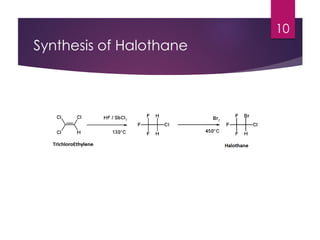
Synthesis of Halothane
10
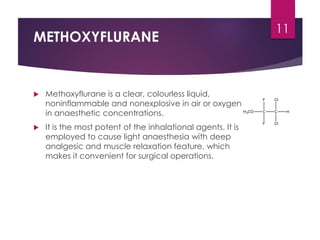
METHOXYFLURANE
 Methoxyflurane is a clear, colourless liquid,
noninflammable and nonexplosive in air or oxygen
in anaesthetic concentrations.
 It is the most potent of the inhalational agents. It is
employed to cause light anaesthesia with deep
analgesic and muscle relaxation feature, which
makes it convenient for surgical operations.
11
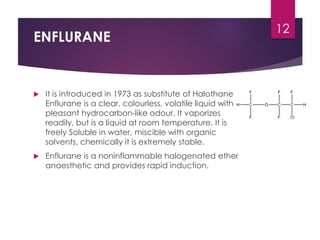
ENFLURANE
 It is introduced in 1973 as substitute of Halothane
Enflurane is a clear, colourless, volatile liquid with
pleasant hydrocarbon-like odour. It vaporizes
readily, but is a liquid at room temperature. It is
freely Soluble in water, miscible with organic
solvents, chemically it is extremely stable.
 Enflurane is a noninflammable halogenated ether
anaesthetic and provides rapid induction.
12
ISOFLURANE
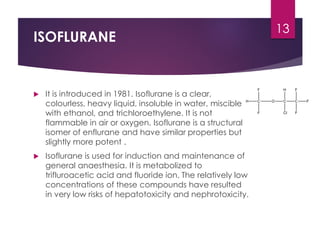
 It is introduced in 1981. Isoflurane is a clear,
colourless, heavy liquid, insoluble in water, miscible
with ethanol, and trichloroethylene. It is not
flammable in air or oxygen. Isoflurane is a structural
isomer of enflurane and have similar properties but
slightly more potent .
 Isoflurane is used for induction and maintenance of
general anaesthesia. It is metabolized to
trifluroacetic acid and fluoride ion. The relatively low
concentrations of these compounds have resulted
in very low risks of hepatotoxicity and nephrotoxicity.
13
ISOFLURANE
 This fluorinated anaesthetic introduced in 1981 is
currently the routinely used anaesthetic all over. It
has totally replaced its earlier introduced isomer
enflurane.
 Isoflurane is somewhat less potent and less soluble
in blood as well as in fat than halothane, but equally
volatile.
 Compared to halothane, it produces relatively rapid
induction and recovery, and is administered
through a special vaporizer; 1.5–3% induces
anaesthesia in 7–10 min, and 1–2% is used for
maintenance.
14
SEVOFLRANE
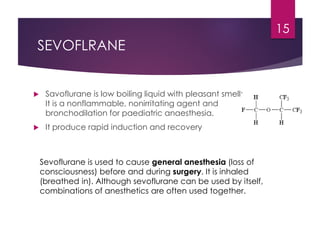
 Savoflurane is low boiling liquid with pleasant smell;
It is a nonflammable, nonirritating agent and
bronchodilation for paediatric anaesthesia.
 It produce rapid induction and recovery
15
Sevoflurane is used to cause general anesthesia (loss of
consciousness) before and during surgery. It is inhaled
(breathed in). Although sevoflurane can be used by itself,
combinations of anesthetics are often used together.
SEVOFLRANE
 This new polyfluorinated anaesthetic has properties
intermediate between isoflurane and desflurane.
Solubility in blood and tissues as well as potency are
less than isoflurane but more than desflurane.
16
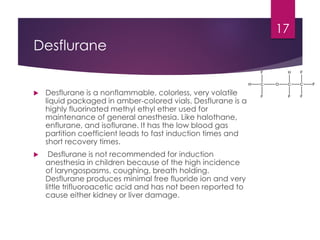
Desflurane
 Desflurane is a nonflammable, colorless, very volatile
liquid packaged in amber-colored vials. Desflurane is a
highly fluorinated methyl ethyl ether used for
maintenance of general anesthesia. Like halothane,
enflurane, and isoflurane. It has the low blood gas
partition coefficient leads to fast induction times and
short recovery times.
 Desflurane is not recommended for induction
anesthesia in children because of the high incidence
of laryngospasms, coughing, breath holding.
Desflurane produces minimal free fluoride ion and very
little trifluoroacetic acid and has not been reported to
cause either kidney or liver damage.
17
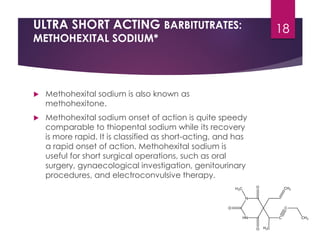
ULTRA SHORT ACTING BARBITUTRATES:
METHOHEXITAL SODIUM*
 Methohexital sodium is also known as
methohexitone.
 Methohexital sodium onset of action is quite speedy
comparable to thiopental sodium while its recovery
is more rapid. It is classified as short-acting, and has
a rapid onset of action. Methohexital sodium is
useful for short surgical operations, such as oral
surgery, gynaecological investigation, genitourinary
procedures, and electroconvulsive therapy.
18
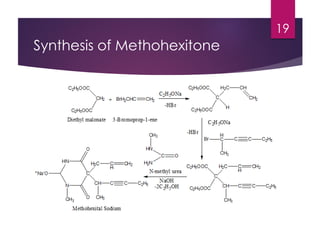
Synthesis of Methohexitone
19
THIOPENTAL SODIUM
 Thiopental sodium is ultrashort acting barbiturates.
High lipid solubility and rapid entry in to the brain
with rapid onset and short duration
 These are usually administered intravenously for the
production of complete anaesthesia of a short
duration. It belongs to the category of ultra short-
acting barbiturates. It is also used as a sedative,
hypnotic, and anticonvulsant.
20
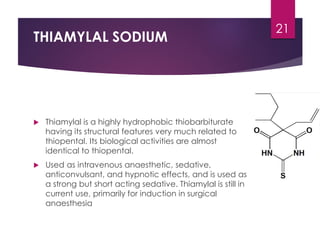
THIAMYLAL SODIUM
 Thiamylal is a highly hydrophobic thiobarbiturate
having its structural features very much related to
thiopental. Its biological activities are almost
identical to thiopental.
 Used as intravenous anaesthetic, sedative,
anticonvulsant, and hypnotic effects, and is used as
a strong but short acting sedative. Thiamylal is still in
current use, primarily for induction in surgical
anaesthesia
21
Dissociative Anaesthetics:
KETAMINE HYDROCHLORIDE*
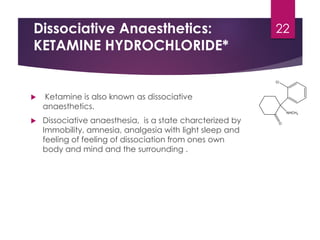
 Ketamine is also known as dissociative
anaesthetics.
 Dissociative anaesthesia, is a state charcterized by
Immobility, amnesia, analgesia with light sleep and
feeling of feeling of dissociation from ones own
body and mind and the surrounding .
22
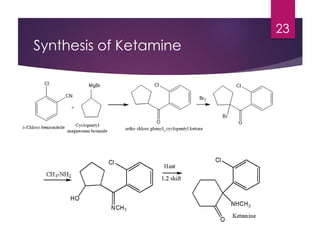
Synthesis of Ketamine
23
Mode of Action
 Mayer and overton pointed out a direct relationship between
lipid/water partition coefficient of GA and their anaesthetic
potency.
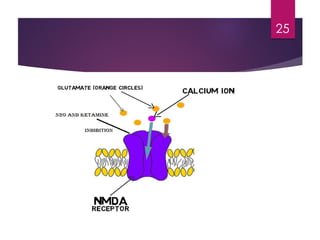
 Ketamine and Nitrous Oxide antagonizes excitatory N-methyl,
D-aspartate (NMDA) type Glutamate receptors. This receptor
gates mainly Ca++ selective cation.
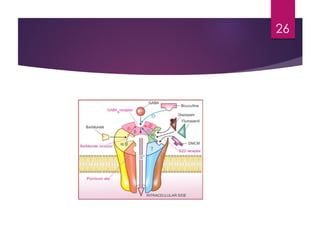
 Many Inhalational anesthetics ,Barbiturates, Benzodiazepines
and propofol enhance inhibitory transmission via γ-amino
butyric acid-A (GABAA) receptor though the binding site and
open cl channel.
24
25
26

General Anaesthetics.pdf

  • 1.
    General Anaesthetics DR. ANSHU CHAUDHARYDUDHE NAGPUR COLLEGE OF PHARMACY, NAGPUR 1
  • 2.
    General Anaesthesia  Generalanesthetics are drugs which produce reversible loss of all sensation and consciousness.  These drugs are used in surgical operations to induce unconsciousness and therefore abolish the sensation of the pain.  The important features of general anaesthesia are:  Loss of all sensation, especially pain  Sleep (unconsciousness) and amnesia  Immobility and muscle relaxation  Abolition of reflexes. 2
  • 3.
    Difference Between GAand LA Sr. No. General anaesthetics Local anaesthetics 1. Site of action CNS Peripheral nerves 2. Area of body involved Whole body Restricted area 3. Consciousness lost Unaltered 4. Care of vital function Essential Usually not needed 5. Poor health patient Risky Safer 6. Use in Non cooperative patient Possible Not possible 7.Major surgery Preferred Cannot be used 8. Minor surgery Not Preferred Preferred 3
  • 4.
    Stages of GeneralAnesthesia  Stage of Analgesia (Stage I): Starts from beginning of anesthetic inhalation and lasts upto the loss of consciousness. Pain is progressively abolished. Patient remains conscious, can hear and see, and feels a dream like state; amnesia develops by the end of this stage. Reflexes and respiration remain normal. Though some minor operations can be carried out during this stage.  Stage of delirium (Stage II). From loss of consciousness to beginning of regular respiration. Apparent excitement is seen—patient may shout, struggle and hold his breath; muscle tone increases, jaws are tightly closed, breathing is jerky; vomiting, involuntary micturition or defecation may occur. Heart rate and BP may rise and pupils dilate due to sympathetic stimulation. This stage can be cut short by rapid induction. 4
  • 5.
     Stage ofSurgical Anesthesia (Stage III):Extends from onset of regular respiration to cessation of spontaneous breathing. This stage is divided into four planes.  Plane 1 – Roving eyeballs. This plane ends when eyes become fixed.  Plane 2 – Loss of corneal and laryngeal reflexes.  Plane 3 – Pupil starts dilating and light reflex is lost.  Plane 4 – Intercostal paralysis, shallow abdominal respiration, dilated pupil.  Medullary paralysis or Impending Death (Stage IV): Cessation of breathing to failure of circulation and death. Pupil is widely dilated, muscles are totally flabby, pulse is thready or imperceptible and BP is very low. 5
  • 6.
    CLASSIFICATION  Inhalational Anaesthetics  Gas Nitrous oxide  Volatile liquids  Ether  Halothane  Enflurane  Isoflurane  Desflurane 6
  • 7.
     Intravenous  Inducingagents  Thiopentone sod.  Methohexitone sod.  Propofol  Etomidate  Slower acting drugs  Benzodiazepines  Diazepam  Lorazepam  Midazolam  Dissociative anaesthesia  Ketamine  Opioid analgesia  Fentanyl 7
  • 8.
    INhalational ANAESTHETICS: HALOTHANE  Halothaneis a nonflammable, nonpungent, volatile, liquid, halogenated (F, Cl, and Br) ethane. It is a clear, colourless, heavy, nonflammable liquid, slightly soluble in water, miscible with ethanol, and with trichloroethylene. It is marketed in amber coloured bottle with thymol as preservatives.  Halothane is a potent, relatively safe general inhalation anaesthetic used in conjunction with N2O 8
  • 9.
    Halothane  Halothane isa popular anesthetic in developing countries, because it is relatively cheap and nonirritant, noninflammable, pleasant with relatively rapid action. It is particularly suitable for use in children, both for induction as well as maintenance.  In adults, it is mainly used as a maintenance anesthetic after i.v. induction. 9
  • 10.
  • 11.
    METHOXYFLURANE  Methoxyflurane isa clear, colourless liquid, noninflammable and nonexplosive in air or oxygen in anaesthetic concentrations.  It is the most potent of the inhalational agents. It is employed to cause light anaesthesia with deep analgesic and muscle relaxation feature, which makes it convenient for surgical operations. 11
  • 12.
    ENFLURANE  It isintroduced in 1973 as substitute of Halothane Enflurane is a clear, colourless, volatile liquid with pleasant hydrocarbon-like odour. It vaporizes readily, but is a liquid at room temperature. It is freely Soluble in water, miscible with organic solvents, chemically it is extremely stable.  Enflurane is a noninflammable halogenated ether anaesthetic and provides rapid induction. 12
  • 13.
    ISOFLURANE  It isintroduced in 1981. Isoflurane is a clear, colourless, heavy liquid, insoluble in water, miscible with ethanol, and trichloroethylene. It is not flammable in air or oxygen. Isoflurane is a structural isomer of enflurane and have similar properties but slightly more potent .  Isoflurane is used for induction and maintenance of general anaesthesia. It is metabolized to trifluroacetic acid and fluoride ion. The relatively low concentrations of these compounds have resulted in very low risks of hepatotoxicity and nephrotoxicity. 13
  • 14.
    ISOFLURANE  This fluorinatedanaesthetic introduced in 1981 is currently the routinely used anaesthetic all over. It has totally replaced its earlier introduced isomer enflurane.  Isoflurane is somewhat less potent and less soluble in blood as well as in fat than halothane, but equally volatile.  Compared to halothane, it produces relatively rapid induction and recovery, and is administered through a special vaporizer; 1.5–3% induces anaesthesia in 7–10 min, and 1–2% is used for maintenance. 14
  • 15.
    SEVOFLRANE  Savoflurane islow boiling liquid with pleasant smell; It is a nonflammable, nonirritating agent and bronchodilation for paediatric anaesthesia.  It produce rapid induction and recovery 15 Sevoflurane is used to cause general anesthesia (loss of consciousness) before and during surgery. It is inhaled (breathed in). Although sevoflurane can be used by itself, combinations of anesthetics are often used together.
  • 16.
    SEVOFLRANE  This newpolyfluorinated anaesthetic has properties intermediate between isoflurane and desflurane. Solubility in blood and tissues as well as potency are less than isoflurane but more than desflurane. 16
  • 17.
    Desflurane  Desflurane isa nonflammable, colorless, very volatile liquid packaged in amber-colored vials. Desflurane is a highly fluorinated methyl ethyl ether used for maintenance of general anesthesia. Like halothane, enflurane, and isoflurane. It has the low blood gas partition coefficient leads to fast induction times and short recovery times.  Desflurane is not recommended for induction anesthesia in children because of the high incidence of laryngospasms, coughing, breath holding. Desflurane produces minimal free fluoride ion and very little trifluoroacetic acid and has not been reported to cause either kidney or liver damage. 17
  • 18.
    ULTRA SHORT ACTINGBARBITUTRATES: METHOHEXITAL SODIUM*  Methohexital sodium is also known as methohexitone.  Methohexital sodium onset of action is quite speedy comparable to thiopental sodium while its recovery is more rapid. It is classified as short-acting, and has a rapid onset of action. Methohexital sodium is useful for short surgical operations, such as oral surgery, gynaecological investigation, genitourinary procedures, and electroconvulsive therapy. 18
  • 19.
  • 20.
    THIOPENTAL SODIUM  Thiopentalsodium is ultrashort acting barbiturates. High lipid solubility and rapid entry in to the brain with rapid onset and short duration  These are usually administered intravenously for the production of complete anaesthesia of a short duration. It belongs to the category of ultra short- acting barbiturates. It is also used as a sedative, hypnotic, and anticonvulsant. 20
  • 21.
    THIAMYLAL SODIUM  Thiamylalis a highly hydrophobic thiobarbiturate having its structural features very much related to thiopental. Its biological activities are almost identical to thiopental.  Used as intravenous anaesthetic, sedative, anticonvulsant, and hypnotic effects, and is used as a strong but short acting sedative. Thiamylal is still in current use, primarily for induction in surgical anaesthesia 21
  • 22.
    Dissociative Anaesthetics: KETAMINE HYDROCHLORIDE* Ketamine is also known as dissociative anaesthetics.  Dissociative anaesthesia, is a state charcterized by Immobility, amnesia, analgesia with light sleep and feeling of feeling of dissociation from ones own body and mind and the surrounding . 22
  • 23.
  • 24.
    Mode of Action Mayer and overton pointed out a direct relationship between lipid/water partition coefficient of GA and their anaesthetic potency.  Ketamine and Nitrous Oxide antagonizes excitatory N-methyl, D-aspartate (NMDA) type Glutamate receptors. This receptor gates mainly Ca++ selective cation.  Many Inhalational anesthetics ,Barbiturates, Benzodiazepines and propofol enhance inhibitory transmission via γ-amino butyric acid-A (GABAA) receptor though the binding site and open cl channel. 24
  • 25.
  • 26.