GENERAL ANAESTHETIC
By-: KARTIK TIWARI
● Outline-:
● General introduction
● Classification of general anaesthetic
● Mode of action
● Stages of anaesthesia
● Drugs
- Uses
- Contradiction
- Dosage
- Adverse effect
★ General introduction
● Definition-:General anaesthetic is defined as the chemical
agent which causes reversible loss of sensation or
unconscious the whole body.
● General anaesthetic is used to unconscious the whole body.
● It act on Central nervous system (CNS) and peripheral parts
of the body.
● The characteristics of general anaesthetic are:
1. Unconsciousness
2. Amnesia
3. immobilisation and muscle relaxant.
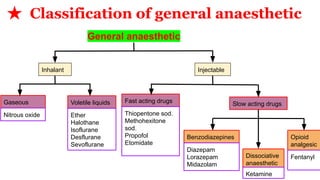
★ Classification of general anaesthetic
General anaesthetic
Inhalant Injectable
Gaseous Voletile liquids Fast acting drugs Slow acting drugs
Benzodiazepines Opioid
analgesic
Dissociative
anaesthetic
Nitrous oxide Ether
Halothane
Isoflurane
Desflurane
Sevoflurane
Thiopentone sod.
Methohexitone
sod.
Propofol
Etomidate
Diazepam
Lorazepam
Midazolam
Ketamine
Fentanyl
● N2O and ketamine do not affect GABA or glycine gated Cl¯ channels.
Rather they selectively inhibit the excitatory NMDA type of glutamate
receptor. This receptor gates mainly Ca2+ selective cation channels in
the neurones, inhibition of which appears to be the primary mechanism
of anaesthetic action of keta-mine as well as N2O. The volatile
anaesthetics have little action on this receptor.
● Mode of action
● Inhalational anaes-thetics, barbiturates, benzodiazepines and propofol
potentiate the action of inhibitory transmitter GABA to open Cl¯
channels.
★ Stages of anaesthesia
Modern anesthetics act very rapidly and achieve deep anesthesia quickly.
With older and more slowly acting anesthetics, the progressively greater
depth of central depression associated with increasing dose or time of
exposure is traditionally described as stages of anesthesia.
A. Stage 1: Analgesia
In stage 1, the patient has decreased awareness of pain, sometimes
with amnesia. Consciousness may be impaired but is not lost.
B. Stage 2: Disinhibition
In stage 2, the patient appears to be delirious and excited. Amnesia
occurs, reflexes are enhanced, and respiration is typically irregular;
retching and incontinence may occur.
C. Stage 3: Surgical Anesthesia
In stage 3, the patient is unconscious and has no pain reflexes;
respiration is very regular, and blood pressure is maintained.
D. Stage 4: Medullary Depression
In stage 4, the patient develops severe respiratory and cardiovascular
depression that requires mechanical and pharmacologic support.
★ Drugs
Halothane
Form - Volatile liquid
● Uses:
Induction and maintenance of anaesthesia
● Contraindications:
History of unexplained jaundice or pyrexia following previous exposure to
halothane; family history of malignant hyperthermia; raised cerebrospinal
fluid pressure; porphyria
● Precautions:
Anaesthetic history should be carefully taken to determine previous
exposure and revious reactions to halothane (at least 3 months should be
allowed to elapse between each re-exposure); avoid for dental procedures
in patients under 18 years unless treated in hospital (high risk of
arrhythmias); pregnancy and breastfeeding
● Dosage:
Induction, using specifically calibrated vaporizer, gradually increase inspired
gas concentration to 2–4% (ADULT ) or 1.5–2% (CHILD ) in oxygen or
nitrous oxide–oxygen
Maintenance, ADULT and CHILD 0.5–2%
● Adverse effects:
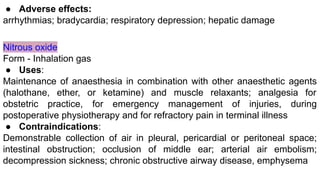
arrhythmias; bradycardia; respiratory depression; hepatic damage
Nitrous oxide
Form - Inhalation gas
● Uses:
Maintenance of anaesthesia in combination with other anaesthetic agents
(halothane, ether, or ketamine) and muscle relaxants; analgesia for
obstetric practice, for emergency management of injuries, during
postoperative physiotherapy and for refractory pain in terminal illness
● Contraindications:
Demonstrable collection of air in pleural, pericardial or peritoneal space;
intestinal obstruction; occlusion of middle ear; arterial air embolism;
decompression sickness; chronic obstructive airway disease, emphysema
● Dosage:
Anaesthesia, Adult and Child nitrous oxide mixed with 25–30% oxygen
Analgesia, 50% nitrous oxide mixed with 50% oxygen
● Adverse effects:
nausea and vomiting; after prolonged administration megaloblastic
anaemia, depressed white cell formation; peripheral neuropathy
Thiopental sodium
Thiopental is a representative intravenous anaesthetic. Various drugs can
serve as alternatives Injection (Powder for solution for injection), thiopental
sodium, 0.5-g and 1-g ampoules.
● Uses:
Induction of anaesthesia prior to administration of inhalational anaesthetic;
anaesthesia of short duration
● Contraindications:
Inability to maintain airway; hypersensitivity to barbiturates;
● Dosage:
Induction, by intravenous injection as a 2.5% (25 mg/ml) solution over
10–15 seconds, Adult 100–150 mg (reduced in elderly or debilitated
patients), followed by a further 100–150 mg if necessary according to
response after 60 seconds; or up to 4 mg/kg; Child 2–7 mg/kg repeated if
necessary according to response after 60 seconds.
Form - Volatile liquid
● Uses:
Induction and maintenance of anaesthesia (administered from many types
of vaporizers)
● Contraindications:
severe liver disease; diabetes mellitus; impaired kidney function; raised
cerebrospinal fluid pressure.
Ether, anaesthetic
● Dosage:
Induction, Adult and Child , up to 15% in inspired gases
Maintenance of light anaesthesia, Adult and Child 3–5% in air (with or
without muscle relaxants); up to 10% for deep anaesthesia
● Adverse effects:
transient postoperative effects include impairment of liver function and
leukocytosis; nausea and vomiting; capillary bleeding.

General anaesthetic

  • 1.
  • 2.
    ● Outline-: ● Generalintroduction ● Classification of general anaesthetic ● Mode of action ● Stages of anaesthesia ● Drugs - Uses - Contradiction - Dosage - Adverse effect
  • 3.
    ★ General introduction ●Definition-:General anaesthetic is defined as the chemical agent which causes reversible loss of sensation or unconscious the whole body. ● General anaesthetic is used to unconscious the whole body. ● It act on Central nervous system (CNS) and peripheral parts of the body. ● The characteristics of general anaesthetic are: 1. Unconsciousness 2. Amnesia 3. immobilisation and muscle relaxant.
  • 4.
    ★ Classification ofgeneral anaesthetic General anaesthetic Inhalant Injectable Gaseous Voletile liquids Fast acting drugs Slow acting drugs Benzodiazepines Opioid analgesic Dissociative anaesthetic Nitrous oxide Ether Halothane Isoflurane Desflurane Sevoflurane Thiopentone sod. Methohexitone sod. Propofol Etomidate Diazepam Lorazepam Midazolam Ketamine Fentanyl
  • 5.
    ● N2O andketamine do not affect GABA or glycine gated Cl¯ channels. Rather they selectively inhibit the excitatory NMDA type of glutamate receptor. This receptor gates mainly Ca2+ selective cation channels in the neurones, inhibition of which appears to be the primary mechanism of anaesthetic action of keta-mine as well as N2O. The volatile anaesthetics have little action on this receptor. ● Mode of action ● Inhalational anaes-thetics, barbiturates, benzodiazepines and propofol potentiate the action of inhibitory transmitter GABA to open Cl¯ channels.
  • 6.
    ★ Stages ofanaesthesia Modern anesthetics act very rapidly and achieve deep anesthesia quickly. With older and more slowly acting anesthetics, the progressively greater depth of central depression associated with increasing dose or time of exposure is traditionally described as stages of anesthesia. A. Stage 1: Analgesia In stage 1, the patient has decreased awareness of pain, sometimes with amnesia. Consciousness may be impaired but is not lost. B. Stage 2: Disinhibition In stage 2, the patient appears to be delirious and excited. Amnesia occurs, reflexes are enhanced, and respiration is typically irregular; retching and incontinence may occur.
  • 7.
    C. Stage 3:Surgical Anesthesia In stage 3, the patient is unconscious and has no pain reflexes; respiration is very regular, and blood pressure is maintained. D. Stage 4: Medullary Depression In stage 4, the patient develops severe respiratory and cardiovascular depression that requires mechanical and pharmacologic support. ★ Drugs Halothane Form - Volatile liquid ● Uses: Induction and maintenance of anaesthesia
  • 8.
    ● Contraindications: History ofunexplained jaundice or pyrexia following previous exposure to halothane; family history of malignant hyperthermia; raised cerebrospinal fluid pressure; porphyria ● Precautions: Anaesthetic history should be carefully taken to determine previous exposure and revious reactions to halothane (at least 3 months should be allowed to elapse between each re-exposure); avoid for dental procedures in patients under 18 years unless treated in hospital (high risk of arrhythmias); pregnancy and breastfeeding ● Dosage: Induction, using specifically calibrated vaporizer, gradually increase inspired gas concentration to 2–4% (ADULT ) or 1.5–2% (CHILD ) in oxygen or nitrous oxide–oxygen Maintenance, ADULT and CHILD 0.5–2%
  • 9.
    ● Adverse effects: arrhythmias;bradycardia; respiratory depression; hepatic damage Nitrous oxide Form - Inhalation gas ● Uses: Maintenance of anaesthesia in combination with other anaesthetic agents (halothane, ether, or ketamine) and muscle relaxants; analgesia for obstetric practice, for emergency management of injuries, during postoperative physiotherapy and for refractory pain in terminal illness ● Contraindications: Demonstrable collection of air in pleural, pericardial or peritoneal space; intestinal obstruction; occlusion of middle ear; arterial air embolism; decompression sickness; chronic obstructive airway disease, emphysema
  • 10.
    ● Dosage: Anaesthesia, Adultand Child nitrous oxide mixed with 25–30% oxygen Analgesia, 50% nitrous oxide mixed with 50% oxygen ● Adverse effects: nausea and vomiting; after prolonged administration megaloblastic anaemia, depressed white cell formation; peripheral neuropathy Thiopental sodium Thiopental is a representative intravenous anaesthetic. Various drugs can serve as alternatives Injection (Powder for solution for injection), thiopental sodium, 0.5-g and 1-g ampoules. ● Uses: Induction of anaesthesia prior to administration of inhalational anaesthetic; anaesthesia of short duration ● Contraindications: Inability to maintain airway; hypersensitivity to barbiturates;
  • 11.
    ● Dosage: Induction, byintravenous injection as a 2.5% (25 mg/ml) solution over 10–15 seconds, Adult 100–150 mg (reduced in elderly or debilitated patients), followed by a further 100–150 mg if necessary according to response after 60 seconds; or up to 4 mg/kg; Child 2–7 mg/kg repeated if necessary according to response after 60 seconds. Form - Volatile liquid ● Uses: Induction and maintenance of anaesthesia (administered from many types of vaporizers) ● Contraindications: severe liver disease; diabetes mellitus; impaired kidney function; raised cerebrospinal fluid pressure. Ether, anaesthetic
  • 12.
    ● Dosage: Induction, Adultand Child , up to 15% in inspired gases Maintenance of light anaesthesia, Adult and Child 3–5% in air (with or without muscle relaxants); up to 10% for deep anaesthesia ● Adverse effects: transient postoperative effects include impairment of liver function and leukocytosis; nausea and vomiting; capillary bleeding.